Jungs und Mädels, Damen und Herren: Dies ist eine epische Geschichte von großem Wagemut in fernen und schwierigen Zeiten. Eine Geschichte von unmöglichen Entscheidungen, die größte Furchtlosigkeit erfordern. Die Geschichte eines jungen Mannes, der sein Leben riskiert, um seine Brüder zu befreien und sein Glück zu finden. Und ein bisschen ist es auch eine Geschichte vom Reiten, im Schlafsack schlafen, Auszüge machen und so was. Es spielen mit: Jede Menge Rindsviecher (das heißt: ein König und seine 7 Söhne), außerdem 7 Prinzessinnen, der Troll, das Pferd, ein Elefant, ein Wolf, ein Krake und einige Geister ... Eine Graphic Novel, ein Roadmovie, eine total verrückte Geschichte, ein Kunstwerk. Kurz - ein Buch, das überrascht!
Øyvind Torseter is a Norwegian artist and illustrator who has created eleven books on his own and several with other authors. He’s received numerous awards for his books, including a Bologna Ragazzi Award and the Norwegian Book Art Prize. In 2014, Øyvind was a finalist for the prestigious Hans Christian Andersen Award.
A children's graphic novel, probably middle grades, based on a Norwegian fairytale, updated to feel more contemporary by the also Norwegian Torsetter, whose The Hole was one of my favorite books of 2014, and whose My Father's Arms Are a Boat was one of my favorite books of 2015. This one is more elaborate, and more sinister and scary in places.
The basic story is that a man sends 6 of his sons out into the world to seek their fortune (and wives) and they run into a troll who turns them into stone. The seventh boy was required initially to stay home, but he goes out to rescue his bros, with the help of a girl who has also been captured by the troll. The troll is "heartless," as many trolls are, but he also doesn't actually have a heart in his chest, but hides it. They have to find it and destroy it to unstone the bros, and free the girl, and so on.
Torseter's art work is wonderful. The updated tale involves, a little absurdly, a saxophone and other silly things that figure into the plot. This seems to be a signature of Torseter, the silly or absurd in places. I really like it, but it is darker than the other two I have read from Torseter.
Really cool book. It is a little cliche, but overall I thought it was a fun little read. The art in this book is very well-drawn. I play the saxophone, so I immediately really liked the octopus character. It was fun to see the octopus playing the saxophone. It was a decent book, but I would fix some pacing issues. Props to the eerie and well-made art, though!
Just what I needed! This is a book that can be shared with children yet still maintains an interest for adults; the art is fantastic and the story is a lean yet balanced 'quest' tale that will hold your interest. I like books that take a different perspective on tales that we remember; it is often a very insightful way to see the world in a new way.
Øyvind Torseter's 2016 graphic novel The Heartless Troll (which in its original Norwegian is called Mulegutten and has been translated into English by Karin Dixon) is loosely based on the classic Norwegian folktale Risen som ikke hadde noe hjerte på seg (found in Peter Christen Asbjørnsen and Jørgen Engebretsen Moe's 19th century anthology Norske Folkeeventyr or as it is called in English translation Norwegian Folktales, although since the Norwegian noun rise means giant in English translation, yes, Risen som ikke hadde noe hjerte på seg is at least in my humble opinion originally and specifically about a giant with no heart in his body and not a troll with no heart in his body, although this probably does not end up changing anything major theme and contents wise or mattering all that much since giants and trolls are of course very similar in many ways).
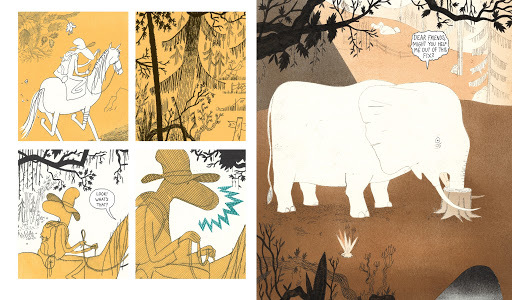
Using a graphic novel format, Torseter with his text and accompanying images (and of course by extension also Karin Dixon with her translation of Torseter's words from Norwegian to English) in The Heartless Troll tells an often rather grotesque tale of a troll with no heart in his body who has turned Prince Fred’s brothers and their new brides into stone statues. And after much begging and pleading, Prince Fred (the youngest of seven sons) convinces his father (of course, the King) to let him go in search of the lost princes, riding the only horse left in the kingdom (a pretty decrepit looking talking nag who also provides much comic relief in The Heartless Troll), with Prince Fred whilst on his journey coming across a saxophone floating down a stream, which later comes in handy, helping an elephant stuck in a tree stump and who rewards Prince Fred later in The Heartless Troll, tricking a very hungry wolf and thankfully not feeding the horse to the latter as is in fact the case in Risen som ikke hadde noe hjerte på seg (and which has always bothered me regarding said particular tale because I love love love horses), and with Fred finally learning the location of the troll's cave, where the prince finds his stone brothers, their stone wives, learns that the Troll also holds a princess captive (and of course how to succeed in his quest).
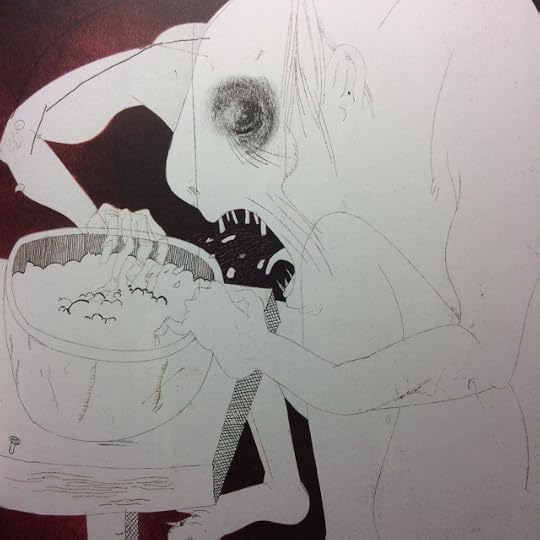
Now for The Heartless Troll, Øyvind Torseter has drawn Prince Fred as appearing humanlike but still not quite human (and to my eyes also kind of looking like Tove Jansson's Moomintroll, which is both entertaining and also a trifle personally problematic for me, as I do kind of wonder whether Jansson would be in agreement with Fred being illustrated to resemble her Moomintroll creation), his six brothers as two legged horned bulls, and that the brothers' six brides as well as the troll's captive princess look like physically rather unattractive humans, not to mention that the troll appears as hugely grotesque with a gnarled naked body and very ugly looking fingernails, with The Heartless Troll thus featuring a generally fun combination of text and artwork, although I do wish that there could be more textual meat to what Toseter (and Dixon) are penning and that the illustrations were not often seemingly more important and more essential that the presented narrative (but I can certainly understand why graphic novel enthusiasts would find the visual experience of The Heartless Troll delightful and in particular if they enjoy visual humour and distortedly exaggerated illustrations).
But while the illustrations and story line for The Heartless Troll are often comical and should certainly entertain a wide age range and different reading levels (from around eight years to adulthood), I personally speaking have unfortunately found some rather annoying and frustrating holes in Øvind Torseter's presented text (and ones that his accompanying pictures also are not able to close up, to cement over, to explain). I mean, who is the troll’s captive princess, how did she get captured by the troll and why was she captured in the first place? And considering that all of these questions are both shown and also answered in Risen som ikke hadde noe hjerte på seg, in the folktale on which The Heartless Troll is based, it definitely bothers me more than a bit how much is left verbally unanswered in The Heartless Troll, and what I find narrationally lacking and how Torseter also does not provide any specific primary and secondary sources in The Heartless Troll, yes, this has negatively affected my reading pleasure enough for me to only consider a low three star rating for The Heartless Troll and to recommend it with reservations.
The classic fairy tale, given strange new life. The retelling is slightly different from what you would find in say, Asbjørnsen and Moe, and the art is VERY different.
I loved it.
Strange, angular, full of odd little details, I kept staring at every little candle stub and tattered curtain of the troll's cave. The page with the toilet just about killed me, not only because it was hilarious, but because it was also so clever! And the troll itself was both terrifying and strangely hard to focus on . . . in a word: perfect.
Children's limited-palette graphic novel. This story is a contemporary retelling of a Norwegian fairy tale, which I have never read, so I'm not sure how close this book stays to the original story. But it feels too familiar to me (with the exception of the talking horse and the mystical elephant). Also confusing at times. Why does a prince act like a pauper and ride a nag? Why does the prince (and his brothers) appear to be a human-animal hybrid? Why does the troll object to the smell of human blood when he lives with a human-looking princess? Why doesn't the betrayal of the wolf have any consequences?
While the story lacks originality, the art is rather inventive - sometimes lovely, sometimes funny, sometimes creepy. Unfortunately, the creator's lack of restraint and consistency makes the art feel jarring and strange to me.
This quite outlandish and fun twist on the fairy tale "The Troll with No Heart," imported from Norway, is about a troll who's hidden his heart and the seventh son of a king who goes in search of his six brothers. The story is told in graphic panel format with delightfully fanciful illustrations that can be as dark as they are humorous.
A delightful and fantastic retelling of a Norwegian fairy tale by Torseter. The images are clean and clear, and Dickson's translation is sweet and hilarious. Also, one imagines the princess could have saved herself at any point before the prince got there since she comes up with almost all of the ideas.
Wonderful illustrations. Loved the anthropomorphic horse, sitting on his butt at the campfire, risk-averse when it comes to carrying Prince Fred through wolf-ridden woods in search of the giant, scary troll's lair ("I really don't want to do this"). Appreciated the Prince perched precariously (hurrah for alliteration!) pants-down on the edge of the gigantic outhouse seat (well, it's inside, but with a wooden, one-holer seat), oh and a giant troll-size roll of toilet paper on the wall, longer than the Prince. What's the story behind those three pics on the toilet wall though? Of a guy with a crown, sitting on his throne --a seat throne, not the toilet kind, the first drawing cruder than the rest. (My guess is the princess drew them, over a period of years, pics of her father, the king, from whom the troll must have snatched her.) Dug the many little touches such as the saxophone Prince Fred finds floating in a stream, which of course figures later in the plot, ala Chekhov's gun-in-the-first-act rule of plot design.
El hermano más pequeño de toda una familia es obligado a quedarse en casa mientras el resto de sus hermanos han salido a buscar esposa, con la promesa de traer una para él. Pero estos nunca vuelven, un trol los ha convertido en piedra y deberá enfrentarse a él para destruir su corazón, que es la única forma de vencerlo, enfrentándose para ello a multitud de retos. En esta historia del galardonado autor noruego Øyvind Torseter, trata de encajar el cuento tradicional del folklore noruego “El trol sin corazón” en una historia gráfica moderna llena de humor, intriga y una pequeña dosis épica que implica una hazaña de tal calado.
Con un dibujo de estilo libre y caricaturesco lleno de diferentes técnicas como efectos de color, fuertes contrastes, líneas sueltas o recortes superpuestos nos lleva por la clásica historia del séptimo hijo de una familia que se convierte en el héroe del relato. Por ello tendremos los hermanos inconscientes, animales parlantes, una princesa y por supuesto, un trol, que crearán un relato con una estructura que nos es muy conocida. Pero consigue darle tres puntos interesantes; aplicando un humor gamberro con diálogos desternillantes, aplicando un rol activo a la princesa en apuros, y una calidad artística que se salta todas las normas establecidas. En ese apartado artístico llama la atención esos personajes que parecen esbozos basados en la línea o fondos en los que utiliza diferentes técnicas. Por último, recalcar que la edición es una gozada, en formato grande y tapa dura, que hacen el cuento aún más disfrutable tanto por adultos como por niños.
An interestingly illustrated retelling of a fairy tale, Torseter makes the troll haunting in a way that makes this more appropriate for middle grade and up even though the actual difficulty could possibly be said to be lower. It left me with a weird and creeped-out feeling (either from the illustrations or the confusing nature of the troll hating human blood's smell and still holding a princess captive or the really odd half-beast type things that the prince and his brothers are that I can't quite figure out) that I generally enjoy from a book so I gave it an extra star.
La base y la estructura es la de un cuento tradicional, pero los dibujos tienen una libertad y una originalidad aclaparadora. Es una delicia perderse en estas páginas y estar atento a los detalles.
The story isn't much to write home about. It's just a Norwegian fairy tale. There was some room for a morale at the end, and I can't help but wonder what you van do with a story like this if you change it up a bit, make it more emotional. Torseter doesn't seem interested in that, though and honestly, who cares. It's hilarious and the illustrations are beautiful. There is a carelessness in the illustrations that I love. He sometimes seems to have cut out pieces of drawings he wasn't happy with, instead of starting over and you can still see it in the finished illustration. On the other hand the pages beautiful and creative, so you can tell a lot of care was put into them. The troll, also, actually looks scary, which is cool. The book reminds me of my mom reading fairy tales to me and my brothers. I think as a kid you kind of know fairy tales are delicious and Torseter gets that.
The story is a traditional folk take with some modern flourishes, the short toy would see in that old “Hungarian Folk Tales” series but with quirky choices like the boon being a saxophone and the princess’ dungeon looking like a concept illustration for an IKEA showroom. The entire book reminds me of the sorts of Japanese-inspired prints and designs you see at IKEA. It’s visually arresting and often hilariously unique. I was initially put off by the standard story, but when I gave it a go I thoroughly enjoyed the refreshing experience of taking in every panel. I know kids will love it and the images will stay with them. Lovers of children’s illustrations have a lot to love here as well, and I know I’ll look at this book again and again for fun, whimsical inspiration.
Este comic me llamó la atención por su estilo tan particular y ha resultado ser una historia divertidísima. En ella acompañamos a El Mulero, el menor de los hijos del rey, quien emprende un rescate para recuperar a sus hermanos que han sido petrificados junto con sus parejas por un troll. El dibujo parte de una línea libre y suelta en blanco y negro al que acompañan collage y diversas técnicas al servicio de su expresividad. El libro está dirigido a un público infantil y particularmente yo lo recomendaría a todos los que estén interesados en el mundo de la ilustración.
The artwork was lovely, but the story felt like a rather generic fairy tale so I didn't really feel invested in it. Certain lines were clearly supposed to be funny but they just didn't work for me...
A fun twist on an old fairytale called "The Troll with No Heart," The Heartless Troll is a troll who's hidden his heart and the seventh son of a king who goes in search of his six brothers. The young man's journey brings him to a mountain, a captive princess, and a terrifying troll. The illustrations are by turns fanciful and lovely as well as dark and terrifying, but a continuous thread of good humor and playfulness runs through the whole story.
Felt rather familiar but still entertaining, as a fable. I enjoyed the talking animals, especially the Prince and his horse. But I wasn't really a fan of the drawing style, which was very sketchy and had the Prince looking like a Moo-Min or SuuPuu from Houshin Engi, and yet he was supposed to be human? I did like the mixed media aspect of the art.