

What do you think?

In the Land of Invisible Women: A Female Doctor's Journey in the Saudi Kingdom
The decisions that change your life are often the most impulsive ones.
Unexpectedly denied a visa to remain in the United States, Qanta Ahmed, a young British Muslim doctor, becomes an outcast in motion. On a whim, she accepts an exciting position in Saudi Arabia. This is not just a new job; this is a chance at adventure in an exotic land she thinks she understands, a place she hopes she will belong.
What she discovers is vastly different. The Kingdom is a world apart, a land of unparalleled contrast. She finds rejection and scorn in the places she believed would most embrace her, but also humor, honesty, loyalty and love.
And for Qanta, more than anything, it is a land of opportunity. A place where she discovers what it takes for one woman to recreate herself in the land of invisible women.
Unexpectedly denied a visa to remain in the United States, Qanta Ahmed, a young British Muslim doctor, becomes an outcast in motion. On a whim, she accepts an exciting position in Saudi Arabia. This is not just a new job; this is a chance at adventure in an exotic land she thinks she understands, a place she hopes she will belong.
What she discovers is vastly different. The Kingdom is a world apart, a land of unparalleled contrast. She finds rejection and scorn in the places she believed would most embrace her, but also humor, honesty, loyalty and love.
And for Qanta, more than anything, it is a land of opportunity. A place where she discovers what it takes for one woman to recreate herself in the land of invisible women.
454 pages, Paperback
First published September 1, 2008
About the author
Qanta A. Ahmed
2 books80 followersDr. Qanta Ahmed (MD, FCCP, FAASM) is one of the top multi-disciplined physicians and medical specialists in the country—licensed in both the United States and the United Kingdom. She is an educator, consultant, researcher, guest lecturer at medical universities and sought-after speaker at medical conferences.
Among her many honors, Dr. Ahmed has served as Diplomat of the American Board of Internal Medicine, Diplomat of the American Board of Pulmonary Medicine, and Diplomat of the American Board of Critical Care Medicine. She was also named a Fellow of the American College of Chest Physicians.
A British born Muslim woman, Qanta was educated and trained in both London and New York City. Her considerable intellect, burgeoning achievements and unique, multi-cultural perspective were tested and refined when she was invited to practice intensive care medicine in Riyadh, Saudi Arabia.
Qanta lives and practices in Charleston, South Carolina
Among her many honors, Dr. Ahmed has served as Diplomat of the American Board of Internal Medicine, Diplomat of the American Board of Pulmonary Medicine, and Diplomat of the American Board of Critical Care Medicine. She was also named a Fellow of the American College of Chest Physicians.
A British born Muslim woman, Qanta was educated and trained in both London and New York City. Her considerable intellect, burgeoning achievements and unique, multi-cultural perspective were tested and refined when she was invited to practice intensive care medicine in Riyadh, Saudi Arabia.
Qanta lives and practices in Charleston, South Carolina
Ratings & Reviews
Friends & Following
Create a free account to discover what your friends think of this book!
Community Reviews
Displaying 1 - 30 of 1,013 reviews

March 12, 2014
So here's the thing. This book is getting a lot of negative reviews because of the quality of the writing. And it's true, the writing has problems (e.g., the word "belie" means the opposite of what the author thinks it does, and I'm amazed this wasn't caught by a copyeditor, along with numerous other issues). But if you can get past that and read for the content, this book is absolutely worth reading, especially if you are interested in what the lives of women are like in places other than the West.
The author is a British-born Muslim woman, also a doctor, who spends a year working (as a doctor) in Saudi Arabia. It's a balanced account by someone who is both a feminist and a Muslim, who is able to see both the beauty of this country and its problems. As a doctor, she traveled in elite circles, so there's not much look at the poorer segment of the population. But it was interesting to see the wide range of viewpoints she encountered among the elites in Saudia Arabia, from nasty and misogynistic men to liberal, progressive men who are working to change their country's repressive environment, from women who accept the repression to women who actively fight against it at tremendous risk to themselves.
The author is a British-born Muslim woman, also a doctor, who spends a year working (as a doctor) in Saudi Arabia. It's a balanced account by someone who is both a feminist and a Muslim, who is able to see both the beauty of this country and its problems. As a doctor, she traveled in elite circles, so there's not much look at the poorer segment of the population. But it was interesting to see the wide range of viewpoints she encountered among the elites in Saudia Arabia, from nasty and misogynistic men to liberal, progressive men who are working to change their country's repressive environment, from women who accept the repression to women who actively fight against it at tremendous risk to themselves.
October 7, 2009
If I could assign negative starts to this book, I would.
Do you know someone who loved this book? Did they recommend you read it ASAP? Let me ask you something about that person. Is he/she a good story teller or do they tend to prattle on and on?
Ahmed's writing is repetitious and overly descriptive about EVERYTHING. I'm not sure what her editor was thinking letting the book go to print in it's current condition. In my opinion, if the editor had done their job, the book would be at least half of it's current length. At one point, while still trying to plow through her painfully descriptive writing, I began to yell out loud at the book. Thankfully, you don't have to go through that. Let me save you the trouble of wading through the muck and sum up the book in a few concise points.
1. She's a Muslim, but doesn't fit in.
2. Women doctors are a rarity in Saudi Arabia. Saudi women doctors even more so.
3. She realizes she can learn from her colleagues, at least a dozen times, each time stating it as though it were a revelation.
4. The Muttaween are scary, oppressive and spread fear wherever they go.
5. She spends half of every chapter describing clothing that she already told you about in a previous chapter.
6. Women and men lead completely segregated lives unless they are married.
7. Women have no rights.
Now, take these six points and repeat ad nauseam each time changing the way you wrote them. Ta Da. You have her book.
Do you know someone who loved this book? Did they recommend you read it ASAP? Let me ask you something about that person. Is he/she a good story teller or do they tend to prattle on and on?
Ahmed's writing is repetitious and overly descriptive about EVERYTHING. I'm not sure what her editor was thinking letting the book go to print in it's current condition. In my opinion, if the editor had done their job, the book would be at least half of it's current length. At one point, while still trying to plow through her painfully descriptive writing, I began to yell out loud at the book. Thankfully, you don't have to go through that. Let me save you the trouble of wading through the muck and sum up the book in a few concise points.
1. She's a Muslim, but doesn't fit in.
2. Women doctors are a rarity in Saudi Arabia. Saudi women doctors even more so.
3. She realizes she can learn from her colleagues, at least a dozen times, each time stating it as though it were a revelation.
4. The Muttaween are scary, oppressive and spread fear wherever they go.
5. She spends half of every chapter describing clothing that she already told you about in a previous chapter.
6. Women and men lead completely segregated lives unless they are married.
7. Women have no rights.
Now, take these six points and repeat ad nauseam each time changing the way you wrote them. Ta Da. You have her book.

November 11, 2008
Qanta Ahmed, a doctor and Muslim of Pakistani descent, is a British citizen who was practicing in NY when her visa renewal was denied. Practically on a whim, she decides to accept an offer to spend 2 years at a Saudi Arabian hospital. This book is a memoir of her time there. On the positive side, any glimpse of a culture so alien to most Western eyes is welcome (even one as unreflective and blinkered as this proves to be).
Unfortunately, the author can't write and her editors were slacking off and not very helpful. There are some truly wince-inducing passages, such as "Now I had a reason to contact him. I was surprised at my cunning. At least one female trait had not deserted me here" (p. 250) or "My detection of latent homosexuality was probably accurate." (p. 270) The reader must also endure clunky and strained metaphors and criminal misuse/overuse of adjectives.
Amateurish writing could be forgiven, however, if Dr. Ahmed had ever really engaged the reader (or herself) on an emotional level. I don't disbelieve that she had some profound experiences or that she made real friends in her two years in the Kingdom but she doesn't have the ability to convey that in her prose, which often reads like a newspaper article or the strivings of an undergraduate anxious to get some use out of that thesaurus she bought.
I actually grew to dislike Ahmed to some extent. In her two years in country, she never attempted to learn any Saudi Arabic dialect; she was as dependent on translators to talk to her patients on her last day as she was on her first. If I were spending several years in a country, I would make some effort to pick up the local tongue; even vacationing, I'd want some familiarity with a language. As a doctor, I would think speaking your patient's native language would be essential.
It's that distance that makes the account of her Hajj (the pilgrimage to Mecca) less than compelling, even though she oft proclaims what a profound, life-altering experience it is for her. There's an incident during the journey: The maids who serve the richer pilgrims have learned Ahmed's a doctor. They approach her one night because one of the poorer female pilgrims is unable to inject herself with necessary pain medication. As Ahmed moves through the camp, she passes a group of women so poor they can't even afford the simple shelters offered to pilgrims and she makes this observation:
The arrogance stuns me anew as I copy it. "Not the least resentful"? "Watched without judgment"? "Accepting their hardships"? How can she possibly know this?! She doesn't even speak the language. She makes no effort to engage these women or anyone beyond the privileged circle of doctors and their families she works with.
I'm reminded of a Somerset Maugham's observation that poverty is noble and uplifting only in the eyes of a man who has wealth. To the poor, it's just a burden whose "nobility" and "uplift" they could sooner do without.
There are some affecting moments in Ahmed's tale. The reactions of her Saudi acquaintances to 9/11 is revealing - of the Saudi depth of hatred for the US and Jews in the Kingdom as well as the author's near total lack of understanding of them or the society she'd been living in for two years. Ahmed also manages to convey is some passages a taste of the paranoia and neurotic misogyny that poisons Saudi society and their interpretation of Islam (if only she were a better and more introspective writer!).
A flawed but interesting read.
Unfortunately, the author can't write and her editors were slacking off and not very helpful. There are some truly wince-inducing passages, such as "Now I had a reason to contact him. I was surprised at my cunning. At least one female trait had not deserted me here" (p. 250) or "My detection of latent homosexuality was probably accurate." (p. 270) The reader must also endure clunky and strained metaphors and criminal misuse/overuse of adjectives.
Amateurish writing could be forgiven, however, if Dr. Ahmed had ever really engaged the reader (or herself) on an emotional level. I don't disbelieve that she had some profound experiences or that she made real friends in her two years in the Kingdom but she doesn't have the ability to convey that in her prose, which often reads like a newspaper article or the strivings of an undergraduate anxious to get some use out of that thesaurus she bought.
I actually grew to dislike Ahmed to some extent. In her two years in country, she never attempted to learn any Saudi Arabic dialect; she was as dependent on translators to talk to her patients on her last day as she was on her first. If I were spending several years in a country, I would make some effort to pick up the local tongue; even vacationing, I'd want some familiarity with a language. As a doctor, I would think speaking your patient's native language would be essential.
It's that distance that makes the account of her Hajj (the pilgrimage to Mecca) less than compelling, even though she oft proclaims what a profound, life-altering experience it is for her. There's an incident during the journey: The maids who serve the richer pilgrims have learned Ahmed's a doctor. They approach her one night because one of the poorer female pilgrims is unable to inject herself with necessary pain medication. As Ahmed moves through the camp, she passes a group of women so poor they can't even afford the simple shelters offered to pilgrims and she makes this observation:
In every direction I looked upon thousands of vagrant pilgrims. Perhaps hundreds of thousands could be here tonight, hiding in the shadows. Yet they were patient, silent, and not the least resentful. They watched me without judgment. Their eyes, glinting in the dark, didn't contain criticism.... Accepting their hardships, they squatted on lean haunches for hours, waiting for dawn without resentment or question.
This was Hajj.
My heart expanded with love. In the deep darkness of that night, finally I heard a message I specifically needed. Their desperate poverty contained an enormous grace, one which, despite my privilege or perhaps because of it, I sorely lacked. Once again, I was deeply humbled.
The arrogance stuns me anew as I copy it. "Not the least resentful"? "Watched without judgment"? "Accepting their hardships"? How can she possibly know this?! She doesn't even speak the language. She makes no effort to engage these women or anyone beyond the privileged circle of doctors and their families she works with.
I'm reminded of a Somerset Maugham's observation that poverty is noble and uplifting only in the eyes of a man who has wealth. To the poor, it's just a burden whose "nobility" and "uplift" they could sooner do without.
There are some affecting moments in Ahmed's tale. The reactions of her Saudi acquaintances to 9/11 is revealing - of the Saudi depth of hatred for the US and Jews in the Kingdom as well as the author's near total lack of understanding of them or the society she'd been living in for two years. Ahmed also manages to convey is some passages a taste of the paranoia and neurotic misogyny that poisons Saudi society and their interpretation of Islam (if only she were a better and more introspective writer!).
A flawed but interesting read.
February 14, 2016
I can't bear to read another page of this. I don't think I've written a negative review before but Lord! This author is nothing short of vexatious. For starters, the writing is terrible. She over-explains mundane things (which is why this book is 454 pages when it could have been summarized in around 200 pages). From the very beginning, she begins to compare everything to New York and is very disappointed by almost everything that isn't Western or familiar. Then she rants about the Islamic veil (hijab) for about half the book. It's okay if you don't like hijab, truly it is. But she gets so melodramatic with it and half the time it's just downright disrespectful. She calls the abayah + hijab ensemble a "wahabi garb". She (not surprisingly) also considers the thobe (Islamic male garb commonly seen in white) and a beard as extremist and frightening, I wonder how she would describe our Prophet Muhammad if he were here today seeing as he sported both. Basically anyone who is more practicing then she is - is automatically deemed a Wahabi in her eyes. I mean please give me a break, just because someone takes their faith more seriously then you does not make them an extremist zealot. She reminds me of many of my family members, they think being a "modern" Muslim entails taking all of Western values and as a direct result comprising their beliefs, meanwhile calling themselves a Muslim by declaration. It does not work that way, you're a Muslim, Christian etc by action. When the author is not speaking about the veil. She parades around with the idea that her Western life should be catered to... which doesn't happen (in case it isn't obvious). Dr. Ahmed carries an air of arrogance from the moment she steps into the airport down to the last page I read. With her limited knowledge of all things Islam and Saudi Monarchy, she perhaps believes the regime to be Islamic - which it isn't. It is far from an ideal Islamic country - made up of contradictions, male patriarchy and oil money. Also what bothered me is that she was there for 2 years, yet does not bother to learn the language or understand the culture. She uses her entire stay to complain and compare the life to New York. Overall, this is so far the worst book I've read all year. I'd never recommend anyone to read this, I mean unless you want to be plummeted with long, dreary descriptions, arrogance and narrow minded views. I suggest this doesn't go on your tbr.
This is an actual line from her book:
"He was handling it (the abayah she bought) as carefully as if it were a Balenciaga gown. It seemed stupid to take such care over the black rag."
dnf @ 36%
This is an actual line from her book:
"He was handling it (the abayah she bought) as carefully as if it were a Balenciaga gown. It seemed stupid to take such care over the black rag."
dnf @ 36%

August 5, 2009
You'd think that after working for 13 years in an intensive English program where 30% of the students are Saudi that I'd know more about Saudis than I do. The truth is that they're still mysteries to me in many ways. This book was quite an eye-opener for me because it set apart some of the concepts that are culturally Saudi versus being inherent to Islam. I've read other books such as Nine Parts of Desire: The Hidden World of Islamic Women which were written by non-Muslims who visited Saudi Arabia. However, the distinction this book has is that it was written by a Pakistani/British/American Muslim woman who went to Saudi Arabia to work in the medical profession. As such, I think it probably gives a much more fair analysis because she didn't go into Saudi Arabia as a gawker.
I think that many times non-Muslims tend to lump every Muslim from the Middle East into the same category and assume that every Muslim country is the same as Saudi Arabia. I have to admit that even having had Muslim students for so many years and even having traveled to a Muslim country, I've not made the distinctions I should have between them. There's a strong difference between what is dictated by law in some countries like Saudi Arabia and what is dictated by religion. When left up to choice rather than law, you'll find some Muslim women who dress fairly western, others who choose to cover all but their face, and still others who prefer covering all but their eyes.
Qanta, the author of this book, was invited inside of many Saudi homes during her stay in the Kingdom. She learned some very interesting things as she talked candidly with her hosts. One thing that was shocking to me was that, as late as 1978, Saudi women were not required to cover their heads in public. This requirement came about as a result of the alliance between the king and Wahabis in government. The Wahabis are an extremely conservative sect of Islam. It's members of this group that wanders around public places as religious police. My students tell me that they can demand to see your marriage license and throw you in jail if you're together with your spouse in public without it.
Qanta went into Saudi Arabia expecting to find more Muslim women, especially in the medical profession, who thought more like she did. And she did find women who wished for more freedoms outside of their homes and at least one woman in the medical field who had decided to stay single so that she could maintain her autonomy. However, she found great differences as well. She was surprised that a female surgeon would be willing to marry in order to be allowed by her father to study abroad. She also couldn't wrap her mind around why an intelligent woman would divorce her husband because he wanted a second wife yet dream about becoming someone else's second wife so she'd be mainly free with the sugar daddy benefits of marriage. Even when she thought she found a western-minded doctor to be the object of her affections, she discovered his truly Saudi roots when he insisted on driving her and colleagues over 100mph on the highway for fun.
One experience that I really enjoyed having through Qanta was her hajj to Mecca. I never realized what preparations go into the journey and that there are so many rituals to fulfill while there. It was interesting to see her extremely logical mind be softened by the spiritual experience that she had there.
In contrast, I was very shocked at the experience Qanta had a few days before the end of her work in Saudi Arabia on September 11, 2001. I really did not expect her intellectual colleagues, many who studied medicine abroad, to react as they did to the twin towers falling in New York City. Many clapped, laughed, and said the USA deserved what they got. One person even bought a cake to celebrate. Those who said that the USA deserved what they got said that it was because the US supports Israel and that they've not cared when other countries have been bombed by terrorists. This brought so many memories flooding back from some of our own Muslim students on that day and the FBI visits afterward.
I finished that chapter feeling very sick to my stomach. I can't imagine being in that type of threatening environment on that day as a single woman from New York City. Yet, Qanta returned later to Saudi Arabia and said that so many of the Saudis' opinions of the USA had changed since she was last there. More had studied abroad and they felt more connected to the world through the internet. She seemed to think that if the same event happened today that the reaction would be different. I hope so.
I strongly recommend this book to anyone curious about Saudi culture through the eyes of a western female Muslim. Her experience was probably more extreme living in the more conservative Riyadh than it might have been if she'd worked in a more liberal city like Jeddah. But I think that's one of the things that makes her story interesting.
I think that many times non-Muslims tend to lump every Muslim from the Middle East into the same category and assume that every Muslim country is the same as Saudi Arabia. I have to admit that even having had Muslim students for so many years and even having traveled to a Muslim country, I've not made the distinctions I should have between them. There's a strong difference between what is dictated by law in some countries like Saudi Arabia and what is dictated by religion. When left up to choice rather than law, you'll find some Muslim women who dress fairly western, others who choose to cover all but their face, and still others who prefer covering all but their eyes.
Qanta, the author of this book, was invited inside of many Saudi homes during her stay in the Kingdom. She learned some very interesting things as she talked candidly with her hosts. One thing that was shocking to me was that, as late as 1978, Saudi women were not required to cover their heads in public. This requirement came about as a result of the alliance between the king and Wahabis in government. The Wahabis are an extremely conservative sect of Islam. It's members of this group that wanders around public places as religious police. My students tell me that they can demand to see your marriage license and throw you in jail if you're together with your spouse in public without it.
Qanta went into Saudi Arabia expecting to find more Muslim women, especially in the medical profession, who thought more like she did. And she did find women who wished for more freedoms outside of their homes and at least one woman in the medical field who had decided to stay single so that she could maintain her autonomy. However, she found great differences as well. She was surprised that a female surgeon would be willing to marry in order to be allowed by her father to study abroad. She also couldn't wrap her mind around why an intelligent woman would divorce her husband because he wanted a second wife yet dream about becoming someone else's second wife so she'd be mainly free with the sugar daddy benefits of marriage. Even when she thought she found a western-minded doctor to be the object of her affections, she discovered his truly Saudi roots when he insisted on driving her and colleagues over 100mph on the highway for fun.
One experience that I really enjoyed having through Qanta was her hajj to Mecca. I never realized what preparations go into the journey and that there are so many rituals to fulfill while there. It was interesting to see her extremely logical mind be softened by the spiritual experience that she had there.
In contrast, I was very shocked at the experience Qanta had a few days before the end of her work in Saudi Arabia on September 11, 2001. I really did not expect her intellectual colleagues, many who studied medicine abroad, to react as they did to the twin towers falling in New York City. Many clapped, laughed, and said the USA deserved what they got. One person even bought a cake to celebrate. Those who said that the USA deserved what they got said that it was because the US supports Israel and that they've not cared when other countries have been bombed by terrorists. This brought so many memories flooding back from some of our own Muslim students on that day and the FBI visits afterward.
I finished that chapter feeling very sick to my stomach. I can't imagine being in that type of threatening environment on that day as a single woman from New York City. Yet, Qanta returned later to Saudi Arabia and said that so many of the Saudis' opinions of the USA had changed since she was last there. More had studied abroad and they felt more connected to the world through the internet. She seemed to think that if the same event happened today that the reaction would be different. I hope so.
I strongly recommend this book to anyone curious about Saudi culture through the eyes of a western female Muslim. Her experience was probably more extreme living in the more conservative Riyadh than it might have been if she'd worked in a more liberal city like Jeddah. But I think that's one of the things that makes her story interesting.

September 10, 2014
Dear Dr. Qanta Ahmed: Please stick to medicine.
Dear Hillel Black (so called "editor"): Did you even read it?
Dear Sourcebooks (publisher): I've never heard of you. Now I know why.
This book was just so poorly written that I decided by the end of page 145 (yes, I made it that far) that it just wouldn't be worth my time to continue reading it. If I had to choose one color to describe this book, it would be purple, as in PURPLE PROSE EVERYWHERE. Here is the first paragraph from Chapter 2 (which really should be Chapter 1 because the actual Chapter 1 is really more of a prologue, but I digress):
I recalled the cold night of my departure only a few weeks earlier. Black rain glistened on liquid streets. Squinting between raindrops, I peered into the red river of brake lights. A blurred boa of traffic oozed ahead. I motored onto the Belt for a final time. A grim weight bore downward upon me, grinding me deeper into the creaking leather seat. Would I ever again call this country home? My flight to Riyadh, the capital of Saudi Arabia, would depart Kennedy at nine. My recent past rushed by in the rearview mirror of a migrant's regret. It was time to leave America.
Oh my gosh?! Do you think it was raining?! I don't think there were enough clues. I mean, I just can't tell. And wait, wait! Is the speaker GOING somewhere? Like, leaving the country? Oh, thank god she spells it out for me. "It was time to leave America." That really clears things up because honestly I had no idea WHAT she was talking about with calling the country home, and flights, and "migrant's regret." What does it all mean???
-_-
Let's try this again:
Squinting between raindrops, I peered into the red river of brake lights. A grim weight bore down upon me as I motored onto the Belt for a final time. My recent past rushed by in the rearview mirror of a migrant's regret, and I wondered if I would ever again call this country home.
Oh look, 48% fewer words and it still makes sense!
To add insult to injury, this memoir was neither interesting nor informative. The 145 pages that I did read didn't really increase my knowledge in any meaningful way. I was SO interested in this topic and I really did want to like this, but I know that there must be so many other books out there that touch on this same topic (and do it better) that there's literally no reason to read this.
And in case you didn't get it the first time: Reading this would be a waste of time.
Again: There are plenty of other books out there that are better than this.
And just to drive the point home: Don't read this book.
____________________________
***EDIT: If anyone has read a book on this same topic that doesn't suck, please let me know.***
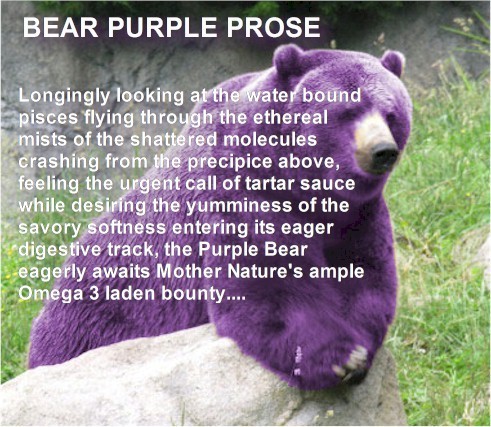
Also, in case you're not sure what purple prose is...
Dear Hillel Black (so called "editor"): Did you even read it?
Dear Sourcebooks (publisher): I've never heard of you. Now I know why.
This book was just so poorly written that I decided by the end of page 145 (yes, I made it that far) that it just wouldn't be worth my time to continue reading it. If I had to choose one color to describe this book, it would be purple, as in PURPLE PROSE EVERYWHERE. Here is the first paragraph from Chapter 2 (which really should be Chapter 1 because the actual Chapter 1 is really more of a prologue, but I digress):
I recalled the cold night of my departure only a few weeks earlier. Black rain glistened on liquid streets. Squinting between raindrops, I peered into the red river of brake lights. A blurred boa of traffic oozed ahead. I motored onto the Belt for a final time. A grim weight bore downward upon me, grinding me deeper into the creaking leather seat. Would I ever again call this country home? My flight to Riyadh, the capital of Saudi Arabia, would depart Kennedy at nine. My recent past rushed by in the rearview mirror of a migrant's regret. It was time to leave America.
Oh my gosh?! Do you think it was raining?! I don't think there were enough clues. I mean, I just can't tell. And wait, wait! Is the speaker GOING somewhere? Like, leaving the country? Oh, thank god she spells it out for me. "It was time to leave America." That really clears things up because honestly I had no idea WHAT she was talking about with calling the country home, and flights, and "migrant's regret." What does it all mean???
-_-
Let's try this again:
Squinting between raindrops, I peered into the red river of brake lights. A grim weight bore down upon me as I motored onto the Belt for a final time. My recent past rushed by in the rearview mirror of a migrant's regret, and I wondered if I would ever again call this country home.
Oh look, 48% fewer words and it still makes sense!
To add insult to injury, this memoir was neither interesting nor informative. The 145 pages that I did read didn't really increase my knowledge in any meaningful way. I was SO interested in this topic and I really did want to like this, but I know that there must be so many other books out there that touch on this same topic (and do it better) that there's literally no reason to read this.
And in case you didn't get it the first time: Reading this would be a waste of time.
Again: There are plenty of other books out there that are better than this.
And just to drive the point home: Don't read this book.
____________________________
***EDIT: If anyone has read a book on this same topic that doesn't suck, please let me know.***
Also, in case you're not sure what purple prose is...
December 26, 2008
OK, I only awarded this book two stars, for the sole reason that it is not terribly well-written. But it has some definite redeeming factors that should compel you to at least skim through it if you have the chance. The subject matter, suppression of women in Saudi Arabia, is one that intrigues and infuriates me no end, and Dr Ahmed has done a good job in conveying the psychology of living under such conditions. It does do strange things to the mind when your every move is scrutinized, when you are forced into a state of perpetual dependency and when even your body is not your own. As a western woman enjoying a high level of personal freedom I can barely even begin to comprehend how profoundly such restrictions must impact your psyche and sense of self.
What the author definitely deserves credit for is avoiding that typical know-it-all arrogance common among some westerners writing on foreign cultures (i.e. Paul Theroux, though he is of course far superior in literary terms). Very recognizable to me, having lived in non-western cultures for a significant portion of my life, is that sensation of enhanced cultural understanding followed by some event that brings you back to square one again, as puzzled as ever; Thus the quest goes on, but you never really get to the bottom of it. Another nicely nuanced view from the author is her perception of how not only women but also men suffer under the tyrannical apartheid of the sexes, perhaps reminiscent of Foucault’s concept of oppression (though this is entirely my own interpretation).
However, one of the things that bother me is the lack of any explanation on how the author manages to reconcile her own Muslim faith with the so obviously pervasively negative influence of the Wahabi zealots in that country. The mantra of “their religion is not my religion” somehow does not do it for me. But I suppose that may be a personal hang-up of mine. Finally, and on a rather negative note, this book is by far not a literary masterpiece. In parts it reads like a romance novel, and in other parts it manages to be rather tedious (for example the overly long description of Hajj).
Overall though, anyone who is interested in the subject matter of this book should definitely give it a try.
What the author definitely deserves credit for is avoiding that typical know-it-all arrogance common among some westerners writing on foreign cultures (i.e. Paul Theroux, though he is of course far superior in literary terms). Very recognizable to me, having lived in non-western cultures for a significant portion of my life, is that sensation of enhanced cultural understanding followed by some event that brings you back to square one again, as puzzled as ever; Thus the quest goes on, but you never really get to the bottom of it. Another nicely nuanced view from the author is her perception of how not only women but also men suffer under the tyrannical apartheid of the sexes, perhaps reminiscent of Foucault’s concept of oppression (though this is entirely my own interpretation).
However, one of the things that bother me is the lack of any explanation on how the author manages to reconcile her own Muslim faith with the so obviously pervasively negative influence of the Wahabi zealots in that country. The mantra of “their religion is not my religion” somehow does not do it for me. But I suppose that may be a personal hang-up of mine. Finally, and on a rather negative note, this book is by far not a literary masterpiece. In parts it reads like a romance novel, and in other parts it manages to be rather tedious (for example the overly long description of Hajj).
Overall though, anyone who is interested in the subject matter of this book should definitely give it a try.

September 30, 2022
Sep 30, noon-thirty ~~ Review asap.
Oct 1, 2pm ~~ I chose this book from my biography pile for two reasons. One, who can resist an inside peek behind the curtain of a country you will never be able to visit yourself? And two, the whole idea of the invisible woman is very much in the news these days because of the turmoil in Iran. Of course, Saudi Arabia is not Iran, but it is a Muslim country and there are very strict rules about much more than I ever realized. I was interested to see what Dr. Ahmed's experience had been like.
I first want to say that I have skimmed over a few of the reviews since I finished my reading, and I agree to a point with some of them. The author has a purple-ish style of writing, and does indeed give many many details, some that I wonder how she could even notice, such as the brand names of almost everything she sees. I suppose it is a mark of class distinction (or snobbery) to be able to identify Baccarat crystal at a glance, or that a man is wearing Italian shoes with hand-stitched soles, but the name-dropping became tiresome and at times made me feel I was reading an auction catalogue. Of course this inventory reporting did give the reader an awareness of what the privileged people in the country live for: nothing like being a living, breathing billboard for certain types of merchandise, right?
I was sometimes a little surprised by the author's intolerance. While on one hand she raves about the beauty of many of her women co-workers, when she attends a party and sees for the first time a large group of women without their required public coverings, wearing party dresses and relaxing, she body shames them all cruelly and is obviously disgusted. Many times during the book she seemed to be such a shallow person, but this time was the worst for me.
My other whine is that she never explains exactly when she was in the country. She never says from x date to y date. From various comments along the way, I figured that it was the late 90's, and she was in the country when 9/11 happened, according to the book. But the Wiki page about Dr. Ahmed is even less precise. She was in the USA for medical training in 1992 and was unable to renew her visa so she accepted a job in Saudi Arabia for one year. "Ahmed practiced medicine in the National Guard Health Affairs in the Kingdom of Saudi Arabia. She returned to the U.S. in 1996..... "
I think it would have been a good idea to state the exact dates of her time in Saudi Arabia, if for nothing more than attention to detail, which she demonstrated while writing about nearly every other topic.
I imagine you might be wondering why I gave this book five stars if I seem so negative about the author. Again, it is for the behind the curtain look at many things: the life of women in Saudi Arabia at the time, her pilgrimage to Mecca and her experiences there, the Western-biased but still possibly correct analysis of Saudi men, and the reasons she feels they have turned into not much more than overgrown and frustrated little boys with lots of fancy toys.
Dr. Ahmed was brought up in a more liberal form of Islam and during the book was continually saying that true Islam was different from what she experienced in Saudi Arabia. that true Islam protects, cherishes and respects women as well as people of other religions. Perhaps this is yet another example of organized religion turning into something the founder did not intend for it to be. That has certainly happened with Christianity. Does anyone really believe that Jesus would have approved of the Inquisition or any of the bloodshed done in His name over the centuries?!
This book was published in 2008 and I wonder just how much the atmosphere in the country has changed since then. There was an epilogue where the author updates the reader on the lives of certain of the people we met in the book, but I am still curious about the overall situation in the country now that even more years have passed since Dr. Ahmed's time there.
Oct 1, 2pm ~~ I chose this book from my biography pile for two reasons. One, who can resist an inside peek behind the curtain of a country you will never be able to visit yourself? And two, the whole idea of the invisible woman is very much in the news these days because of the turmoil in Iran. Of course, Saudi Arabia is not Iran, but it is a Muslim country and there are very strict rules about much more than I ever realized. I was interested to see what Dr. Ahmed's experience had been like.
I first want to say that I have skimmed over a few of the reviews since I finished my reading, and I agree to a point with some of them. The author has a purple-ish style of writing, and does indeed give many many details, some that I wonder how she could even notice, such as the brand names of almost everything she sees. I suppose it is a mark of class distinction (or snobbery) to be able to identify Baccarat crystal at a glance, or that a man is wearing Italian shoes with hand-stitched soles, but the name-dropping became tiresome and at times made me feel I was reading an auction catalogue. Of course this inventory reporting did give the reader an awareness of what the privileged people in the country live for: nothing like being a living, breathing billboard for certain types of merchandise, right?
I was sometimes a little surprised by the author's intolerance. While on one hand she raves about the beauty of many of her women co-workers, when she attends a party and sees for the first time a large group of women without their required public coverings, wearing party dresses and relaxing, she body shames them all cruelly and is obviously disgusted. Many times during the book she seemed to be such a shallow person, but this time was the worst for me.
My other whine is that she never explains exactly when she was in the country. She never says from x date to y date. From various comments along the way, I figured that it was the late 90's, and she was in the country when 9/11 happened, according to the book. But the Wiki page about Dr. Ahmed is even less precise. She was in the USA for medical training in 1992 and was unable to renew her visa so she accepted a job in Saudi Arabia for one year. "Ahmed practiced medicine in the National Guard Health Affairs in the Kingdom of Saudi Arabia. She returned to the U.S. in 1996..... "
I think it would have been a good idea to state the exact dates of her time in Saudi Arabia, if for nothing more than attention to detail, which she demonstrated while writing about nearly every other topic.
I imagine you might be wondering why I gave this book five stars if I seem so negative about the author. Again, it is for the behind the curtain look at many things: the life of women in Saudi Arabia at the time, her pilgrimage to Mecca and her experiences there, the Western-biased but still possibly correct analysis of Saudi men, and the reasons she feels they have turned into not much more than overgrown and frustrated little boys with lots of fancy toys.
Dr. Ahmed was brought up in a more liberal form of Islam and during the book was continually saying that true Islam was different from what she experienced in Saudi Arabia. that true Islam protects, cherishes and respects women as well as people of other religions. Perhaps this is yet another example of organized religion turning into something the founder did not intend for it to be. That has certainly happened with Christianity. Does anyone really believe that Jesus would have approved of the Inquisition or any of the bloodshed done in His name over the centuries?!
This book was published in 2008 and I wonder just how much the atmosphere in the country has changed since then. There was an epilogue where the author updates the reader on the lives of certain of the people we met in the book, but I am still curious about the overall situation in the country now that even more years have passed since Dr. Ahmed's time there.

January 5, 2014
Description: For two years, Qanta Ahmed worked in one of the world's most modern hospitals in Saudi Arabia. In 'A Stranger in the Kingdom', she recalls her experiences of being a woman in a fundamentalist Islamic state.
Opening: SEEKING RESPITE FROM THE INTENSITY of medicine, I trained my eye on the world without. Already, the midmorning heat rippled with fury, as sprinklers scattered wet jewels onto sunburned grass. Fluttering petals waved in the Shamaal wind, strongest this time of day
 Some aspects were fascinating.
May 13, 2022
This is how I felt when I read this extraordinary book by Qanta Ahmed, M.D.: Shocked. Enraged. Stunned. Dumbfounded. Disturbed. And fascinated. Absolutely fascinated.
This nonfiction book reads like a novel. It is a very personal and highly observant memoir of a female physician's two years spent in highly repressive Saudi Arabia from 1999 to 2001. But if it were a novel, a good editor would have nixed huge swaths of it as being too unbelievable. It's not. It's true.
Ahmed, who is of Pakistani origin, was born in Great Britain and educated there and in the United States. She is board-certified in critical care (translation: ICU physician), pulmonology, and sleep disorders medicine. In the late 1990s, Ahmed, at age 31, was happily working in New York City when she was unable to renew her visa. In a rushed decision in 1999, she accepted a position at a hospital in Saudi Arabia, a kingdom ruled by a crown prince and governed by very strict Muslim Sharia law. Since Ahmed was born and raised in the Muslim faith, she naively thought she would do just fine working in Riyadh. She was right in some ways and very, very wrong in others.
At the time Ahmed worked in Saudi Arabia it was a country where women are treated little better than animals. They could not drive, and they could not go anywhere unaccompanied by a husband, father, brother, or son. They had to be veiled head to toe at all times and were often harassed (or worse) by the religious police if even a strand of hair was exposed. The rules were deep, restrictive, and absolutely enforced. Ahmed entered this very scary society as a single, working woman. (Since then, some of this "gender apartheid committed in the name of Islam," as Ahmad writes in the afterword, has been lifted.)
Published in 2008, her tale of not only living and surviving, but also falling in love (dating and mingling among the sexes was absolutely prohibited, which made this an interesting dilemma) is a riveting one. She shares what it was really like to live in a place of such extreme oppression against women. From minor, but fascinating, details about life in the kingdom to big stories, such as her hajj journey, the annual Islamic pilgrimage to Mecca, and what it was like living in Saudi Arabia on 9/11 and in its immediate aftermath, this is the rarest of nonfiction books: a page-turner.
This nonfiction book reads like a novel. It is a very personal and highly observant memoir of a female physician's two years spent in highly repressive Saudi Arabia from 1999 to 2001. But if it were a novel, a good editor would have nixed huge swaths of it as being too unbelievable. It's not. It's true.
Ahmed, who is of Pakistani origin, was born in Great Britain and educated there and in the United States. She is board-certified in critical care (translation: ICU physician), pulmonology, and sleep disorders medicine. In the late 1990s, Ahmed, at age 31, was happily working in New York City when she was unable to renew her visa. In a rushed decision in 1999, she accepted a position at a hospital in Saudi Arabia, a kingdom ruled by a crown prince and governed by very strict Muslim Sharia law. Since Ahmed was born and raised in the Muslim faith, she naively thought she would do just fine working in Riyadh. She was right in some ways and very, very wrong in others.
At the time Ahmed worked in Saudi Arabia it was a country where women are treated little better than animals. They could not drive, and they could not go anywhere unaccompanied by a husband, father, brother, or son. They had to be veiled head to toe at all times and were often harassed (or worse) by the religious police if even a strand of hair was exposed. The rules were deep, restrictive, and absolutely enforced. Ahmed entered this very scary society as a single, working woman. (Since then, some of this "gender apartheid committed in the name of Islam," as Ahmad writes in the afterword, has been lifted.)
Published in 2008, her tale of not only living and surviving, but also falling in love (dating and mingling among the sexes was absolutely prohibited, which made this an interesting dilemma) is a riveting one. She shares what it was really like to live in a place of such extreme oppression against women. From minor, but fascinating, details about life in the kingdom to big stories, such as her hajj journey, the annual Islamic pilgrimage to Mecca, and what it was like living in Saudi Arabia on 9/11 and in its immediate aftermath, this is the rarest of nonfiction books: a page-turner.

August 13, 2012
Dr. Ahmed writes a compelling memoir based upon her two years as a resident physician in Riyadh, Saudi Arabia. She writes from a western woman's point of view, as well as from a Muslim woman's point of view, and interjects her observations about the internal conflicts that exist among both Saudi men and women. Dr. Ahmed comments on her personal journey to Mecca and the heart of Islam, as well as the difficulties the educated elite face as they hurdle towards the future with hopes of uplifting the masses out of ignorance. Her insights are perceptive and her writing is engaging.

June 12, 2026
Good grief, the purple prose! I don't think I have ever read a more annoying and long-winded and self-important narrative of any person who has lived in a foreign country. From the moment Qanta sets foot in Saudi Arabia, she exudes judgement on anything and everything Saudi to the point of racism. The whole book is an exercise on white adjacency and the author apparently believes everything western = good, everything eastern = bad. Yes, Saudi had major issues with freedom and women's rights in the 90s, and still does, but sheesh!
Qanta Ahmed is a Pakistani British doctor, who studied in New York, and became completely Americanised within two years (oh, joy!) before she had visa issues and decided to take up a two year tenure in Riyadh. Her whining starts within seconds of landing as she takes issue with the man who came to pick her up. She takes issue with the vehicle they use, and then pretty much everything else that came after.
She goes on and on about her black abayah and how the cheap polyester was suffocating her. This is nonsense because at any point in the long-winded four hundred and fifty pages of torture the readers had to suffer, she could have gone to ANY shop in Riyadh and bought a nice linen or cotton abayah, or even a georgette one. She could even have bought cloth of her choice and gotten it tailored. But then, how could she whine for 450 pages?
Instead of focusing on her experiences in KSA and how she overcame the challenges, she instead blares forth the stories of random people she meets, probably embellished and fabricated in some form or the other. These people took her into their circles despite her never bothering to learn a single word of Arabic (just try and do that in the US or UK with English, ha!). And she repays them with broadcasting their private information to everyone. I do wonder what these nice Saudi people think of their "friend" and if they ever read this book?
Besides, the woman LIES just to moan about women. As a feminist, I hate people like this who just exotify women of other cultures to create dramatic effect for their own profit. Qanta was in KSA between 1999 to 2001. And then she tells a story about Rania al-Baz, a pioneer in Saudi television news, who was brutally beaten up by her husband. She went on to achieve justice and her husband was sentenced to a fine and lashes. This happened in 2004, but Qanta apparently already had a crystal ball in which she saw this was about to happen before 2001 when she left. Also, her friend who told her all about this incident while she lived in Saudi. Two crystal balls here. After reading this, I am now left wondering what other 'facts' she manipulated or lied about.
The only portion of the book that was somewhat interesting to me was her performing hajj. Despite the author trying to insert herself into everything as usual, there was still many new things that held my interest in these chapters. But oh no, racism in Saudi Arabia! How is it possible? Poor Pakistani British woman living in the US has never come across any racism before. Didn't even know about such a thing, and it is only in KSA that she was horrified to see it. Oh no! How horrible for her! No such thing in UK and US, do you understand?
The author comes across as an extremely unpleasant person through this book, and for me, this was confirmed when I looked her up and saw that she supports wars, genocide, and the destabilisation of West Asia. And she has the temerity to complain about people not caring much about the 2001 terror attacks in NY because it didn't affect them. Qanta, maybe it's time you straightened your back and stopped licking the white man's boots. It's okay to be South Asian and Muslim.
And honestly, I don't believe this woman made me defend KSA in my review. I don't actually think so. I think their human rights and women's rights need complete overhauling, but it won't be achieved by hypocrisy or bullying by the collective West, in which KSA is also white adjacent and a perpetrator in many ways. Buzz off, Qanta. Leave the Saudi people to deal with their own problems.
Qanta Ahmed is a Pakistani British doctor, who studied in New York, and became completely Americanised within two years (oh, joy!) before she had visa issues and decided to take up a two year tenure in Riyadh. Her whining starts within seconds of landing as she takes issue with the man who came to pick her up. She takes issue with the vehicle they use, and then pretty much everything else that came after.
She goes on and on about her black abayah and how the cheap polyester was suffocating her. This is nonsense because at any point in the long-winded four hundred and fifty pages of torture the readers had to suffer, she could have gone to ANY shop in Riyadh and bought a nice linen or cotton abayah, or even a georgette one. She could even have bought cloth of her choice and gotten it tailored. But then, how could she whine for 450 pages?
Instead of focusing on her experiences in KSA and how she overcame the challenges, she instead blares forth the stories of random people she meets, probably embellished and fabricated in some form or the other. These people took her into their circles despite her never bothering to learn a single word of Arabic (just try and do that in the US or UK with English, ha!). And she repays them with broadcasting their private information to everyone. I do wonder what these nice Saudi people think of their "friend" and if they ever read this book?
Besides, the woman LIES just to moan about women. As a feminist, I hate people like this who just exotify women of other cultures to create dramatic effect for their own profit. Qanta was in KSA between 1999 to 2001. And then she tells a story about Rania al-Baz, a pioneer in Saudi television news, who was brutally beaten up by her husband. She went on to achieve justice and her husband was sentenced to a fine and lashes. This happened in 2004, but Qanta apparently already had a crystal ball in which she saw this was about to happen before 2001 when she left. Also, her friend who told her all about this incident while she lived in Saudi. Two crystal balls here. After reading this, I am now left wondering what other 'facts' she manipulated or lied about.
The only portion of the book that was somewhat interesting to me was her performing hajj. Despite the author trying to insert herself into everything as usual, there was still many new things that held my interest in these chapters. But oh no, racism in Saudi Arabia! How is it possible? Poor Pakistani British woman living in the US has never come across any racism before. Didn't even know about such a thing, and it is only in KSA that she was horrified to see it. Oh no! How horrible for her! No such thing in UK and US, do you understand?
The author comes across as an extremely unpleasant person through this book, and for me, this was confirmed when I looked her up and saw that she supports wars, genocide, and the destabilisation of West Asia. And she has the temerity to complain about people not caring much about the 2001 terror attacks in NY because it didn't affect them. Qanta, maybe it's time you straightened your back and stopped licking the white man's boots. It's okay to be South Asian and Muslim.
And honestly, I don't believe this woman made me defend KSA in my review. I don't actually think so. I think their human rights and women's rights need complete overhauling, but it won't be achieved by hypocrisy or bullying by the collective West, in which KSA is also white adjacent and a perpetrator in many ways. Buzz off, Qanta. Leave the Saudi people to deal with their own problems.

August 16, 2013
The author of this book is British, of Pakistani origin, and is a devout Moslem. Thus she is the ideal person to write impartially about the role and status of women in the Saudi Kingdom, a subject which has interested me tremendously since the first time I spent more than a few months in a place where Islam was the main religion. While the book appealed to many of my prejudices about places that deny women basic civil rights and demand that they veil themselves in public, I more interested in the viewpoints of the women to whom this pertained.
Much of what I learned was surprising - that there is some security in wearing the veil, and to living with one's birth family until marriage. However, the laws against women driving and the extreme segregation of the sexes are only two examples of what make women's lives very difficult, in effect for no reason. The author describes the religious police and their raids on such events as dinner parties, and the discomfort of the polyester abbayah in desert heat conditions, the shunning and the shaming of women and foreign laborers, and the general racism towards "lesser" races than the Saudis.
One of the most interesting parts involved the author's description of her Hajj, how this actually took place, and how it brought her closer to her understanding of Islam.
She was in Riyadh during 9/11, and her reaction to the local attitude towards this act was one of horror. However, she also described how some tried to comfort her, as one city she considered "home" was in fact New York.
She ends the book on a highly optimistic note, describing how more and more women are entering the workforce in Saudi Arabia, and more girls are being educated. And she states that the laws again women driving are being relaxed.
All in all, this is a most powerful and fascinating read.
Much of what I learned was surprising - that there is some security in wearing the veil, and to living with one's birth family until marriage. However, the laws against women driving and the extreme segregation of the sexes are only two examples of what make women's lives very difficult, in effect for no reason. The author describes the religious police and their raids on such events as dinner parties, and the discomfort of the polyester abbayah in desert heat conditions, the shunning and the shaming of women and foreign laborers, and the general racism towards "lesser" races than the Saudis.
One of the most interesting parts involved the author's description of her Hajj, how this actually took place, and how it brought her closer to her understanding of Islam.
She was in Riyadh during 9/11, and her reaction to the local attitude towards this act was one of horror. However, she also described how some tried to comfort her, as one city she considered "home" was in fact New York.
She ends the book on a highly optimistic note, describing how more and more women are entering the workforce in Saudi Arabia, and more girls are being educated. And she states that the laws again women driving are being relaxed.
All in all, this is a most powerful and fascinating read.
May 11, 2009
Unfortunately this book reads like a dragged-out Readers Digest piece. It's largely made up of reconstructed conversations with Saudis during which they "tell" her simplistically how things work in the Kingdom ("You see, Qanta, here in Saudi Arabia we...." [etc:]). But she'll present these various cultural situations without fully contextualizing them; though to be fair, having been there for only a couple of years in a highly specialized environment, she may not have had the opportunity to grasp the authentic context herself. She spends an inordinate amount of time describing in ornate and sexualized detail how incredibly lushly beautiful Saudi women are: is this gratuitous overcompensation for showing us the evils of the abbayah? The only angle I can say I liked, though I cannot relate to it myself, is the author's rendering of her own religious reconciliation; this made up the most genuine and least forced parts of the book.

November 11, 2011
Interesting and somewhat, sometimes, less than compelling read. It is really 2.5 stars. I'm not sorry I read it, but Dr. Ahmed's editors really let her down. I mean it. The writing is at times cringe worthy. Honestly, sometimes rain is just simply rain.
I did learn some things, and the look into a distant culture was intersting. At times, however, the book felt like a lecture. Apparently, everyone lectured Dr. Ahmed about everything. (Something I find hard to believe). I think a book like this is needed, the heart is in the right place, but the executation could have been a bit better.
I did learn some things, and the look into a distant culture was intersting. At times, however, the book felt like a lecture. Apparently, everyone lectured Dr. Ahmed about everything. (Something I find hard to believe). I think a book like this is needed, the heart is in the right place, but the executation could have been a bit better.
February 8, 2013
I found this to be a very frustrating book. Either the author is conflating circumstances to create a "good" story or she is the most willfully uninformed person.
I can't understand how a well-educated woman could sign on to living in Saudi Arabia for 2 years and show up with no covering. How incredibly ignorant. She came from New York so she doesn't have the excuse of lack of access to proper attire. I could walk from my house in Brooklyn and get an abbaya!
She (supposedly) at the last minute decides she's been called by god to do a pilgramage to Mecca but doesn't even have a koran with her.
She complains about her cheap abbaya and is constantly panting over other womens' and I can't swallow that a doctor brought over from the West doesn't make enough money to afford a decent one.
She also claims not to follow fashion and branding, but the book almost reads like it was written by Bret Easton Ellis with all the brand descriptors of everything everyone else is wearing.
I also got sick sick of every woman being described as beautiful. I felt myself rolling my eyes for every new loving decription.
It's a real shame because she does spend quite a bit of time getting to know many different kinds of people while she is in Saudi Arabia. I know some of the time she is acting stupid to forward the story.I just wish she didn't come off as such an ignorant drama queen
I can't understand how a well-educated woman could sign on to living in Saudi Arabia for 2 years and show up with no covering. How incredibly ignorant. She came from New York so she doesn't have the excuse of lack of access to proper attire. I could walk from my house in Brooklyn and get an abbaya!
She (supposedly) at the last minute decides she's been called by god to do a pilgramage to Mecca but doesn't even have a koran with her.
She complains about her cheap abbaya and is constantly panting over other womens' and I can't swallow that a doctor brought over from the West doesn't make enough money to afford a decent one.
She also claims not to follow fashion and branding, but the book almost reads like it was written by Bret Easton Ellis with all the brand descriptors of everything everyone else is wearing.
I also got sick sick of every woman being described as beautiful. I felt myself rolling my eyes for every new loving decription.
It's a real shame because she does spend quite a bit of time getting to know many different kinds of people while she is in Saudi Arabia. I know some of the time she is acting stupid to forward the story.I just wish she didn't come off as such an ignorant drama queen

January 18, 2012
If Goodreads so allowed, this book would get 3.5 stars. It's interesting and enjoyable but certainly the product of a first time author. Her recollections at times felt quite vague and at others filled with details with no rhyme or reason to why in each section. She would talk about something urgently coming up and being a big deal (Ramadan) and then the next chapter Ramadan was already over, with nothing about it. She also has a habit of introducing characters, telling a story about them and then dropping them out of her book, even though it seemed that they were colleagues that worked together and they would have likely had other interactions. I feel if this book was more strongly edited, it could have gotten 4 or possibly even 5 stars.
I liked how she described the people in the novel and the thought she put into how it was perceived versus what it was like "on the inside". It was a great first person account of something I am certain I will never do.
I liked how she described the people in the novel and the thought she put into how it was perceived versus what it was like "on the inside". It was a great first person account of something I am certain I will never do.
April 16, 2009
This is a wonderful and very disturbing book. The author is a Moslem of Pakistani descent who was born in London and grew up in a very assimilated family. She became a physician and moved to the US for additional training. Then, not knowing what to do with her life, she decided to spend a couple of years in Riyadh, Saudi Arabia. She thought that because she was Muslim, it would not be a problem to adapt, but she was totally unprepared for Saudi mores. I highly recommend this book for understanding what life is like for women in a Moslem country.
September 8, 2009
Memoir of 2-years in Saudi Arabia by female doctor. A few interesting incidents stretched into a too-long book by bad writing. Might have made a passable book of 100-pages if tightly written.

November 20, 2010
A coworker of mine loaned me this book so that I could learn more about Saudi culture since the majority of our students are Saudi. I did learn a lot about Saudi culture, and it made me want to learn more, which I think is always a compliment to a book. However, this book had a lot of issues that warranted it 3 stars when it had the easy premise to be an outstanding and conversation-provoking book.
Ahmed has the unique perspective of being a British Muslim of Pakistani parents who completed her medical training the United States. Her two year stay in Riyadh as an ICU doctor in a large hospital there was the answer to a visa problem with the US and also the impetus for her to reconnect to her repressed Islamic faith.
The problem, I think, is that Ahmed tries to do more social commentary than she should. A lot of her book comes off as very judgmental, particularly towards some of her friends, and I wonder if her friends (who all speak English fluently) have read her book. I also felt like Ahmed exoticized Saudi culture while at the same time railing against it. Her views often seemed contradictory, and it was hard to figure out exactly what she thought or felt. For example, she criticizes the Saudis for their excessive display of wealth in the form of designer clothes, diamonds with names that I certainly didn't recognize (but she certainly did), and expensive furniture while at the same time appearing to be very impressed with it. I understand pointing out the inconsistency of living under fundamentalist Wahabist Islam while at the same time adorning oneself and showing status through discreet labels and brands, but I felt like Ahmed was drawn into this excess of status symbols, noting how she herself dons a pair of designer heels for a business dinner.
What was missing in this book was more personal information about Ahmed and more connection between the experiences that she recounts. The story jumps around, and some parts of it don't match up sequentially. For example, earlier in the book, she talks about how Faris was recently divorced. About 200 pages later, she says that she was shocked to learn that Faris was getting divorced. Maybe the intense heat of Saudi Arabia warps time. In addition, the book was poorly edited, and what was a 430 page book could have easily been a much more efficient 230 page book.
I swear, if Ahmed used the expression "I was deeply disturbed" one more time, I was going to start ripping pages out. She relies on the same expressions of outrage and confusion throughout the book. I longed for more depth in the analysis of her reactions and more insight into just how complex and schizophrenic Saudi culture can be instead of just telling us "I was beginning to learn that Saudi women are complex." Show it, don't tell us about it.
In conclusion, this book opened the door for me into learning more about Saudi culture, but I want to seek out other books that have a more grounded critical perspective and a better writing style.
Ahmed has the unique perspective of being a British Muslim of Pakistani parents who completed her medical training the United States. Her two year stay in Riyadh as an ICU doctor in a large hospital there was the answer to a visa problem with the US and also the impetus for her to reconnect to her repressed Islamic faith.
The problem, I think, is that Ahmed tries to do more social commentary than she should. A lot of her book comes off as very judgmental, particularly towards some of her friends, and I wonder if her friends (who all speak English fluently) have read her book. I also felt like Ahmed exoticized Saudi culture while at the same time railing against it. Her views often seemed contradictory, and it was hard to figure out exactly what she thought or felt. For example, she criticizes the Saudis for their excessive display of wealth in the form of designer clothes, diamonds with names that I certainly didn't recognize (but she certainly did), and expensive furniture while at the same time appearing to be very impressed with it. I understand pointing out the inconsistency of living under fundamentalist Wahabist Islam while at the same time adorning oneself and showing status through discreet labels and brands, but I felt like Ahmed was drawn into this excess of status symbols, noting how she herself dons a pair of designer heels for a business dinner.
What was missing in this book was more personal information about Ahmed and more connection between the experiences that she recounts. The story jumps around, and some parts of it don't match up sequentially. For example, earlier in the book, she talks about how Faris was recently divorced. About 200 pages later, she says that she was shocked to learn that Faris was getting divorced. Maybe the intense heat of Saudi Arabia warps time. In addition, the book was poorly edited, and what was a 430 page book could have easily been a much more efficient 230 page book.
I swear, if Ahmed used the expression "I was deeply disturbed" one more time, I was going to start ripping pages out. She relies on the same expressions of outrage and confusion throughout the book. I longed for more depth in the analysis of her reactions and more insight into just how complex and schizophrenic Saudi culture can be instead of just telling us "I was beginning to learn that Saudi women are complex." Show it, don't tell us about it.
In conclusion, this book opened the door for me into learning more about Saudi culture, but I want to seek out other books that have a more grounded critical perspective and a better writing style.

November 25, 2011
The author has done her readers of all faiths and nationalities a service by writing this memoir of her time in the Kingdon of Saudi Arabia as an ICU doctor. While her position, shielded by the royal family, afforded her great privilidge, it also allowed her to better understand her own Islamic beliefs.
One of the really interesting aspects of this story is seeing that for Ahmed, part of the trip to Saudi Arabia is a homecoming, a chance to experience a culture smiilar in religious beliefs to those with which she was raised (she's of Pakistani descent from the UK).
The memoir covers many different aspects of her life. Some are common to all women (the purchase of and dealing with the abbayah and all that entails) while others are personal to her alone (a forbidden crush, or working with men who usually weren't allowed to be alone with women--ever). While Ahmed is hard on her self for not having as much aptience as she believes she should have, her frankness brings us in touch with her world.
As she was raised in the West, she has a cosmopolitanism that affects her Islamic faith. Because she's been exposed to people and raised not to hate "the other," she has a natural curiousity to learn about others. In contrast, it was hard to read about her time there after 9/11 not as an American, but as someone who values human life. It seems like the bombing in the United States made it ok for the racist attitudes held by many of her colleagues were then "okay" to be expressed, suddenly.
What I hope for all people, is that even if raised by our parents' own prejudices, that we want our children to be free of these types of prejudices towards people we consider to be "other" from ourselves. You will be happy with Ahmed's book if you have curiousity--she educates and is a pleasure to read, all at the same time.
One of the really interesting aspects of this story is seeing that for Ahmed, part of the trip to Saudi Arabia is a homecoming, a chance to experience a culture smiilar in religious beliefs to those with which she was raised (she's of Pakistani descent from the UK).
The memoir covers many different aspects of her life. Some are common to all women (the purchase of and dealing with the abbayah and all that entails) while others are personal to her alone (a forbidden crush, or working with men who usually weren't allowed to be alone with women--ever). While Ahmed is hard on her self for not having as much aptience as she believes she should have, her frankness brings us in touch with her world.
As she was raised in the West, she has a cosmopolitanism that affects her Islamic faith. Because she's been exposed to people and raised not to hate "the other," she has a natural curiousity to learn about others. In contrast, it was hard to read about her time there after 9/11 not as an American, but as someone who values human life. It seems like the bombing in the United States made it ok for the racist attitudes held by many of her colleagues were then "okay" to be expressed, suddenly.
What I hope for all people, is that even if raised by our parents' own prejudices, that we want our children to be free of these types of prejudices towards people we consider to be "other" from ourselves. You will be happy with Ahmed's book if you have curiousity--she educates and is a pleasure to read, all at the same time.

August 16, 2018
I am so very glad to have read this book! I started reading the book with the expectation to have a glimpse of Saudi Arabia. However, with this memoir, the author deep dive into the culture, separating the truth of Quran and the false interpretations by some so-called religious leaders for the sake of ruling the country with an iron fist. She takes us to Hajj experience also. I felt blissful even with her experience of Hajj.
Very glad to hear about the oppressions of both women and men are slowly decreasing with the new enactments to bring radical change to the culture by the King and the crown prince of Saudi Arabia.
Very glad to hear about the oppressions of both women and men are slowly decreasing with the new enactments to bring radical change to the culture by the King and the crown prince of Saudi Arabia.

June 5, 2014
3.80 stars
I enjoyed this. I will say that it was far from perfect, but I'll read absolutely anything that takes me into the world of Saudi women, or women anywhere in the east, for that matter. I thought this book would be primarily about Qanta's experience in Saudi Arabia as a woman and female doctor, as well as a really in-depth look into what life was like for women there. And it was kind of that. But about a quarter of the way in, Qanta decides to go on Hajj (the Muslim pilgrimage to Mecca). Every step is explained in great detail. And trust me, there are a lot of steps. She has a spiritual awakening there, and starts to see her faith in a new, enlightened way. Because of this, much of the book reads more like a spiritual awakening than a cultural expose. I'm not saying I didn't enjoy learning about Hajj and Qanta's experience there, but this part of the book was a bit tedious. And after all, I came to get the goods on everyday Saudi life, so I was kind of biding my time until this (long) interlude was over.
The subject was mainly fascinating. The writing wasn't bad but it wasn't great either. I listened to the audio version, and the narrator was great. I do think her performance really enhanced the experience. Now I wasn't counting (but I kind of wish I was), but Qanta uses the phrase, "I was incredulous!" about 50 times (If anyone decides to read this book and is willing to count the number of times this phrase is actually used, I'll give you five dollars. I'd be really curious to know the exact number).
That aside, I really did like this book. Qanta is very likable! She is a sweet lady and a smart one, too. She's bold and insightful. I can't get enough of memoirs written by women from the west who are checking out the lives of women of the east. I eat it up. I should probably make a shelf (if I could figure out a way to make the title of that shelf a little shorter). If this is your bag too, then this is a must read. I'm glad for any glimpse into this world, and this one was pretty good. 3.8 stars (yes, I know I've been getting ridiculously specific in the "3" range lately, but I just feel like "3" really does have a huge range and I must be true to my rating :)
I enjoyed this. I will say that it was far from perfect, but I'll read absolutely anything that takes me into the world of Saudi women, or women anywhere in the east, for that matter. I thought this book would be primarily about Qanta's experience in Saudi Arabia as a woman and female doctor, as well as a really in-depth look into what life was like for women there. And it was kind of that. But about a quarter of the way in, Qanta decides to go on Hajj (the Muslim pilgrimage to Mecca). Every step is explained in great detail. And trust me, there are a lot of steps. She has a spiritual awakening there, and starts to see her faith in a new, enlightened way. Because of this, much of the book reads more like a spiritual awakening than a cultural expose. I'm not saying I didn't enjoy learning about Hajj and Qanta's experience there, but this part of the book was a bit tedious. And after all, I came to get the goods on everyday Saudi life, so I was kind of biding my time until this (long) interlude was over.
The subject was mainly fascinating. The writing wasn't bad but it wasn't great either. I listened to the audio version, and the narrator was great. I do think her performance really enhanced the experience. Now I wasn't counting (but I kind of wish I was), but Qanta uses the phrase, "I was incredulous!" about 50 times (If anyone decides to read this book and is willing to count the number of times this phrase is actually used, I'll give you five dollars. I'd be really curious to know the exact number).
That aside, I really did like this book. Qanta is very likable! She is a sweet lady and a smart one, too. She's bold and insightful. I can't get enough of memoirs written by women from the west who are checking out the lives of women of the east. I eat it up. I should probably make a shelf (if I could figure out a way to make the title of that shelf a little shorter). If this is your bag too, then this is a must read. I'm glad for any glimpse into this world, and this one was pretty good. 3.8 stars (yes, I know I've been getting ridiculously specific in the "3" range lately, but I just feel like "3" really does have a huge range and I must be true to my rating :)
February 23, 2009
This book overall was extremely interesting....it deals with the plight of women in The Kingdom (Saudi Arabia). It follows the journey of a British Muslim women educated in Britian and the US as a doctor. She goes to the Kingdom on a 3 year contract as an ER doctor. I felt that at first she was being honest and than as the book progressed she became reticent and even understanding of how women are treated! She is a highly educated intelligent women and yet she could not even drive a car or even leave her apartment to go to a store without an "approved" male escort....it was dissapointg...It seemed as if in writing this she was fearful of really upsetting the male dominated regime in the off chance she would return to the Kingdom (she is currently in the US) and have to answer for it. The racist, sexist nature of the current extreme muslim regime is terrifying, it is hatefilled and violent, the account of Sept 11 is particularly saddening since every one of her accounts in the book are from American educated individuals ....this book is worth definately reading just do not let the books outside presentation fool you into thinking you are getting a true heartfelt account...instead you must intepret for yourself how terrifying it must be to be a women in this society....also she was as high standing as a women could be there....I feel for the uneducated common women and girls...it is a brutal life....

June 25, 2021
I liked this book less and less as it went on. It *was* interesting, but dear god, could’ve definitely used some editing! Way too long, I wish it were like a hundred pages shorter.
This memoir from a feminist Muslim doctor about her experience working at a hospital in Saudi Arabia for 2 years was wild. I can’t get over that she literally wasn’t allowed to hold onto her U.K. passport while she was there??? Like some driver dude/sponsor took it??? I have questions.
The casual anti-semitism and the insidious, ingrained misogyny made me feel some ways 🙃 Basically her colleague was like “I hate Jews but I love and respect my American mentor who is Jewish and also I’m going to teach my infant son to hate Jews too, and also hate America” (even though this guy was educated at American medical schools?? K.) It was a lot. At the end of the book, there’s a chapter about 9/11 and how two Saudi doctors bought cake to celebrate (!!!) and I’m like…wowowow I mean…goddamn. Can’t we all just not?!? This is just all so pointless! Gah. There were a bunch of western doctors and other nurses who were understanding and swapped condolences, but some of Qanta’s coworkers were like 😈🤷🏻♀️🔥 and…big yikes.
Her experience of doing Haji was so interesting! I know nothing about that, and thought her descriptions were so vivid. Overall, I did enjoy this book, even though it was supremely infuriating (the Mutawaeen 🙄).
This memoir from a feminist Muslim doctor about her experience working at a hospital in Saudi Arabia for 2 years was wild. I can’t get over that she literally wasn’t allowed to hold onto her U.K. passport while she was there??? Like some driver dude/sponsor took it??? I have questions.
The casual anti-semitism and the insidious, ingrained misogyny made me feel some ways 🙃 Basically her colleague was like “I hate Jews but I love and respect my American mentor who is Jewish and also I’m going to teach my infant son to hate Jews too, and also hate America” (even though this guy was educated at American medical schools?? K.) It was a lot. At the end of the book, there’s a chapter about 9/11 and how two Saudi doctors bought cake to celebrate (!!!) and I’m like…wowowow I mean…goddamn. Can’t we all just not?!? This is just all so pointless! Gah. There were a bunch of western doctors and other nurses who were understanding and swapped condolences, but some of Qanta’s coworkers were like 😈🤷🏻♀️🔥 and…big yikes.
Her experience of doing Haji was so interesting! I know nothing about that, and thought her descriptions were so vivid. Overall, I did enjoy this book, even though it was supremely infuriating (the Mutawaeen 🙄).
This entire review has been hidden because of spoilers.
February 13, 2013
I'll grant that the writing style is very stilted and I could hear the good doctor in my ear as I read. An editor might have tightened up the text but would have eliminated the personal style of Dr Ahmed's voice. I had a frind who spent several year in Saudi Arabia so I was eager to read this.
The stifling treatment of women, the religious police patrolling for errors in dress or behavior, the gap between men and women, all described as would be expected. What I didn't expect is the religious epiphany she had during Hajj. I had never read about what it's actually like to be on a Hajj so it was quite eye-opening. So was the prejudice within the Islamic community at the height of its most holy activities of one sort on Muslim over another sort of Muslim. It is obvious that the social life of the Saudi Kingdom is not tied to Islam to her, and therefore we should stop painting all Muslims with one paint brush. She holds great hope for young Saudi women in changing the status quo. She also points out that isolating the sexes means men cannot get to know women so arranged marriages probably make some sort of sense.
I really gained a lot from this book; it took me places nobody else could take me. It showed me a pure form of Islam that is as pure as any Christian feels. Lots of bitter pills in this book but some joy as well.
The stifling treatment of women, the religious police patrolling for errors in dress or behavior, the gap between men and women, all described as would be expected. What I didn't expect is the religious epiphany she had during Hajj. I had never read about what it's actually like to be on a Hajj so it was quite eye-opening. So was the prejudice within the Islamic community at the height of its most holy activities of one sort on Muslim over another sort of Muslim. It is obvious that the social life of the Saudi Kingdom is not tied to Islam to her, and therefore we should stop painting all Muslims with one paint brush. She holds great hope for young Saudi women in changing the status quo. She also points out that isolating the sexes means men cannot get to know women so arranged marriages probably make some sort of sense.
I really gained a lot from this book; it took me places nobody else could take me. It showed me a pure form of Islam that is as pure as any Christian feels. Lots of bitter pills in this book but some joy as well.
June 12, 2012
This author brings a lot of passion to her book, a memoir of two years of her life spent working as a physician in the Kingdom of Saudi Arabia. Maybe a little too much passion. Her writing style is too florid for me, her vocabulary a bit far-fetched; I had the sense she was writing with a thesaurus at hand. She often seemed to get carried away with her descriptions of characters, to the point I had trouble believing the people she met could really be THAT beautiful, THAT magnificent, THAT talented. And maybe it was all that passion that led her to make sweeping, and often harsh, judgments about the people and culture she was writing about.
But none of my admittedly petty criticisms should stop you from reading the book. In the end I gained a deep appreciation for her perspective on Saudi Arabia and her insight into the Gulf Arab culture. She worked and socialized with a number of remarkable individuals, and she clearly made every effort to know them and understand them well. In turn, her book helped me better understand the country and its fascinating people.
But none of my admittedly petty criticisms should stop you from reading the book. In the end I gained a deep appreciation for her perspective on Saudi Arabia and her insight into the Gulf Arab culture. She worked and socialized with a number of remarkable individuals, and she clearly made every effort to know them and understand them well. In turn, her book helped me better understand the country and its fascinating people.
April 16, 2012
Very interesting book about a western educated muslim doctor's 2 years in Saudi Arabia. Learned a lot about her pure passion for her religion (and the role of Haaj in it) and her clear thinking about the history, future and circumstances in Soudi Arabia. I was perhaps particuarly interested because a family member lived there with her husband for a while. Probably a bit before Qanta was there. So thought provoking.

August 5, 2015
A fascinating insight into what life was like for a woman in Saudi Arabia in the early years of this century. The author is an expatriate unmarried muslim woman who worked for a couple of years in Riyadh. The writing is good, and improves as the book progresses - so persist.

August 10, 2019
What a read.
Infuriating and but educational and informative...
"Nothing is as fierce or imbued with goodness as the oppressed who have overcome their cowardly oppressor."
Infuriating and but educational and informative...
"Nothing is as fierce or imbued with goodness as the oppressed who have overcome their cowardly oppressor."
Displaying 1 - 30 of 1,013 reviews