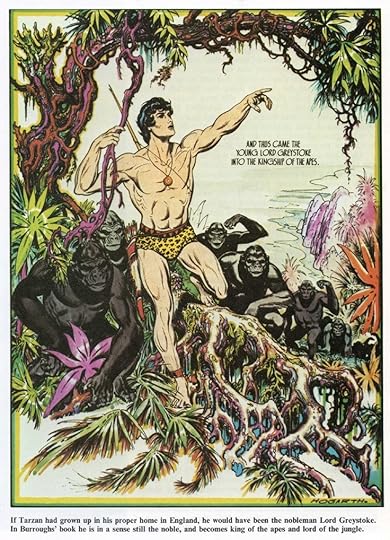
Burne Hogarth started young. Born in 1911, he was enrolled in the Chicago Art Institute at the age of 12 and an assistant cartoonist at Associated Editors' Syndicate at 15. At the age of 26, he was chosen from a pool of a dozen applicants as Hal Foster's successor on the United Features Syndicate strip, "Tarzan". His first strip, very much in Foster's style, appeared May 9, 1937. It wasn't long before he abandoned the attempt to maintain the original look of the strip and brought his own dynamic style to the Sunday comics page.
In 1947, Hogarth co-founded (with Silas Rhodes) the School of Visual Arts which became his new direction in life. He was able to pass his unique methods on illustration to his students in the classroom and, in 1958, to the readers of his first book, Dynamic Anatomy.
Hogarth retired from the SVA in 1970 but continued to teach at The Parsons School of Design and, after a move to Los Angeles, The Otis School and Art Center College of Design in Pasadena. During his years teaching, Hogarth authored a number of anatomy and drawing books that have become standard references for artists of every sort, including computer animators. Dynamic Anatomy (1958) and Drawing the Human Head (1965) were followed by further investigations of the human form. Dynamic Figure Drawing (1970) and Drawing Dynamic Hands (1977) completed the figure cycle. Dynamic Light and Shade (1981) and Dynamic Wrinkles and Drapery (1995) explored other aspects relative to rendering the figure.
After more than 20 years away from strip work and being hailed in Europe as "the Michelangelo of the comic strip," Hogarth returned to sequential art in 1972 with his groundbreaking Tarzan of the Apes, a large format hardbound book published by Watson Guptill in 11 languages. It marks the beginning of the sober volume of integrated pictorial fiction, what is currently understood to be a graphic novel.
Burne Hogarth passed away in 1996 at the age of 84.
My 5 years old daughter wanted reading some book of his dad from when he was a kid, so I went upstairs into the dusty cobwebs packed attic here in our countryside family's summer house and started looking.
Such a surprise finding back this 1973 book that I loved so much reading in my childhood piled with many others under a plastic sheet.
Reading it again was a real blast of a nostalgia trip, remembering me happy past times when I used spending whole days losing myself inside its pages.
And artworks from Burne Hogarth, a real Master of Ninth Art, are so glorious, gorgeous and wonderful ones, that you just can't stop reading this book, the ultimate adaption of a timeless classic, with joy filled eyes.
Probably too brutal for my daughter to read now, but I'm sure she's going to love it too in a few years.
I can’t express how much I loved this book as a boy. My library got a copy when it first came out in 1972 and I immediately gravitated to it. This outsized tome was magnificent, especially for a 7-year-old.
I actually prefer this adaptation over the original book by Burroughs. Hogarth’s art is incredible. It’s clear storytelling, dynamic, and just beautiful to look at. And “Burne Hogarth” is an awesome name, isn’t it? He sounds like a character in a Burroughs adventure tale.
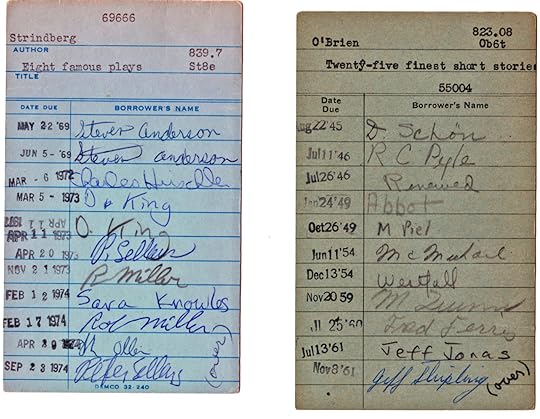
I checked this book out constantly, and back in the day they would write your name on the card. I don’t know how many names fit on one of those index cards, maybe 20 or 30 front and back, and my name filled up three of those suckers all by itself. That’s 120 weeks altogether, basically 2-1/2 years. I practically owned that copy. After one of those times, the librarian gave me the card, which I then used as a bookmark for years. Sadly, I lost it at some point. I don’t know why I didn’t put it in a safety deposit box at the bank. Stupid me.
Edit: this is what those old library cards looked like, for those of you too young to remember,
"Then Tarzan, Lord Greystroke, wiped his greasy fingers on his naked thighs and took up Kulonga's trail."
Although frankly I could do without the orgy of praise for the artist that takes up half the book. A lot of these collections of older comics or whatnot apparently can't be put together without at least a dozen pages devoted to convincing the reader that the tome they are about to embark upon will open their eyes to the revolutionary genius and artistic mastery that went for too long unrecognized.
Burne Hogarth’s Tarzan of the Apes is a stunning graphic adaptation that captures both the spirit and the sensual dynamism of Edgar Rice Burroughs’ original novel. Faithful to the story yet completely reimagined through Hogarth’s inimitable style, this work proves once again that few artists have ever understood the human body — its grace, strength, and expressive power — as deeply as he did. Every panel feels alive: muscles coil, vines twist, the jungle breathes. Hogarth transforms Tarzan into a figure of pure myth — both feral and noble — and his art pushes the narrative beyond mere adventure into something almost operatic. The original story remains beautiful, but in Hogarth’s hands it gains a new visual majesty. A must-read (and must-see) for anyone who loves classic adventure, anatomical mastery, or the golden age of illustrated storytelling.
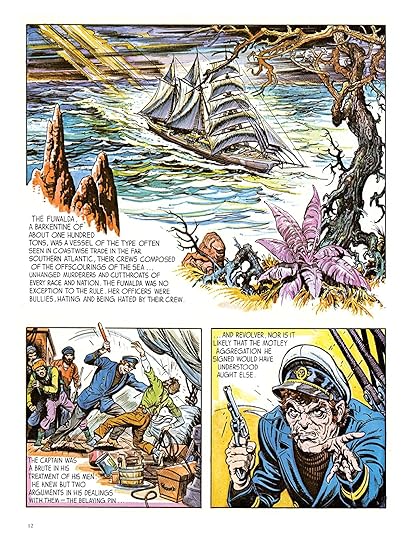
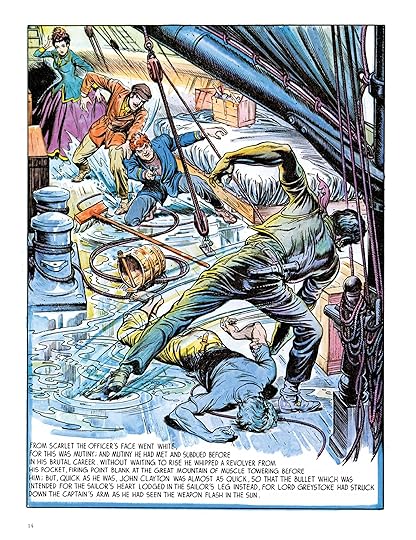
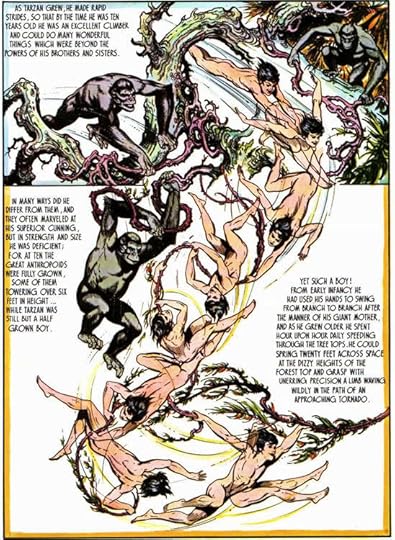
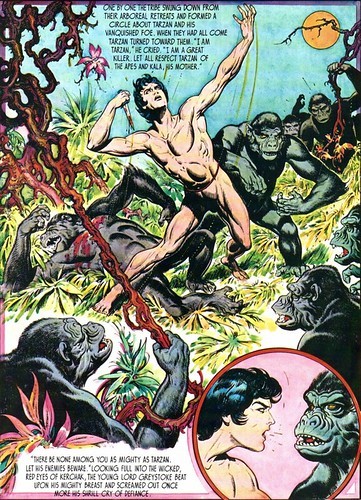
Using actual text from Edgar Rice Burroughs, Hogarth illustrates the origin of Tarzan of the Apes. Unlike some early illustrations of the ape-man, his renderings are dynamic, capturing the story mid-action. His jungle scenes are eerie, with twisted trees and draping vines.
Burne Hogarth was once a marvelous illustrator but a lousy storyteller. That fact makes it difficult to evaluate this graphic novel based on roughly the first half of Edgar Rice Burroughs’s first Tarzan novel. The book uses mostly Burroughs’s words for the text as edited by Robert M. Hodes.
Look at any page and you will see a Hogarth past his prime, but still able to deliver lush and vibrant illustrations. The problems begin with the fact that while the illustrations are striking, they do a poor job of making the story compelling. Hogarth often busies the panels with so much information, usually leaves and bushes or minor figures reacting to the action, with the result that the eye does not center on the figures that advance the story. Hogarth’s trademark pointed leaves and enveloping branches are not as important to the story as the central figures, but Hogarth sometimes draws them as if they are. Burroughs’s prose is already stodgy. This adds to the stodginess established by the visuals. The color pallet is pastels, not forest browns and greens, and the panels are so multi-colored that attention is drawn to the colorist’s work, not to the story and away from the illustrations. Attention goes everywhere but where it is really needed.
This book should have been celebrated as a great Tarzan artist returning to the character that made his reputation. Instead, it is just another forgettable graphic novel.
Listened to this on Librivox. I was expecting it to be different than the Disney movie, but wow!
- Kerchak killed Tarzan's father. No loving father bond with the apes there. Tarzan eventually kills him. - Kayla dies part way through the book - Jane is American? What? - Tarzan teaches himself to read - There's one of the WORST insta-loves ever! Seriously, Jane sees Tarzan roaring and killing a gorilla for her and falls head over heels for Tarzan. Because seeing a half-naked forest guy kill a gorilla is a great basis for starting a relationship. - Tarzan drives a car through Wisconsin. WHAT????
Beyond some evolutionary stuff, racism, and stuff like that, this book still is a fun adventure, if a bit campy. It wasn't meant to be anything other than fun entertainment, and it still succeeds there.
Rating 3-1/2. Chosen by my Classics Book Club for July, 2010. A fun re-read for me. We had a good discussion about nature v. nurture and the genius ability to read and understand complex ideas. We had an unusually big group for the discussion. The book was a hoot and several people said they want to read the next in line.
Often considered the "Michaelangelo" of comics, Burne Hogarth was the definitive artist for Tarzan. This graphic novel was made years after he had stopped doing the newspaper strip, and it contains all of the standard stylistic quirks of Hogarth. The artwork tends to be even more "dynamically twisted" than his earlier work. A must for the Tarzan or Hogarth fan.
El talento narrativo y elegancia plástica de Hogarth adaptan el clásico relato de Edgar Rice Burroughs en una estupenda novela gráfica, logrando de paso una de las mejores interpretaciones del Hombre-Mono.