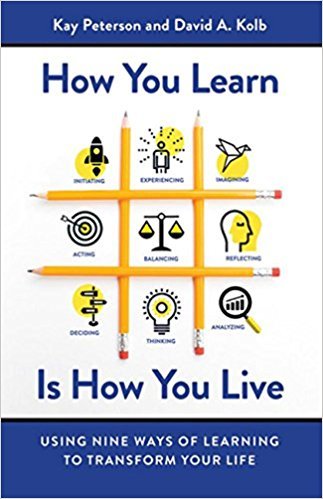
I found this book at ITBA’s university library. First I discovered Kelb’s Learning Style Inventory 3.1 booklet that called my attention and after reading it I saw this book next to it and gave it a try to go deeper into this author’s approach.
Having read about personality types, different profiles, many learning theories and taking several tests (Benziger, Myer-Briggs, etc.) it didn’t sound novel to me. Many times there are the same ideas but each author adds their own subtle twists and gives different names to the same concepts to make them their own. Having said that, I still found a couple of ideas, actionable points or concepts that made it worth reading.
I did a speed reading in one hour focusing just on the parts that were of interest for me and taking photos of the most interesting charts or sections to deep dive later. I thought it was going to be more academic but it has a general reader approach without introducing technicalities or complex concepts. He even quotes well-known authors at the beginning of each chapter and is written in an easy-to-read language. I like that he doesn’t hide the origin of some concepts (I don’t know if Daniel Goleman was that generous with Howard Gardner when he created Emotional Intelligence relying heavily on Gardner's multiple intelligences theory). In the Introduction he already mentions his predecessors on experiential learning like John Dewey, William James, Carl Rogers and Jean Piaget. His theory is now forty years old. The booklet I read before (the KLSI 3.1 version) is outdated because he later launched the fourth version that is used in this book that introduces some changes (and I saw on his website that now he moved from KLSI to KELP so his theory keep developing -or changing names at least-).
The KLSI 4.0 learning styles are nine: experiencing, imagining, reflecting, analyzing, thinking, deciding, acting, initiating and balancing. For each of them he provides tips on how to lead, how to start learning new learning styles among other recommendations. Unlike this former 3.1 approach here he takes off from the fixed mindset of predefined personality types (thanks Carol Dweck for your contribution!) and joins in the new wave of growth mindset.
In summary, if you have read some book on this subject probably you can skip this one without missing much. But if you like reading all you can about it or want to learn another way of knowing better your team, your boss, your family and yourself this could be another good tool. Have fun!
A couple of quotes:
“A human being should be able to change a diaper, plan an invasion, butcher a hog, conn a ship, design a building, write a sonnet, balance accounts, build a wall, set a bone, comfort the dying, take orders, give orders, cooperate, act alone, pitch manure, solve equations, analyze a new problem, program a computer, cook a tasty meal, fight efficiently, die gallantly. Specialization is for insects.” (Robert Heinlein)
“Happiness, not in another place but this place… not for another hour, but this hour.” (Walt Whitman).
“A great many people think they are thinking when they are merely rearranging their prejudices.” (William James)