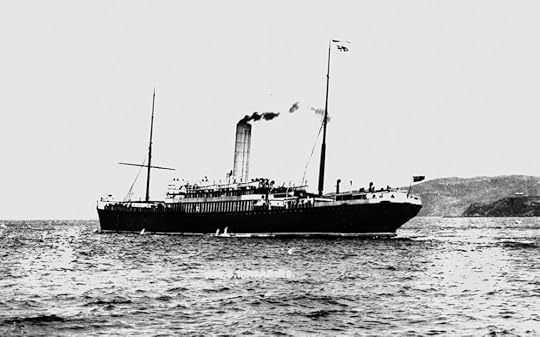
With ‘Twixt Land and Sea, Conrad’s works signify a moving away from the more political novels that provided many of his best works. As Conrad himself says, the three stories here are not connected in any way, and differ greatly in tone and content.
The first story has a distinctly ironic accent to it. In ‘A Smile of Fortune’, a young captain lands his ship at a tropical island called Pearl. He is greeted by a trader called Jacobus, which he regards as a stroke of luck as his employers had asked him to cultivate Jacobus’ favour. In fact it turns out to be the brother of Jacobus, and he is on bad terms with the correct Jacobus, and regarded as somewhat disreputable by the islanders.
The captain however is drawn to the brother and repelled by the actual Jacobus whom he witnesses beating a mulatto servant. As a result the captain visits the brother’s home and becomes infatuated with Jacobus’ sulky daughter. After obtaining some kind of reciprocation, he loses interest, but this is witnessed by Jacobus, and the captain is obliged to buy a large consignment of potatoes that he does not want. By another stroke of luck, the captain arrives on another island where there is a famine and he is able to sell the potatoes, but the thought of returning to Pearl fills him with disgust and he resigns his command.
The story presents issues in a cynical way, but there is a lack of clarity about its intentions. Some of the issues left unresolved are as follows. Should we share the captain’s hostile view of the respectable Jacobus, or should we disregard his seeming ill-treatment of a possibly bad mulatto servant (Conrad’s attitude towards ethnic minorities was notoriously bad, so it is possible that he believes this)? Should we feel sorry for the disreputable Jacobus, or should we regard him as a shady man who is cynically using the captain for blackmail purposes?
Also what of the relationship between the captain and Alice, Jacobus’ daughter? Is she a sulky and insipid person, or a victim, brought up outside respectable society through no fault of her own? Is the captain an innocent gull, or should we despise him for trifling with her feelings?
There is of course no reason why a story has to present the reader with clear unambiguous characters and motives, but the lack of clarity is here a drawback since it leaves the purpose of the story uncertain. Ultimately I think the reader will probably decide that both Jacobus brothers are bad (the resemblance to the word ‘succubus’ is possibly intentional), that the captain has behaved badly, and that Alice is a pitiable figure.
While the story is uncertain in meaning, it is told in very clear prose and is very readable. There is a very moving scene at a child’s funeral that is irrelevant to the story, but which adds some depth to it. The tale is readable, but not Conrad’s best work.
Just as there are two seemingly different but really similar brothers in ‘A Smile of Fortune’, so there are two seemingly different but really similar characters in ‘The Secret Sharer’. I have already reviewed this story recently in Typhoon and Other Tales, and do not wish to review it again. However in the interests of completeness, I shall copy my earlier comments about it.
‘The Secret Sharer’ is one of those tales that seems to tease us with an extra meaning that we cannot quite pin down. The narrator is once more a young man on his first voyage as Captain of a ship. While alone on the deck, he is startled by a young man climbing aboard. The man is an officer from a neighbouring ship who murdered one of his crew members, and is now a fugitive.
The fugitive (Leggatt) feels that he was justified, because the victim was a bully who refused to obey an order at a time when the ship was in peril from a storm. The narrator conceals Leggatt in his cabin because he feels a strange affinity with the murderer. The two men look alike and they both went to Conway, a training ship. Eventually the Captain agrees to take his ship close to an island at great risk to the safety of his ship and crew so that Leggatt can safely swim ashore.
‘The Secret Sharer’ cries out for psychological interpretations, especially those of a Freudian nature. The two men look similar, suggesting a dual identity. Even the cabin in which Leggatt is concealed is in an ‘L’ shape, reflecting both his name and a letter that comprises two identical sticks, one fallen over. The title too hints at this. Leggatt is a sharer of more than just the secret of his concealment in the cabinet. He shares a resemblance to the Captain.
There are some characteristically Conradian ideas about the weakness and fallibility of humans. Had circumstances been different, the story suggests, then Leggatt and the Captain’s places might have been interchangeable. However, it is a mistake to see Leggatt as an imaginary or psychological projection of the Captain’s personality. The story is a concrete tale, and Leggatt’s existence is confirmed by others. We should also avoid seeing the story as a Jekyll and Hyde variation, as both men are morally ambiguous.
In fact, this gets more to the heart of the narrative. Insofar as it is about psychological issues, it is more about the moral choices made by Leggatt and the Captain. On the surface, it might seem that Leggatt is the darker character, but this position is far more blurred. Leggatt kills a man to saves his ship from disaster. The Captain endangers his ship to save a known murderer. Right and wrong are uncertain. Was the Captain in the right to risk all to protect Leggatt, and was Leggatt justified in his murder?
There is also the question about the Captain’s motives in protecting Leggatt. These are never explained to the reader, but seem to lie in the strange resemblance between the two men. The Captain is almost protecting himself, or an alternative version of what he might have been. This lends itself to other interpretations.
Some see a form of elitism in the actions of the Captain. He and Leggatt were trained in the same place, and both men are intelligent and well-educated. They are more compatible with one another than they are with their stupid crew members. This creates a freemasonry between the two men. Another reading of the story is to see a homosexual connection between them, and some of the language the Captain uses might suggest an attraction between them.
While ‘The Secret Sharer’ may not bear out all the psychological interpretations placed on it, the story is a fascinating one that appeals to the dark recesses of the imagination, and its ambiguity leaves the reader guessing.
If the first two stories are teasingly ambiguous, ‘Freya of the Seven Isles’ is entirely straightforward. It concerns a romance between Freya, living with her father in a remote area, mature, passionate, and addicted to playing the piano – and Jasper Allen, a young man who proudly runs a ship called the Bonito, which both he and Freya set much stamp on. The serpent in their Garden of Eden is a Dutch naval officer called Heemskirk. Heemskirk is in love with Freya and uses his influence as a Dutch officer to terrify her timid father.
When Heemskirk realises that Freya will not return his affections, he avenges himself on the couple by hauling in Allen’s ship on accusations of gunrunning and then casting it adrift on the reef. Deprived of his ship, Allen sinks into decline and Freya too despairs and eventually dies.
Conrad was criticised for writing a harrowing story, and it is certainly that. However, Freya and Allen are far too romanticised to be ever imagined having a serious, long-lasting romance. We cannot imagine them living in domestic bliss together, so a passionate unhappy fate is the inevitable one when they come into contact with the real world. Heemskirk too is a romantic villain, utterly without a redeeming trait, and existing only to provide a tragic resolution for the story.
‘Freya of the Seven Isles’ does not have much substance or depth to it. It is a romantic tale, and not much more. The writing does have a certain poetic power to it however, and Freya is one of the most appealing Conrad heroines, strong and mature where the male characters are not. It may seem absurd that the two lovers fall apart over the loss of a ship – indeed it is. However, this is not a tale of social realism. It is purely a romance.
The stories here do not have much in common. They are united by the sea, and being in the same part of the world. They also present a world in which justice is absent. The fate of the characters depends on chance, and their own ability to establish their own sense of justice.
The book is not one of Conrad’s greatest works, although it is elevated by the inclusion of ‘The Secret Sharer’, one of his best short stories. However, they are certainly readable and interesting, and the book is well worth a look.