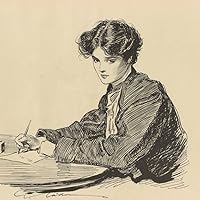
Margaret Sidney was the pseudonym of Harriett Mulford Stone (1844-1924). She was an American author, born in New Haven, Connecticut. In 1878, at the age of 34, she began sending short stories to Wide Awake, a children's magazine in Boston. Two of her stories, Polly Pepper's Chicken Pie and Phronsie Pepper's New Shoes, proved to be very popular with readers. The success of Harriett's short stories prompted her to write the nowfamous Five Little Peppers series. This series was first published in 1881, the year that Stone married Daniel Lothrop. Daniel had founded the D. Lothrop Company of Boston, who published Harriett's books under her pseudonym, Margaret Sidney. Harriett eventually wrote over 30 books; in addition to the Five Little Peppers series she wrote a number of books on patriotic themes, including A Little Maid of Concord Town (1898) and A Little Maid of Boston (1910).
Margaret Sidney was the pen name of American author and publisher Harriett Lothrop, best known for creating the enduring Five Little Peppers series, one of the most popular works of American children's literature of the late 19th century. Raised in a cultured and literary household in New Haven, she developed an early passion for storytelling and imaginative writing, though she did not publish until her mid-thirties. Her breakthrough came with short stories for the magazine Wide Awake, whose enthusiastic reception led to the publication of Five Little Peppers in 1881 and a long-running series that followed the Pepper family through numerous sequels. Writing under the name Margaret Sidney, she became widely read by generations of young audiences. After the death of her husband, publisher Daniel Lothrop, she successfully managed his publishing firm while raising their daughter, later returning to writing and continuing the Pepper books. Beyond literature, she played a significant role in American cultural life, helping to establish Concord, Massachusetts, as a literary center and working to preserve historic homes. She was also the founder of the Children of the American Revolution, reflecting her strong interest in history, education, and civic values.
Review of the Kindle Edition of this nineteenth-century children's classic
This is Book 3 (in terms of events, not when the author wrote it) in the Five Little Peppers series of nineteenth century children's books. (I've provided a complete list of the Pepper books below.)
I was delighted to discover I could instantly download to my Kindle what I presume is the Project Gutenberg free version of this nineteenth century children's classic. The formatting is what I'm coming to see as typical of these free versions. Though there are few typos, there are frequent missing tabs and/or hard returns to set off paragraphs from each other, which makes readability a bit difficult.
This book continues the adventures of the Pepper family of five children and their widowed mother, whom they call "Mamsie," and the millionaire, "old Mr. King," and his son Jasper King. Mrs. Pepper is Mr. King's housekeeper, but the Pepper children all call him Grandpapa, since he has informally adopted the Pepper children. Most especially Phronsie, whom he absolutely adores and endlessly showers with dolls.
The events of this book occur immediately after the end of Book 2. In this book, Mrs. Pepper is now married to kind Dr. Fisher of Book 1, who saved Polly's eyes when she got the measles. Mr. King decides to take Dr. and Mrs. Fisher, Polly, Phronsie, Jasper and Reverend and Mrs. Henderson (who were neighbors and friends of the Peppers in Book 1) on a tour of Europe.
The story is written in omniscient point of view, as are the other two books, so we get to experience the thoughts of many different characters, but Polly remains the key character in this book as in the others. Once again, everyone who meets her adores Polly for her bright smiles and kind nature--which we are, as always, made to understand that she owes to the influence of her down-to-earth, compassionate, hard-working mother.
Though the story reads like an historical novel to modern readers, it was actually a contemporary novel when it was written in 1902. There are horse-drawn carriages instead of cars, gaslight instead of electric lamps, no running water, no refrigeration, no central heating, and the traveling party gets to Europe on a "steamer," presumably an ocean liner run with a steam engine.
As the title of the book states, there are five siblings:
Polly (Mary) is 14, and midway through the book she turns 15.
Ben (Ebenezer) is now presumably 16, or nearly so, because he is a year older than Polly. Ben is one of my favorite characters, and I'm sorry to say that other than at the very beginning of the book, we don't see much of him in this book since he he has a job he doesn't want to leave to go to Europe.
Joel is now presumably 12 or 13, because he is two years younger than Polly. He, too, is not onstage except at the beginning of this book because he is left behind to go to boarding school.
Davie (David) is now presumably 10 or 11 years old, because he is two years younger than Joel. He, too, is left behind to go to school.
Phronsie (Sophronia) was four at the time of Book 1, but is listed as being only eight in this book as she was in Book 2, even though Book 2 says five years have passed since Book 1. She continues in the roll of the adored baby of the family. She is so beautiful, strangers stop on the street to stare at her, but she continues to have an angelic disposition to go with her celestial beauty.
Jappy (Jasper) King is now 17, since he is two years older than Polly, and he is not in school nor, unlike Ben, going to any kind of job. In this book Mr. King's source of wealth still isn't mentioned, but it is clear by his actions and lofty attitude that he comes from "old money." (It is not until Book 4, Five Little Peppers Grown Up, that we learn for a fact that Mr. King has never worked a day in his life and believes, much like European aristocrats and nobility of that era, that soiling his hands with "trade" would be beneath him.)
A lot of this story reads like a fascinating travelogue of what it was like to take the Grand Tour of Europe at the end of the nineteenth century. However, there are plenty of fun adventures caused by the Pepper girls' taking under their wing many troubled fellow travelers. These include a sick old man who turns out to be an earl who is on their ocean liner incognito; the earl's incorrigible, teenage grandson; an artistic orphan girl age fourteen, and an impoverished father of starving children who mugs Mr. King and Phronsie in a Parisian park.
In this book as in the previous two, Mr. King's age is still never given, and he is constantly referred to by the author as "old Mr. King," but he's mighty spry. He loves having Phronsie sit on his lap (indeed, in the later books, she continues to sit on his lap even when she is an adult, which you would think would be very hard on an old man's body to bear that kind of weight).
Margaret Sidney was the pseudonym of successful, American children's author, Harriett Mulford Stone Lothrop, who was born in New Haven, Connecticut in 1844 and died in 1924, eight years after writing the last Pepper book. She began her writing career in 1878 at age 34 by publishing stories about Polly and Phronsie Pepper in a Boston children's magazine. She married the magazine's editor, Daniel Lothrop, who began a publishing company and published Harriett's "Five Little Peppers" series, starting in 1881. Here is a list of the 12 Pepper books by date written, which were produced over the course of 35 years:
Five Little Peppers and How They Grew (1881) Five Little Peppers Midway (1890) Five Little Peppers Grown Up (1892) Five Little Peppers: Phronsie Pepper (1897) Five Little Peppers: The Stories Polly Pepper Told (1899) Five Little Peppers: The Adventures of Joel Pepper (1900) Five Little Peppers Abroad (1902) Five Little Peppers At School (1903) Five Little Peppers and Their Friends (1904) Five Little Peppers: Ben Pepper (1905) Five Little Peppers in the Little Brown House (1907) Five Little Peppers: Our Davie Pepper (1916)
Margaret Sidney originally had no plans to write more Pepper books after the fourth book, "Phronsie Pepper", was published in 1897, which she states in her introduction to that book. However, over time the pleas of avid fans from all over the world caused her to give in and write eight more Pepper books. The events in the last eight books take place before the events of the third book in the original series of four books. If you would like to read the six main Pepper books in chronological order, rather than by publication date, this is the ideal sequence:
"Five Little Peppers and How They Grew" "Five Little Peppers Midway" "Five Little Peppers Abroad" "Five Little Peppers and Their Friends" "Five Little Peppers Grown Up" "Five Little Peppers: Phronsie Pepper"
If you read all the Pepper books, you will discover that the author did not take great care as to continuity in the later books, perhaps because so many years passed between writing these books. The Pepper books are products of a much slower-paced era, and it is relaxing to experience that approach to children's fiction while being warmly enfolded into the loving Pepper family.
This book, and all the Pepper books, are strictly G-rated, and the values they show (not tell through preaching) are very useful ones for any child to be exposed to, including civility, kindness, gratitude, consideration, keeping commitments, accepting difficult circumstances without complaint and forging through them with good cheer.
Please see my review for Midway as it applies to this title too.
I am just not finding Sidney’s take on the children when they’re older to be realistic or likable - an eight year old Phronsie is stilled being babied and Polly, now fifteen, seems more childish then she did in the first book at age twelve.
For this reason, I’ll give Five Little Peppers in the Little Brown House a try (as the children are the age in the first book) before completely stopping with this series (even though I own copies of four other titles).
Cleanliness: nothing to note.
**Like my reviews? Then you should follow me! Because I have hundreds more just like this one. With each review, I provide a Cleanliness Report, mentioning any objectionable content I come across so that parents and/or conscientious readers (like me) can determine beforehand whether they want to read a book or not. Content surprises are super annoying, especially when you’re 100+ pages in, so here’s my attempt to help you avoid that!
So Follow or Friend me here on GoodReads! And be sure to check out my bio page to learn a little about me and the Picture Book/Chapter Book Calendars I sell on Etsy!
Seeing Europe through the eyes of Polly and Phronsie was fun, but the constant buying of things over relishing the places got in the way of the story quite a bit. Sometimes Polly can be a bit whiny, and Phronsie a bit too weepy. The addition of the Selwyns to the story was wholesome.
Oh my, how I loved this books as a child. They were very dear to me and are firmly entrenched into my memory strong enough to have become parts of my character. There are is a veritable plethora of life examples and lessons to be learned through these works of literature that take us back to a simpler time and place, entirely different family values and senses or morality and ethics; there is much to be learned from these simple books. Most of all, family and love, loyalty and a moral compass much needed in today's society, camaraderie and ...well, the list is entirely too long. I think the books are relevant to the youth of today, if nothing else to provide an example that though some things change with time, a great many others do not.
In the back matter of this book there's an ad for another Sidney title, promised to be good reading "for all who love simplicity, truth, and cheerfulness."* This has all that in spades but also has this overly hearty, knowing tone, as if all readers could be expected to have gone to Switzerland and to know the old college songs. A breathless quality. Too many jollies, especially when the jollies become reactionary.
Again, more of the same (see my revew of the first book). A couple new characters got introduced, but like the main characters, they were two-dimensional at best. Still good for people who like this sort of thing (which does include me, but I don't see myself rereading these books; once was enough).
Polly occasionally reminded me of Mandie; unfortunately, she did so by emulating some of Mandie's most annoying traits.
This isn't nearly as good as the original, but I guess sequels almost never are. Good old Mr. King takes Polly, Phronsie and Mamsie to Europe and the book details their goodness and their exploits in the "old country." Now that they have money, their problems aren't as absorbing.
Two scenes are repeated ad nauseam throughout this novel.
1) Polly: Oh my goodness, I'm just so excited about going to [name of place that was probably a popular spot on Victorian-era tours of Europe]!
Jasper: Me too!
Everyone else: We agree!
*Everyone goes to the place and takes photos and paints pictures without commenting, most of the time, on what is being seen*
I understand this. A book talking about a visit to the Statue of Liberty doesn't require a detailed description. I assume that the undescribed places in Sidney's work were similarly familiar to her audience. But most of them are not familiar to me. It would have been nice to know what the Peppers and Kings were so excited about. And about 85% of the time, there was no clue.
2) Jasper: Let's go do something artistic and/or athletic that we both love!
Polly: Oh, Jasper, I can't do that, because Mamsie will be upset if I 1) don't do something Phronsie wants to do, 2) don't martyr myself by doing something boring for someone I don't care about or 3) make Mr. King sick by not complying with plans that he might have, even though he's perfectly healthy and I could ask him about his plans.
Jasper: Okay, we won't do that.
Polly: No, no! I can't disappoint you! Mamsie would be horribly cross with me if I did that! *bursts into tears*
Reader: *facepalms after reading this for the billionth time*
2a) The Phronsie Variant:
Mr. King: Come along, Phronsie. Let's visit the tourist attraction you've been excited about for three days.
Phronsie: Oh, grandpapa, we can't do that, because I'm worried about a doll, a donkey, or a man who stole your wallet recently. Also, for some reason I am still talking as if I'm younger than my age, only now I'm supposed to be eight instead of nine and the author thinks that I was three when we moved in with you, not four.
Mr. King: Never mind, I think an eight-or-nine-year-old acting as if she's three is adorable. Don't worry about the doll, the donkey or the man. There! Problem solved. Shall we go?
Phronsie: Oh, no, grandpapa, as I'm certain that they need help that only you can provide, and I really, really need to know that they're all right. *puppy eyes*
Mr. King: ...you're going to keep guilting me out until I agree, aren't you?
Phronsie: The author seems to feel that as an innocent child, I'm a Christ figure leading others to greater goodness. And it's already been established that I only have to climb in your lap for you to agree to anything I ask for.
Mr. King: I might as well give in now as later. Let's go do what you wish, Phronsie.
If the Phronsie Variant is somewhat creepy in your eyes, it is to me, too. There's a difference between loving a child and being hopelessly besotted. I honestly wouldn't be surprised if Mr. King married Phronsie in a later work.
In addition to Phronsie's age having altered yet again, Polly starts this book at age fourteen and has her fifteenth birthday in the Netherlands...which makes absolute hash of her age in previous books. It's not important, but it is annoying. *sighs*
Other things happen besides enthusiasm for vagueness, Polly being guilty and passive-aggressive, and Phronsie being an obnoxiously good brat. Impoverished little old men on steamships are actually earls incognito whom they care for during an illness and who befriends them afterwards. Polly's piano playing is so good that the greatest music teacher in Europe (who doesn't know who she is) is eager to listen to it. A hotel that they're in catches fire. And so on. But there's no cohesive plot. It is just a series of events. Most of them aren't even unfortunate.
As I said last time, "If the books don't improve, I'm going to stop reading them." Well, they haven't improved, and I really don't feel any need to continue reading the series. Nor could I recommend it to anyone. This is just treacle from beginning to end.
The Peppers (and their ridiculously large group of friends and family) go on a European vacation. They meet an earl, the earl's son, a clingy young artist, and a "big fat man with [a] dreadful black beard", who is soon vindicated despite the family's initial unfavorable description of him. Phronsie--who must be at least eight by this time--retains the innocence and demeanor of a four-year-old, likely due to the fact that Mr. King is still spoiling her relentlessly. Friends fight over Polly, Jasper is the best friend and doesn't fight over Polly--maybe because he knows what it's like from being fought over by his nephews, and aforementioned nephews and Joel and Davie are stuck at boarding school, which is a crying shame. Ben isn't here either, so there are only two Peppers. And the title is misleading. There's so much more I could say about this appendage to the classic book, but I don't want to. I want to read the next one (in chronological, not published order). Five Little Peppers Abroad is free on the internet or as a Kindle book anyway, if you feel like giving it a go.
I am reading these according to their number, but really this one should have been read before Five Little Peppers Grown Up. Oh well, it was still a good one.
I do feel like these have mostly aged well, other than the treatment/descriptions of servants and unfortunately of black people as well in a previous book and the manipulations used in all of them to get Phronsie and others to stop crying ("Look, Grandpa will get sick if you don't stop crying" and such statements). But overall I've been enjoying the series!
The endless perfection of the Pepper children is becoming a little wearing. Books aren't all that interesting when there are no challenges to be overcome or changes to be made, even if the characters are traveling around Europe.
It's so refreshing to see moral character valued. I so enjoy a job that centers on the moral of the story. Every child should read, or be read, books from this time period. The world would be a better place.
Very old-fashioned but wonderful to dip into as a way to experience what a Grand Tour of Europe must have been like a century and a half ago. (Staying for over a year!). An old childhood favorite, probably not best first encountered as an adult.
In the 1980s, my grandma took me to a consignment store and bought this book for me, and I still own it. I don't remember anything about the story, but every time I see it on my shelf I think of my grandma and our adventures in thrift shopping. <3
My pet peeves about travelogues from this time period (Betsy and the Great World, Little Dorrit, Middlemarch, Trollope's Pallisers Series, Daniel Deronda, and even bits of Little Women) is that the stories are rarely about Europe. They're all about the people they meet(often from their own country), the travel issues, the problems back home. This is mimicked in The Grand Tour. Which, as you think about it, makes sense. "A Grand Tour" was something everyone did, a rite of passage for many youthful men and women(and their chaperones or new husbands).
But, not having gone to Europe, I'm more interested in what they saw. However, what actually happens, is probably worth a paper somewhere. Whenever I have the time/desire.
Mr. King and Jasper escort Polly, Phronsie, their parents and friends on a grand tour of Europe before depositing Polly for a fall of music training. Their natural friendliness endears them to an earl and his son, traveling incognito, and Polly reforms the young man simply by existing. What wonderful powers. At the same time, they shake off the more socially-conscious matrons - though their daughters adore Polly and would be better people if only their mothers would allow it, just to please Polly. Good bedtime reading - you can fall asleep and it really doesn't matter, plus nothing scary to disturb your dreams.
Such a delightful, fun, classic read. I have enjoyed reading about the Peppers and I am excited to watch and observe their journey as they grow up. Phronsie is a darling as ever and you can't help but fall in love with her sweet ways. Polly is in the stages of adolescence where a girl wants longs for friends and where those friends might easily sway her, but Mrs. Pepper and Papa Doctor Fisher always keep her in check. Jasper can always be depended on, and Mr. King is quite funny in his old, grumpy way. As this book is a lot about their tour to Europe, I sure wish I could take a similar tour as well. Maybe someday.
Kathryn and i enjoyed this story of the Peppers' European travels, esp of Holland, but we did miss stories of Joel and Davy as they stayed home at school.
I enjoyed this one a bit more than the last two as it was more of a sustained narrative rather than stories to fill in holes. Definitely made me want to travel around Europe!