Offered a large sum of money to appear in tourneys, Sir Godfrey Tallboys departs for Spain with his knights, but the Moors defeat them, and he is enslaved.
Norah Ethel Robinson Lofts Jorisch (27 August 1904–10 September 1983) was a 20th century best-selling British author. She wrote over fifty books specialising in historical fiction, but she also wrote non-fiction and short stories. Many of her novels, including her Suffolk Trilogy, follow the history of a specific house and the residents that lived in it.
Lofts was born in Shipdham, Norfolk in England. She also published using the pseudonyms Juliet Astley and Peter Curtis. Norah Lofts chose to release her murder-mystery novels under the pen name Peter Curtis because she did not want the readers of her historic fiction to pick up a murder-mystery novel and expect classic Norah Lofts historical fiction. However, the murders still show characteristic Norah Lofts elements. Most of her historical novels fall into two general categories: biographical novels about queens, among them Anne Boleyn, Isabella of Castile, and Catherine of Aragon; and novels set in East Anglia centered around the fictitious town of Baildon (patterned largely on Bury St. Edmunds). Her creation of this fictitious area of England is reminiscent of Thomas Hardy's creation of "Wessex"; and her use of recurring characters such that the protagonist of one novel appears as a secondary character in others is even more reminiscent of William Faulkner's work set in "Yoknapatawpha County," Mississippi. Norah Lofts' work set in East Anglia in the 1930s and 1940s shows great concern with the very poor in society and their inability to change their conditions. Her approach suggests an interest in the social reformism that became a feature of British post-war society.
Several of her novels were turned into films. Jassy was filmed as Jassy (1947) starring Margaret Lockwood and Dennis Price. You're Best Alone was filmed as Guilt is My Shadow (1950). The Devil's Own (also known as The Little Wax Doll and Catch As Catch Can) was filmed as The Witches (1966). The film 7 Women was directed by John Ford and based on the story Chinese Finale by Norah Lofts.
This is quite unlike some of her other "house" books, as it is #1 in a trilogy that follows this family as much as the dwelling built at the beginning of this book. #2 and #3 I will read in sequence. These I read decades ago, but they are worth the reread.
This is not the usual characteristic Lofts deep characterizations either, IMHO. NOT that the main protagonists are shallow or flat, but that their actions do surmount the word copy of their core wishes, desires, personality, etc. In fact, in this book so much happens and at such a wide scale that it is rather an "epic" read.
Sir Godrey Tallboys and his wife Lady Sybilla, this is their incredible saga. He is a Knight in the last years of that cultural surrounding and institution. Much is in flux and the times of the Civil disputes (War of the Roses) is imminent.
If I tell you any more about the plot, it would be spoilers.
Suffice it to understand this. This particular Lofts reflects OUR era in myriad of history repeating itself. Sir Godrey is within the Spanish fight with Islam. And the culture clash of nearly a decade's length is a large part of the story. There is as much in Moorish surroundings here than is centered in England at Knight's Acre.
We have an intense and dramatic beginning here. And plague is also raging.
Cannot wait to get #2 The Homecoming. #3 is Lonely Furrow.
This is Norah Lofts at her best for the periods before the Tudors. Serfdom in England is breaking up, as Knight's Acre is being built on land across the stream from 10 freeholdings started by individuals given "leave" to depart from their Lord's dominion. And given scarce in size but trivial and unwanted land near Layer Woods to clear.
The particulars of providing foodstuffs, spices, clothing, animal husbandry, and many other cloth or leather by-products from this period are exceptionally well done in this book. The usual excellent Norah Lofts reality of the mid-15th century.
Sir Godfrey Tallboys, in 1451, not the brightest bulb in the box, was conned into traveling to Spain to be in a tournament for Juan Enrique de Mendez, Count of Escalona, which, of course is a minor war. His wife, Lady Sybilla, awaited him at home in the house he had just built for her, Knight's Acre, with, among other people, Walter, who helps her furnish it. (Just why did he have to die again?) Sir Tallboys loses, is imprisoned and endures terrible things. But he befriends a fiery girl from an unnamed, far-away country, Tana, 16, who cleverly works to help them both escape. The book has an odd ending, to me, but perhaps still within the characters personalities and the time.
This a is VERY well-written novel, with enough people and places to give a modern editor headaches. I liked it when Father Ambrose, with writer foresight or character absentmindedness asks about Sir Godfrey's return, was told (yet again!) that he had died in Spain, and declared "I am sorry, I will say a mass for his soul"! . . . the crooked priest . . . the gardens of Knight's Acre and of Juan of Escalona . . . the ship that sank . . . Acrol, but maybe his get did live on . . .
First in Lofts' trilogy about generations of families in an English manor house. It begins in the year 1451, with a stirring story about romantic love, war and separation, the plague, and mundane difficulties of life in the Middle Ages. (This book is followed by The Homecoming and The Lonely Furrow.)
Norah Lofts was an extremely popular writer of historical fiction where I grew up in England. I remember picking up this book up from my mother’s coffee table when I was bored one Sunday fully expecting to toss it aside within the hour, only to become engrossed in the tale.
Knight’s Acre (the first of a trilogy) tells the story of Godfrey Tallboys and Lady Sybilla who set out to build a manor home. Godfrey is a man of many qualities, including his martial prowess, loyalty, and honesty, but he is also gullible and recklessly naïve. Soon after moving into their new home, Godfrey is hoodwinked into fighting in a disastrous foreign war that ends with him being imprisoned, leaving Sybilla to fend for herself and her children as best she can.
Some of the difficulties Sybilla faces are quite mundane—planting a garden, growing a crop, furnishing the house, figuring out where everyone should sleep, and choosing what cakes to serve distinguished guests. But she must also fend off unwanted advances from suitors who presume her husband to be dead, and protect her family from brigands wandering the countryside, all whilst Godfrey seeks to engineer his escape and make his way back home.
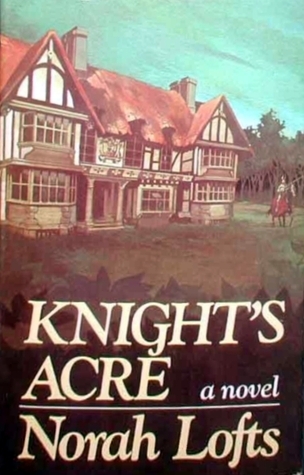
From the cover, I expected the book to be a bit of a saccharine romance, but it wasn’t at all. There was romance, sure, but it was not the heart of the story. The author’s world is not a world full of swooning damsels. Rather, it is a very real world, as befits her almost scholarly attention to historic detail. It is harsh, unfair, and at times brutal. You cannot presume a happy ending with Lofts. And for any happy ending that comes, there may be a heavy price to pay.
Norah Lofts seems to be a somewhat forgotten writer, given the quality of her work, and how prolific and popular she once was. She deserves more attention.
I have enjoyed other books by this author (notably Gad’s Hall), but for some reason this one novel has stuck with me.
I first read this book back in the 1980's and I loved it. Having read several thriller type novels recently, I fancied a change and Nora Lofts name popped into my head. The Knights Acre follows the fortunes of Sir Godfrey Tallboy, his wife Lady Sybilla and their young family. The book brilliantly recounts the lives of people of this era and feels very authentic and well researched. We track Godfrey's need to earn money competing at 'tourneys', where skilled Knights compete against one another for money. His adventures lead him abroad and into extreme danger, while Lady Sybilla is left to raise their family and take care of the first house she has ever owned. I loved this book all over again. The characters are engaging and the story exciting . I am ow reading the next book in the series The Homecoming. I can highly recommend .
I discovered Norah Lofts as a teenager, and thus was born my lifelong interest in historical fiction. She brought people to life for me, and this book is no exception. After re-reading this one, which I found at a book sale, I want to find the sequels because I didn't read them one after the other back then. Her characters are believable, and her descriptions of their personalities are detailed and realistic. She brings home the realization that people in the past all worked really hard, and even those who lived in castles didn't have the comforts we take for granted. Travel was harder, too, but somehow people like Sir Godfrey were able to make it to Spain and even farther, but it was a brutal life, especially for the military and for the poor at home.
An easy book to read, still contemporary with themes not out of place in a modern TV boxset. Not necessarily historical there is enough language to set the scene. Characters and events race by on the pages to make this a bit of a page turner.
The first two books in this series were among the books I inherited from my Aunt Mary. When I began to evaluate the books and put them in some order I realized that they were the first two in a trilogy, so I went to ThriftBooks and purchased the third to complete the set before I started reading. That was a mistake, as I later came to see. First, a few words about the trilogy as a whole. This is NOT a romance, as I thought it might be, but instead is a medieval family saga that follows one family through over 30 years and three generations. The dust covers were sadly missing from Aunt Mary’s books, but a google search shows that the original books had these house-focused covers, while the newest versions have a young woman on the cover of every book. It’s true that these stories are, in large part, focused on women and how they are affected by the decisions and choices of the men in their lives. They aren’t helpless victims, though. That’s probably the best thing about these books. The women are strong and independent, but in no way take from the masculinity of the men in their lives. I think Lofts was really more about the time and place than she was about the characters as such. These books were written in the 1970s and it probably shows. They’re told in a remote, almost blunt, and there are no chapter breaks or pauses in the action so you have this sense that things are just continually flowing along. It’s not an emotional story, no attempt is made to pull at heartstrings or even really pass judgment on behavior one way or another. It’s kind of odd, really, especially the rather blunt but non-graphic descriptions of violence as just routine. I'm sure that's historically accurate, but these days writers try hard to make you feel things, and that's just not at all what Lofts was doing.
So now to each specific story:
Knight's Acre (Suffolk #1) by Norah Lofts (2022 Book 86) Book 1 wasn’t bad, but it also wasn’t great. This is the story of Sir Godfrey Tallboys, a poor man but a Knight in the waning days of such men. He’s got a bit of an income, but it’s mostly from tournaments (I began to think of him as an aging Rodeo Cowboy). He’s really only in his 30s, though, but life is rough. He leaves his wife and four young children to go off to what he thinks is a tournament in a faraway land (somewhere in the Middle East), and is taken captive and enslaved for several years while his wife and children cope with life back home. He returns just at the end of the story. I was most interested in this story for two reasons: the tension of “will he make it back” and ”what will happen with all these different relationships when he does”. I also enjoyed the descriptions of medieval life and history, but that’s just backstory stuff, not enough to keep you going, IMHO…which brings me to book 2.
This book is a cherished friend...which I first read when I was 17. I'm a huge fan of Norah Lofts. Her beautifully written stories never get old no matter how many times I read them. And each time I encounter something new that I didn't see before; possibly because I am in a different stage in my life. They are old school stories, but I highly recommend novels by Norah Lofts.
Some of the story is a too unlikely for belief, even in a fiction novel, but in general I liked the book. The other two books in this trilogy are much better (not that this is bad by any means) and it's worth reading this book as a prologue to the last two.
Rereading my favorites from high school. I barely remembered most of this one, and it was a treat to read again. A classic Lofts with plague, crusades, class tensions, enclosure as a financial strategy,and unsatisfactory children. Perfect!