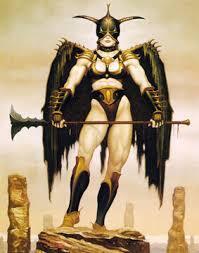
With a militia of nobles, templars, and slaves, Rikus, the man-dwarf gladiator who sparked the rebellion that plunged the Free City into chaos, must save the city from the armies of Urik, the sorceror-king
It took me less than a week to finish the first book in the series, reading only in my very limited free time while preparing for my qualifying exams and writing my dissertation proposal. This book, the second in the series, has taken over seven times that and I am still not finished with it. That should tell you all you need to know right there, but I'll expand on it a bit.
This book benefits from the general absence of the paper-thin character Sadira (who reads less like an actual literary character and more like an embarassing junior high fan-fic) and the Larry-Stu-esque Agis (who has his moments, but is overall too unbelievably altruistic and naive for this setting). However the book also suffers from a surfeit of Rikus (an excellent secondary character but far too simple in his desires and motivations to be a compelling protagonist) and a dearth of the cunning and amoral Tithian. The principal antagonist of this novel, Maetan of House Lubar, feels whiny and dull -- certainly no substitute for the first novel's brutal King Kalak.
As other reviewers have noted, the first book in the series covered enough material to fill an entire trilogy and was the weaker for its hurried pace; Denning seems to have reversed course with the second book, stretching what could have been two chapters of material into an entire novel. The reader is told that matters are urgent, told that things need to happen quickly, but there is no feeling of that urgency in the text itself. Even the battles feel sluggish. The issue of the traitor was tiresome and I spent no time trying to suss out his-or-her actual identity. Denning overall spent entirely too much time telling and entirely too time little showing.
There are interesting elements: the dwarven community's absolute stubbornness is fun, as is the dwarven necropolis; the introduction of the Thri-kreen character was much needed; the wraiths and Rikus's possession were neat. But it's just not enough to raise this book over the "mediocre" level -- I'm only sticking with it because i want to be read up for the next book, which i hope will be an improvement on both previous novels (even if it does apparently focus on Sadira).
On a personal note, i've always found Hamanu and Urik to be the most fascinating aspect of the Dark Sun setting -- Denning manages to turn them into boring, stock plot devices.
I don't think I was ready to read a series about such flawed heroes back in the early '90s, so it is with much greater satisfaction that I revisit this second book of the Pentad that chronicles the pigheadedness and blunders of Rikus the ex-Gladiator as the protagonist, but also his struggles to do the right thing and protect those he cares about when put in a series of impossible positions. In a genre oft criticised for having too many "Mary-Sue" Child of Destiny characters who seem to be granted an easy road or spared the consequences of bad decisions by eucatastrophes and 'plot armour' it's refreshing to experience a different approach to storytelling.
The formidable Neeva's love and loyalty for Rikus is tragically put to the test.
Though by no means a perfect book Denning does a great job building out more of the present and now past of the brutal world of Athas, shedding light on the uncomfortable themes of enslavement, human sacrifice to a tyrannical monster, and a dark history of conflict and genocide that left the world of Dark Sun so defiled and broken.
The world of Dark Sun, a TSR Dungeons and Dragons world, is a very magical and dangerous place. It’s fun to visit once in a while in fiction and immerse yourself in and Troy Denning does a good job of just that.
The book, The Crimson Legion, is the second novel in the 5 part “Prism Pentad” series set in the world of Dark Sun.
Troy Denning does a pretty good job in this novel of getting you inside of the protagonist’s head - only problem is there is not really too much in there worth looking at. You see, the protagonist is Rikus, an ex-slave from the gladiatorial pits and a mul (a super hardy race built for war), but he is of one mind - fighting.
He is now the leader of the free slaves of Tyr (see book one as to how this happens) and its army’s general. He thinks he knows what he is doing, but his only tactic it seems it frontal assault with his ex-slaves who know how to fight.
This tactic, of course, leads to many unwanted situations and bad calls.
This novel and series is virtually swords and sorcery in a unique setting.
The swords in this world are not what you are used to. Most are made from obsidian or bone as iron is extremely rare. And swords would be misleading as a lot of weapons are anything but swords. Imagine anything of any shape that has points or sharp edges and you get a grasp of the killing tools of Dark Sun.
The sorcery in this world takes a few forms. Magical energies are sucked out of animal life, or plant life or directly from the sun. And the king of magic - why that would be the sorcerer king of Hamanu.
And when you see what he is capable of at the end of the book - well I was impressed. Very nasty and cool villain I must say.
Overall though, I enjoyed this novel well enough. There was enough magic, enemies, battles, adventure and character interaction to keep the pages turning. One cool character of note was a Thri-kreen - essentially a larger than man sized praying mantis.
I will read the rest for sure.
For those wanting to know the titles of all 5 books (all written by Troy Denning as well) are:
1) The Verdant Passage 2) The Crimson Sun 3) The Amber Enchantress 4) The Obsidian Oracle 5) The Cerulean Storm
The second instalment of the Prism Pentad. Again, I really liked these books when I was younger. The world is very harsh and cool. This book has the characters from the first book split up and doing their own adventures. I think the best and worst part of this book is when Rikus tells everyone that he has an amazing tactical plan for his slave army, which we find out is "ATTACK!!!" HAHAHAHa
A let down after the excellent 'Verdant Passage'. it doesn't help that Rikus basically runs the whole book and he's my least favourite character from the first book. Caelum the Dwarf kept it together for me.
THE CRIMSON LEGION is the second novel of the Prism Pentad series by Troy Denning. Set in the harsh world of Athas AKA Dark Sun for TSR's Dungeons and Dragons, it is a post-apocalypse story except the pre-devastation world was a typical fantasy setting. Now everything is desert, evil wizards, and guys dressed up like Lord Humungus. In the previous book, the city of Tyr was trying to overthrow its evil Sorcerer King and now we're following Rikus the Gladiator as he attempts to lead its army against an invasion by the city of Urik.
Generally, I absolutely love The Crimson Legion and think it has a lot going for it. It's a war novel and has a huge amount of interpersonal drama. We get a lot more character development for both Rikus and Neeva, who are two of my three favorite characters from this series. It does have some areas that I'm willing to criticize and if The Verdant Passage is a 4.5 to 5 out of 5 then this is a 4 to 4.5 out of 5. Which is perfectly respectable and well above most other Dungeons and Dragons fiction that usually is a fun but substanceless 3 or 3.5 out of 5, numbers wise.
The book is essentially a running chase as Rikus and the army of Tyr achieve an unexpected victory against a vastly superior force through what amounts to sheer dumb luck. Basically, the big superweapon/monster of the Urik army was controlled by a mind-controlled slave that they just so happen to free. Rikus confuses the fortunes of war for military genius on his part and proceeds to lead his army into greater and greater danger. Rikus is driven by revenge as much as victory as Maetan Lubar, the enemy commander, happens to have once owned Rikus.
Maetan Lubar is a perfectly hateable villain, a smug Urik nobleman and slaver who intends to clap as many Tyrians in chains as he can. Even though he spends the entirety of the book fleeing from Rikus and his armies, he maintains his insufferable superiority. If you're looking for particular depth to your bad guys, he's not the guy to look to. However, that doesn't mean he's not realistic as there's alot more people who look down on their social "inferiors" and are pathologically incapable of recognizing how they've screwed up.
Indeed, the moral ambiguity of the novel isn't from the villain but the hero. Rikus is arrogant beyond belief and his personal flaws alienate Neeva as well as those among his command. I'm a big Neeva/Rikus shipper, so I wasn't happy about how he increasingly drives her into the arms of Caelum the Sun Priest. Caelum is just as flawed as Rikus but not in as interesting a way. However, you can see why Neeva wants something more stable as Rikus keeps trying to convince her to live in polyamory with him, Sadira, and Agis. Not exactly the sort of plot you expect from Dark Sun, eh?
The book also provides a lot of foreshadowing for the eventual revelations about the nature of Athas, the origins of the Sorcerer Kings, and the mysterious entity known as Rajaat. This is all spoiler territory now but I appreciate Troy Denning was willing to get into the meat and drink of the setting if not set the banquet himself. Athas was largely undefined and mysterious before this series and the history he creates for it is fantastic.
In conclusion, another great entity in a book series that I feel is fantastically underrated. It was an influence on my Cthulhu Armageddon series and remains a personal favorite. Would I prefer more Neeva and Rikus? Absolutely, but I also understand why he's screwing up what is an otherwise good thing.
Grueling trek across the sun-scorched desert, with non-stop monsters, magic and murderous mayhem. I absolutely loved Rikus, he's definitely the best-written intelligence-as-a-dump-stat-fighter ever featured in fantasy literature. 3.5/5
When TSR came out with the Dark Sun setting in the early 90's, I was a huge fan. I owned all the books, played the game and had a blast with it all. I'm twenty years older now and getting still playing DnD and trying to start a new Dark Sun Campaign and re-reading the books to get me in the spirit of things.
My first thought is: boy oh boy! Does time ever change your perspective. I remember not liking this book when I read it when it first came out but I couldn't understand why. Now, older and "wiser", I can see that it's probably because a) Rikus, the main protagonist, is one of the most dislikeable characters out there. And b) The ending so ambiguous as to make very little sense.
So little is resolved by the end of the book it's maddening. With Tyr's army reduced to shreds because of Rikus's "plan" (Full frontal assualt on the city is a plan, right) what prevents Hamanu from striking out against it again? How will Agis and Sadira react to Rikus's account that Tithian tried get him killed on more than one occasion? How will the people react to the fact that Rikus refused a truce with Urik because he's ginormous douchebag?
Another thing that irked me is the whole strategy of how Rikus wins his battles flies in the face of what history has taught us. Mainly: discipline wins over numbers. Rikus and his gladiators run to troops of "regulars" and comes away with little to no casualties.
Of course this is because this book (and most books churned out by TSR in that period) used DnD logic instead of real world logic. On paper, a group of mid to high level gladiators will make mincemeat of low-level fighters but I've grown to like battle plans that are more intricate than: "CHAAAAAAAAAAAAAAAAARGE!".
Still I'm high on nostalgia and looking forward to my campaign so my judgement is definitally biased. If you're not a DnD player, stay away from this book. In fact, stay away from any book with TSR o the cover.
This entire review has been hidden because of spoilers.
Twenty one years after having read it the first time, Troy Denning's The Crimson Legion was not exactly as I remembered it. Two of the major characters disappear in short order (check) but are effectively unaddressed for the rest of the book (not what I remembered). For some reason, in the intervening years, I confused Bors and Rajaat, which made the question of "what happened to Bors?" seem less important. What did remain consistent is that Rikus does not make for a compelling protagonist when he views everything as a him-against-the-world gladiatorial match. The book does a good job of developing the larger conflicts of Athas (past and future). The dragon is somewhat explained, how magic works is given a better description, and the social structures are better examined. What works less well (perhaps because of outside influence) are how the fighting scenes are described. Maneuvers take focus away from the combat, and in doing so makes the stakes of each battle feel muddled. And the manner in which several of the supporting cast are dispatched feels detached from any concern on behalf of the author, which makes the reader wonder why he or she should care that those characters are dead. Some of the things I thought were in this book clearly come from book four in the series, so I am somewhat glad I am doing the re-read before finally getting around to the fifth book.
I didn't enjoy this book nearly as much as the first. The plot and story are fine, but the author pushes my favorite character from the first novel into the lead, and then proceeds to make him one of the most frustratingly stupid and bull-headed protagonists I've ever read. It's just 400+ pages of dumbassery from Rikus. I just wanted to reach into the book and slap him silly. I might be able to sustain enjoyment for 150 pages of that, but for more than 400? No. It was too much. And any lesson he might learn or growth he might have comes in the last chapter. Too late. And I'm not convinced he even knows what he did wrong. Anyway. The world building is pretty good, but this kinda sucked the air out of the room when it comes to my excitement for reading the rest of this series. Maybe I will. We'll see.
3.5 stars While the main character can be obnoxious, the story in itself details a world-then-much-in-development. It enriches the roleplaying material being published by TSR with very interesting locations, descriptions and more. For that it deserves this rating all by itself.
The fact that only two of the book series' main five characters get the focus is both a good thing (for the story/plot) and a bad thing (because Rikus is tedious and Neeva too dependent upon Rikus and not having a full character herself aside from a development away from Rikus).
Book Two of the Desert Sun Prism Pentad is one big kick out the jams battle. The only character that develops at all is the Mul, who learns more about what it takes to be a leader and the nature of real power.
The undead stuff is awesome. The additional history and color of the world of Athas is amazing.
This book gets a lot of bad press for just being one long fight scene, but I thought it read well and was a lot of fun.
I liked this second installment better than the first book. There is actually a bit of character development, though there is entirely too much endless fighting for my own personal taste.
I must say, I like thri-kreens much more after reading this!
Army management is difficult especially when you are dealing with spies and wraith possession. The magic items are interesting like a girdle of missile attraction and the Scourge of Rkard.
Averages out to two stars for me. On the one hand, great flavour and lore, on the other, rather unrealistic action.
I didn't really like any of the characters in the first book. In this one, they are either more of the same or worse. Rikus was definitely worse. I don't see how he can inspire confidence and leadership when he all does is improvise and turning out lucky. He's overconfident, arrogant, and completely tactless. But at least there was a point I guess, right at the end you'll see why.
What I didn't like about the battles is that they are completely unrealistic. Food and water were only used as plot mechanics as opposed to being essential in a military campaign out in the desert. There's no strategy to speak of yet trained soldiers fall like wheat to the scythe - completely ineffective against Tyr's gladiators, which doesn't really make sense. Gladiators are great at duels and skirmishes, but they should not be able to bulldoze soldiers in large-scale battles where tactics and discipline are crucial.
I did like the side story regarding the lore of the dwarves and getting to see another of Athas' city and sorcerer-king. I guess this is the set up to the next book. I'll be happy to get back to just focusing on things on the smaller scale.
It has been a long while since I read the first Prism Pentad book, but I finally decided I enjoyed it enough I would continue on. As a consequence, I didn't strongly remember a lot of the characters' idiosyncrasies, only broad contours of the characters. With that in mind, I rather enjoyed this book as a bit of world-building. It outlined more areas of Athas and some of its roots and a few of the more unique racial characteristics, mostly for dwarves and half giants this time, and took us to see another city-state and some other areas in the wastes, while dealing with smaller groups, like tribes of former slaves living independently, and despite the heroes having better equipment, it showcased the perils of travel and lack of resources in this world. I enjoyed the journey, and I don't think I will take so long to get on to the next one.
The world the author built here is still very interesting. A world where the usage of magic made everything in to a desert and every bit of useful item is consider a treasure is way different from the average fantasy world. It was frustrating that two of the MC just went away after a few chapters never to be heard from until the next book, but the story was still interesting. Some of the plot hooks felt forced, like when the half dwarf MC, which never showed he cared about his heritage is compelled to be a dwarf knight. Or when the same MC get an unimaginable important historical relic, and a powerful one at that, just for being in the right place in the right time.
What really made the book for me was the outcome of the last battle and the way it influenced the MC afterward.
Funnily enough, i think it’s a sequel that I really l Ike better than the first book in the series .Rikus is one of my favorite of the cast of heroes. Yes, he’s a muscle-bound dumbass who struggles to value to the strong women around him (and he really really makes a dumbass decision by not just getting with Neeva 😡). But he also really wants to make the world a better place, doesn’t struggle with the same privilege as Agis, and his growth towards self awareness is really awesome.
Pros: - most likable of all the complicated protagonists - best action so far in the series - backstory of the world really starts to expand
Cons: - same issues with setting, biological essentialism - pacing seems a little off, can be a little convoluted for how quickly new elements are wrapped up
TW: violence, slavery, racism (towards fantasy races), sexism
It’s interesting how much people have said in reviews how bad this series is. Two books in and I can’t agree. Sure there is some weak areas but over all the story, world, and characters are engaging. The strongest of the three would be the world building. The majority of the story is very strong. I would have liked to see it head in a slightly different direction but not enough to discourage me from continuing on with the series. The weakest area is the character development and arc. My favorite character was a side character that didn’t survive the story which for me is a failure on the writers part. That said I like where the main protagonists ends up even if I don’t agree with how he got there arc wise.
Well this was a challenge to get through. It seems like there was at least two book's worth of plot in The Verdant Passage, but this book stretched a few chapters of material into 341 pages. There were some interesting moments scattered throughout, though the moments of critical plot development were overwhelmed by seemingly endless combat scenes. Entirely too much fighting with very little payoff at the end. The resolution was rushed and disjointed from the earlier thrust of the story, so while I really enjoyed the first book greatly I can't say the same for The Crimson Legion. 2.5 stars at best.
Set in the world of Dark Sun, this is the second in a series of 5 books. Being a D&D fan that played the Dark Sun setting at home and at GenCon, I found this just delightful, explaining many things that are spread over many sources in the Dark Sun materials.
I like the characters, development, and plot lines. At times, it might seem a bit contrived, or perhaps a mite predictable, but very enjoyable.
I liked this second book as well, but I would have like to have more magic, at least as much as in the first book. The story is anyway really nice and, in a way epic, and depicts the acts of Rikus that is trying to protect the city of Tyr. After the first 100 pages, I read it almost in one go. Looking forward to reading the third.
This book was well written and featured a good story. It seemed to be a diversion focusing on Maetan and the Book of Kermalok Kings. But it proved to be a winning story. I think this book will be enjoyed better with 2nd read as well. Good stuff!!
Se me hizo más pesado que el primer libro. Tiene momentos interesantes pero abusa de las escenas de acción. Entretenido, sin más. Y hay algunas cuestiones que a falta de leer el siguiente libro no sé si se han dejado en el aire sin explicar o ya profundizarán.
I haven't torn through a series at quite this rate in years. The first book was like finding a glass of water in the desert, a refreshing blast of pulp fantasy in a genre that has become saturated with modern globo-homo politics and toothless millennial wish-fulfillment.
This one was also pretty good. The first book covers a LOT of material, probably way too much, and had lightning fast pacing as a result. This is the opposite approach, it's essentially one extended war march across the desert where we remain (mostly) stuck in the POV of Rikus, a bullheaded half-breed. He's placed in a position of impossible odds, where every mistake is costly in the extreme, and he makes a LOT of mistakes.
The slower pace does a lot of things, some good, some bad. Rikus didn't get much development in the first book, despite being the first POV, and he actually has a very solid arc here. Forced to make horrible decisions, pushing people away, learning that he isn't able to solve every problem with a battle-charge, is all good shit.
On the other hand, the book can be a bit of a drag. It's still relatively brief compared to a lot of fantasy fiction, but the middle and latter half of the book are very intense, very combat-heavy, and very dour. Never getting to take a significant break away from Rikus' war front is exhausting, which is interesting in that it mirrors his own suffering to some extent, but I would have GREATLY appreciated a significant break away from his POV to see what Sadira and Agis were doing in the interim.
It's also worth noting, the villains are not very interesting. I was excited to see Tythian get the opening prologue to himself, he's a very good villain roughly allied with the protagonists to survive himself, but he is absent for the vast majority of the rest of the book and nobody takes his place.
All in all, very solid read. Still planning to read the next three.
Tried reading this a few days after the finishing the previous book, got about 50 pages in before bouncing off of it.
It seems to suffer from many of the same issues as the previous book from being a D&D tie-in, but the writing was less enjoyable to me.
Just splatting out the names of various beasts with no description and expecting me to go to my TTRPG reference books is apparently something I am not tolerant of anymore in my casual reading. Maybe if I was deeper into the Dark Sun lore this wouldn't be an issue, but for someone not super deep into it, this makes the books inaccessible at times. I get the desire to use the in universe name and such, but you need to at least describe what the hell it is when it introduced. And this isn't just an issue of the besteriary, just describing the thing as being a siege engine gives me no bloody idea of the scope or shape of the thin, like it is a catapult, a tower, a battering ram?
This bleeds into the action sequences to, since there is limited description of scale or even what things are, it is just a bunch of textual noise when the narrative describes something. Like character A throws a %#$^ at a &*%*% and then jumps on the *&^*. Like what as a reader am I supposed to do with that? It is borderline like reading a foreign language. Which maybe is the point to make it feel 'alien', but without reference points it is just squiggly lines on dead tree.
Also apparently I just don't like the characters. They feel way flatter than the previous book, not that they were super dimensional before, but at least they were telling me what archetype they were supposed to be. I don't care about what happens to them in this novel, which is not how I felt about the first.
So hard to read, not particularly enjoyable prose, and characters I am not invested in...
Such a harrowing book! While the first book introduces us to the world of Dark Sun, this book explores how battles and wars are fought on such a beautiful and savage world. Not only are the characters marching across vast stretches of desert under a merciless sun, struggling to stay alive outside of battle just as much as they try to survive each fight, but they’re under constant attack by evil mind-bending telepaths, undead genocidal spirits, eldritch shadow monsters from other planes, and mistrust among your own comrades; and yet Rikus and his Crimson Legion still fight on.
In post apocalyptic fiction, the reader may ask themselves what they would do in the situations these characters go through. Dark Sun was always about survival, war, and a way for the players to explore the moralities of their characters as they face overwhelming odds, trying to cling to hope in a dying world. Even though the world of Dark Sun is bleak, it’s always heroes like Rikas that show true strength and determination as a light in a dying world.
4.5 Stars. I also recommend the audiobook version to read along to.
The first book in the series was more of an ensemble cast. Here in the second volume, Rikus the gladiator comes to the fore to shine. The story deals with the aftermath of the slave revolt in the city of Tyr and what the gladiators and freed slaves do next. Their neighbouring city is not best pleased that the slaves killed the ruler and don't want their own citizens getting ideas. This sets the stage for the conflict. The fact that the gladiators under Rikus manage to pull off what they do is a negative point for me: they aren't trained soldiers, but no doubt excellent duelists - this half shattered my suspension of disbelief. Rikus himself comes across as arrogant and his sheer level of luck is amazing. How he got others to follow him is in itself the other part that shatters suspension of disbelief. World-building was great though, and a real highlight and there is at least more character development happening here than previously. Balancing up all these contrasting view is tough, but for those reading the series, this is a "must" despite the drawbacks.
2.5: started off pretty weak, one of the only books I’ve read where I felt the pacing was wayy too fast. In a sense it was like I was reading a series of D&D encounters, but the rapidity of them really didn’t give me room to enjoy the setting or plot beats unfolding. While I miss the main characters missing from book 1, I enjoyed most of the new side characters well enough. I was pretty surprised by how much the ending made me feel for the characters that met unenviable fates, which cemented the .5 over 2 for me. Rokus really started to grate on me by the halfway point of this book, and just did not feel satisfied with his wraith/gem plot line. Seeing the end of this arc however, makes me have some hope for him in the future.
This book focuses on Rikus and is more action packed than the first one. So if you like Rikus and battles this book is for you. However Agis and Sadira are absent in this book (wich I consider a loss). The other characters that acompany Rikus deliver less compelling conflict between each other (though this changes towards the end of the book). And though a lot of stuff happens, most of it feels irrelevant. All in all the book has less heart than the first one. I considered giving it 2 stars. But in the end I still enjoyed it and would not have judged it as harshly, if it hadn`t been for the stronger predecessor.



![Profile Image for [Name Redacted].](https://i.gr-assets.com/images/S/compressed.photo.goodreads.com/users/1347082397i/287915._UY200_CR0,0,200,200_.jpg)