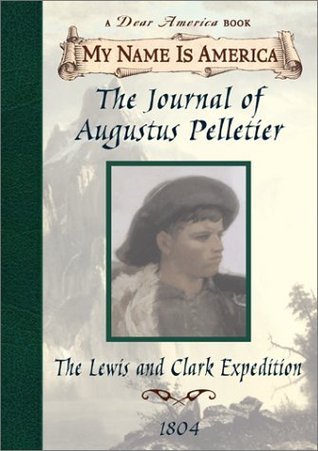
In Kathryn Lasky's first book for the My Name Is America line, the acclaimed author tells the story of the Lewis and Clark expedition through the eyes of fictional, fourteen-year-old Augustus Pelletier. Eager to strike out on his own, Gus joins Lewis and Clark's Corps of Discovery on their journey from Missouri to the Pacific Ocean as the youngest member of the trip.
Kathryn Lasky, also known as Kathryn Lasky Knight and E. L. Swann, is an award-winning American author of over one hundred books for children and adults. Best known for the Guardians of Ga’Hoole series, her work has been translated into 19 languages and includes historical fiction, fantasy, and nonfiction.
Augustus Pelletier's diary starts off May, 1804 at the St. Charles, Louisiana Territory, Missouri River, north bank and ends on November 14,1805. Augustus gives details on the what is expected of him, his thoughts about his interactions with the others on the expedition. Sacajawea is also included in the book which I truly enjoyed, he is able to show her in ways I have yet to find in other books. This fiction book is able to give you a very raw, real look into this adventure. The interactions with the Indians they come in contact with, some are friendly and some are not. The book includes Nonfiction information in the back as well as pictures, this helps you make connections and put faces with the people talked about, nice touch.
I really loved the descriptions, especially in the tone of wonder for this basically untouched scenery. It really felt like someone who was seeing these amazing places for the first time, and felt as much awe as the rest of us would. It also didn't play down the difficulties of the travel (hunger, terrain, fear, etc). I also loved that they made an effort to state the differences between the various tribes they pass by, not just saying 'Oh! Natives!' and leaving it at that. It wasn't just stating they were different either, but making note of specific things that made up their lives (dwellings, hunting practices, etc).
I also love that they didn't take away from the importance of Sacajawea (a legitimate fear, since this book is apparently written for a boy audience, and boys wouldn't read books where girls do anything important *sarcastic sigh and eye roll*). She wasn't the main character, but she was still one of the most important.
As engaging as most of these are. I liked reading about the survival that took place on the expedition, as well as Augustus' encounters with several famous persons from history. I liked the small details - Lewis' dog, Augustus getting the date wrong during the new year, etc. I liked Augustus' personal history that brought him into the expedition. It was clear that Augustus liked the Native Americans, but it was hard not to think about the impending doom meant for them all while reading about this expedition.
Not thrilling, but thoroughly amusing--an interesting recounting of the Lewis and Clark expedition from a teenager's point of view. Kathryn Lasky does a wonderful job of creating a character who isn't too smart or brave for his own good, but is still fascinating for us to read about. I don't ask for too much else out of these books.
I loved rereading this book. Augustus has so many insights about Captain Lewis and Captain Clark and the entire Corps of discovery. I love his friendship with Sacajawea and all the little stories making up the main story, how he begins by sneaking after the others to secretly join the expedition to becoming a member of the permanent party to eventually making his way to the Pacific Ocean.
This entire review has been hidden because of spoilers.
Good condensation of the Lewis & Clark adventure. Just enough to whet your appetite for more. I still have that massive novel Sacajawea sitting unread on my shelf; right where it’s been for quite some time. This gets me closer to starting it.
This was an endlessly fascinating journal. I definitely thought this expedition started with just Lewis and Clark. I realize how misinformed that was now. Of course more people went with them. I also liked the map that was included in this so you can follow along with the journey.
This book was okay, it was just hard to follow and feel connected with the story. I felt like I was reading notes from a student, not a book. It was interesting, just felt like I could skip a few pages.
3.5 rounding up. The protagonist is very likable, and the book does a great job of creating an enjoyable journey without the traditional plot. Some of the "lessons learned" get a little cutesy, but it's not too heavy handed. Accessible historical fiction choice for a jr. high audience.
Fictitious journal of 14-yr-old boy who accompanies Lewis and Clark to attempt to find a Northwest passage to the Pacific Ocean. Accompanied by Sacajawea.
I really enjoyed this. It was nice to see something from a boys view, and how he was able to just join in and prove to himself that he could do more even though he was thin.
Love it, lots of adventure and action. I felt like I was in the book and love the author Kathryn lasky 5 stars on all her books, my favorite book from her, across the wide and lonesome Prairie.
It was fun and Gus was interesting. I really liked that Gus actually got Sacajawea and didn’t see her like Lewis and Clark did. Not groundbreaking or anything, but interesting none the less.
This entire review has been hidden because of spoilers.
I'm revisiting Kathryn Lasky's writing (I previously read and really enjoyed her YA novel Beyond The Burning Time, regarding the Salem Witch Trials) with this epistolary novel that helps bring the Lewis & Clark Expedition to life for middle grade readers. Blazing West tells the history through the eyes of fictional figure Augustus Peltellier, a fourteen year old half French / half Native American boy. Augustus's biological father, a French trapper, is killed, leaving Augustus to be raised solely by his mother. But it doesn't take too long for his mother to remarry. Not long after her new marriage, she falls ill and dies (from pneumonia, I believe it was). Augustus is then left with his stepfather, a horrid, brutally abusive man. To escape the now violent house, Augustus hides out in the woods outside the camp of Meriwether Lewis & William Clark and their Corps of Discovery Expedition team, knowing that if he walks in outright he will be turned away for being too young.
So Augustus lives out in the woods, just out of sight, for some time until he finds the perfect time to casually introduce himself to Lewis. I cracked up at the image of Lewis not at all being ruffled by the sight of a teenage boy randomly walking out of the woods, Lewis just handing something to him, saying "hold this." X-D Proving himself useful, Augustus quickly becomes the general assistant / "go-for" boy to both Lewis and Clark. He also hunts for the crew and sketches wildlife for the expedition journals. A few months into the journey, Augustus also meets and becomes good friends with Sacajawea, just a year older than Gus but already married off with a baby on the way.
Gus's story, told entirely through his journal entries (beginning in May 1804, ending November 1805), give middle grade readers an idea of what such a journey might have been like through the eyes of someone close to their age. Gus survives a number of hardships out in the wilderness -- the camp running out of supplies, harsh winters, potentially hostile tribes, etc. --- but in the end gets to experience one of the great historical adventures, allowing readers to experience it as well. I liked Gus's voice, his good sense of country-flavored humor. I also liked that Lasky's way of weaving the actual history into this format will help the history come to life for students of the period, taking it out of the stale textbooks and making it feel like a real-life time period again.
While there's a great benefit to the diary-style format for young readers, as far as absorbing the facts along with the storyline, I will say that adult readers may not find the story itself entirely riveting. It is good, but not breath-takingly so, IMO. Still, a good starting point when looking for teaching materials on the subject. Another note on sharing this book with young readers -- the storyline does address factual information regarding people being lashed as a form of punishment. While not violently graphic in description, the mention of it is in the text. Just a heads up for parents and teachers. Also within the author's historical notes at the end Lasky does mention that Lewis committed suicide four years after coming back from this expedition. Again, just a heads up. (Sidenote on this: I read up on this a little bit and discovered that the suicide ruling is actually debated by some historians. Turns out there's some sketchy business to the accounts given by those who last interacted with Lewis, sketchiness that leads some historians to speculate that it possibly could have actually been murder. Who knows.)
With a lot of historical fiction you feel like the author created a back story as a vehicle for the presentation of all that historical research. But in this case you just get the Lewis & Clark adventure pretty straight up, and I appreciate it. Augustus Pelletier is definitely a character you root for. He's the youngest member of the Corps of Discovery and a total stand-up guy who admires "the Captains" for all the right reasons, but also privately questions their uber-Euro-Ego-centric approach to the Indians. His relationship with Sacajawea and her baby is particularly endearing, as his refusal to eat dog meat even in the face of hunger!
"Journal of Augustus Pelletier: The Lewis and Clark Expedition" was a very good non-fiction book. The book was about a boy named Augustus Pelletier. HE joined Lewis and Clark on a journey to the Pacific ocean. There journey had some ups and down, but still managed. They even mention Sacagawea. The climax was when they reached the Pacific ocean. They met a ton of indian tribes.
What I liked about this book was that the description they about the book. Every little detail was described in each journal entry. If there was I would change about the book would definitely be the illustrations. They could've at least left a picture of the map they used or some drawings.
I recommend this to people who love history. People who like history that goes way back. I even recommend this book to all social studies teachers.
In 1804, two army men, Meriwether Lewis and William Clark, were chosen with other men to go to the Pacific Ocean to find the Northwest Passage and open trade with the Native Americans, and China too. They left from Camp Wood, Illinois and up the Missouri River and met many tribes like the Omaha (Augustus' Tribe), Tenton and the Sonshoni (Sacajawea's Tribe). Then they settled down in Fort Mandan, where they met Bird Woman (Sacajawea). At the time she was pregnant with Jean-Baptiste. When they went to the Rockies, more danger was ahead. At the Great Falls, what was supposed to be a 8 Hour Portage became a 8 DAY Portage! It snowed all day in the Rocky Mountains, and all they could eat on the other side was Salmon! But on the other side of the continental divide, they met Sacajawea's Home Tribe before she was kidnapped. After that they finally saw the Pacific Ocean and settled down in Fort Clatsop for the Winter.
The narrator was 16 year old Augustus Pelletier, who was half Omaha and half French. He was from St. Charles, Missouri and wrote down the expedition, but he is fictional.
This book was very awesome in every way: accuracy, history and time. Covering the Expedition from St. Charles, Missouri all the way to Fort Clatsop on the shores of the Pacific. This book was a historical fiction, but a little bit of non-fiction added to it. Because it was written from a point of view from a boy, this helped me understand the expedition.
This book is a journal account written by a young man named Augustus Pelletier from St. Charles, Louisiana. Augustus wanted to join the Corps of Discovery, an expedition group that was supported by the government. He followed the Corps of Discovery keelboat down the Missouri River till he met up with Lewis and Clark. After meeting Lewis and Clark, Augustus joined the Corps of Discovery. For months they explored, mapped routes and took animals so that they could show them to the president. During the expedition, the crew met various indian tribes which they traded with and friended. Lastly, Augustus shared his experiences of how life was like when there was no food and how they had to hunt and kill animals to eat.
I really liked this book because of the experiences you learn about and how life was like back in the 1800's. It also tells you about the exploration equipment that the Corps used and how it was used. The one thing I did not like was how the book was laid out.
This book was very inspiring. I enjoyed it very much. This was because I felt like it was that kind of book that made me feel very patriotic. I liked the way Kathryn Lasky desribed the setting of the book. How it was ever changing. The way Augustus described seeing a prairie dog for the first time "A kind of dog that poked his head out of holes". I could really feel like I was there, on the Lewis and Clark expedition. The last part, I felt very inspired when Augustus was the first of the party to see the Pacific ocean.
I have never thought of the Lewis and Clark expedition this way before. I thought that it was just a bunch of guys who just went to the Pacific. I now look at the expedition in a new light, they lost men, they had gained Sacagewea. They lost morale, and gained morale. All in all, I think that this book was very good.
I read this aloud to my daughter. It is a story about the youngest member of Lewis and Clark's expedition. It was very creative, and an okay story line...but I was disappointed with how little we actually learned about Lewis and Clark and the expedition. Okay and semi-informative read, but not good for a sole study of the great expedition. I've read about 5 books about Lewis and Clark...and this one, while not a bad book, is definitely at the bottom of my personal list.
What it DOES have going in its favor is that it is written from the perspective of a child. This is to pull the child in and help him/her be more interested in something deemed over their head. The narrator is personable and quite likeable and easy to relate to. Augustus makes a good "Mediator" through which we get a glance of Lewis, Clark, and other members of the expedition.
Every person in life has a goal they dream to achive. Now the main character of the story agustus pelletier or gus for short dreams of making it to the shinnig sea. Or as we know as the pacific ocean. His origanal plan like many of us would do was to sneak away from all of the drama going on during the lewis and clark expedition so he dicides to blend in with ''the crowd''. Then like most of us he has a fire burning inside him and brake out of his shell. know he is more open about him self then ever and like us all is determined to achive his goal and dreams, but know the only question is like most of us have tried is will he make it? Or die triying. (I would recomend this book to julian becuse it is a mix of adveture,exitment, and most importantly non fiction)-cesar.a
Lewis and Clark's journey is clearly evident in this story; however, in The Journal of Augustus Pelletier by Katherine Lasky (from the Dear America series), the 14 year-old Gus Pelletier follows closely behind, not showing himself until he is sure they will accept him. This book is a little odd because he does not belong in this story I already know. I am not sure how else to say that.
This book is written in diary/ journal format and appropriate for a middle school student due to some language.
Gus wants to go with Lewis and Clark He is 14. His cousin speaks "Omaha" and knows sign language. He thinks Gus is too young. When Gus's drunken stepdad tries to cut his ear off, Gus decides he's going. He is smart enough to avoid the crowd, by going upstream a mile or so. He scouted ahead of them for 40 days before he made himself known. He becomes a student of M. Lewis. He learns to use the cronometer, and is a good enough sketcher to become invaluable to Meriwether Lewis. He made it all the way, although part of the group turned back.
This entire series is a wonderful way to learn history or teach it to adolescents. I find today's generations seem to recall more when they learn through other people (pop songs, celebrity gossip, etc.), so what better way to teach history than through someone else's perspective? Yes, "authentic" diaries would be "better", but would the language really hold the modern student's attention? Did the diary writer know what WOULD be important in the context of history? Probably not.
this book is intersting to me because with it i've learned so much more about lewis and clark! and thats a good thing, because it helped me with knowing that lewis is sorta the quiet outdoors type, while clark is the complete opposite, with him being loud and social and everything. well, i like gus, the main character, because i think that he's brave to write the journal in his own blood and to sew his ear together with the gut of a cat. nasty!