“Turtledove is the standard-bearer for alternate history.”— USA Today
The novels of Harry Turtledove show history balancing on single One act of folly. One poor decision. One moment of rage. In this astounding new series, the unthinkable has come to pass. The Cold War turns hot—and the United States and the Soviet Union unleash their nuclear arsenals upon each other. Millions die. Millions more are displaced. Germans battle side by side with Americans, Polish freedom fighters next to Russian fascists. The genie is out of the bottle. And there’s no telling what fresh hell will come next.
At the heart of Fallout are Harry Truman and Josef Stalin. Even as Joe McCarthy rises in power, the U.S. president is focused elsewhere, planning to cut off the head of the Soviet threat by taking out Stalin. It’s a daring gambit, but the Soviets have one of their own. Meanwhile, Europe’s weak sisters, France and Italy, seem poised to choose the winning side, while China threatens to overrun Korea. With Great Britain ravaged and swaths of America in ruins, leaders are running out of options. When the United States drops another series of bombs to slow the Russian advance in Europe, Stalin strikes back—with horrifying results.
These staggering events unfold through the eyes of a sprawling cast of a Holocaust survivor in a displaced persons camp in Washington; the wife of a bomber pilot and her five-year-old daughter starting a new existence; a savage Soviet fighter waging war by his own rules; a British pub owner falling in love with an American pilot. In the masterly hands of Harry Turtledove, this epic chronicle of war becomes a story of human struggle. As the armies of the world implode, the next chapter will be written by the survivors—those willing to rise up for an uncertain future.
Praise for Fallout
“Turtledove proves, yet again, that he is the best when it comes to rewriting history!” — Suspense Magazine
“Turtledove, the master of alternate history, has done well again.” — Shelf Awareness
“No one writes alternate-history novels quite like Turtledove. . . . Expect epic political stakes as well as personal and heartfelt stories of war.” —BookTrib
Dr Harry Norman Turtledove is an American novelist, who has produced a sizeable number of works in several genres including alternate history, historical fiction, fantasy and science fiction.
Harry Turtledove attended UCLA, where he received a Ph.D. in Byzantine history in 1977.
Turtledove has been dubbed "The Master of Alternate History". Within this genre he is known both for creating original scenarios: such as survival of the Byzantine Empire; an alien invasion in the middle of the World War II; and for giving a fresh and original treatment to themes previously dealt with by other authors, such as the victory of the South in the American Civil War; and of Nazi Germany in the Second World War.
His novels have been credited with bringing alternate history into the mainstream. His style of alternate history has a strong military theme.
I’ve been a Turtledove fan for three decades now. For diehard fans, Fallout is another grand outing into speculative history with the master of the genre. Unfortunately, that’s the problem. The Turtledove Formulaic Doctrine is alive and well in this story. Same old Turtledove with the same old cast of characters. The same things seem to happen in every Turtledove book.
There is even a subplot in Fallout that is recycled almost point by point from Joe Steel. I’ve found that Turtledove’s non world war stories to be more engaging and better written.
It took me two weeks to slog through Fallout and that’s something since I usually can read a 300 – 400 page book in less than a week. I’m glad I picked up a digital ARC on Netgalley. I would’ve been disappointed had I purchased Fallout.
Fallout is still a decent read, and newer converts to Turtledove won’t recognize the TFD and the recycled plots. I suspect that since I’ve read everything Turtledove has ever published, I’m a bit jaded. Three stars for Fallout.
Guilty pleasure: nuclear war. I mean, not the world-devastating, civilization-ending version, but the tremendous, yet recoverable kind. The kind that will invariably convince the civilizations which come after of the horrific and awful nature of these weapons, which will be forever banned afterwards. And this seems to be a story which could serve as the prequel to that.
Bombs Away by Harry Turtledove was a good, if flawed, book. That being said, how does its sequel, Fallout, hold up to the original?
Our story continues (and maybe skip the next two paragraphs if you haven’t read Bombs Away) immediately after the atomic bombing of Paris. Soviet forces are pushing hard across western Europe and are on the verge of overrunning West Germany, forcing President Truman to resort to tactical nuclear strikes to stem the tide. The Soviet Union is rocked back on its heals, but its not out of the fight just yet. Massive stores of weaponry from the last war may be obsolete, but still useful when you care little about the lives of your soldiers. Still the Soviet Union is showing signs of cracking as rebellions break out in their satellite states and unless Stalin can strike back at the United States, there may not be a Soviet Union for much longer.
Granted the United States has seen better days as well. Joe McCarthy is riding a tide of popularity that might take him to the White House since Americans are angry after the nuclear strikes on the West Coast and continuing defeats in Europe and Korea. The United States is also having trouble supplying its forces fighting oversees after the destruction of the Panama and Suez Canals. Truman, who decided not to run for reelection to give the Democrats a chance at beating McCarthy, is desperate to scratch out a victory before his country elects a potential fascist or America’s allies in Western Europe make a separate peace with Stalin. Meanwhile, the war in Korea rages on, forgotten by most of the world, but still deadly to those few who still fight there.
At a book signing I attended years ago, Turtledove joked about how he was getting political in his old age and you can certainly tell he is with Fallout. I am not exactly sure when Fallout was completed, but McCarthy’s road to the White House does parallel a certain political candidate’s campaign in the 2016 election. And, why not? I have seen some describe the War on Terror as “World War III” and Soviet deceitful tactics (like painting their bombers in American colors to confuse defenders) do resemble contemporary terrorist tactics. Also if you are the type of person who doesn’t feel we are winning that world war and you are afraid you may be the next casualty, perhaps voting for someone who promises to be tough on your enemies doesn’t sound like a crazy idea.
Still I thought Turtledove did a better jobs of highlighting the flaws of both the communist and capitalist systems that are at war with each other. For example, characters in the East lament how their is no incentive to work hard since anything extra goes immediately to the state and you will see zero benefict, but you can’t complain about that unless you want to be taken away by the secret police. Meanwhile, in the West, other characters get angry how corporations see caring about the health of their workers or paying insurance money owed to victims of atomic attacks, as unnecessary expenses that they can do without and anyone who thinks otherwise is just a dirty commie. Thus you see characters in the communist world moving to the right with their politics, while characters in the capitalist world move to the left.
Politics aside, Fallout as a book was…okay. If you liked Bombs Away, then you will like Fallout. It is a continuation of the story that begins right where the last book left off with all of the same POV characters who were still alive at the end of the first book. If you didn’t like Bombs Away, then you won’t like Fallout. Admittedly I do like how the stakes have gotten higher, while weaponry has actually devolved rather than advanced in the face of nuclear warfare, but its hard to sell something that is part two of the same story, rather then a new story in the same universe.
So in conclusion, if you are a Turtledove fan and enjoyed Bombs Away, I would check out Fallout. I found it to be an enjoyable read that managed to have some interesting commentary on modern politics. If you are not a fan of the first book, however, then you aren’t going to find much in this book to change your mind.
Fallout is the second book in Harry Turtledove's new alternate history series “The Hot War”, in which the Korean War goes nuclear. In general, this review is free to reveal plot events of the first book, so I would suggest you read no further, if you want to avoid spoilers of Bombs Away. It will not reveal plot developments of Fallout itself. Consider yourself warned.
The point of departure (POD) of this alternate history is in 1950, after China intervenes to prevent the loss of Korea to US/UN forces. In the first book, President Truman authorized the use of atomic bombs against Chinese troops in China, near the Korean border. In response, the Soviet Union took nuclear retaliation against western Europe, and started a land invasion across Germany. There have also been one-time strikes against the major cities of west coast USA and European USSR. These strikes have been delivered by aircraft, and were limited by the range of the bombers in use at that time.
The way to tell a big story is with lots of personal points of view, and what could be bigger than World War III? The narrative switches frequently between a dozen lead characters, located at various points around the globe. This conflict is only a few years after the end of World War II, but the central European nationalities are now arranged in different combinations. Former allies like the Germans and the Hungarians are now on opposite sides. Former enemies like the Germans and the Americans are now allied. And there is a heavy representation of Poles, Czechs, Slovaks, Ukrainians, Lithuanians, etc. Conspicuous by their absence is any mention of Tito and the Yugoslav nationalities. However, all are impacted by the conflict – civilians who live near cities that have been nuked, or pilots that fly the bombers – tank crews, and infantry – and President Harry Truman. Unfortunately, the time span of this novel covers a period where those individual experiences are all kind of the same.
In this second book of what is looking like it will grow into an extended series, the war expands. There is more mass death and destruction of famous landmarks, and a general de-sensitizing of the population and the characters to all of the violence. There are also hints towards long-term historical divergences which could occur in the subsequent books, but that is not yet developed. Still, we have familiar 1950s people getting thrown out of their comfortable existences. Hopefully the next novels of the series will reveal Turtledove’s deeper plan for this universe he has created – but this one has not yet explored any kind of science fictional possibilities. I’m still waiting.
Harry Turtledove is a brilliant alternate history writer. Which should come as no surprise, as he's a professional historian. His new Hot War series is probably the most brilliant idea for an alternate history I've ever seen. Most nuclear war novels and movies treat nuclear war as an hour-long event, in which civilization exists in the morning, and doesn't exist in the afternoon.
Turtledove found the right niche in time, specifically early 1951, when an atomic war would not necessarily be over in a day. In this alternate history, General MacArthur, losing the Korean War, convinces President Truman to use nuclear weapons on Chinese cities north of the Yalu River. this does not result in an all-out launch of Soviet nuclear missiles, because in 1951 nuclear missiles didn't exist. The delivery system of choice for the United States was the B-29 bomber, and the Soviet Union's copycat Tu-4.
This meant that the war would happen slowly over the course of days, weeks, and months. Rather than an all-out spasm attack, the attacks are spread out, giving both civilizations time to adjust, and possibly recover. Also, the atomic bombs of that time were rather small, "only" about twenty kilotons in yield. This meant that a bomb dropped on a city only destroyed part of that City. This lack of total destruction allows both sides to keep the atomic war going.
The story is told in standard Turtledove style. That is, multiple point-of-view characters, mostly soldiers, mostly cursing up a storm. As in all Turtledove's books, there's the non-com with the cynical Heart of Gold, the army officer who is too smart for his superiors, a young attractive female shopkeeper who is just trying to get by, liberal Jewish characters for the others to pick on, and assorted real life historical personages, usually in positions of power. They all tell their stories of the slow motion atomic war in round-robin style, going from one character to the next, with the cast of characters getting smaller and smaller, as, with all Turtledove's books, anyone can die.
I was fortunate enough to discover volume 1 of this series earlier this year. I read Volume 2 within the month of its release. And now I've got to wait an entire year for volume 3. This series plot is so compelling, it will be worth the wait.
Really liked the "Hot War" and was glad to hear more of the stories and this book dragged on a bit in the middle after finishing it and realizing that it is probably book two of a series the slow parts made more sense and looking back I can enjoy the "filling in" they have the story.
I look forward to the next in the series to continue the tales of the characters.
The second hand on the wall clock was sweeping up toward eleven on the dot. The red lights under the TV camera lenses glowed, so they were filming or broadcasting or whatever the right word was. Truman took his place behind the lectern and glanced down at the papers. Yes, they said what they were supposed to say. If they hadn't, he could have given the gist without them. The gist was, the world was going to hell in a handbasket, and he'd just thrown some more gasoline on the fire.
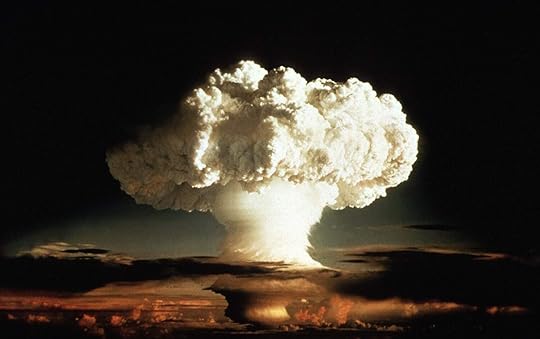
~~August saw the 80th anniversary of the bombs dropped on Nagasaki and Hiroshima (the latter is pictured above). To this day scholars and historians debate whether or not dropping these devastating bombs was justified. Turtledove writes an alternate history where the dropping of A bombs spirals into all-out nuclear warfare in the trilogy that includes Fallout sandwiched in the middle.
First two sentences: It was a bright, warm, sticky day in Washington, D.C. Summer wasn't here yet, but it was less than two weeks away.
Vital statistics: Author's home: Born in 1949 in Los Angeles, California, he has a PhD from the University of California. Year written: 2016 Length: 419 pages Setting: multiple POVs from around the world in the early 1950's. Genre: Historical fiction that is based in truth, but takes us in an alternate, fictional direction Read if: You really like epic trilogies such as The Lord of the Rings. I didn't realize this was part of a set, and read it as a standalone. From other reviews, this is not recommended.
My two cents: I was intrigued by the premise of the book. Alternate history is an interesting concept that can be used to show how close we came to disaster as a society, and caution us to avoid situations such as that in the future. They can also just be dang fun. Turtledove is definitely cautioning us in this particular novel. The problem is that the scope is *so* wide, and there are *so* many characters that the story (and his warning) are diluted down, and it's hard to feel emotionally invested. With that being said, the prose is solid. It's a good book. Just not (in my opinion) a great one. There are horrific elements to war, and Turtledove doesn't shy away from describing what humans inflict on each other. Tagged horror for that reason. Given 3 stars or a rating of "good." Recommended as a library check-out if you enjoy alternate history, but not necessarily as a buy.
Other good quotes: You hurt just as much if you got maimed in a fight nobody back home gave a damn about, and you were just as dead if you got killed in that kind of fight.
~~To Jim Summers, irony was what his wife used to put the creases in his gabardine work pants.
~~"I serve the Soviet Union!" Gribbkov said, which here meant something like I'm stuck with whatever you tell me."
~~When the girl drew back to survey her work, Truman asked her, "Will the bathing suit be green or orange this time, dear?" She giggled, "You're a card, Mr. President!" "I don't know about that, but people have been telling me for a long time I ought to be dealt with," Truman said, not without pride. When the make-up girl got it--she needed a couple of seconds--she made a horrible face. The president grinned.
~~Nothing came down too close to Cade, for which he thanked heaven. Of course, heaven had just decided to visit hell on some other sorry bastards instead, so how grateful should he have been, exactly? He shook his head. When you started asking yourself questions like that, where did you stop? Anywhere?
~~"It's the end of an era," the press secretary said. "Eras end. That's what makes them eras," Truman said. "Pretty damn quick, whoever comes after me will start looking like a dinosaur, too."
~~Back in Marsberg, some potbellied Soviet lieutenant colonel had to be on the brink of apoplexy. How could you fight a proper war if soldiers kept trying to stay alive?
The Hot War: Fallout is an sci-fi alternate history book written by Harry Turtledove. Turtledove is known as the “Master of Alternate History,” and I can’t really disagree with that. I do, however, have my problems with him. But let’s see what the book is about before I deal with that.
“The Hot War” is a series based on the “what if” question: “What if President Harry Truman had decided to use nuclear weapons against the Chinese when the Chinese invaded North Korea?” In this 1950s alternate timeline, the Chinese did much more damage to the American troops when they decided to intervene in the Korean War, and Truman felt that he had to stop them in any way possible.(A few minor spoilers for the first book follow)
The Soviets retaliated for this, invading West Germany through the Fulda Gap and dropping their own atom bombs on some cities in England, Paris, Seattle, and Los Angeles. The newly “hot” war escalates even further after that, with the US dropping atom bombs on various cities in the Soviet Union. This is before ICBMs were invented, so these bombs are being dropped by B-29 Superfortress bombers and their Soviet Tu-4 counterparts. (End spoilers)
As with most Turtledove series (as opposed to some of his one-off stories), the tale is told through a large number of viewpoint characters: a Soviet bomber pilot, a Soviet tank commander, a Ukrainian and a Hungarian foot soldiers conscripted by the Soviets, a West German soldier, and a US infantry officer in Korea.
The civilian side is told from the point of view of a widowed British woman, a widowed Seattle woman, a family man in Los Angeles, the wife of the German soldier, and President Truman himself. There are a few others as well. Fallout deals with the war from June 1951 to May 1952.
The rotating viewpoints can get confusing, which causes Turtledove to restate certain character traits again and again whenever he goes back to them. Sometimes that’s useful, but if you do remember the traits, then it gets a bit irritating after a while.
So why do I have a love-hate relationship with Turtledove books? I find his writing tedious, but I love his imagination.
Whenever I happen upon a Turtledove book, I look at the description of the plot. What is the alternate history hook? Is it an interesting situation?
There was a trio of series that took place spanning 1914 – 1945, with the backdrop of the South having won the Civil War. It basically covered World War I, the years between the wars, and then World War II, with the South basically being Germany. I found the series fascinating. It was 10 books!
But it was the concept that kept me going. His writing just annoyed me. (Yes, I was annoyed for 10 books, but thankfully I didn’t read them all at once) If I like Turtledove’s idea, then I will tend to like the book(s) even if I struggle with them.
Such is the case with “The Hot War.” The idea of the Cold War becoming a real one before ICBMs were invented, so it can’t end in the total destruction of all mankind, is really a fascinating one. Fallout continues that plot very well. Some of the individual point of view characters are a bit boring, but overall it’s not bad. I’m actually enjoying this series more than I did the many of his other books.
But Fallout does suffer from some of the usual Turtledove irritants (though thankfully he avoids the fault from his previous books of writing cringe-worthy sex scenes).
Many of the characters have similar speech characteristics even though they are from different countries (almost from different worlds). Whether they are Soviet infantry or American civilians, guaranteed there’s going to be some variation of “I would like to tell you you’re wrong, but I know you’re not.” Most of them speak in some kind of “down-home, salt of the earth” dialect that really doesn’t differentiate them very much.
Turtledove tells his story in a number of scenes bouncing from character to character, and some of these scenes don’t really seem to forward the story much. Neither the over-arching war story nor their own personal story. Sometimes it seems like Turtledove is treading water to add heft to the book.
Finally, and this is just for those of you who are sensitive to this, there is a lot of foul language and racial slurs in the book. They are all used in the character dialogue and point of view description, so it’s Turtledove being true to his characters and the 1950s era time period, but you should still be ready for it. Don’t read this book or this series if you don’t like seeing it at all.
So what’s good about the book, other than the overall alternate history idea? First, I’m really happy that Turtledove is not afraid to kill off POV characters. Much like George R.R. Martin in Game of Thrones, just because you’re getting part of the story from a character’s viewpoint does not mean that the character will survive. I love that. (though one of the apparent deaths is actually kind of ludicrous)
Secondly, as the book nears its conclusion, it really ramps up the tension in the overarching story. The war is going quite badly for both sides and the reader is left wondering just how this is going to end. Will both sides annihilate each other somehow? Is there any going back when so many major cities are radioactive rubble? What’s going on inside the Soviet Union, anyway? It has left me really wanting to check out the final book in the series sooner rather than later. It’s also very interesting to see how civilians are handling all of this, trying to get on with their lives in the midst of such total carnage of a global conflict. You still have to get a job and pay the bills.
Overall, The Hot War: Fallout is one of Turtledove’s better books, and this series (at least so far) would be one I would recommend for anybody interested in checking out alternate history novels. Yes, the writing can still be tedious, but it’s some of Turtledove’s best and the concept just grabs you and won’t let go. If you already know you don’t mind Turtledove’s writing, then this one will really get you and I highly recommend it.
Not Turtledove’s best work. Too many characters left this reader unattached to all but the historical figures. While the treatment of McCarthy was an exception, many of the other events fell flat until near the end. A lot of emphasis on the army and air force left almost all naval engagements ignored. Good, but not as great as other works.
Another harrowing, action-packed alternate history novel by Harry Turtledove that keeps the pages turning. Like so many of Tutledove's books, there's no one protagonist or main character (though Harry Truman would figure as the most significant in terms of real-world historical prominence), but a variety of characters, military and civilian alike, from countries on both sides of the conflict, all of whom go to remind the reader that war is an all-too-human endeavour that affects all sides, regardless of nationality or ideology.
RANDOM STREAM-OF-CONSCIOUSNESS NOTES, OBSERVATIONS, AND FAVORITE PASSAGES: SOUTH GATE STATUS:
--p. 26: "Artillery was the big killer. Everybody knew it." Yep, King of Battle
--p. 31: "'A wounded man makes more trouble than a dead one.'" Very true.
--p. 40: San Pedro and Long Beach (sigh)!
--p. 42: Rams and Trojans (FIGHT ON!!) and bRuins (ugh)!!
--p. 44 Sark (haha)! --"Latvian or Lithuanian" = "trouble with a capital T." But does the Russian wore for "Trouble" also start with "T?" Nope, it's "beda" and several other "B" words.
--p. 132: "Grigory Papanin squealed like a bull calf when it was suddenly made into a steer. His hands flew to the wounded part. Vasili did his best to turn Papinin into a steer, all right. His booted foot caught the other man square in the crotch. Papanin squealed again, on a higher note this time, and folded like a concertina." Steers & queers? Heh heh.
"He didn't believe in anything so stupid as a fair fight. He fought to win, and to teach a lesson the other guy would never forget." AMEN!!!
--p. 143: "Cade whooped again, and pumped his fist in the air. He knew that was an un-Christian thing to do. The Red Chinese were men, just like him. But they were also men trying their goddamnedest to kill him. Maybe he should have regretted their untimely demise, but he didn't." Amen!!
--p. 145: "....the Korean Christians. They live up to the name better than a bunch of folks back home, and you can sing that in church."
--p. 155: Did the USAF already have dark blue uniforms by 1950?
--p. 176: "A bully who didn't scare you wasn't a bully any more."
--p. 191: "The South Korean leaders had mostly collaborated with the J*ps." Really? Does Turtledove have real-life historical evidence of this? Turledove's depiction of the ROK troops' fighting prowess is quite a contrast of the rep they've received from other sources from the Vietnam War onward.
--p. 202: KFI!
--p. 222: "Washington's incestuous world," LOL!
--p. 224: "'I'm not Stalin, thank God, and this isn't Russia. We have a government here, not a dictator.'" Um, Harry, I hate to break it to ya, but the two concepts aren't mutually exclusive.
--p. 229: "'All the Russians swear so much, like sailors or whores. They swear so much, they don't even notice they're doing it. It's nothing but the foulest language every minute of every day.'" LOL, ochin karasho, na zdaruvya!
--p. 234: Aaahhh, SFV references (Reseda, Sherman Way, Van Nuys).
--p. 245: "smegma-lips," LOL!
--p. 259: "metyeryebyets!" Has Turtledove been reading Clavell? Heh heh.
--p. 267: "Officers and sergeants who led from the front got better results than the ones who just ordered their men forward while they stayed safe in the rear, the way so many World War I commanders had." Demo Dick Marcinko would approve!
--p. 269: George Kennan!
--p. 284: Carl Cummings!?!?
--p. 318: "'We serve the Soviet Union!' the sergeants chorused. [i]And the Soviet Union serves us too--medium rare[/i], Konstantin thought."
--p. 324: "'Most of the time, though, the Yankees are plenty good at tactics and not so hot with strategy.'" Um, I daresay just the opposite, at least at that point in history.
--p. 359: 11 September 1951; mere coincidence on the author's part?
--p. 394: "bilgewater like Pabst and Schlitz," haha!
I fully expected to like this book - I like military SF and I like alternate history. But I didn't just like it, I loved it. Much to my surprise, it reminded me of John Dos Passos' U.S.A. trilogy.
It doesn't have the "Newsreel" inserts Dos Passos used so effectively (and later John Brunner in Stand on Zanzibar), but it is similar in that it written in short chunks from the viewpoint of multiple characters who are very different from each other, and in the feel of the characters and the prose. At first I thought I would have trouble keeping all of the characters straight, but they are so different from each other and so well written that I found it less of a problem keeping the characters straight than I do in many books with a single narrative. This even though it is the second book in a trilogy and I had not read the first. (Coincidentally, I started the U.S.A. trilogy with the second book - 1919 - as well.) One thing worthy of note regarding this middle book - although I was fine starting here and plan to read book 1 as a "prequel," this book doesn't have a real ending. Presumably that will come in book 3.
So, WWII has barely ended, the Korean conflict began, but in this alternate history it goes nuclear and instead of a Cold War between capitalist and socialist standard-bearers WWIII begins. The Korean front becomes secondary to a new war over Europe. The largest number of point of view characters are combatants in the war in Europe, but characters also include one combatant in Korea, a gulag prisoner, and a civilian each in England, the USSR and the US. Plus Harry Truman. Major cities are nuked, including American cities. Even though many thousands of people die in each city, many effects are surprisingly local as, I suppose, must have been the case in Japan as well. Of course, the timeframe is too short to show longer-term effects. When the US again uses nuclear strikes for military advantage, retaliation strikes follow which then escalate on both sides. We see a small slice of the thinking at the top through the eyes of Harry Truman, but most of the story is seen through the eyes of characters who are actively engaged in and/or affected by the war - both nuclear and conventional, including foot soldiers.
One thing that struck me as odd was the prevalence of Jewish characters but the lack of diversity overall. I recall one interaction with a Hispanic character (a 14-year-old thief), a couple of minor Asian (Korean) characters, and no black characters at all (just a couple of general references to them). A North Korean or Chinese point of view character would have been welcome, or one who is black or Asian. I understand that segregation policies of the era complicate that, but more recent events have shown us that black experiences in disaster situations can be quite different from white experiences. And what about the Japanese who had been interred on the west coast? Would more diversity cause too much scope creep?
But yes! Read this! Read it for the points of view surrounding war, economics, and morality. Read it for the insights into European history and politics at the everyman level. Read it for the excellent writing and characterization. Read it just because it's a really good read.
I received an advance uncorrected proof of this book for free by requesting it from the FirstReads program on Goodreads. I have limited time to read so I do not request books unless I really want to read them - i.e. unless I think they will be worth 4-5 stars. Fallout delivered.
“Fallout” eBook was published in 2016 and was written by Harry Turtledove (https://en.wikipedia.org/wiki/Harry_T...). Mr. Turtledove has published over 100 books. This is the second of his ‘Hot War’ alternative history series where the Korean War spins out of control.
I received a galley of this novel for review through https://www.netgalley.com. I categorize this novel as ‘R’ because it contains scenes of Violence and Mature Language. The story is set at various locations around the world. As in the first volume of the series, there is not a principal character, but several characters are followed.
This Alternate History is based upon US President Truman authorizing General MacArthur to use nuclear weapons to stem the flow of Chinese troops into Korea. The US bombs a few strategic Chinese cites to cut the supply lines. Russia responds by bombing US allies in Europe. Every time one drops bombs, the other responds in kind. Soon a second ground war is raging across Europe. After dropping "nukes" on Russian forces in Germany, the US is pushing the Russians back. This volume picks up at the end of the prior volume. The US and Russia continue to retaliate ‘in-kind’ every time the other drops a nuclear bomb.
Individuals are followed in various locations: a US Army officer in Korea; US President Truman; a female pub owner in the UK; a US AF bomber co-pilot in Korea and his wife left back in Seattle; a Russian bomber pilot; a Russian tank commander, a German militia volunteer, and a Hungarian infantry man among others.
The story not only deals with the military conflict, but it also touches on the emotional extremes that they are going through. Mr. Turtledove does not pick a ‘right’ and ‘wrong’ side in the war, but attempt to show what this war would have cost the world. I have read several of Mr. Turtledove’s books and this ranks up with the best of them. The story is fairly fast paced, though it if far from continuous military action. The cover looks kind of old fashioned, but it certainly gets the point across with areas of radiation spreading across Europe, China and the US. I give this novel a 5 out of 5.
This picks up right where The Hot War ended. The world is being ravaged as the Korean War has spread and, unlike in our time, an uneasy peace/Cold War that forms out of the split between the Western and Communist powers is not what forms. Things went wrong in the fist book when President Truman approved the dropping of an atomic bomb on communist forces because of the Korean War. Since then, Europe, Russia, and the United States have been confronted with the dropping of multiple atomic bombs and traditional war has accompanied them.
Like most of Turtledove's books, the story is told from the perspective of a number of everyday characters such as Russian, Ukrainian, German, and American troops as well as British widowed barkeep (woman), a Jewish delivery man living in California, an American refugee on the move with her daughter after her cities was bombed, a female prisoner of war in a Russian gulag and a number of others. I really enjoy how well-developed each of the characters and their backstories are. You cannot help but feel for them.
The book doesn't really finalize things ... in fact, things actually become quite intense as it comes to a close. As a result, I have no doubt that there will be another book in this series. I will definitely be ready to read it when it comes out!
I've only been a fan of Harry Turtledove's books for a few years. Because of that I've been able to go from book to book in some of his series. With this series I have to wait for the next one to come out.
As the second book in the series and with a year between books, it took me a bit to remember all the characters from book 1. Believe me, there are a lot of characters to remenber.
The story starts up just after book 1 ends. The characters are from both sides of the war. Soldiers & civilians. We get to see how the war affects everyone. I read a review that says this book fits well into Turtledove's style. I agree & I like that. The story isn't told strictly through the eyes of big shots...the president, generals, dictators. The story is told through the eyes of the little people. Fictitious people, but it is a work of fiction.
Once I got a handle on everybody, I got back into the plot. Towards the end I started to recognize the plot lines that would be carried over to the next book. I was really sorry that I'll have to wait till next year to see how they turn out.
If you are a fan of Turtledove's other books, you will enjoy this one.
Harry Turtledove has devoted most of his alt-history novels to re-fighting the Second World War, so his new series, exploring the escalation of the Korean War into a nuclear conflict, represents a welcome departure. FALLOUT follows the same structure as his other AH books: a series of vignettes exploring sequential episodes in the lives of his main characters, most of whom are soldiers and airmen and most of whom, alas, I found forgettable. Exception may be made for Daisy Baxter, an RAF widow recovering from the atom-bombing of her town; Luisa Hozzel, a West German soldier's wife arrested by the Soviet secret police and deported to the gulag, where starvation and abuse await; and Vasili Yasevich, a Russian struggling to make a living in Soviet-occupied Harbin. Harry Truman, the only non-fictional character in the story, serves mainly to advance the strategic narrative, keeping us apprised of cities bombed and lives lost. This larger narrative isn't terribly exciting – Turtledove's Korean War develops much like the historical one, into a stalemate (enlivened with occasional nuclear air raids) – but HT does save a few good surprises for the end.
Atomic bombs have been exchanged. The world after WWII is much different in this alternate reality. The world is at war again and it is the war that Douglas McArthur feared, where the USSR and China are fighting the US and it's allies. This book appears to be a compilation of stories from those who are fighting the war and those who have survived the atomic bombs.
Turtledove provides insight to how those who dropped the bombs feel and how those who have survived the bomb are struggling to exist.
Tankers, survivors on both sides, pilots and bar keeps all have stories in this book. That is it's strength and it's weakness. It reads very disjointed and there are way too many characters to keep a train of thought as to who is doing what.
I love Turtledove's characterizations, the life that he brings to them but this book was a struggle to read.
Fallout picks up where Bombs Away left off following most of the same characters. The reader gets to follow the lives of a bomber pilot widow, a British pub owner, several Germans, and a White Russian displaced back to the Soviet Union from China. The war continues to heat up with strikes on cities in Eastern Europe, Britain, and the United States. The last occurs when the Soviets come up with the concept of mid-air refueling. Turtledove provides glimpses of who life still continues in the midst of world-shattering events. He also continues his habit of killing of characters who the readers have followed for a long time. Based on how the ending developed, there will be at least one more book in The Hot War series. Wonder who will buy it first - Stalin or Truman?
It's been a while since I've read a Turtledove book, but through the years I've read most of them. I picked this up after my laptop died on a trip, and I was in need of some entertainment. I didn't realize that it was the middle of a trilogy until I was three quarters of the way through the novel.
Long story short, this novel recycles a lot from previous HT novels, especially the characterizations. I doubt this would be a turn off to a casual reader, but is mildly disappointing for a long term fan. Regardless, the book was still a page turner, though it's 50/50 whether I will hunt down the final book in the series, I certainly don't feel the need to do so with the prequel.
for those of us who grew up or came of age in the atomic era this series is a frightening vision of what might have been. Harry is careful enough to set this a few years before the birth of hydrogen bombs but I suspect that they may show up in the third book of this series. He'll need some more characters as he has done away with a few of the main characters in this book. Not unusual for him but it seemed as if a few more than normal went off to meet their maker. I almost wish I could wait a while to read these so it wouldn't be nearly a year until the next volume appeared.
Continues where the first left off, could be a stand alone read but you wouldn’t want to. Pretty dull and boring. Like most of his stuff - the concept is interesting but he just can’t develop the characters or the story enough to make it interesting. I kept wishing he would just turn it into raw action to spice it up. But just like the first, there really is no ending, it just trails off and ends - no climax, no “finish”. Very unfulfilling.
Addictive although also repetitive when compared to his other novels when it comes down to his characters. The large sweep of events and the decision making by the major players is what keeps this one riveting. I think that Dr. Turtledove is spot on when he shows that once you get the nuclear genie out of the bottle, it is very hard to put it back in.
Another good series (Book 2) from Turtledove. This guy can write and you don't have to wait forver for his next book like some authors ahhmm Geroge Martin are you listening??
This was absolutely amazing. Even better than Bombs Away (book 1). Turtledove is truly a master of alternate history. Anyone who ever wondered "what if" should read his work especially this series.
Fallout picks up where Bombs Away leaves off. After spoofing NATO air defenses with counterfeit IFF codes and sneaking in at low level to drop an A-Bomb on the City of Lights in June 1951, Tu-4 pilot Boris Gribkov and his crew struggle with feelings of guilt for their role in the obliteration of two old European cities AND Seattle. Some crew members deal with the stress less well than the others and take drastic action to avoid flying such missions again.
Meanwhile, the Soviet Union and its allies continue to push into Germany's Ruhr Valley from the east in spite of heavy resistance from NATO forces. As the Reds are on the verge of reaching the German border with the Netherlands, U.S. President Harry Truman sees no choice but to launch tomic strikes in West Germany. The strikes (witnessed by Gustav Hozzel - NATO infantry POV, Konstantin Morozov -Red Army Tank POV, Ihor Shevchenko - Red Army Infantry POV, and Istvan Szolovits - Hungarian Army Infantry POV) devastate the Soviet Union's front lines. The Red Army and its allies are forced to begin a tactical retreat, allowing NATO forces to push the front eastward.
What better way to tell a big story than with lots of personal points of view? The narrative switches frequently between a dozen lead characters, located at various points around the globe. The lives of all are impacted by the conflict in various ways – civilians who live near cities that have been nuked, or pilots that fly the bombers – tank crews, and infantry – and President Harry Truman.
Outside of obvious battles of World War III, I was looking for an event that would lead to a huge deviation from our real-life timeline. I found one large deviation and one small one. The small one in Turtledove's story is an earlier and more urgent interest by the Soviet air force in developing aerial refueling capabilities than they showed in real life. The development of this capability directly impacted the 1952 U.S. election cycle posited by Fallout.
Turtledove has also done an outstanding job of highlighting the flaws of both the communist and capitalist systems. For example, characters in the East lament how there is no incentive to work hard since anything extra goes immediately to the state and the individual is robbed of any benefit. Worse, those who complain end up in gulags and re-education camps.
On the other hand, characters in the West are angered by corporations who consider paying for the health of their workers or disbursing insurance money owed to victims of atomic attacks as unnecessary expenses. Thus we see characters in the communist world moving to the right with their politics, while characters in the capitalist world move to the left.
I found this an enjoyable read. If you liked Bombs Away, then you will like Fallout. It is a continuation of the story that begins right where the last book left off with all of the same POV characters who were still alive at the end of the first book. If you didn’t like Bombs Away, then you won’t like Fallout.
Turtledove continues his examination of what the world and war might be like if Truman had used atomic weapons against Chinese bases on their side of the Yalu River to stem the flow of Chinese in to North Korea during the fall of 1950. Interesting premise…however, would the Russians have responded for the Chinese who did not have Nukes at that time. In this world they did and the free for all exchange started. It seems that there is a never ending supply of Nukes and throwing them around, obliterating cities and such does not seem to have much affect besides the devastation plus radiation sickness and death for those too close. The “lingering” effects so far have been minimized. Since the Soviet Union did not successfully test their weapon until 1949, how many weapons could they have had to use…well that is history, not alternative history. Also, tactical nukes (lower yields) were not available until the late 50’s, and have not reared their ugly head in this series.
Turtledove’s story telling continues a familiar line, following people on both sides and does a good job empathizing with their situation and making it believable. The story line is believable, and there are a few outcomes some of us might wish have happened, but not the nuclear exchange per se, but the outcomes. Turtledove weaves a story and an alternate history that is both believable and enticing. Enjoy the series
This is the second book of the Hot War trilogy (after Bombs Away and before Armistice). It continues the "alternate history" of a nuclear world war begun when Harry Truman okayed the use the use of nuclear weapons in Korea and the war metastasized from there all around the northern hemisphere. (The southern hemisphere is pretty much ignored.) It has all the glories and trials of a Turtledove giant series. It is world-encompassing, made possible by focusing on many small groups of people scattered around the globe with the big picture filled in by their conversations (or passing comments) with one another. With so many characters, any one can be a hero and any one can die abruptly. The book is over 500 pages and the time any group gets focus is about five pages. So that's about a hundred shifts of focus, maybe to characters who haven't been mentioned for for fifty or more pages. That's a lot for the reader to hold on to, particularly with all that has happened to other groups/individuals in between. Turtledove is good at starting a jump with the focus character and a few reminders of what was going on for him or her. But it's work that makes it hard to just breeze through the book (particularly for me, since there was a gap of several months for me after finishing the first book). But it was worth it--even at the cost of getting me way behind on my Reading Challenge.
And it might be because I had a problem with the way Turtledove wrote his Point-of-view characters this time. There seemed to be SO much foulness and social ills hidden in these pages and the characters either were almost like displaced modern persons suffering through the fifties mindset, giving a running commentary about the backwardsness of societal morals and things like racism or they wholeheartedly embrace these traits we would define as negative if not despicable and turn them up to 11... BOTH of which made it hard to really cheer for anybody in this...
But then maybe that was intentionally as a hot nuclear war isn't anthing you should have reason to cheer for... when every "victory" means another fifty or hundred thousand persons vaporized in the blink of an eye... it turns more into a gruesome, letahl version of the "Phony war" with no side really managing to show any superiority and to do anything decisive...
All in all "Fallout" had some good descriptions of personal reactions to the horrors of a nuclear war and even the conventional side, a lot of sketches of human depravity and yet wasn't anywhere near as nice a read or as dynamic as the other Turtledove AltHis novels.
This entire review has been hidden because of spoilers.