

What do you think?

The Forgery of Venus
"Chaz Wilmot is a painter born outside his time. He possesses a virtuosic command of the techniques of the old masters. He can paint like Leonardo, Goya, Gainsborough - artists whose works sell for millions - but this style of painting is no longer popular, and he refuses to shape his talent to fit the fashion of the day. So Wilmot makes his living cranking out parodies for ads and magazine covers. A break comes when an art dealer obtains for him a commission to restore a Venetian palace fresco by the eighteenth-century master Tiepolo, for a disreputable Italian businessman. Once there, Wilmot discovers that it is not a restoration but a re-creation, indeed a forgery. At first skeptical of the job, he then throws himself into the creative challenge and does the job brilliantly. No one can tell the modern work from something done more than two hundred years ago." "This feat attracts the attention of Werner Krebs, an art dealer with a dark past and shadier present who becomes Wilmot's friend and patron. Wilmot is suddenly working with a fervor he hasn't felt in years, but his burst of creative activity is accompanied by strange interludes. Without warning, he finds himself reliving moments from his past - not as memories but as if they are happening all over again. Soon, it is no longer his own past he's revisiting; he believes he can travel back to the seventeenth century, where he lived as the Spanish artist Diego Rodriguez de Silva Velazquez, one of the most famous painters in history. Wilmot begins to fantasize that as Velazquez, he has created a masterpiece, a stunning portrait of a nude. When the painting actually turns up, he doesn't know if he painted it or if he imagined thewhole thing." "Little by little, Wilmot enters a mirror house of illusions and hallucinations that propels him into a secret world of gangsters, greed, and murder, with his mystery patron at the center of it all, either as the mastermind behind a plot to forge a painting worth hundreds of millions, or as the man who will save Wilmot from obscurity and madness." In Chaz Wilmot, we meet the rarest breed of literary hero, one for whom the reader feels almost personally responsible. By turns brutally honest and self-deceptive, scornful of the world while yearning to make his mark on it, Wilmot comes astonishingly alive for the reader, and his perilous journey toward the truth becomes our own.
318 pages, Hardcover
First published January 1, 2008
About the author
Michael Gruber
46 books313 followersMichael Gruber is an author living in Seattle, Washington. He attended Columbia University and received his Ph.D. in biology from the University of Miami. He worked as a cook, a marine biologist, a speech writer, a policy advisor for the Jimmy Carter White House, and a bureaucrat for the EPA before becoming a novelist.
He is generally acknowledged to be the ghostwriter of the popular Robert K. Tanenbaum series of Butch Karp novels starting with No Lesser Plea and ending with Resolved. After the partnership with Tanenbaum ended, Gruber began publishing his own novels under William Morrow and HarperCollins.
Gruber's "Jimmy Paz" trilogy, while critically acclaimed, did not sell at the same levels as the Butch Karp series in the United States. The Book of Air and Shadows became a national bestseller shortly after its release in March of 2007, however.
Series:
* Jimmy Paz
He is generally acknowledged to be the ghostwriter of the popular Robert K. Tanenbaum series of Butch Karp novels starting with No Lesser Plea and ending with Resolved. After the partnership with Tanenbaum ended, Gruber began publishing his own novels under William Morrow and HarperCollins.
Gruber's "Jimmy Paz" trilogy, while critically acclaimed, did not sell at the same levels as the Butch Karp series in the United States. The Book of Air and Shadows became a national bestseller shortly after its release in March of 2007, however.
Series:
* Jimmy Paz
Ratings & Reviews
Friends & Following
Create a free account to discover what your friends think of this book!
Community Reviews
Displaying 1 - 30 of 453 reviews

July 14, 2012
Book Review
The Forgery of Venus represents Michael Gruber's fictitious foray into the world of representational art, aesthetics, forgeries, galleries, and art criticism. Meet Chaz Wilmont, an artist and our narrator within a narrator, the vehicle - a lemon - through which Gruber delivers his novel. Chaz speaks to you, the actual narrator, in the first person, through a series of sound files he recorded onto CD for you to listen to; and as with a lot of second-hand vehicles he breaks down often.
You might say this is a novel about madness as witnessed from within the mind of he that is going mad. It is a story of an astonishing representational painter who feels he is born into the wrong time; a time of post modernism, kitsch, pop-art, and artistic and critical pretentiousness surrounding the abstract; a world in which technique, drawing skills and true representation in art are dead. Chaz enters the novel indifferent to it all much as the following passage is descriptive of his ambivalence:
Slotsky was showing a kid named Emil Mono, big square tricolored abstracts in the loose dramatic style of Motherwell. One ground color, a blob of another color, and some blobs and streaks of a third color, perfectly respectable work, suitable for corporate lobbies, hotel meeting rooms, and the Whiteney Biennial. I really have no problem at all with work like this, in most cases a kind of wallpaper, anodyne, meaningless, or rather announcing the fact that meaning no longer inheres in painting.
Of what ailment is indifference indicative? When what you love is denigrated and abused as if finding a beautiful woman with whom you had a relationship leaning against a grimy wall, in a mini-skirt, in a congested tunnel where she may be bought? What behavior might it lead to? Depression? Amorality? Alcoholism and drug abuse? Yes! Of course! And so we meet Chaz Wilmont, who struggles to just be, to survive in a modern world, an art whore who delves into substance abuse, a behavior born out of his painful indifference.
I'd forgotten that booze knocked you out of that state of just being, which is why drunks are always going on about the past and making promises about the future, and why AA is always preaching one day at a time.
As most of my GR friends know, I read crime fiction. But I am also a seeker of unusual crime fiction and I am traveling across the world in search of inspiration only to find it right here in Seattle, with Michael Gruber. After all The Forgery of Venus is above all about the crime of forgery, about mafia criminals, Nazis, fraudulent museum purchases and greedy industrialists (and here I refer to the real meaning of "greed" - as opposed to self-interest - where one obtains what one wants at the severe cost to others, by stepping across dead bodies to get it). Representational art may well be considered dead but this does not mean the art form and its many historical paintings aren't used to create fabulous wealth: in auctions, theft, underworld money laundering and forgeries.
This is the carrot that is brought dangling before Chaz's nose, as if to say: "Your incredible talents need not be wasted. There are people who want what you do and what you have up until this point refused to do. There are people out there who understand the historical significance of a painting they might view; who understand that knowing art history lends to the enjoyment of a representational painting. There is no need to whore yourself out to advertising agencies and produce kitsch in order to survive and feed your wife and children."
Every painting begins with an idea. The artist takes this idea and concretizes it into various aspects or objects that he places within the frame and onto his canvass. When we walk into a gallery or museum a subconscious communication takes place between you and the painter and it goes something like this: "I've given you the concretes," the painter says, "and now it is up to you to put them together and if I'm successful, you will within your own experiences arrive at the place where I started." (I will confine these remarks to representational art alone). Here is the painting in question:
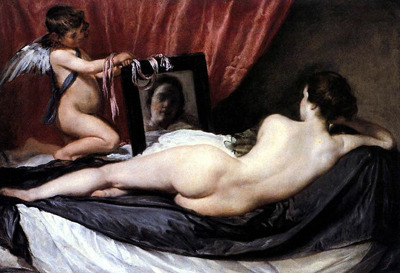
Robeky Venus by Diego Velasquez
This communication is similar to what an author experiences with his readers. For example: one idea that helped trigger the novel, or is included in the novel, comes from Gruber himself:
Some years ago my daughter worked on the campus of a technology firm here in Seattle and I occasionally went to lunch with her out there. On one of these occasions, we were walking down a corridor lined with glass-walled offices when I was struck by an image hanging against the glass of one of them. It was a reproduction of a Renaissance painting, a St. Sebastian, tied to a stake, pierced with arrows, looking hopefully heavenward. I was seized with curiosity as to why the inhabitant would post such an image in his office (or her, actually, for the inhabitant was at home.) As it happened, my daughter knew her, and made introductions. She was an art major, a fairly recent graduate of a good university, and she was helping the firm to organize its image holdings. I said,"I like your St. Sebastian." Blank look. I said, "The picture in your window."
"Oh, is that who it is? I just liked the image."
"Who is it by, do you know?" I asked
"No, but I found it in that book. I could look it up."
With that, she went to a copy of Gombrich's art history, in a particularly lavish, heavily illustrated edition, and threw it open in the middle, as one does with a thick volume. The page exposed showed an image of a 17th century Dutch landscape. She started to page through the book, but in the wrong direction, towards more modern art and not towards earlier.
When I pointed this out to her, she said, "How do you know? I thought you said you didn't know who painted it."
"I don't. But the style of the painting is from earlier in the book. You're in the 17th century there, and the Sebastian is a quattrocento painting, the 15th century, two centuries earlier."
Now appeared on her face a look that suggested to me that no one had ever spoken to her about historical styles of art. I might have been speaking Welsh. She clearly did not share my sense that an understanding of where art came from and what the artist meant by it, as derived from his own historical experience, is essential to the intelligent viewing of a picture.
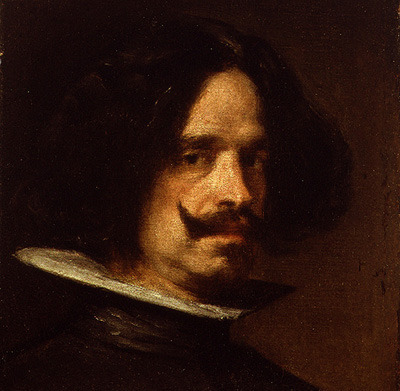
Velasquez
And so this remarkable story begins...steeped in art history: the history of a painting by Velasquez and a man who through ingesting an experimental drug travels back in time and believes he has become Velasquez. It is a story about a criminal deception, about the control some would exert over Chaz Wilmont. About people in his life who would do anything to get him to paint as he was meant to paint while profiting enormously in the process.
-------------------------------------------------------
About the author
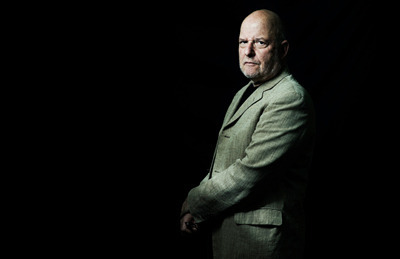
Michael Gruber
Are you a little bored with the conventional thriller but do you still get your entertainment from books, and are you the sort of reader that might read literary fiction but is often frustrated by the lack of a good "yarn" in such novels? Are you totally incensed at having to live in the "Cult of In-between" where your desire for the standards of literature that harbor questions posed in a serious way - questions surrounding the human condition - is in constant conflict with your craving for a good yarn; sadly consigned almost exclusively to thrillers that are formulaic and written in dull prose?
Michael Gruber shares your sensibilities. It's not that he harbors the inability to write popular fiction. He's actually quite good at it. He is generally acknowledged to be the ghostwriter of the popular Robert K. Tanenbaum series of Butch Karp novels starting with No Lesser Plea and ending with Resolve. That partnership ended when Gruber realized that writing the same book over and over was boring. And as Gruber says:
I'm not exactly bitching, had I stayed with that job I might be a Patricia Cornwell or a Clive Cussler by now, with seven-figure advances and the rest of that kind of life. On the subject of cults in fiction he clarifies the issue and defines it "as a writer with a relatively small number of passionately devoted fans, who never quite breaks into mass-market popularity."
And it's true: since then, Michael Gruber has not written the same book twice. Otherness is a word Gruber frequently uses to describe the Cult of In-between. Having discarded popular fiction and with it its millions of followers and since "I don't do cute, and there goes another 70 million readers..." it seems to Gruber that he will never attain the sales of some of his fellow authors (though he once did arrive on the NYT best seller list). Perhaps with a movie this might change as there are cases where a cult readership arrives at popular readership via the exposure of a novel onto the silver screen.
The novel, THE RETURN, (out since early September) would be an ideal vehicle for a couple of older male stars, and there's a nice ingenue role there as well. We shall see. I am pretty content with the cult as is, although I guess I could learn to like being fabulously wealthy too.
;
Gruber's life reads like that of a Renaissance man. Born in NYC and a graduate of the public school system he earned a BA in English literature and after working for various small magazines in NY, he went back to City College and obtained a second BA degree in biology. Even that wasn't enough, following this he went to Miami and received a masters in marine biology. During his stint in the U.S. Army he served as a medic. In 1973 he received a Ph.D. in marine sciences, for his study of octopus behavior.
Doing a 180 he worked as a chef in various NY restaurants, then he was a hippie, worked as a roadie for rock bands, was an analyst in Metropolitan Dade county, followed by the title of Director of Planning for HR; worked in D.C. in the Carter White House, Office of Science and Technology Policy; a policy analyst and speech writer for the EPA and was promptly promoted to Senior Executive Service of the U.S., the highest level of civil service.
Only then did he begin writing fiction, mostly writing the novels for Robert K. Tanenbaum after having moved to Seattle. Michael Gruber is a brilliant author whose books not only serve up great prose (and as is so often the case nary a plot to go with it), but delivers on both: a plot that is brilliant, cleverly worked out, and simultaneously delving deeply into the human condition. This, while reading along in "page turning" mode. That is not easy to do :-)
Michael Gruber is unique. I've only met a few that have read him, but he is an island unto his own: a brainy human being's thriller.
The Forgery of Venus represents Michael Gruber's fictitious foray into the world of representational art, aesthetics, forgeries, galleries, and art criticism. Meet Chaz Wilmont, an artist and our narrator within a narrator, the vehicle - a lemon - through which Gruber delivers his novel. Chaz speaks to you, the actual narrator, in the first person, through a series of sound files he recorded onto CD for you to listen to; and as with a lot of second-hand vehicles he breaks down often.
You might say this is a novel about madness as witnessed from within the mind of he that is going mad. It is a story of an astonishing representational painter who feels he is born into the wrong time; a time of post modernism, kitsch, pop-art, and artistic and critical pretentiousness surrounding the abstract; a world in which technique, drawing skills and true representation in art are dead. Chaz enters the novel indifferent to it all much as the following passage is descriptive of his ambivalence:
Slotsky was showing a kid named Emil Mono, big square tricolored abstracts in the loose dramatic style of Motherwell. One ground color, a blob of another color, and some blobs and streaks of a third color, perfectly respectable work, suitable for corporate lobbies, hotel meeting rooms, and the Whiteney Biennial. I really have no problem at all with work like this, in most cases a kind of wallpaper, anodyne, meaningless, or rather announcing the fact that meaning no longer inheres in painting.
Of what ailment is indifference indicative? When what you love is denigrated and abused as if finding a beautiful woman with whom you had a relationship leaning against a grimy wall, in a mini-skirt, in a congested tunnel where she may be bought? What behavior might it lead to? Depression? Amorality? Alcoholism and drug abuse? Yes! Of course! And so we meet Chaz Wilmont, who struggles to just be, to survive in a modern world, an art whore who delves into substance abuse, a behavior born out of his painful indifference.
I'd forgotten that booze knocked you out of that state of just being, which is why drunks are always going on about the past and making promises about the future, and why AA is always preaching one day at a time.
As most of my GR friends know, I read crime fiction. But I am also a seeker of unusual crime fiction and I am traveling across the world in search of inspiration only to find it right here in Seattle, with Michael Gruber. After all The Forgery of Venus is above all about the crime of forgery, about mafia criminals, Nazis, fraudulent museum purchases and greedy industrialists (and here I refer to the real meaning of "greed" - as opposed to self-interest - where one obtains what one wants at the severe cost to others, by stepping across dead bodies to get it). Representational art may well be considered dead but this does not mean the art form and its many historical paintings aren't used to create fabulous wealth: in auctions, theft, underworld money laundering and forgeries.
This is the carrot that is brought dangling before Chaz's nose, as if to say: "Your incredible talents need not be wasted. There are people who want what you do and what you have up until this point refused to do. There are people out there who understand the historical significance of a painting they might view; who understand that knowing art history lends to the enjoyment of a representational painting. There is no need to whore yourself out to advertising agencies and produce kitsch in order to survive and feed your wife and children."
Every painting begins with an idea. The artist takes this idea and concretizes it into various aspects or objects that he places within the frame and onto his canvass. When we walk into a gallery or museum a subconscious communication takes place between you and the painter and it goes something like this: "I've given you the concretes," the painter says, "and now it is up to you to put them together and if I'm successful, you will within your own experiences arrive at the place where I started." (I will confine these remarks to representational art alone). Here is the painting in question:
Robeky Venus by Diego Velasquez
This communication is similar to what an author experiences with his readers. For example: one idea that helped trigger the novel, or is included in the novel, comes from Gruber himself:
Some years ago my daughter worked on the campus of a technology firm here in Seattle and I occasionally went to lunch with her out there. On one of these occasions, we were walking down a corridor lined with glass-walled offices when I was struck by an image hanging against the glass of one of them. It was a reproduction of a Renaissance painting, a St. Sebastian, tied to a stake, pierced with arrows, looking hopefully heavenward. I was seized with curiosity as to why the inhabitant would post such an image in his office (or her, actually, for the inhabitant was at home.) As it happened, my daughter knew her, and made introductions. She was an art major, a fairly recent graduate of a good university, and she was helping the firm to organize its image holdings. I said,"I like your St. Sebastian." Blank look. I said, "The picture in your window."
"Oh, is that who it is? I just liked the image."
"Who is it by, do you know?" I asked
"No, but I found it in that book. I could look it up."
With that, she went to a copy of Gombrich's art history, in a particularly lavish, heavily illustrated edition, and threw it open in the middle, as one does with a thick volume. The page exposed showed an image of a 17th century Dutch landscape. She started to page through the book, but in the wrong direction, towards more modern art and not towards earlier.
When I pointed this out to her, she said, "How do you know? I thought you said you didn't know who painted it."
"I don't. But the style of the painting is from earlier in the book. You're in the 17th century there, and the Sebastian is a quattrocento painting, the 15th century, two centuries earlier."
Now appeared on her face a look that suggested to me that no one had ever spoken to her about historical styles of art. I might have been speaking Welsh. She clearly did not share my sense that an understanding of where art came from and what the artist meant by it, as derived from his own historical experience, is essential to the intelligent viewing of a picture.
Velasquez
And so this remarkable story begins...steeped in art history: the history of a painting by Velasquez and a man who through ingesting an experimental drug travels back in time and believes he has become Velasquez. It is a story about a criminal deception, about the control some would exert over Chaz Wilmont. About people in his life who would do anything to get him to paint as he was meant to paint while profiting enormously in the process.
-------------------------------------------------------
About the author
Michael Gruber
Are you a little bored with the conventional thriller but do you still get your entertainment from books, and are you the sort of reader that might read literary fiction but is often frustrated by the lack of a good "yarn" in such novels? Are you totally incensed at having to live in the "Cult of In-between" where your desire for the standards of literature that harbor questions posed in a serious way - questions surrounding the human condition - is in constant conflict with your craving for a good yarn; sadly consigned almost exclusively to thrillers that are formulaic and written in dull prose?
Michael Gruber shares your sensibilities. It's not that he harbors the inability to write popular fiction. He's actually quite good at it. He is generally acknowledged to be the ghostwriter of the popular Robert K. Tanenbaum series of Butch Karp novels starting with No Lesser Plea and ending with Resolve. That partnership ended when Gruber realized that writing the same book over and over was boring. And as Gruber says:
I'm not exactly bitching, had I stayed with that job I might be a Patricia Cornwell or a Clive Cussler by now, with seven-figure advances and the rest of that kind of life. On the subject of cults in fiction he clarifies the issue and defines it "as a writer with a relatively small number of passionately devoted fans, who never quite breaks into mass-market popularity."
And it's true: since then, Michael Gruber has not written the same book twice. Otherness is a word Gruber frequently uses to describe the Cult of In-between. Having discarded popular fiction and with it its millions of followers and since "I don't do cute, and there goes another 70 million readers..." it seems to Gruber that he will never attain the sales of some of his fellow authors (though he once did arrive on the NYT best seller list). Perhaps with a movie this might change as there are cases where a cult readership arrives at popular readership via the exposure of a novel onto the silver screen.
The novel, THE RETURN, (out since early September) would be an ideal vehicle for a couple of older male stars, and there's a nice ingenue role there as well. We shall see. I am pretty content with the cult as is, although I guess I could learn to like being fabulously wealthy too.
;
Gruber's life reads like that of a Renaissance man. Born in NYC and a graduate of the public school system he earned a BA in English literature and after working for various small magazines in NY, he went back to City College and obtained a second BA degree in biology. Even that wasn't enough, following this he went to Miami and received a masters in marine biology. During his stint in the U.S. Army he served as a medic. In 1973 he received a Ph.D. in marine sciences, for his study of octopus behavior.
Doing a 180 he worked as a chef in various NY restaurants, then he was a hippie, worked as a roadie for rock bands, was an analyst in Metropolitan Dade county, followed by the title of Director of Planning for HR; worked in D.C. in the Carter White House, Office of Science and Technology Policy; a policy analyst and speech writer for the EPA and was promptly promoted to Senior Executive Service of the U.S., the highest level of civil service.
Only then did he begin writing fiction, mostly writing the novels for Robert K. Tanenbaum after having moved to Seattle. Michael Gruber is a brilliant author whose books not only serve up great prose (and as is so often the case nary a plot to go with it), but delivers on both: a plot that is brilliant, cleverly worked out, and simultaneously delving deeply into the human condition. This, while reading along in "page turning" mode. That is not easy to do :-)
Michael Gruber is unique. I've only met a few that have read him, but he is an island unto his own: a brainy human being's thriller.

January 12, 2020
Brilliant in many respects, Gruber takes the reader on an unusual journey toggling back and forth from the present to the days of the famous Spanish artist, Velasquez. The catch is that the mind of the central character, Chaz Wilmot may or may not be how this journey is experienced. Extremely well researched, the characters engage at a deep level offering art history in parallel with the underworld of art forgery. With a lifelong appreciation for great art while lacking the knowledge of the masters, this story has inspired me to learn more about them! But it's the journey that will continually raise questions in your mind, the central theme being, What is real? This is a great story and unique in many respects. Highly recommend, whether art is of interest or not!
This entire review has been hidden because of spoilers.

November 25, 2013
Thanks to Judy Wisdomkeeper's comment on Goodreads for recommending this book. Gruber's writing style has a voice, and right away that puts him at the top of my list. Besides the plotting, which goes back and forth in time in ways I've never experienced in a book, The Forgery of Venus fascinates in two other ways - its meticulous description of painting technique and its depiction of mental illness. Peter Carey's Theft, which I also enjoyed, also has these two elements. The neurological issues are also reminiscent of another masterpiece novel, The Marriage Plot by Jeffrey Eugenides.

September 30, 2024
I was so mesmerized by Michael Gruber’s captivating novel “The Forgery of Venus” that I stayed up to finish it until the subtle pink and gold slivers of dawn crept over my bedroom drapes.
This complex story gets fascinating when Chaz Wilmot Jr, a frustrated artist, takes part in a drug trial that tests historically mystical shamanistic herbs on subjects. The doctors running these trials suggest that the subjects should experience increased creativity after taking the herbs.
Being in a productivity lull, Chaz jumps at the chance to participate in the study, and it turns out that he is highly susceptible to this herbal medicine and begins experiencing past life experiences of 16th C. Spanish artist Diego Velázquez.
Oddly, during Chaz’s college days, he boasted, “I can paint like Velázquez. I can paint like anybody—except me.”
After another herb-induced trance, Chaz declared, “I’m in the lushest creative run of my entire life…”
But is it his art he's producing, or is he tapping into the genius of a long-dead old master artist—Velázquez?
Could these be the signs of a creative breakthrough or a descent into madness? What is going on with Chaz?
I was utterly drawn into Gruber’s mesmerizing narrative, a literary rollercoaster filled with vibrant imagery and a mind-bending exploration of Chaz’s experiences.
This story is a kaleidoscope of constantly changing colored glass pieces. It's like flipping through flashcards of the artist's life—wondering if what he's experiencing is a dream, a premonition, a shared consciousness from a regressed past life, a hallucination, or perhaps a psychotic break.
You’ll have to read until the very end to uncover the truth—or decide for yourself what you believe to be the truth.
JoyReaderGirl1 submits this objective review, and I offer my heartfelt gratitude to Author Michael Gruber and Publisher William Morrow for making this enthralling mystery-thriller novel available to the general public.
This complex story gets fascinating when Chaz Wilmot Jr, a frustrated artist, takes part in a drug trial that tests historically mystical shamanistic herbs on subjects. The doctors running these trials suggest that the subjects should experience increased creativity after taking the herbs.
Being in a productivity lull, Chaz jumps at the chance to participate in the study, and it turns out that he is highly susceptible to this herbal medicine and begins experiencing past life experiences of 16th C. Spanish artist Diego Velázquez.
Oddly, during Chaz’s college days, he boasted, “I can paint like Velázquez. I can paint like anybody—except me.”
After another herb-induced trance, Chaz declared, “I’m in the lushest creative run of my entire life…”
But is it his art he's producing, or is he tapping into the genius of a long-dead old master artist—Velázquez?
Could these be the signs of a creative breakthrough or a descent into madness? What is going on with Chaz?
I was utterly drawn into Gruber’s mesmerizing narrative, a literary rollercoaster filled with vibrant imagery and a mind-bending exploration of Chaz’s experiences.
This story is a kaleidoscope of constantly changing colored glass pieces. It's like flipping through flashcards of the artist's life—wondering if what he's experiencing is a dream, a premonition, a shared consciousness from a regressed past life, a hallucination, or perhaps a psychotic break.
You’ll have to read until the very end to uncover the truth—or decide for yourself what you believe to be the truth.
JoyReaderGirl1 submits this objective review, and I offer my heartfelt gratitude to Author Michael Gruber and Publisher William Morrow for making this enthralling mystery-thriller novel available to the general public.

April 6, 2009
Although it contains a promising theme, The Forgery of Venus lacks a compelling story. Its characters are largely shallow and uninteresting; its plot is overly-complicated; the pacing suffers from an overabundance of exposition. While I'm sure Gruber had the best of intentions, his poor technical execution leaves much to be desired. Ultimately, I found The Forgery of Venus unsatisfactory.
For reasons that later become clear (unreliable narrator), Gruber chooses to wrap the story in a frame narrative told from the point of view of the protagonist's former college buddy. The scenario goes as follows: the protagonist, Chaz Wilmot, has recorded his narrative on a CD, which he then hands to the frame narrator at a party celebrating the sale of a 17th century painting that Wilmot may or may not have painted. For the first few chapters, Gruber dazzles us with exposition, in which our cardboard characters get shellacked with various traumas and emotional baggage--daddy issues, mommy issues, commitment issues, etc.--and the structure works! But then the story proper begins, and suddenly it doesn't sound like Chaz is dictating his story anymore. However, the "suspension of disbelief" sign has turned on, and I've fastened my seat belt, so apparently I'm going along for the ride.
And this is an important point: why is it necessary to justify a story told from the first-person perspective. If it isn't a frame narrative, it's a weak Call-Me-Ishmael chapter. In the specific case of The Forgery of Venus, I have the misfortune in that the only character I dislike more than Chaz Wilmot is the frame narrator. While Gruber can justify Chaz's painful expository chapters as consistent with the structure of the narrative, the frame narrator has no such crutch upon which to lean: the exposition in the introduction is anaemic and unnecessary. Just to set the record straight, most Canadians don't say "eh" at the end of their sentences; while I'm sure there are some who do, the very idea that you mentioned the stereotype offended me. The frame narrator's explanation of why Chaz is talking to him is weak at best: he suddenly switched his major from acting to pre-law because of a painting Chaz did while he was in costume? And somewhere along the way he picked up enough art history to appreciate the significance of Chaz's adventure from a scholarly perspective?
The unbelievable plot, in addition to the unbelievable, paper-thin characters, is what ruined this book for me. The themes that Gruber attempts to evince are worthy. The book improves toward the end, so I'm glad I persevered, and I understand Gruber's message about the mutability of our reality. Unfortunately, any redeeming aspects of The Forgery of Venus are crushed by its poor plotting and weak writing. It's, in some ways, an anti-The Da Vinci Code--Dan Brown's research was weak, but as a writer he managed to create a compelling story. Conversely, Gruber's research and themes are strong, but the story lacks life and substance. The number of acceptable scenarios in which one can say, "Dad had a little problem" are few. I think that's the point where I gave up on the book's quality and resolved merely to finish it so I could give it a complete (notice I didn't say "fair") review.
I eked very little enjoyment from The Forgery of Venus. As romantic and attractive as the art forgery scene may seem, Gruber manages to quash that feeling in his drug-induced insanity plot. Had I any sympathy for the protagonist after the first few chapters (which I didn't), in which he whines about how unfortunate his life has been, it would have slowly bled out of me while I watched Chaz firmly refuse to take any responsibility for his own life. He's a passive protagonist.
The Forgery of Venus is a dead-on-arrival story burdened by its author's prose. I feel sorry for it, but not for its characters. I look forward to cleansing my reading palate with something more tasty next.
For reasons that later become clear (unreliable narrator), Gruber chooses to wrap the story in a frame narrative told from the point of view of the protagonist's former college buddy. The scenario goes as follows: the protagonist, Chaz Wilmot, has recorded his narrative on a CD, which he then hands to the frame narrator at a party celebrating the sale of a 17th century painting that Wilmot may or may not have painted. For the first few chapters, Gruber dazzles us with exposition, in which our cardboard characters get shellacked with various traumas and emotional baggage--daddy issues, mommy issues, commitment issues, etc.--and the structure works! But then the story proper begins, and suddenly it doesn't sound like Chaz is dictating his story anymore. However, the "suspension of disbelief" sign has turned on, and I've fastened my seat belt, so apparently I'm going along for the ride.
And this is an important point: why is it necessary to justify a story told from the first-person perspective. If it isn't a frame narrative, it's a weak Call-Me-Ishmael chapter. In the specific case of The Forgery of Venus, I have the misfortune in that the only character I dislike more than Chaz Wilmot is the frame narrator. While Gruber can justify Chaz's painful expository chapters as consistent with the structure of the narrative, the frame narrator has no such crutch upon which to lean: the exposition in the introduction is anaemic and unnecessary. Just to set the record straight, most Canadians don't say "eh" at the end of their sentences; while I'm sure there are some who do, the very idea that you mentioned the stereotype offended me. The frame narrator's explanation of why Chaz is talking to him is weak at best: he suddenly switched his major from acting to pre-law because of a painting Chaz did while he was in costume? And somewhere along the way he picked up enough art history to appreciate the significance of Chaz's adventure from a scholarly perspective?
The unbelievable plot, in addition to the unbelievable, paper-thin characters, is what ruined this book for me. The themes that Gruber attempts to evince are worthy. The book improves toward the end, so I'm glad I persevered, and I understand Gruber's message about the mutability of our reality. Unfortunately, any redeeming aspects of The Forgery of Venus are crushed by its poor plotting and weak writing. It's, in some ways, an anti-The Da Vinci Code--Dan Brown's research was weak, but as a writer he managed to create a compelling story. Conversely, Gruber's research and themes are strong, but the story lacks life and substance. The number of acceptable scenarios in which one can say, "Dad had a little problem" are few. I think that's the point where I gave up on the book's quality and resolved merely to finish it so I could give it a complete (notice I didn't say "fair") review.
I eked very little enjoyment from The Forgery of Venus. As romantic and attractive as the art forgery scene may seem, Gruber manages to quash that feeling in his drug-induced insanity plot. Had I any sympathy for the protagonist after the first few chapters (which I didn't), in which he whines about how unfortunate his life has been, it would have slowly bled out of me while I watched Chaz firmly refuse to take any responsibility for his own life. He's a passive protagonist.
The Forgery of Venus is a dead-on-arrival story burdened by its author's prose. I feel sorry for it, but not for its characters. I look forward to cleansing my reading palate with something more tasty next.

July 2, 2008
Oh how I love Michael Gruber.
Here's a man who never writes the same book twice. The first of his I read was The Witch's Boy, a modern fairy tale.
Then I read Tropic of Night, which has mainly to do with voodoo in Miami (I'm leaving out a lot of important details, but it was excellent).
And then I moved on to The Book of Air and Shadows, which is a "literary thriller," meaning that it's a thriller that centers around books, one of my very favorite genres.
And now The Forgery of Venus, which has to do, broadly, with art and a sort of time travel. I was an art history minor in college, so I could conjure up all the paintings in my mind while reading about them, which of course helped, but I'm sure that's not necessary. It's a real page turner; I read this book in the space of 24 hours.
The point is: this man can write. I'm happy that I still haven't read everything he's written.
Here's a man who never writes the same book twice. The first of his I read was The Witch's Boy, a modern fairy tale.
Then I read Tropic of Night, which has mainly to do with voodoo in Miami (I'm leaving out a lot of important details, but it was excellent).
And then I moved on to The Book of Air and Shadows, which is a "literary thriller," meaning that it's a thriller that centers around books, one of my very favorite genres.
And now The Forgery of Venus, which has to do, broadly, with art and a sort of time travel. I was an art history minor in college, so I could conjure up all the paintings in my mind while reading about them, which of course helped, but I'm sure that's not necessary. It's a real page turner; I read this book in the space of 24 hours.
The point is: this man can write. I'm happy that I still haven't read everything he's written.

April 11, 2021
Initially captivating - the premise of a hallucinogen that allowed a 21st century artist - who is drowning in his own personal stories about how art should be versus how it is now - to find himself transported into the body, mind and era of Diego Velasquez. Sometimes.
But soon the story became repetitive and terribly overwrought - as though the author needed to demonstrate his vast knowledge. Yada yada. Halfway through, when i realized i was not enjoying it anymore i considered giving up. But the book’s perseveration allowed for skimming without the loss of anything valuable, so i did that. Still a waste of time.
Maybe the author’s chosen photo on the back cover should have been a hint. Why is he dressed as a medieval monk? A definite skip.
But soon the story became repetitive and terribly overwrought - as though the author needed to demonstrate his vast knowledge. Yada yada. Halfway through, when i realized i was not enjoying it anymore i considered giving up. But the book’s perseveration allowed for skimming without the loss of anything valuable, so i did that. Still a waste of time.
Maybe the author’s chosen photo on the back cover should have been a hint. Why is he dressed as a medieval monk? A definite skip.

November 20, 2018
A fascinating tale of art, artistry, art forgery, time travel and what literary critic John Clute dubbed godgaming: the gaslighting, for reasons nefarious or otherwise, of someone so that they come to believe in a completely false reality.
Chaz Wilmot Jr, living in the shadow of the memory of his father, an artist in the Norman Rockwell mold, is himself a relatively successful commercial artist who's constantly trying to hide it from himself that, just like his celebrated father, he could have been so much more of an artist than his own timidity has allowed him to be. To increase the pressure on him, his son by his second failed marriage has a mystery ailment that may kill him young unless he has the kind of medical treatment that only multimillionaires can afford.
When a medical researcher offers Chaz a place on an experimental program to test a new drug that will supposedly boost imaginative creativity, he jumps at the chance. But the drug does more than enhance creativity. It also -- as per the drug in Daphne du Maurier's The House on the Strand -- seems to give him the power to travel into other lives and alternate versions of his own life. In particular, he finds himself drawn into the existence of Diego Velázquez, the great 17th-century Spanish painter. On occasion he recovers consciousness after one of his transtemporal journeys to find that in his absence, so to speak, he has been painting in the style of Velázquez.
From there it's but a short step to Chaz's immersion in an international conspiracy to launch new forgeries of the Old Masters onto the art market, beginning with a phony Velázquez, an erotic masterpiece that he painted in response to a months-long love affair he experienced in his centuries-ago existence as the great painter.
But there's a drawback to forging artworks for gangsters. They reckon the one thing that could go wrong with their fraudulent schemes is if the forger himself blabs, and there's an obvious way of making sure this doesn't happen . . .
It's difficult to know quite where to start in describing why I enjoyed this book so much. So far as I can tell (I was married for twenty years to a fine artist), the artistic insider-talk is authentic, complete with lots of very funny, very snide remarks about New York's Whitney Museum and the stuff it chooses to hang. (For some reason MoMA escapes similar mockery.) I know far less about the art-forgery world, for obvious reasons -- the closest I've ever come to it is never quite getting round to reading Tom Keating's autobiography -- but in this respect, too, the details seem authentic.
The book's stuffed with nice artistic insights. Here, for example, is part of Chaz's commentary on why a particular life-sized portrait Velázquez did is so affecting:
On reading that observation, that what's important about a portrait is not just the painter, not just the subject, but the intersection of their two lives, I sat back in my chair, and said, "Yes!" before continuing to read. And there are countless little observations like this. For the time I was reading this novel I felt I was learning to think how a fine artist can think.
Aside from a short framing section front and back, the novel's narrative is supposedly a transcription of Chaz's own account of events as dictated by him onto a compact disk. As such, it mimics spoken monologue, with lots of sequential commas everywhere and the like. It took me a little while to get used to this but, once I did, it seemed completely natural, the "spoken" flow of the words drawing me in in a way that a more formally correct text might not have done -- so much so that, when I got to the book's last few pages and the concluding little section by Chaz's friend, the more written style seemed almost anticlimactic. I felt rather like Chaz's friend did when he wrote, as the book's final few lines:
The wrapup near the end of the book, where most of what has gone before is rationalized, struck me as a tad hasty, and I can imagine this section would strike some readers as being clodhoppingly Dan Brownish. As for me, though, it made me grin. For much of the book Gruber has been pretending to spin a Dan Brownish tale while mischievously addressing quite different concerns, and now here he comes right out into the open in a sort of take-it-or-leave-it moment before returning to what he's really interested in.
The Forgery of Venus represented, for me, an absolutely addictive experience -- far more gripping than the average thriller or adventure yarn. It surely has launched Gruber into the forefront of my consciousness as a writer to watch.
Chaz Wilmot Jr, living in the shadow of the memory of his father, an artist in the Norman Rockwell mold, is himself a relatively successful commercial artist who's constantly trying to hide it from himself that, just like his celebrated father, he could have been so much more of an artist than his own timidity has allowed him to be. To increase the pressure on him, his son by his second failed marriage has a mystery ailment that may kill him young unless he has the kind of medical treatment that only multimillionaires can afford.
When a medical researcher offers Chaz a place on an experimental program to test a new drug that will supposedly boost imaginative creativity, he jumps at the chance. But the drug does more than enhance creativity. It also -- as per the drug in Daphne du Maurier's The House on the Strand -- seems to give him the power to travel into other lives and alternate versions of his own life. In particular, he finds himself drawn into the existence of Diego Velázquez, the great 17th-century Spanish painter. On occasion he recovers consciousness after one of his transtemporal journeys to find that in his absence, so to speak, he has been painting in the style of Velázquez.
From there it's but a short step to Chaz's immersion in an international conspiracy to launch new forgeries of the Old Masters onto the art market, beginning with a phony Velázquez, an erotic masterpiece that he painted in response to a months-long love affair he experienced in his centuries-ago existence as the great painter.
But there's a drawback to forging artworks for gangsters. They reckon the one thing that could go wrong with their fraudulent schemes is if the forger himself blabs, and there's an obvious way of making sure this doesn't happen . . .
It's difficult to know quite where to start in describing why I enjoyed this book so much. So far as I can tell (I was married for twenty years to a fine artist), the artistic insider-talk is authentic, complete with lots of very funny, very snide remarks about New York's Whitney Museum and the stuff it chooses to hang. (For some reason MoMA escapes similar mockery.) I know far less about the art-forgery world, for obvious reasons -- the closest I've ever come to it is never quite getting round to reading Tom Keating's autobiography -- but in this respect, too, the details seem authentic.
The book's stuffed with nice artistic insights. Here, for example, is part of Chaz's commentary on why a particular life-sized portrait Velázquez did is so affecting:
But [the portrait's] power comes from a lot more than scale, because a life-size Kodachrome print would be a joke. It's not mere illusion, has nothing to do with those fussy little nature mort or trompe l'oeil paintings you see in the side rooms of museums, it's its own thing, the life of two men, artist and subject interpenetrated, coming alive, the vital loom of a life in a moment of time . . .
On reading that observation, that what's important about a portrait is not just the painter, not just the subject, but the intersection of their two lives, I sat back in my chair, and said, "Yes!" before continuing to read. And there are countless little observations like this. For the time I was reading this novel I felt I was learning to think how a fine artist can think.
Aside from a short framing section front and back, the novel's narrative is supposedly a transcription of Chaz's own account of events as dictated by him onto a compact disk. As such, it mimics spoken monologue, with lots of sequential commas everywhere and the like. It took me a little while to get used to this but, once I did, it seemed completely natural, the "spoken" flow of the words drawing me in in a way that a more formally correct text might not have done -- so much so that, when I got to the book's last few pages and the concluding little section by Chaz's friend, the more written style seemed almost anticlimactic. I felt rather like Chaz's friend did when he wrote, as the book's final few lines:
[I] stood for a moment in front of the greatest painting in the world, The Maids of Honor by Velázquez, and thought about what it would be like to be him, really be him, and I couldn't deal with it, and I left and reentered the long, gray sanity of my life.
The wrapup near the end of the book, where most of what has gone before is rationalized, struck me as a tad hasty, and I can imagine this section would strike some readers as being clodhoppingly Dan Brownish. As for me, though, it made me grin. For much of the book Gruber has been pretending to spin a Dan Brownish tale while mischievously addressing quite different concerns, and now here he comes right out into the open in a sort of take-it-or-leave-it moment before returning to what he's really interested in.
The Forgery of Venus represented, for me, an absolutely addictive experience -- far more gripping than the average thriller or adventure yarn. It surely has launched Gruber into the forefront of my consciousness as a writer to watch.

March 19, 2009
Rather than give a complete summary of this book, it would would be preferable to comment on several points. It is positively essential for the reader to suspend many previous held beliefs while reading this complex tale because it has the appearance of being a supernatural fantasy. Yet, perhaps it is. The reader is guided through a maze of elaborate, yet wondrous experiences. Is Chaz, the protagonist, actually experiencing these time travel events? Is he psychotic? Are the amazing events, so vividly portrayed here, stimulated by drugs? Just when the reader discovers that the answers have been provided toward the end of the book, many new questions arise. Despite Gruber's capable manipulation of the facts, it seems that for everything to have occurred, there would have had to be an amazing amount of coordination and manipulation of the many people and locations involved.
Despite some criticism stated here, it is impossible not to appreciate this novel. Gruber is an elegant, intelligent writer. He is masterful in his ability to provide the reader with vivid representations of art work, the environment and to portray his characters. His discussions of historical events, artists and their great works are inspirations to seek further information on them.
It was also rewarding to note that Gruber made many references to how senselesss and unappealing "modern" art was to Chaz and others- a feeling that this reader shares. The senseless materialism of many consumers was approached well also.
This book has inspired me to seek other works by this gifted, clearly elite author.
Despite some criticism stated here, it is impossible not to appreciate this novel. Gruber is an elegant, intelligent writer. He is masterful in his ability to provide the reader with vivid representations of art work, the environment and to portray his characters. His discussions of historical events, artists and their great works are inspirations to seek further information on them.
It was also rewarding to note that Gruber made many references to how senselesss and unappealing "modern" art was to Chaz and others- a feeling that this reader shares. The senseless materialism of many consumers was approached well also.
This book has inspired me to seek other works by this gifted, clearly elite author.

November 15, 2018
B.R.A.CE. 2018 4 βιβλία των Εκδόσεων Bell
(3/4)
Καθώς το διάβαζα αναρωτιόμουν αν διάβαζα Το Νησί των Καταραμένων (τσέκαρα και το εξώφυλλο ξανά). Δεν μπορούσα να καταλάβω που θα το πάει, στην παράνοια ή στο παραφυσικό. Δεν θα σας πω γιατί, όπως είναι γνωστό, ΕΣΥ αποφασίζεις!
Μου κράτησε το ενδιαφέρον, ενώ δεν το περίμενα για να είμαι ειλικρινής. Μου άρεσαν οι αναφορές στη ζωγραφική και στις τεχνικές και όπως πάντα με τέτοιες περιπτώσεις "χάθηκα" στο wikipedia για να μάθω για πίνακες που αναφέρονταν, για τον Diego Velázquez κι άλλα τέτοια που πολύ μου αρέσουν!
Ωραία υπόθεση, ενδιαφέροντα στοιχεία, πέρασα την ώρα μου ικανοποιητικά!
Καθώς το διάβαζα αναρωτιόμουν αν διάβαζα Το Νησί των Καταραμένων (τσέκαρα και το εξώφυλλο ξανά). Δεν μπορούσα να καταλάβω που θα το πάει, στην παράνοια ή στο παραφυσικό. Δεν θα σας πω γιατί, όπως είναι γνωστό, ΕΣΥ αποφασίζεις!
Μου κράτησε το ενδιαφέρον, ενώ δεν το περίμενα για να είμαι ειλικρινής. Μου άρεσαν οι αναφορές στη ζωγραφική και στις τεχνικές και όπως πάντα με τέτοιες περιπτώσεις "χάθηκα" στο wikipedia για να μάθω για πίνακες που αναφέρονταν, για τον Diego Velázquez κι άλλα τέτοια που πολύ μου αρέσουν!
Ωραία υπόθεση, ενδιαφέροντα στοιχεία, πέρασα την ώρα μου ικανοποιητικά!
July 23, 2016
For those reviewers who gave this less than 5 stars: respectfully - you are of course entitled to your opinion! - but really, what can you want from an author? The book is creative & well written, the author has done his research and uses it to support an intriguing look at art, memory, the nature of our identity, our selves, our relationships, how value is derived (at least in art) the gray areas of human behavior and a whole lot more. So really - you're going to complain?
Okay, okay, as I said, everyone is entitled to their opinion, which is what makes it all so much fun. And speaking of fun, this book is a great read. It's not light and breezy fun, but a great summer combination of page-turning and thought-provoking. The unreliable narrator, in this case, is the perfect instrument for exploring many of the topics named above, and I did from time to time think of Billy Pilgrim, untethered from time in a similar way, though more of a foil than is the protagonist here. And similarly either crazy or not. Beyond that, maybe the similarities end with the fact that they both float around in time and space and are therefore fascinating & suspect storytellers, but in my defense, how often do you meet people, even fictional ones, like that?
As someone who used to hobby-paint, I *loved* the descriptions of painting. The writing in general is enthusiastic and deft, but while I found these passages inspiring enough to make me want to find my brushes again (if I could get off the couch - perhaps I'll read another novel instead), I do wonder how someone uninterested in the process might get through them. Maybe just fine - it's not a question meant to imply a negative, but a genuine curiosity. On the other hand, I once read a 10,000 word article on shipping via the eyes of sailors on a tramp steamer simply because the writing was just so good, and I suspect the same thing will pull along any non-artistically oriented reader.
A word about endings: I felt a bit let down by this one, but I also feel a tremendous sympathy for the author - and contemporary writers generally. The arc of modern literature has left them in a position whereby if they leave the ending ambiguous, people complain that it's a cop-out; yet if they come down on one side or the other, people complain that it's too tidy and real life does not work that way. Perhaps this suggests the need to re-structure the novel, but in Western literature, conflict is at the heart of every story, and where does that leave the writer? Not everyone can writing an ending as perfect as Joyce did for The Dubliners, and there are plenty of books out there with satisfying endings. Still, I empathize, and it did little to dampen my enjoyment of the novel.
But as usual, I digress. Pick up the book, pay the author, read the story. You'll be doing a good thing.
Okay, okay, as I said, everyone is entitled to their opinion, which is what makes it all so much fun. And speaking of fun, this book is a great read. It's not light and breezy fun, but a great summer combination of page-turning and thought-provoking. The unreliable narrator, in this case, is the perfect instrument for exploring many of the topics named above, and I did from time to time think of Billy Pilgrim, untethered from time in a similar way, though more of a foil than is the protagonist here. And similarly either crazy or not. Beyond that, maybe the similarities end with the fact that they both float around in time and space and are therefore fascinating & suspect storytellers, but in my defense, how often do you meet people, even fictional ones, like that?
As someone who used to hobby-paint, I *loved* the descriptions of painting. The writing in general is enthusiastic and deft, but while I found these passages inspiring enough to make me want to find my brushes again (if I could get off the couch - perhaps I'll read another novel instead), I do wonder how someone uninterested in the process might get through them. Maybe just fine - it's not a question meant to imply a negative, but a genuine curiosity. On the other hand, I once read a 10,000 word article on shipping via the eyes of sailors on a tramp steamer simply because the writing was just so good, and I suspect the same thing will pull along any non-artistically oriented reader.
A word about endings: I felt a bit let down by this one, but I also feel a tremendous sympathy for the author - and contemporary writers generally. The arc of modern literature has left them in a position whereby if they leave the ending ambiguous, people complain that it's a cop-out; yet if they come down on one side or the other, people complain that it's too tidy and real life does not work that way. Perhaps this suggests the need to re-structure the novel, but in Western literature, conflict is at the heart of every story, and where does that leave the writer? Not everyone can writing an ending as perfect as Joyce did for The Dubliners, and there are plenty of books out there with satisfying endings. Still, I empathize, and it did little to dampen my enjoyment of the novel.
But as usual, I digress. Pick up the book, pay the author, read the story. You'll be doing a good thing.

July 12, 2008
I've read Michael Gruber's voodoo-mystic, Miami atmosphere thrillers, loved them, and was thrown by this latest effort.
The Forgery of Venus takes the reader to the New York art scene, and immerges him into a world whose boundaries have been lost by drugs and self pity. The protagonist, an artist who has failed to live up to his potential, becomes involved in a scheme to forge a Valezques.
What the reader is left with at the end is questions, not answers. Did the drug trial the artist participate in create an alternate universe? Was he forced into his criminal business deal? Did he really go insane, or did he find his way to his true artistic gifts outside the strict codes the New York art community was enforcing?
If your preference is a book that makes you think, and leaves you wondering, this book is for you. Everything is pitch perfect: the atmosphere, characters, plot. Gruber doesn't hit one wrong note in this work. I'll be thinking about this one for a long time, and eagerly will await his next effort.
The Forgery of Venus takes the reader to the New York art scene, and immerges him into a world whose boundaries have been lost by drugs and self pity. The protagonist, an artist who has failed to live up to his potential, becomes involved in a scheme to forge a Valezques.
What the reader is left with at the end is questions, not answers. Did the drug trial the artist participate in create an alternate universe? Was he forced into his criminal business deal? Did he really go insane, or did he find his way to his true artistic gifts outside the strict codes the New York art community was enforcing?
If your preference is a book that makes you think, and leaves you wondering, this book is for you. Everything is pitch perfect: the atmosphere, characters, plot. Gruber doesn't hit one wrong note in this work. I'll be thinking about this one for a long time, and eagerly will await his next effort.
This entire review has been hidden because of spoilers.

February 24, 2008
I cannot even describe how much I love art forgery. I don't know why. I don't know what it is, but art forgery fascinates me. Which is weird because unoriginality, copycatting, clones of society, all that crap pisses me off. But there's just something about...the lengths people go to, the imitation of something so great that someone would rather try to recreate it than even bother to attempt to create something better of their own, the...homage of it. It just excites my emotions. Anyway! This book is a head trip. It's great. It's like living in madness, at least a little bit...until the book is over. I loved it a lot. I may try to read the author's other works as well now.
January 11, 2009
I really like the way Gruber writes. I like his use of language, his rhythms, his pacing, his words. His characters live, too. Here, they're similar to the characters in his first book, but that's fine, since they're fun. In this book, he has some really lovely moments where character changes occurr subtly and effectively. He writes about art-related topics with sensitivity. His endings are a little over the top for me...his writing is good enough that he doesn't need all the fuss at the end. But still, they're fun. This is a great airplane book...or rainy weekend book. It's totally absorbing. I like it even more than his first book.

March 8, 2014
This was a pretty good book. One that I didn't hold out to big of expectations for to be honest. In the hands of someone else this book could have been very dry and boring because in my opinion the actual story wasn't that great until almost the end, but it was neither. The writing and characters kept me going, especially Chaz. Even though he was a batshit crazy, snotty artist he was likable and him as narrator was great. The details about art in general were bordering on pretentious, but were mostly enjoyable and immersed you into the world. Great ending as well. Thumbs up :)

August 28, 2022
Pues al final ni chicha ni limoná. El libro cuenta la historia de un pintor hijo de un pintor reputado que, tras tomarse una droga experimental, empieza a tener recuerdos de la vida de Velázquez. El libro mejora mucho cuando se narra la historia de Velázquez, pero empeora sobremanera cuando vuelve al presente. Además, para disfrutar de todo del libro hay que saber de pintura, porque si yo que algo sé de eso las partes de pintura pura y dura se me han hecho densas no quiero ni imaginar a alguien que no sepa absolutamente nada de Historia del Arte o de Velázquez. Está bien, normal, pero poco más.
July 7, 2024
I should not blame the author for the annoying, crappy, horrible, constantly distracting formatting fuckups, but they are the TOTAL reason why I rated this excellent novel, a “4”. It should be a “5” or even (impossibly) higher. In it, quattrocento art, artists, atmosphere, history, etc., are front and center in the story of a contemporary painter whose gift is remarkable though out of step with today. And, as Hamlet says, “there’s the rub.” When he channels the genius of Velazquez, is Chaz Wilmot sleeping? Perchance, dreaming? Drugged? Crazy? You decide. I love this imaginative roller-coaster ride of a narrative. I hate its look on the ePage. Buy the physical copy.

April 24, 2026
Το πλέον βαρετό που βιβλίο που έχω διαβάσει ποτέ από τις εκδόσεις Μπελ.

September 18, 2008
notes in no particular order:
concept: Charles Wilmot Jr. gifted painter with serious personality flaws and gift for self- destruction gets involved in a complicated scenario during which he both begins to go mad, imagining himself to be the famous painter Velasquez and also being hired/ sucked-in by a sophisticated criminal master forger (Werner Krebs).
- The beginning rolls along a little too quickly and we get an abbreviated bio on Wilmot with few scenes and most dialogue being heavily reported. A LOT of background on his family and maybe not all needed.It seemed like the author wanted to do more with the family history that appears here, but he let go maybe from editorial pressure. The sister and mother who are so heavily built up here barely play a role at novel's end.
- The book really finds its stride around page 50 when characters come alive in scenes and via dialogue. Much nicer to watch the story develop instead of getting Wilmot's quick reports.
The book has some wonderful meditations on art and the role it plays and on morality and what it means in the modern age.
Werner Krebs is a great antagonist to Wilmot a sociopathic liar, control freak and scholar of the German condition who happens to share a deep a passion for painting as Charles does.
The scenes in the past of Velasquez are beautifully handled with wonderful moments of historical detail. In particular I remember a discussion about all the gold that the Spanish Empire is bringing back from Central America and yet how poor the Spaniards are. It's nice to see the author, Michael Gruber, does not shirk from describing the excesses of capitalism and the free market in history.
Made me much more interested in the history and theory of painting.
The ending, however, was a little too abrupt for me. I appreciated the final connection between Wilot and Velasquez, but the criminal conspiracy stuff involving mind control etc was unbelievable (in a bad way)
concept: Charles Wilmot Jr. gifted painter with serious personality flaws and gift for self- destruction gets involved in a complicated scenario during which he both begins to go mad, imagining himself to be the famous painter Velasquez and also being hired/ sucked-in by a sophisticated criminal master forger (Werner Krebs).
- The beginning rolls along a little too quickly and we get an abbreviated bio on Wilmot with few scenes and most dialogue being heavily reported. A LOT of background on his family and maybe not all needed.It seemed like the author wanted to do more with the family history that appears here, but he let go maybe from editorial pressure. The sister and mother who are so heavily built up here barely play a role at novel's end.
- The book really finds its stride around page 50 when characters come alive in scenes and via dialogue. Much nicer to watch the story develop instead of getting Wilmot's quick reports.
The book has some wonderful meditations on art and the role it plays and on morality and what it means in the modern age.
Werner Krebs is a great antagonist to Wilmot a sociopathic liar, control freak and scholar of the German condition who happens to share a deep a passion for painting as Charles does.
The scenes in the past of Velasquez are beautifully handled with wonderful moments of historical detail. In particular I remember a discussion about all the gold that the Spanish Empire is bringing back from Central America and yet how poor the Spaniards are. It's nice to see the author, Michael Gruber, does not shirk from describing the excesses of capitalism and the free market in history.
Made me much more interested in the history and theory of painting.
The ending, however, was a little too abrupt for me. I appreciated the final connection between Wilot and Velasquez, but the criminal conspiracy stuff involving mind control etc was unbelievable (in a bad way)
This entire review has been hidden because of spoilers.

May 15, 2012
Sometimes you just want to read at a fast pace and not have to think too deeply. Especially if like me, you don't watch TV. Don't get me wrong. Michael Gruber can actually write. He falls into a category of thriller author who is a step or more above the David Baldaaci crowd, plus his subject matter tends toward the cultural: Shakespeare and rare books in The Book of Air and Shadows; painting in The Forgery of Venus.
Painter Chaz Wilmot is the tortured genius type. I always enjoy reading about a genius, either from real life or imagined. I was surprised to find an incident where the artist runs amok, slashing paintings in a museum. Elizabeth Kostova included such a scene in The Swan Thieves, though her book was published two years later. Apparently crimes against art are more prevalent than I realized.
In fact, the thriller aspect here involves several varieties of art crime and features a villain you almost like. In another twist concerning male genius, the artist is the victim instead of the wife. And I loved the fact that Chaz participates in program testing a new drug to enhance creativity, leading him to either channel a famous Spanish painter or go into past life regression. Delicious!
Great read. Michael Gruber is on my list any time he writes a new book. He might have a touch of genius himself.

April 14, 2008
Admired this book just as much, although in a different way, as Book of Air and Shadows. Once again the narrator was not a particularly admirable human being, but he was real and always interesting. His descent into madness, if that is what it was, was as well described as pretty much anything similar that I've read. And the discussions of memory, personality, the general concept of forgery and what it means, the depictions of life in the 17th century all rang very true. Not strictly a suspense novel--there was little nail-biting tension; but genuinely suspenseful in that I strongly needed to find out how it would all come out. I could see no narrative solution for the situation Chaz Wilmot got into; but Gruber managed to come up with a plausible and pretty satisfying one.

November 11, 2008
I started recommending this book before I had even finished it. The main character is an artist who takes a roller coaster emotional and psychological ride to the very end of the book. Gruber makes you wonder as the story progresses whether his artist is someone born outside of their time or living in a world of his own creation. Interesting mix of stories from different times historically and action to build a plot. I will read some of Gruber’s previous books now.

May 9, 2008
This book started out like a house afire, petered out toward the middle and ended up a right slog to the end. Full of twists, but either not enough or just not believeable - or maybe I just never liked the whiny protaganist who seemed to need a good slap. It felt like reading a Reader's Digest Condensed version of the novel that could have been.

August 21, 2022
This was selected by my book club. While I learned a bit about art and the art business, I can’t say it was my speed. This one took multiple attempts to grab my attention, and I was nearly 2/3 done before I had a true handle on the storyline. It’s ending is meant to leave the reader with more questions than answers, however I personally had no desire to ponder this one after I finished.

July 27, 2025
Βαρετή περιπέτεια με έναν ζωγράφο που τον ναρκώνουν και φαντασιώνεται ότι είναι ο Βελάσκεθ και τον χρησιμοποιούν για να φτιάξει πλαστούς πίνακες. Μπερδεμένη γραφή ( μια υποτίθεται ότι είναι ο ίδιος και μια ο Βελάσκεθ!) χωρίς ενδιαφέρον.

January 12, 2025
i want whatever he's on

January 4, 2009
I love books that explore Art: creation, history of, art theory and this was great in that respect.

March 10, 2020
I did really like The Book of Air and Shadows, so wit the previous positive experience under belt, I had high hopes for this one.
Alas, it did not come up to the same level of smooth literary experience. It was literary bumpy and uneven .... Some parts I enjoyed, especially truly "artsy" parts - the process of writing, the visions, the chemistry behind art and its creation, but the rest was a mess, and a pretty messy mess for that.
The framework for the story was too simple, the resolution was not clear, the point is still unknown to me. Again, quite enjoyable at places, and a total flop when it comes to plotting.
Alas, it did not come up to the same level of smooth literary experience. It was literary bumpy and uneven .... Some parts I enjoyed, especially truly "artsy" parts - the process of writing, the visions, the chemistry behind art and its creation, but the rest was a mess, and a pretty messy mess for that.
The framework for the story was too simple, the resolution was not clear, the point is still unknown to me. Again, quite enjoyable at places, and a total flop when it comes to plotting.
April 23, 2011
A brilliant book, or rather a book with a brilliant concept that sometimes lagged in the narrative details of the story surrounding it, but necessary in a novel that tells a story. Otherwise, well, you’d have an extended historical art study, and who would want to read that except for a few scholars? What was really missing, though, was a full page illustration of Velazquaz' THE ROKEBY VENUS, as well as some other famous nude paintings that are mentioned in the novel. Granted, there is a muddy picture on the cover, but it hardly does Velazquaz' great painting justice. As the entire book centers around a forgery of this painting and goes into depth about the details of its details, an illustration in front of the reader would have made the story more immediate. the reader then could stop at any time flip some pages, and stare at the painting.
The story is a convoluted one about a very talented painter, Chaz Wilmot, who is essentially wasting his time doing commercial art work in contemporary New York City. His story is contained within a framework narrative in which he has given a long tape of his adventures to a college classmate he has not seen in many years. Why does he give him the tape, then? Apparently, he wants someone who is not closely connected with his life to hear of his fantastic experiences. Does the narrator believe the story that Chaz tells him.? At first, he is skeptical, but at the end of the book, he meets Chaz again, and now he seems to believe him, ". . .I stood for a moment in front of the greatest painting in the world, THE MAIDS OF HONOR by Velazquaz, and thought about what it would be like to be him, really be him, and I couldn't deal with it, and I left and reentered the long gray sanity of my life."
Chaz's life is fantastic because his talent is recognized by a mysterious Werner Krebs, whose father was a Nazi, a very knowledgeable and wily European art dealer. Krebs manages to enlist Chaz in creating a forgery of the 17th century Velazquaz’ ROKEBY VENUS, one so good that no one is able to recognize it as a fake. Obviously, there is a lot of money to be made in such an enterprise. Chaz is drawn in by a combination of the appeal of money and by the use of drugs which create in him a sensation of actually being Valazquaz, living in the Spanish royal court of the early 1600's.
The drugs are so powerful that Chaz undergoes psychotic symptons of not knowing who he is. Is his identity that of Velazquaz or is it of Chaz Wilmot, a struggling contemporary painter who is divorced with two children to support?
At the heart of the novel, are questions about how we know reality. It is the "question of questions - how does your brain work?" The ROKEBY VENUS itself poses the same question, one of mirrors and reflections. A nude woman, seen from the rear, is lying on a couch staring into a mirror in which is reflected a very blurry image, hard to even tell if it is a man or woman. Near her is a Cupid. Does she have a sensuous love with an objective reality, or does the mirror reflect only her own interior fantasies?
Chaz has some of the same concerns - he is tired of the contemporary art scene, driven by fads and patrons with too much money to spend. It is all show and pretense. He comments, "Whenever I think about doing another gallery show, it makes me sick." He recalls that one of the old masters, Vermeer, had the same problem, resenting the commercial value placed on his art, so much so that sometimes he tried to buy back his own paintings so that it would not be "soiled" by commerce.
What does he want to do, then? He wants to capture the "vibrating moment" when everything is loaded with meaning; he wants to experience "life" through the medium of pure art, without the blurring effects of everyday concerns of worry and regret. He feels his life like Beckett's Krapp (who in KRAPP'S LAST TAPE, recounts his life as if it were just a recording, shallow, overly influenced by the media, and cut off from the sources of REAL life). Krebs gives him the opportunity to do this, to become alive in another time period (never mind that this experience is largely drug-induced), and to become Velazquaz in all of his creative genius. Technically, a forgery, yes, but his experience could not be more real.
In the end, though, he is drawn back to the reality of his two children, one who is sick and needs him. He turns his back on Krebs and goes back to a more mundane existence, realizing, though, that occasionally he produces a painting that is really good, "something we all recognize as true, what my sister [a Catholic nun - a nod to the close alliance between art and religion] calls grace." But we cannot live constantly in this hyper-reality of “art” or” grace”
Back to my original comment - over 300 pages to work all of this out, and sometimes I felt bogged down with all of the details of life in Madrid and Rome, both 21st and 17th century. But it could be my shortcoming – I, like Chaz, just wanted hyper-reality all the time.

June 29, 2010
I’ve read a few different books on art forgery in the last few years, most memorably Dolnick’s The Forger’s Spell. I enjoy combining learning more about art and art history with how high stakes crimes in this area have operated in the past, and how they (I assume) continue to endure in the present. I know that technology regularly offers advancements in spotting the fakes, but I’d suspect that it also regularly offers criminal minds – particularly the more creative ones – ways to circumvent those advances as well.
This is a novel, so I can’t assume the criminal master techniques described and discussed here are truly practiced in the real world, but they do make for a good read. The author clearly loves art and did well in art history at university. He expects that with a few references and allusions any reader will recall which Old Master was famous for which technique or stylistic innovation, and he assumes a shared reverential devotion to artistic achievements in the West from the Renaissance forward. If these requirements concern or bore you in the slightest, forego reading this novel.
If, however, you don’t mind mulling over the personal struggles of an artist with great natural talent who feels he has replicated his father’s descent into mediocrity in the service of corporate demands, if you can handle psychological reflections on how our early relationships with parents can mold and scar us for life, and if you’re open enough to accept that in a hallucinatory drug state, it might be possible to cross over and truly experience the life of a person in another time and place as if you were that person (though it could well throw your own sense of identity and reality into jeopardy)—well, then, this is a novel for you, especially if you hold a special place in your heart for the work of Velasquez.
This is the first book by Gruber I have read, and I picked it up on a fluke—no one recommended it, I had never heard of it, it was just in the right place at the right time when I reached for something to read. However, the author makes enough of an impact that I shall remember his name and probably check out some other work of his in the future.
This is a novel, so I can’t assume the criminal master techniques described and discussed here are truly practiced in the real world, but they do make for a good read. The author clearly loves art and did well in art history at university. He expects that with a few references and allusions any reader will recall which Old Master was famous for which technique or stylistic innovation, and he assumes a shared reverential devotion to artistic achievements in the West from the Renaissance forward. If these requirements concern or bore you in the slightest, forego reading this novel.
If, however, you don’t mind mulling over the personal struggles of an artist with great natural talent who feels he has replicated his father’s descent into mediocrity in the service of corporate demands, if you can handle psychological reflections on how our early relationships with parents can mold and scar us for life, and if you’re open enough to accept that in a hallucinatory drug state, it might be possible to cross over and truly experience the life of a person in another time and place as if you were that person (though it could well throw your own sense of identity and reality into jeopardy)—well, then, this is a novel for you, especially if you hold a special place in your heart for the work of Velasquez.
This is the first book by Gruber I have read, and I picked it up on a fluke—no one recommended it, I had never heard of it, it was just in the right place at the right time when I reached for something to read. However, the author makes enough of an impact that I shall remember his name and probably check out some other work of his in the future.
Displaying 1 - 30 of 453 reviews