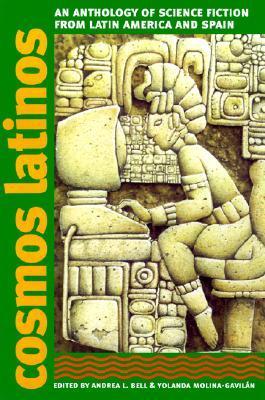
Cosmos Latinos, published in July 2003, is the first-ever collection of Spanish-language science fiction in English and has received unanimously rave reviews with a few "buts". I'm on the side of those who say "but". I knew there was trouble when I read the introduction, which explained that stories were selected "to reflect the historical progression of the genre", "geographical and thematic variety", but while "overall quality ... has also been a consideration", it was not the primary one.
The anthologists, Andrea L. Bell and Yolanda Molina-Gavilán, are well-meaning and hard-working scholars who let their scholarship get in the way of good literature. They chose works that illustrate the characteristics they say (others might disagree) typify Latin American and Spanish SF: a preference for "soft" and social sciences, an examination of Christian symbols and motifs, and humor, along with u- and dystopias. They also tried to cram in as many stories as they could, 27, so there are a lot of very short stories. One frustrated reviewer wondered if Spanish-language authors have considered writing longer works. Not all the stories are good, but I know those same authors have written better.
Still, the translations range from reasonable to very good, and when the stories are good, they are phenomenal. Reviewers, including me, recommend "Acronia" by Pablo Capanna, Argentina, 1966, a corporate workworld without clocks; "Post-bombun" by Alberto Vanasco, Argentina, 1967, a satire of life after the nuclear holocaust; "Cuando Pilato se opusó" by Hugo Correa, Chile, 1971, first contact; "Los embriones del violeta" by Angélica Gorodischer, Argentina, 1973, a planet with strange powers; "Ruido gris" by Pepe Rojo, Mexico, 1996, a human TV camera; "Como tuvieron que morir las rosas" by Michel Encinosa, Cuba, 2001, surreal cyberpunk.
Spain is represented by "En el planeta Marte" by Nilo María Fabra, 1890; "Mecanópolis" by Miguel de Unamuno, 1913; "Gu Ta Gutarrak" by Magdalena Mouján Otaño, 1968; "Estreno" by Elia Barceló, 1994; "El día que hicimos la Transición" by Ricard de la Casa and Pedro Jorge Romero, 1998. English-language reviewers loved the last three, and "Transición" is already on the reading list for the 2003 Sidewise Award for alternate history.
On SciFi.com, Paul Di Filippo enthuses that "the cultures and traditions and tools of these writers are skewed just enough from our arbitrary Anglo-American baseline to insure that a welcome sense of cognitive estrangement is presented even before the ostensible subject matter of each story is encountered". The stories, he says, use "our models as springboards to unique visions".
The Library Journal recommends that public and academic libraries buy it, and SFRevu recommends borrowing it from the local library but not necessarily buying it. I agree. The English-speaking world still needs a "best of" professional anthology of Spanish-language SF.