(3.5 stars) I read once that the furthest distance the average American will walk without getting into a car is 600 feet, and I fear the modern British have become much the same, except that on the way back to the car the British will drop some rubbish and get a tattoo.
I’ve spent many happy hours in Bill Bryson’s company since I first read his delightful Notes from a Small Island (for the first time) some 15 years ago. I’ve chuckled to the sound of his voice narrating his own quirky-brainy anecdotes while cycling to work; I’ve giggled, hand over mouth, above the Atlantic Ocean while reading one of his books in a cabin full of sleeping passengers, my reading light being the only one turned on.
This book is the sequel to Notes from a Small Island, published almost 20 years ago, and this time he decides to travel along ‘the Bryson line’ – from Bognor Regis in the South of England to Cape Wrath in the North – his idea of the longest straight line possible on the map of Britain.
There’s something decidedly heartwarming and wistful about Bryson’s nostalgic trip around Britain. He is a font of information about all things British, historical and current, and though he still has the keen eye of the knowing outsider – being an American from Iowa – this book bears evidence to his greater familiarity with Britain since his first book.
To be honest, however, this one seemed more of an economic enterprise than the first book. I still loved many of his digressions and anecdotes, but there was, at times, too much inconsequential and repetitive rambling that seemed stretched out for the occasion. Also, he is infinitely grumpier this time round. All is not as it should be in the paradise that is Britain. But then he, like the rest of us, has gotten older, and Britain has changed, too. I can bear witness to that myself.
He is on a mission in this book, I felt, telling anyone who’ll listen that e.g. the British countryside should be preserved, that people should think twice before covering the country with litter, that the level of stupidity (notably in Austin, Texas; only partially in Britain) is becoming critical. To a large extent I agree with him, but he came off a bit too angry some of the time, whereas previously he was merely funny, even when complaining about the state of things. I also felt the f-word was strewn a bit too generously into the anecdotes. I’m no prude, but it underlined how curmudgeonly this usually gentle American expat has become. (Part of the problem could simply be over-exposure to Bryson’s tried and tested formula, charming and humorous though it often is).
I learned that:
- Mount Everest is named after a man who never saw the mountain, and the name is actually mispronounced: Mr. Everest himself pronounced it Eve-rest (Adam’s mate + two syllables)
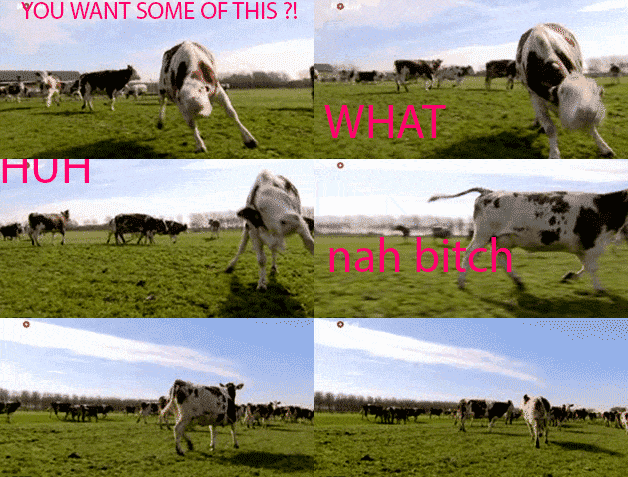
- Cows are more dangerous than bulls and have actually killed ramblers in Britain (Bryson goes out of his way to downplay this problem because people were developing a fear of cows, but I just never knew cows had it in them to trample people so it was news to me).
- There is a name for the rather pervasive (modern?) phenomenon of someone being so stupid that they don’t know just how stupid they are: The Dunning-Kruger effect (I’ve previously called it the X-Factor syndrome: ‘how can they not hear I sound like Beyonce?!’)
- The British citizenship test which he takes at the beginning of the book is clearly as stupid and ridiculous as the Danish equivalent, making it nearly impossible for any normal native of the country to actually pass. (His description of this test was just priceless. He did pass it though and is now officially a Briton).
Read it if, like me, you have a small crush on England, enjoy a good dollop of encyclopedic fun facts and travel commentaries and a narrator who doesn’t take himself too seriously. If you’ve never read him before, begin with Notes, but do begin.