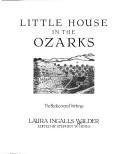
This was a very nice book. Laura Ingles Wilder wrote a collection of articles and essays, and they were compiled into this book. It is about her life in the Ozark Mountain farm of her and Almonzo in southern Missouri. There they had an apple orchard, which Almonzo managed, and Laura was busy as both a "farm wife" and an author of articles for local publications. This book takes you back in time to an era where life was simpler. It is a very good read. (Amazon customer)
Ingalls wrote a series of historical fiction books for children based on her childhood growing up in a pioneer family. She also wrote a regular newspaper column and kept a diary as an adult moving from South Dakota to Missouri, the latter of which has been published as a book.
Nice additional stories, but for some reason I didn't anticipate how disjointed it would come across. I suppose this was my own naivety, plus coming off of the magic of the actual books that seamlessly flowed together. I enjoyed the extra information about her life as she got older.
A find at an Atlanta area used book store, I enjoyed most of these writing of Laura Ingalls Wilder, a grown woman living with her husband in the Ozarks of Missouri where she had spent the last years of her life. I found myself dog-earing pages and underlining passages, which I very rarely do to my books. Some of these writings, gleaned from farm papers and national magazines, were quaint and dated, others were a little dull, but I was most struck by the ones that are still true, relevant and inspirational almost 100 years later.
I was happy to come across this book of articles and essays written by Laura Ingalls Wilder. She seemed to be somewhat of a visionary and fond of adventure, probably inherited from Pa, but her resilience and wisdom, just like Ma, is what stood out to me. Wilder wrote on many different subjects, but my favorites were the ones that dealt with farm life, education, and the roles of women. She wrote with wit and candor and it was enjoyable to read an article or two every day.
I got this book on a recommendation by Kressel Housman and enjoyed it very much. Although I'm not a farmer and it's not the 1920s, I do live in the country and appreciate the farm struggles Laura writes about.
It's interesting to see Laura's wide-ranging interests: politics, home economics, national and state economics, little lessons that can be learned from little everyday interactions.
And it's fascinating, as you read Laura in her formative writing years, to think about the amazing books she had in her which she wouldn't write until a few decades later; did she know she had them in her? Do any of us know what we have in us?
To help along with my Little House binge, my husband brought home this book that I was completely unaware of. It's a collection of Laura's essays which she published in a column in a farmer's newspaper in the Ozarks, which is where she and Almanzo ended up. She wrote these in the early 20th century, which means she was in her 50's at the time, younger than when she wrote the books, but writing for an adult audience. She writes about all kinds of topics: farming tips, the values of thrift, unselfishness, and cheerfulness, and she gets political, too, with discussions of World War I and women's suffrage. It made for a fascinating read and convinced me (so far) that she most definitely had her own voice and was not ghost-written by her daughter Rose (though I still have more to read on that subject.) My favorite essay by far was called "Are You Your Children's Confidant?" I loved that so much, I sent it out to a dozen or more friends on Mother's Day - and I don't even celebrate Mother's Day.
All Little House fans will want to get hold of this one. It's Laura, but for adults!
I started this book years ago and finished it after a trip to the real little house in the Ozarks. It is a compilation of some of the columns Laura wrote for "The Missouri Ruralist" before she wrote her books. They are full of wit and wisdom and also contain some of the stories that later end up in the books in longer forms. It's interesting to see her early writing and compare it to the fictional results later. Plus some of the essays are really good and have ideas that modern audiences will still enjoy.
I learned what a remarkably sensible woman Laura Ingalls Wilder was, and after reading these rediscovered writings of her, felt like I'd spent time with a good down to earth friend. I very much enjoyed her insights, thoughts and views on the range of topics about which she wrote. Excellent book.
I found this collection a lot of fun to read for the most part, but there were particular essays that were very hard to read. I acknowledge for the most part she was more forward thinking than some of her contemporaries, but I still skipped two of the essays because the racist/sexist views were not worth casually reading in a contemporary context.
So beautiful! So full of wisdom! This is the perfect thing to dip into when in need of advice or encouragement. I could listen to Laura Ingalls Wilder talk about anything, forever !!
A collection of Laura's articles written for a farm journal. As they are meant to be read one at a time ,they became a little repetitive reading one right after another. Mostly written in the 1920's ,the articles provide a glimpse into farm life at that time which I found interesting. Some of the advice given can still be given today. Worth reading if you are a Laura fan!
Several years ago, when I was reading various books about Laura Ingalls Wilder, my favorite childhood author, a friend offered to loan this book to me. It consists of short essays, usually 1 1/2 pages in length, that Wilder wrote for several publications, mostly during the years 1911 and 1924, starting when she was 44. I have been slowly reading the essays – far too slowly. Finally, I sat down and finished them and can return this far overdue book.
During these years, Wilder lived on a farm in south central Missouri. Most of the essays are commentaries on farm and small town life. They give the reader a sense of time and place and of a very principled life. From these essays we learn that she is an honest and prudent woman who keeps her promises and expects others to follow her example.
It is hard to see the childhood Laura in her adult writings. This Laura follows the rules and does not understand when others behave badly. She seldom refers to her childhood and her daughter Rose is rarely mentioned.
These rediscovered writings are slightly interesting. They become very repetitive in manner and feeling. Thus it took me years to get around to finishing them.
I still own seven of the nine Little House books, illustrated by Garth Williams, which now have yellowed pages and crumbling covers.
As an adult I’ve read most of the fictional series’ related to Wilder’s ancestors and enjoyed all of them more than I expected: Little House: The Martha Years Little House: The Charlotte Years Little House: The Caroline Years
I have not read Roger Lea MacBride’s The Rose Years, probably because my Children’s Literature professor did not approve of MacBride’s claim to the Wilder material.
This book is a compliation of short articles that Laura Ingalls Wilder wrote for various local newspapers in Missouri (Ozark area) from 1911-1925 when she was in her 40's and 50's. These were written before she wrote her Little House book series.
There were the same social and political issues today that there were 100 years ago. People were worried about the same things that we worry about today. War, deforestation of the land, education, work, etc. She wrote from the view of a farmer's wife; the world as she saw it.
I'm not pleased with how the book is set up. It's arranged according to topics instead of chronologically, which I would perfer. Setting it up chronologically would not only give a clear time frame but a better understanding of her mindset at that point. I also found several articles that were repeats of previous articles as they were written on the same subject matter and there weren't any new ideas put forth.
Laura wrote about people (neighors, friends, associations) and she frequently used names. I wonder what those people thought of her writing so openly about them, especially if it wasn't they weren't painted in the best light? I wonder if she had any backlash from those articles.
This book gives you a glimpse into her life and thoughts, but it's not in-depth. Interesting but not incredible.
Like many other young people, I grew up with the Little House on the Prairie series. Laura Ingalls Wilder has had a huge affect on my life and my writing though she died years before I was even born. So, reading this treasury of some of her articles and essays was a pleasure and a special treat.
Wilder wrote of farming, friendship, family, politics, morals and current events. Some of her observations on the state of the nation and on its future were eerily prophetic. Other aspects of her writing, like her wonderment at the "modern" inventions of the day and some of her predictions for the future are funny to read now.
Stephen W. Hines did a great job of editing and compiling these literary gems. Personally, I think I would have preferred the writings to be in chronological order; however, it is obvious Hines put a great deal of time and thought into the chapters he separated the writing into.
Laura Ingalls Wilder's spirit continues to live strong through her writings, and her influence will be felt in generation after generation.
My sister loaned me the book after I had been to the Laura Ingalls Wilder Museum in Walnut Grove, MN. This is a collection of writings that Laura Ingalls Wilder did for the newspapers in the Missouri area where she lived. They pretty much encompass the years 1916-1922, approximately. The editor occasionally added notations to explain something but that was about all. What I found amazing was the fact that so many of her writings are most applicable today to families, friends, others. For being 100 years old, they are remarkably current, notwithstanding, of course, the ones about churning butter or keeping chickens, etc. But the ordinary musings of things such as manners, gossip, family, etc. should be read by many people of today. I have LOVED her books ever since I was a child and began reading them. I'd love to actually do the "Little House" driving tour and go from one place to another that Pa dragged his family--and there IS such a tour.
It was a beautiful day when I walked into my local bookstore and discovered this gem. Much like many other children, I grew up with a love of the Little House books. I was thrilled to discover that Laura's writings hadn't ended and actually hadn't even begun with her Little House books.
This is a compilation of newspaper columns she wrote for a rural newspaper in Missouri from 1911-1925. They are entertaining, and full of good old common sense. Laura is a firm believer in marriage being an equal partnership. She discusses farm life and politics; literacy and the importance of hard work.
You don't need to read it all at one sitting. Just read one or two columns at a time. It's thought-provoking and so many of the issues she writes about are still so relevant for our time today.
If you were to imagine the exact opposite of The Stranger, you would probably come up with a book something like The Rediscovered Writings–reading the two books simultaneously was fascinating. Wilder’s collection of essays, written before she wrote her famous books, is a beautiful and educational look into the life and times of Wilder, and many of her thoughts, although almost 100 years old, are perfectly applicable today. Wilder advocates personal responsibility, hard work, thrift, and joy in everything. Camus says nothing has importance; Wilder says everything has importance. If you judge a philosophy by the quality of the lives of those who hold it, Wilder is undoubtedly the winner, and I’ll take her musings over Meursault’s vapidity any day.
While I had read the original "Little House" series before, this is the first time I've read this collection of Wilder's writings. It is very different from the series, being a collection of columns written by Wilder from an adult's perspective for an adult audience of fellow farmers, while the series is written from a child's perspective for a young audience. Therefore, it won't necessarily appeal to everyone who enjoys the "Little House" series. However, I found it a very enjoyable read, for the moments of wit and humor and the continuous insights into farming life during the early 20th century that Wilder provides. Also, it gives a happier closure to the "Little House" series than the rather depressing "The First Four Years".
What a pleasant surprise to find this book. I thought I had read all of the Laura Ingalls Wilder books. This one was icing on the cake. It is a collection of articles she wrote for a rural news paper full of friendly advice and good common sense. I actually felt like I was sitting on the front porch on a cool summer evening with my grandmother, gleaning the bits of wisdom learned from a long and productive life. So much of what was written still holds true today because it is part of the human condition. I really enjoyed myself.
I really enjoy this book, although I don't feel an urgency to finish it (thus it is taking a while) and I've stopped to read other books several times.... until now I had to return it to the library, and will have to finish it later! However, I know this is a book I would like to own. I am an avid Laura Ingalls Wilder fan and was delighted to find that she was a farm journalist and I could read more of her work. I love peeking into the window of the past, and finding her insights relevant and thought provoking even today.
This book was such a pleasure to read. I felt as if I was sitting by the fireplace with Laura Ingalls Wilder each time I cracked open the book to read some of her rediscovered writings. Most of the book is comprised of short articles Wilder wrote for a farm column in the early to mid 1900s. I learned a great deal about farm life and attitudes surrounding the War. Her advice, principles and opinions are wise and undeniably practical. I finished this book feeling as if I had just gotten to know a wonderful new friend.
If you are a Laura Ingalls Wilder fan (and I am...crazily so), this book, a compendium of her adult writings mixed in with some her daughter's writings (Rose Wilder Lane was also an accomplished writer in her day and she urged Mama Bess to get cracking), then you will enjoy this book.
It fills in details about Laura's adult life and in it you see her abiding affection for farm and family. It's a lovely treat.
It was cool to read Laura's writing from the early years in the 1900's. I was surprised at how much of it could relate to today's world and wondered what she would think about the way the world is today. She grew up very much in a household very much like my mother and grandmother and learned all the old country ways of doing things. I liked her straightforwardness and common sense, too bad that way of thinking is going by the wayside.
I thought this book got better the more I read it and changed my opinion of what I wanted to learn from it. At first I thought it would be more about Laura's life, but then I enjoyed the life's lesson and simple truths she was sharing through her newspaper articles, which still have relevance today.
This book was collected writings of Laura Wilder when she wrote for a column for a newspaper. Her column was about being a farmer's wife. I wished she could have written about something else some of the time, but that seemed to be her favorite subject. It was somewhat interesting, but got a little dull.
I loved it. It really is just like chatting with Laura in her farmhouse. Fascinating to hear of her life in the 20's. It's very wittily written and presents an intriguing view on many national issues of the time, but is also humble and real enough to delve into topics such as chickens and kneading dough. A wonderful book, especially for fans of the Little House series.
Briefly: Laura Ingalls Wilder had a newspaper column for years before she began writing the Little House books at her and Almonzo's farm in Mansfield, Missouri.
Her adult self and opinions are much more visible in these pieces than in her Little House books.
I read this book and found that I loved and admired her more than ever.
This book is not a cover to cover read; rather - it's a book that has 140 essays that you can pick up and put down as you will. It's so fun to read L.I.W. write for adults. May I also just say that although some of this material is somewhat dated, most of it can be easily applied to today - especially as we strive to strip down and return to the basics.
This was a wonderful and interesting book to read. The stories told within these pages are actually the articles LIW wrote for the Missouri Ruralist. They include her thoughts about farming, politics, women in politics, relationships between a husband and wife, etc.
While some of Laura's ideas were pompous and preachy, there was a lot of sound advice. Also, the book confirms, yet again, that no matter how much things change, people basically stay the same.