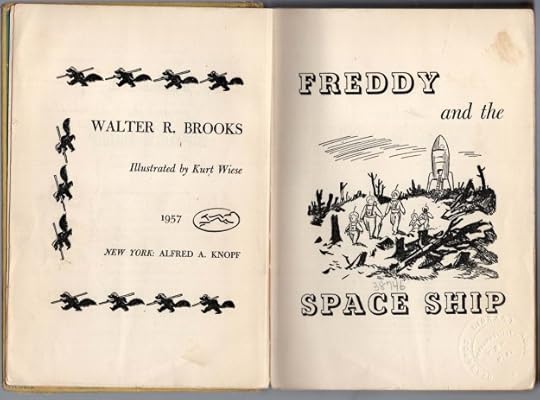
At the beginning of this YA novel, two plot strands are set in motion. Sociopathic Mr. Bismuth, his whiny wife, and two voracious children have moved in with Mr. and Mrs. Bean. A freeloader, con artist, and thief, Mr. Bismuth preys on Centerboro humans and animals. Generous Mrs. Bean will not evict the Bismuths because they are distant relatives. It is up to the Centerboro animals, therefore, to rid their idyllic home of evil marauders.
Uncle Ben Bean is building a space ship in the Bean woods. Uncle Ben, Freddy the pig, Charles the rooster, Jinx the black cat, and Georgie the dog are bound for Mars. At the last moment, Mrs. Peppercorn, a feisty old lady who bought a phony ticket from Bismuth, joins the Mars expedition. In outer space, the crew must adapt to weightlessness: “After the first day, the novelty of not weighing anything, of not knowing whether they were on their heads or their heels, had worn off. . . Freddy had brought. . . a checker board, and he and Mrs. Peppercorn tried to play; but the checkers wouldn’t stay on the board. They floated an inch or so above it, and if you happened to brush one with your hand it would drift off. . . (72). When Mrs. Peppercorn accidentally touches a valve, the ship spins out of control. When spinning stops, the ship lands on a planet the travelers assume must be Mars. Having unknowingly returned to the Beans’ woods, the travelers mistake the humans and animals they encounter for Martians. Centerboro residents compound the comic confusion, assuming that Uncle Ben’s spaceship must have come from another planet.
In an earlier book, FREDDY THE DETECTIVE, Freddy had solved crimes by using Sherlock Holmes as a model. While the problem-solving Freddy was in space, Mr. Bismuth’s cheating and stealing escalated. Incognito on the Bean farm, Freddy disguises himself as a “Neptunian”: “He painted his face blue and stuck a heavy black beard upright on top of his head, and he took . . . rat tail mustaches. . . and made eyebrows with them” (154-155). Freddy, Old Whibley the owl, Mr. and Mrs. Webb the spiders, and other trusted animals find the hidden jewelry Mr. Bismuth has stolen from the Bean ducks. Mr. Bismuth is brought to trial. Though the trial ends ambiguously, the Bismuths are forced to return to Cleveland. Serpents banished, Centerboro is again a prelapsarian paradise--a place where humans and animals freely and innocently support each other.
Rereading FREDDY AND THE SPACE SHIP, I thought of Ray Bradbury’s iconic story, “Mars is Heaven.” When Freddy and his companions land on the planet they believe is Mars, it looks (not surprisingly) just like home: "There were trees and a brook. . . and beyond, green fields with what looked very much like earthly grass growing in them" (98). In "Mars is Heaven," the crew, landing on Mars, find an earthly small town. Bradbury's telepathic Martians have, of course, entrapped the travelers by constructing an illusion, based on their collective, idealized memories of small town upbringings. Though it seems as safe and nurturing as Brooks's Centerboro, Bradbury’s small town is a deadly deceit. The reader of Brooks’s Freddy books, in contrast, is fictionally transported to the benign, Edenic place that Bradbury’s Mars only pretends to be.
I was introduced to Freddy the Pig in the 1940’s by my fifth grade teacher, Mrs. English. Every morning, before arithmetic, she read our class a chapter from a Freddy book. As a child who longed to converse with beloved pets, I was enchanted by Freddy’s adventures! Now as a senior citizen living in Syracuse, New York (near the fictional CNY Centerboro), I am rereading Freddy the Pig novels and have joined the Friends of Freddy Facebook group. Every night before bed, I visit a place where animals solve crimes, write poetry, serve on juries, and are respected participants in civic life.