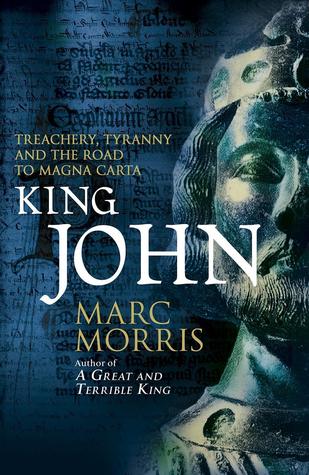
A rousing and authoritative new biography of the notorious King John, by Wall Street Journal bestselling author Marc Morris.
King John is one of those historical characters who needs little in the way of introduction. If readers are not already familiar with him as the tyrant whose misgovernment gave rise to Magna Carta, we remember him as the villain in the stories of Robin Hood.
Formidable and cunning, but also cruel, lecherous, treacherous and untrusting. Twelve years into his reign, John was regarded as a powerful king within the British Isles. But despite this immense early success, when he finally crosses to France to recover his lost empire, he meets with disaster. John returns home penniless to face a tide of criticism about his unjust rule. The result is Magna Carta – a ground-breaking document in posterity, but a worthless piece of parchment in 1215, since John had no intention of honoring it.
Like all great tragedies, the world can only be put to rights by the tyrant’s death. John finally obliges at Newark Castle in October 1216, dying of dysentery as a great gale howls up the valley of the Trent. 16 pages of color and B&W illustrations
Marc Morris, PhD, is an historian and broadcaster, specializing in the Middle Ages. An expert on medieval monarchy and aristocracy, Marc has written numerous articles for History Today, BBC History Magazine and Heritage Today; he speaks regularly to schools, historical societies, and literary festivals, and also leads specialist tours of UK castles. He is a fellow of the Royal Historical Society and lives in England.
This book looks at one of England’s most notorious monarchs. Known for his reputation as a villain in English history, King John (1199-1216) is often remembered for his failures and the eventual signing of the Magna Carta in 1215, which laid the groundwork for constitutional governance. Marc Morris’s biography seeks to understand the man behind the myth, providing a balanced and nuanced portrayal of a king whose reign was marked by controversy and conflict.
The strength of Morris in this is book is his ability to sift through the layers of historical bias that have colored King John’s legacy. While previous historians and chroniclers have often depicted John as an incompetent and malevolent ruler, Morris approaches his subject with a critical eye, examining the political, social, and economic contexts that shaped John’s actions and decisions. He acknowledges John’s flaws, his tendency towards cruelty, his paranoia, and his ineptitude in certain aspects of kingship; while also highlighting his administrative skills, his attempts at legal reform, and the difficult circumstances he faced, including the loss of the Angevin Empire in France and the rebellion of his barons.
Morris’s narrative is both scholarly and accessible, making the complexities of medieval politics and governance understandable to a wide audience. He does an excellent job of tracing John’s life from his early years as the youngest son of Henry II and Eleanor of Aquitaine, through his tumultuous reign, and finally to his death and the legacy he left behind. The book is rich with detail, drawing on a wide range of primary sources, including royal charters, letters, and contemporary chronicles, which Morris uses to paint a vivid picture of John’s reign.
While Morris’s portrayal of John is generally sympathetic, it does not shy away from the darker aspects of his character. The book details John’s ruthless treatment of his enemies, his often arbitrary and oppressive rule, and the deep mistrust he engendered among his subjects. Morris presents a king who was deeply flawed and often his own worst enemy, but who was also a product of his time, struggling to maintain control over a fractious kingdom in an era of shifting power dynamics. Some readers might find the book’s focus on political and military history a bit dense, particularly if they are looking for more insight into John’s personal life and relationships. While Morris does touch on John’s marriages, his relationships with his family, and his interactions with his court, these aspects are secondary to the broader narrative of his reign and its impact on English history.
Unfortunately, for me this is not as good as Morris’ other work. Like others who have reviewed this before me, I found the format confusing and therefore the book hard to follow. Morris explains why he has done this in this way, but in my opinion this doesn’t really work. However, the book is lacking the most important thing, which is the analysis of John himself and the context of his time. Some parts are there, he was an irresponsible arrogant youth, who blundered his expedition to Ireland. He shocked Christendom with his violent and brutal treatment of Arthur of Brittany. He was like his older brothers, he betrayed Richard to try and take the throne. But I didn’t get any further senses of John, like Morris has delivered in his other books. The book leaves a confusing, half tail and because of the format I felt that Magna Carta ‘appears’ suddenly, is discussed and then it’s back to war with Philip Augustus. I have come away feeling like I will need to read someone else’s work about John, which is disappointing. However, Morris does successfully demystifies John, presenting him as a complex and multifaceted ruler whose reign, though deeply flawed, was also pivotal in the development of the English state. Some in my opinion the book isn’t a complete flop, but merely frustrating as Morris is clearly a very talented writer.
Morris is a terrifically readable and accessible historian, and this account of John's reign reads almost like a novel at points, as it tells the story of his better documented and ever more screwed up later years with flashbacks to earlier events. Cracking writing, engaging presentation, and a very persuasive account of this flawed king and terrible human being.
Now I feel like I need to read his book on Edward I but I don't wanna because he's a psychopath. (The king, not the historian.)
John, the scion of House Plantagenet (though this term isn't coined till 1460), King of England (1199-1216), First of His Name was a most unlikely King. Oft despised and, only occasionally, rehabilitated by historians. John has been called "Lack Land" and "Soft Sword" and, compared to his brothers, almost an afterthought for his powerful parents. Only the vicissitudes of the life of Norman noble life saw him crowned King at all.
King John is generally known for two things: (1) His conflict with his brother- Richard the Lion Heart (and the whole Robin Hood mythos) and (2) the Magna Carta.
Marc Morris is able to show many other facets of the life of King John. While deserving much of the blame, Morris shows the things that John did well and the situation that he was placed in by being born into the Plantagenet family's tumultuous existence. It could not have been easy for John to have brothers such as the Young Henry, Geoffery, and Richard. Almost ignored till the dynastic struggle causes his parents, King Henry II and Queen Eleanor of Aquitaine, to use him to play their particular games of control.
John had the capability to be a good King, but his lack of military ability, especially compared to his glamorous brothers, and the heavy taxation to fund these military adventures caused so much of his conflict. Morris's account is not only very readable, but it is quite detailed in the various events surrounding King John's life and reign.
An additional Kudos to Marc Morris including the entire, translated into modern English, Magna Carta in the appendix. Most people have never actually read the actual thing. Well done! Highly recommended for any King John fan. Or the Magna Carta :)
John was the last son born to the great Henry II and Queen Eleanor of Aquitaine. Nothing was expected of him as Eleanor had 3 living sons prior to his birth. He was given an education at Fontevrault .
He was the first King of England since the Norman conquest who could speak English. Probably the evolving Middle English dialect, which is incomprehensible to many in our current form. The Anglo Norman French was favored by the nobility.
He was ignored by his mother, Eleanor, and his father jested about him being "Sans Terre" without land. Given the nickname John Lackland. Younger sons typically did not inherit land.
As the years went on, he became an unlikeable person. His older brothers each died, leaving him to eventually take the crown.
His name is usually remembered as the King who signed the Magna Carta, meaning the "Great Charter" in 1215, the contents of which requires its own book.
His older brother Richard the Lionheart regarded John as a pushover and cowardly. There was no overflow of brotherly love among any of them.
King John never wanted to sign Magna .Carta. He was pressured into signing by the powerful Barons. This document would lessen the powers of the King and benefit them.
I've always thought of a scene from the "Godfather." With King John and these Barons Giving him an offer, he could not refuse.
Either his signature or his brains would be on the famous document.
King John died a miserable death one year later in 1216 at 49 years old. Battlefield Dysentery. A common cause of death at the time was due to filthy water and tainted food.
The book is a good read on a King often regarded as generally disagreeable and a villainous character.
I wish I had bought the Kindle version, which I still may or may not do. Not sure yet. The narration was superb but still difficult to follow because, as with every historical non-fiction book, it is very, very, very detailed. So much so, that I had to rewind quite often.
That doesn't mean it was absolutely bad. Besides, I don't know enough of King John, the person, to ascertain how good or bad the book itself was.
For those who wish to listen to the audio version, I recommend to read up a little on King John, as I found the number of places, persons and deeds quite overwhelming. Wikipedia, alone, would have been my friend here.
Edit Okay, with about two days in between, I've noticed that I was still mulling over this book and what to make out of King John.
As the narration in the first half of the book jumped back and forth, before John became king and after, a few points stick out (simplified): - His reputation at the time of his coronation was already heavily damaged. He had rebelled against his father in his father's last days, and joined the cause of his brothers; he later tried to take the crown from Richard Lionheart whilst he was in imprisoned. - The loss of Normandie in 1204 was a major setback. Trying to get the lost territories in France back, money was needed. The taxation (other, various words are used but I'll keep it simple) was heavy and seemed - in many cases - arbitrary. For a widowed mother to keep custody of her children to an heir to get a hold of his/her inheritance (to name only two of many ways John tried to raise money), nothing was out of the reach of the king. I say arbitrary for it seemed to be dependent on John's liking or disliking of a person whether said person had to pay the money at all or in what kind of instalments. Sometimes, even payments weren't guaranteed to fulfil John's demands as he could simply demand even more. - The death of Arthur I. of Brittany, his brother Geoffrey's only surviving son, and a serious contender to John's crown, at - supposedly - his own hands, further damaged his reputation and didn't necessarily lead for the baron's to trust their king. - His excommunication from the church over the question who should be Bishop of Canterbury was another blow that took years to mend. - The decline of the economy. Now, here's where I'm not sure if the author was trying to be too nice, as he didn't attribute it directly to John. At the end of the day, wars cost money. Money needs to be raised. Coins were debased. Taxes still needed to be paid, et voilá, the economy suffers. Simply put, of course. And of course, for an economy to suffer other components are important. But if put together, there's no wonder that the economy declined during his reign. - A strong French king who knew how to play the game of changing loyalties, and taking advantage of it.
John's reign was catastrophic for the institution 'kingship', and though not everything was entirely his fault, one very important point remains. John's hubris to stand not only above the law but actually be the law, whatever it meant for those who had to experience setbacks which led to bad blood. Not that his ancestors didn't act similarly, but what John didn't seem to understand was the simple concept and consequences of 'action vs. reaction'.
Nothing makes that clearer than his wishes in his dying days when he wanted to make amends to at least a few people he had wronged.
In other words, he was not the sharpest knife in the drawer when it came to emotional intelligence.
This is an absorbing life of King John who is generally and rightly regarded as one of England's worse kings. Marc Morris reviews his reign and his earlier life in detail which reveals John's weaknesses and dishonesty. He is fair in describing the King's good points but sets these against the full picture of a cruel man with weaknesses who had a singular capability to make a bad situation worse. Richard I comes out reasonably well as does Eleanor of Aquitaine; John does not but finishing the book will add much to the understanding of a man and a complex era. In 1066 and all that, Sellars and Yeatman did get John bang to rights. The book ranges widely across England, France, Ireland and Scotland and is rewarding reading for anyone wishing to know more of an age of complicated history and strong personalities. One minor carp is that the book does depart from strict chronology to no apparent benefit - at least for this reader.
King John is one of those villains who seems too wicked to be true. It was bad enough that he squeezed his countrymen again and again to fund his fruitless wars. But no man or woman was safe if caught by his displeasure, and even his contemporaries were horrified at his cruelty; starving his victims in dungeons seemed to be his favorite retribution. He behaved with little or no regard for consequences, until caught in the web of his own misbehavior. Once forced to retreat from an intolerable position, he would charm his way back into the good graces of his barons; grants of land (often stolen from them in the first place), money and promises were proffered, though there was no way to know what he would take back in the future. He ruled through fear (often with mercenaries paid by extorted funds) and treachery.
This is the kind of king you don’t read about for pleasure. I’ve read about him in the past, and the litany of evil deeds started to weigh on me like a heavy burden. I wasn’t sure I could shoulder more of the same, but fortunately Marc Morris was able to distance the reader from the perils of too much misery. Yes the events happened; it seems impossible that every year he forced more and more money out of rich and poor alike. Yes, he committed many murders, debauched many wives, broke almost all his promises. But we are able to see the events from an academic point of view rather than being thrust into the thick of oppressive bullying. I know he was a tyrant; I’m relieved that I didn’t have to suffer along with his victims.
Because John’s younger days were not well documented, the author began with the early part of his reign (1203) when king Philip II of France began driving John from his continental possessions. This was certainly an interesting sequence of events and showed us how his reckless behavior was destined to make lots of enemies: “This frank exchange (with William Marshal) made John predictably angry, and he shut himself away in his chamber. The next day he was nowhere to be found in the castle, and his men were annoyed to discover that he had slipped out of Rouen without them; they eventually caught up with him on the coast at Bonneville-sur-Touques, more than fifty miles away.” Apparently John made a habit of slipping away like a thief in the night, especially when things started to get uncomfortable. Like his father, he was constantly on the move and could cover great distances in a remarkably short time. No one could figure him out, but his actions were usually not favorable.
As I expected, in the second chapter we went back to his father’s reign so we could get some background. That was fine and necessary. But for the next several chapters, the author decided to take us back and forth from post-coronation to pre-coronation to post-coronation again, etc. As a reader I had a difficult time following the events; I couldn’t hang on to the chronology. Frustratingly, each chapter ended with a “bang”, and then the story picked up somewhere else, which slowed down the momentum. Every time I had to go back two chapters and figure out where he left off. It wasn’t until halfway through the book that the chronology finally “caught up”, and from then on the events were in proper succession. That worked a lot better for me.
It was interesting to see just how far John was able to go before his barons presented him with the Magna Carta; the mystical power of kingship almost did give him unlimited dominion over his subjects. It was also curious to see how the Pope’s overuse of excommunication lost its potency. In the end, it seems, Might was Right and as usual in the feudal world, the guys with the biggest armies won.
Throughout, the narrative flowed well and I'm glad I read this book, which I received from the publisher in exchange for an honest review.
This is a generally well written and informative biography. Interestingly, Morris presents a more positive portrait of John than most accounts. Plantagenet fans will likely also discover a few new details about his reign. On the other hand, those reading about this period of British history for the first time may be a bit overwhelmed. Additionally, the author employs the unusual technique of shifting back & forth between two chronologies, which can be confusing.
So fine to read just how evil and manipulative King John was. Self-indulgent down to his choice of wife. Just how he was allowed to keep his crown makes him more sickening when compared to the ones who did lose their thrones.
In an unlikely tune of events, given John was the youngest son of Henry II, he became King of England on 6 April 1199. However, he soon lost the great Continental empire assembled by his ancestors (Anjou, Normandy and Brittany) and spent the remainder of his reign trying to regain it, often to the exclusion of all else.
There are two concurrent narratives: John’s route to the throne, and John’s attempts to get his French land back. What clearly emerges are John’s shortcomings. His judgement was frequently awry, he was politically inept, he was often cowardly and cruel, his decision making was short termist and cack handed, indeed there’s very little to recommend him. Being charitable, he was full of energy, and generally on the move, and it’s no wonder he died relatively young in 1216 aged 49.
Whilst Richard III has found his supporters in ever-growing numbers in recent years, there has been no such reevaluation or redemption for England's other black legend, King John. And, as Marc Morris ably demonstrates, there is good reason for this. Richard III didn't reign for long enough for any real evaluation of his reign, and his track record prior to his accession was one of proven loyalty and steadfastness. Richard III was damned by history effectively because he lost at Bosworth - had he gone on to a long and stable reign it is unlikely we would view him as the evil hunchback bequeathed to us by Shakespeare.
John on the other hand had a history of treachery and betrayal as long as your arm, even before he became king, betraying his father on his deathbed and his brother Richard whilst the latter was on crusade. He most definitely did murder his nephew Arthur, potentially even by his own hand. He was cruel beyond even the standards of his time, murdering hostages, starving captives to death, defying the chivalric convention that expected defeated noble enemies to be held in honourable captivity. He was an incredibly poor politician, alienating his barons by his excessive financial demands, needlessly provoking them with his high-handed behaviour before trying to woo them back once he needed them. And whilst he did not shy away from warfare, he was not personally courageous, often cutting and running in the face of conflict, earning himself the sobriquet 'Softsword' to go alongside his youthful nickname of 'Lackland'.
It was a turbulent era, with a great deal of back and forth of military fortunes and political infighting and conflict, but Morris lays it out in a concise and readable manner, neither condescending to the reader nor assuming too much knowledge. I had previously read and enjoyed his book on Edward I and this book was equally as enjoyable a read, although the chapter-by-chapter jumping back and forth of the chronology threw me a little bit. Whilst this is by no means a whitewashing on John's reign (and it would be impossible to do so without resorting to flights of fantasy), neither it is a thorough castigation.
John's legacy, after all, is a mixed one. As Morris points out, John may have lost all of the Continental possessions of his ancestors, reducing the once mighty Angevin Empire to little more than the kingdom of England, but it was through his tyranny that the Magna Carta was bequeathed to posterity. Whilst in his lifetime John never came to terms with the Great Charter, seeking to evade its provisions through appeal to the Pope, the Charter came to signify the rights of subjects against a tyrant, enshrining the concept for the first time that the king could not act entirely without the consent of the governed, that no-one, not even a king, was above the law. It is a legacy John himself would have loathed, but history ought to thank him for that at least.
As expected, Marc Morris presents a well-researched and detailed study of the life and reign of King John. Morris sifts effectively through often-conflicting chronicles (both contemporary and subsequent) and scholarship to support his conclusions about the king's character and style of kingship.
The text of Magna Carta is included. The book's emphasis on the importance of this event in John's reign is in the proper perspective of his time. (It was only later in history that the charter won greater fame and influence.)
This is an excellent overview of John's life, covering all the major events that shaped not only his life, but much history of England. His behaviour as royal son and prince, king, brother, father and Christian is studied and evaluated. John's much-praised administrative ability is not overlooked in this study, but is placed in perspective to the rest of his kingship, where it is not, as some 20th century historians had it, his most important trait. Instead, John's whole character is reviewed, leading to the conclusion that for all John's genius as an administrator, he was wanting in many other areas required for effective medieval kingship.
Picking this book up, I was expecting a fairly straight-forward bashing of John's character, but after having read it, my impression is that Morris has delivered as balanced a study of John the man and the king as is possible at a remove of eights centuries and after the accretion of countless lies, legends and errors to his historical aura. He neither overpraises nor underpraises John, recognizing his few virtues, his talents and his failings in a manner that struck me as quite fair.
4.5 Stars. First off: a great villain makes for an exciting story. King John takes the cake. This was a really fun and informative read. However, I had one small complaint about this book. The first few chapters jump back and forth in time relative to 1203, when John lost Château Gaillard, a pivotal moment in King John's disastrous reign. The author explains his reasons for structuring the narrative this way, but I regarded it as both unnecessary and sufficiently irritating to not give a full five stars to this otherwise superbly written biography of King John. Riveting and fascinating, it is objective and balanced. Even so, it is readily apparent what a cruel, devious, wicked, and cunning tyrant King John was. He was not the sniveling weakling I had presumed him to be as portrayed in pop culture. He was actually quite astute and talented at manipulation, exploitation, and extortion. He had the talent and capability to be a good sovereign. But his character and personality were manifested in devious scheming, treachery, and wanton cruelty. As a result, he lost the continental empire of his ancestors and left England divided and ravaged by war. After his death, his subjects did not mourn him. A contemporary chronicler, Matthew Paris, wrote, "foul as it is, hell itself is made fouler by the presence of King John." But his oppressions led to Magna Carta. And Magna Carta has guaranteed ever since that such egregious oppressions would not be repeated, and that subjects have rights that tyrants cannot abrogate. If you like medieval history, you'll enjoy this book. I definitely recommend it.
Very well presented and researched - King John is one of my favourite historical figures (Good Lord what does that say about me??!!). I am more of an 'insights' person than a 'dates and figures' person and this book caters more to the latter but that's just my personal taste. I think I would have preferred to read rather than listen to this as the audio delivery was very dry and I would have liked the opportunity to skim read the bits that were boring me rather than rolling my eyes and shouting come on get to the good bits!!!
Interesting! Morris creatively narrates King John’s biography, integrates wider medieval contexts, interrogates source biases, and speculates upon the gaps. I knew little about John, so this was excellent!
Cool to see Robert fitz Walter being an important player. If I’ve inherited any arrogance (…) I think I will now blame that on the bloke who appointed himself ‘Marshal of the Army of God’.
Tangent now. It’s been ages since I read public history. It makes me think about German. When English has ‘history’, German differentiates between geschichte as story and geschichte as past events. When English has ‘historiography’, German has geschichteschreibung as history-writing and forschungsgeschichte as research-history. Because Anglophone literature linguistically can’t and ideologically won’t separate these spheres, our public history ends up being a mishmash of all the above.
King John falls into this conundrum. It’s kind of ‘everything studies’, lacking identity and unable to excite much research. Morris tries to compensate with some fancy chronological restructuring, but this only serves to confuse. We’re left with a Carlylian ‘history of great men’. Fine as a biography or textbook, but it would be more exciting to have some nuanced and driven approach.
Morris shows how King John's disastrous reign led to the loss of the Plantangenet empire on the European continent during the early years of his tenure. He was an ineffective commander, leading troops by threats of punishment and tyranny rather than by inspiration. He was seen as a cruel and fickle ruler by his contemporaries. As a means for punishment, he would frequently lock away his enemies and starve them to death. He did not honor his promises or agreements, making him untrustworthy to his enemies and allies alike. His oppression of the Scots and Welsh ended up pushing both of these groups into an alliance with the English Barons, who, during the last years of John's reign, went into open rebellion against their King. The result of this was the Magna Carta, which stated that a king must govern within the law and was the first step in preventing a repeat of his type of tyrannical reign.
The book begins a couple of years into his reign and continues chronologically every other chapter. In the first half of the book, the alternating chapters are flash-backs to John's childhood and early adulthood. These flash-back chapters are quite effective in revealing how his unsavory character began to develop and fit in quite well with the main timeline. I would recommend this book to those interested in delving into the details of King John's reign.
2.5 stars. I found this one a little dry, especially at first. I like the Plantagenets, and I enjoyed this author’s book on Edward I and his book about the Conquest, but this one seemed to frequently bog down in a litany of castle sieging, treachery, and relentless fundraising.
It’s the fundraising that got John in the most trouble: he extorted money, through taxes, fines and fees, to an unprecedented degree.
John is most famous for his role in Robin Hood’s story as the wicked Prince taking advantage of the absence of his noble crusading brother King Richard. He’s next most famous for being such a bad king that his nobles forced the Magna Carta on him.
John was the fifth and youngest son of the great Henry II and Eleanor of Aquitaine, so far from the throne that his father had given all of the important provinces to his older brothers, leaving John with the nickname “Lackland”. But his brothers fell, one by one, until the death of Richard the Lionheart left John on the throne of England and at the head of the great Angevin empire: all of Britain and much of what is now France. John would leave to his own son a greatly reduced legacy.
Explaining that John’s childhood and youth are barely documented, the author chose to begin the book in the middle of his reign, in 1206, just as he begins to lose his hold on his territory in France. The author then relates the earlier history in flashbacks. I think this was a mistake. First of all, the brief discussion of John’s predecessors (Henry I, Stephen and Maud, Henry II and Eleanor) would be unintelligible if you weren’t already pretty familiar with them. Then when the flashbacks reach Richard’s reign, it became confusing to bounce back and forth between the politics and military actions going on then and those happening after 1206.
The text of the Magna Carta is printed in an appendix.
I had some idea of King John from reading Dan Jones' The Plantagenets. And I could remember the tension (to put it lightly) between Henry II and his eldest surviving sons. But there was a lot to learn and digest in Jones' book. That's all thankfully re-told here in Marc Morris' King John: Treachery and Tyranny in Medieval England.
The early part of John's life and the whole situation between his father, Henry II, and himself and his elder brothers is pretty much worth reading the book on its own. The favouritism. The rivalry. The backstabbing. The opportunism. There's more drama here than you could ever make up. And the end of the book, dealing with the barons' uprising, the issuing of Magna Carta, and the ensuing civil war is equally as riveting to read. It was also interesting to hear about all John's issues with the church and the pope once he became king.
King John makes for an interesting figure. He was cruel, reckless, and insecure. And definitely no military genius. A master at driving people away from him and losing their support, threatening people and then groveling to win them back. However, if you were close to him and loyal to him, and you found him on a good day, with the wind blowing in the right direction, and the stars aligned properly, he could be quite generous. Morris provides a summation of John's character at the end of the book, and it's basically 'yeah, he was awful.' John was a real person, and so there is certainly complexity to him, but ultimately there's no way to redeem him.
I have to say, I really hated the back-and-forth chronology of most of the book. Each chapter jumps between two separate, but progressing, time periods in John's life. I just found it to be confusing. King John was my read-at-work-ebook, so I wasn't opening it every day; sometimes there would be several days before I got back to reading. Because of this, I usually found it hard to re-situate myself in what was going on. Perhaps this would be less of an issue if you were reading this daily, or - better yet - you had a general idea of John's life. It also sometimes felt a bit dry, and read kind of slow at different points.
I'd probably give this a 3.5 simply due to my issues with the jumping chronology and the dryness from time to time. But otherwise it was a fascinating book. And there's something about the cover that I really love. The only other biography I've read on a medieval English king was the one on Edward III, and man, what a difference in the two men.
I enjoyed this book about King John and found it to be well researched. However the jumping back and forth between time periods in the first half, two thirds of the book caused a little bit of confusion for me. I had to keep stopping and thinking, "ok, what was happening two chapters ago so I can keep following along with the story." Great information in this book but the time hops is why I knocked it down a star.
Whoa, it was exhausting just listening to all the comings and going’s, seizes, assaults, feuds, battles, revenge attacks plots, etc etc etc that went on throughout John’s reign and in the long run up to it. Sellar and Yeatman 1066 and All That: A Memorable History of England certainly seem justified in their summary ... King John - a bad king - but as Morris reaffirms the depth of his betrayals and attempts to extort money led in the end to the most important charter for everyone’s freedom and access to fair justice. I am glad I opted for the audio version as I am not sure I would have stuck with the print book and even so have little recall of specific details, but I feel rewarded with a deeper sense of the history of the period and John’s place in it. Pity Robin Hood was noticeably absent though even if John definitely appointed a pretty unpleasant sheriff of Nottingham.
Postscript A couple of years ago I had the opportunity to visit Corfe Castle for the first time in nearly 50 years . A wonderful ruin . Shocking to read of how John used that castle to cruelly punish and dispose of some of those he deemed enemies and strange to realise how significant a place it was 7 or 8 centuries ago.
Morris is an informative and entertaining author however, this book was marred by the fact the first nine chapters were not in chronological order! So Eleanor’s dead and Eleanor’s alive, now we are in the Anarchy, then Richard’s dead then alive again … Eleanor's dead (again) and I’m thinking, wait? Is Arthur still alive? I thought he killed Arthur during Eleanor's lifetime? [So have to read chapters out of order.]
Most importantly: John really was as bad as all the stories say. He was needlessly cruel; he lied -even to allies - for no purpose; he schemed against his brother Richard when Richard was on crusade; he was a poor military commander; he crushed his kingdom into the ground with taxes, from huge taxes on the middle class to charging exorbant fees for heirs to keep their titles, for widows to not marry, scoutage charged almost every year; he was inconsistent in his friendships - granting favor one day and taking land the next; he treated his so magnates poorly they begged the King of France to come and rule: in short King John truly was awful.
[Read this on Hoopla so I can't easily add my 75 quotes. Will add as I have time.] There was no doubt that John's reign had been a disaster. He had come to the throne in 1199 as the rule of a great empire, the most powerful prince in the Europe. Yet within 5 years most of his continental inheritance had been lost and now he was being buried in the midst of a bitter civil war.
John's reputation was already very badly tarnished at the time of his accession. His mistakes in Ireland, and even his last minute desertion of his father, might easily have been forgiven; even the best medieval monarchs were criticized for the misadventures of their youth. It was, however, far less easy to excuse John's attempt to usurp the throne while Richard had been on crusade. This was treachery, pure and simple, and as such deeply damaging. The Normans in particular must have regarded John with suspicion and loathing after his refusal to help defend the duchy in 1193. At that point they fought against both John and Philip Augustus, even though Richard was in prison. Ten years later, even after the change in leadership, they were unwilling to resist Philip's invasion even though John was present in person.
As soon as the outcome seemed anything less than certain the king preferred to cut and run. There was much truth in the remark attributed to Richard: my brother John is not a man to win lands for himself by force if there is anyone to put up a mere show of resistance.
Being a poor warrior put John at a great disadvantage, which me managed to compound by being a poor politician.
On many other occasions during his reign, John set about needlessly provoking people when he felt strong, then desperately trying to win them back when his confidence had evaporated. ... John may well have been a genius when it came to devising new ways to extort money, but when it came to the fundamental skills of political management, he was clumsy and foolish.
He was also cruel. ... John, however committed acts where were considered to be excessive ben by the standards of his own day. In a chivalrous age, when defeated enemies expected to be held in honourable captivity and eventually ransomed, John chose to starve people to death. ... This was bout a cruel a death as could be devised. Richard, as we have seen, resorted to it on one occasions to punish a man who had betrayed him. John used it repeatedly against anyone who fell into his clutches: knights, clerics and women.
It was the king's cruelty, said William Marshal's biographer, that cost him the support of the barons of Anjou, and the cruelty of his mercenaries that extinguished any vestigial support in Normandy.
In the opinion of the Melrose chronicler, probably writing very soon after Magna Carta had been sealed, the king 'had perverted the excellent institutions of the realm, mismanaged its laws and customs, and misgoverned his subjects. His inclination became law; he oppressed his own subjects; he placed over them foreign mercenary soldiers and pout to death lawful heirs whom he had taken as hostages, while aliens seized their lands.
Perhaps the most clinching argument for the personal nature of John's failure and the loathing hi inspired is the speed which which the situation in England was retrieved once he was gone.
About the Magna Carta: This was the lasting legacy of King John. He lost the continental empire of his ancestors, and left England divided and ravaged by civil war. But his oppressions led to the creation of a document that ensured they should not be repeated, and which still symbolized the rights of the subject against the power of a tyrant.
Having very little knowledge about King John of England, except that his terrible leadership resulted in the Magna Carta, I was interested in learning more through Marc Morris' biography "King John." Was John really so terrible? Was he as cruel as many believe? Was the baronial revolt that resulted in the Magna Carta justified? After completing Marc Morris' book, the short answer is yes.
Even before John became King, he demonstated treachery in trying to undermine his father, King Henry II, and, later his brother, King Richard (the Lionheart). After Richard's death, John took no time in illustrating all the qualities that would lead to a terrible reign. He allegedly killed Richard's son Arthur (either directly or on orders); taxed the bejeezus out of everyone, from nobility on down; cruelly destroyed anyone who annoyed him, including walling up William de Braose's wife Matilda and their adult son in Corfe Castle and allowing them to starve to death; losing lands in France his family had gained; stealing a compatriot's 12 year old "fiancé" who quickly became his wife. He surrounded himself with paid mercenaries and pillaged and burned his way through England. After his death, chronicler Matthew Paris wrote, ‘Foul as it is, hell itself is made fouler by the presence of King John.’
Overall, this is an excellent book to give one an overview of a tyrannical king - a king so corrupt that there has never been another "King John" in British history. Recommend for history and medieval fans; an easy read and fascinating book.
Though sometimes disjointed (driven by flashbacks as it is), Morris's portrait of King John, one of England's several truly inadequate kings, is both complete (as far as the sources allow) and fair. It's hard to be patient with John. Even if he wasn't the figure many of us grew up detesting (the Prince John of the Robin Hood movies), he lost the English holdings in France and engaged in conflict with his nobles that he couldn't win. His reign did result in the Magna Carta, but it also led to more turmoil and instability (an invasion by the French, uprisings by the nobles) than even bad luck could produce. He even lost the national treasury while on the run from his nobles. His father's nickname from him, "Lackland" (because as the very youngest son he wasn't provided with a territorial base for much of his childhood) proved pedictive, given his losses to the French.
Morris writes books that are a bit like those of Dan Jones (on the Plantagenets and the War of the Roses), though they are not organized quite as well
This is a very well-told story. It ran the risk of being a repetitive series of - John goes here and fights with folks - John goes there and fights with other folks - but Morris avoided all that by providing the reader a view into the relationships between major power brokers. His presentation of how the English King and the Roman Pope interacted, why they each made certain strategic decision and how those decisions effected history was very engaging. He spent time flushing-out relatively minor players such as Sheriffs, rural Barons and the like to create a larger portrait of the time.
All-in-all an interesting and enjoyable presentation of a part of history we hear little of today.
I'm beginning to feel like Marc Morris's jam is taking on controversial English rulers, going through their positives and negatives in detail, and issuing an assessment. That's what A Great and Terrible King: Edward I and the Forging of Britain more or less was, and that's pretty much what this was, too.
John's kind of famous for being the other bad guy in Robin Hood movies and being the "Magna Carta" king, both of which come up in that Russell Crowe/Ridley Scott Robin Hood movie. I've only seen that once, I should rewatch it some time. But anyway! Other things John's known for include losing the continental lands of the Angevin Empire--i.e. the ancestral lands of Normandy and Anjou--and thus being real unpopular for that. Morris's goal here seems to be to try and do a fair assessment and ask, was John really that bad? (Spoiler alert: yep.)
The one downside of this book, for me, anyway, is Morris's decision to alternate between John's early life and his attempts to win parts of his empire back from Philip Augustus in the early 13th century. Mostly I dislike this because it was confusing to me, particularly listening via audiobook--many of the players involved are the same, and I'm not good at keeping track of dates in my head, and so we'd jump from a guy becoming Archbishop of Canterbury to that guy dying and I'd get real confused. Or we'd be talking about John doing something in Poitou in 1200, and then him doing something there ten years later, and I'd just be going "okay, what's the backstory there again?" I guess structuring the book this way gives one a little something different from the good ol' chronological order, but I think the fanciness was lost on me. It actually made it hard for me to get back into the book after I'd taken a few days off from listening to it--I felt like I needed a reminder of the timeline every time, like, "are we in early John at this point or later John?" And then of course the two timelines intertwine, so whatever.
I liked the rest of it, though. I keep listening to audiobooks on the same span of time in English history, the 12th and 13th centuries, and I really like getting different writers' perspective on it. Some highlights for me were: a detailed accounting of what John got up to while Richard was crusading; Morris getting real snarky about William Marshal (whom I like as much as the next person, but I still snickered); the focus on John's hate-turned-love with Innocent III; straight-up including the text of Magna Carta in the appendix, because it's cool hearing about the specific grievances and demands the barons, Londoners, Welsh princes etc. had; more details on Henry II's failure as a father; more foreign mercenaries than you can shake a stick at; and the weird situation where his teenage wife and his ex-wife, both named Isabella, were apparently living together.
As far as assessing John's reign, I think Morris is pretty fair about it--he gives John more credit for industriousness and caring about his kingship than he often gets, but as he pointed out, people generally weren't HAPPY about John getting more involved as a king, because he was so vindictive and exploitative. What's fascinating to me is, from this and other depictions of John I've encountered this summer, it seems like in some respects John was really clever--identifying when a moment was ripe for exploitation or when the situation had turned against him, taking advantage of opportune moments--but in some respects he seemed profoundly short-sighted, because his scheming caused people to dislike him and gave him a reputation for untrustworthiness that hurt his goals even in situations where he might have intended to keep his word. Like, he could have been known as a hero for getting William Longchamp removed as justiciar while Richard was on Crusade, but instead he overplayed his hand and got a reputation for stabbing his crusader brother in the back that kept on hurting him. He could have, like, not starved a bunch of prisoners to death or killed his teenage nephew, and that probably would have helped his reputation, too. The finances of the king's treasury at this period are kind of fascinating to me because I don't know that much about them, but John's exploitative relief policy just blew my mind. No wonder the barons got PO'd. I was kind of entertained by the end, where Morris is like, "It could have been really bad for the Angevins after John died, seeing as how Henry III was a little boy and William Marshal was an old man and they were in the middle of a civil war, but actually, just not having John and his reputation for being a sleazy liar around really helped Henry and Marshal out."
Moral of the story: don't alienate your allies and barons and don't marry Hugh de Lusignan's fiancée on Philip Augustus's advice. Lesson learned, book enjoyed.
It doesn't matter how you look at it, John was just not a very nice man or a decent king!
Morris' account is full of historical reference and clear argument but written in an entirely accessible and entertaining way. I would recommend it to anyone with an interest in medieval history who is looking for an introduction to the era.
One note of caution though: I started this as an audio book and thought the narration dreadful. It was read like a 'Boys' Own' adventure aimed at 10 year old lads in 1965. Although it settled down after a while, I gave up and chose to read the hardcopy instead. Much better!
This felt longer than necessary but was extremely thorough. Interesting to see the differences in biographies. Nicholas Vincent's John: An Evil King views some of the players in this drama very differently. William Marshal comes immediately to mind. Morris views him as debased as John and Vincent seems to see him more as an average for his time & place and basically an okay guy. Interesting. Worth reading and I found this easy and light. I hated the Battle descriptions though and so this ranks as my least favorite of the 3 biographies on King John.
This was a very cool biography about one of England’s most notorious rulers. It was so interesting to learn about his successes and failures. I think that ultimately he was a very bad King, but his failures were compounded by the successes that were required to keep the Angevin Empire together at the time. Nonetheless, he was on track to lose the throne when he died, his tyranny led to constant brutality, and he betrayed his brother and father consistently. Morris does a great job at showing you this.
Most people are familiar with the deeds of King John, generally through Robin Hood retellings. He was the younger brother always trying to usurp the throne and the king who lost the crown jewels. This book sets out to explore the life and times of the infamous monarch. I found it interesting to learn more about John and read it whilst in Worcester where I visited his tomb in the cathedral.