A transformative portrait of Churchill, whose love of history, theater, and reading was inextricably linked to his life as a statesman
This strikingly original book introduces a Winston Churchill we have not known before. Award-winning author Jonathan Rose explores in tandem Churchill’s careers as statesman and author, revealing the profound influence of literature and theater on Churchill’s personal, carefully composed grand story and on the decisions he made throughout his political life.
Rose provides in this expansive literary biography an analysis of Churchill’s writings and their reception (he won the Nobel Prize for Literature in 1953 and was a best-selling author), and a chronicle of his dealings with publishers, editors, literary agents, and censors. The book also identifies an array of authors who shaped Churchill’s own writings and George Bernard Shaw, H. G. Wells, Margaret Mitchell, George Orwell, Oscar Wilde, and many more. Rose investigates the effect of Churchill’s passion for theater on his approach to reportage, memoirs, and historical works. Perhaps most remarkably, Rose reveals the unmistakable influence of Churchill’s reading on every important episode of his public life, including his championship of social reform, plans for the Gallipoli invasion, command during the Blitz, crusade for Zionism, and efforts to prevent a nuclear arms race. In a fascinating conclusion, Rose traces the significance of Churchill’s writings to later generations of politicians, among them President John F. Kennedy as he struggled to extricate the U.S. from the Cuban Missile Crisis.
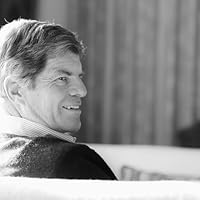
Jonathan Rose is the William R. Kenan Professor of History at Drew University. His fields of study are British history, intellectual history and the history of the book. He served as the founding president of the Society for the History of Authorship, Reading and Publishing, and as the president of the Northeast Victorian Studies Association. His The Intellectual Life of the British Working Classes, won the Jacques Barzun Prize in Cultural History, the Longman-History Today Historical Book of the Year Prize and the British Council Prize. He is co-editor of Book History, which won the Council of Editors of Learned Journals award for the Best New Journal of 1999. He held visiting appointments at the University of Cambridge and Princeton University and he reviews books for the The Times Literary Supplement and the Daily Telegraph.
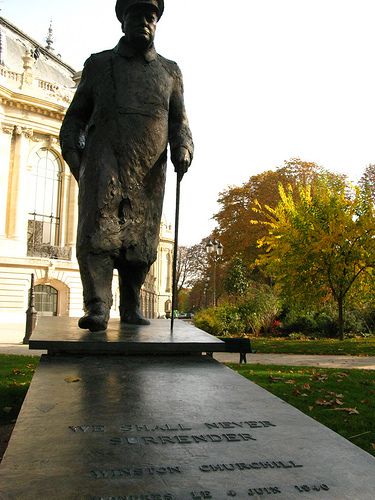
"We Shall Never Surrender" outside the Petit Palais in Paris
From Charles De Gaulle “The Complete War Memoirs”(from page 352 of my edition)
“he was fitted by his character to act, take risks, play the part out-and-out without scruple...Whatever his audience – crowd, assembly, council, even a single interlocutor – whether he was before a microphone, on the floor of the house, at table, or behind a desk, the original, poetic, stirring flow of his ideas, arguments, and feelings brought him an almost infallible ascendancy in the tragic atmosphere in which the poor world was gasping. Well tried in politics, he played upon that angelic and diabolical gift to rouse the heavy dough of the English as well as to impress the minds of foreigners. The humour, too, with which he seasoned his acts and words, and the way in which he made use now of graciousness, now of anger, contributed to make one feel what a mastery he had of the terrible game in which he was engaged... Winston Churchill appeared to me, from one end of the drama to the other, as the great champion of a great enterprise and the great artist of a great history.”
It should be emphasized that Charles De Gaulle was not one to be effusive on most of those he encountered during his lifetime.
This book reiterates (to some extent over and over again) how Churchill was an artist in every sense of the word – his phrases abounded in colourful projections, he painted, he attended the theatre, read voraciously. He associated with the “art world”; there is a wonderful description in this book when the anti-war poet Siegfried Sassoon met with Churchill.
Churchill constantly sought out the eclectic – like T.E. Lawrence. He was an admirer of the science fiction writer H.G. Wells, particularly of his apocalyptic works.
Churchill wrote constantly, and he even wrote one novel, “Savrola”. When he became Prime Minister in the critical period of May, 1940 he stated that “the business of government will be conducted by the written word”. There were reasons for this, one being that he was already planning to write the primary account of the Second World War – and he wanted the day to day events – and his feelings on them, preserved for his future reference.
All forms of literary influence on Churchill are abundantly described in this book. Do not look in this work, for example, on how Churchill related to his wife Clementine. The word “melodrama” is used over and over again to describe the personality of Churchill. The attachment he put to his own words and those of others is significant. Churchill read “Mein Kampf”, and like everything he read, took it seriously.
One must also emphasize the energy of Churchill, contrast that to Chamberlain – and his possible successor when Chamberlain resigned, Lord Halifax (Halifax acknowledged that he didn’t want the job of PM and that he was a poor speaker).
As John Colville (Churchill’s secretary) remembered (page 294): “Churchill arrived on the scene like a jet-propelled rocket”.
During the 1920’s, and more so during the 1930’s, Churchill, his words and his methods (melodramatic picturesqueness, theatricality, emotion) were regarded as anachronistic. It was an era of nihilism, of anti-individualism, and of democratic countries looking feeble and pushed aside by vigorous fascist and communist regimes.
But Churchill rebounded with the advent of war. His personality magnificently united his people – and the entire world to the just cause.
Note the flow of images and how Churchill personalizes his words, in this broadcast of Britain’s support for the Soviet Union, given on June 22, 1941, the day after the massive German invasion of the Soviet Union:
From page 348:
“But all this [Churchill’s anti-communism] fades away before the spectacle which is now unfolding. The past, with all its crimes, its follies and its tragedies, flashes away. I see the Russian soldiers standing on the threshold of their native land, guarding the fields which their fathers have tilled from time immemorial. I see them guarding their homes where mothers and wives pray – ah, yes, for there are times when all pray – for the safety of their loved ones, the return of the bread-winner, of their champion, or their protector. I see the ten thousand villages of Russia where the means of existence was wrung so hardly from the soil, but where there are still primordial human joys, where maidens laugh and children play. I see advancing upon all this in hideous onslaught the Nazi war machine, with its clanking...”
Rose argues convincingly that every important political decision made by Churchill was influenced by literary experiences.
One major tenet of this argument is around “Savrola” which was Churchill’s only major novel. Nowadays it’s mostly forgotten but with uncanny prescience he prophesied a brilliant author and speaker who used his oratorical powers to defeat and evil dictator. A dictator who tears up treaties, stabs political rivals in the back, murders POWs, uses torture and recklessly seeks an armed confrontation with the British Empire.
He argues that historians have often struggled to explain why Churchill who was wrong about so many things was right about Hitler from the very beginning due to the influence of “Savrola”.
Rose also states that Churchill loved Victorian melodrama where the hero often dies valiantly or saves the day at the last minute. On the Queen Mary in the Atlantic he was warned a sub might sink the ship. He had a machine gun mounted on his lifeboat so he could engage in a shoot-out with the U Boat. “The finest way to die is in the excitement of fighting an enemy” he told Averell Harriman “you should come with me in the boat and see the fun.”
The author doesn't attempt to deify Churchill and also looks at the poor decisions that Churchill made, particularly in India. He claims that one of Churchill’s greatest failing was that he saw 20th century India through the prism of bad 19th century plays.
The book itself is not a biography, but does cover the major political activities of his life and Rose’s approach offers a vibrant and fascinating study on the influence of literature and theatre on Churchill’s political career.
This work isn’t a biography of Winston Churchill, nor is it a book about his literary works. Rather, Jonathan Rose’s book is a more subtle study which analyzes the influence of literature and the theater on Churchill’s political career. Rose sees much of Churchill’s public image as the product of a conscious pose modeled after many of the tropes of popular theater. Churchill was hardly unique in this respect, as his political career began in an era when dramatic oratory was highly prized, and many politicians appreciated the value of the coup d’theatre. Though Churchill’s approach proved dated in the interwar era, with its preference for less affected politicians, it made him the ideal opponent for Adolf Hitler, a figure Rose sees as “a photo negative” to Churchill in his similar embrace of politics-as-theater. The dramatic style which was out of step in the interwar era proved a perfect fit for the war, becoming a critical component of both Churchill's success as prime minister and his depiction of his role in his image-defining postwar memoirs.
Rose’s approach offers a fresh and interesting perspective to understanding the ways in which Churchill shaped and defined his achievements. Though Rose oversells his argument by trying to read the influence of literature into more aspects of Churchill’s life than it can plausibly sustain, he makes a convincing case for viewing Churchill as more than just a politician who earned his income as a writer. Readers seeking to learn more about Churchill literary career would be better served by turning to more specialized studies such as David Reynolds’s In Command of History: Churchill Fighting and Writing the Second World War or Peter Clarke’s Mr Churchill's Profession: Statesman, Orator, Writer, but for how literature helped make him into the unique politician he was this is the book to read.
A genuinely fresh and original insight on this much studied man - revealing the literary and dramatic influences on Churchill's performance - especially interesting are Rose's insights into the impact of melodrama. Sometimes the theme does seem to move into overdrive....
A superb one volume biographical survey of the life of Winston Churchill. What makes this book especially absorbing is the authors focus on, as his subtitle indicates, Churchill as "Author, Reader, and Actor." Mr. Rose presents actions Churchill made along with the causative factors of those actions - books he read, plays and movies he saw. Churchill was largely self-taught. Although he attended a prestigious public school, Harrow, he didn't go on, as did many of his contemporaries, to "Oxbridge." Through force of personality and the gifts of public speaking prowess, he led Great Britain through dark times, as well as times of success.
I can't praise this book enough. Since doing history O-Level back in 1987 I have been fascinated by Churchill - warts and all. I've read a number of books about him and by him but I think this book - exceptionally well-researched and well-written by Jonathan Rose - seems to be the one that has really got to the heart of Churchill.
Rose - whose book, 'The Intellectual Life of the Working Classes' I also found a fascinating read - has managed to write cultural history that informs and clarifies the political history. 'The Literary Churchill' seems to me to be the 'real' Churchill.
The analysis of Churchill's life, treating him as an artist in politics as opposed to just a plain old politician, is wonderfully backed up by Rose's research and makes strong use of Churchill's own works particularly as support of his approach.
My next Churchill book is planned to be Andrew Robertson's book - whose biographies of Napoleon & Lord Halifax - who, naturally, crops up in this book - but Robertson will have to do a mighty fine job to improve on this.
If you want to read a book that helps you understand Churchill start with this one. It's rather good.
I find this a frustrating book. It starts well, with good accounts of Churchill's early life and the literary and artistic influences that shaped his formative years. There is an important focus on Churchill's only novel, "Savrola". But as Churchill's career progresses, the book meanders from this theme and one gets a mix of the well-known narrative of Churchill's life with occasional divergences into the literary works with which he engaged at these times.
There are lot of good things in this book and some interesting insights into, for example, Churchill's literary style. But virtually everything that Jonathan Rose discusses has been covered in greater depth by both the manifold biographies and the specialist studies of Churchill's literary work by David Reynolds, Robin Prior, Peter Clarke and Maurice Ashley, among others.
One annoyance. There are copious references but no bibliography.
Persuasive polemic on the influence of 19th-century melodrama on the formidable Winston Churchill - not simply his prose and wit but, more consequentially, his political thinking and world-altering decision making. The imprint of Shaw, Wells, and Wilde is repeatedly revealed, as well as that of earlier authors like Gibbon. The book climaxes with a look at Churchill's literary influence on others, particularly JFK.
A brilliant analysis of the literary influences on Churchill's life and actions. Engrossing with lots of information and insights I have encountered before. Magisterial and dense and heavy going in parts, but well worth the effort
Of all the great books about Churchill, this one stands out as it is so unusual. Jonathan Rose has done amazing research to uncover the sources for many of Churchill's speel
This is a very compelling biography that maps out the influence of literature and the stage on Winston Churchill's writings, speeches, and political career, showing important ways that authors such as Wells and Shaw, along with Victorian melodrama, had a profound effect on Churchill. I'm reviewing this book elsewhere so I won't say much more here, but it's a great read and a good book to map out intersections between literature and history. The book concludes with a fascinating discussion of how JFK's direct and indirect reading of Churchill influenced his decisions during the Cuban Missile Crisis. History buffs would find this valuable, as would literature scholars of the late-Victorian period and the twentieth century. It's also an interesting discussion of the significance of middle-brow history writings such as Churchill's.