What do you think?
Rate this book


160 pages, Paperback
First published January 1, 1876
 A Gentle Creature, White Nights and The Dream of a Ridiculous Man are the three short tales about dreamers divorced from reality collected in this read. 6 out of 12, Three Stars; reading seven Dostoyevsky's back to back in around 50 days was probably not the best way to taste this classic writer and a more relaxed series of rereads of this and his other books would not go amiss for me.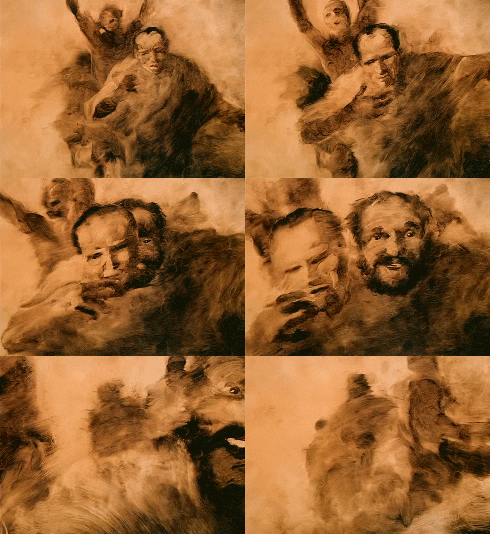
"If in the first act you have hung a pistol on the wall, then in the following one it should be fired."Two of the three stories in this well chosen collection prove Chekov decisively wrong. If you have mastered human psychology and looked deep into the human soul like Dostoyevsky then the pistol can appear but its hammer does not need even to be cocked.
"Do you know that I am compelled to celebrate the anniversary of my own sensations, the anniversary of what was formerly so precious to me, but never actually existed—because the anniversary is celebrated in memory of those same silly disembodied dreamings—and do this because even those silly dreams are no more, since I lack the wherewithal to earn them: even dreams have to be earned, haven’t they? Do you realize that on certain dates I enjoy recalling and visiting those places where I was once happy after my own fashion? I enjoy constructing my present in accord with things now irrevocably past and gone, and I often drift like a shadow, morose and sad, without need or purpose, through the streets and alleyways of Petersburg. What memories there are! I recall, for instance, that it was exactly one year ago, here at this precise time, that I wandered along the same pavement as lonely and depressed as I am now. I remember that even then my dreams were sad, and although things were no better back then, there’s still the feeling that that living was somehow easier and more restful, that there wasn’t this black thought which clings to me now; there were none of these pangs of conscience, bleak, and gloom-laden, which give me no peace by day or night. You ask yourself: where are your dreams now? And you shake your head and say how quickly the years flew by! And you ask yourself again: what have you done with your best years, then? Where have you buried the best days of your life? Have you lived or not? Look, you tell yourself, look how cold the world is becoming. The years will pass and after them will come grim loneliness, and old age, quaking on its stick, and after them misery and despair. Your fantasy world will grow pale, your dreams will fade and die, falling away like the yellow leaves from the trees…"He is nostalgic, not for the past itself but for the fantasies he was able to harbor in the past, before the futility of his idealism became obvious to him, as well as the inevitability of his continued inaction; he is nostalgic not for anything accomplished or experienced, but simply for potential. It would be one thing if accomplishment and experience alone remained elusive, but the true horror is that potential vanishes too, year by year. Nonetheless, the novella’s conclusion provides a hint of the spiritual consolation Dostoevsky will later offer, even as his visions of horror become more drastic: "A whole moment of bliss! Is that not sufficient even for a man’s entire life?" We are defeated by time, but may triumph in eternity, even the eternity mystically represented by a moment. And our moments, needless to say, are what art, more than any other human activity or institution, can preserve—hence modern literature’s (and cinema’s) consecration to the days and nights of the ever-moving, ever-changing city.