Ollmann has been called the best writer of short stories working in comics today. Featuring a lengthy introduction, this is the definative collection of those stories. Although the term “graphic novel” has become widely accepted in the publishing industry and the culture at large, it describes long form works. This omnibus makes obvious that there is a need for a term to describe the short story version of the graphic novel. In the same way the short story has recently had a resurgence, winning many literary awards, so too the graphica version. Ollmann won the Doug Wright Award in 2007 for This Will All End in Tears, most of which is contained in this omnibus. The best stories from Chewing on Tinfoil are included, as well as two new stories, written just for this book.
Joe Ollmann lives in Hamilton, the Riviera of Southern Ontario. He is the winner of the Doug Wright Award for Best Book in 2007 and loser of the same award another time.
I thought this was awesome. It's my first experience with Ollmann, I think. But I kind of agree with Seth, who blurbs on the back of the book that he is "criminally under-appreciated" with "an understanding of heartbreak and comic timing." As we learn from Jeet Heer's nice intro, this book features the best of two previous (under appreciated, and under-read) short story collections, Chewing on Tinfoil (2002) and This Will All End in Tears (2006, which won the 2007 Doug Wright Award), and adds two more recent stories that are unaffected by what he claims were particularly difficult periods in his life out of which the stories emerged. He, like Seth and Chris Ware, who would seem to be influences, apologizes profusely for what he claims is terribly lettered and drawn work, either embarrassingly bad (to him), or wonderfully affecting (to me).
These are short stories, fine literary prose productions, and also comics, of course, reminiscent of the best of Seth, or Ware, or Raymond Carver. Sad work, as Seth suggests, heartbreaking, but also with sweetness about them. And craft! Beautifully done. And sort of like Dave Eggers in A Heartbreaking Work of Staggering Genius, he both creates the heartbreak and calls attention to the fact he is doing it sometimes. The opening (sort of) preface has a bunch of sad sack people lining up to audition for his stories, which is an hilarious frame for the sadness that follows. . . and then on the last page he depicts himself at a drawing board weeping at his own creation. Funny, right?!
I would say the earlier stories, while technically a little rougher and less complex, are actually better than the two that are drawn and lettered in a way reflecting his artistic and narrative "growth". The earlier stories have more heart and are edgier and sadder, which may put off some people, but they are really, really good stories that will stay with me, stories of a hapless ventriloquist; a guy who is pressured by his macho coworkers to go deer hunting and kills a deer he doesn't know what to do with; a "plus size" waitress and her restaurant menagerie; a man who drinks himself to oblivion while he fails to adequately care for his ailing mother and mentally disabled brother; a bookseller who is in a conflict with a rival bookseller. . . Oh, I know, they all just sound too sad, but they are all so skillfully drawn and told! There's humor and warmth underneath it all!
The stories remind me of Harvey Pekar, only they are crafted as fiction. Or Will Eisner. But tell me who are the great comics short story tellers? Not many. Ollmann is one, for sure, and he's great. Now I'll read his novels but I am afraid they might not be sad enough for me, as he's in a happier place now! :) I recall now attending an Allison Krause and Union Station concert from a few years ago where she was going to play one of this great songwriter's songs that they had basically gotten famous from playing. They had heard he was getting married, though, so were worried he might be too happy now to write any more of the exquisitely sad stories that they had made them so successful. That rings true for me with Ollmann.
PS I have since read more work by Ollmann and he's never let me down for sure misery (and talent).
Whoa, where did that come from? Why have I never heard of Joe Ollmann? Based on the quality of the short stories collected in this book, he should be a household name of alternative comics, up there with the likes of Harvey Pekar, Dan Clowes, Adrian Tomine, Seth, etc. As David Schaafsma noted in his much more elaborate review (check it out, it's great!), you can even find traces of Will Eisner in Ollmann's elegant, spot-on cartooning.
The stories are every bit as dark, complex, weird, unpredictable, obsessive and dysfunctional as real life, yet the tone ultimately is a humanistic, vaguely hopeful one - a quality that sets Ollmann's stories apart from the usually rather cynical alternative comic-book competition.
There's just one thing that struck me as a little odd: the very strict and stiff nine-panels-per-page layout of all the stories felt strangely at odds with their otherwise casual, almost conversational tone. I sometimes felt a more relaxed layout could have added to the stories' expressiveness - but maybe that's just me. Otherwise all I can say is: what a discovery! Go Ollmann!!
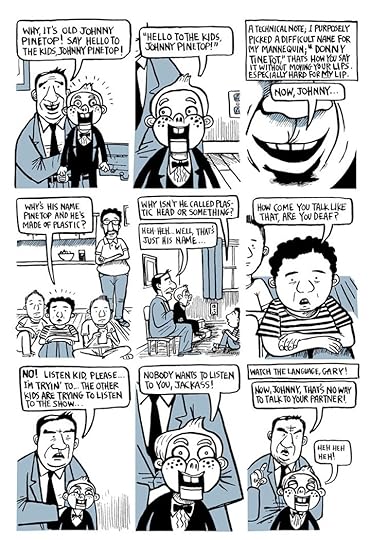
I don't give out five stars lightly, and whenever I do so I tend to hesitate at first and ask myself, "Do I truly intend to give this book the highest rating?" In the case of Joe Ollmann's Happy Stories about Well-Adjusted People, I have no such hesitation. This is a collection of short comics stories by Ollmann, many of them previously published, but now all brought together on one larger volume. These stories are outstanding primarily because Ollmann demonstrates a mastery of the short story form in comics like no other writer that I can think of. His comics have that same brief, condensed, yet fully realized feel that some of the best prose examples of the form give you. The title of the collection is ironic, as all of the protagonists in the book are anything but happy and well-adjusted. And that's what makes the stories so powerful: these are all broken people we're reading about, yet in their brokenness we are able to empathize with them and see ourselves and others in a more direct way. There are some figures who are more overtly humorous, and whom we are supposed to laugh at -- such as the lame ventriloquist Gary in the opening story -- but whose life is funny to the point of being painful. And it is in that way that we can identify with him, through his pain marginality. Many of the stories end abruptly and without neat resolution...which is another way Ollmann's stories stand toe to toe with some of the best prose short fiction. This is definitely one of those books I wish Andy and I had read for The Comics Alternative podcast.
These are pretty much the same stories as "This Will All End In Tears." There might be one or two new ones. I'm not sure (I don't have the patience to check.) I'm glad I reread the stories, because they're great, but I'm not sure why there are two different books with very similar content.
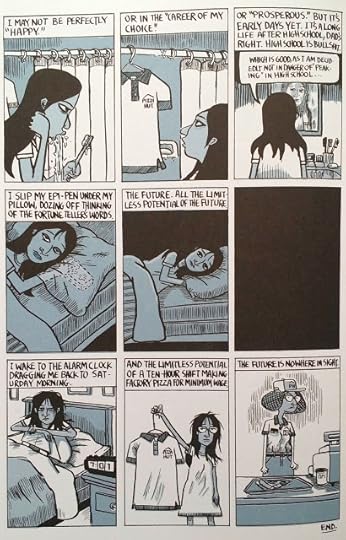
Wow, this was even better than I was expecting! Those rave quotes from Jeet Heer and Seth that talk about how Ollmann is a master of short stories in comics? Yeah, those aren't just blowing smoke. He really is that good. He makes you care about his protagonists. They may be flawed, but we understand them. Through their thoughts and actions, we gain insights about them, insights they may not be aware of themselves. They feel like real, ordinary people. I remember them almost more as characters than as stories. There's the reluctant hunter, and the young girl with the peanut allergy, and the ventriloquist with the harelip, and the man suddenly responsible for the care of his autistic brother, and ... There is darkness to some of these stories, but leavened with warmth and compassion and humanity and humor. Highly recommended!
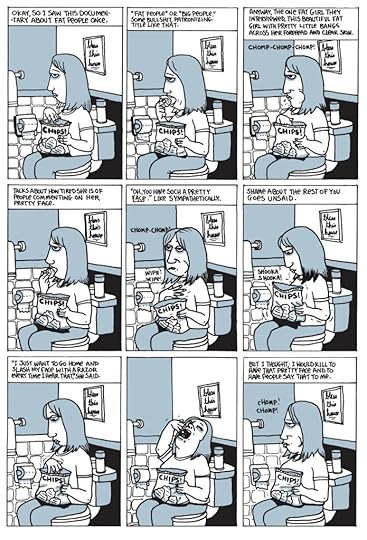
I almost feel like I should give this 5 stars just because I was able to make it through an entire graphic novel. I'm trying to get better at reading graphic novels, and this was wonderful practice. I liked that it was a collection of short stories, and I though the art was easy to follow. I didn't love every story ("Johnny Pinetop" and "Big Boned" were pretty weak to me), but there's something about the way Ollman shared bits of these characters' lives that felt quite poignant. My favorites were "Giant Strawberry Funland," "Hanging Over," and "They Filmed a Movie Here Once." This is an uncomfortable and sad and funny collection, and I recommend.
this had the same effect on me as when I watch Louie - each story is narrated by a strong voice, it is usually a depressed or cynical voice, the stories are well told and create a fine reading/watching experience, but they make me feel sadder than when I began.
A collection of short-stories that all appear to be grim and depressive, but in some unusual way actually live up to the title's premise. Ollmann's mastery of the sudden, indeterminate conclusion is always a joy to behold. One of the best short-story collections I've ever read.
Very well fleshed out vignettes of seemingly ordinary people without any sugar-coating. Somewhat sad at times, there is always some hope lurking in the stories. Can still be dark at times.
This is a tricky one -- it's of the fakesy, old school, very deliberately constructed school of cartooning about certain things in a certain a way, and I bristled at that quite a bit -- like, bro, what are you trying to do here, where do you get off writing about the people in these stories -- but surprisingly, the most moving ones were about young woman struggling to figure out their shifting identities as they become adults -- it felt like every character was a little slice of Ollmann's psyche expanded upon. The weird, slow build of earnestness in this collection got under my skin, in a good way. The art was fine -- very traditional panelly stuff -- I forget how weird and risk-takey alot of the stuff I read is until I read something like this that looks like it's straight out of the classified section of the alternative weekly, but eh, so it is. Not half bad, all in all.
My reviews over the next few months will have to be concise, and quickly churned out; I’ve got lotsa stuff on my plate (nothing bad.) The title of Joe Ollman’s graphic story collection, Happy Stories About Well-Adjusted People, is ironic, natch. These characters are anything but happy and well-adjusted, and that’s what makes them interesting. Favorites include ‘Johnny Pinetop’, in which a self-hating ventriloquist finds in his puppet a twin, a doppelganger. This is familiar, creepy ground, and it reminded me of an old Twilight Zone episode. ‘Big Boned’ is a poignant exploration of self-image. I also quite liked ‘Oh Deer’, about a reluctant hunter, and ‘They Filmed a Movie Here Once’. ‘Hanging Over’ was a bit of a downer, an alcoholic guy coping (not so well) with his elderly mother and ‘simple’ brother. For budget purposes, I suppose, this book is on the small side, about 6x 8.5. The lettering in some panels was sometimes crowded and small, maybe better suited to a larger format. Am I interested in seeing more from this author? You bet.
I used to read Ollman's strips in the Hamilton papers back when I lived there, and I have one of his older collections, Chewing on Tinfoil, which I liked but didn't remember well. He's that rare thing, a graphic novelist but for short stories--a graphic short story writer! You don't even really ever hear the term, do you?
Anyway, his stories are great and this collection is great--sad and quiet, funny and pretty dark in spots. Character-driven and without a lot of conclusive endings. Very much my thing. I'm a terrible graphic-anything reader, as I tend to flip past images too fast and I don't have a great sense of visual detail, but even I like how Ollman renders a face grumpy, nervous, excited, intrigued. The other reviews here and elsewhere get much more into the art of his drawings, so I'll leave that to people who actually know what they are talking about. They're good!
The more I read Joe Ollman's graphic short stories, the more I appreciate them. This is a collection of 8 short stories, and 2 of them I had read before in a previous collection, and one in particular, "Fire Sale", leaves me wondering (whether "he did it" or not) even though I have read it several times. The story called "Hanging Over" also has an ending that leaves you wondering, but the story is so poignant and so well done it will stay with me for a long time. The title of the collection is ironic because they are NOT happy stories about well-adjusted people, but they are stories about real people which will resonate with you and they have both tragedy and glimmers of happiness in their lives.
While some of the stories were hit and miss for me the ones that I liked I REALLY REALLY loved. I've been a fan of Ollmann's writing ever since I read Mid-Life, so I'm just catching up on stuff from before and after it now. He really is a master of real people with honest and often dark thoughts. If you like slice-of-life with an edge of darkness, this is the graphic novel writer and artist you've been looking for.
I was floored by how good these short stories are. It is definitely an art to write compelling short stories, and there are few authors who are adept at writing both short stories and novels. Ollmann has proven his mastery of the short story here.
These are all character-driven stories, and the protagonists are generally flawed, sometimes reprehensible. But, I found myself sympathizing with them and wanting to know more (the sign of a good short story, in my opinion).
The best comic I read all month. Collecting some of the earlier work of Joe Ollmann, this is a collection of fantastic short stories. I believe this is a 'best-of' of his stories from "This Will All End in Tears" and "Chewing on Tinfoil". The title is pretty funny, obviously these stories depict the exact opposite. Typically featuring people living sad desperate lives. It reminded me of the Raymond Carver stories I read recently just with the setting adjusted to Ollmann's Ontario of the 90s/00s.
As his blurbers point out, Ollmann excels at the short story form. Even though you'd think there'd be more mental health content with the title, it's really just one story that is basically about someone with disordered eating (binge-eating disorder probably comes closest.) Grim but good stuff, I can see why these were collected and reprinted here.
Cool collection of short stories. A little dark, but I loved how each one left me wondering what happens next. Definitely love the irony of the title. 😂
Like Carver’s prose, the hard, important work the author has put into Happy Stories About Well-Adjusted People is often unnoticeable due to their excessive readability. Ollmann is a deeply caring author who knows that he is, in part, each of his characters. He displays their flaws so intently that some readers may read these characters’ inner monologues without a sense of unreliability, and take their misguided opinions of themselves and the world for the author’s unconscious flaws. In this book, we see the characters teasing their quirks out up to the point of realizing the flaws they possess, which the author already understands in himself, then lose sight of them just before they make (or refuse to make) a real change in their lives.
These stories are a hybrid form of sorts. They are comics, but they are text-heavy, and read closely to how prose short stories read in term of length, narration, and dialogue. This is due mostly to Ollmann’s visual and textual design of his pages. Without variation, every page is made of a 3×3 vertical rectangular panel design, which has a regularity to it that mimics traditional prose and paragraph form. In many cases, a page is constructed just like a paragraph would be.
The stories rely heavily on two types of word-image combinations, which Scott McCloud describes as “word specific” and “additive”. (I should mention now that I have disagreements with this system of categorization, but that discussion is for another day.) In a word specific combination, “pictures illustrate, but don’t significantly add to a largely complete text” (McCloud, 153). Essentially, the text narrates and the picture illustrates. Each of these stories is driven by a character’s monologue and he often has them narrate the events of a day while the pictures illustrate the actions they describe. Sometimes this is used complexly, to produce dissonance between the picture, which is reality, and the text, which is subjective to the character. Additive combinations are panels that use words to “amplify or elaborate on an image or vice versa” (154). This can come in many shapes and sizes, but Ollmann generally uses this to deliver his characters’ opinions/evaluations of whatever is being shown in the panel.
There are all kinds of word-image combinations used in his Ollmann’s stories, but these two word-image combination techniques are central to his style, which relies on showing what is in the character’s mind, contradicting or supporting that with what is objective, then going back into the mind, which brings the reader to what is most human in these happy stories about well-adjusted people. The way this pattern emerges is usually in a sequence of events where the character muses on their situation, or critiques it, or trash-talks on those around them, then has to interact without the monologue. It’s in these moments that Ollmann uses straight dialogue and images, which are rare compared to his pages that employ narration. Right when the action ends, the reader is back in the monologue. Usually, narration annoys me, as it’s an easy way to explain a lot without doing the hard work of showing instead of telling. But, this collection is different, and the narration feels like a necessary part of the writing, rather than a short cut. I haven’t quite figured it out yet, but I do know that it is mostly because of the wonderful unreliability of the protagonists. When reading this, we must remember how often we lie to ourselves, with and without realizing it.
This book has characters that feel realistic and who have fears most people can sympathize with, and the pacing of the stories and the way that the protagonists are fleshed out is fantastic. The art is endearing, which may sound like a backhanded complement, but I mean it in the most sincere way possible. It serves Ollmann’s words well by being deadpan when needed and overly expressive when text alone fails. This book may be a good choice for someone new to comics or for someone who criticizes the medium for not being literary enough. That being said, the type of person who would appreciate Ollmann’s wit and sympathy would probably not be the type of person to discount an entire medium before giving it a fair chance.
Joe Ollmann is - op dit moment - slechts te vinden in de Franse afdeling van Wikipedia, terwijl zijn werk niet eens vertaald lijkt te zijn in het Frans. Op de website van Drawn & Quarterly is meer te vinden over Ollman: "Joe Ollmann lives in Hamilton, the Riviera of Southern Ontario. He is the winner of the Doug Wright Award for Best Book in 2007 and loser of the same award another time". Maar ook dat is natuurlijk karig. Voor wie meer wil weten van Ollman, is er gelukkig dit lange interview waaruit onder andere blijkt dat Ollman werkt of heeft gewerkt als "a writer, as an illustrator, as a publisher, as an editor, as a DIYer, and as a creator for smaller and larger presses" én waarom hij in de Franse wikipedia staat genoemd...
Ik ken(de) Ollman niet, maar mijn oog viel op de titel van dit boek terwijl ik door de afdeling Graphic Novels van de Bookdepository aan het bladeren was. Zoals de eerste zin van een boek je direct het boek insleuren kan, zo overkomt mij dat regelmatig met titels. De beschrijving van het boek gaf het laatste duwtje en een paar dagen later lag 'the best of' van John Ollmann in mijn brievenbus. Acht korte verhalen waarvan er zes uit twee eerdere boeken van Ollmann zijn overgenomen, aangevuld met twee nieuwe verhalen. Met een zucht van spijt heb ik zojuist de laatste bladzijde gelezen en omgeslagen...
De hoofdpersoon uit Otherwise, arachis Hypogaea is een tiener van Aziatische afkomst met een pinda-allergie. Ze heeft het zwaar in en met het leven, maar vergeleken met de andere zeven hoofdpersonen valt het allemaal nogal mee. Je zult maar buikspreker zijn met een hazenlip, zonder werk, levend onder het dak en op kosten van je moeder. En dan gaat zij dood. Of je zult maar een vrouw met zware botten zijn die een beetje verliefd is op die collega, waarvan je 'zeker weet' dat hij nooit in jou geïnteresseerd zal zijn. En daarom wil je niets anders dan alle mogelijkheden op succes zorgvuldig vermijden. Of je zult maar die treurige, eenzame man zijn die dacht zijn altijd dronken moeder en zijn 'speciale' broer ontvlucht te zijn, die geconfronteerd wordt met het feit dat er van jou verwacht wordt dat je je speciale broer opneemt, omdat je moeder in het ziekenhuis ligt met een gebroken heup, diabetes en beginnende dementie. Dát, zo had je je ooit voorgenomen, dát nooit.
Zo tragisch als de verhalen lijken, zijn ze niet. Het is het gewone leven, vertelt door Ollmann, het lot en in het geval van Fire sale voorzien van een snufje magie. Of kerosine. Maar in ieder geval geen rozengeur en maneschijn. Niet voor de buikspreker, niet voor de tiener met pinda-allergie en niet voor alle andere hoofdrolspelers. De titel beschrijft, anders dan wat het voorgaande wellicht oproept, exact wat het boek bevat. Hoe Ollmann dat voor elkaar krijgt is zo moeilijk uit te leggen dat ik me gemakshalve maar aansluit bij Seth, die op de achterflap van het boek de volgende quote heeft laten opnemen: "[Joe Ollmann is] a man with an understanding of heartbreak and a talent for comic timing. The work is deceptive--reading as smoothly as a page-turner but remaining in the mind and soul long after the covers are closed."
I thought I never liked short stories until I read this book. Maybe I needed to read them in comic form. This time, I "got it!" - I understood their glory.
These stories are great. The comic format, Ollman's skilled drawing and writing (along with the perfect explanation of the short story form, in the introduction to this book), have caused me to reconsider short stories.
In the introduction, Jeet Heer writes, "The glory of the short story is that it is a form that forces us to be alert." What a beautiful sentence and so true.
Heer explains that a short story is a stand-alone piece, not a warm-up to a novel. He explains that great short story writers are experts at distillation (so that every scene and bit of dialogue requires attention), and that great short story writers, "have all worked to sharpen our perceptions: to make us more attentive readers of both the printed page and of human behaviour."
I love that description and explanation of the importance of the short story. After reading this book, I feel I have a much better understanding and love for short stories, so much so that I now think reading them could rightly count as a form of mindfulness practice.
I found myself staying in the moment when reading these stories, knowing it was for a discrete period of time that I had set aside, that there would be a clean beginning and end, and that the action of reading them could be a healthy method of taking time out for quiet, focused reflection.