¡Finaliza la odisea del Rey del Sueño! En esta última entrega, Neil Gaiman cuenta con la participación de algunos de los mejores autores de la industria del cómic -Michael Zulli, Jon J. Muth y Charles Vess- para relatar las consecuencias de la trascendental decisión tomada por Morfeo. Emotiva historia con la que poner un broche de oro a una saga para el recuerdo.
“That which is dreamed can never be lost, can never be undreamed.”
I have been reading this for five years, reading one volume every six months or so. I have paced my reading out, staggered it, delayed it and put it off completely at times. Why? Because I never wanted the story to finish, so I tried to hold back the inevitable. For me this says a great deal: The Sandman was so good that I did not want to read it because I would never be able to read it for the first time again.
I can think of only a handful of times that a story has affected me so. The first time I watched Lost and when I found out the sequel To Kill a Mocking Bird was to be released are the only comparisons that come to mind. Sometimes when greatness is established very early on, there is a worry that as you continue to read (or watch) it will begin to lose its spark and crumble as it falls short of the potential it originally established. I have seen it happen so many times in books, films and even music.
Gaiman is one of my favourite writers and this is Gaiman at his absolute best; he retains the brilliance here to the very last page, to the final act: to the closing of the curtain. I do not want to talk about the plot here or even the characters. I do however want to remark how powerful the concepts that drive it are, concepts that have captured my imagination for many years.
How everything ends here is pure poetry because it's not really an ending, it is just the finalisation of a point of view. I imagine Gaiman laughed as he wrote, knowing just how clever he had been. I shall say no more other than finishing this was extremely difficult.
___________________________________
You can connect with me on social media via My Linktree. __________________________________
A very nice send-off for The Sandman. The Wake gives all the characters (and fans) a chance to process and come to terms with the end of an Endless. It was sweet. Or bittersweet. However you choose to look at it.
My favorite story was definitely the one with Hob Gadling. It surprised me. In a good way! And that doesn't happen very often anymore.
And of course, the story I liked the least was the boring/confusing story with William Shakespeare that closed the volume. I guess Gaiman loves Shakespeare. And that's fair because who doesn't appreciate his stuff? But the two stories in the Sandman universe that I've read with him in them have both been stand-outs as complete slogs to get through. Sorry, Will.
Overall, though? I loved that Wake tidied up all the loose ends for this run. The new Dream is a kinder, gentler version of the old Dream. And when it comes to dreams, isn't that what we hope for?
Illustrators: Michael Zulli, Charles Vess, & Joe J Muth
Covers: Dave McKean
Letterer: Todd Klein
DREAM OF A FUNERAL AND...
Nobody died. How can you kill an idea? How can you kill the personification of an action?
This final volume (from the regular series while there are still some other TPBs yet to read about) is dedicated by Gaiman to Dave McKean for his amazing work doing the covers of all single comic book issues of the original publishing of the series. I think that that it’s quite adecuated and deserved. What I found curious is that Sam Keith and Mike Dringenberg, artists involved in the creation of the series and they are acknowledge for it, that they weren’t here, in the final song of the party.
I swore I would never shed another tear for him.
The ending of the regular series of The Sandman is here and you have to attend to a funeral. Basically the whole volume is about that, and even so, it isn’t, since a big part of the TPB is used in extra stories post-ending.
While it’s written in such wonderful way, with great prose, honestly I found this final volume quite weak and not the way that I’d expected that this series would end.
It’s kinda contradictory, since while the previous volume, The Kindly Ones, I found it unnecessarily long, here in, The Wake, I considered it unexpectedly short.
The King is dead. Long Live the King.
Obviously you can’t lengthen a funeral more than what it’s done here, but again, you are left with undeveloped elements of the story, like a very, very, VERY important “first” meeting and at least one day or one “first story” after the funeral to feel the change in thrones’ styles since it’s quite obvious that the “new” king will manage things in a different way, better? Maybe. Worse? Unlikely, but possible. Again, I’d like to read about that “first” day in the job, a “first” challenge.
You get kinda something like it in one of the extra stories but hardly it’s what I’d like to see about it.
Everybody’s here. You’re here.
And Gaiman wasn’t kidding, since definitely everybody is on the funeral, even you and me, and everybody who is reading the story.
Obviously there are people speaking on the funeral, a few words to express their feeling for the one who is “away”. But I felt kinda cheated since the most important character to know what she has to tell, you can’t hear it, just guessing, and honestly, besides the huge respect that I have for the author, I thought that instead an artistic choice of not putting that words in the prose, I thought more that it was fear of not matching the expectations of readers since definitely that speech can be the mother (or it should be “sister”?) of all speeches, and so, instead of taking the challenge, the narrative took the easy road just “commenting” that the speech is done instead of actually printing the words. Ironically, it was like “cheating death”.
I lived a good life and it ended. Would you take that away from me?
One of the highlights and easily the strongest analyzed issue is about Life and Death, and since it’s impossible to deny that The Sandman is a comic book, it’s obvious the power after all the arguments exposed along the volume about dying and returning to life. Since, for better or worse, in comic books, almost nobody remains dead too long. Is it really a good thing that after having “a good death” getting back from it? If so, are they really the same ones who died before?
But, honestly, the greatest story ever told is about resurrection, so, how can they be blamed to try to make their own angles about that topic that changed the world?
I had good dreams along the journey of this series and finally I am...
...awake.
But, obviously, there will be time to dream again...
Brilliant. So my review that took me really long to write somehow got deleted... :( Hate that. (Actually, it almost got lost for the second time, thankfully I was smarter this time and copied it.)
So, this is it? The end? It seems almost...sad. But definitely strange. Like I should hold a wake. Or maybe I already did.
"Everybody’s here. You’re here."
"You were there."
I finally got to the point that I could finish this series. And this remains my favourite comics series and the best thing Neil Gaiman ever created.
Unfortunately, I had a bit of a hard time remembering what happened at the end of the previous part but thankfully I managed to remember enough to enjoy this one.
"The king is dead, that's what they say. The king is dead. Long live the king.”
I was a bit disappointed by the ending because I expected something truly amazing that would blow me away but the rhythm of this one was slightly off. However, I still really enjoyed it. At first, I thought that it should have ended right after the wake, the other stories seemed wrong. But then I realised it just really makes sense.
“Nobody died. How can you kill an idea? How can you kill the personification of an action?" "Then what died? who are you mourning?" "A point of view.”
I hope that one day I will be able to re-read this series and it will be like remembering a long time forgotten dream.
“That which is dreamed can never be lost, can never be undreamed.”
This is the final volume–if you exclude the prequel—of the Sandman series, but it is really more coda than conclusion. Half of it consists of the “wake” itself (Morpheus’ wak, funeral services, and related events) and the other half of three stand-alone tales that provide a philosophical commentary on the life and death of Dream.
The wake itself will be a moving and interesting for most faithful reader of the series, as we reacquaint ourselves with most of the characters we remember—and a few we have forgotten about entirely. At times these first three numbers feel like the final chapters of a long Victorian novel, but that is not in any way a criticism; it is pleasing to observe each small part—and person—falling discretely into place.
The second three numbers, though, I liked even better. The first (“An Epilogue, Sunday Mourning") features Hob Gadling, the Renaissance Englishman made immortal by Dream, and his experience at a U.S. Renaissance fair. Hob meets up with Death, has a dream about Dream, and tells us all the reasons why he hates Renfair. (As any good renaissance man should!) The second tale (“Exiles”) features an encounter between Morpheus and an old Chinese civil servant. It has much to say about duty, and the death of sons, and causes the reader of The Sandman to think of the death of Orpheus. The last tale (“The Tempest”) is about Shakespeare and the writing of his final play, and makes a fitting conclusion to series.
I loved the series, hated to see it come to an end, and am already experiencing withdrawal. Luckily, I still have Overture, the prequel!
An appropriately contemplative denouement for a series that, when considered as a whole, suggests that Neil Gaiman is either:
1) A certified genius whose ability to blend myth, folklore, imagination, social issues, and pop culture puts him at the absolute apex of storytelling masters working today, regardless of medium; or
2) An authentic whacko whose ingestion of psychotropic fungus is of such heroically epic proportions that it would slay an entire army of genetically engineered giant yaks with enough psilocybin left over to enable a tone deaf monkey to produce a musical output that would put the Grateful Dead to shame.
Frankly, I’d wager even money on either, and there’s a distinct possibility that both are true.
Sandman is unlike anything else I’ve ever read before of similar length; while its 75 issues do encompass a consistent narrative thread, it veers off in different directions and with different characters in a way that’s very different from, say, Preacher or Transmetropolitan. I’m not sure there are many other writers—and perhaps Gaiman is the only one—who could pull off the trick without losing the audience, and even with Gaiman’s superhuman narrative prowess, Sandman makes for a challenging read. But, it’s also a worthwhile one, and if the concluding volume of the series saunters a bit slowly, it’s an appropriate tempo, as your brain needs a little time to digest the diversity of story that has preceded it and process the fact that it’s all coming to a close.
I read the first volume of Sandman about 15 years ago and was utterly perplexed; I didn’t pick up the second volume until a few months ago. I’m glad I waited before taking that plunge—I’m not sure I could have appreciated it then the way that I do now.
If you haven’t yet taken a trip (or, perhaps, gone tripping) with Mr. Gaiman and a slew of talented artists, I highly recommend it (no pun intended).
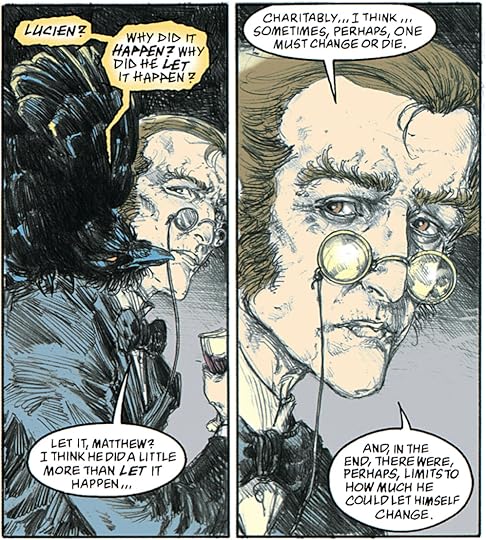
“Charitably... I think... sometimes, perhaps, one must change or die. And, in the end, there were, perhaps, limits to how much he could let himself change.”
I loved that this is an ending that is also a beginning. There was something beautiful and cathartic about essentially attending a funeral for a much loved character.
“But we do not need to recount every sermon and eulogy. After all, you were there.”
The entire time I was reading this I had the song Death Is Not The End stuck in my head - the cover version by Nick Cave & The Bad Seeds.
I have loved all the art over the course of this series, even the 'uglier' styles, which I think suit the story. Here it was softer and prettier than usual, which felt fitting. And of course the issue illustrated by Charles Vess was especially lovely. His art is absolutely wonderful and works well with the Shakespeare tales. I really appreciated the conclusion to the story of Dream's relationship with the playwright, and thought it was the perfect place to leave them behind.
I'm not really sure what else to say about the conclusion really. I thought it ended perfectly, though I also didn't really want to read it, because I wasn't really ready for it to be over. Of course, I still have the Death stories (which I am especially excited about) and the Overture and a few others, but the main story is done now. I feel quite sad about it, but also very grateful that Neil Gaiman brought it to a close so brilliantly.
I will be rereading soon I think, so I will probably add more to my reviews as I do so. I know there was much more that I wanted to say, but once I closed the book most of those thoughts drifted away. Perhaps they'll return eventually! I will say that these ten volumes have been one of my favourite reading experiences ever. I'm so pleased that I finally started reading them, and that they ended up exceeding all of my very high expectations.
“That which is dreamed can never be lost, can never be undreamed.”
This entire review has been hidden because of spoilers.
Dream of dreams; story of stories: The Sandman—a somberly joyous cacophony of storytelling.
The driving desire to make sense of every last morsel of existence and put it in terms our little human consciousnesses are capable of comprehending—that is the thesis of Gaiman’s majestic epic.
Abel said it best. It's the end of a point of view.
Original Review:
It was a sad and deeply nostalgic first few volumes, even when there weren't any actual recapitulations going on. It's the nature of a wake, or a waking from a dream. It was the letdown, the reminiscence, the transition that made these so powerful.
Death is not the end, and indeed, it is not the end at all, but the waking from the dream.
Pure poetry.
Of course, the remaining volumes do much the same, especially the last with our very own Shakespeare, with Prospero breaking his staff. Ah yes, the strings become clear now, don't they?
And thus ends Sandman. The four issues of The Wake may be my favorite issues of the entire run. For all the crap the series takes for "bad art", Michael Zulli's art is stunningly beautiful and detailed. I love how everyone dreaming attends the Wake, including some DC characters you wouldn't expect.
These issues were just so meticulously put together. Everything about them is perfect. Now issues #74 and #75 are a different story. Gaiman probably would have been better off having just stopped after revisiting Hob. These last 2 issues are dull and uninteresting. Upon further re-reads, I'll definitely just skip them. That being said, Sandman is still a fantastic series. One I'll continue to revisit for the rest of my life.
a word of warning : might be a major spoiler to read on if you don't know what went on in the previous volume ( The Kindly Ones ).
The Wake is a farewell, a last gathering of all the oddball characters that accompanied us into the realm of the Lord of Dreaming, but also a celebration of the power of imagination. Sadness prevails, inevitably, at saying goodbye to the Endless family, to the denizens of the Dreaming( Matthew, Cain, Eve, Corinthian, the librarian, the pumpkinhead, etc), to the mortals caught up in the drama and to the mythological creatures - gods, demons, angels, elves, chimaeras that fill in the halls of mourning for a last homage to Morpheus. But the story itself is endless, and the epitaph is one of the best quotes in the series :
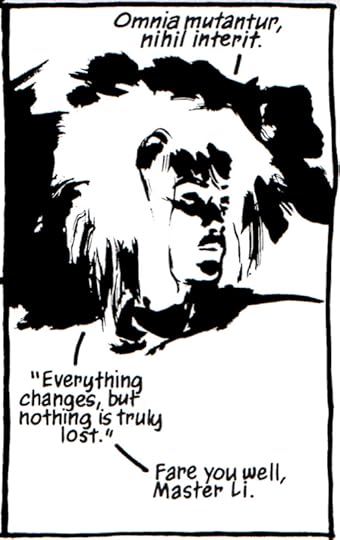
Only the Phoenix rises and never descends. And everything changes. And nothing is truly lost.
Some personages merit their own single issue, and I feel the author and the editors saved the best for last, both in terms of the artwork (Michael Zulli may be my favorite guest artist in the whole series) and in content:
An Epilogue, Sunday Mourning features Hob Gadling in a contemporary setting, grumbling about the cheap, fake atmosphere of Renaissance fairs. He should know, he was there to witness the smelly, ugly, diseases ridden epoch at first hand. Insead of meeting Morpheus for a glass of ale, he meets with his sister (you know, the one who always dresses in black) and wonders what's the point of being immortal.
Exiles is a return to the deserts of Asia, a place where the barrier between worlds and timelines is very thin. I loved the stark, Chinese ink and brush graphics and lettering by Jon Muth. The story is of an elderly adviser to the Celestial Emperor, sent into exile for connections with a rebellion. It is also about second chances, and how it is never to late to start life anew.
The Tempest is a companion piece to A Midsummer Night Dream, two plays commissioned by Morpheus from the Bard of Stratford-upon-Avon. Less about the actual play, and more about the condition of the artist, about the power of stories, about legacies and endings - it is easy to see why Gaiman has chosen it for closing the collection.
“Whatever happened to me in my life, happened to me as a writer of plays. I'd fall in love, or fall in lust. And at the height of my passion, I would think, 'So this is how it feels,' and I would tie it up in pretty words. I watched my life as if it were happening to someone else. My son died. And I was hurt, but I watched my hurt, and even relished it, a little, for now I could write a real death, a true loss. My heart was broken by my dark lady, and I wept, in my room, alone; but while I wept, somewhere inside I smiled. For I knew I could take my broken heart and place it on the stage of The Globe, and make the pit cry tears of their own.”
Somehow I can't believe I've come to the end and there are no more journeys into alternate worlds of myth and wonder, time travels to meet with Marco Polo or the Roman Emperor Augustus, Harun al Rashid or William Shakespeare. I know there are spin-offs, and I will probably get around to reading them sometime, but I don't think it will be quite the same as the original run. Oh, well, everything changes, and nothing stays the same. And that's the true beauty of it all: it's like a box of chocolates, you never know what you'll get.
This is the last volume in the Sandman series. Well, except for volume 0 that was published last but tells of the very beginning (with spoilers though so I really recommend reading it last). And it is a farewell.
Dream of the Endless is dead and we are all attending his wake and funeral. All creatures are in attendance, in fact, and we all speak. Thus, characters from throughout the series recount their relationship with Morpheus and - often without them realizing it - discover their interconnectedness.
As such, the volume was not too gripping or in any way action-laden. It was indeed a goodbye from Neil Gaiman and the artists but it was what the character deserved and it was beautiful. As was the art (it was quite different from what we had seen before).
And as we are used to by now, the writing packed a punch or one hundred (also see some examples above). Not just because we learn what Morpheus meant to so many creatures but also because of the author's take on love, faithfulness, loss, grief and solace.
The volume was difficult for me to get through. Forget the "epilogue" with the stories of Master Li, Will Shakespeare or Bob Gadling, the actual volume was one long funeral procession and it was breaking my heart. Though, truth be told, the epilogue didn't help either. Still, it also gave me closure - despite that not meaning that I'm OK with what happened.
A truly epic series that deserves all the praise it has gotten and is still getting with intelligent writing, tons of details from all kinds of mythologies intertwined with important aspects of history and such rich in imagery!
“We are such stuff as dreams are made on, and our little life is rounded by a sleep”--Prospero, The Tempest
This is a terrific finish to an impressive epic series that has its place as among the great works without question of comics history, one of comics's contribution to literature and the literature of fantasy, story, and horror.
Gaiman says simply, "The ten volumes of The Sandman, of which this is the last, comprise a story of stories."
So if what happens in the ninth volume, The Kindly Ones is (spoiler alert) the death of Dream, and what happens in the tenth is a funeral and a wake, attended by the rest of The Endless family, and as wakes can be, is often moving.
There's also some happy surprises, given how predictable a volume would be named The Wake. We get a chapter on Hob, the guy who never dies, who learns of Dream's death, and learns it from Dream's sister, Death. Given the choice to join his old friend from several centuries, the (now) cynical drunken Hob chooses life, which is sort of a surprise. We get a Chinese tale in "Exiles" that brings us back in some ways to volume one, in a desert, and maybe most importantly, we get to see that in some sense Dream never dies, as he/it becomes reconstituted for future generations with perhaps a more human face.
To complete the whole thing we get "The Tempest," which is also the second play Dream contracted to be made by Will Shakespeare, a work of play and imagination and story and color, Shakespeare's last play. That the whole epic ends with Shakespeare makes it clear he intends this to be a tribute to him and to creativity and fantasies like The Tempest and Midsummer Night's Dream and calling to attention his own Dream-like contributions to that specific fantasy tradition. Some people doubt a working class actor like Shakespeare could have written these plays; he couldn't have been that sophisticated! What Faustian deal did he make with the Devil. . . or with Dream? (Some people feel the same thing about Gaiman, that a kid who grew up in relatively modest surroundings could have written this epic tale! How?!)
Gaiman's own stamp on this tradition is both a traditional one and a postmodern one, in the very variety of the tales and ways of telling, and artistic depictions, a celebration of variety, and also how he includes one of his personal hobbyhorses, horror, as part of the fantasy story mix. He tacks back and forth between High Fantasy, the world of the Endless, the World of Imagination and Ideas, with its epic canonical language, across western and eastern traditions, and the everyday lives of people who need stories and dreams to more than survive, but to thrive. You may not like all of this, but you have to admire Gaiman's ambition, his reach, and the amazing team of artists he assembles to help him envision for us his tales. I love the art from Michale Zulli and Charles Vess in this one, even better than the art of The Kindly Ones.
Death asks Shakespeare, of The Tempest, "So tell me, do you see yourself reflected in your tale?” And Shakespeare responds, "I would be a fool to deny it." By implication, one can see Gaiman's own life and struggles and screw-ups and triumphs in The Sandman.
Shakespeare asks what might have happened if he had not been given the extraordinary power to Dream that Lord Shaper/Morpheus/Dream gives him to become the greatest playwright of all time, and Dream says he might have been a teacher, and gone back after some modest success in London to live a more quiet life with his family in Stratford. Then Will asks Dream if, in the bargain for literary greatness, was it worth it to lose his family as he did for much of his life?
“And Hamnet, my boy, might he have lived?" But Will takes back the question; finally, it's not knowable, and Will finds it too painful to know, finally.
So, executive summary: You want to know what the basic theme of The Sandman is, the moral, over all? That Life is Change, but some things remain that you can count on. (!?!) Do you need ten volumes to learn that?! I say yes, you do! Great works often have simple central themes. Anyway, I finally did it, read it all, and loved it! A masterpiece, for sure!
I thoroughly enjoyed this series and I'm quite sad that it's over.I've been reading the books since September and I've never read such creative, interesting, philosophical graphic novels with such great characters. It was interesting to see all the stories come together in the end.
Well, after a quarter of a century of meaning to get around to it, I’ve finally read The Sandman all the way through. Yes, I know there are lots of spin-offs and I will get to them but I’ve finished the main book and... well, I love it.
Part of me wishes I’d read it when it first came out but, honestly, I was not in a good place at the time and probably wouldn’t have appreciated it as much as I do now, twenty five years later.
This final volume has the most beautiful artwork of all the Sandman books (with the exception of Overture, if you include that as part of the main series proper) and it provides a fitting ending... or epitaph, I suppose, might be a more fitting description.
I laughed, I cried, I applauded and I even learnt something about myself that I’m not sure I appreciated having to learn but if that’s not the product of great art I don’t know what it is. Thanks, Neil.
Probably 4.5 stars. I really loved this until the final piece The Tempest. I wasn't a big fan of that section. I think I might like it more on a re-read for meaning, but it was a bit lackluster on first impression compared to the emotion of the other sections. However I'm rounding up to 5 stars because Gaiman.
“Just remember, what the French say. No, probably not the French, they've got a president or something. The Brits, maybe, or the Swedes. You know what I mean?"
"No, Matthew. What do they say?"
"The king is dead, that's what they say. The king is dead. Long live the king.”
Τελευταίος τόμος........ο μισός τόμος ήταν η συνέχεια του προηγούμενο και ο άλλος μισός κάποιες extra short stories. Ένας ωραίος επίλογος σε μια σειρά που ουσιαστικά τελείωσε στο προηγούμενο. Και ήταν μπορώ να πω ένα πολύ ωραίο ταξίδι που σίγουρα στο μέλλον θα ξανακάνω, αν όχι ξανά ολοκληρωμένο, έστω απλά ξεφυλλίζοντας τις σελίδες και ανατρέχοντας στα αγαπημένα μου κομμάτια! Τώρα αν το Sandman είναι ένα από τα καλύτερα κόμικ που γράφτηκαν....δεν ξέρω ακόμη, θα το διαπιστώσω με τον καιρό που θα έχω διαβάσει περισσότερα. Σίγουρα όμως ήταν μια εξαιρετική ιστορία, ένα δύσκολο και μεγάλο έργο που χρειάστηκε πολύ δουλειά για να ολοκληρωθεί και που αξίζει και μπορεί, παρά την ηλικία του, να διαβαστεί μέχρι και σήμερα, αρκετά χρόνια μετά την πρώτη του κυκλοφορία. Και σίγουρα ήταν ένα εξαιρετικό ξεκίνημα για εμένα! Πολύ χαίρομαι που άρχισα με αυτό!
The end is here. Sandman had a few bumps along the way (Volume 8...) BUT holy hell, what a grand experience it was to get here.
While the last volume covered moving towards death and accepting it, this deals with the fallout. What about the people who you've known in your life. How will they feel, or be effected, in the long run. When Dreams family gathers to say goodbye, strangers from all points of time/life come to the dream land to also say goodbye. Some remembering Dream vividly, some just in passing, but they all have something that connects them to this world.
While this is happening, Daniel, the new Dream, is dealing with learning to be who he is. With the help of Matthew and his brother, he begins to figure that out. Similar to the old dream yet different in ways no one would expect. A nice contrast of how one dies and changes, yet who they are, and what they are, might still b intact.
One of my favorite volumes of the series. Strong character work, meaningful goodbyes, and a hell of a way to end the series. A 5 out of 5.
Ed eccoci alla fine. Un voume quasi perfetto, con dei disegni ottimi per questa storia.
Morfeo è morto, c'è un nuovo Sogno degli Eterni in attesa di entrare nel ruolo, e i sognatori arrivano in massa per partecipare alla veglia funebre e al funerale. Non del Sogno, che le idee non possono morire, ma di un... punto di vista. Di un aspetto del Sogno.
Una marea di personaggi visti o intravisti nel corso di questa serie, con le loro storie e i loro rapporti con Morfeo. Una fine e un nuovo inizio.
Peccato solo per le due storie finali che rovinano un po' l'atmosfera, per quanto inserite nel contesto per cui la materia del Sogno travalica il tempo, e le Storie sopravvivono al narratore prendendo vita e rimanendo. Ma francamente chiudere con la fine della Veglia sarebbe stato molto, molto meglio.
The final volume in the Sandman series is a bit odd, and I'm wavering between giving it 3 and 4 stars. The first half of the book deals with the wake held for Morpheus, and is rather touching and satisfactory wrap-up to the series. The final half, however, seem anticlimatic and out of place. The issues about Hob and Shakespeare do have an "end" feeling to them and appropriately concludes their stories that were started in earlier volumes, but I'm not sure what the issue about the exiled advisor to the Chinese emperor is doing here. In any case, although it's not the best volume, its first half is very well done.
Hayır hayır bitmiş olamaz! En son sayda Neil Gaiman'ın kısa ama çok özel cümleleri olmasa inanmazdım da zaten. Okurun Sandman'den ayrılması ne kadar mümkün değil ise Gaiman'ın da uzak kalabileceğini düşünemiyorum. Kalmamalı! Neil Gaiman çağımızın en iyi hikaye anlatıcılarından, zaten var olan, bilinen unsurlardan yeni harikalar yaratıyor ve bu da çok özel bir yetenek. Samimiyeti her cümleye yansıyor. Sandman bitti ve şu ana kadar hiç Sandman okumamışları kıskanıyorum. :)
And it all comes to an end, it is good that the journey stops here, when the story is still strongly captivating, and this is much better than having it milked to the last drop. A story that ends leaving you hungry for more is much better than a story that keeps on going when you had your fill and want no more..
Well that was well done. We also got some nice closure on some things and of course a tale or two to round things out.
"The Wake" follows Dream's family as they prepare to say goodbye along with others.
I thought this was great. Gaiman does a great job and has shown us before that the Endless can often "die" and another form of them comes about. We know that the Despair we have known in this series, was not the first, and even know that Delirium has changed over time. Even so, the Endless family in their own way miss him and go about making the preparations that they need to do when one of them dies. As many of the characters we have known start to fall asleep, they find themselves in the Dreaming and say their own goodbyes to Dream.
We also of course get the former Daniel Hall as the new Dream. I liked this character and could have read more issues about him. We know that he is the new Dream, but seems more careful, hesitant of hurting people's feelings. He does a kind thing for Lyta. I think Dream (the former) would have hard shrugged about her.
Matthew was a stand-in for readers I think. The readers who are angry about Dream's death and refusing to deal with someone new. I loved Matthew's last words for Dream.
A lot of sorrow. A little regret. And the memory of the coolest, strangest, most infuriating boss, friend...boss...I ever had. That's what.
And of course we don't get to read Death's words for Dream, but we are left with the feelings of those that heard it.
The writing was sad, but also joyful at times, with many seeing Death not as an end, but as another thing that is going to come to pass for all of us. I did think it was pretty funny that Gaiman decides to not show us the new Dream sitting down with his family. We are left with an illustration of them all in the hall, waiting for him though.
After "The Wake" we do get other stories, we get to see Hob with a new girlfriend at a renaissance faire called "An Epilogue, Sunday Mourning". There's a story "Exiles" following a man in China who was cast out by the Emperor due to what his son has done. And then we end with William Shakespeare in "The Tempest". Dream appears in all of these stories, and the story taking place in China we get our two versions of Dream.
The flow was great though the "Exiles" story dragged a bit for me. I also had a hard time reading some of the text. I really need to get a magnifying glass.
Sandman, Vol 10: The Wake: Incredible artwork and a moving coda
Don't read this unless you've already read the previous volumes. It's the last volume of the epic SANDMAN saga, and one of my favorites. You’d think that it being a wake, a celebration and remembrance of the passing of someone, I found it filled with not only with melancholy, but an equal amount of empathy and gentle humor at the lives of all beings both mortal and immortal, god or faithful companion. It also has, by far, the most radiant and evocative artwork of the entire series, courtesy of Michael Zulli, which really blew me away with its incredible range of detail in both character expressions and background. Why was he not asked to participate earlier? It almost made up for the dreadful artwork done by Marc Hempel in Vol 9: The Kindly Ones, which almost ruined my enjoyment of that climactic story arc.
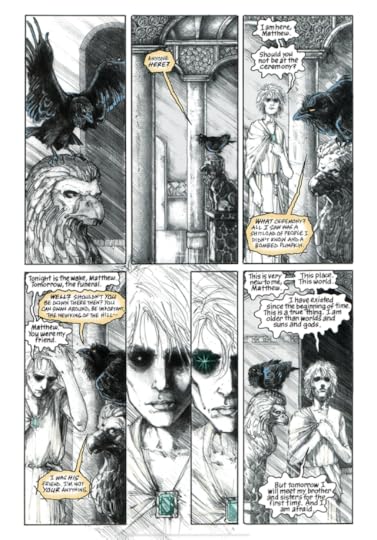
If you have read all the previous volumes, you know by know who this wake is for. It has been foreshadowed throughout the series, especially at the end of Vol 8: Worlds’ End, and explored in detail in Vol 9. So what is left to tell? A lot, as it turns out. With the passing of one aspect of Dream, namely Morpheus, a new aspect takes on the duties of Dream, the young child Daniel. He declines the name of Morpheus, content to be called Dream, and this volume details his experiences as he deals with the aftermath of Morpheus’ passing, the huge host of mourners and well-wishes, reviving many of Morpheus’ loyal servants, and finally meeting his siblings for the first time, if that makes sense. As he says, “This is very new to me, Matthew. This place, this world. I have existed since the beginning of time. This is a true thing. I am older than worlds and suns and gods. But tomorrow I will meet my brother and sisters for the first time. And I am afraid.”
One of the best relationships is between Matthew, who is still deeply upset that Morpheus chose to face his death at the Furies’ hands alone, and the new Dream, who is just getting his bearings. Matthew does not feel he owes anything to Dream, and wishes to have died along with Morpheus, but when he sees how much help the new Dream will need to assume his duties, his attitude changes. The young Dream is so vulnerable and unsure of himself, which is beautifully conveyed by the artwork of Michael Zulli, who gives him a younger appearance but the same deep black pools of eternity for eyes, with that spark of life and intelligence. Each time he speak with someone known from his former aspect, he pauses as if to retrieve their info from his inherited memories, and then act accordingly.
The tone of the story has shifted completely, as all the beings and former lovers of dream who bore grudges have gotten what they wished for. Now everyone seems contrite and solemn, as it it was all done in a pique of madness. And yet we know just how inevitable those events were, as did Morpheus and the Furies themselves, along with his brother Destiny. The question arises, why is there a wake if Dream lives on. Cain answers, “Nobody died. How can you kill an idea? How can you kill the personification of an an action?”
During the wake we again meet so many of the people touched by Morpheus, including former lovers like Calliope, the mother of Orpheus, the faerie Nuala, even Queen Titania of Faerie. Then there is Lyta Hall, the mother of Daniel who triggered the whole crisis in her mistaken quest for vengeance, as well as Rose Walker whose story was told in Vol 2: The Doll’s House. We even get some surprising revelations from the witch Thessaly. Finally Morpheus’ siblings speak of him at the wake, each in their own unique way, and their behavior is quite funny. The new Dream is not allowed to attend the ceremony, but receives a very unexpected visitor to his castle instead. I loved their conversation, it just opens up so many interesting possibilities. Matthew the raven and Death, Morpheus’ sister, give some very touching tributes. It really feels like a proper remembrance. And there is a final meeting between Lyta and the new Dream, who was her son Daniel, and much of import is discussed.
But this last volume contains more. The next segment is on my favorites, called “An Epilogue - Sunday Morning”. This is one of the most humorous sequences in the whole series, centered on the seemingly immortal man Hob Gadling, who is attending a Renaissance Fair with his black girlfriend Gwen. He goes by Robbie, and having actually lived through those dirty, grim, and altogether barbaric times, the whole cheapness and lack of authenticity puts him in a foul and antagonistic mood. There is nothing worse than a foul-tempered Englishman who gets deep in his cups, which is exactly what happens.
His comments to the fair participants are priceless, especially with the server wench. But when he takes a brief break in an abandoned building, he encounters someone who suddenly puts it all in perspective for him. It’s quite a chilling sequence, not least because the artwork is absolutely incredible, conveying complex emotions via the characters’ expressions with a subtlety I have rarely seen before. The dialogue too is filled with deep insights delivered with such ease - some of Gaiman’s best work, in my opinion.
Then Gaiman gives us a little gem called “Exiles”, about a Chinese elder who has served as advisor to the Emperor and enjoyed great success, only to lose it all and face exile across a desert at the far corner of the empire. This happens because of the actions of his son, which enraged the emperor. Astute Sandman fans will recognize this desert from “Soft Places” in Vol 6: Fables and Reflections. He encounters a certain gothic figure in the desert, and they have a long-ranging and fascinating conversation that subtly references many of the climactic events of The Kindly Ones and The Wake. It’s a very illuminating window into the thoughts of both Dream and Morpheus, and the artwork by Jon J. Muth is truly dream-like and haunting.
The final story is called “The Tempest”, and follows up his brilliant story “A Midsummer Night’s Dream”, as William Shakespeare confronts writer’s block in his later years, but must finish a final play as part of his bargain with Dream in exchange for artistic inspiration. Much like the previous story, there are many levels to the story as it explores the sacrifices that writers make in terms of family life, artistic integrity, and also celebrates the difficult creative process that writers must struggle with. It’s also a tribute to the genius of Shakespeare’s skills with the English language, and a form of meta-commentary by Gaiman the writer. Like “Exiles”, the main character engages in a meaningful conversation with Morpheus, both his benefactor and tormentor.
Overall, the quality of writing throughout this volume is very high, and the two extra stories at the end demonstrate that Gaiman can craft stories from almost any subject matter and seamlessly weave in his mythology of the Endless to make thought-provoking stories. Complemented by excellent artwork, this is definitely one of the highlights of the series. There is another volume called Endless Nights featuring a story about each of the Endless, along with stand-alone companion pieces like The Dream Hunters, Death, and Sandman: Overture, so there is still more to look forward to.
If I had one complaint, it’s that Gaiman never explains why the Endless came about, who the Creator is, what the purpose of the Silver City is, or any of the unseen forces that have established all the rules that bind even the most powerful immortal beings. I basically figured that he would not go there, but waited until the full sequence before passing judgement. In some sense it’s disappointing, but I think Gaiman’s main point is that it is humankind who can created its own mythologies and explanations for the universe, so any answers can only come from our own imaginations.
So this is where we wake up. After being lulled by the nocturnes, after trekking the steep places that only exists when we slumber, after journeying with the good and the bad and the in-betweens, after hurrying to and from the heart of the Dreaming, there will come a time when we need to open our eyes. Nightmares or good dreams—they have to end sometime..
Those were the words that came in my head some time ago, when I was about to read the last volume of this beloved series for the first time. I have the same thoughts when I reread this recently. The Wake is the solemn "epilogue" tome for The Sandman where all characters mourn the death of Morpheus, the Dream king. But it’s not just all about mortality; it’s also about constant changes in life, forgiveness, endings and new beginnings, and looking forward to the future.
The threefold account of farewells, eulogies, and reminiscing may seem a tad too long for an epilogue but it seems just right to me, after the lengthy adventures we had with the brooding Lord Shaper. So the Endless sans Destruction gather to prepare the ceremony for the late Dream. Mourners, dreamers, deities, friends, and even old nemeses come to pay respect to Morpheus; some speak of their encounters with him, some prefer to keep silent and grieve. As I said I read this before, but rereading Matthew’s speech almost made me well up again. He is such a loyal friend:
"I was told to say whatever was in my heart. And I thought I was going to say something about how he was my boss, and how he gave me a second chance, and how he trusted me. About how sometimes he treated me like he thought I was an idiot, and sometimes treated me like he was my boss, and sometimes--very occasionally--treated me like a friend. I was going to say something about how he died. And about how that was what I wanted to do too...but that isn't what's in my heart. Not really. He was the most important person in the world to me, and he's gone...but you can't kill dreams. Not really. I mean, despair may be the thing that comes after hope, but there's still hope. Right? When there's no hope, you might as well be dead. What's in my heart? A lot of sorrow. A little regret...and the memory of the coolest, strangest, most infuriating boss...friend...boss...I ever had. That's what."
All three issues are affecting in some way, and I liked how the narration is on the second person point of view. When the speaker says “Everyone’s here…you’re here,” I feel as if I’m really there. I like how it goes so far to tell the readers that it really did happen, and we just forget it in our waking hours, tantamount to normal dreams. It’s been a great series, but just like what the Kindly Ones once said in the previous tome, “For good or bad, it’s done.” All-things-shall-perish-from-under-the-sky and all that.
Daniel Hall as the new incarnation of Dream is still adjusting, and it’s understandable. He looks exactly like Morpheus, except that he’s all white—hair, skin, garments, even the wobbly speech bubble. He seems to be more compassionate than his predecessor, as seen by his treatment of his servants as well as his easy issuance of forgiveness (and perhaps love) to Lyta Hall. She was, after all, his mother once upon a time. I think a spin-off or a series zeroing in on the new Dream would be great, too. His fear in meeting the other Endless for the first time is almost endearing; his confusion about everything being strange and familiar at the same time is too…humanlike. He’ll certainly be a darling for most Sandman fans.
The art is gorgeous—soft and shady, unlike the sharp and vibrant illustrations in The Kindly Ones. I think it’s fitting for the atmosphere of the volume.
Anyway, there are also three stand-alone stories here, one about Hob Gadling (the long-living mortal friend of Morpheus this time chitchatting with the lovely Death), one about a Chinese story that have parallels with the tale of Orpheus and Morpheus (the art is superb!), and the last one about William Shakespeare again (yes, it’s a sequel of sorts to A Midsummer Night’s Dream). They are wonderful, of course, but they seem a little out of place being compiled in the same volume as the first three.
It’s hard to say goodbye to a very good series, but as I’ve said in the introduction of this review, we will eventually come to that stage.
I didn't start reading Sandman until some two years ago. Not for lack of knowledge of its existence; a friend had tried to push it to me for over 10 years. I guess it took some maturity and expanding of my reading habits to finally be ready for it (comics was never my strongest side, luckily Sandman is so textbased it didn't bother me). It's been a powerful experience in every way. A complete, immersive universe spanning every myth and folktale and religion and historical events and figures out there, blending them beautifully and meaningfully with Dream at the center. Dream, or Morpheus, or Lord of the Dreaming, or any other name he's known by, a brooding, self centered, dramatic, goth-lookalike, whom you equally want to smack over the head or protect with all your life.
Then there are his siblings, the other Endless, who all tolerate him and sometimes do give him a verbal smack, and sometimes do protect him.
But none of it would have worked it it wasn't for Neil Gaiman's assured storytelling, stringing plot threads together here, pulling them apart there, only to bring them back around and together again several issues later. I've read a lot of his works and I don't love all of it equally, but The Sandman is and remains a masterpiece.
This is the end.Well volume 10 is more of an epilogue. This was intriguing series, sure it had low points but when it was good it was among best graphic novels and among best Gaimans work overall.Only thing that was bad throughout the series where illustrations, there where several different illustrators but I don't think any of them did a good job.
Around 12 months ago, I started to read Neil Gaiman's 'The Sandman' series.
I borrowed the first collection, Preludes & Nocturnes, from the library and that's where my obsession started. It had me hooked from the start, and I haven't stopped since. Neil Gaiman has since become my favourite writer.
I have started to read some of his short stories, and some of his novels. The obsession just keeps growing!
I'm SO sad to see The Sandman come to an end, but it's been an emotional, and amazing journey.
Whilst reading the fourth volume, Season of Mists, I lost my Father. There was a quote in there somewhere that really touched me and helped me through that hard time in my life.
‘You attend the funeral, you bid the dead farewell. You grieve. Then you continue with your life. And at times the fact of her absence will hit you like a blow to the chest, and you will weep. But this will happen less and less as time goes on. She is dead. You are alive. So live.’