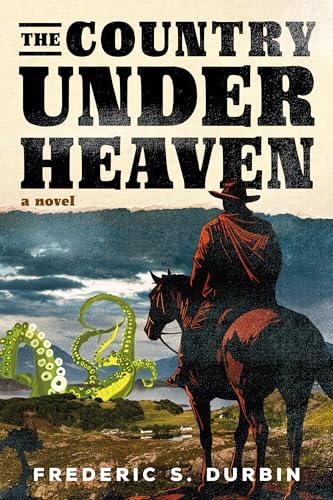
Louis L’Amour meets H.P. Lovecraft in this thrilling western epic about a former Civil War soldier following enigmatic visions that started coming to him after he survived one of the war's bloodiest battles . . .
Set in the 1880s, the story follows Ovid Vesper, a former Union soldier who has been having enigmatic visions after an explosion at the Battle of Antietam. As he travels across the country following those visions, he finds himself in stranger and increasingly more dangerous encounters with other worlds hidden in the spaces of his own.
Ovid brings his steady calm and compassion as he helps the people of a broken country, rapidly changing but still reeling and wounded from its Civil War two decades earlier. He assists with matters of all sorts, from odd jobs around the house, to guiding children back to their own universe, to hunting down unnatural creatures that stalk the night--all the while seeking his own personal resolution and peace from his visions and the war that changed his life.
This epic journey across the American West with Ovid and a surprising cast of characters blends elements of the classic Western with historical fantasy in a way like no other.
This novel is set in the 1880s American West and follows Ovid Vesper, a former Union soldier. After a near-death experience leads Ovid to see visions of unnatural beings, he decides to go on a journey across the country to investigate all the different supernatural occurrences.
The story is told in chapters, each representing a new experience for the main character, functioning as a standalone tale or resembling an episode of a show. Between chapters, interludes offer a deeper glimpse into the main character's thoughts and experiences.
The book’s genre is entirely outside my comfort zone. It blends the key elements of classic westerns with fantasy and historical fiction. Add to the mix horror themes, which make things even more interesting. This unique blend of genres really worked for me and reminded me of the same atmosphere I enjoyed in Stephen King’s The Gunslinger.
The vivid setting, eerie horror elements, compelling protagonist, and the author’s intriguing writing style all together made the book a fun reading experience. I would say it is a mixture between the book “The Gunslinger” and the TV show “Supernatural.”
Many thanks to NetGalley and the publisher for providing me with the ARC of this book.
Who knew a Lovecraftian Western could be so romantic? I mean that in both the classical and modern senses. This is a beautiful book about wide open spaces and monsters. Old monsters, cosmically Old Ones, to be specific!
The Country Under Heaven follows straight-up dude and former Union soldier Ovid Vesper as he travels from adventure to adventure across the frontier, through deserts, canyons, and into caves.
If you've been reading a lot of Zahler and McCarthy, and find yourself trained to expect the darkest "man's inhumanity to man" acts possible when reading Westerns, you'll be comforted by the human heart at the center of this novel. Also, I liked Jack the horse. :)
Well this was a pleasant surprise. I plucked this one out of thin air-- not really-- but just from a perusal of Edelweiss for horror coming out from May-July. It looked interesting so I took a leap of faith. So glad I did.
Three Words That Describe This Book: vignettes, weird western, thought-provoking
Draft Review: It’s 1880 and Union vet Ovid is still struggling to find his way. During Antietam, he nearly died from a blast that also opened a crack between dimensions, both giving Ovid “the sight” and allowing monsters through into a country where citizens were tearing each other apart, including, “the Craither,” who follows Ovid everywhere. Told in vignettes, readers will quickly fall in step with Ovid as he travels across the west, visiting old friends, riding into town on his trusty horse, Jack, working cattle drives, stopping bank robbers, having shootouts, and going to traveling carnivals. Each stop has Ovid battling monsters both real and supernatural, but the action pauses with “interlude” chapters as Ovid contemplates his life, the after effects of war, and his connection to other worlds. The danger escalates as the pages turn, with the monsters becoming more numerous and the barriers between worlds beginning to thin, but Ovid becomes more determined to find peace for himself, his friends, and the creatures he encounters. A stellar and unique novel, a story full of heart, a tale that manages to replicate what is best about a classic Western and an awesome Cosmic Horror novel all in one terrifying, thought-provoking, and thoroughly entertaining package.
I put contemplative there because while there is clearly action-- there is a lot of contemplation bu Ovid about his life, the Civil War, his near death experience, and how it connected him to openings to other dimensions, yes, but also brought some things into our world at the same time.
He has visions. His place as someone who can reach between worlds is noted by others and accepted by him. "The Craither" came to Ovid when he was almost killed during an explosion at Antietam. It still comes to him-- follows him. While he encounters other things throughout the book, this "Craither" and the mystery of exactly what it is, why it is following him, and their connection-- runs through the entire book. It is what leads readers through he entire book and connects it all-- this mystery.
It is an excellent Western AND and excellent cosmic horror novel. It does both things extremely well. Makes for an awesome reading experience. But you need to know it is a classic western with monsters coming through from other dimensions. There are many. More than we humans can know. Ovid is the conduit and our narrator. But the story follows a traditional-- Louis L'Amour type western-- not an updated version (ala River of Teeth or Red Rabbit).
As a Western-- The language (plain spoken and sparse), pacing, long descriptions of the untamed landscape, plot points (see below) are all Western. But there is also The Edge-- places where the vast landscape meets with other dimensions. Where there are cracks and things come through
Western tropes/plot points: *Ovid and his trusty horse Jack *Damaged CW vet *Loner narrator as he goes in and out of town, setting things right and then moving on *bank robbers, cattle drives, traveling carnivals, shoot outs-- it's all there
The structure of the book is also important. Vingettes of action-- each is a place that Ovid rides into usually because he knows someone (from the War) and they need his help with a job like a cattle drive OR something more uncanny like when a war buddy asks him to help relocate some green children that he stole from a sideshow to their world.
In between each there its an "interlude," a short chapter between jobs where Ovid is contemplating his life, the ramifications of the CW in general, and on him and his connection to other worlds in particular.
1880s as he travels-- the cosmic danger escalates with each chapter. Things get more dangerous and more supernatural. The monsters more dangerous and numerous. The barriers between worlds-- thinner. The Craither...closer. Ovid, more drained by his closeness to it and his battles across the decade.
There is a through line between chapters and people and events come back, but each is its own story as well. truster reminded my of Lovecraft country a bit
For fans of weird westerns specially those with cosmic elements but not too much gore.
The pacing is 100% classic western though. Similar to THE HUNGER by Katsu or Lone Women by LaValle over Red Rabbit by Grecian, although people who like any weird western will enjoy this book.
Ovid reminded me of The Captain (MC) in News of the World. This is like that book but with monsters coming through the cracks between our worlds. Both contemplate the real horrors of a post Civil War world. Living through it and fighting and what they lost-- what everyone lost.
Also this book's structure was not unlike Craft: Stories I wrote for the Devil which was one of my favorite books in 2024. I think that will have to be in my readlaikes
In this book-- the horrors of war and the monsters coming through into our world are equivalent and Ovid thins about that. The Civil War itself cause this crack between words-- he is a conduit between the two.
Oh this book was wonderous strange! This is a gorgeous epic western following the journey's of a war weary gunslinger named Ovid Vesper languorously mixed with the kind of cosmic horror that would have made H.P Lovecraft and Lord Dunsany purr like kittens and touched the creaky heart of Larry McMurtry and Louis L'Amour.
There is nothing like the thrill of discovering a new (for me anyway) author. Frederic Durbin made my heart skip with his stunning descriptions of the dying old west and the gentle, melancholy hero he's crafted in Ovid. Ovid's wanderings have frequently been described as "genre bending" but I found it deeply appropriate to blend old gods and horrors too immense for mortal man to comprehend with the story of a man still damaged by his time in the Civil War. What better way to balance otherworldly monsters than with the memories of a man who has seen, truly seen, the extent to which we are capable of creating horrors of our own.
Ovid wanders through a country being born and dying slowly all at once and travels the edges of other worlds that are just touching the walls of ours, taking advantage of the tiny tears and soft spots the chaos of war has ripped along its boundaries. He's a haunted man, but a deeply good one, and everywhere he goes he works to right old wrongs or lend a hand to anyone who needs it. Rather than turn his trauma into a murderous rage against the world his struggle is to pull some grace from the blackness that consumed it for too long.
This is one of those visceral novels that is so easy to see in your minds eye and it is full of fabulous, memorable characters that pulled at the strings of my heart and are still with me right now. I could feel the wind on the endless plains of Montana and I swear I broke out in gooseflesh as Ovid traversed the dark passages of New Mexican caves searching for treasure and setting traps for those things that guarded it. Durbin pulls his monsters and ghosts from all manner of folk tales and fairie stories and each fits seamlessly into this lovely, lonely world he's built.
I wanted this book to go on forever and I tried, desperately and futilely, to make it last as long as I could.
Evoking the majesty and grandeur of the Old West, Durbin spins a stirring yarn about the aftershocks of battle and the struggle to overcome what haunts us.
Durbin’s A Green and Ancient Light was one of the first books I reviewed for The Speculative Shelf in 2016, and it has stayed with me to this day. It’s a thrill to return to one of his worlds. At the time, I wrote: “He creates a setting filled with such beautiful imagery that opening the book felt like being transported to the nameless countryside each and every time.” The same holds true here, as the American West comes to life, down to the last flower petal and blade of grass.
While I found Ovid Vesper’s journey and visions intriguing, the loosely connected chapters often felt disjointed and could have benefitted from fewer characters and a more streamlined plot.
★★★½
My thanks to the publisher and Edelweiss for an advanced reader copy in exchange for an honest review.
Cover had me worried this was going to be Lovecraft fanfiction with a veneer of Yeehaw Shit. Very happy to be wrong. Solid Western with plenty of respect for the big dogs (McMurtry, McCarthy, some Elmore Leonard in places) and nicely integrated horror/fantasy/Weird Fiction elements within that mode.
A wandering western thriller! I would describe this more as a paranormal/fantasy fiction than as a horror book. It has all the fabulous western vibes with the addition of wild and weird creatures. Like if Supernatural were set in the 1800's. But at no point was I frightened for the character or myself. 3.5 stars rounded up to 4. I enjoyed the ride.
It is a series of short stories tied together by the main character's visions and ghouls. You can think of each section like a TV episode where it's the same show and you should watch them in order but each one is a contained story. Some of the stories I was obsessed with and others not so much.
I would recommend this for fans of spooky shows who wish that said shows were set in a time of horseback travel, gold mining, dusty street shoot outs, and roaming the wide open country.
Thank you to NetGalley and the publisher for this advance reader copy. All opinions are my own.
I’ve never read a real western and didn’t know what to expect for this. It is a western but it also borders sci-fi, fantasy, and horror (probably horror most of all).
The biggest comparison to make is probably Slaughterhouse 5 - the effects of war and trauma on the rest of someone’s life but it’s also very different.
While that theme is clear it also doesn’t overshadow the best parts of the book. At its core it’s just a good man trying to make his way through a rapidly changing world- and stumbling into situations that quickly turn fantastical, creepy, or into Lovecraftian horror. All the while he’s also walking through and naming all the plants he finds in some of the best descriptions of nature I think I’ve read.
I loved this book for way more reasons than I expected and wish there were more like it.
4.5. I love how this story is told through adventures. The visuals were great, and the western setting was immaculate. The side characters were all intriguing, and overall, I loved this!! My only issue is that it gets a bit repetitive at times, but I was having enough fun that that didn’t hinder my enjoyment of the book. I would just have loved a bit more stakes. Besides that, it’s a journey I highly recommend!
I find it hard to put an accurate description on this book. It is a series of tales in chronological order and they belong together like family. It feels like sitting on a stump in a wild place, tipping a draught laden with nostalgia. It is full of memory, simultaneously distant and touching. Effective.
I've grown increasingly fond of Western-type films, but had never attempted to read a Western novel. Frederic Durbin's The Country Under Heaven felt like a unique, fresh take. We follow former Union soldier Ovid Vesper, who has visions after a close call during the Civil War, and his horse Jack on different adventures.
The book consists of fairly loosely connected stories, with each chapter being its own tale. We're introduced to lots of interesting characters and the surreal situations they and Ovid find themselves in. All the individual stories were quite good, and the book moves at a good pace to keep readers engaged. Even with the fantastical elements, it still feels pretty grounded. I was entertained the whole way through; it's a world you really settle into, and I was almost disappointed to leave it behind.
For a book with no dialogue, this was pretty dang good. I mean, there IS dialogue, kinda. It’s just not marked with the usual ““ bits. See, the story is told in 1st person POV, entirely. Anything that anyone says is just related to us by the narrator, like “I asked him if the horse was lame. He answered in the affirmative.” That kinda thing. If you’d have told me this before, I would’ve said that it sounds like it would get old—which it does, but recovers from. By the end, not only did I not might it, I’d begun to kinda prefer it—for this story at least.
Ovid’s story is a bit like the Last Wish; a series of interconnected short stories which tell a greater tale, and serve as an introduction to the character. Don’t get me wrong—I’m pretty sure this is a standalone. But it’s done in the Witcher (or Lovecraftian) style, all the same. Part of the tale, fans of the author may recognize. It’s the reworked, expanded version of “Someplace Cool and Dark”, from ‘ Challenge! Discovery ‘, published in 2017.
If you’ve read Durbin before, you likely recognize his style. A taste of horror, a bit of adventure, a veil between worlds. It’s a formula that seems to work quite well for the author, and he’s taken advantage of it multiple times over. Country Under Heaven—while not as good as A Green and Ancient Light, in my opinion—still spins an excellent yarn, one that I thoroughly enjoyed. I will say that the pacing takes a bit of getting used to, as does the way this particular tale is related. But once you do—assuming you do—there’s an excellent, entertaining journey beneath.
TL;DR
I’m a sucker for adventure; new places and new things. Add in some fantasy, plus maybe some supernatural, paranormal, science fiction, or horror elements—and I’m sold. Doesn’t hurt that it’s done up by the author of one of my favorite ever books, A Green and Ancient Light. The hardest bit of Country Under Heaven is the learning curve. It’s told in an unusual style, with the narrator relating everything, including the dialogue. Like, “I asked him if the horse was lame. He answered in the affirmative”. That kinda thing. Once you get used to that, and the fact that the book is just a series of interconnected short stories (all with the same narrator), which makes for some interesting pacing—it’s all uphill to the end. But it’s a hurdle you have to get over, and one I’m sure not everyone will.
While I really enjoyed Country Under Heaven for the setting, the style, the adventure, and more—it’s still going to be hard to recommend for everyone. If you’re a fan of the author—go for it. Same for if you enjoyed the Last Wish, or like you some eldritch horror. If not—maybe try an ebook sample first, before buying, or check out a copy from your local library.
i feel like as a short story collection of western tales with some horror thrown in this works well, but as a book described as bringing lovecraft to the wild west it really only gets there once for me (in the story with the slumbering dragon beneath the earth, which was a banger!)
in terms of quality i also feel the best stories were saved for the first and last entries, with the middle sort of stumbling along without the same passion and energy. the ending was also far too wholesome, for horror in particular but ESPECIALLY for lovecraft. i get that the market we are in nowadays allows for absolutely 0 stress to be given to the reader, but cmon man. how are you gonna end your lovecraft retelling with this man and woman sitting on their homestead in illinois waxing lyrical about how they are in gods own country??????? hELLO
This book was a very difficult case of wanting it to be much more than it was. The bones were there, but it never ventured far into cosmic horror, or too far into being a true western. Now, it may just be that it’s written more with a focus on young adults, which is fine by all means, but I just found it to be boring and a bit too surface level. Ovid as a character could be good, but he simply lacks any real depth to make me care about him past the fact that he’s the main character and I have to.
His motivations for going home seem a bit hollow, and so does the love interest sadly. The book just seems to really want to be a number of different things, but ultimately ends up being none of them in any substantive way.
Frederic S. Durbin is a veteran fantasy and horror writer whose earlier work leans wistful and mythic, the kind of soft focus weird that could sit on a mainstream shelf without scaring the shit out of anybody. Here he heads out to the Weird West with a fix up of previously published tales and new material, stitching them into the life story of Ovid Vesper, a Civil War vet who can see things that should not be walking under God’s sky. It feels like Durbin trying to graft his lyrical, old school sensibility onto a bloodier, tentacled frontier.
Ovid rides from Missouri to Texas to New Mexico and beyond, crossing paths with a creepy “Fate Machine,” a maybe angelic, maybe demonic shadow figure called the Craither, and various haunted towns, hungry hills, and tentacled things under the plains. He wants something simple, really: a life that is not full of war and horror. What he keeps getting is fresh supernatural bullshit testing his faith and his nerves.
What I really dug here were the set pieces. The cornfield revival around the typewriter seance, the showdown with a child murderer out by the creek, the bur oak corpse flensed by something inhuman, the quiet Illinois finale with a haunted olive tree. When the book locks into one of those scenes, it works. You feel the dust in your teeth and the cold little hand of the Craither on your neck.
The problem is everything in between. The prose is careful and often pretty, but it rambles. Ovid’s voice is part frontier memoir, part Sunday school lesson, and the result is a lot of talk where you want the story to shut up and ride. The cosmic threat is vague, the theology chatty, and the episodic structure means tension resets every chapter. You keep waiting for all this shit to crescendo, and instead it sort of politely peters out.
Themes include faith, guilt, and how slaughter, human or otherwise, stains the land. Horror is the spiritual hangover of war and manifest destiny. It’s ultimately bittersweet and oddly gentle, more melancholy campfire story than full on nightmare.
Contextually, this sits as a respectable but minor entry in both Weird West and Durbin’s catalog, closer to a mood piece than a genre benchmark. Solid enough craft and a few really fucked up images, but too baggy and polite to stick in the brainpan for long.
Read if you want a slow Weird West road trip, dig folksy narration, and do not mind your cosmic horror served with Bible verses.
Skip if you crave momentum, need your monsters explained, or have no patience for long, earnest monologues between the cool creepy bits.
A unique exciting blend of the old West with Ovid riding his horse Jack while dealing with strange creatures from other dimensions. This was a pure pleasure to read. I would have rated it five stars but I thought the last two stories were a tad dull. Still this is very well worth reading. The time period ranges from 1880 to 1891. This is without doubt one of the most fun westerns I have read! And these stories are not centered on revenge either (as many of the westerns I have read before seem to use that as a main theme). No, these are more original. And they are action packed too!
Ovid himself is the one who carries this whole book. He cares about people and he tries to help the best he can, often risking his own life. And he is cursed with this odd gift to have visions, to see the bizarre things that others can't see. He can see through the veil to other places and times...and sometimes he goes to these places as well. But it's far from fun and games: these things are often trying to kill him.
In these pages you will meet the pig-spiders, the bear-witch, green children and a bunch of other things you never heard of. But from story to story is the main "craither' that follows Ovid. Of course the word "craither" is used throughout the book to describe all of these creatures, but it also refers to the main one that often tries to suck the life out of him. And what a twist that is at the end!!
Yet there are the usual western things in here too: shoot outs, outlaws, gold, horses, rifles and pistols, dynamite, wagons, etc. There are mountains, canyons, grasslands and horrible storms too.
It's also obvious the author has done some research while writing this as near the beginning the "Texas Fever" was mentioned. It's a tick illness that affects cattle. I had never heard of this so I had googled it and it's real. It truly shocked me that ticks were causing trouble way back during the Civil War.
But if you want a fast moving western that is different, than try this. In my opinion it's not scary. It's action with weird creatures. It's basically one long story but it's broken up into different chapters and each chapter tells a different adventure.
I definitely enjoyed this book. It was much better than I had expected.
I had to think long and hard about how to rate this book, genuinely. 3.5/5 stars
What’s good about the book?
- It’s refreshing! The combination of unknown otherworldly creatures and the Wild West is a unique twist. The episodic format of each chapter made the story feel like a creature feature.
- Each creature is thoroughly different, some are benevolent, others are standoffish, and some are down right nasty. No two encounters are the same.
- Ovid is haunted by visions or “second sight” and is sought out by old friends, colleagues, and anyone who has heard of his mysterious visions with the hope of being able to aid them. His visions are never truly understood but appear to be a physical manifestation of head trauma and unresolved grief of serving the Union in the Civil War. These visions are conceptually interesting!
What did I not like?
- When Ovid mentions his visions, they are often paired with him regaling his war time memories. Despite his gun-toting, war-torn past, he’s generally cheerful and a do-gooder. His cheerfulness, steady nonchalant demeanor makes his visions and veteran backstory so disjointed. He was literally blown sky high by a canon blast, deaf for four days, and now walks between our plane and another with monstrous visions and he sees literal dragons and he NEVER ONCE FREAKS OUT? Likely story.
- The Big Bad is an ominous, life-draining ambiguous figure that Ovid calls the Craither (Irish English spelling of creature). This entity that can withstand a twister that LAUNCHED Ovid through the air, that can strip the flesh off four or five mens’ bodies at once, that stalks Ovid until the last chapter - just up and disappears for no reason. No big show down, the biggest confrontation before promptly disappearing is Ovid asking it: “What do you want?” Disappointed!
- Lastly, Ovid marries a wonderful lady named Nancy, regular old human Nancy, who ALSO survives a twister that is so powerful it rips her storm cellar out of the ground and throws her even further than Ovid, and then she rides thousands of miles to find a depressed Ovid at his childhood home…just completely destroyed the impact of her original “death” and wiped out Ovid’s only genuine motivation in the book.
This entire review has been hidden because of spoilers.
When you have a favorite genre that you read frequently, some of the more general contours and expectations of that content sort of retread the same territory so often that the larger body of works you've read start to blend together over the long run. Then you come across something that really does something unique and new that you can't help but sit up and acknowledge that you actually in fact have not seen it all.
This was a spontaneous bookstore buy that I didn't recognize (wasn't until I finished it did I realize this book has been out for just about two months; it's basically brand new) and the back cover marketing blurb of "Louis L'Amour meets H.P. Lovecraft!" that originally had me roll my eyes... ended up being actually pretty goddamn accurate! This is a Western first and foremost with all the usual trappings you'd expect: beautiful-yet-unforgiving landscapes, the hardscrabble and rugged individuals who make a life for themselves out there, and a foreboding sense of technology-induced change on the horizon. However every so often we catch a glimpse of something or other that looms underneath our understanding of reality. Not in a jarring way that sets a hard tone shift, but definitely in a way that you realize this isn't just a boilerplate western.
As for our protagonist, Ovid is just about the best-suited person to go through some grade A cosmic horror and come out the other end, maybe not unscathed, but at least intact. When presented with a sort of possession plotline (it's complicated) and some of the more unique depictions of the unknown I've ever read, he exhibits the proper amount of terror, but ultimately is just too down-to-earth to let it rattle him for long. This is the kind of guy who would experience horror beyond our comprehension, but rather than lose himself to insanity instead he'd just shake his head and say, "ah hell, well what can you do about it? Anyways..." Definitely a unique take on a lead character in this kind of situation.
All in all, a pleasant surprise and a satisfying blend of two of my favorite genres. I'm gonna keep an eye on this author in the future.
This book is unlike almost anything I've ever read. It's also probably my favorite book of 2025, excluding books I've reread. There is so much I want to say about The Country Under Heaven. It's immediately a strange mix of genres: historical fiction, classic Western, and... Lovecraftian cosmic horror? Yep, not a story premise you see every day. Speaking of the story: Ovid Vesper is a ex-Union soldier still reeling from the aftermath of the Civil War. He's gone through a lot, and his story is revealed in bits and pieces throughout the book. At the devastating Battle of Antietam, Ovid is stunned by a Confederate explosive. He has a near-death experience, something that haunts him for a long time after. Something is following Vesper. He calls it the Craither- which I find more entertaining once you realize that word is slang for "creature" or "critter." Ovid describes all sorts of living beings with the name- from bugs to kittens to eldritch terrors. They are all craithers- but only one is The Craither. Its origins, its motives, its thoughts, its very state of existence is beyond Ovid's understanding- and thusly, beyond ours as well- but it will not forget Ovid. It will not stop following him. Ovid narrates snapshots of his life to us, as if he's sitting at a campfire, reminiscing on his more than unusual history. The book is written in an impeccable, endearing country style. The simple yet extremely effective way the author describes reminds me of The Book Thief's descriptive style- a complement few books can attain to. Also like The Book Thief, The Country Under Heaven is very, very quotable. There were times when I slowed down, rereading a single sentence or two several times over. Durbin has some profound stuff to say, and he says it incredibly well. I would put some quotes here but I'm too lazy to go through and find them all- I should have underlined them. (Lesson learned.) Now, this is supposedly horror. Was it scary? Well, if you refer back to my Necronomicon review, you'll find that I have created a handy scale of creepiness from 1 to 5. The content of this book varies widely, with some "scary" parts being as low as a 1, while some climb to 3 or 4. It had its fair share of spookiness and disturbing-ness, but I will be able to sleep tonight without fear of any Craithers under my bed. My only gripes with the book: (1) Durbin does not use quotation marks when someone is speaking, which can make the dialogue hard to follow; (2) there is a decent amount of language (though not as bad as The Book Thief); and (3) the ending could have been a bit more satisfactory. Oh, and yes, I did mark this book as Want To Read, then as Currently Reading, and now as Read, all in the space of about 6 hours. That alone should tell you that I love this book. I knew basically nothing about it until earlier today, bought it on impulse and do not regret the purchase at ALL. One more thing: I have had a story idea for a few months, one that I will not explain here- but it bears some slight similarities to this book (primarily in overall plot and theme). If I ever do write it, no- I am not ripping Frederic Durbin off, although his marvelous work will certainly influence me to some extent. It's just an idea, though, and there's no guarantee I'll write it for a while. Over all, this book is awesome.
Told myself to take it slow since I so rarely get a new Durbin...then a weekend later....
Everything I love about his writing. The way it doesn't remind me of anything else. It can be scary and a little skin-crawling while strangely beautiful too. I love his use of Biblical themes disbursed in quiet moments of introspection. I couldn't recommend this to just anyone, there's some gruesome parts and violence that some might not prefer. I'm pretty sensitive and I was fine, but others maybe not. Ovid will stay with me as one of my favorite narrators in a work, and I enjoyed that each chapter almost read as 7 little "novellas". I would say if the premise intrigues you at ALL put it on your list! My only complaint...I've probably got to wait years and years for another work by him :(
A rambling rider haunted by monsters, gifted...or cursed...with sight beyond the natural world. Ovid crosses paths with many displaced beings, some human, some otherworldly, all of them longing for home. As he helps others find a place to belong, he wonders how his story will end and is there rest for him somewhere in this wild world. The Country Under Heaven is a satisfying blend of science-fiction, historical fantasy and horror, I thought it was very well done.
One of my favorite parts about reading is that you can travel to far off places and see things from a new perspective. In a story that blended historical and science fiction with a protagonist whose moral compass and vivid visions guided the way in equal measure, I treasured Ovid’s journey across The Country Under Heaven. I too hope that I might find my own Olive Tree one day.
2.5 ⭐️ This book certainly grew on me as I read it, but I have never been a fan of westerns which I knew would make it hard for me to like this book or overcome. It took getting about 40% in to want to keep reading. Ultimately, Ovid is a very likable protagonist and maybe if he wasn’t set in a post-civil war western, I may have enjoyed it more.
Sorry book club- could not get into this for more than 30 seconds. Some of the action was entertaining, but really left me wondering what this book was all about
Once I got past the fact that there are no quotation marks around the dialogue, I really liked this! A good mix of different types of spooky fiction AND it involves a misunderstood alien being that seems evil at first, which is a trope I really enjoy. I also liked the fact that this was more of a collection of stories; it made the reading fly by!
I was constantly debating whether to rate this book 3 or 4 stars but by the end I think it's more than deserving of a solid 4 stars. This was just a genuinely nice book to read. I loved Ovid as the main character, there's something so refreshing about having someone who is a good man for the sake of being a good man without a hero complex. His interactions with all the other characters felt so real and humble and I think his horse Jack needs a little attention too because I also adored him and his relationship with Ovid. The way this book was set up, with each chapter based on a certain experience Ovid had at different stages in his life, kind had a fairy tale atmosphere to it. What also enhanced that was the way it was told as if Ovid himself was telling you each experience rather than you reading it as it happened at the time. It also explored the elements of human emotions and experiences, delving into Ovid's thoughts about himself and his experience from the war as well as understanding the experiences of those around him. This moral discussion and the aspect of Ovid's visions really added to the fairy tale atmosphere and I really loved it.
Now, for the setting and genres of the book itself, I LOVED the western setting. I've been playing a lot of Red Dead Redemption at the moment and so this environment immediately had me hooked and I need more like this one. Not a romance but a real quest-like story set in the wild west. It's mix of the fantasy/the supernatural was a really interesting addition to this environment which I quite enjoyed. In saying so, I do have one gripe about this element and that's because there's no real explanation when it comes to how aware or prominent these creatures and fantasy elements are in this world. They just kind of happen and since no characters really question it or have a major reaction I just assume it's naturally apart of their world but, aside from dealing with the creatures head on, there's no discussion of them in their every-day conversation (aside from Ovid's connection with the Craither) which kind of threw me off. For a quick example, there's this giant dragon-like creature who takes the shape of a mountain that Ovid and a group of people deal with, there's no discussion of any creature like this beforehand and once it flies away they just choose to not talk about it with anyone, but wouldn't there be at least some awareness or dire reaction to something like that? I don't know, it happens quite a lot and I just chose not to question it and take it as the story was telling it so it didn't bother me too much. It probably didn't help with the way this story was told from Ovid's recounts because it made all the events feel a bit distant since you were getting a second-hand version of it. There's also not quotation marks used in this book and I'm sorry but when dialogue's written like that, I find it really hard to feel close with what's happening and the outside characters since it doesn't feel like I'm IN the story hearing these conversations. That, mixed with a vague fantasy explanation, are the main two reasons why I was debating between a 3 or 4 star rating for this book but at the end of the day, so many elements were written fantastically. The plot was really interesting and the characters were enjoyable to read from and the climax of each chapter really captured you in the moment. The fights and gun battles were really fun to read as well.
So, overall, this book was really lovely and I did really enjoy it. Minus two main aspects but I could still look past them to take in and enjoy Ovid's journey following his visions and the way he helped people along the way. The ending was a perfect conclusion to his story as well.