Peter Matthew Hillsman Taylor was a U.S. author and writer. Considered to be one of the finest American short story writers, Taylor's fictional milieu is the urban South. His characters, usually middle or upper class people, often are living in a time of change and struggle to discover and define their roles in society. Peter Taylor also wrote three novels, including A Summons to Memphis in 1986, for which he won the 1987 Pulitzer Prize for Fiction and In the Tennessee Country in 1994. His collection The Old Forest and Other Stories (1985) won the PEN/Faulkner Award. Taylor taught literature and writing at Kenyon and the University of Virginia.
Nonostante un prestigioso Pulitzer vinto per il romanzo A Summons to Memphis - Ritorno a Memphis, arrivato quando era ormai settantenne (ironicamente si definì il più noto degli scrittori ignoti), Peter Taylor rimane essenzialmente scrittore di racconti: ne ha pubblicati una sessantina divisi in otto raccolte. Non è la quantità, ovviamente, a determinare il suo peso letterario di scrittore di short stories. È il suo amore per la narrazione breve, che gli faceva dire: Mi annoiano i romanzi che in un capitolo non riescono a fare quello che un racconto fa in una frase… Occorre economia e compressione. Tutto deve poter dire due o tre cose allo stesso tempo… e nel romanzo non si può mantenere tale intensità di linguaggio come in un racconto. È come il suo amore per la narrazione breve si traduce nelle sue storie, nei suoi racconti, come l’essere cresciuto con maestri e ispiratori dediti alla poesia, abbia affinato la sua capacità di “comprimere”.
Uomo del sud degli States (Tennessee), si iscrive in quel filone letterario cui appartengono nomi più celebri come Flannery O’Connor e William Faulkner. È soprattutto il rapporto campagna-città che marca questa sua appartenenza: La storia del topo campagnolo e del topo di città ha avuto una reale influenza sulla mia vita letteraria. Quella parte di Stati Uniti era più che mai legata alla terra, alla campagna: ma Taylor, grazie anche alle vicende familiari, ha saputo cogliere la trasformazione verso una società industriale, e quindi urbana, senza caricarsi di rimpianto per il “piccolo mondo antico” e di rifiuto per la modernità. All’opposto, è proprio scrivendo i suoi racconti che ci dice è riuscito a comprendere quanto nel Sud i negri fossero limitati dai bianchi, e quanto le donne lo fossero dagli uomini.
Il suo approccio narrativo è per me legato alla migliore scuola di short stories: personaggi ordinari che non vengono coinvolti in intrecci complicati e/o situazioni estreme, ma piuttosto in vicende ordinarie, nei loro abituali comportamenti, nell’intimità familiare e sociale, sul lavoro e sul tempo libero. Ed è proprio dall’ordinario di queste esistenze e storie che emerge lo straordinario che è in ciascuno di noi. Quel qualcosa che ci differenzia e contraddistingue. Taylor non parte mai giudicando i suoi personaggi, cerca sempre di vedere le cose da ogni lato: è come se li scoprisse man mano che li racconta – o li lascia raccontarsi – scoperta che avviene anche nel lettore. E se a giudizio di qualche tipo si arriva, è solo a storia conclusa.
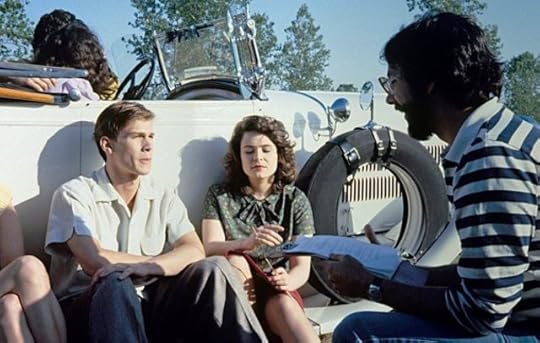
Steve Ross dirige Steven Wilkerson e Amy Shouse in una scena del TV movie omonimo (1985).
Taylor is the master of the unreliable narrator. At first, his stories seem like nothing more than "stories of manners" of aristocratic and polite Southern society from a vanished time, but then as the ironic narration begins to reveal itself, they become harrowing portraits of families hiding behind layers of suppressed emotions and beliefs. "The Prodigal Son" and "A Friend and Protector" are best examples from this collection. The latter has so many levels of irony it's impossible to know for sure where to begin peeling them back. Among the great Southern short story writers, Taylor tends to get nudged into the shadows of Welty and O'Connor, but he is very bit their equal.
A four star book with some five-star stories. This is Taylor's standard fare; this is not, however, to say it's just the same old thing all over again. We have a wonderful mix of stories that were written in the early 1980s and collected for the first time here, combined with re-printings of some very strong stories from Taylor's earlier collections. "The Old Forest" is one of the three best stories I've ever read (behind "The Dead" and "The Beast in the Jungle"), and "A Long Fourth" is astoundingly incredible. "A Walled Garden" and "Allegiance" are the closest Taylor ever gets to experimental fiction, and are wonderfully rewarding in their own strangeness. "The Little Cousins" and "Promise of Rain" are minor masterpieces of domestic life and manners, of the power and problematics of nostalgia.
Yet, the one-act play at the end drags the collection down and leaves us feeling flat as we close the last page. Taylor, for all his stated desires to be a dramatist, is a mediocre one at best; he cannot write a play with the level of nuanced, invested detachment he uses in his stories; "Death of a Kinsman" would have been another strong short story, but is very weak as a play.
While always a concern throughout his work, race relations are presented significantly and complexly in many of these stories, showing a deeply moving portrait of a world Hollywood has us understand all too simply. The black servant class of the urban, midcentury South were neither agency-less, powerless automatons, nor were they necessarily noble and heroic transgressors of the injustice leveled against them. They were, just as much as those that employed them, flawed human beings whose everyday lives were negotiations of chance, circumstance, belief, and dreams within flawed and often unjust contexts. Taylor always did an exemplary job of showing the whites of his world in such a light; these stories reveal the same sympathy for the black individuals he, and his society, knew, and his presentation of these complications in this collection is, indeed, commendable.
Ultimately then, a very fine book of short stories. Unfortunately for eleven of the thirteen, "The Old Forest" and "A Long Fourth" are magisterial, staggering works of immense beauty. The other eleven get lost, making this a fine, but uneven collection. Still, highly recommended--though you should skip the play.
I have to admit that I feel like a heel giving this book 2 stars and now writing these comments to explain why. Because I met Peter Taylor in graduate school, just a year or so before his death, and he was one of the few professional writers we met who was not a complete jerk. He was kindly, generous about answering our apprentice-level questions and eager to learn about our ideas from us rather than just lecture at us.
And though I am quite fond of the two opening stories in this collection ("Gift of the Prodigal" and the title story), and I was also fond of "Bad Dreams," a lot of the stories in here were simply agonizing to get through. Reading Taylor in one collection is probably a bad idea, for his method quickly becomes transparent, and often I found that I didn't have the patience to go along with him most of the time. I wouldn't go so far as to agree with Updike's assessment of Taylor's work consisting of "prissy, circuitous prose," but I did find many of his beginnings very tedious to entertain--this, mind you, with my second reading of this book (the first was shortly out of graduate school). Even when I remembered where a story was going, I often found myself irritated with waiting for the style to get me there. Taylor often comes to intriguing endings for his stories, but the beginnings are way too typical of each other, often starting with disconnected whisperings of others or vague dialogue. Though I often see what he is trying to do, I simply found myself rather disinterested in it.
Perhaps what would have bothered me less would have been an attitude like John Cheever's in his introduction to The Stories of John Cheever, where he commented that he found it unfortunate that the collection was chronological and that the early stories showed too much of a shock at people's shortcomings--Taylor's work could have used more of that in the stories besides the ones I mentioned before.
My apologies, Mr. Taylor. I don't know what came over me.
These are stories that examine the South in the 1940’s and 1950’s. Taylor examines the nuances of familial and romantic relationships in a minutia, and with lazar precision. He is also gifted writing in first person narration, with narrators reflecting on a moment in history that changed them, often a complicated point of telling. Peter Taylor’s stories remind me a bit of Cheever, perhaps because they are both character studies encased in a specific kind of society, and told without frill. Perhaps it is because they came from the same generation of writers. Either way Taylor has made his way alongside one of my longtime favorites, Cheever, and I’m not quite sure how I overlooked him for so long.
The Old Forest and Other Stories by Peter Taylor was winner of the Penn - Faulkner Award in 1986. Some of the stories date back as far as 1941 however.
Peter Taylor is one of America’s best 20th century writers. His milieu is the South specifically mid century Tennessee - Memphis and Nashville. His characters are almost exclusively well-to-do whites and their black servants. The focal points in the stories often relate to problems that arise in these patrician societies.
Taylor’s character development is always superb. There is a crispness to his writing that is the polar opposite of say Faulkner but he seems to capture the mood of this generation. Nearly all of his stories are written in the first person which I prefer with short stories.
There are a total fourteen stories in this collection. Here are the four that I really enjoyed and think of as five star stories.
1. The Old Forest - one of the best American short stories ever written. This lengthy short story is set in Memphis. The plot involves a young man who is to be married in a week but he soon becomes involved in a car wreck. A young woman, not his fiancé, is riding along with him. She is not of the Memphis debutante strata. The young woman flees the scene of the accident and a series of psychological blackmail episodes ensue. In the end it is a convincing story about class distinctions in this Southern city.
2. Promise of Rain - a well to do father in Memphis is worried about his immature son who will soon graduate high school. The story takes place during the Great Depression. The son is starting to hang with the bad crowd and is obsessed with his own good looks. Will the son return to the straight and narrow and figure out what he wants to do with his life? Another story of social strata.
3. The Gift of the Prodigal - adult son is a ne’er de well and his father continually bails him out of various scrapes. The father wants to spend more time with his son but dreads that his son will ask for money. In the process the son begins to feel sorry for the aging father and grows distant even as his father thinks of his son as the prodigal one.
4. Two Ladies in Retirement - a well to do and aging aunt moves to St.Louis to live with her niece’s family. The aunt also brings her lifelong friend along. The aunt seeks to win the affection of her nephews but is in a pitched battle with the long time African-American servant for their affection. The servant is very popular but can be opinionated. The bad feelings escalate. Excellent character study. My second favorite story.
A mostly good collection of short stories. Most of the stories were about the interactions between the extended families of upper class Southerners with black servants and, because most of the stories were written in the 40's and 50's, the racist comments. The comments stand out not because they were malicious but because they were expressed so easily without any concern about being insulting. The best stories in the book were the first two titled "The Gift of the Prodigal" about the father of a grown problem child and "The Old Forest" about a young man searching for a girl who walked away from a car accident he was in. Both of these stories were excellent while the rest were a little more mundane. Peter Taylor's writing is excellent but I have to admit that the subtle racism stood out most to me.
Absolutely wonderful. My first encounter with Peter Taylor was with his short story "Venus Cupid Folly and Time." After that I read his first two novels and decided to pick up The Old Forest a few months later. Taylor is truly the Henry James of southern literature. There is no one better at conveying the social angst and insecurities of the wealthy and dying southern aristocracy. I would recommend this book to anyone.
Rating for Taylor’s story “Porte- Cochere” which I read via the New Yorker Fiction podcast. Listening to this story was stressful. This is basically the story of an unhappy family and their tyrannical patriarch. The adult children of the patriarch are understandably resentful of their father. The father figure for his part completely deserves his children’s resentment. This story like many others on the New Yorker Fiction podcast I have listened to lately was very negative and depressing. This was basically the story of a very uncomfortable family gathering with an elderly parent. For many reasons, this wasn’t what I was looking to read about. Hopefully, I get the chance to read some less stressful stories soon.
From reading this, I understand that this story is a commentary on the author’s own childhood relationship with his father and in that respect this story caused me to feel pity for the adult children in the story as well as the life experiences of the author. Having said that though, the subject matter of “Porte Cochere” is not something I would typically deliberately read about. “Porte Cochere” was well written from a technical standpoint, but the story was a slog to get through largely because of the subject matter. This story does deal expressly with various forms of abuse so this makes it even more difficult and depressing to read. In some ways, I regret reading this story. in addition, this story offers yet another negative portrayal of blindness/vision loss, essentially emphasizing the various ways in which blindness and vision loss both literally and figuratively traps or imprisons people in their daily lives. “Porte Cochere” is yet another story featuring a blind character that vilifies disability and emphasizes and reinforces the most negative stereotypes of blindness and promotes ableism sigh…. After studying healthcare in college, I’m much more sensitive to these kinds of negative stereotypes in literature that relate to medical conditions and disabilities. Finally, reading this story via podcast was awkward as a Caucasian female narrator chose to provide narration for a story that contained bipoc terms and vernacular in the story that shouldn’t have been narrated by a Caucasian narrator such as Marisa Silver.
This entire review has been hidden because of spoilers.
A collection of thirteen stories and a play by the 20th century master, Peter Taylor. Two of the best stories here, "The Gift of the Prodigal" and "The Old Forest," had never before been published in a collection and were written late in Taylor's career. The others had already been collected and were written between 1940 and 1960. There is a similarity between all the stories because they mostly take place in Nashville and Memphis in the early to mid-20th century. Many are about older people looking back to the way things were as they were establishing themselves. A few feature narrators who think they know what happened, but by the end of the story, their understanding of the events broadens and they realize much more was going on than they knew at the time.
There are some common themes in the stories, mainly the changing of the South from an agra-based society to a more global economy and the challenges increasing opportunities for sons and daughters posed to the customs and traditions of wealthy old southern families. The masterful title story contrasts the lengths a woman of old southern society needed to protect the only future she had--marriage into another society man's successful career--against the growing independence of middle class office girls becoming common in Memphis.
These are leisurely stories that take their time and self-reflect. It's a bit like a more soul-searching Jane Austin in Tennessee. I would warn any potential readers that every Black person in these stories are servants and while they are treated generally well by their employers, there are a lot of words used to describe and call the servants that feel shocking today. I understand this is simply reflective of the times and represents the world that Taylor grew up in and was familiar with but I can't quite reconcile that with the mostly negative way the Black characters are portrayed.
My feelings about this book are complex. The stories are well written, but the subject matter bothered me. This is the old South; the upper class of Nashville and Memphis area, bigoted and highley structured. I was captivated by the last story and play. Both were about old maiden aunts and the complex roles they played within households. I am glad I read this collection, but would not seek this author again.
Wow, this was written in a very different time. The narrators of the stories typically feel flat. The reader learns by the narrators' interactions who the narrator is. The loaded language is tough to get through in 2018...be warned of racial epithets.
Very well written but I could care less about Southern life during the 30s and 40s (or present day, for that matter). No interest in putting myself through his Pulitzer Prize winning work.
Peter Taylor, from an upper class Southern family and a Harvard man, is the kind of writer one doesn't see that much of these days. If he transgresses, he does so politely, with an awareness of the sensibilities of the civilized white reader. His characters are mostly proper, well-off white Memphians, yet their lives are frequently involved with the less fortunate, particularly the black folks whom they employ. His prose is very nicely put together, with a good amount of realistic detail, along with interesting insights into his characters. In fact many of these stories turn on the subtle revelation of a character, or the true nature of a relationship. His big subjects seem to be family relationships, loyalty (of family members, of servants and masters), and the interdependence of white and black folks in the South.
"The Old Forest" is the best story here, and it was encountering this that made me want to read more of his work. It is a real classic, a gracefully written, almost novella-length tale of troubled young romance and class in the South. In it, a young man of means is running around with a lower class girl in the weeks leading up to his marriage to a proper young lady. This kind of behavior is quite the norm in the world of this story, and the guy is a decent sort, but still totally clueless as to the feelings he may be arousing in others and the pain he could cause them. He gets into a car accident, and his semi-paramour flees the scene and vanishes, thus causing a big problem for all concerned. The police begin looking for her, and his wedding has to be postponed. Finally his fiancee takes charge and begins to sort things out.
I was hoping the other stories would be up to this standard, but most of them are not as outstanding. "A Friend and Protector" was fascinating and eloquent, the story of a troubled black servant and the white family that always rescues him and forgives him. "The Little Cousins" is a nice look at the excitements of a bourgeois Memphis childhood, and is one of several stories that looks at the relations of young folks and their elders. In "The Gift of the Prodigal", a rascal of a son provides his bored, lonely father with some vicarious excitement. "A Long Fourth" was also very enjoyable, a study of an extended family, focusing on the matriarch, as it goes about a summer get-together. There is not much of a plot, but the piece as effective as a family portrait in a certain time and place.
If you are interested in Southern literature and stories of bourgeois families, this is well worth a look.
Good psychological stories, of people trying to understand other people, or beginning to understand them.
"I felt that I had never looked at her really or had any conception of what sort of person she was or what her experience in life was like. Now it seemed I would never know. I suddenly realized—at that early age—that there was experience to be had in life that I might never know anything about except through hearsay and through books."
In each story there are moments of obscure tension—should you be nervous?—and then while you're reading on high alert he'll go on not quite getting to the point. So the scenes feel rich. Sometimes cinematic in its images—the boy standing looking into the fully-stocked fridge, while his sister and her boyfriend are silent in the next room; a woman's voice and carriage changing, in the instant the light switches on—but not grand cinematography, more like filmmaking out of day-to-day events that would seem pretty ordinary to the people not experiencing them.
Also some interesting bits about women performing as well as they can the roles available to them, sometimes wishing they could have other roles.
"I was sitting on a cotton trough beside one of those windows, eating my club sandwich, when I heard the telephone ring back in the inner office. ... At first I thought I wouldn't answer the phone. I let it ring for a minute or two. It went on ringing—persistently. Suddenly I realized that a normal business call would have stopped ringing before now. I jumped down from my perch by the window and ran back between the cotton troughs to the office."
Peter Taylor was a brilliant writer. The Old Forest was but one of this collection of short stories that brought to life the conflicting social strata -- and mores -- in the Memphis of the late 1930's. Taylor is a quiet writer who weaves a spell that the reader finds him/herself enveloped in. Although all the stories in this volume are excellent, The Old Forest is perhaps one of the finest short stories I have ever read.
To understand Southern society of the mid-20th century, and more importantly, to understand how blacks' life of servitude was just a milder version of outright slavery, you need someone from that world, a masterful storyteller, and one who saw things from the black point of view. Surely Taylor is one of the only writers who qualify.
Like some other readers here, I too felt some of these pieces were difficult to follow -- but the good ones are so very good.
Excellent stories although I don't think I quite made it through all of them. It sounds odd but I remember thinking that I wasn't quite worthy of these stories -- that they were so well written that maybe I shouldn't be reading them -- something akin to not using the good furniture unless company is visiting. Don't know why I have that impression but there it is.
Jonathan Yardley of The Washington Post says, "There is not a finer work of short fiction in American literature than the title story of this collection, and others — “The Gift of the Prodigal,” most particularly — are not far behind it. The book that brought this incomparable writer out of obscurity."
Poignant stories of people and families trapped by a way of life that is no longer in step with the rest of the world; Taylor is the Southern version of John Marquand. Some may find his stories a bit musty, but they are beautifully written with an aching sensitivity to the destructive walls that we can build around ourselves even in the most intimate family relationships.
*The gift of the prodigal -- *The old forest -- Promise of rain -- Bad dreams -- *A friend and protector -- A walled garden -- Allegiance -- The little cousins -- A long Fourth -- *Rain in the heart -- Porte cochere -- *The scoutmaster -- Two ladies in retirement -- The death of a kinsman-- *** *In the Miro District--
These 14 stories by Tennessee-born author Peter Taylor portray the old aristocratic Southern way of life (e.g. Tennessee) during the 1930's and 40's. Taylor won the Pulitzer Prize for his novel "Summons to Memphis," and is an excellent Southern story teller.
like a 1930's Memphis Updike, rich but mired in one context. Started (and stayed) slow, but it grew on me as a fairly masterful working of short-story form.