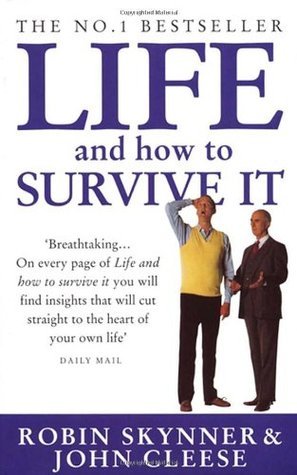
Brilliantly entertaining, enlightening and inspiring, Robin Skynner and John Cleese take on the big life, and the challenge of living, in all its myriad forms. This book is an essential guide to surviving life's ups and downs - at home or in the workplace, as a member of a family or society.
Presented in the same lively style as the best-selling Families and How to Survive Them , Life extends Skynner's and Cleese's study beyond the family to relationships and group interaction in life outside it. The book deals with such pithy issues
-Why life gives you all the lessons you need -How grief can be good for you -Why work is essential to our psychological health -What mid-life crisis means for you
We are all searching for healthier, happier, more satisfying lives, but it's the journey that matters, not the destination. Skynner and Cleese are the perfect travelling companions.
Robin Skynner was a Royal Air Force (RAF) pilot who flew the Mosquito twin-engined bomber, and was also a psychiatric pioneer and innovator in the field of treating mental illness. Trained in Group Analysis and working as a child psychiatrist, and a family therapist, he employed group-analytic principles in that therapeutic modality. He was a gifted teacher and practitioner of psychotherapy with individuals, groups, families, couples and institutions. He was also a prolific writer.
Robin Skynner will be remembered for his prolific writing; he authored One Flesh: Separate Persons, Principles of Family and Marital Psychotherapy (1976), Explorations with Families: Group-Analysis and Family Therapy (1987), Institutes and How to Survive Them: Mental Health Training and Consultation (1989), Family Matters (1995), Families and How to Survive Them (1975), and Life and How to Survive It.
He was educated at St Austell County School and at Blundell's School, after which, at the age of 18, he volunteered for the Royal Air Force (RAF), and was selected as a prospective bomber pilot. He was adversely affected by the shared destruction and slaughter he was obliged to carry out, an experience that, for a variety of complex reasons, drew him to psychiatry as an eventual vocation.
To this end, after demobilisation from RAF service, he enrolled as a student at University College Hospital and qualified MB, BS (Lond) in 1952. He then began his psychiatric training, and in 1957, he passed the Diploma of Psychological Medicine. In 1971, he was elected MRCPsych, proceeding FRCPsych in 1976. He was successively the Director of the Woodberry Down Child Guidance Unit, Physician-in Charge of the Queen Elizabeth Hospital for Children, Senior Tutor in Psychotherapy at the Institute of Psychiatry and Honorary Associate Consultant at the Maudsley Hospital.
Dr Foulkes, a psychoanalyst and psychiatrist, was one of the founders of group analysis in Britain, a group approach developed out of Foulkes's treatment of war victims in Northfield Hospital, Birmingham. Foulkes was a pioneer, and quickly attracted the attention of others keen to change the way mental health patients were dealt with. Skynner was intrigued by Foulkes, and by the early stages of the Therapeutic community movement, which was beginning to gather strength. He became Foulkes's pupil and later his patient in a group; Robin Skynner would readily admit he needed treatment himself. In 1959, Skynner, together with fellow disciples of Dr Foulkes, founded the Group Analytic Practice, which specialises in group, family and marital therapy. A logical development was the emergence of the Institute of Group Analysis for the specific purpose of giving training in group therapy. However, it was Skynner himself who in 1977 founded the Institute of Family Therapy and chaired it for the next 2 years.
He subsequently worked with adults and children of an unusually wide range of socio-economic status, from the poorest districts of the East End of London to private practice. His chief interest was the practice and teaching of psychotherapy, with individuals, groups, families, couples and institutions. The important posts he successfully filled were senior tutor (psychotherapy) at the Institute of Psychiatry, honorary assistant consultant psychiatrist at Bethlem Royal and Maudsley Hospital and physician in charge of the Department of Psychiatry at Queen Elizabeth Hospital for Children, London. He was a founder of the Group-Analytic Practice and of the Institute of Group-Analysis, and a founder and first chairman of the Institute of Family Therapy, London.
It has been a surprising, thrilling and enjoyable journey through this book. I really like the exchange of ideas and arguments of the two authors, and especially the conversational format of the book.
What is it about? In short, mental health of individuals, families, organizations and societies. But I think I learned more from the detailed discussions than the main points. The book covers how we think about and deal with family members, neighbors, colleagues, friends and ourselves, with tons of advocative examples analyzed from different points of view and cultures.
The central concept of the book is (mental) "health," applied to individuals and groups. The effect of any guiding principle or life lesson is determined by the level of health. The authors discuss the characteristics of health in various group settings, then finally advise how health can be improve.
As I reflected on my own family and work, I have to painfully concede that the authors are quite correct. I realize a lot of room for me to learn and improve, thanks to this very helpful book.
Note that the conversational format of the book is very entertaining to read, but may be hard to follow for some readers, as there is no clear outlines.
I was going to write a lot about this book, but I'm going to simply say that you should read it. Just do it. You'll never see humanity, or issues in your own life, in quite the same way.
My fav quotes (not a review): "children don’t have to suppress spontaneity for fear of ‘upsetting people’" “Before we can laugh at something, we need to experience ‘a momentary anaesthesia of the heart’." "learning is not finding out what other people already know, it is solving our own problems for our own purposes" "It’s not that children mind criticism, is it, if there’s some warmth and involvement in it? When one teacher described my attempt at a rugby tackle as ‘dancing about like a disabled fairy’ I enjoyed it, even at that moment! But when a science teacher said ‘Your housemaster says you’re clever – I just can’t see it myself,’ I think it slightly damaged my confidence in physics forever." "Sir John Harvey-Jones, the ex-Chairman of ICI, described the process of building two identical paraxylene plants, one in Japan, and one in the UK. The Japanese were still having their endless discussions four months after the British began to build. But once the Japanese started, as Harvey-Jones puts it, ‘they moved like greased lightning’ and finished their plant seven months earlier than the British. What’s more it all worked from day one, whereas when the British plant finally opened seven months later, it went through three months of teething troubles!" "motto for meetings: ‘Cooperation between people, competition between ideas’." "At trial screenings of my movies, to get the real criticism that will enable me to re-edit properly, I no longer say: ‘What didn’t you like?’ because people won’t tell me if I ask them like that; I’ve learned to say: ‘If I was making this again from the beginning, what two bits of advice would you give me?’ That way people can sound positive while expressing thoughts that are in fact critical." "The Japanese have a clever way of dealing with reluctance to criticise. After a discussion, when the time comes to decide on the action to take, the leader will invite everyone there to give their opinion but beginning with the most junior person and working up the scale of seniority. That way no one has to disagree with someone more senior, and there’s less likelihood that they will just parrot what the boss thinks." "you couldn’t repress one emotion without risking repressing them all." "G. K. Chesterton’s remark about Christianity: ‘It hasn’t failed, it has simply never been practised.’" "If you want people to be really nice and supportive to you in Britain, the thing to do is to fail, or at least appear to fail … John Isn’t that true! We’re loser-friendly. Fall flat on your face and everyone’s ringing you up, helping you feel better. Only fair really, since you’ve made them feel so good. Robin Our famous British ‘modesty’ is one way we try to deflect our fellow-countrymen’s strong tendency to be envious of anything that smacks of success. John But Americans love you if you’re successful: it’s failure they can’t forgive. Robin That’s true. If you are not succeeding, no one wants to know you. You don’t really exist" "The Protestant work ethic flourished dramatically just because the early pioneers could be as Protestant as they liked and work as hard as they wanted; if a new establishment tried to control them they could move on, and on, at least until they reached the Pacific. The land was so rich and empty that there really was some truth in the idea that poverty was a personal failure." "I’d guess a nation that’s just experienced real disaster tends to have few illusions. There’ll be an attitude of humility, a realisation you’ve got to work very hard and use your wits, and a sense of obligation to society, to pull together for the common good. That would be a very favourable situation for economic success, wouldn’t it? Nations like this haven’t acquired fat cat attitudes themselves yet" "Man’s achievements are due to his extraordinary capacity for abstraction. Without it neither our science, nor our art, nor our literature, nor our philosophy could exist. All our most positive achievements arise from this gift for abstraction; that is, for simplifying things by selecting out those aspects of reality that we want to concentrate on, while ignoring the other aspects as if they didn’t exist." "If a map included everything it would actually be the territory itself. John As Michael Frayn once said, a truly complete history of the Hundred Years’ War would be the Hundred Years’ War. Robin Which would take another hundred years! So … we’ve got to simplify things, so we’ve got to abstract." "Now although myths can never be as persuasive as experience, the more they engage our feelings, the more they affect us. That’s why so many of these myths, especially the religious ones, tap into our basic feelings about the family." "Chinese saying: ‘Tell me and I’ll forget. Show me and I may remember. Involve me and I’ll understand.’"
This is a book that centralises mental health and psychological self-insight into the individual and collective human experience. It is a great read that uses an almost Socratic method of dialogue throughout. Both Cleese and Skynner are really really intelligent. They have both practical/well-researched advice and empathy for the problems they discuss. The main foundation of the book lies in the foundational nature of the family. They orientate most of their discussions around the individual who is inextricably attached to various caregivers (or lack thereof) during the formative years of childhood. These childhood years give individuals a crash course in how to be a person in the world, occupying spaces in various systems both personally and professionally. Further, one is taught (or again not taught very well) how to play the games (Piaget) of life and play them well in order to have a more secure footing in the world. There are effective families and conversely not very effective families. The former includes a good structure with strong parenting, yet allows children to develop self-sufficiency in thought, personality and action. Further, a good family has well-defined roles that members occupy confidently and happily- yet retain the fluidity within the structure to temporarily swap roles with someone else when required. While conversely, a non-efficient family lacks good structure, the roles of the parents are diluted with those of the children, and the family lacks a sense of direction or unity.
The book highlights how having a poor family structure can set one up for a difficult life. This is because one is not clear on effective role-playing, on effective communication, and also does not understand how systems work. Skynner is really big on systems and understanding them, as he sees most if not all systems emulating the family structure. If family is the central metaphor, then it is extended throughout the book to themes like businesses, religion and politics. Again, clear role-playing, good leadership, and fluidity and consistency in communication all increase the efficiency of a system.
Being valued and working for it in any family is important. Also a good family allows its members to be independent of the family - have a personality and life that allows it to connect with people, ideas and projects outside of the family. A good family never suffocates its members, and good parents are ultimately responsible and accountable for their children. Switching the caregiver role with one's children is confusing for children and often traumatic, which does not play out well when these children occupy other systems in their life. Saliently, parents must be unified in their decision making- just like the leaders of a political party should be in agreement on ideology or party politics. Junior members of the family will use the cracks in leadership disunity to their advantage while damaging the family as a whole. Think of the analogy of Brexit and the Tory eurosceptics over the years- in this case the family tensions lamentably diffused out to the whole nation as Brexit became a national issue of constitutional significance.
Before delving into meaning, religion and spirituality, Skynner is asked what are the two most important aspects of mental health? In which he responds illustrating that the fundamental measure of good psychological health is facing, comprehending or accepting reality for what it is. Linked to this is also the 'extent to which you behave inclusively', so that's connecting and including others in one's own thoughts and experiences. Ultimately, Skynner argues that authentic integration of the self and its surroundings is the core of good mental health. I personally believe this can allow anyone to develop and transcend beyond certain difficulty and trauma in one's life. Knowing one's self is an ancient maxim that necessitates that you also know what you are not, but also what others around you are and accepting them, and integrating them into your experience. There is also lots of scope here for discussion on free will, the anatomy of morality and the irrepresibility of the Jungian shadow. Come to think of it, this is really a fantastic book that gets you thinking very deeply but also very practically. I think this should be read at least a few times in one's life as the research and insight, to an extent, is timeless and very helpful for individual and collective betterment.
Absolutely amazing. I cannot recommend this book too highly. The generalized insights on human psyches and relationships are unlike anything I've ever seen anywhere else.
The authors start by discussing the characteristics of exceptionally healthy families and spend the rest of the book expanding widely and thoroughly in all directions. They talk about what it's like for individuals, families, companies, and societies to be mentally and emotionally healthy, unhealthy, or somewhere in the middle and about the forces that makes them healthier, less healthy, or keep them at the status quo.
The format is taken from the Socratic dialogues, a long-running conversation between the authors. Their close friendship and Cleese's comedy background (he was a co-founder of Monty Python's Flying Circus) keeps the tone very light and casual. But the content is still very dense. it is not a quick read.
If you read it I am rather confident it will make your life considerably better.
Vezmeme-li v úvahu, že jde o bezmála třicet let staré výzkumy/názory, které již v té době pocházely od postaršího usedlého britského gentlemana střední třídy s ne zrovna progresivními názory, tak to navzdory některým názorům nelze neoznačit za zajímavé. Ano, je to dosti jednostranné, chybí ženský vzhled (čím neříkám, že to straní mužům, protože nestraní), mnohé názory jsou dnes vyloženě úsměvné, jiné přežité až zpátečnické a některé byly naivní již tenkrát. Přesto si v tom lze najít dodnes platné pravdy a vzorce chování, ve kterých sebe/své nejbližší bezpečně rozpoznáte, to zase ne že ne.
Velmi tomu napomáhá forma. Je to koncipováno jako dialog zvídavého laika s "panem učitelem". Cleese se umí ptát sakra dobře, stejně jako Skynner vysvětlovat. Díky tomu se to příjemně čte. Zdráhal bych se to označit za odbornou literaturu, ale v ranku "populárně (na/po)učné", to své místo má.
Life and How to Survive It was one of my favourite books. Although it resembles a self-help book, it avoids the usual feel-good platitudes. Instead, it takes the form of a thoughtful dialogue between Robin Skynner, a highly accomplished psychiatrist, and John Cleese, a revered comedian and actor. Their conversation combines psychological expertise, personal experience, humour, and observations about the problems that matter most in our lives.
The book covers a surprisingly wide range of subjects, including family relationships, childhood, therapy, politics, democracy, creativity, social behaviour, and emotional maturity. I particularly appreciated its discussion of how people can become caricatures of their social roles, adopting increasingly rigid and polarised positions that damage healthy relationships. The political sections also felt remarkably pertinent, especially the observations about citizens feeling unrepresented, minority views being imposed on larger populations, and the time and stability required for democratic attitudes to develop.
The book is full of concise observations that stayed with me. I enjoyed the idea that too much absurdity in a tragedy can make it funny, as well as Henri Bergson’s description of laughter as a social response to inflexible behaviour. The comment that “he who doesn’t make mistakes is unlikely to make anything” also captures the book’s attitude towards creativity and growth. I particularly appreciated the discussions of democracy, political polarisation, and the fact that social and political change takes time. The authors emphasise that people moving from authoritarian systems towards democracy need a period of stability in which democratic habits and skills can develop, an observation that feels especially relevant today.
The discussion of therapy was especially interesting. Knowing what to do may be relatively straightforward; knowing how and when to do it, while avoiding intrusiveness and respecting a family’s beliefs, is far more difficult. That kind of judgement is not simply acquired once, but developed through continual experience and lifelong learning.
Overall, I found the book intelligent, humane, funny, and highly relevant. It is full of ideas worth returning to, and I expect to read it again with a notebook nearby. For me, it has the qualities of a valuable reference book as well as an enjoyable read.
If you ever wondered how a 3-4 episode podcast series on late-90ties UK human condition would've looked like. Cleese isn't as funny as you might have expected (at times comes joyfully condescending), whilst most of Skynner insight is relatively well accepted (affective vs. effective, importance of dealing with one's issues first, ability to tame critique etc). Nothing spectacular, but worthwhile a quick scan.
Funny fact, in Polish translation, under meritocracy someone put "not observed in Poland"; so there was (still is?) audience that would benefit from a self-reflective read 😉
Trebalo bi da se zove "Kako izmusti još para od prethodne knjige". Deluje kao da su se zapili, uključili diktafon da snimi pijanu raspravu do zore i onda dali nekome da prepise ... loše! Pošto je u celom četvrtom poglavlju ostao track changes lektora. Srećom po ovu ocenu pa mene baš zanimaju dve od 5 tema o kojima baljezgaju.
A book that takes some thought, delving into research about what makes the 'healthiest' people, families, organisations and countries. It's written as a conversation between John Cleese and the late Robin Skynner (his therapist) with a few moments of humour. It makes for an enjoyable read but the depth of the concepts isn't always immediately obvious.
The sections on 'religion' were rather revealing, despite some facets not tying in with Christian belief. A surprising emphasis is given to Jesus' words, considering that it's basically a secular book.
It's taken me almost a year to re-read it as the dialogue format doesn't lead to skimming or reading a lot at one sitting. But although the concepts were not, this time around, new to me, I thought it well worth revisiting them.
Written after 1 year of reading: The book is in the form of a written conversation, which makes it very easy to read. The book contains a lot of statistical information resulting from academic or other studies and Robin and John talk about what they mean. It is very interesting to read how these two clever people translate the outcome of these studies in everyday language. I think that this book should be read every once in a while. It is not at all like a self improvement do-this do-that kind of a book - but the scientific studies and explanations implicitly makes you feel like you want to change a few things about yourself.
Can't give it anything other than 5 stars. I studied Psychology in college but this book took it all and made it relevant to my life. Thoroughly enjoyable and well-presented. Despite it's dialog format, you don't get the feeling that the book is scripted (though it must be) and it doesn't go off on all these tangents as a normal conversation would - it has all the logical build up of a proper non-fiction book. A must read.
The sequel to "Families" stays true to sequel form by being more of the same and not quite as good. Family dynamics is probably quite enough of a topic for a book and when the duo takes the leap to explain Life, the bite feels a bit too large to chew. Skynner's self-assured teachings, told to a bit too uncritical Cleese does not ring quite so true this time around. Still, it is an entertaining book, and not without insights and good passages.
Using John Cleese's wit and Robin Skynner's thoughtful insights, this book illuminates patterns in the lives of people who are most satisfied with their lives -- not the usual "disfunctional" targets of psychological research. This remains a really useful and fun way to re-think your approach to new people, situations, and problems.
Very interesting format, quite easy to absorb the basics due to the conversational format. I did miss, however, a summary page, point form, to summarise the basics. Apart from that, quite an interesting book on the various stages of 'healthiness' from all levels of society - micro & macro.
I only gave this 1 star because unlike the Families edition, I just couldn't get into this book. The chapters were too long and it was hard to pick up the thread if I had to stop reading part way through. I'm sure it is a very useful book for those who have a bit more time available.
Informative and extremely eye opening. In some cases the language and/or ideas are a little hard to take as homosexuality is effectively described as a deviation. All in all, the story seems to come back to a fundamental point, that all our avoidances manifest themselves as our fundamental traits.
Still the only comprehensive research on how functions healthy mind. Besides, it's co-written by John Cleese. Stop looking for mental disorder symptoms and learn better some smart things.