In the year 1714, the world is a most confused and unsteady place - especially London, center of finance, innovation, and conspiracy - when Daniel Waterhouse makes his less-than-triumphant return to England's shores. Aging Puritan and Natural Philosopher, confidant of the high and mighty, and contemporary of the most brilliant minds of the age, he has braved the merciless sea and an assault by the infamous pirate Blackbeard to help mend the rift between two adversarial geniuses at a princess's behest. But while much has changed outwardly, the duplicity and danger that once drove Daniel to the American Colonies is still coin of the British realm.The Baroque Cycle, Neal Stephenson's award-winning series, spans the late 17th and early 18th centuries, combining history, adventure, science, invention, piracy, and alchemy into one sweeping tale. It is a gloriously rich, entertaining, and endlessly inventive historical epic populated by the likes of Isaac Newton, William of Orange, Benjamin Franklin, and King Louis XIV, along with some of the most inventive literary characters in modern fiction.Audible's complete and unabridged presentation of The Baroque Cycle was produced in cooperation with Neal Stephenson. Each volume includes an exclusive introduction read by the author.
Neal Stephenson is the author of Reamde, Anathem, and the three-volume historical epic the Baroque Cycle (Quicksilver, The Confusion, and The System of the World), as well as Cryptonomicon, The Diamond Age, Snow Crash, and Zodiac. He lives in Seattle, Washington.
“On the contrary, my lord...there is nothing quite so civilized as to be recognized in public places as the author of books no one has read.” - Neal Stephenson, The Baroque Cycle, Vol 3, Book 1
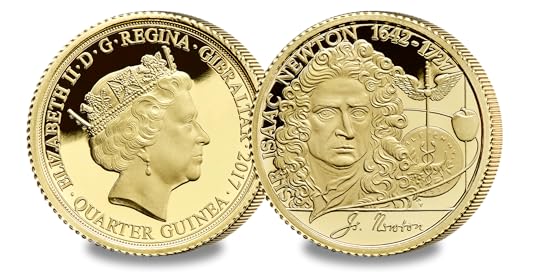
I can feel the end of this series closing in. The sixth book of this series, nested, like a Russian doll inside of Volume 3 (The System of the World) centers primarily on Daniel Waterhouse. Daniel has been summoned back to England to act as a middle-man (or a narrative bridge?) between Isaac Newton and Gottfried Leibniz concerning the invention of Calculus. Someone tries to kill him with an infernal device (mechanical bomb). The book ends with Jack Shaftoe (aka Jack the Coiner) attempting a heist of the Tower of London where Netwon is the "Warden" and later "Master" of the Royal Mint. Newton has been using this role at the Royal Mint to standardize the guinea, but also to to search for Solomon's lost gold.
The book tends to bend easily between swashbuckling adventure and nerdy historical/light scifi fiction. It is dense in parts, but it is hard to not respect Stephenson's ability to weave the real with the almost supernatural and the outrageous. I'm constantly entertained by The Baroque Cycle but the charm is starting to tarnish a bit and I'm ready for this almost literary adventure/ride to end.
This is book 6 of 8 in the Baroque Cycle by Neal Stephenson. I'm slowly working my way through the series while reading some other material to keep up with my book groups. Since this is part of an eight book series, writing a review for each book is a little like writing a review following long chapters of a long book.
This book picks up from the very beginning of Quicksilver, book one of the series, with Daniel Waterhouse returning to Europe from Massachusetts in 1713 at the request of Caroline of Brandenburg-Ansbach for the purpose of resolving an explosive scientific battle of preeminence between Isaac Newton and Gottfried Wilhelm Leibniz over the development of calculus. Therefore, Books 1 through 5 have served as a flashback into the earlier life of Daniel and various other characters, both historical and fictional.
The following are some snippets from what I remember from the book:
1. Daniel Waterhouse witnesses a demonstration of an early prototype steam powered pump designed for the purpose of dewatering nickel mines in Cornwall.
2. I learned what a money-scrivener is, and the reason why his services are needed.
3. The book provides a description of early 18th Century economics in England.
4. The geography of the London in 1714, and the Tower of London complex in particular, is described in great detail in the book.
5. The relationship of religion and politics was explored by the book.
6. There are various conversations by these 18th Century characters indicating the need for an "automatic knowledge storage machine." There is some historical basis for this. However it may also be a Twenty-First Century author portending the development of the digital computer.
7. The book provides a description of Frederick Peter (the great) of Russia wanting to develop a center for the study of natural philosophy (i.e. science). [see Message 3 below]
8. The book has an interesting description of Bear baiting.
9. The book contains a humorous conversation between two individuals who are trying to insult each other but are disguising it within traditional Quaker style "thee and thou" speech.
10. The book contains a mystery involving a time bomb which is a very innovative device for the time.
11. The conflicted politics of the time are described. The death of Queen Anne on England is anticipated, and the Catholic's want her half-brother James Francis Edward Stuart to be the next king, and the Protestants want George Augustus, the electoral prince of Hanover, to be king.
12. Toward the end of the book there's an incredible scene of George "The Coiner" attacking the Tower of London via a zip-line. The scene of course is fictional and as a practical matter probably impossible. But it's a heck of a story.
13. The mystery continues on into the next book because once the Tower is invaded, they're not interested in the crown jewels. They're interested in doing something else, and the readers of this book will need to read the next book in the series to find out what and why.
LINK TO Wikipedia article about the Baroque Cycle by Neal Stephenson. LINK TO my review of Quick Silver (Bk. 1) by Neal Stephenson. LINK TO my review of King of the Vagabonds (Bk. 2) by Neal Stephenson. LINK TO my review of Odalisque (Bk. 3) by Neal Stephenson. LINK TO my review of The Confusion (Bks. 4 & 5) by Neal Stephenson. LINK TO my review of Currency (Bk. 7) by Neal Stephenson. LINK TO my review of System of the World (Bk. 8) by Neal Stephenson.
Each book in this series just gets better and better. That is saying something since I gave the first book four stars and the middle one five stars. Others have summarized the plot and sidewindings of the book better than I could, so I will limit this review to two things. 1) The narrator of the audio book, Simon Prebble, is the perfect match for the material, and I highly suspect listening is the BEST way to experience the Baroque Cycle. 2) Neal Stephenson’s writing is simply par excellence. Below is just one quote to exemplify why I say this. [sorry if I spelled the names wrong, remember I was listening, not reading the book]
"If you were strolling in the gardens of Versailles you might one day hear sudden noises and turn around to see, some distance away, one fellow, let’s call him Arnault, going after another, call him Blaise, with a drawn blade, from which, if you were a careless observer, you might think that Arno had just snapped without warning, like an ice-covered bough falling from the tree. But in truth, the Arnaults of the world were rarely so reckless. A careful observer watching Arnault for two or three minutes prior to the onset of violence would see some sort of exchange between him and Blaise, a calculated insult from Blaise, let us say, such as a refusal to let Arnault through a door ahead of him, or a witticism about Arnault’s wig which had been so very fashionable three months ago. If Blaise were a polished wit, he would then move on, blithe, humming an air, and giving every appearance of forgetting the event. But Arnault would become a living exhibit, symptoms would set in that were so obvious and dramatic as to furnish a topic of study for the Royal Society. Why, a whole jury of English savants could stand around poor Arnault with their magnifying lenses and their notebooks, observing the changes in his physiognomy, noting them down in Latin, and rendering them in labored woodcuts. Most of these symptoms had to do with the humor of passion. For a few moments, Arnault would stand fast, as the insult sank in. His face would turn red as the vessels in his skin went flaccid and consequently ballooned with blood from a heart that had begun to pound like a Turkish kettle drum signaling the onset of battle. But this was not when the attack came, because Arnault during this stage was physically unable to move. All of his activity was mental. Once he got over the first schock, Arnault’s first thought would be to convince himself that he had reigned in his emotions now, got himself under control, was ready to consider matters judiciously. The next few minutes, then, would be devoted to a rehearsal of the recent encounter with Blaise. Affecting a rational, methodical approach, Arnault would marshal whatever evidence he might need to convict Blaise of being a scoundrel, and sentence him to death. After that, the attack would not be long in following, but to one who had not been there with the fellows of the Royal Society to observe all that had led up to it, it would seem like the spontaneous explosion of an infernal device."
I've been listening to Simon Prebble for nearly 87 hours and his performance is Baroque Cycle has been fantastic. I'm really glad that Audible got a top notch narrator and maybe that's why I'm enjoying this series so much. In the sixth installment, "Solomon’s Gold" is something that I was looking forward to because it explained more about the monetary system, but the story fell short for my liking.
Remind you, I just finished and wrote the review for "The Confusion" just a few days ago and maybe my mind is still on pirates, but for some reason, I thought that "Solomon’s Gold" is the weaker of the set so far. The tale was very erratic on most parts of the book. I need to remember that this is the first part of the last volume and there are two more books to go. My expectation was very high after coming off from "Bonanza" and "The Juncto."
I don't think that I'm loosing steam in the Baroque Cycle and cannot wait to complete the entire series. Maybe Simon Prebble is starting to annoy me. His Scottish accent for one of the characters is not so great. Probably downright awful from his overall performance.
"Solomon’s Gold" should had been the strongest chapters, but it fell short. I just wanted to know more about Quicksilver and how banking got started, but the story was all over the map and didn't hit the target, unlike the other books.
The book is still very good with a few exclusions.
This book smells strongly of an author that committed to 8 books and just had to fill some pages with something. The excitement, adventure, and pirates of the previous books is long gone and replaced with an Adam Smith-esque history of English monetary policy. The entire novel is a longwinded discussion of Jack Shaftoe's shenanigans from Daniel's point of view. This book is hardly worth reading on its own, but die-hard completionists will read it anyways to finish up the series.
For any other writer, I'd give "dull" two stars. The novel is written in legible English and it isn't actively offensive. However, this is Neal Stephenson. He wrote *Cryptonomicon.* He wrote *Seveneves.* He wrote *The Confusion,* which came immediately before this novel in his Baroque Cycle. Neal gets graded on a curve.
*The Confusion* combined Stephenson's love for the Dickensian with a fascinating tale about pirates, princesses, and stolen treasure. *Solomon's Gold* finds Stephenson giving full flight to his compulsion to describe, in excruciating detail, every neighborhood of Early 18th Century London - down to the last cobblestone. To leaven the dreariness, he distracts us with a tale about what a dick Isaac Newton was.
This is not the stuff of which 5-star reviews are made.
I feel like this book is an example of a writer getting too well-respected. Where was the editor telling him tighten things up, that his 300-page story could have been told in 125 pages, tops? Where were the beta readers, the friends and family who could have put a hand on Stephenson's shoulder and told him, "We love you, but this one's getting away?"
Wherever they were, this book could have used them. I'm pressing on with the next book in the Cycle, but it has some amends to make.
I was initially disappointed that this book switched focus back to Daniel Waterhouse, because the Royal Society arc (primarily Quicksilver) has been the slowest in the series. I always liked Daniel, but didn't connect as easily with him early in the series as I did with Jack and Eliza. I REALLY enjoy old Waterhouse - the humble, quiet, easily overlooked elderly scientist who seems to be mixed up in all the most exciting intrigues. He's very dryly funny!
This book has it's slow meandering parts, but they are never dull and can be laugh out loud funny. This review it based entirely on the Audible version of this book. Simon Prebble does an expert job at bringing out the characters' personalities. He's a prefect Daniel, but he's also perfect Jack and a perfect Bob. He uses distinct accents and voices and they are all perfect! He even does a great job with the female characters.
It was supposed to be the perfect book for me - origins of money, alternative history, English enlightenment politics and newton - but honestly it was exhausting .. Stephenson being himself but just a bit too much - a type of old English that I needed a dictionary near by, never ending anecdotes, and a story line that makes it easy to get lost. I admit I finished the book and needed to talk with AI just to figure out what happened in the book since it was so confusing .. I loved cryptonomicon and snowcrash though , so I’m not giving up on Stephenson yet
The series are still brilliant, this is where we reconnect with Daniel Waterhouse on his return to England which is where the story started 5 books ago.
This is the prelude to the finale, this is where the threads of the story begins to come together and as such this instalment in the series feels slightly as a buildup without its own narrative.
I am committed to finishing this very long series, but my commitment becomes less, um, committed, every time Stephenson describes something as "baroque." Yes, I know it is the "Baroque Cycle," but surely there are other adjectives out there. Plus, it is a little jarring to have someone one describe something as "baroque" *during* the Baroque Period.
If you've read this far, you know what this series is like. This book continues on from the previous, without some of the strange convolutions required to move the plot on. All of your favourites are here, with a return to Daniel, and Dappa gets his own storyline. And that's all I really have say. Onward to the next volume.
Thoroughly smart and exciting, Stephenson’s Baroque Cycle just gets better and better. I enjoyed this one perhaps more than the others, though they are all hard acts to follow. The continued wild ride of Jack continues to keep me enthralled and smiling.
If you haven’t read any of the Baroque series, do it now.
Finished much sooner than I anticipated, but curiously, it didn't capture my attention in the same way as the former ones. Nevertheless, it was a great listen, maybe I am just slightly jaded after reading six volumes in the span of six months.
I think this is volume 7 of Stephenson's baroque cycle which I've really liked. I found this volume less compelling. Not much happens until the end and I thought it just wasn't as interesting as some of the other books
A bit long winded and introduction of characters not relevant to the story. Lots of MacGuffins, that were probably not required, at least as far as this book is concerned. Will have to see in the next books though. Better than volume 2, not worse than volume 1.
*1st reading* I have mixed feelings about this entry in the series. I enjoyed the first half of the book with Daniel Waterhouse as a sarcastic detective working for Newton, but I felt the dramatic shift in tone from picaresquish in previous novels to serious action in the last half of the book was incredibly jarring. Something about the heist story where you, the reader have no idea what's going on because you don't inhabit the head of the guy who planned it (that is the sections describing taking over the Tower of London. Plus the abrupt ending was pretty irritating.
*2nd reading* My opinion still stands. I still have no idea what was going on there at the end, even though this was my second readthrough.
Being some time since I read the first two books in the series. Well written for sci fi and very good dialogue. Good character development. However this is not so much sci fi but historical fiction with a heavy science bent with the key characters of Newton and Leibnitz. However much I liked it, it is definitely not something I would recommend to a friend unless they really love stephenson and has already read all his other (and much cooler) novels.
Kind of like all these books. Its okay but is not always clear where it is going. The story is entertaining and the characters interesting and amusing. But I just did not get the full story. I know that the author is doing sort of a historical fiction series and such, but I would prefer a less roundabout process.
While perhaps lacking the same level of swashbuckling adventure enjoyed in the previous installment, Solomon's Gold more than makes up for any decreased action by focusing on socio-economic intrigue of the era, as well as by providing key climatic moments to kickstart the final volume of Neal Stephenson's epic series.
I love Stephenson's style. However, this book just didn't get going for me. This whole series is too crass and tedious for my tastes. I will probably finish the last two books (listening). Like I said, I love his prose.
The EPIC journey continues. Nice to see the story threads coming together, though I will admit to some fatigue. I am now ~80 hours of audiobook into this series, and I still have 26 hours to go... Really love the world, the characters, the mechanics, the storytelling. It is just LONG....