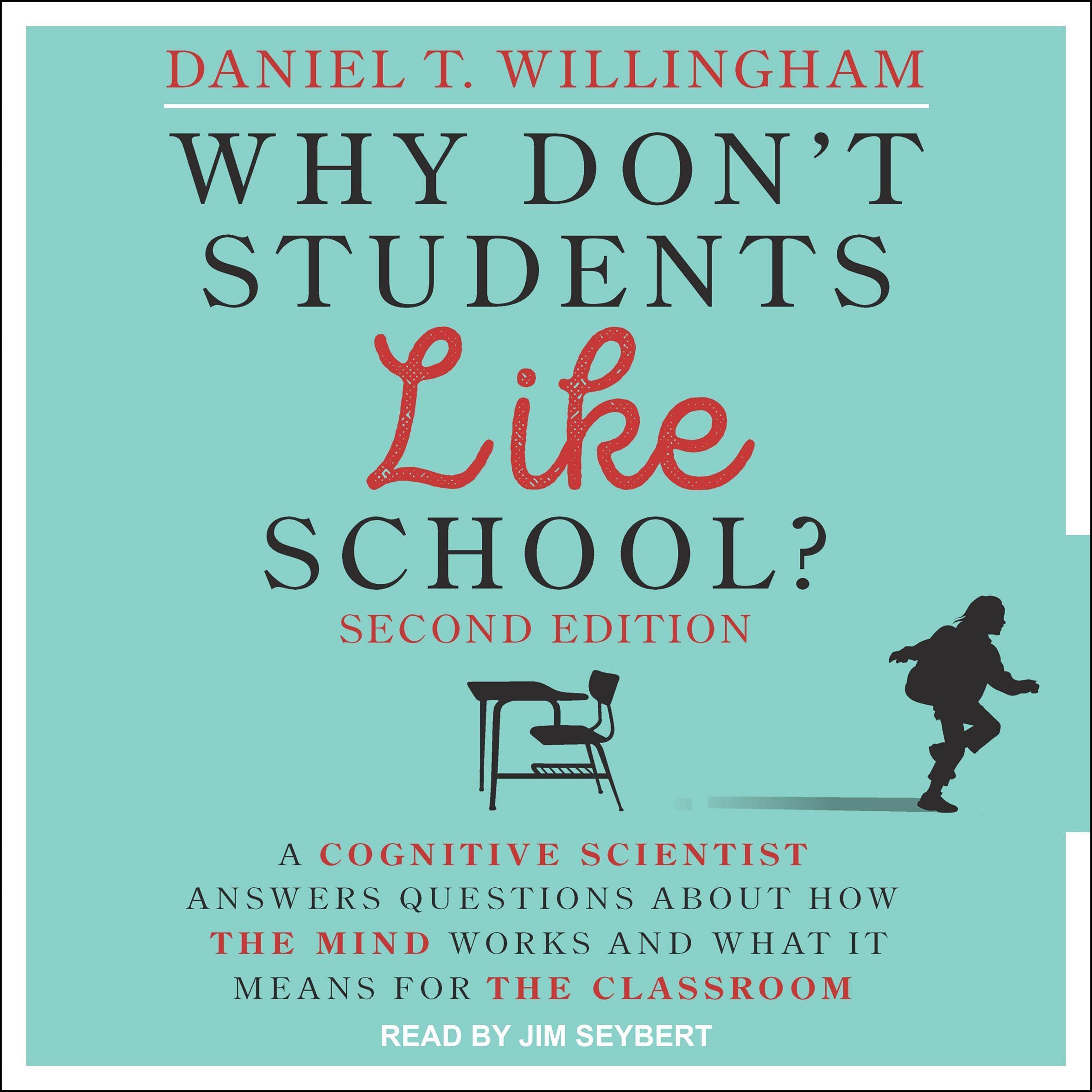
This book reminded me a bit of Outliers; the author actually cites some of the same studies, and makes some similar points. Here, the primary audience is clearly K-12 teachers. The author takes the body of current cognitive science research, and applies it to the classroom, in a very quick, easy-to-read format.
Here were some of the ideas that I found the most interesting:
-People actually really enjoy solving problems, as long as those problems aren't too easy or too hard for them. Otherwise, it's a horribly boring or frustrating experience. (Seems like an obvious point, but not one that schools have taken advantage of yet. Right now, there's pretty much a one-size-fits-all mentality going on, so that a particular lesson might hit the sweet spot for a few lucky kids, but most will find themselves either bored or frustrated most of the time.)
-You've got to have some background knowledge to make sense of new knowledge. We understand and remember new things, because we relate them to what we already know and understand. So when one child arrives at school with an extensive background knowledge that's been developed through years of trips to the zoo, museums, grandparents' houses, cooking with mom and dad in the kitchen, reading books, daily conversations with adults about all kinds of things, etc.- they've got a huge advantage over a child who's had fewer interactions and experiences. This difference becomes more pronounced over time, rather than less pronounced - you gain new knowledge more quickly, and now your advantage is even greater for understanding the next new fact; the rich get richer, and it's continually harder for the poorer kids to catch up. (I'm using rich and poor metaphorically, to mean those with more and less background knowledge - but sadly, these do actually correlate with socio-economic status). The divide is exacerbated further in about 4th grade, when the emphasis on decoding skills (sounding out words) has been replaced with an emphasis on comprehension.
-In the same chapter: "Trying to teach students skills such as analysis or synthesis in the absence of factual knowledge is impossible. Research from cognitive science has shown that the sorts of skills that teachers want for students - such as the ability to analyze and to think critically - require extensive factual knowledge.... Factual knowledge must precede skill."
THANK YOU! I have been trying to verbalize this idea for a couple years now, and Willingham did it very nicely. I have been so frustrated with the WASL-prep exercises my children have been doing in school - which emphasize these types of cognitive skills, with no real care for the actual content of the lesson. The students are given brief written clips, and asked to answer a series of questions about the text. The fact that they don't really understand the topic is of no interest to the teacher - because the point of the lesson isn't really to understand the solar system or global warming or indigenous societies or whatever - it's to learn to draw inferences. Well, HELLO - a second-grader doesn't care about the abstract concept of drawing inferences - she wants to know what the *%$# the passage is talking about. If we could tackle actual issues, answer the kids' genuine questions, have a discussion about the topic in question - then in the process, they'll learn about drawing inferences. But when the school treats all content as an unimportant means to an end (learning abstract and generalizable cognitive skills), they fail at an otherwise laudable goal. And they make school really boring in the process.
-In the last couple decades, theories about different learning styles and multiple intelligences have gained a lot of traction among educators. According to Willingham, the research doesn't bear it out. Sure, some people are more talented at music, other at movement, and so forth. But it doesn't follow that kids will be helped by having various subjects taught to them through these particular channels. The fact that one child is a better auditory learner means he or she will do better at remembering how something sounded (e.g. which voice was deeper?), while a visual learner will do better at remembering how something looked. But usually, in school, we want kids to think about what something means - for example, the meaning of a vocabulary word. Presenting the vocabulary list through auditory or visual channels seems to make no difference - because the meaning of the word (and the way the brain processes that info) is distinct from the sight or sound of the word. Thus, he says, lesson content, not student differences, should drive the decision about how to teach.
-Intelligence is a function of both genetics and environment. Intelligence is malleable - it isn't fixed. For example, he refers to twin studies which showed that children who were removed from a deprived home and adopted by a more affluent family showed an increase in intelligence. So while genetics are clearly a factor, we can take steps to increase the intelligence of our students. One specific tip: if you want to praise your child or student for a job well-done, you should praise their effort rather than their smarts. Multiple studies have reinforced this idea. When we tell kids, "Great job! You're really smart!", they ultimately perform worse than kids who are told, "Great job! You must have worked really hard!"
I thought the book lost a little steam by the end. In the last chapter, he claims to explain what cognitive research has to say about the minds of teachers themselves. Apparently, the answer is: try harder to be a better teacher, try videotaping yourself teaching, and talk to your teaching buddies about teaching, but nicely, so as not to hurt anyone's feelings. I guess the advice is all right, but the link to actual research seemed more tenuous in this section.
My favorite quote from the book:
"I am willing to bet you have heard someone say, "Every student is intelligent in some way"... I think teachers say this in an effort to communicate an egalitarian attitude to students: everyone is good at something... This sort of statement rubs me the wrong way because it implies that intelligence brings value. Every child is unique and valuable, whether or not they are intelligent or have much in the way of mental ability. I admit that being the father of a severely mentally retarded child probably makes me sensitive on this issue. My daughter is not intelligent in any sense of the word, but she is a joyful child who brings a lot of happiness to a lot of people."