What do you think?
Rate this book


428 pages, Hardcover
First published January 1, 1982
Nothing sticks to us but smoke in our hair and clothes. It is dead time. It never happened until it happens again. Then it never happened.
This is where I want to be. History. It’s in the air. Events are linking all these countries. What do we talk about over dinner, all of us? Politics basically. That’s what it comes down to. Money and politics. And that’s my job.
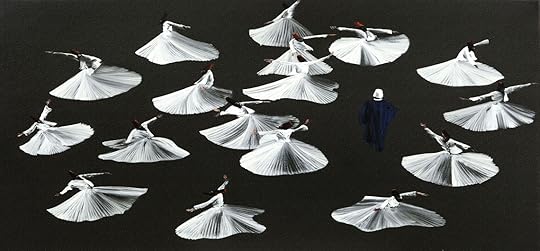
Was religion the point or language? Or was it costume? Nuns in white, in black, full habits, somber hoods, flamboyant winglike bonnets. Beggars folded in cloaks, sitting motionless. Radios played, walkie-talkies barked and hissed. The call to prayer was an amplified chant that I could separate from the other sounds only briefly. Then it was part of the tumult and pulse, the single living voice, as though fallen from the sky.
The alphabet is male and female. If you will know the correct order of letters, you make a world, you make creation. This is why they will hide the order. If you will know the combinations, you make all life and death.




Critic Diane Johnson has written that Mr. DeLillo's books have gone unread because ''they deal with deeply shocking things about America that people would rather not face.''
''I do try to confront realities,'' Mr. DeLillo responds. ''But people would rather read about their own marriages and separations and trips to Tanglewood. There's an entire school of American fiction which might be called around-the-house-and-in-the-yard. And I think people like to read this kind of work because it adds a certain luster, a certain significance to their own lives.''
THE writer to whom Mr. DeLillo has most often been likened and for whom he has great respect is Thomas Pynchon. ''Somebody quoted Norman Mailer as saying that he wasn't a better writer because his contemporaries weren't better,'' he says. ''I don't know whether he really said that or not, but the point I want to make is that no one in Pynchon's generation can make that statement. If we're not as good as we should be it's not because there isn't a standard. And I think Pynchon, more than any other writer, has set the standard. He's raised the stakes.''
Mr. DeLillo also praises William Gaddis for extending the possibilities of the novel by taking huge risks and making great demands on his readers. Yet many readers complain about the abstruseness of much contemporary writing.
''A lot of characters,'' Mr. DeLillo says, ''have become pure act. The whole point in certain kinds of modern writing is that characters simply do what they do. There isn't a great deal of thought or sentiment or literary history tied up in the actions of characters. Randomness is always hard to absorb.''
Mr. DeLillo believes that it is vital that readers make the effort. ''The best reader,'' he says, ''is one who is most open to human possibility, to understanding the great range of plausibility in human actions. It's not true that modern life is too fantastic to be written about successfully. It's that the most successful work is so demanding.'' It is, he adds, as though our better writers ''feel that the novel's vitality requires risks not only by them but by readers as well. Maybe it's not writers alone who keep the novel alive but a more serious kind of reader.''