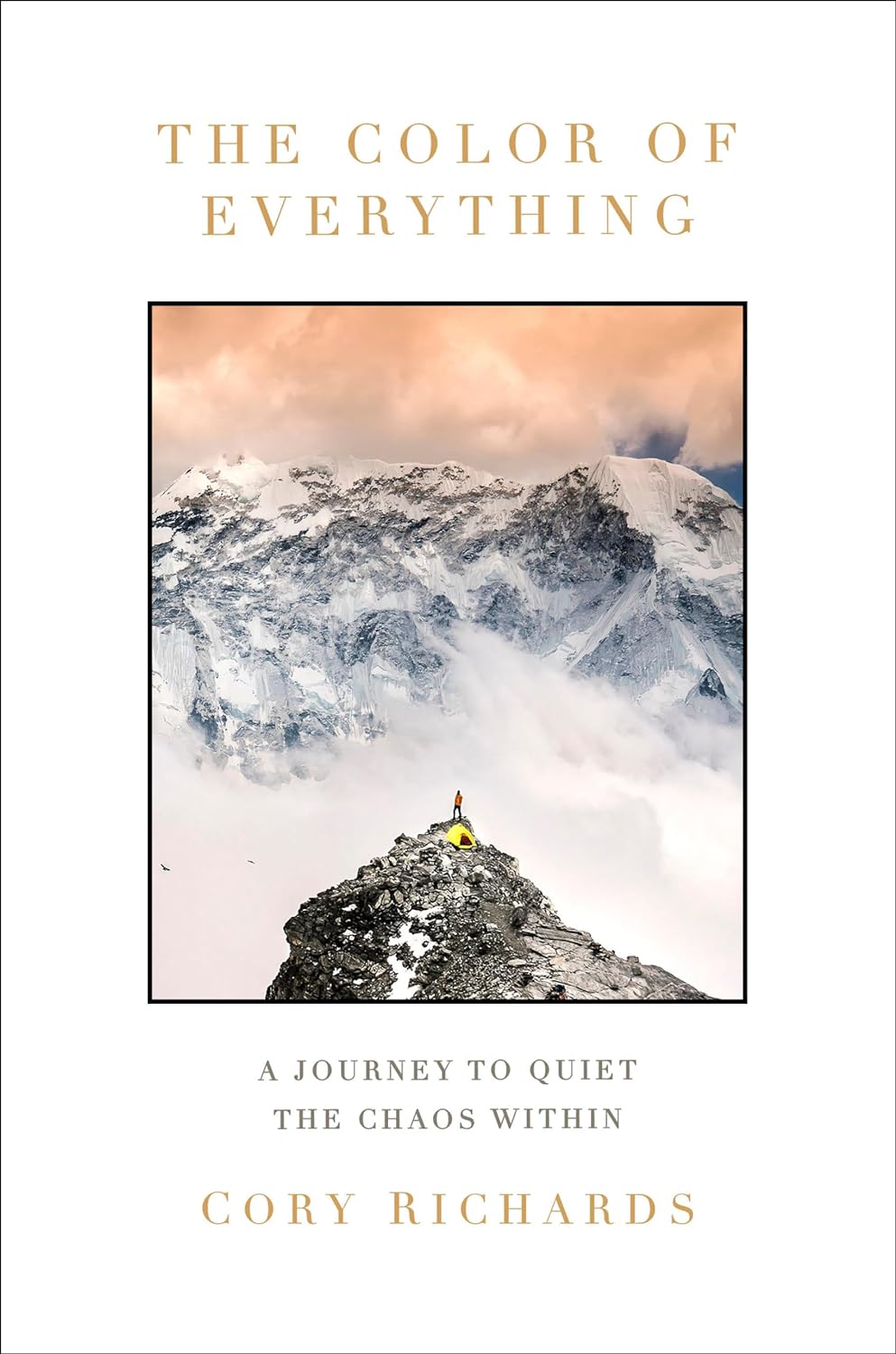
Before picking up The Color of Everything, I had never heard of Cory Richards. In case you haven't either, he's most well known for being a National Geographic photographer specializing in photography of high altitude mountain climbing. In The Color of Everything, Richards details his life. He opens with an intense telling of being buried alive by an avalanche. Then, the book swings back to his childhood, through his adolescence, and eventually to the avalanche and beyond. The book is broken up into three parts, of which I loved the first two. The third felt disorganized to me, which really soured the ending.
What I loved about this book:
-Richards's descriptions of his family, family trauma, and how it impacted his life perspective and behaviors (trigger warning for domestic violence)
-The details of climbing mountains! I love the sense of adventure, awe of nature, and severity of high altitude mountain climbing (did you know that 22% of people who attempt to climb a mountain >8,000 meters die while doing so?!)
-Richards's experiences with mental illness -- and he has a broad spectrum of diagnoses he openly shares about, as well as his treatment attempts
-Richards's general openness with the pain he's lived with, including his being named as a perpetrator during the height of the #MeToo movement
What was harder to get behind:
As I mentioned, the third part of this book felt disorganized, disconnected, not cohesive. The first two parts followed, more or less, a consecutive telling of Richards's life. Even when the history moved back and forth, it was easy to follow and highly readable (although emotionally challenging). The third part felt like Richards had a lot he still wanted to say, on a wide variety of topics, and did a massive brain dump. It didn't all come together well, some of it is his story, some of it is random facts and statistics, and some of it used a different narrator voice (this was really noticeable to me in the story about his girlfriend who was a sex worker). And despite his vast struggles, I felt like Richards's ego shines throughout, and that made him difficult for me to like at times. Lastly, the acknowledgments really bugged me.
Overall, I would recommend this book. It's interesting and powerful. I'm hopeful the final version will have some editing that will improve the third part. Thank you to NetGalley and the publisher for an ARC in exchange for an honest review.
“After all, family dynamics aren’t independent clusters of choice and consequence, but rather a tapestry of intricately woven threads of action and reaction, passing over and under each other, knotting together time, emotion, and experience as one.”
“I don’t yet understand that consent is not singular, but an unfolding string of agreements made throughout any experience. I don’t know that I can say no once I’ve said yes.”
“I know I’m not the most talented, but I’m talented enough. I have a talent for relentlessness to the point of annoyance.”
“But I don’t wonder anymore at the irony of staying sane to do insane things to escape insanity.”
“Only fourteen mountains in the world are higher than 8,000 meters, or 26,246 feet, which is just below the altitude of a commercial airline flight. The average summit-to-death ratio combined across all fourteen peaks is a little over 4 to 1—which means about 22 percent of the people who attempt an 8,000-meter mountain die. Himalayan mountaineering boasts one of the highest mortality rates of any sport.”
“The big difference is that narcissists intentionally set land mines for other people to benefit themselves. It’s calculated behavior and they often know they do it. Bipolar people tend to step on the landmines that fall from their pockets while they’re manically running through a field.”
“There’s a table and lamp with soft orange light and a box of tissues. By now I’ve killed a forest in rooms just like this. Maybe my next sponsor should be Kleenex.”
“…satisfaction doesn’t translate on newsstands. Happiness is a better story. The first thing he explains is that it’s slippery and elusive and I feel vindicated…”
“Happiness is both internal and external. It’s choices as much as hormones as much as environment. It’s how much you walk (lots), how much time you spend with friends and community (four to six hours a day), and what you put in your mouth (mostly plants). It’s security and family and ownership and belonging. It’s purpose, play, place, and people and I’m becoming more and more confused by what happiness actually looks like.”
“Hard as it might be to accept, trying to fix someone is deeply narcissistic behavior. I’d given her all of my power and stolen all of hers because that’s what “saving” a person does. It isn’t respect. It isn’t love. It’s an arrogant extraction of agency. It does not say “I love you.” It says, “You are a broken thing.””