

What do you think?
Judge Dee (Chronological order) #4
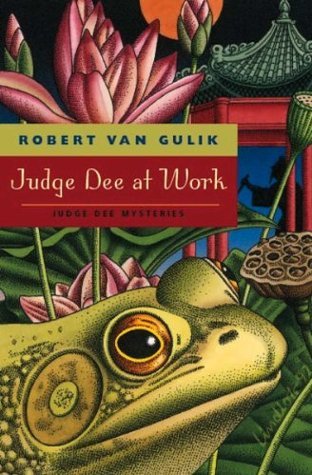
Judge Dee at Work: Eight Chinese Detective Stories
The eight short stories in Judge Dee at Work cover a decade during which the judge served in four different provinces of the T’ang Empire. From the suspected treason of a general in the Chinese army to the murder of a lonely poet in his garden pavilion, the cases here are among the most memorable in the Judge Dee series.
186 pages, Kindle Edition
First published January 1, 1967
About the author
Robert van Gulik
182 books309 followersRobert Hans van Gulik was a Dutch diplomat best known for his Judge Dee stories. His first published book, The Celebrated Cases of Judge Dee, was a translation of an eighteenth-century Chinese murder mystery by an unknown author; he went on to write new mysteries for Judge Dee, a character based on a historical figure from the seventh century. He also wrote academic books, mostly on Chinese history.
Ratings & Reviews
Friends & Following
Create a free account to discover what your friends think of this book!
Community Reviews
Displaying 1 - 30 of 78 reviews

September 20, 2024
A collection of eight Judge Dee stories, a bit melancholic since it is the last, however mesmerizing. 15 novels (16 if you count two joined to form another) and two short stories books, seventeen are too few... Needless to say enjoyed all from Dutch scholar, diplomat and writer Mr. Robert van Gulik who lived in China numerous years and absorbed Chinese culture as much as a westerner could. Let us begin with the judge, based on a historical figure, Dee Jen-djieh A.D. 630- 700. A marvelous magistrate during the glorious T'ang dynasty, well known for solving difficult crimes, films in his native land are still being made today to honor him. A Chinese Sherlock Holmes stating it crudely, in his later career became a powerful, honest man in the royal court of the Empress Wu. Speaking candidly if I may say, not exactly the proper term writing for the internet... while composing this. The atmosphere is captivating, the substantial reason to read it, we metaphorically walk on the enthralling streets of ancient China almost 1,400 years in the past, seeing, smelling, listening, feeling and yes eating their exotic foods as our lungs breathe it in entirely. Woops sorry friends, back to the murders they're generally well done with major suspects in the plots, yet the reader will be fooled a lot, since the strange customs, the police investigations, procedures and harsh punishments are very strange to modern people especially foreigners. The fun is Dee seemingly puzzled and clueless in each case, the wise magistrate thinks, his mind in turmoil and pauses, the loyal assistants wondering if he no longer has the gift, lost the talent. Be assured readers not viable, our judge may take a while to ponder the situations, but calmly, methodically, step by step constantly forward to the inevitable. The killings unlike today, tend not to wallow in the blood and gore, the books interested more in the mystery not the carnage, a welcome relief for lovers of detective novels. But to the connoisseur these stories will have to be read again and again for they have sadly no other option. Finally, my last thoughts, Judge Dee tales are for anyone that wants a different type in the genre, readers who prize substance above everything and a shame the books are not better known now, as they were in the fifties and sixties. I rest my case...

July 10, 2025
Short stories
A fine book of short stories based upon the exploits of real life Chinese detective and magistrate, Judge Dee. The author, Robert van Gulik, was a Dutch diplomat in China and a scholar of Chinese history.
A fine book of short stories based upon the exploits of real life Chinese detective and magistrate, Judge Dee. The author, Robert van Gulik, was a Dutch diplomat in China and a scholar of Chinese history.

April 2, 2022
Quite nice set of eight very different type stories from Van Gulik. Making use of the short story format meant that these tales about Judge Dee had to forego Van Gulik's usual intricate plotting and detailed layout he employed in the Judge Dee novels. Instead, the stories are richly filled with atmosphere and sense of place, which, in the novels I've read so far, often take a backseat to the procedures of Dee's case work. Not only that, but the places in which the stories take place differ, as they are spread out over provinces and towns Dee moves to over the course of his career. Perhaps the most interesting aspect, however, is how Van Gulik presents Dee's growing frailty and vulnerability over time.

May 2, 2025
Дэтэктыўныя гісторыі. Атмасфера Кітая 7 стагоддзя н.э. Агульнае гуманістычнае накіраванне.

November 8, 2008
Back in the day, before the infomercial conquered late night TV, independent stations (yes, such creatures existed before the 1996 Telecom Act) aired movies, some good, most bad, and sometimes I would stay up all night watching them. It was on one of these marathons that I first saw Judge Dee and the Monastery Murders (based on van Gulik's The Haunted Monastery) with Khigh Dhiegh (Wo Fat, the crimelord from "Hawaii 5-O", and the diabolical psychiatrist who hypnotizes Laurence Harvey and Frank Sinatra in The Manchurian Candidate, among other roles) as the eponymous character. I was already something of a sinophile, and so enjoyed the story of a Tang-era judge who solved mysteries (for a made-for-TV movie, it was fairly well done).
Imagine my joy when I learned 20 years later that that sole movie was based on a series of short stories and novels by a Dutch diplomat named Robert van Gulik, who left this world the very year I entered it. I know I've read some of the stories but it's been 15+ years since and I can't remember exactly which ones and am rereading the series as opportunity permits.
Judge Dee is based on the real Tang magistrate Dee Jen-djieh, who lived from AD 630-700, and really is remembered as a model Confucian minister and paragon of justice. Though the crimes Judge Dee solves under Gulik's hand are fictional, he bases many of them on actual criminal cases from the period.
Van Gulik is not a great writer but he is good enough to write entertaining yarns with interesting characters and intriguing mysteries. (Though, frustratingly, readers must often wait till Judge Dee explains things to figure out the crime; there are not enough clues for them to more than guess at who may have transgressed the law.)
In this particular collection, the two best stories IMO are "The Wrong Sword" and "Murder on New Year's Eve." Both involve what are, on the surface, cut-and-dried cases of murder that take some devious twists before Dee manages to smoke out the real culprits.
Imagine my joy when I learned 20 years later that that sole movie was based on a series of short stories and novels by a Dutch diplomat named Robert van Gulik, who left this world the very year I entered it. I know I've read some of the stories but it's been 15+ years since and I can't remember exactly which ones and am rereading the series as opportunity permits.
Judge Dee is based on the real Tang magistrate Dee Jen-djieh, who lived from AD 630-700, and really is remembered as a model Confucian minister and paragon of justice. Though the crimes Judge Dee solves under Gulik's hand are fictional, he bases many of them on actual criminal cases from the period.
Van Gulik is not a great writer but he is good enough to write entertaining yarns with interesting characters and intriguing mysteries. (Though, frustratingly, readers must often wait till Judge Dee explains things to figure out the crime; there are not enough clues for them to more than guess at who may have transgressed the law.)
In this particular collection, the two best stories IMO are "The Wrong Sword" and "Murder on New Year's Eve." Both involve what are, on the surface, cut-and-dried cases of murder that take some devious twists before Dee manages to smoke out the real culprits.

November 20, 2017
Yes, they're a bit old-fashioned, and yes, you could write a great thesis on the biases in van Gulik's world view, but the truth is that his Judge Dee mysteries were an introduction to Chinese historical culture and popular literature for many Westerners, in their day. Yes, you can comment about how his illustrations always manage to bring in a topless, or totally nude, female -- once or twice per volume; which wasn't uncommon in the sixteenth century books from which these stories derive. Nonetheless, I have always found them amusing and entertaining. They are also worth studying, for a writer, as they manage to impart the flavor of a foreign culture without endless explanation or opaque references.
This volume (and I'm sad to admit I've only got one to read after this) consists of eight short stories, from different periods in Dee's career. Van Gulik took some of the details and cases from Chinese crime literature, but fashioned the tales to include Dee. About half involve his team of assistants (Ma Joong, Chaio Tai, Sergeant Hoong) as investigators, but unlike the novels, several have Dee solving the mystery on his own. Several involve interactions with rival magistrates or military officials. A Colonel Meng (whom I don't remember from the novels) appears in a couple of these.
One of the interesting issues of the legal system under which Dee operates is that he has to get a confession out of the criminal, especially in a capital case. Yep, that complicates matters.
This volume (and I'm sad to admit I've only got one to read after this) consists of eight short stories, from different periods in Dee's career. Van Gulik took some of the details and cases from Chinese crime literature, but fashioned the tales to include Dee. About half involve his team of assistants (Ma Joong, Chaio Tai, Sergeant Hoong) as investigators, but unlike the novels, several have Dee solving the mystery on his own. Several involve interactions with rival magistrates or military officials. A Colonel Meng (whom I don't remember from the novels) appears in a couple of these.
One of the interesting issues of the legal system under which Dee operates is that he has to get a confession out of the criminal, especially in a capital case. Yep, that complicates matters.

December 11, 2024
Я люблю дэтэктывы) І мне спадабаліся гэтыя кароткія гісторыі. Зручнасць у тым, што можна чытаць адну ў дзень-два. Прачытала 20 старонак і можна зрабіць перапынак на абдумванне, і не непакоіцца, што забываеш сюжэт, як бывае з доўгімі творамі.
Троху шкада, што ўсе гісторыі пра забойствы, неяк сумна. Справы выдуманыя, так што можна было б выдумаць і пра крадзеж ці, там, пра знікненне чалавека.)
Крыху засмуціў пераклад. Напрыклад, напісана "ідзём" замест "хадзем" ці хаця б "ідзЕм". У астатнім чытаць лёгка і прыемна.
Троху шкада, што ўсе гісторыі пра забойствы, неяк сумна. Справы выдуманыя, так што можна было б выдумаць і пра крадзеж ці, там, пра знікненне чалавека.)
Крыху засмуціў пераклад. Напрыклад, напісана "ідзём" замест "хадзем" ці хаця б "ідзЕм". У астатнім чытаць лёгка і прыемна.

June 30, 2021
Люблю дэтэктыўныя гісторыі, пра суддзю Дзі даўно чула, але вось пачытала толькі на беларускай. Прыемныя расказы, больш за ўсё цікавыя незвычайным гістарчным сэццінгам.

November 24, 2020
Aštuoni trumpi pasakojimai apie teisėją Di ir jo narpliojamas bylas. Ir iš to trumpumo – pralošia. Nes išsiplėtot neišsiplėtoja, tai gaunasi kažkaip paskubom ir naiviai. Ne, tegul van Gulikas rašo didesnės apimties detektyvus.
Kol kas – silpniausia ciklo knyga. Tai daug ir nesiplėtosiu – galima buvo net ir neskaityt. Du iš penkių.
Kol kas – silpniausia ciklo knyga. Tai daug ir nesiplėtosiu – galima buvo net ir neskaityt. Du iš penkių.

November 2, 2016
μου είχαν λείψει οι περιπέτειες του Δικαστή Τί, δεν ειναι απ τα καλύτερα βιβλία του van Gulik, το συγκεκριμένο λειτουργεί συμπληρωματικά στα προηγούμενα του, σε κάνει να θέλεις να τα ξαναδιαβάσεις όλα απ την αρχή και με την σωστή χρονολογική σειρά της ζωής του διάσημου Δικαστή Τί!

April 23, 2010
This is an enjoyable book, but I wouldn't recommend it as an introduction to van Gulik's Judge Dee mysteries. Van Gulik was raised in East Asia from early childhood and tutored in Mandarin from an early age. He served throughout Asia in the Dutch Diplomatic service and married a Chinese woman, so few people would be so ideally positioned to write works based on Chinese culture for Western audiences. As Van Gulik explains in his afterwards, Judge Dee is a real historical person who lived from A.D. 630 to 700 and contemporary "Chinese still consider him their master-detective, and his name is as popular with them as that of Sherlock Holmes is with us." I first read the Judge Dee mysteries when a friend loaned me her Dee novels, so the only book in the series I bought and own is this one, an anthology of short stories very much akin to Arthur Conan Doyle's Adventures of Sherlock Holmes stories in flavor. Purely as mysteries I don't think these match the Sherlock Holmes stories such as "The Speckled Band," nor is the character of Dee quite so strong as Holmes, and Van Gulik's style is rather creaky. One reviewer called the language "stilted" and I rather agree. But the draw here is more the depiction of Chinese culture and history during the Tang Dynasty and on those terms I find the novels offer something unique and are well worth seeking out, and even though I don't think Van Gulik is strongest in this short form, these stories do display something of the appeal of those novels. The eight short stories are fine little puzzle pieces that turn on such things as an incense clock, a pawn ticket or croaking frogs in a lotus pond and takes you through all levels of Chinese society from great generals and rich merchants to prostitutes, beggars and street performers. If you're at all curious about things Chinese, you might find these just your cup of (green) tea. Although I'd start with the first book chronologically if you can find it, The Chinese Gold Murders.

May 2, 2025
Мне сапраўды вельмі спадабалася. Немудрагелістыя сюжэты, расследаванне злачынстваў у Кітаі 7-га стагоддзя. Напісана з увагай да гістарычных асаблівасцей і краіны таленавітым кітаістам. Мноства невялікіх апавяданняў, якія лёгка чытаюцца і ўсё роўна не пакідаюць абыякавым. Была б радая і другой частцы (калі аўтар вырашыць яе аднойчы напісаць), захацелася зараз і серыял паглядзець (з кнігай не звязаны, проста пра таго ж персанажа) - паколькі суддзя Дзі, гэта "кітайскі Шэрлак Холмс"
Увогуле, вялізная падабайка і асобны вялікі дзякуй за пераклад на родную мову ❤️
Увогуле, вялізная падабайка і асобны вялікі дзякуй за пераклад на родную мову ❤️

July 15, 2021
Generally I prefer novels to short stories, but it was really nice to delve into Dee's world again, with its intriguing customs, characters and, of course, mysteries. While the shorter form of the stories doesn't let the story truly develop which results in Dee making truly astounding leaps of logic, the stories themselves were both interesting and at times funny and reading them was a pleasure.

December 1, 2018
Vahelduseks siis kohtunik Dee jutukogu. Kui romaanides lahendab ta kolm eraldi mõistatust - mida serveeritakse lugejale tavaliselt kui üht suurt ja ülimalt keerulist juhtumit - siis siin lahendab ta kaheksas jutus kaheksa juhtumit. Kõik on mõnusad, viimane lugu erineb teistest ja kogu kohtunik Dee üldisest foonist sellega et vana hea Dee paneb ikka põhjalikult bambusesse ja näeb seal mõrva kus mõrva pole. Ei, lahe oli. Kogu Dee sari on hea, ma nende viimasteni kus kvaliteet juba väidetavalt kõigub alles jõuan.

May 13, 2021
At first take all seems a bit theatrical (did they really do autopsies in Ancient China? Did they keep dictionaries? Surely not scrolls?). In any case - a canvas to hang on little defective stories. Replace the proper nouns and you get the Napoleonic France if you wish. Yet Judge Dee comes along nicely and knowing people say this volume is not ideal to start. So, I'll give him another chance.

Want to Read
April 25, 2023An account of a real Chinese judge (private detective, cop,, and jury) is taken from ancient texts and made into an enjoyably informative and interesting plot. Chinese judges performed AlLl this positions while sitting, also, as judge. Narrator(s) did an excellent job (2 had a cameo role while the 1 performed throughout.). A worthwhile read for mystery fans or history buffs.

June 16, 2021
8 short stories which overlap with some of the Judge Dee novels.

July 10, 2021
A collection of short stories od Judge Dee. Really makes you wonder how he comes up with some solutions. Anyway, fast to read and entertaining.

February 26, 2026
Richter Di ist eine historische Persönlichkeit, die im 7. Jahrhundert in China lebte. Er löste damals eine Vielzahl von Kriminalfällen, über die es schriftliche Nachweise gibt. Robert van Gulik lebte selbst viele Jahre in China und hat die Originalfälle übersetzt und zusammengestellt. Daneben hat er auch eine Vielzahl eigene Romane mit Richter Di erdacht, die jedoch jeweils ebenfalls einen realen historischen Ursprung haben. Neben den Romanen gibt es auch diese Zusammenstellung von Kurzgeschichten. Ich persönlich mag bei Krimis kurze Geschichten eher weniger. In meinen Augen kann sich die Handlung zu wenig entfalten, die Charaktere durchlaufen keine Entwicklung und die Lösung ist häufig offensichtlich. Ähnlich erging es mir auch hier. Die Geschichten sind gut konstruiert, sobald man den Tatort und die Verdächtigen erblickt hat, ist es auch schon wieder vorbei.
Sehr interessant fand ich allerdings die historischen Hintergründe, z.B. wie stark ausgebaut der Verwaltungsapparat war, wieviel Bürokratie es gab. Auch die Tatsache, dass Richter Di bis zu vier Frauen haben durfte und Kurtisanen sehr üblich waren, fand ich sehr spannend.
Jeder Erzählung ist mit einer Zeichnung Robert Van Guliks illustriert und da scheint der Autor barbusige Frauen besonders zu mögen.
Ich würde jetzt gerne noch einen Roman mit Richter Di lesen, um ihm etwas ausführlicher bei seinen Ermittlungen beiwohnen zu dürfen.
Sehr interessant fand ich allerdings die historischen Hintergründe, z.B. wie stark ausgebaut der Verwaltungsapparat war, wieviel Bürokratie es gab. Auch die Tatsache, dass Richter Di bis zu vier Frauen haben durfte und Kurtisanen sehr üblich waren, fand ich sehr spannend.
Jeder Erzählung ist mit einer Zeichnung Robert Van Guliks illustriert und da scheint der Autor barbusige Frauen besonders zu mögen.
Ich würde jetzt gerne noch einen Roman mit Richter Di lesen, um ihm etwas ausführlicher bei seinen Ermittlungen beiwohnen zu dürfen.

September 2, 2026
Cute, short detective stories that immediately transport you to old China.
Exactly what I wanted for some summer, beachside reading. 🏖️📖
Exactly what I wanted for some summer, beachside reading. 🏖️📖

November 12, 2012
I enjoyed "meeting" Judge Dee years ago in a collection of "historical sleuth" stories and enjoyed meeting up with him again in van Gulik's collection of short stories.
What I most appreciate about the author is how he takes a figure of antiquity and shares the society of that time (without apology, though many aspects of 7th C. China might not "suit" contemporary readers) and makes it accessible.
Oddly enough, I am not always a mystery fan. Historical mysteries? Just the ticket.
If you like historical mysteries, I recommend finding and reading Judge Dee. He's smart, has a good heart, and very human.
What I most appreciate about the author is how he takes a figure of antiquity and shares the society of that time (without apology, though many aspects of 7th C. China might not "suit" contemporary readers) and makes it accessible.
Oddly enough, I am not always a mystery fan. Historical mysteries? Just the ticket.
If you like historical mysteries, I recommend finding and reading Judge Dee. He's smart, has a good heart, and very human.

September 22, 2011
I think I prefer short stories when it comes to mysteries: they are concise and to the point. And despite their briefness, every one of them tells us something about the main character. In this, Robert Van Gulik's stories are very similar to Arthur Conan Doyle's. For example, in "He Came with the Rain", we find out how Dee married his third wife. In "The Red Tape Murders", we see what a pedant Dee is and how little patience he has with disorderly, stupid people. In "Murder on New Year's Eve", it's shown that even Dee can jump to conclusions. A lovely collection.

December 18, 2016
3,5 / 5

December 25, 2016
Ωραίες μικρές ιστοριούλες που λαμβάνουν χώρα σε διάφορες εποχές, κατά την διάρκεια της θητείας του δικαστή Τι σε διάφορα μέρη. Πολύ ευχάριστο ανάγνωσμα!

October 11, 2020
公允地说,高公原文大致该在四颗星,但非常佩服译者严谨的翻译及考据工作,一定要五星支持。针对《猴与虎》一文开头天干地支说反的情况,与译者张凌老师做了交流,确定是原文如此。
从注释和后记中得知高公的《狄公案》很多案件灵感来自中国古代笔记,实在让我大涨见识。
从注释和后记中得知高公的《狄公案》很多案件灵感来自中国古代笔记,实在让我大涨见识。

August 15, 2021
Robert van Gulik wrote 14 original novels, 2 novellas and 8 short stories about the Chinese Tang-dynasty crime solving magistrate Judge Dee. The eight short stories have been collected in Judge Dee At Work, which was published in English in 1967. The stories are set at different times in the fictional career of Judge Dee and are quite nice, but not as good as the novels (which in fact are usually combinations of 3 separate stories to demonstrate the reality of work as a busy magistrate where no case comes by on its own). The novels have more atmosphere thanks to their greater length.
The stories are:
- "Five Auspicious Clouds." Set in the summer of 663 when Judge Dee was magistrate of Penglai. When Judge Dee is finishing a project to control the naval industry, with the help of two shipowners, he is warned of the suicide of the wife of one of them. He quickly realizes that it is a case of murder rather than suicide thanks to an unexpected witness: an incense clock. Incense clocks were used in China since the 6th c. and were in fact specialized censers, that worked through burning lines of powdered incense. While religious purposes were of primary importance, these clocks were also popular at social gatherings, and were used by Chinese scholars and intellectuals. One or more grooves were etched (often in intricate patterns, such as here auspicious clouds) in a plate of stone or metal, and the time could roughly be read from how far the powder trail of incense had been burned along the pattern.
- "The Red Tape Murder." Set in the summer of 663 when Judge Dee was magistrate of Penglai. As an official of the Dutch Ministry of Foreign Affairs, Van Gulik was a bureaucrat and to keep good files and dossiers without any documents lacking is a concern he shared with his protagonist, Judge Dee. A missing document in a dossier brings Judge Dee to the huge military fort at the estuary near Penglai, where he assists - although this fort is outside his jurisdiction - to solve the murder of Colonel Su, the second in command of the fort. He demonstrates that careful attention to bureaucratic detail, even when it seems superfluous and just "hair splitting," can be very useful...
- "He Came with the Rain." Set in mid-summer of 663 when Judge Dee was magistrate of Penglai. The final story set in Penglai, in the marshes that lie between the town and the coast. It is a hot and humid day when after six months on his post, Judge Dee is finally joined by his wives and children. That day he also solves a crime whose only witness is deaf and mute...
- "The Murder on the Lotus Pond" - set in the year 666 when Judge Dee was magistrate of (fictional) Hanyuan, a mountain town with a lake resort. Van Gulik uses a motif (the trick with the beggars) from the Tangyin bishi, "Model cases from under the pear tree," a collection of 144 exemplary lawsuits complied around the year 1200 in Song dynasty China. Why was retired poet Meng Lan murdered? His body was found in a small pavilion, on the edge of a lotus pond, where he used to enjoy moon-viewing. The murder weapon: a knife with an ivory handle. The clues: an empty wine pitcher and a wine cup. It seems at first glance there were no witnesses...
- "The Two Beggars" - set on the 15th day of the 1st month 670, the Feast of Lanterns, when Judge Dee was magistrate of Poo-yang.
As Judge Dee finishes his day and prepares to feast with his family, he thinks he sees the specter of an old man pass in front of him. It is at this moment that Sergeant Hoong, his faithful advisor, comes to warn him that the body of a beggar has been transported to the morgue. According to him, it is an accident, the coroner having so concluded. Intrigued by the apparition, Judge Dee decides to inspect the corpse. And some details don't add up. What is the relationship between the deceased beggar and the disappearance of an old tutor in love with orchids? Through this affair Judge Dee will be late for his family dinner ...
- "The Wrong Sword" - set in the autumn of 669 when Judge Dee was magistrate of Poo-yang.
Judge Dee is traveling to the neighboring district, and Ma Joong and Tsiao Tai, the magistrate's two lieutenants, have been left back in Poo-yang. From a restaurant, they watch the performance of a traveling theater troupe. In one scene, the killing of a young boy with a sword is simulated, but when he really falls dead, it is clear the fake sword has been exchanged with a real one...
- "The Coffins of the Emperor" - set in the early winter of 672 when Judge Dee was magistrate of Lanfang. Judge Dee is visiting a colleague whose district is close to the border. There is a war with the Tatars going on and the atmosphere around dinner is gloomy. It was then that the Marshal asks the judge to solve a riddle: weapons could be hidden in the coffin of the late crown prince. How to verify it knowing that the tomb is sacred and that one cannot touch it?
- "Murder on New Year's Eve" - set in the winter (the eve of the Chinese New Year) in early 674 when Judge Dee was magistrate of Lanfang. A boy has found blood in their room and thinks that a quarrel between his parents has led to murder. Judge Dee investigates and happily, reality is different...
The stories are:
- "Five Auspicious Clouds." Set in the summer of 663 when Judge Dee was magistrate of Penglai. When Judge Dee is finishing a project to control the naval industry, with the help of two shipowners, he is warned of the suicide of the wife of one of them. He quickly realizes that it is a case of murder rather than suicide thanks to an unexpected witness: an incense clock. Incense clocks were used in China since the 6th c. and were in fact specialized censers, that worked through burning lines of powdered incense. While religious purposes were of primary importance, these clocks were also popular at social gatherings, and were used by Chinese scholars and intellectuals. One or more grooves were etched (often in intricate patterns, such as here auspicious clouds) in a plate of stone or metal, and the time could roughly be read from how far the powder trail of incense had been burned along the pattern.
- "The Red Tape Murder." Set in the summer of 663 when Judge Dee was magistrate of Penglai. As an official of the Dutch Ministry of Foreign Affairs, Van Gulik was a bureaucrat and to keep good files and dossiers without any documents lacking is a concern he shared with his protagonist, Judge Dee. A missing document in a dossier brings Judge Dee to the huge military fort at the estuary near Penglai, where he assists - although this fort is outside his jurisdiction - to solve the murder of Colonel Su, the second in command of the fort. He demonstrates that careful attention to bureaucratic detail, even when it seems superfluous and just "hair splitting," can be very useful...
- "He Came with the Rain." Set in mid-summer of 663 when Judge Dee was magistrate of Penglai. The final story set in Penglai, in the marshes that lie between the town and the coast. It is a hot and humid day when after six months on his post, Judge Dee is finally joined by his wives and children. That day he also solves a crime whose only witness is deaf and mute...
- "The Murder on the Lotus Pond" - set in the year 666 when Judge Dee was magistrate of (fictional) Hanyuan, a mountain town with a lake resort. Van Gulik uses a motif (the trick with the beggars) from the Tangyin bishi, "Model cases from under the pear tree," a collection of 144 exemplary lawsuits complied around the year 1200 in Song dynasty China. Why was retired poet Meng Lan murdered? His body was found in a small pavilion, on the edge of a lotus pond, where he used to enjoy moon-viewing. The murder weapon: a knife with an ivory handle. The clues: an empty wine pitcher and a wine cup. It seems at first glance there were no witnesses...
- "The Two Beggars" - set on the 15th day of the 1st month 670, the Feast of Lanterns, when Judge Dee was magistrate of Poo-yang.
As Judge Dee finishes his day and prepares to feast with his family, he thinks he sees the specter of an old man pass in front of him. It is at this moment that Sergeant Hoong, his faithful advisor, comes to warn him that the body of a beggar has been transported to the morgue. According to him, it is an accident, the coroner having so concluded. Intrigued by the apparition, Judge Dee decides to inspect the corpse. And some details don't add up. What is the relationship between the deceased beggar and the disappearance of an old tutor in love with orchids? Through this affair Judge Dee will be late for his family dinner ...
- "The Wrong Sword" - set in the autumn of 669 when Judge Dee was magistrate of Poo-yang.
Judge Dee is traveling to the neighboring district, and Ma Joong and Tsiao Tai, the magistrate's two lieutenants, have been left back in Poo-yang. From a restaurant, they watch the performance of a traveling theater troupe. In one scene, the killing of a young boy with a sword is simulated, but when he really falls dead, it is clear the fake sword has been exchanged with a real one...
- "The Coffins of the Emperor" - set in the early winter of 672 when Judge Dee was magistrate of Lanfang. Judge Dee is visiting a colleague whose district is close to the border. There is a war with the Tatars going on and the atmosphere around dinner is gloomy. It was then that the Marshal asks the judge to solve a riddle: weapons could be hidden in the coffin of the late crown prince. How to verify it knowing that the tomb is sacred and that one cannot touch it?
- "Murder on New Year's Eve" - set in the winter (the eve of the Chinese New Year) in early 674 when Judge Dee was magistrate of Lanfang. A boy has found blood in their room and thinks that a quarrel between his parents has led to murder. Judge Dee investigates and happily, reality is different...

February 16, 2024
A superlative collection of short stories by Orientalist Van Gulik, whose Chinese detective fiction was based on a real historical personage and certain elements from China’s literature and jurisprudence. Van Gulik sought to introduce Western readers to Chinese detective literature by way of the Judge Dee books, the first of which was translated from an actual 18th century text while the others are mostly Van Gulik’s invention.
Judge Dee at Work, set like the other books in the 7th century AD, is arranged in the manner of other Golden Age anthologies. Even the title evokes Poirot Investigates, Lord Peter Views the Body, etcetera. One of the charms of Van Gulik’s work is that he gives you a grounding in medieval Chinese folklore, society, and jurisprudence alongside finely wrought detective plots.
Of the eight stories here, my favourite is “He Came with the Rain”, for its charming and fascinating relation of legends that clung to riverside communities about water spirits and other creatures. Ancient superstitions and ways of being come up against Dee a few times in this collection, such as when he is forced to deal with societal practices of which he does not approve. These include prostitution, brothels to which are sold “courtesans”, attractive young women who are trained in subjects like music and dance for the entertainment of men who may purchase them as wives, while in the meantime they must serve their brothel’s patrons.
Van Gulik deals with the harshness of Chinese society at this time with an honest but sensitive touch. In “The Coffins of the Emperor” we meet a strong and kindly young mother, one of whose breasts has been disfigured by corporal punishment, when she dared to try to consult with her husband in military prison and so lied about her work as a “whore”; sex workers are not permitted on garrisons on pain of whipping. This is another excellent story, bringing in the Empire’s fight against invading Tartars, and expertly interweaving the tale of the sex worker’s wrongly convicted husband with another concerning potential high treason.
None of the stories are bad. Each comes with italicised introductions explaining their place in the larger Judge Dee canon. (The book ends with a colophon and chronology further surveying his dates and career.) Other highlights, though, include “The Two Beggars”, with its ghostly apparition, clever explanation for such, and moving portrait of tragic sexual obsession. Moreover, the stories are expertly arranged, beginning with a more intellectually oriented Sherlock Holmes-esque mystery, moving through denser fare, and ending on a sweet little story with a happy ending, “Murder on New Year’s Eve”, where a misunderstanding that almost leads to tragedy is averted.
Line drawings of scenes and objects from the stories are littered throughout. This is, all in all, a gorgeously tailored little book of mysteries.
Judge Dee at Work, set like the other books in the 7th century AD, is arranged in the manner of other Golden Age anthologies. Even the title evokes Poirot Investigates, Lord Peter Views the Body, etcetera. One of the charms of Van Gulik’s work is that he gives you a grounding in medieval Chinese folklore, society, and jurisprudence alongside finely wrought detective plots.
Of the eight stories here, my favourite is “He Came with the Rain”, for its charming and fascinating relation of legends that clung to riverside communities about water spirits and other creatures. Ancient superstitions and ways of being come up against Dee a few times in this collection, such as when he is forced to deal with societal practices of which he does not approve. These include prostitution, brothels to which are sold “courtesans”, attractive young women who are trained in subjects like music and dance for the entertainment of men who may purchase them as wives, while in the meantime they must serve their brothel’s patrons.
Van Gulik deals with the harshness of Chinese society at this time with an honest but sensitive touch. In “The Coffins of the Emperor” we meet a strong and kindly young mother, one of whose breasts has been disfigured by corporal punishment, when she dared to try to consult with her husband in military prison and so lied about her work as a “whore”; sex workers are not permitted on garrisons on pain of whipping. This is another excellent story, bringing in the Empire’s fight against invading Tartars, and expertly interweaving the tale of the sex worker’s wrongly convicted husband with another concerning potential high treason.
None of the stories are bad. Each comes with italicised introductions explaining their place in the larger Judge Dee canon. (The book ends with a colophon and chronology further surveying his dates and career.) Other highlights, though, include “The Two Beggars”, with its ghostly apparition, clever explanation for such, and moving portrait of tragic sexual obsession. Moreover, the stories are expertly arranged, beginning with a more intellectually oriented Sherlock Holmes-esque mystery, moving through denser fare, and ending on a sweet little story with a happy ending, “Murder on New Year’s Eve”, where a misunderstanding that almost leads to tragedy is averted.
Line drawings of scenes and objects from the stories are littered throughout. This is, all in all, a gorgeously tailored little book of mysteries.
February 4, 2022
This is a collection of 8 short stories all of which feature Judge Dee and cover almost the entirety of his career before being promoted to the Metropolitan Court. In these short stores Judge or Magistrate Dee once again shows his understanding for and of those whom he serves, the common people be they lowly fisher foik or peasants or the merchant class or the, in their eyes at least, more important literati class.
Written by a Dutch diplomat of whom it has been written that he was born in the wrong century and on the wrong continent, being at heart a 14thC Chinese literati himself. A fabulous series, one that I can proudly claim to not only own all the books in paper form but also a growing number in e-book form, and most of all a series that I can state that, having read my first book in this series when I was around 9 years old (bored and I found one of my father's library books, borrowed it, read it and have been a confirmed and devoted fan for the past 50 years now. This was one of the last books in the series I was given (probably the best present my husband has ever given me was the entire Judge Dee series) and it is also a great way to pass that time waiting for the dentist or the doctor as the stories are the perfect length.
Highly recommended and an excellent way to discover this remarkable character who actually did live 1300 years ago and as a Judge, ending his career in one of the highest positions in the land and also achieving the remarkable accomplishment for a politician of his rank of dying from old age at a time when the Empress Wu had a habit of helping those who opposed her to disappear. Permanently.
Written by a Dutch diplomat of whom it has been written that he was born in the wrong century and on the wrong continent, being at heart a 14thC Chinese literati himself. A fabulous series, one that I can proudly claim to not only own all the books in paper form but also a growing number in e-book form, and most of all a series that I can state that, having read my first book in this series when I was around 9 years old (bored and I found one of my father's library books, borrowed it, read it and have been a confirmed and devoted fan for the past 50 years now. This was one of the last books in the series I was given (probably the best present my husband has ever given me was the entire Judge Dee series) and it is also a great way to pass that time waiting for the dentist or the doctor as the stories are the perfect length.
Highly recommended and an excellent way to discover this remarkable character who actually did live 1300 years ago and as a Judge, ending his career in one of the highest positions in the land and also achieving the remarkable accomplishment for a politician of his rank of dying from old age at a time when the Empress Wu had a habit of helping those who opposed her to disappear. Permanently.

February 17, 2024
This is a collection of short stories, each one a quick mystery solved by Judge Dee. Most of the Judge Dee books are regular novels, and very engaging, but I enjoyed this collection at least as much as those.
Sometimes you just want a 20-page short story to read, you know?
I like that the MC is very insightful and a little bit of a jerk. He's good at what he does, but he's kinda short with others, and he doesn't mind giving a whole bunch of people their worst day ever while finding the truth. He's no saint. Nor is he infallible. As a result, he feels pretty round, like a regular person who happens to also have a particular set of skills, so when he cuts through the nonsense and solves a tough crime, it doesn't give you any Mary Sue vibes.
Crusty old Judge Dee catches the bad guys and helps the downtrodden, the wrongly accused, and the kinda lost get a second chance, sometimes, (though it might come with a bit of a sermon--LOL) which is all you want from a collection like this. And just a touch of the risqué, actually, though it's not terribly shocking stuff. It is 60+ years old, after all.
Good fun. Recommended for mystery readers.
Sometimes you just want a 20-page short story to read, you know?
I like that the MC is very insightful and a little bit of a jerk. He's good at what he does, but he's kinda short with others, and he doesn't mind giving a whole bunch of people their worst day ever while finding the truth. He's no saint. Nor is he infallible. As a result, he feels pretty round, like a regular person who happens to also have a particular set of skills, so when he cuts through the nonsense and solves a tough crime, it doesn't give you any Mary Sue vibes.
Crusty old Judge Dee catches the bad guys and helps the downtrodden, the wrongly accused, and the kinda lost get a second chance, sometimes, (though it might come with a bit of a sermon--LOL) which is all you want from a collection like this. And just a touch of the risqué, actually, though it's not terribly shocking stuff. It is 60+ years old, after all.
Good fun. Recommended for mystery readers.

April 6, 2024
Enjoyable collection of short stories about 7th Century Chinese magistrate Judge Dee. The stories are highly focused, with usually a single crime at its center. In a sense, they are almost like one component of the much more complex stories Robert van Gulik presents in his novels. The stories are placed in different settings and different phases of Dee's career: a military outpost; a theater group; the dwellings of the rich; and the dwellings of the poor. They all show Judge Dee's genius for noticing small details and ferreting out the clues that lead to the solution. The judge's coterie of assistants (Sergeant Hoong, Ma Joong, and Chiao Tai) participate in some of the stories.
Van Gulik also shows the darker sides of China in the 7th Century, with widespread sexual exploitation of women, use of judicial torture, and war-fueled prejudice against Koreans.
"Five Auspicious Clouds" (4 stars)
"The Red Tape Murder" (4-5 stars)
"He Came With the Rain" (3 stars)
"The Murder on the Lotus Pond" (3 ½ stars)
"The Two Beggars" (4 stars)
"The Wrong Sword" (4 stars)
"The Coffins of the Emperor" (3 stars)
"Murder on New Year's Eve" (4 stars)
Van Gulik also shows the darker sides of China in the 7th Century, with widespread sexual exploitation of women, use of judicial torture, and war-fueled prejudice against Koreans.
"Five Auspicious Clouds" (4 stars)
"The Red Tape Murder" (4-5 stars)
"He Came With the Rain" (3 stars)
"The Murder on the Lotus Pond" (3 ½ stars)
"The Two Beggars" (4 stars)
"The Wrong Sword" (4 stars)
"The Coffins of the Emperor" (3 stars)
"Murder on New Year's Eve" (4 stars)
Displaying 1 - 30 of 78 reviews