The secrets of a state often remain secret – locked away in a dusty file somewhere, until the file itself crumbles into dust. But Procopius of Caesarea evidently had no intention of allowing what he considered the key state secrets of the Eastern Roman Empire to vanish thus. While writing official histories that glorified the achievements of the Byzantine Empire and its 6th-century emperor Justinian, Procopius was privately working on an unofficial history, a sort of minority report; and the Ἀπόκρυφη Ἱστορία, under its customary modern title of The Secret History, is one of the most challenging and ambiguous works of its time.
Procopius, whose classical education seems to have prepared him for a career in the law, became an advisor to Justinian’s top general, Belisarius, and accompanied Belisarius on a wide-ranging set of military campaigns through which Justinian hoped to recover the lands that had been lost to Rome when the Western Roman Empire fell in 476 A.D.
As a sort of aide-de-camp to Belisarius, Procopius became highly placed in the Byzantine court at Constantinople; and eventually, he was trusted with the tasks of writing the eight-volume History of the Wars of Byzantium, as well as a book called The Buildings that praised Justinian’s public-works projects like the Hagia Sophia cathedral, then the largest church in Christendom. Procopius’ fulsome praise of Justinian and his works in these two books is counterpointed by his bitter, scabrous criticism of Justinian, and of Justinian’s entire inner circle, in The Secret History.
But why the disconnect? Why is the emperor Justinian praised in such elaborate terms in Procopius’ other works, and denounced in such a harshly personal manner in The Secret History? Before we try to answer that question, we may want to address the image of Justinian that prevails in Western history – largely a positive one.
Justinian, who reigned as emperor from 527-565 A.D., is sometimes called “The Last Roman” -- and not just because he was the last Roman emperor, of East or West, to speak Latin (his Byzantine successors all spoke Greek). With Justinian, I still feel that I’m in an historical moment where the classical sensibility, at some level, lives on; it’s still the Eastern Roman Empire, and calling the people of the empire “Romans” doesn’t seem affected. After Justinian, by contrast, things seem thoroughly Byzantine – and completely, dishearteningly medieval.
Justinian certainly had the Caesarian taste for military conquest. Not one bit daunted by the fact that the Western empire had fallen 50 years before his accession to the throne, Justinian set himself the task of reconquering as much of the lost empire as he could – and was successful in recovering all of Italy, a long stretch of the North African coast from Libya to Morocco, and a decent-sized part of southern Spain.
Justinian was also an important legal reformer. Any practicing attorney, or student of the law, knows that Justinian’s Corpus Juris Civilis (Body of Civil Law), a radical rewriting of Roman law set down between 529 and 534 A.D., established an important precedent for how civil law would be organized in nations around the world, including modern democracies like Great Britain and the United States of America.
And any visitor to contemporary Istanbul will see the public-works projects with which Justinian transformed Constantinople – the Hagia Sophia cathedral, as mentioned above, but also the Basilica Cistern that shows Justinian’s determination to provide his people with a safe, stable supply of clean fresh water.
The impression that I had of Justinian, before reading this book, was of an active, energetic, effective, and successful monarch – much like his image in the mosaic that one can see on one’s way out of Hagia Sophia. The Virgin Mary and the Christ Child are at the center of the mosaic: on one side, the emperor Constantine offers them the city of Constantinople; on the other, the emperor Justinian offers them the cathedral of Hagia Sophia. The image of Justinian that emerges from The Secret History, by contrast, is utterly different.
How unfavourable is Procopius’ portrayal of Justinian in The Secret History? Well, for starters, the author claims that he can’t even be sure that Justinian is fully human: “It is said that Justinian’s own mother told some of her close friends that he was not the son of her husband Sabbatius, or of any man at all. For when she was about to conceive him, she was visited by a demon, who was invisible but who gave her the distinct impression that he was really there with her” (pp. 51-52).
The story that Procopius tells here is a kind of demonic inversion of the legends that sprang up about Alexander the Great, who was said to be truly a son of Zeus rather than of Philip of Macedon. And Procopius’ Justinian behaves exactly as would be expected of an Omen-style demon-son. “In a word,” Procopius writes, Justinian was “a great destroyer of well-established institutions”, and the author adds further that “it gave [Justinian] no satisfaction merely to ruin the Roman Empire: he insisted on making himself the master of Libya and Italy for the sole purpose of destroying their inhabitants along with those already subject to him” (pp. 26-27).
It is as far as one can get from the traditional picture of Justinian as an emperor who is busy conquering new territory for his people, and rewriting the legal code, and building cathedrals and cisterns. “While he ruled the Romans,” Procopius insists, “neither faith nor doctrine about God continued stable, no law had any permanence, no business dealing could be trusted, no contract meant anything” (p. 56).
Procopius leaves no travertine limestone unturned in his determination to depict Justinian as a corrupt and immoral ruler. A characteristic Procopian example of Justinian’s supposed corruption relates to Constantinople’s strategic position between the Bosphorus and the Dardanelles, the two straits that connect the Black Sea with the Mediterranean and Aegean seas. Procopius tells us that
Directly as Justinian took over the Empire he established official customs houses on both straits and regularly sent out two salaried officers. He arranged for the salaries to be paid to them, it is true, but he impressed on them that they must use every endeavour to see that he received as much money as possible from their operations. The officers, having no ambition than to convince him of the strength of their loyalty to him, forced the seamen to hand over the entire cash value of their cargoes. That was the course he followed at both straits. (pp. 101-02)
And this, Procopius tells us, is no isolated incident; rather, it is characteristic of Justinian’s rulership of the empire. After commenting extensively on Justinian’s cruelty and injustice, Procopius provides the following devastating overall assessment of Justinian’s reign:
Such were the disasters which in the time of this demon in human form befell the entire human race – disasters for which Justinian, as the reigning Emperor, provided the causes….For while this man administered Roman affairs, there was a continuous series of catastrophes, which as some maintained were due to the presence here of this wicked demon and to his machinations, though others argued that the Divinity, hating all that Justinian did and turning away from the Roman Empire, granted the avenging demons licence to effect such things in this manner. (p. 76)
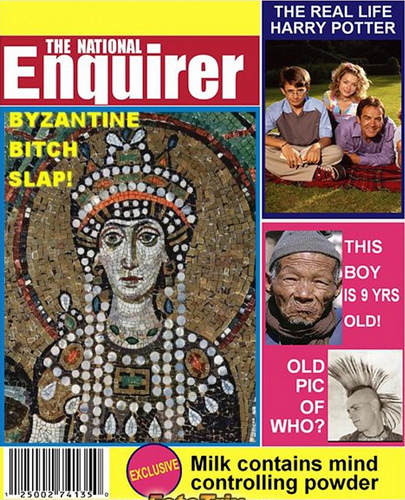
And Justinian is hardly alone among those who suffer the jabs of Procopius’ poison pen. His wife, the empress Theodora, is in Procopius’ formulation a former sex worker and sexually insatiable wanton, constantly cheating on her imperial husband and forever seeking to gratify her increasingly kinky tastes (I won’t go into details, but Procopius does). Belisarius, the general who conquered all that territory for Justinian, emerges here as a weak-minded fool, easily manipulated by his money-hungry, power-starved, sex-crazed, and forever revenge-minded wife Antonina.
You get the idea. It can be heavy going, at times.
Procopius concludes The Secret History by looking ahead toward the death of Justinian, writing that “whenever Justinian, if he is a man, departs from this life, or, as the Chief of the Demons, sets this mortal life aside, then all those who have the fortune still to be alive will know the truth…” (p. 123) Clearly, Procopius wanted to keep The Secret History secret until after he died, or after Justinian died; and it stayed hidden much longer than that – until the early 1620’s, in fact, when a researcher found it in the archives of the Vatican Library.
So, why did Procopius write this strange and troubling little book? I have seen a couple of different possible explanations. One school of thought is that Procopius, loyal at first to the Emperor, became disillusioned over time and turned against Justinian, resulting in the broadside and jeremiad that is The Secret History. A second is that Procopius, knowing which side his imperial bread was buttered on, set down the official history for public consumption, and saved The Secret History as his private expression of what he really thought – to be published after his death as a sort of raised middle finger against Justinian and Theodora, once he was safely beyond their vengeful reach.
Yet if either of those possible explanations is true, then why didn’t Procopius arrange for the publication of The Secret History? How is it that the document disappeared for 1100 years, existing only as a rumour in the writings of others?
There are two other possible explanations, both of which I find more intriguing than the two mentioned above. One is that Procopius, seeing how uncertain the reign of even the mightiest emperor could be, may have written The Secret History as a sort of insurance policy, in case the day might come when Justinian and Theodora might be overthrown and deposed. In such an eventuality, Procopius, even though he had been Justinian’s court historian, could present The Secret History to the new rulers of Byzantium and say, “See? This is how I really felt about them!”
And the last possibility is even more intriguing. Translator Peter Sarris of Cambridge University, in a helpful introduction, points out that Procopius’ classical education would have exposed him to many prominent literary genres of classical times, including the psogos or invective. To anyone who might point out (correctly) that The Secret History does not seem fair or objective, Procopius might reply that the psogos was not supposed to be fair or objective; rather, the author was expected to demonstrate a sort of fierce ingenuity in launching unrelenting attacks on the man or woman unfortunate enough to be chosen as the subject for such an invective. Think Alexander Pope’s Dunciad (1728), only more so.
Did Procopius write The Secret History as a sort of private rhetorical challenge for himself? Having dutifully set forth Justinian’s military and architectural achievements in his other writings, did he want, for his own amusement, to "flip the script," with as much emphasis in denouncing Justinian as he had once utilized in praising him? Was it nothing more than a naughty little literary exercise, to be kept carefully under lock and key? It is an intriguing question – and is one of many troubling questions that are likely to flash across the modern reader’s mind as he or she reads The Secret History.