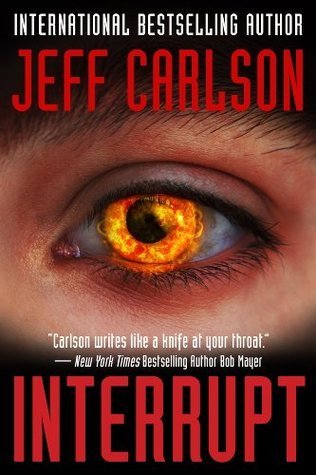
This book is audacious. So much so, that I was a little scared that it just wouldn't work at all. Most readers will have to make a huge suspension of disbelief to go along with the main concept. Once you get over that hurdle, it's a fun premise and makes for some very effective enemies.
The danger is three-fold. Allow me to unfold them in the order I enjoyed them:
First, humans must deal with solar activity so powerful that it incapacitates not only modern infrastructure, but also the workings of the unshielded human mind itself. Carlson is extremely adept at handing the End of the World, as he proved with the Plague trilogy. I found the survival aspects of the book to be vivid and gripping. Bleak, of course, but realistic.
Second, not all humans are effected the same way. Some of them become very efficient and deadly survival machines. I think it would be a huge spoiler to reveal the exact nature of the transformation, so I'll not be more specific. This threat was given the most space in the book and was also the most difficult for me to believe. Despite that, it was probably the most fun aspect of the whole thing. It was described very well and certainly did not fail to be interesting!
Third, and most confusingly, the Chinese may or may not be at war with the US. They also may or may not be using disruptive EMP technology - which, confusingly, is very similar to what's being dealt to the whole planet by the Sun. This threat was brought up early, so I won't say it was tacked-on. But it wasn't explored a lot through the bulk of the story. When it became vitally important to the final act, I found it distracting because it wasn't what I wanted to read about. I wanted to deal head-on with the first and second threats instead.
I thought the characters were quite good, though I was at times confused by their motives, particularly in the climactic struggles for power. I would have liked for the characters to have been given more chances to explore their relationships between each other so that I could have gotten to know them better. Much of this was handled through exposition which flashes back to a part of the narrative that had been skipped. It wasn't satisfying the way actually living through those moments would have been (the boring parts could have been pushed to the background to make room for character exploration).
I really like Carlson's inventiveness and his fearless handling of big events. Interrupt reminded me a lot of the Plague trilogy because they're both apocalyptic scenarios and, of course, they have the same author's voice. But I felt that I had a lot more time to get to know the characters in even just the first Plague book, let alone the whole trilogy.
Interrupt is one of those stay-up-all-night quick reads. I was actually surprised when it was over. I could easily have read another 100 pages.
Tags: solar radiation, genetics, brains, primitive problems, the end of the world, guns, blunt force trauma, sunburns