Turner porte un lourd passé sur ses épaules. Ancien flic à Memphis, il a passé onze années en prison après avoir tué son partenaire durant une mission. Reconverti en psychothérapeute à sa sortie, Turner s'est finalement retiré à Oxford, une petite ville du Mississippi où les circonstances – plus qu'une réelle volonté – ont fait de lui un adjoint du shérif local. Un soir, Turner et ses hommes arrêtent un chauffard qui traverse Oxford à tombeau ouvert au volant d'une Ford Mustang. L'homme transpire le Jack Daniel's et transporte un sac contenant 200 000 dollars. Au petit matin, alors que le soiffard cuve à l'ombre, une fusillade éclate : deux types viennent 'extraire' le prisonnier de sa cellule et blessent grièvement un adjoint et la secrétaire du commissariat. Quand Turner apprend que l'évadé est connu des services de police et qu'il travaille pour un caïd de Memphis, il décide de partir à sa poursuite. En roulant vers cette ville qu'il a fuie, Turner ne se doute pas qu'il va libérer les fantômes de son passé et que la vague de violence ne fait que se lever…
James Sallis (born 21 December 1944 in Helena, Arkansas) is an American crime writer, poet and musician, best known for his series of novels featuring the character Lew Griffin and set in New Orleans, and for his 2005 novel Drive, which was adapted into a 2011 film of the same name.
Gli oggetti possono essere più vicini di quel che sembrano. Gli oggetti che vedi nello specchietto retrovisore della tua macchina. Ma lo si può intendere come avviso e raccomandazione utile in più situazioni: la soluzione è a portata di mano, è più vicina di quello che sembra. Oppure è il pericolo a essere dietro l’angolo, più vicino di quello che sembra.
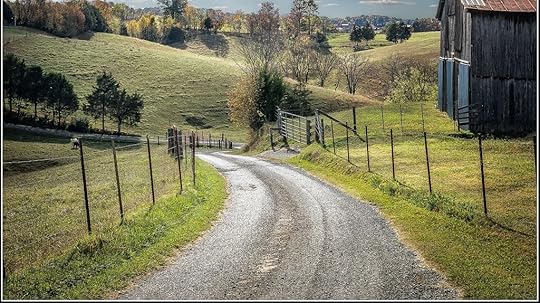
La strada che porta a casa di Turner.
John Turner ha un passato che non si dimentica: guerra in Vietnam nei corpi speciali, detective in polizia con anche “semplice” attività di strada, un giorno per sbaglio uccide il collega, seguono undici anni di carcere, durante i quali consegue laurea in psicologia, quando esce per qualche anno, sei, esercita la professione di psicoterapeuta. Finché decide di andare in pensione e di ritirarsi in una casetta nel bosco accanto a un lago in Tennessee. Ma lo sceriffo del paesello - credo si chiami Cripple Creek, che significa qualcosa tipo il ruscello dello zoppo - gli chiede aiuto e lo coinvolge in un’indagine come consulente. Al termine dell’indagine, Turner ricompone il puzzle e finisce col restare invischiato, rientra nel corpo di polizia, col grado di vicesceriffo.
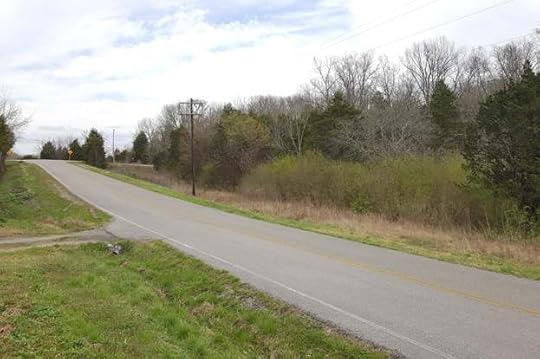
La strada che porta a Cripple Creek.
James Sallis fa dire a un altro dei suoi protagonisti di serie, il detective afroamericano Lew Griffin: Ci mettiamo un po’ di tempo a capire che le nostre vite non hanno trama… Siamo le cose che ci accadono, la gente che abbiamo conosciuto, e niente di più. Un compendio della sua poetica, come giustamente osserva Tiziano Gianotti nell’ottimo breve saggio posto alla fine. In pratica si traduce con una linea verticale, anche detta caso di puntata, la trama dell’indagine che inizia e finisce in questo romanzo, che è essenzialmente una scusa per raccontare altro, il collante che tiene insieme scene e situazioni d’altro tipo.
Rural Noir
Il caso da risolvere comincia quando lo sceriffo ferma per guida pericolosa un giovane forestiero piuttosto arrogante: così arrogante da meritare l’arresto. Tra il suo corredo di viaggio spunta nel bagagliaio un borsone con oltre duecentomila dollari in contante. Il prigioniero ha diritto a una telefonata: ma non chiama il suo avvocato. Qualche ora dopo giungono nel paesello i rinforzi che lo liberano e fanno evadere: per strada lasciano due vittime, lo sceriffo e la figlia dell’ex sceriffo. Se vittime morte o solo ferite lo si scopre leggendo il romanzo.
Da qui parte una specie di faida: Turner vuole vendicare i suoi amici rimasti a terra, ma lo chiama fare giustizia. Chi ha mandato i rinforzi, i capi del giovane arrestato non vogliono lasciar testimoni. Turner diventa un bersaglio. Bersaglio mobile, molto mobile. Ma come dicevo, tutto questo è piuttosto esile, viene dilatato da svariate divagazioni: che sono storie, episodi, momenti, che Sallis distribuisce a piene mani, che dal punto di vista della trama non vanno da nessuna parte, sono intermezzi. Ma dal punto di vista dei personaggi, dell’atmosfera, del quadro generale, invece raccontano ben più di molto. Danno il ritmo, il passo, il sapore, lo spessore.
Il risultato è un romanzo immerso nel sud degli Stati Uniti, condito con elementi gotici, cajun, bluegrass, jazz (la musica è importante), blues, country. Turner e i suoi nuovi amici (la compagna Val, l’ex sceriffo e sua figlia, il nuovo sceriffo ex vice sceriffo, la giovane donna che fa la sua prima apparizione nel corso della storia, il vicino di casa…) sono personaggi più che umani, per parafrasare il titolo di un romanzo di Theodore Sturgeon, scrittore molto amato da Sallis. Un romanzo a forti tinte esistenzialiste. Sì, proprio l’esistenzialismo made in France. Dimenticavo: il finale è uno shock e Sallis lo racconta in modo magistrale.
PS Che grandi film avrebbe tratto dai libri di Sallis Jean-Pierre Melville…
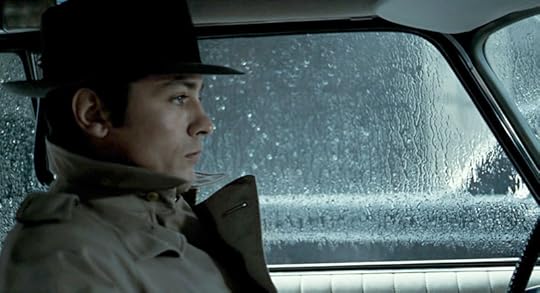
Alain Delon in “Le Samouraï - Frank Costello faccia d'angelo”, capolavoro diretto da Jean-Pierre Melville, 1967.
Accidentally reading this series backwards has provided some unexpected insight in to the nature of Turner as a character and what Sallis is/was doing as a writer. With the facts of Turner's ending already known the reflective nature of a man looking back over his life, sifting through his memories, connecting the dots across several timeframes, making the connections with observations and events, learnings and most notably, in this series at least, losses becomes heightened, especially with the traumatic events that occur at the end of this one. Sallis makes one tiny literary decision towards the end of this collection of Turner's memories that says so much about the way people deal with traumatic events that it makes the entire series worth the price of entry alone. Once more, wonderful stuff from this fantastic storyteller.
I had forgotten how dark these books about this lawman in Tennessee are. I remembered that I liked the way Sallis' tells a story and that John Turner is an interesting character. I also remembered that Sallis' use of language in this series is as wonderful as in his Lew Griffin mysteries. I just did not remember that wherever Turner goes, terrible things happen.
That does not mean that I disliked this novel. I liked it a lot. I got hooked in the very beginning and desperately wanted to know how it ended. I just was hoping for a different ending. I felt like I knew the characters and I wanted the best for them.
So now I have one more book in this trilogy. Knowing that I may disagree with where the author takes his characters, I am unsure is I am ready to listen to this last story. I don't think that Sallis and I agree on what might be the right ending for Mr. Turner.
James Sallis is obviously in love with the sound of his own voice. But it's hard to take a writer to task for that. Kind of comes with the territory. In this case, he's walking in the oversize footsteps of James Lee Burke, as Cripple Creek relates the life and times of John Turner: a detective turned social worker turned detective who's basically a clone of Burke's famous character: Dave Robicheaux. Both are men of violence who routinely take the law into their own hands, get innocent people around them killed, and then wallow in self-pity. This book gives the impression of a narrative pieced together from a much larger manuscript - with the strong sense of pieces missing. For all the striking language, real emotion is entirely absent. There are memorable anecdotes, here and there - and maybe some insights into the paradoxes of life - but the overall effect is that of a paint-by-numbers project to pay some bills: where the author didn't have the time, or ambition, to color in the whole picture. Worth reading, if you don't mind coping with a sense of impatience about the whole thing.
Pretend it's a southern night back in some piney woods, you're sitting on the porch and it's hot and humid. No, more than that, like the air is sticky and heavy and incapable of movement. Some sadness has recently come into your life and now you're alone with some thoughts and a cold beer. Only sound is the occasional hum of insects in flight, the only light comes from an occasional star and a partial moon peeping behind cloudy skies.
Another night alone with just your thoughts and a beer, like the one before. Alone, wishing for a cool breeze knowing it ain't never going to come. Yet you endure ...knowing, there's another beer waiting in the refrigerator.
It reads kind of like that ... sorta sad yet meaningful.
Carol was right about this one. I was so disappointed that it was over I read the intro to his next book and I never do that. James Sallis needs to be on your will-read list for sure. John Turner has had quite a life, 11 years in prison, then a psychotherapist, a cop in Memphis, now he thinks he will settle down in a small town in Tennessee like he grew up in, and ends up as "acting" Deputy Sheriff. His friends are a bit "off the beaten path", but he respects their differences, event he possum who comes in his window one night and stays. He gets caught up with some "bad guys" when a guy is arrested and put in jail for speeding, and two thugs break him out, assaulting the two other officers in the process. John Turner heads to Memphis to find them, and is rescued by a woman who says she is his daughter! Great read, and I am going to get more of this author.
I'd heard of James Sallis many times over the years--always positive reviews. I'm not sure. I think the book was hurt, frankly, by ridiculously poor interior design, among other things. It's trade paperback, very short, and with huge type reminiscent of YA novels. I love the South, and all of the character(s) intrinsic to the area, but though Sallis certainly references the atmosphere, the blues, the food, the hometown feel, it's just not quite...there. And the disjointed memory sequences, the varied and seemingly unrelated plot threads, while revealing something of the main character, also make it seem very much like a weekly network drama. Like maybe if you read all 13 books, you'd get why all the extraneous info is there, but in one book, it's inelegant. Anyway, I might try another, but not right away.
I think this author writes some beautiful prose, certainly about nature--birds, storms, etc. and provocative, not in an erotic way but a thought-provoking way, of getting into people's psyches. I will be looking into other works of this author, particularly his poetry.
Even though this is a series and the second in this trilogy, I was miffed that there was no closure in the ending of this book. I would have read the third one anyway. Also would have liked more of a connection with the title, Cripple Creek. Might have to go back and look deeper to see if I missed something.
My man Turner is part Spenser/part Scudder/part Robicheaux, and all-human. Sallis' character is at once an innocent and a cynic, trying with all his might to reconcile his place in the order of things. Saddened and bent by a checkered past,redeemed (oh so slowly) by rebirth in his brave new world, Turner is an everyman intent on re-forming (not reforming)his present.
Sallis is an author of language, and his words are as carefully chosen as lithe lines of poetry. Do yourself a favor and come on down.
Cripple creek appears to be a crime novel, published by a company specialized in such (No Exit Press), but like many of Sallis’ books, it is not really a crime story.
And that’s perfectly ok.
James Sallis is not so much interested in the good guys versus the bad guys thing, in a detective or policeman solving some heinous crime through deduction and analysis, or in the careful, irreversible steps of a plot. It’s less about crime than about the effects crime has on people, on this small but tight community, somewhere in the rural south. Sallis writes with compassion about the people there, common people with their own daily problems, sometimes down on their luck, trying to keep afloat, looking after each other because no one else does.
The story is entertaining enough. Protagonist Turner (who has a history as policeman, convicted criminal and psychotherapist) tries his luck as a deputy in a small town. There, he is confronted with a small-time gangster who robbed his boss. This sets off a string of events that unfold erratically, with many sidesteps into Turner’s – colourful, but also traumatic - past and many sidelines about other characters in the novel. Now these small distractions of the main plot are not really disturbing– they’re pictures of people, serving to give the story its peculiar flavour and atmosphere. However, sometimes it’s hard to follow the crime-part of the book’s plot, which remained a bit vague. And that’s because Sallis does not spell everything out – he only hints indirectly. As a consequence, he lets his characters use few words when talking to each other. And this language may well fit the general atmosphere of the book, with its rural, honest, down-to-earth people, but there were moments when the über-cool, almost artificial-sounding dialogues annoyed me somewhat.
“So this is the South.” “Part of it, anyway. Disappointed?” “Not really, just trying to get the lay of the land. Disappointment requires expectations. Like people have these scripts running in their heads about how life is supposed to go?”
“That’s the way of it. Violence is a lonesome thing, it gets inside you and sits there calling out for more. But they had no right to bring it here.”
"Pain as the fulcrum, loss as the lever, to keep their worlds aloft. After a while that can get to be all they feel, all that reassures them they’re alive.”
Sallis is a good writer, but sometimes he’s overdoing it. Or maybe it’s just me.
The second in Sallis’s Turner trilogy, a deceptively dense slim novel(la) told from the POV of Turner, ex-cop, ex-con, former-psychologist, at some indeterminate point, looking back on his time as the accidental deputy in the town of Cypress Grove. The barest bones of a crime novel, rather than being expanded upon with twists and red herrings, are instead used to as opportunities to reflect on previous cases, characters, or moments in his life. Within a sentence you’re transported from the tale being told to something that happened weeks or years earlier. Sometimes we skip forward days or months, other times we backtrack, all told with that same voice Tommy Lee Jones uses to discuss serial killers while eating breakfast in the diner in No Country for Old Men. The chapter length set pieces of a typical crime novel are instead dispensed with in single laconic sentences, sometimes even not at all, much like the deadpan violence in a Kitano movie.
I enjoyed this a little more than its prequel, and since everything Sallis writes is at least very good, that is praise.
The deepening of the world around Turner, how it continues to mould and haunt him, as well as nurture and hurt him is at times painful to observe but remains true as well as mythic. For all his acknowledged flaws as a person, a father, a companion, he remains a character we wish well, perhaps more out of hope than expectation.
Can't say I enjoyed this as much as the first in the Turner trilogy - there doesn't seem to be much of a plot and Sallis keeps going off at a tangent reminiscing about Turner's previous experiences and throwing in little stories told by Turner or about some of the other characters. I found this quite distracting particularly as I felt that we were getting nowhere with the narrative. Left me feeling a bit depressed and unsure if I can be bothered with the final book. Pity.
I enjoyed this book even though it lacked suspense and the end was anticlimactic. It left the reader with a few unanswered questions but maybe that’s just how life is.
EDITED to add that I didn’t realize this is book two of a trilogy. Maybe it would be more suspenseful if I read the beginning and the end hasn’t really happened yet. That should answer a few questions and have a climax!
I really enjoy James Sallis. His characterisation is superb and his laid back but deeply profound writing style is amazing. Quality, Quality, Quality!! His books are much more than mere crime novels.
I feel like the second of the Turner trilogy faired a bit better with the origin story stuff mostly out of the way and the narrative being more linear. And damn if the “old white guy philosopher” stuff didn’t grow on me. On to the last one.
This was a very satisfying book to read. The characters have depth. The story is sufficiently complex to keep your attention. And best of all the actual writing is top notch.
I read the first book in Sallis' Turner series, Cypress Grove, and found it, by and large, to be a perfectly fine start to what I think of as "testosterone cozies": you know, those male mystery series where a paragon of male competence incisively cooks, screws, questions, and punches his way through a dramatic murder or series of murders showing that life is brutal even while it is lovely, and unfair even while it is worthwhile, and savage even while it can be savored via the charms of good cooking, refined but unflashy taste, and sweet, sweet lovemaking with a quirky, inteligent, and good-humored equal.
The half-dozen Spenser books by Robert B. Parker I read are like that, the two or three Dave Robicheaux books by James Lee Burke I read are like that, and Cypress Grove and Cripple Creek are both like that and that's okay. Although I tease the genre, I do so out of love. Like the meals exquisitely described and devoured by the sensitive-yet-tough protagonists, these types of books are entirely pleasurable comfort food. They casually flatter and instruct their readers in how to live right, and they're usually well written (at least until the author's inspiration dies out and only the desire for a decent check remains).
But whereas Cypress Grove does a fine job of introducing Turner--sensitive soul who returns to the backroads of the Deep South after his world-weary turns as cop, convict, and psychotherapist--with a wry, understated tone, some downright astonishingly lambent prose, and a mostly serviceable murder mystery, Cripple Creek makes a royal mess of things. The flashbacks to Turner's past are too frequent and inelegantly jammed in; the plot is a quagmire of poor motivations and skipped-over events; and worst of all, the telling observations and poetic details of the first book have become pure cornpone hokum. At one point, Sallis mentions The Andy Griffith Show and it's unfortunately one telling mention too many: Cripple Creek reads like an episode of The Andy Griffith Show if Parker's Spenser was Barney Fife and Miami drug money got involved, and it meshes together about as badly as that description suggests it would.
I think it's absolutely unfair to write a review without giving the reader a larger sense of context, so here's what you should know about the conditions under which I read Cripple Creek: I had the flu, and I read a not-insubstantial amount of the book while either shitting my brains out, or being beaten down by alternating bouts of exhaustion and insomnia. I was quite probably in every way the antithesis of a generous reader. And yet, I read Stark/Westlake's The Score right before when all symptoms were markedly worse and I had none of the impatience and ill humor with The Score that gripped me through Cripple Creek.
It could be that when one hasn't eaten in 72 hours and has absolutely no appetite, yet another description of a small animal shot and fried, another rueful remark about the unfairness of the world, another admiring comment made by another admirable character to an even-more-admirable protagonist doesn't have the allure it would under other conditions. Or maybe Cripple Creek is just a terrible book written by an author clearly capable of writing much better ones, and therefore it deserves the scorn of those who believe easy, pleasurable books should be easy and pleasurable for the reader, not the writer. In any event, I'll be reading the next book in the series in a month or so (because I bought all three on sale for the Kindle). I hope it proves to be more like the first book in the series than the second.
Turner continues the struggle with his personal philosophy of life. He has a talent for helping those around him so his plan to live outside the boundaries of society doesn't really work. He becomes enmeshed in people's lives, slowly becoming friends while continually refining his idea of why he's in the world. He always chooses to do right, taking whatever fate hands him and doing the best he can with it. This title does not disappoint. I loved it. It has a few plot surprises and much soul searching. It is set in the south with a generous sprinkling of old time southern music including banjo. (Don't so many of the good, soulful reads hover around the music?). This is exceptionally well written - a pleasure to read. I couldn't put it down.
A year after the events in Cypress Grove, life for Tuner – the main character – is pretty good. He is settled, with a job as a deputy and a girlfriend (Val) who seems the perfect fit for him, a woman who wants – need – her own space as much as he does. It isn’t necessarily where he thought he would be but it seems like a good place to end up for someone who has been a policeman, convict, and psychiatrist among other things. He life is simple and he is accepted for who he is in the small southern town he has landed in.
Then, a young man is arrested for drunk driving. He has close to a quarter of a million dollars in his bag in the boot of his car. Not what you would expect to find…and neither is the jailbreak that follows, leaving the sheriff seriously injured. The trail leads Turner back to Memphis, where he was a cop and a killer, not somewhere he wants to be. Life, though, is rarely what he wants and that’s the case in Cripple Creek where things go from bad to worse for Turner.
Having read more than a few James Sallis books this isn’t a surprise. His stories tend to be quite dark, full of troubled characters and broken lives. Yet, generally, there is some light at the end of the tunnel. I didn’t find that here and I felt a little sad at the end as a result. That doesn’t mean I didn’t enjoy it though, I did, and I grew to like Turner as a character more than I already did. No matter how many things he might have done, in his heart he is a good person and I’d want him on my side in a fight. He is true to himself and others and his back story, woven through the book in short chapters, helps explain why he is who he is.
This way of telling his story is the same in Cypress Grove, which I think it would help to read first but isn’t absolutely necessary, and it’s one I like – as is Sallis’ sparse writing style and way of setting the scene and painting a picture of a world I don’t really know at all. Still, I feel I know Turner’s south – the good, the bad, and the gritty. I’m not sure it’s a place I would want to live but I do want to keep reading about it…
I don't know if James Sallis is definitely the best living American Crime Fiction writer - but if he isn't, there's a treat waiting for me out there somewhere. Like the best crime writers, Sallis takes you waay beyond the supposed limits of his genre. You find yourself thinking thoughts that make you uncomfortable, but gaining insight, touching nerves that you thought were insensate, learning they aren't. At the same time as being entertained by a master craftsman of twisting plot and beautiful prose.