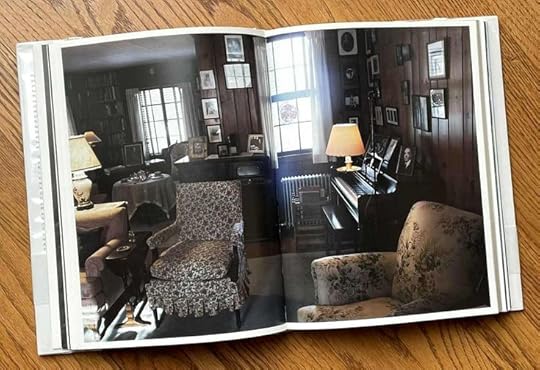
This is another book I picked up after seeing the author speak at City Arts & Lectures. Lately I've been really drawn to books about objects, or about people interacting with and discovering the stories behind objects. I think this is because my work is (in part, at least) also about objects- the objects that we are drawn to, that become sentimental to us, and ultimately that resonate with others as well. Leibovitz's book is not really about objects, it's about a journey she took that helped her discover something inside herself that she may have forgotten, or was perhaps never aware of. And many of the photographs within are of landscapes, but in visiting the homes of and places that inspired so many historical figures, she found herself unable to avoid being drawn in by the objects they left behind, and those images are the ones that speak to me the most.
In Leibovitz's lecture, she read about 3/4 of the book (it's a quick read) and showed us an equal number of photographs on a large projector screen. There were a number of those images that made me and the whole crowd gasp, like the one of Darwin's bird specimen, its neck coiled under and its feathers the most beautiful pale pinks and greens. The images were lovely- a departure from AL's well-known portraits and editorial pieces- many times snapshots that weren't that different from ones you or I might take when touring a historic home. But in the book itself, the images become secondary to the text. Not only are they printed rather small and often too dark to really see the beauty in them, but they are out of sync with the narrative so that you might be looking at Lincoln's top hat while reading about Georgia O'Keefe's southwestern home, or looking at Freud's sofa while reading about Annie Oakley. I found that disconcerting and wish that the publishers or editors or Leibovitz herself had insisted on formatting the book differently, whether as a non-fiction piece with corresponding illustrations, or as a large-format book of photographs with corresponding descriptions. Still, I really enjoyed reading the book, and it made me want to go back and read Maira Kalman's "And the Pursuit of Happiness," which also takes inspiration from historic homes.