The New York Times Book Review said of The Yard, “If Charles Dickens isn’t somewhere clapping his hands…Wilkie Collins surely is.” Now Alex Grecian returns with his new novel of Scotland Yard’s Murder Squad—and it’s a gripper.
The British Midlands. Inhabitants call it the “Black Country”—and with good reason. Bad things happen there.
When three members of a prominent family disappear from the Midlands—and a human eyeball is discovered in a bird’s nest—Scotland Yard’s Murder Squad is called in. But Inspector Walter Day and Sergeant Nevil Hammersmith have stepped into something much more bizarre and complicated than expected.
Superstitions abound in the intertwined histories of the villagers, including a local legend about a monster some claim to have seen. In addition, a mysterious epidemic is killing off the inhabitants, and the village itself is sinking into the coal mines below. Day and Hammersmith soon realize that they, too, are in over their heads. And the more they investigate, the more they fear that they may never be allowed to leave.
Grecian is the author of several bestselling thrillers, including THE SAINT OF WOLVES AND BUTCHERS, and five novels featuring Scotland Yard's Murder Squad: THE YARD, THE BLACK COUNTRY, THE DEVIL'S WORKSHOP, THE HARVEST MAN, and LOST AND GONE FOREVER, plus the original Murder Squad ebook, THE BLUE GIRL.
He also created the six-volume graphic novel series PROOF, and the two-part graphic novel RASPUTIN.
He currently lives in the American Midwest with his wife and son. And a dog. And a tarantula.
I liked The Yard, and expected another good one with the same coppers. Nope. This is a stinker.
This one has a ludicrous gothic plot, full of cardboard characters and more deaths than Hamlet.
Poor old Hammersmith - Grecian tells us over and over and over again how H never looks after himself, then for the second half of the book treats the guy like Beaker from the Muppet Show.
A key character vanishes halfway through and isn't missed or even mentioned.
The bad guy tracks a character for years, including an ocean crossing and several cities, but never has any trouble finding him, never seems to have to worry about earning a living or anything - and no one notices he's carrying a Civil War rifle. The long-barreled kind that long-range snipers used.
A certain geological thing is way, way overused in the plot. It is hinted at early, then used once, then Grecian just goes crazy with it at the end and the whole thing turns into a farce as he uses it over and over again to wrap up all the loose ends.
I'd tell you more things wrong with this sloppy book, but I don't care about it enough to take the time.
If you enjoyed The Yard, walk away. This is NOT a worthy sequel.
I really wanted to like/rate this one more because I think the author is a fine writer and does a nice job of characterization, both of the series 'regulars' and the locals specific to the book. But the mish-mash of plots and red herrings (or, in this case, pig's bodyparts) unfortunately stretched belief.
In the heart of a Victorian Midlands pit village you have: --three missing family members (father, second wife, toddler) --mysterious stranger stalked by *another* mysterious stranger - with an adultery sub-sub-plot --half the village suddenly felled by a 'plague' --locals terrified & acting out due to folklore/bogeyman stories --huge out of season snow storm --house/foundations (unsafely built on top of mineshafts) conveniently shifting/sinking at serious plotpoints more than once --and, ohbytheway, the first wife in that family disappeared a couple of years ago and was never heard from again, either.
Also, the local bobby who drops out of sight about a third of the way through and completely gets left out of the end of story wrap-up (though the reader knows what happens.) Not to forget the red herrings/pig's bodyparts... But, OTOH, quite a bit of heavy foreshadowing/dropping of hints that made the actual 'murderer' pretty obvious way before the end.
Then there's the part where the MC/Scotland Yard Inspector's heavily pregnant wife, whom he hasn't seen for all of 24 hours since his despatch to Yorkshire for two days to solve the case, conveniently drops in for a little visit enroute to her family. WTH?
As mentioned, I actually do like the author's writing style and I'll be looking out for the next in series, but I'm glad I got this one from my public library instead of spending money on it, and I hope he tightens up his plotting. IMO, there's a big difference between successfully writing about an era and writing in the style of an era (i.e., Victorian tripledecker) and it may not be worth the effort to try pulling off the latter.
ETA: and did I forget to mention the US Civil War sub-sub-sub plot/tie-in? ;D
This entire review has been hidden because of spoilers.
Rawhead and Bloody Bones Steals naughty children from their homes, Takes them to his dirty den, And they are never seen again.
So starts the story in the Black Country (That’s the West midlands UK!) with Inspector Day & Sergeant Hammersmith of the Yard sent to the coal mining village of Blackhampton C1890 to investigate the disappearance of a husband, Wife & youngest child of a family. The 2 MC’s keep the story flowing as characters (suspects) are introduced, we also have Dr Kingsley & genial Giant Henry returning from the first story to assist which add to the charm of the story. A simple enough tale if implausible at times with the amount of happenings occurring in the 2 day period....... but enough in it to keep you guessing towards the last 100 pages where it all starts to fall into place although you’ll have suspicions early enough.
The real charm of the series is the MC's & the storytelling keeps you turning them pages deep into the night.... an engaging read which I ran through in 3 days, a solid 4 stars for me & recommend to all crime fans out there looking for an easy read
Great googly moogly! How much plot can you cram into one book? In the case of "The Black Country", far too much. Grecian's first book, "The Yard", suffered from overplotting, but not to this extent. At the risk of giving too much away, this book has five separate murders (with four different murderers), an epidemic, a thunderous blizzard (reminiscent of Edward Bulwer-Lytton's prose), a building fire, and several mine tunnel collapses...many of these happening simultaneously.
Oddly, the numerous plots and subplots don't really seem to go anywhere. Characters run around doing stuff in colorful ways, and lots of things happen, but there's not a lot of logical cohesion. It's interesting in a "Plan Nine From Outer Space" sense - you want to keep reading to see what kooky thing will happen next.
There's a whole raft load of characters too, each with a single defining trait, making them 'colorful' but one-dimensional. Not to mention unbelievable - Nevil Hammersmith's stamina seems to have made him immortal.
And that's not to mention the egregious use of modifiers to add unneeded levels of detail (one character has a 'thirty-three inch' rifle - the reader doesn't need that level of precision). Oh, and he seems to revel in the gore - I'm sure Grecian's thesaurus was well-thumbed as he searched for new ways to describe characters being shot in the head.
In the end notes, Grecian thanks his editor - which leads me to think he needs a new editor. The book is rife with grammatical errors - it includes the word 'sunken' as a verb - scenes where characters just recap the plot to date, and entire chapters that could be removed entirely.
Having enjoyed Grecian's previous outing 'The Yard' (though it's not a patch on Ripper Street, I had relatively high hopes for the further adventures of Inspector Walter Day. This time, Day and his trusty Sergeant Hammersmith have been called in by local Constable Grimes to investigate the mystery of the Price family. Sounds clear enough? However, as another commenter on here has already noted, how much plot can be crammed into one narrative? (which in itself begs the question what has happened to Grecian's editor, surely someone should have said hang on a mintute...) So, we have the vanishing Prices, a rogue eyeball, an enigmatic Scottish giant with American connections, an even more enigmatic psychotic American, a sinking village, an apparent case of plague (still with me?, bizarre villager straight out of the Wicker Man - we don't be doing that sort of thing round 'ere.. types, animal torture and the care of a baby magpie. Add to that the pointless appearance of Day's pregnant wife, just calling in en route to Manchester (he's due to be away for two days)and the mystery of the vicar's wife, then we have the plot. It's also rather nasty in parts, using a child as a vehicle for gleeful sadism seemed to be over-egging (if that is at all possible) it and the ending seemed infinite. Indeed I found myself saying 'just get on with it' as not only is it incredibly drawwn-out and long-winded, the finale is of epic proportions with a body count Shakespeare and Middleton would be proud of. Not only are there multiple victims but multiple murders and pointless events all within the last thirty or so pages. Something of a disappointment as 'The Yard' was an interesting addition to the post-Ripper London milieu.
It is 1890 and Scotland Yards recently created Murder Squad is back to lend its skills outside of London this time. Inspector Walter Day and Sergeant Nevil Hammersmith have been called to the village of Blackhampton in what is referred to as the Black Country of England, the coal-mining region. Scotland Yard has only allotted two days for the pair to clear up a case of a missing husband, wife, and child from a prominent family. They not only have to contend with a suspicious, uncooperative community, but a late season snow storm complicates gathering facts and evidence. So many secrets and so much information lie just below the surface of each encounter with the people of Blackhampton, very much in keeping with the unnerving sinking of the village into the mines below. The novel begins with the discovery of an eyeball in a bird's nest by a child, which portends the importance of children in the resolution of the mysterious disappearances. Walter Day is eager to solve this case and return to London, as his wife, Claire, is due to deliver their first child soon. Claire makes a brief appearance in this book, but one disgruntlement of mine is that brevity. I enjoy the working relationship of Day and Hammersmith, and the isolation of this case allowed for further development of that. The supporting cast of characters were both interesting and smoothly incorporated into the interaction with the main characters. While the ending is not exactly a surprise, it isn't given away early either. I like my mysteries to be mysterious and not predictable. Grecian has done another excellent job with his followup to The Yard. I look forward to his next installment and hopefully more of Walter and Claire.
The Black Country follows on from Alex Grecian’s brilliant debut novel The Yard (which you should certainly pick up if you have not read it yet). Whilst it is not necessary to have read the prior novel I do recommend doing so. The books tell two completely different stories but there are aspects which carry over from the first book into the second, references which you will only truly understand if you have read the first book.
The Black Country continues with the best characters as they deal with a crime outside of London. The story starts with Day and Hammersmith trying to reach the bottom of the mystery that is to be found in the Black Country with Kingsley arriving later in the book to offer up his forensic aid. Throughout we grow to love the characters even more as they all develop in their own ways.
The story is just as gripping as the first, filled with just as many amusing moments as the first. With mysteries piled up on top of mysteries you’ll be unable to put the book down until you know exactly what had happened in the town. There were one or two moments that were slightly predictable but for the most part the book was filled with twists and turns that keep you on edge.
It wasn’t quite as good as the first but it was a great second novel which I recommend to anyone who enjoyed The Yard.
I wanted so, so much to love this book. After falling in love with Day, and Hammersmith, and Kingsley in the first book, I was so excited to read about them again. Unfortunately, this story left me sorely disappointed. All my favourite characters were out to play, but the plot was another story (and another story, and another story, and another...)
The numerous plot lines were a hodgepodge of bits and pieces that barely held together, like a child's art project put together with scotch tape. I think in trying to create red herrings, Grecian let his plotbunny breed and it got out of control. We started following the one plotbunny, then a cuter one caught his eye so we would start following that one, and then an even cuter one would grab his attention. The abandoned plotbunnies were left to mew pitifully for attention (to no avail), then wandered off into the sunset never to be seen again. I mean, literally, the local policeman (who requested Day and Hammersmith to go to the village) drops out halfway through the story and is never seen again.
Another point that was bugging me was the story's emphasis on the squad's two day timeline. It was mentioned or alluded to at least 10 times throughout the novel. What was the point? I assumed it was to convey a sense of urgency in solving the case, but if that's what Grecian was aiming for it fell flat on its face. For example, as soon as Day and Hammersmith arrived at the village they began questioning the villagers (yay, good, don't waste any time). The villagers are all evasive and secretive. Day thinks "oh, I need to get them one at a time and drill them to get straight answers. But lah-di-dah I can do that later". LATER?? How much later? You're only there for two days, buster!
In the end, it took Day and Hammersmith only a day and a night (a Day and a Hammersmith?) to solve the case. If you're going to have your characters solve the case before the timeline, why bother giving them two days?? Their actions kept detracting from any sense of urgency.
So I would have given a 2.5/5 star rating, but I'll round up to 3/5 stars because I think the series has a lot of potential. *cross fingers* that the next book realizes that potential!
Second in the Scotland Yard's Murder Squad historical mystery series and revolving around Inspector Walter Day whose case takes him to the British Midlands in March 1890.
My Take It's an interesting combination of immature writing with a tension-filled plot that kept me intrigued. Grecian certainly kept the tension up as he slowly, slowly dribbled out the information on the identities of the American and Campbell as well as the cryptic comments made by Anna and Peter *shiver*, that bit of foreshadowing, Campbell's admission to murder in London…
Grecian is using a third person global subjective point-of-view, as we hear the thoughts of a variety of characters and experience events at which some of those characters aren't present.
That village, Blackhampton, sounds quite grim as their homes, the inn, and the church are slowly sinking into the ground due to the tunnels burrowing under the village. That description, the individual confessions of the killers, and events at Andersonville are, unfortunately, the only real bits of show with the rest of the story not really pulling me in, even though this tale of suspense kept me flipping the pages. And whatever happened to Grimes…?
The way in which these villagers are so stubborn in their superstitious beliefs makes me grateful for today and what we know. It does make me wonder what "beliefs" we have now that will be pooh-poohed in the future, lol. Maybe it will be like Dr Kinglsey's repulsion about Denby using leeches. Such an old-fashioned thing! And now we're re-discovering the benefits of leeches, lol. It's a bit of true history combined with Grecian's ignoring some of the customs and mores of the time.
Hilde does crack me up with her obsession and subsequent disappointment about the eyeball. As for Sutton, I do have to wonder if he isn't a sociopath. Henry…now Henry is an absolute sweetheart. Grateful for the compassion shown him and willing to pass that kindness forward.
As a continuous connection with The Yard, 1, Scotland Yard is still rebuilding its reputation, and Sergeant Hammersmith is still being poisoned, poor baby.
The Story When members of a prominent family disappear from a coal-mining village — and an eyeball is discovered in a bird’s nest — the local constable sends for help from Scotland Yard’s new Murder Squad.
Fresh off the grisly 1889 murders of The Yard, Inspector Walter Day and Sergeant Nevil Hammersmith respond, but they have no idea what they’re about to get into.
The villagers have intense, intertwined histories. Everybody bears a secret. Superstitions abound. And the village itself is slowly sinking into the mines beneath it.
The Characters Inspector Walter Day has been at Scotland Yard for six months now. Claire is his very pregnant wife who tries so hard to learn how to keep house.
After The Yard, the tightly focused Sergeant Nevil Hammersmith, who is tireless in pursuit of justice, has been assigned to Day. Nevil arrives in the village with a chip on his shoulder, having suffered as a child in the mines where he grew up. Mrs Flanders is his landlady.
The twelve-man Murder Squad at… …Scotland Yard is overseen by Commissioner Sir Edward Bradford. Dr Kingsley is the now-official forensic examiner for Scotland Yard. The simple but compassionate Henry Mayhew is Kingsley's assistant and names the bird Oliver. Fiona is Kingsley's fifteen-year-old daughter.
Lacassagne's patterns of blood is a technique of using blood spatter to determine what happened. Dr Snow proved that typhoid, like cholera, can be spread in a similar manner.
Blackhampton, British Midlands, is… …a village that ended up centered above a coal mine. Constable Harry Grimes is the village's policeman. Young Freddy Higgins drives the carriage and does odd jobs. Dr Denby is overworked with the sickness that is plaguing the entire village.
Oliver Price is the only son of their stepmother, Hester Price, their former nanny. Mathilda was the first Mrs Price who disappeared a few years ago. Oliver's half-siblings include almost-thirteen-year-old creative Peter, eleven-year-old practical Anna, and the brilliant and nasty five-year-old Virginia. Sutton Price is their missing father. There is a housekeeper.
The solitary Hilde Rose found the eyeball. Her father, the obstreperous Bennett Rose, runs the only inn in the village. Mr Brothwood is the vicar; Margaret is his wife. Miss Jessica Perkins is the schoolteacher. Heath Biggs is but one of the sick. The Baggses must leave and enter their home through a window. Nicky is one of their kids.
Calvin Campbell, an ornithologist, is a British citizen who had volunteered with the Union Army. The cowardly American has been hunting for more than twenty years.
West Bromwich, The Midlands, 1871 Seventeen-year-old Hester is the youngest of four sisters and helps out at a brother-in-law's pub. Mr Stephens cares nothing for her interests but does propose marriage.
Andersonville Prison, Georgia, 1865 Joe Poole is a friend of Calvin's. Duane is one of the new kids. Richard Devine helps Calvin out. "Grey Eyes" is a sadistic guard.
The Cover and Title The cover is a muted yellow-green, misty with fog as a lone figure in black overcoat and top hat walks away from us down the cobbled street, buildings on either side, a lone gaslight lit in the upper left corner. All the text is in white, starting with an info blurb at the very top. Below that is the author's name centered to the right of the light. A sheer black band with orange-gold picot-style borders provides the background for the title. At the very bottom is the series information.
The title is a nickname for this coal-mining region, The Black Country, that happens to be experiencing black times.
*A creepy mystery that balances elements of classic detective fiction with original ideas*
I ended up reading two Historical Mystery series around the same time: Scotland’s Murder Squad and Barker & Llewelyn. Although I enjoyed both, having read at least the first two of each, I found the former more original while the latter was too much of a Sherlock knock-off.
It had been a while since I read The Yard, so I did have to dust off some cobwebs of who certain characters were. But I quickly got into the flow of the story and easily plowed through it.
The story isn’t overly gory, but it may be worth looking into the content warnings for this as it deals with some tough subjects. I can’t say more than that without spoilers.
The storyline was more straightforward than the first book. Which wasn’t a bad thing, because the first one was a bit… elaborate. The sequel still had the “interlude” flashback scenes, but since I knew what to expect, they were not so confusing as in the first book. The more streamlined story made the plot flow quicker.
The setting was also different from the first book. Instead of busy London, this installment took place in a small, rural town in the British Midlands where Day and Hammersmith had to deal with an entirely different situation.
Overall, I felt that The Black Country improved upon its predecessor while still maintaining the elements that made the first book stand out. I look forward to continuing on with the series.
RATING FACTORS: Ease of Reading: 4 Stars Writing Style: 4 Stars Characters and Character Development: 4 Stars Plot Structure and Development: 4 Stars Level of Captivation: 4 Stars Originality: 4 Stars
Shockingly awful. I only struggled through to the end to see just how badly he could further mangle British history. He seems to honestly believe there were still wolves in England in the 19th century (note to Mr Grecian, the last one in Britain was killed in Scotland in the 17th century!). Despite setting this in the Black Country he could only find one bit of local dialect and threw it in twice, at least once putting it in the mouth of a character who would be unlikely to use it (I really can't see an educated man like a doctor saying 'Ow bist?'). He also thinks that coal miners would not only have a housekeeper but potentially a whole host of menial staff. These are just a handful of the egregious errors scattered throughout.
The only convincing bits of the whole novel were the flashbacks to the American Civil War. Possibly Mr Grecian should stick to what he knows.
I won't give a rating as I didn't get very far into this book before I realised it was not for me. If you are going to set your historical novel in the Black Country in late Victorian times you need to ensure that your local characters speak in the accent and language relevant to their social status. Having them use words like 'wanna' is a pretty basic error. It put me off as I lost the sense of time and place.
Book #2 of this series jettisons much of Book #1's psychological underpinnings in favor of whiz-bangish action. (And tell me again why Scotland Yard investigators are in coal country instead of London?)
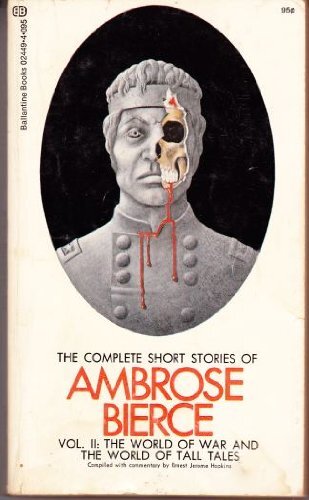
p.s. I have an irrelevant-but-lurking suspicion that the badass villain was inspired by this vintage Ambrose Bierce paperback cover.
Way, way too much for one book. The plot runs away into too many directions and has illicit sex with the subplots and they make ugly secrets together. There is too much talking. Too much banter. Too much frivolous conversation about NOTHING. Make your point and move on. But no.
There are too many giants. Too much snow. Too much illness, too many accidents, too much clumsiness, and by the way, whatever the hell happens to constable Grimes? Another trail that begins with vigour and goes out with a poof.
I love a good work of historical fiction and I had high hopes on this one, which Alex Grecian dashed early on enough for me to reevaluate quickly what my expectations would be. Keep them low.
The book has some keen points but they dim in the view of everything that goes so horribly wrong. By the end of this novel I pretty much hated everyone but none more than the author who is clearly in love with his own creation and simply cannot suffer to kill his babies.
No pun intended.
This entire review has been hidden because of spoilers.
I really enjoyed the second book in this series. I like the characters,the settings and the plot. I look forward to more books in this series. I was really lucky to have had a chance to get this book before it came out. Alex you rock can't wait for more!
3-1/2 stars. As much as I hate to let the narrator affect my rating, I really struggled this time. Half star deduction. It took me a while to get into the story but once I did, I enjoyed it.
2.5 stars, rounded up to 3 I started out listening to this on audio, but the sudden shift to a Civil War interlude made me think I had missed something vital in the story, so I started over reading a print edition. It was easier to see these sudden shifts in time in print – not so much in audio. I loved the first book in this series, The Yard. Unfortunately, The Black Country wasn’t nearly as good. I think it suffered by moving the action from Victorian London to the British Midlands (the Black Country). I also missed Claire, Inspector Day’s wife, but she does make a brief appearance. The book is crammed full of characters and plot lines (another reason it was hard to follow on audio.) Inspector Day and his sidekick, Hammersmith, travel to the Black Country to assist a local lawman find 3 missing people – a man, his wife and infant son. Half the people in the village are sick from a mysterious illness. There is also an American sniper stalking someone in the village. The people in this village were a strange and terrible bunch. There was a little girl keeping an eye in a box. A real eye and no one thought it was odd! The local barman swore there was no point in looking for the missing people – he was sure that Rawhead and Bloody Bones, the local bogeyman had already killed them. Their homes were built on top of mine tunnels and the entire village was slowly sinking. Everything is NOT neatly tied up at the end. There is a major character who disappears and his disappearance is never dealt with. I still plan on reading the next book in the series and hope it is as good as the first book or at the very least, better than this one. If not, that will be the end of the Scotland Yard Murder Squad for me.
9 SEP 2020 - another solid and very readable installment in The Murder Squad series. I will be reading Book 3 soon. The author is still working on developing his characters and I am looking forward to finding out how they grow.
In this second book in the Murder Squad series, the duo of Inspector Walter Day and Sergeant Nevil Hammersmith are sent to the coal mining village of Blackhampton after local constable requested assistance from Scotland Yard to help when a prominent couple and their young son go missing. Grimes, the local constable is further alarmed because a mysterious sickness is spreading through the town and a young girl has discovered an eyeball in a bird’s nest.
When Day and Nevil arrive in BlackHampton, they find a village that covered in grime and ash and is sinking due to years digging miles of tunnels and mind shafts beneath the village. Day, Hammersmith, and Grimes also come up against reticent villagers who are steeped in secrets and superstitions. On the periphery of the missing family members, the contagious sickness plaguing the villagers, a list of suspects grows to include the mysterious outsider Calvin Campbell, there is the grey-eyed, menacing American stranger who has arrived in Blackhampton to stalk and kill his prey.
Alex Grecian has once again delivered a superb Victorian mystery with vivid description of a crumbling mining town and the bleak, unhealthy conditions that poor people in mining towns lived under. I could feel the grimy atmosphere permeating the village and feel creeped-out by the sinister folklore, especially the looming specter of the Rawhead and Bloody Bones.
Hammersmith and Day had their hands full with only two days to find the missing family and they do an admirable job as a working team. The supporting characters were also very well developed. It was wonderful to see Henry, formerly the Dancing Man, thriving and safe with his own place and working as Dr. Kingsley’s assistant. Henry being roped into caring for a baby bird was a sweet experience. Dr. Kingsley is his brilliant, eccentric self. It is his compassion for other and taking a vulnerable Henry under his wing that give his character gravitas. My heart just broke for Calvin Campbell, the poor man always tried to do the honorable thing and he suffered so much loss for duty and love.
The Black Country was a suspenseful page-turner. This series is a finely woven combination of mystery and historical fiction. I look forward to reading more of the murder squad.
I gave this a good shot, but it was just going nowhere slowly. The story seems a good’n but there’s no movement and at times the writing seems ‘dumbed-down’ for want of better words.
The Murder Room is better, but I note from my review that I wasn’t moved to head onto this immediately. I can see why now.
In this second installment of Mr. Grecian’s new series Inspectors Hammersmith and Day travel to Blackhampton. It is known as the “Black country” because of the coal mining, but also because bad things seem to happen there. The local constable has reached out to The Yard for help in solving the disappearance of a prominent local family and the mysterious appearance of an eyeball in a bird’s nest.
Yes, I am always saying I do not have time to become invested in yet another “series” and then I go ahead and start one anyway. As I picked up this second of Mr. Grecian’s books I had already made up my mind that if it was a cookie cutter rehash of the first I was done with “murder squad”. Well, this was anything but a cookie cutter rehash. A change of locale brings our protagonists to this coal-mining town. The Inspectors, Dr. Kingsley and Henry (my favorite character so far) are interesting characters but the small town-ness, quirkiness and strangeness of the villagers coupled with their local superstitions makes this an interesting and fun read despite the “murderous” plot. If I had to find negative thing to say about this book it would be that the author had a little too much going on. Sometimes I had to page back and forth to keep some of the characters straight.
A little girl has discovered a human eyeball in a bird's nest in the coal mining village of Blackhampton, where a local couple and their little son have disappeared. Baffled and alarmed, the local constable summons assistance from Scotland Yard, which assigns Inspector Walter Day and his sergeant, Nevil Hammersmith, to the case. They duo arrives by train in the midst of a blizzard, but the deepening white blanket can't disguise the grit and grime of the village, where houses are actually sinking into the miles of mine shafts that snake about under the ground. After less than an hour in the pub, where a few of the taciturn villagers have gathered to meet the inspectors, they learn that Blackhampton is also riddled with superstitions and secrets. To make matters worse, a mysterious contagion has infected half of the townsfolk, so many that the church has been turned into a makeshift hospital. Add a couple of sinister American strangers to the mix, and Day and Hammersmith have their hands full.
Author Grecian injects his plot with authentic Victorian atmosphere, and enough menace and mystery to keep the pages turning at a rapid pace. As gritty as its setting, the book is marred only by a somewhat histrionic conclusion, but in the milieu of that village, it works well enough, especially because the characters are so richly developed.
It's been some time since I read the first in this series so it took me a little while to remember the specifics about each character. This wasn't hard to do, mostly because there isn't immense depth to the characters, but there also isn't much character development involved so even once I remember who was who I didn't feel like I had gained much insight. I love the quick verbal exchange that happens for the majority of the dialogue - all very short, sweet, to the point, and offhandedly humorous. At the same time, though, it does fall into the trap of lengthy verbal exchange where the reader loses track of exactly who is speaking, which became mildly irritating at times. Regardless, while I didn't enjoy this book as much as the Yard, in part because the novelty had worn off, Grecian maintains the Holmes-esque vintage freshness of how he tackles murder mysteries. On the whole this story was still quite entertaining, enough so that I probably will venture onto the next installment, though I don't know if I would hasten other readers to both reading past the Yard, which seemed more thought out and developed than the Black Country. Anyhow, it was a fun read at best. Perfect for blizzard weather and procrastinating.
This is the second novel with Inspector Walter Day and Sergeant Nevil Hammersmith of Scotland Yards Murder Squad. It's 1889 and the pair are sent to a coal mining town to find some missing villagers. Although I don't really like murder mysteries that involve children I guess there are good and bad children out there. I do like all the main characters in this series including the forensics doctor Bernard Kingsley. If you like Martha Grimes books you might like these. Alex Grecian has a good way of presenting the characters good and bad.
This was a pretty good follow up to The Yard. Inspector Day and his Sergeant have been called to a small mining town to find a young family. Once they get there, the town seems on edge and jumpy. The innkeeper is superstitious, and there are strangers among the villagers. They are faced with many twists and turns in their pursuit of the truth. For awhile, you are unsure of where the family is, but then everything falls into place. A good read.
I read book one in 2014. Then it took some time after I got back to the series. This is a book with a wide range of ratings. I'm fan of Walter Day and Nevil Hammersmith and for me they did not disappoint me. I enjoyed the plot, the settings, and the characters.
This wasn't as amazing as the first book, but still a whole lot of fun and a crazy addicting read. We follow Day, Hammersmith, Kingsley and Henry as they are called to a mining village where a husband, wife and their youngest child have disappeared. They find themselves amongst a group of superstitious people, sinking houses, a plague and then things get even worse when a snow storm hits.
It isn't too difficult to figure out what happened, but that doesn't lessen the enjoyment when everything falls into place (and shit hits the fan) in the last 100 pages. I loved seeing Day and Hammersmith work together, they make a great duo. Day is the kind but firm DI we've grown to love in book 1, and Hammersmith proves himself to be great in his new role as sergeant. He is incredibly stubborn and does anything to get justice done, putting his own well-being last. Henry is a great addition to the cast, a simple but gentle giant.
The atmosphere in this was great. Although I do like London a lot, this small village adds a layer of intimacy and tension to it. Added to this is the superstition of the villagers and the legend of Rawhead and Bloody bones who steals naughty children from their homes.
There were some inconsistencies and predictable moments which take a star of my rating, but overall it was a great read that kept me up way past my bedtime. This is definitely a book that can be read on its own (although I don't see why you wouldn't want to read the first book).
In an earlier review I wrote about that disappointing moment when you realize an author you really like has written something that isn’t all that good. I made the comparison to other arts, mentioning in passing R.E.M.’s 2004 turd of an album, Around the Sun. And that pains me, because if I had to choose a favorite band, R.E.M. would be it. They’ve soundtracked my life pretty consistently from the time Green was released when I was but a wee lad in high school, and in that time it felt like they maintained a remarkably high degree of quality control. Through the stylistic diversions, the superstardom, the loss of drummer Bill Berry to a brain aneurysm – there really weren’t any flat-out misses in their discography. Until Around the Sun, which really has nothing to commend it, especially not the guest rap by Q-Tip from A Tribe Called Quest. Where I’ve internalized their other albums to the point where they almost feel like part of my DNA, I couldn’t hum a single melody from Around the Sun if you pointed a gun at my head. Anyway, Gold Coast was Elmore Leonard’s Around the Sun – boring, uninspired, and an uncharacteristic bellyflop in an otherwise graceful career.
Just as this analogy carries over from music to books, so too does the sophomore slump. You probably know what I’m talking about: a musician crafts a high-water mark of a debut album and then follows it up with something that, more often than not, isn’t terrible, just pedestrian. The best recent example is probably The Stone Roses’ Second Coming, an album which isn’t half bad, but I guess that’s the point of the sophomore slump. When you release an album that defines a period in time the way their self-titled debut did for England in the early 90s, “isn’t half bad” just doesn’t cut it.
The saying goes something like, “Bands have a lifetime to create their first album, and a year to create their second.” The implication being that the pressure to create a brilliant follow-up in a much more constrained timeline can cripple the artistic process (even though with the Roses the slump in question came from taking too much time between Albums 1 and 2). I imagine the same can be said of Alex Grecian, a graphic novel writer whose debut novel The Yard came bursting out of the gate to awards and best-selling accolades. And it’s quite good. I wouldn’t bestow Instant Classic status on it or anything, but it’s a complicated, densely-plotted historical mystery about the birth of Scotland Yard in the time immediately following Jack the Ripper’s reign of terror.
Coming a year after The Yard, Grecian’s follow-up, The Black Country, features the same core cast of characters and does almost nothing right. This time around, Inspector Walter Day and Sergeant Nevil Hammersmith are called to England’s coal-mining Midlands (the “Black Country” of the title) to assist with the search for a missing family. They’re cast almost immediately into a not-at-all-compelling mystery involving a missing eye, a couple of unpleasant children, an errant ornithologist, and a “mysterious” stranger whose identity is supposed to be a big secret but which is telegraphed to the reader straightaway.
The whole affair just comes off as rushed and sloppy, with a bunch of stuff happening that’s supposed to be – I think – ominous and creepy, but which never coheres into anything memorable. Day and Hammersmith search the woods. They’re drugged by the local innkeeper. Flashbacks to a prison in Georgia. Day’s wife visits and then leaves without anything happening. People get sick. It snows. And then the resolution for the whole thing hinges on a laboriously- and tediously-described earthquake. Where The Yard was a twisty-turny thriller with clever narrative feints, here it seems like Grecian just threw a bunch of garbage at the wall to see what would stick. It doesn’t speak well of a novel when I could just as easily have summarized it by saying, “A bunch of stuff happens and none of it matters.”
Grecian also made the questionable stylistic choice to incorporate some lengthy sections of dialogue that are apparently meant to highlight the characters’ rapid-fire, whip-smart conversations. The problem is the characters are neither rapid-fire nor whip-smart. Cormac McCarthy can do this kind of thing. So can Elmore Leonard and James Ellroy. Denis Johnson, too, and Kurt Vonnegut was arguably the master at it. But not Grecian. Note to writers: Don’t draw attention to what your characters are saying if you can’t make it sound interesting.
So: a terrific first novel followed by a disastrous second. It troubles me that there’s a third which I will undoubtedly read because I’m A) a glutton for punishment, B) immensely forgiving, C) eternally optimistic, or D) some unholy combination of the above. I’d like to think Grecian can return to form, but with only two books to judge by, it’s unclear which book is actually most representative of what he’s able to do.