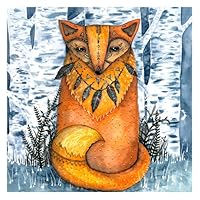
Here are a hundred of Andersen and the Grimm Brothers' best-known stories, fully illustrated and with new introductions by Charles Mosley, writer, broadcaster and historian.
Hans Christian Andersen (often referred to in Scandinavia as H.C. Andersen) was a Danish author and poet. Although a prolific writer of plays, travelogues, novels, and poems, Andersen is best remembered for his fairy tales. Andersen's popularity is not limited to children; his stories — called eventyr, or "fairy-tales" — express themes that transcend age and nationality.
Andersen's fairy tales, which have been translated into more than 125 languages, have become culturally embedded in the West's collective consciousness, readily accessible to children, but presenting lessons of virtue and resilience in the face of adversity for mature readers as well. Some of his most famous fairy tales include "The Little Mermaid", "The Ugly Duckling", "The Nightingale", "The Emperor's New Clothes" and many more. His stories have inspired plays, ballets, and both live-action and animated films.
i think reading so many european children's stories growing up permanently altered my brain chemistry... now i have this big gaping hole right in the middle of my chest and the only thing that fills it up is an aching longing for worlds that do not exist.
I read the Grimm’s Fairy Tales with my kids, and they enjoyed them. I enjoy seeing how the movies have been changed and adapted from the original. But reading all of them together did begin to get monotonous with nearly every story having a prince, a witch, maiden-turned-princess, etc.
The Tales of Grimm and Anderson are quite contrary to the beloved Disney movie renditions of these fairy tales. Disney has altered these stories quite a bit. I enjoyed reading the original stories, but was surprised to found out how "grim" and slightly disturbing these stories can be! Within this collective book of fairy and folk tales, I read Briar Rose, Snow White, Cinderella, Rapunzel (all by the Grimm brothers) and The Mermaid (by Hans Christian Andersen). Each of the Grimm fairy tales are short and to the point but there are grotesque details such as miserable deaths and gory situations that were unexpected. Despite the disturbances, each Grimm fairy tale I read had a "happily every after" ending. Andersen's The Mermaid is sad, but portrays true love and sacrifice. Different from our usual happy and heart-warming view of the story told by Disney. Despite the obvious change from Grimm/Andersen to Disney, I enjoyed the stories. I would have liked pictures, and recommend reading these stories that have pictures to children (and maybe taking out the gory details for really young children).
I was first interested in reading this because I had learned more about the Grimms in my linguistics class in college. Many of the tales are pretty awful in terms of torture and suffering. Others are quite funny though, such as The Three Spinners or The Youth Who Could Not Shiver And Shake.
As for the Anderson tales, my mother had read to me The Little Mermaid, and as a child that was horrible. When I read it again as an adult though, it became my favorite of his. I love the color descriptions and the imagery in general. As a child I hadn't gotten the part at the end, that the real thing the mermaid had wanted wasn't just the prince, but the chance to have an immortal soul. I don't like the last paragraph that Anderson threw in there to get children to behave though.
My other favorite of Anderson's is actually The Ugly Duckling. His writing is what is good, so even though I was of course familiar with the story, I was able to find a deeper meaning to it. My favorite line was "It matters nothing if one is born in a duck-yard, if one has only lain in a swan`s egg."
I'm a huge fan of fairytales of every kind, and I loved reading the Grimm brothers take on these fairytales. I think they did a great job on Rapunzel, Sleeping Beauty, and Cinderella. I thought they were all very well written, but they included more disturbing factors than I thought they were going to include. I think that the Grimm's stories shouldn't be told to kids right when they are young, because I think the stories are a little too gruesome. Although I do think that young teenagers should read these stories. They might be disturbing, but I found them to be almost more interesting than children fairytales. As for Andersen's take on The Little Mermaid, I thought it was okay, but I am very biased when it comes to this fairytale. Overall the take on these fairytales, were done amazingly well. I would recommend these to people who like darker stories.
I read so many fairy tales from these authors, and I am still looking for more!!! There are so many different version of each tale, and so many stories from each culture. For example, in 3 different kinds of Cinderella, the stepsisters are either forgiven, ignored, or, as in the French version, their eyes were pecked out by wild birds. In Snow White, she and the Prince forced the Wicked Queen into burnning hot shoes where she was forced to dance 'til she was dead. Even the Little Mermaid was strange as the original, she got lungs and commited suicide by drowning, and is now waiting to go to heaven. But with a diferent spin off of old stories, there are many new ones that have never been heard of. It is fun to read and compare to many other tales, for anyone.
This entire review has been hidden because of spoilers.
I took my time reading through these iconic tales. I enjoyed them quite a bit, but I will probably wait a while before reading them to any children. Themes that I do not want to raise children on: beauty=good, ugly=bad, evil is not redeemable, favoritism, clever deals and deceit are essential, royalty is the best, a girl's story is only complete when she marries, and step-mothers are always bad news. At the same time these stories have lived on and inspired so many iconic modern stories that they cannot be written off. One could also pull out these worthy themes: right and wrong exist with real consequences, things are not always what they seem, good behavior is rewarded in the end, people need one another to survive, life is fragile, and the world is full of fantasy and wonder.
The classic version of these tales and not always the happy-ending Disney versions, thus it might not always make the best bedtime story for younger readers or listeners.
32 Anderson tales and 35 of The Brothers Grimm fairy Tales. Includes many of the most popular fairy tales as well as some lesser-known ones.
I have a bit of a binding fetish and I fell in love with the red silk binding and gold embossed cover of this one, red ribbon marker to keep your place, nice paper weight, and the classic illustrations. Beautiful book!
I cannot overemphasize the impressions these tales, in this edition, made on me as a child. The very colors of the covers of the two books are forever wedded to the two collections in my mind. Andersen's tended to be more sentimental, and Grimms' to be more, well, grim. Some of the stories were entirely horrific. Just what the pediatrician ordered....
I find this to be like O.Henry except for kids. Some of the stories are great and lifting/building while a bunch of others are perhaps exciting but not character building...and therefore, not what I want to spend time feeding into my children's heads when there are so many other good choices. If they want, they can read it later in a college course or something.
Call me "Disney-indoctrinated,” but the original version of these fairy-tales were only family-friendly in the 19th century. Fully 3/4 are either poorly written, or over-long. Some gems exist, but they're few, and far between.
Finally finished this collection of stories. Some were really good, and worthy of their place as classic fairy tales, but many of the were overly similar and preachy.