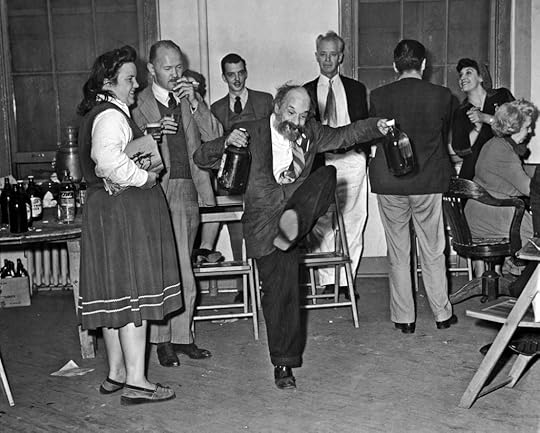
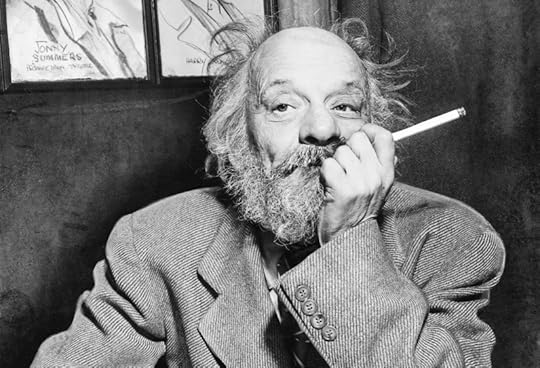
This book, about a Village eccentric character named Joe Gould, who was active in New York City from around the 1920s to the early 1950s, consists of two New Yorker magazine profiles about Gould by Joseph Mitchell, the first written in 1942 and the second, in 1964, as well as an introductory essay by William Maxwell and an explanatory author´s note. The pieces are all beautifully written and give a glimpse into the world of Village in those decades from the perspective of a perpetually down and out character, a fixture at parties and bars, who seemingly knew everyone, such as E. E. Cummings and Ezra Pound, to name just two, and lived a grand, interesting life despite his poverty.
Gould came from an upper middle class socio-economic milieu in Boston, graduated from Harvard, but never fit in somehow with society and was unable to find some way to make a living that he could stick with. At his final job, a few years after he graduated from Harvard, he decided that he had to focus on writing a book that would capture the never-ending conversations he either participated in or overhead on the street, at bars, cafeterias or parties - and that this project would really reflect the history of his time, rather than histories that focused on great men, military conquests, and the like. And so, without a way to sustain himself, he had to essentially work on his book in libraries, or in parks, depending on the weather or time of year, or on the subway, stay in flophouses, and mostly subsist on very little food. He had figured out how to survive this way until the profile of Gould appeared in the New Yorker and an anonymous benefactor made it possible for him to stay at a rooming house for around three years. Rather than spoil the book, I shall refrain from saying what happened to Gould from then on, and what the secret of Joe Gould actually was.
This is actually a strangely affecting book - a look into a life that might otherwise have been written off as a passing curiosity - yet it also conveys a great deal of truth about the worlds or masks everyone constructs, how they present themselves to the world to build themselves up, and how they may eventually come to believe those constructs are real. You may have thought you were an artist or a poet as a youth - and time and possibilities seemed limitless. It was a myth you constructed for yourself that preserved your self-esteem or sense of self-worth. For whatever reason, nothing came of the talent you thought you had - but rather than admit to yourself that your subsequent rather banal, ordinary existence was in fact the sum total of your life, and the possibilities of your life, you may stick with the illusion that you are actually a great writer or painter. We may all have such fantasies that sustain us - that make the meaning of our existence less random and meaningless to ourselves. We may excel in cooking or be a successful gardener - yet secretly we think we are the un-discovered greatest cook, or the best gardener ever. And so forth. The pathos and truth of this book consists in it crystallizing this probably typical, human trait, and by showing how it played out in one individual, we can see how personal myths about ourselves probably are key in most peoples´ lives, even our own. Everyone must think they´re unique and special in some way - usually they´re too modest to admit such things casually. Gould on the other hand, would talk about his book and how it would change the world´s view of history once it was published. His myth, or ¨secret¨ was public knowledge among his many friends in New York.
The book is impressively, clearly written and will give the reader some insights into Village life in those past decades of the 20th Century, as refracted through the life of a resourceful eccentric character who lived by his wits for decades all the while writing in innumerable notebooks the history of his time. The book is actually acutely insightful into human nature in general, and the need we all have to continue believing in personal myths or dreams - something quite important in an urban environment that can be quite depersonalizing otherwise. Despite its humble, eccentric, obscure subject, it´s well worth reading.
The quotes:
From the Introduction by William Maxwell:
¨I loved looking at [Joseph Mitchell] ... because of the light in his eye and his smile, which became broad and joyful when he remembered some extreme oddity of human behavior.¨
From the book:
¨[Gould] ... says he is out of joint with the rest of the human race because he doesn't want to own anything."
¨In the winter of 1942, after hearing that the Metropolitan Museum had moved its most precious paintings to a bombproof storage place somewhere out of town for the duration of the war, [Gould] ... became panicky.¨
¨If all the perverted ingenuity which was put into making buzz-wagons [cars] had only gone into improving the breed of horses,¨ [Gould] ... wrote, ¨humanity would be better off.¨
¨As a rule,¨ [Gould] ... says, ¨I despise money.¨
¨[Gould:] To begin with, I was undersized; I was a runt, a shrimp, a peanut, a half-pint, a tadpole."
¨[Gould:] That´s one of the damnedest things I ever found out about human emotions and how treacherous they can be--the fact that you can hate a place with all your heart and soul and still be homesick for it. Not to speak of the fact that you can hate a person with all your heart and soul and still long for that person.¨
¨[Gould:] The trouble is, the more radical these [Village] people became, the more know-it-all they became. And the more self-important. And the more self-satisfied.¨
¨[Gould:] In other words, they completely lost their sense of humor.¨
¨As the young reporter listens [to the old man], it dawns on him that it is not the South that he longs for but the past, the South´s past and his own past, neither of which, in the way that he has been driven by homesickness to think of them, ever really existed, and that it is time for him to move out of time gone by and into the here and now--it is time for him to grow up.¨