

What do you think?

The Sword of Welleran and Other Stories
An influential fantasy writer and a key figure in the Irish literary renaissance, Edward J. M. D. Plunkett, the eighteenth Baron Dunsany (1878-1957) produced a trove of gems of the imagination. The 12 stories here are some of his best. They will take you on a remarkable journey to places that sometimes seem soft and pleasant, sometimes bleak and ominous — but always surprising.
Ten magnificent illustrations by S. H. Simes, perfectly reflecting Dunsany’s mood, accompany
such inventive tales as "The Highwayman," "In the Twilight," "The Ghosts," "The Lord of Cities," "The Doom of La Traviata," and the title piece. A delight for lovers of fantasy, the volume will enchant readers of folk tales and science fiction as well.
Ten magnificent illustrations by S. H. Simes, perfectly reflecting Dunsany’s mood, accompany
such inventive tales as "The Highwayman," "In the Twilight," "The Ghosts," "The Lord of Cities," "The Doom of La Traviata," and the title piece. A delight for lovers of fantasy, the volume will enchant readers of folk tales and science fiction as well.
112 pages, Paperback
First published October 26, 1908
About the author
Lord Dunsany
713 books888 followersEdward John Moreton Drax Plunkett, eighteenth baron of Dunsany, was an Anglo-Irish writer and dramatist, notable for his work in fantasy published under the name Lord Dunsany. More than eighty books of his work were published, and his oeuvre includes hundreds of short stories, as well as successful plays, novels and essays. Born to one of the oldest titles in the Irish peerage, he lived much of his life at perhaps Ireland's longest-inhabited home, Dunsany Castle near Tara, received an honourary doctorate from Trinity College, and died in Dublin.
Ratings & Reviews
Friends & Following
Create a free account to discover what your friends think of this book!
Community Reviews
Displaying 1 - 30 of 105 reviews

May 20, 2013
Tolkien was a curse for fantasy literature.
The professor, speaking the truth, has no fault, but he and the ones who declared the commercial success of the "tolkenian" vision of fantasy (Terry Brooks and Dungeons & Dragons above all) were a curse for this genre. Today, any writer of fantasy must deal with the pattern elves-dwarves-orcs-humans-hobbits/halflings to embrace it, deny it or parody it, at least to some extent.
The professor, speaking the truth, has no fault, but he and the ones who declared the commercial success of the "tolkenian" vision of fantasy (Terry Brooks and Dungeons & Dragons above all) were a curse for this genre. Today, any writer of fantasy must deal with the pattern elves-dwarves-orcs-humans-hobbits/halflings to embrace it, deny it or parody it, at least to some extent.
Maybe fantasy was much more simple for Lord Dunsany: there was no Tolkien, no Terry Brooks, no Weis-Hickman; he had not to care about what other fantasy writers had written before him because there had been nearly none. Maybe he had heard something about William Morris and George Macdonald, and read some of their books, but even so fantasy at those times was like a virgin forest, waiting to be discovered. Nowadays I imagine this same forest crossed by a highway and its trees cut down to build a metropolis... but that's another story.
Yes, maybe fantasy was much more simple for Lord Dunsany: in no other ways I can explain his originality, the freshness of his tales, the sense of wonder he is able to move in the reader. Lord Dunsany writes fantasy and he doesn't feel any shame in using elements which today fantasy(less) writers will firmly refuse: he makes talk an Earthquake and a Hurricane; he makes one of his characters speak with a Whirlpool resting on the sand (!!!); he makes your spine chill with his honiric landscapes (oh my god, the dreams of Gaznak); he summons the reader in his tales. And then he leaves him free.
Of course, some novels in the collection are more exciting than others: I loved "In the twilight"and "The fortress Unvanquishable, save for Sacnoth" while "The Fall of Babbulkund" bored me a little.
Somewhere you will find christian-influenced elements and maybe you too, you will think "Oh no, another Lewis!" as I did at first. But keep on reading: you will notice that the religious parts too, far from being moral lessons for the "pious" reader, are well inserted in the context, enriching the story.
Am I forgetting something? Yes, the language. Well it's not so difficult: sometimes you will need a little patience, but nothing compared to William Morris's The wood beyond the world. So don't worry.
Five stars, no doubt. And now the gods of Pegana await me.

April 17, 2014
A splendid collection including some of Dunsany's finer stories (the titular Sword of Welleran, and The Fortress Unvanquishable Save by Sacnoth, amongst others) plus prose poems reminiscent of his earlier work in Time and the Gods and The Gods of Pegana, and the occasional early 20th Century ghost story. As always, the chief attraction is his gorgeous, almost Biblical prose.

November 17, 2015
Predivna zbirka priča majstora fantazije. Lord Dansejni je nepravedno zapostavljen na našim prostorima, a kada se spominje, uvek ide samo kao napomena da je Tolkin bio njime inspirisan.
Dansejni je mnogo više od zaboravljenog Tolkinovog korena. Njegova maštovitost i jezička raskošnost, poetičan stil koji nalikuje pažljivo vučenim pokretima i nijansama jednog slikara, podjednako maštovitog čitaoca će potpuno uvući u priču.
Ako pak volite novotrendovske fantazije u kojima saznajete celokupna porodična stabla, bolesti, kraste na nosu, bubuljice u ušima, nameštaj, pokućstvo, svaku božju pomisao o svim mogućim članovima porodice, svaki žbun i travku do detalja opisanu u bespotrebno preširoko mapiranim svetovima kako bi se popunio prostor i napisala knjiga od 1070 strana, kao deo sage od 11 tomova, onda Dansejni nije za vas.
Svaka priča, bilo fantazmagorija ili ispričana da opiše konkretan događaj, nosi u sebi čitav jedan svet, pažljivo i vešto utkan između reči. Maštoviti čitaoci će ga uočiti, pronaći, doživeti.
Nemaštoviti će žaliti za pseudokaratkerizacijom i klaustrofobičnim sistemom izgradnje sveta kakav je opisan gore. Njih žalim.
Ova knjiga je, jednom rečju - divota.
Bar kada bi još neki savremeni pisci čitali Dansejnija pa da i na njih utiče...
Dansejni je mnogo više od zaboravljenog Tolkinovog korena. Njegova maštovitost i jezička raskošnost, poetičan stil koji nalikuje pažljivo vučenim pokretima i nijansama jednog slikara, podjednako maštovitog čitaoca će potpuno uvući u priču.
Ako pak volite novotrendovske fantazije u kojima saznajete celokupna porodična stabla, bolesti, kraste na nosu, bubuljice u ušima, nameštaj, pokućstvo, svaku božju pomisao o svim mogućim članovima porodice, svaki žbun i travku do detalja opisanu u bespotrebno preširoko mapiranim svetovima kako bi se popunio prostor i napisala knjiga od 1070 strana, kao deo sage od 11 tomova, onda Dansejni nije za vas.
Svaka priča, bilo fantazmagorija ili ispričana da opiše konkretan događaj, nosi u sebi čitav jedan svet, pažljivo i vešto utkan između reči. Maštoviti čitaoci će ga uočiti, pronaći, doživeti.
Nemaštoviti će žaliti za pseudokaratkerizacijom i klaustrofobičnim sistemom izgradnje sveta kakav je opisan gore. Njih žalim.
Ova knjiga je, jednom rečju - divota.
Bar kada bi još neki savremeni pisci čitali Dansejnija pa da i na njih utiče...
January 6, 2023
Beautifully written short story collection
The Dunsanian prose is next level but that is to be expected from Lord Dunsany! This collection needs to be savoured and appreciated, one reading is not enough; when I have read it a few times I can provide a more detailed review.
For now just know that this is a stunning short story collection. Dunsany writes poetic fairy tales and fables like nobody else, evoking a bygone and legendary era. Dunsany is a master at setting a scene; the mood is deeply mournful and woven into a tapestry of poetic and erudite prose that has a light touch that bespeaks his skill with words. A visual image builds in each story deployed through metaphors and double meanings. The affect is at once beautiful and mysterious lilting with the rhythm of an impressionistic painting.
Different themes are represented across the various settings and types of tales told; Death, religion and change are reoccurring motifs.
A subtle magic weaves through each tale, pervasive and enigmatic that reads like myth except these are created myths that draw on older traditions; there is the Arabesque evoked in the title story "The Sword of Welleran" and "The Fall of Babulkund", the legendary hero quest of "The Fortress Unvanquishable, Save for Sacnoth" familiar to many an English folk tale, the evocation of the fae in "The Kith of the Elf Folk" and Biblical portent in "The Doom of La Traviata".
A delicious cauldron of myth, magic and religion delivered with apblomp. Dunsanys poetic prose is archaic and distinctive, its clear that these stories were written in a different era. Ejecting modern narrative tropes like character development and detailed plotting Dunsany delivers fables that read like ancient legends, the style is fresh in this era of endless cookie cutter grim dark fantasy clones.
I recommend this collection to anyone who enjoys fantastic fiction. Dunsany is a master of the written form and will leave an impression for years to come.
The Dunsanian prose is next level but that is to be expected from Lord Dunsany! This collection needs to be savoured and appreciated, one reading is not enough; when I have read it a few times I can provide a more detailed review.
For now just know that this is a stunning short story collection. Dunsany writes poetic fairy tales and fables like nobody else, evoking a bygone and legendary era. Dunsany is a master at setting a scene; the mood is deeply mournful and woven into a tapestry of poetic and erudite prose that has a light touch that bespeaks his skill with words. A visual image builds in each story deployed through metaphors and double meanings. The affect is at once beautiful and mysterious lilting with the rhythm of an impressionistic painting.
Different themes are represented across the various settings and types of tales told; Death, religion and change are reoccurring motifs.
A subtle magic weaves through each tale, pervasive and enigmatic that reads like myth except these are created myths that draw on older traditions; there is the Arabesque evoked in the title story "The Sword of Welleran" and "The Fall of Babulkund", the legendary hero quest of "The Fortress Unvanquishable, Save for Sacnoth" familiar to many an English folk tale, the evocation of the fae in "The Kith of the Elf Folk" and Biblical portent in "The Doom of La Traviata".
A delicious cauldron of myth, magic and religion delivered with apblomp. Dunsanys poetic prose is archaic and distinctive, its clear that these stories were written in a different era. Ejecting modern narrative tropes like character development and detailed plotting Dunsany delivers fables that read like ancient legends, the style is fresh in this era of endless cookie cutter grim dark fantasy clones.
I recommend this collection to anyone who enjoys fantastic fiction. Dunsany is a master of the written form and will leave an impression for years to come.

April 23, 2018
I could not get into the first few stories. What I did enjoy were THE TWILIGHT, THE GHOSTS, THE FORTRESS UNVANQUISHABLE, and ON THE DRY LAND.
The FORTRESS UNVANQUISHABLE is a gem, a magical tale of vanquishing an evil sorcerer told in 6000 words. It took Tolkien 455,000 words to tell his story. Dunsany does a far better job of it.
The FORTRESS UNVANQUISHABLE is a gem, a magical tale of vanquishing an evil sorcerer told in 6000 words. It took Tolkien 455,000 words to tell his story. Dunsany does a far better job of it.

Read
June 19, 2023fables of yore and tales of the soul spake at the campfire shimmer like a gossamer thread in the night

December 16, 2014
Dunsany is a dreamer, and THE SWORD OF WELLERAN AND OTHER STORIES are not just stories but flights of fancy rendered in gorgeous Jacobean language.
It is hard to describe the flow of the narrative and control of the language with a few isolated examples, but here is an excerpt that demonstrates the mystery and turns of phrase present in his writing:
"In a wood older than record, a foster brother of the hills, stood the village of Allathurion; and there was peace between the people of that village and all the folk who walked in the dark ways of the wood, whether they were human or of the tribes of the beasts or of the race of the fairies and the elves and the little sacred spirits of trees and streams."
The stories are airy and fanciful. They are about mighty whirlpools, mechanical dragons, soulless Wild Things, and sins that take the form of dogs. Sometimes they are naive and a wee bit indulgent, no more than extended daydreams; but often what is on the surface a simple fantasy turns out to be a dagger wrapped in ribbons. "The Doom of La Traviata," for example, is a lament for the fate of sinners - that they are punished even though many parts of their soul are beautiful.
"Presently the seven angels, as they swept Hellwards, uttered speech.
'She is very young,' they said; and 'She is very beautiful,' they said; and they looked long at the soul of La Traviata, looking not at the stains of sin, but at that portion of her soul wherewith she had loved her sister a long while dead... And as they looked long at the beauty of all that remained beautiful in her soul they said: 'It is but a young soul;' and they would have taken her to one of Heaven's hills, and would there have given her a cymbal and a dulcimer, but they knew that the Paradisal gates were clamped and barred against La Traviata."
For me, Dunsany is always a treat to read; his mastery of the English language and his imaginative vision make him one of the best fantasy authors of all time. If this sounds even slightly interesting to you, check it out. You can find WELLERAN and his other works on the public domain (though make sure to look up the Sidney Sime illustrations online!).
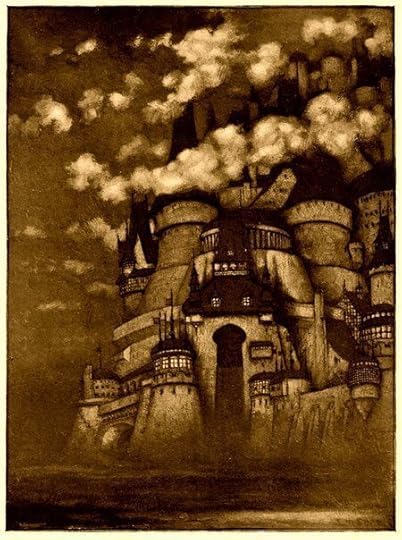
The Fortress Unvanquishable, Save for Sacnoth
by Sidney Sime
It is hard to describe the flow of the narrative and control of the language with a few isolated examples, but here is an excerpt that demonstrates the mystery and turns of phrase present in his writing:
"In a wood older than record, a foster brother of the hills, stood the village of Allathurion; and there was peace between the people of that village and all the folk who walked in the dark ways of the wood, whether they were human or of the tribes of the beasts or of the race of the fairies and the elves and the little sacred spirits of trees and streams."
The stories are airy and fanciful. They are about mighty whirlpools, mechanical dragons, soulless Wild Things, and sins that take the form of dogs. Sometimes they are naive and a wee bit indulgent, no more than extended daydreams; but often what is on the surface a simple fantasy turns out to be a dagger wrapped in ribbons. "The Doom of La Traviata," for example, is a lament for the fate of sinners - that they are punished even though many parts of their soul are beautiful.
"Presently the seven angels, as they swept Hellwards, uttered speech.
'She is very young,' they said; and 'She is very beautiful,' they said; and they looked long at the soul of La Traviata, looking not at the stains of sin, but at that portion of her soul wherewith she had loved her sister a long while dead... And as they looked long at the beauty of all that remained beautiful in her soul they said: 'It is but a young soul;' and they would have taken her to one of Heaven's hills, and would there have given her a cymbal and a dulcimer, but they knew that the Paradisal gates were clamped and barred against La Traviata."
For me, Dunsany is always a treat to read; his mastery of the English language and his imaginative vision make him one of the best fantasy authors of all time. If this sounds even slightly interesting to you, check it out. You can find WELLERAN and his other works on the public domain (though make sure to look up the Sidney Sime illustrations online!).
The Fortress Unvanquishable, Save for Sacnoth
by Sidney Sime
March 11, 2019
4/5
Es la primera antología que leo de Lord Dunsany (1878 - 1957), autor anglo-irlandés que influyó notablemente en autores como Lovecraft y Tolkien, y ha sido una experiencia gratificante. De hecho, cuando leía algunos de los relatos de La espada de Welleran, creía estar leyendo a Tolkien, no lograba imaginar que le pudiese haber influenciado tanto. Las historias de la presente recopilación son bastante variadas, aunque las une ese espíritu poético y descriptivo que caracterizaba la prosa del escritor y que supone el elemento principal de su obra. Este estilo bastante barroco me pedía, en ocasiones, releer determinados párrafos, pues me perdía en su lírica. En gran parte de las historias los protagonistas son elementos de la naturaleza. Como suelo hacer, he valorado cada relato de manera individual, como muestro a continuación:
- La espada de Welleran. (4/5). La guerra abandonó la ciudad de Merimna hace más de cien años, aunque todavía pervive el recuerdo de sus héroes...
- La caída de Babbulkund. (3,5/5). Los viajeros buscan la mitológica ciudad, pero tendrán que afrontar un amargo final.
- La parentela de los elfos. (4/5). Una Criatura Salvaje, de la raza de los elfos, adquiere un alma humana.
- Los salteadores de caminos. (4/5). Unos bandidos acabarán beneficiando espiritualmente a quien creían haber perjudicado.
- En el crepúsculo. (4/5). Un marinero realiza un viaje onírico al perder el conocimiento.
- Los fantasmas. (3,5/5). Un episodio con fantasmas le hace perder la razón al protagonista.
- El remolino. (4,5/5). Un remolino parlante descansa un día cada cien años, permitiendo a los viajeros llegar a las Islas Míticas.
- El huracán. (4/5). Asistimos a la conversación entre el Huracán y el Terremoto.
- La fortaleza invencible, salvo que Sacnoth la ataque. (5/5). Tan solo la espada forjada a partir de las escamas y ojos de un dragón podrá vencer a un nigromante. Maravilloso relato. Mi preferido de la antología.
- El señor de las ciudades. (4/5). La conversación entre un camino y un río.
- La condenación de la Traviata. (4/5). Se describe el recorrido de una mujer por el más allá tras su muerte.
- En tierra baldía. (4/5). Asistimos a la conversación entre el Amor y un viejo.
Es la primera antología que leo de Lord Dunsany (1878 - 1957), autor anglo-irlandés que influyó notablemente en autores como Lovecraft y Tolkien, y ha sido una experiencia gratificante. De hecho, cuando leía algunos de los relatos de La espada de Welleran, creía estar leyendo a Tolkien, no lograba imaginar que le pudiese haber influenciado tanto. Las historias de la presente recopilación son bastante variadas, aunque las une ese espíritu poético y descriptivo que caracterizaba la prosa del escritor y que supone el elemento principal de su obra. Este estilo bastante barroco me pedía, en ocasiones, releer determinados párrafos, pues me perdía en su lírica. En gran parte de las historias los protagonistas son elementos de la naturaleza. Como suelo hacer, he valorado cada relato de manera individual, como muestro a continuación:
- La espada de Welleran. (4/5). La guerra abandonó la ciudad de Merimna hace más de cien años, aunque todavía pervive el recuerdo de sus héroes...
- La caída de Babbulkund. (3,5/5). Los viajeros buscan la mitológica ciudad, pero tendrán que afrontar un amargo final.
- La parentela de los elfos. (4/5). Una Criatura Salvaje, de la raza de los elfos, adquiere un alma humana.
- Los salteadores de caminos. (4/5). Unos bandidos acabarán beneficiando espiritualmente a quien creían haber perjudicado.
- En el crepúsculo. (4/5). Un marinero realiza un viaje onírico al perder el conocimiento.
- Los fantasmas. (3,5/5). Un episodio con fantasmas le hace perder la razón al protagonista.
- El remolino. (4,5/5). Un remolino parlante descansa un día cada cien años, permitiendo a los viajeros llegar a las Islas Míticas.
- El huracán. (4/5). Asistimos a la conversación entre el Huracán y el Terremoto.
- La fortaleza invencible, salvo que Sacnoth la ataque. (5/5). Tan solo la espada forjada a partir de las escamas y ojos de un dragón podrá vencer a un nigromante. Maravilloso relato. Mi preferido de la antología.
- El señor de las ciudades. (4/5). La conversación entre un camino y un río.
- La condenación de la Traviata. (4/5). Se describe el recorrido de una mujer por el más allá tras su muerte.
- En tierra baldía. (4/5). Asistimos a la conversación entre el Amor y un viejo.
May 29, 2024
Very excited that I was able to read this 1908 version of this super cool book. Felt like I was reading an ancient tome.
Dunsany's prose is pretty poetic yet very easy to follow. He paints an almost magical or wondrous sense of environment in very few words, which was cool.
My favourite stories were "The Sword of Welleran" and "The Fortress Unvanquishable, Save for Sacnoth". Both great stories of fantasy, incredible these were written over 115 years ago.
Dunsany's prose is pretty poetic yet very easy to follow. He paints an almost magical or wondrous sense of environment in very few words, which was cool.
My favourite stories were "The Sword of Welleran" and "The Fortress Unvanquishable, Save for Sacnoth". Both great stories of fantasy, incredible these were written over 115 years ago.

January 13, 2018
'And who shall say what hath befallen in the days of long ago?'
Lord Dunsany, that's who. This is a stunning collection of some of his best stories, dreams and visions, seductively told in language as high as the mountains and as simple as the seas.
In the title tale the author dreams of Merimna, an ancient city now populated by nothing but the statues of its past heroes. What are dreams? "We are but dreams, let us go among dreams."
'The Fall of Babbulkund' is a vision from an alternative Old Testament (the name immediately brings Babylon to mind), an ancient City of Marvel with seven wonders and four gates facing all the nations, a River of Myth, the Waters of Fable and a sacred purple garden.
Journeying towards her is a prophet in rags causing the king to have dreams of doom for "very beautiful she is, but proud; and the Lord the God of my people hath seen her in her pride"
'The Kith of the Elf Folk' are soulless Wild Things that nobody can see 'unless they were born, as I was, in the hour of dusk, just at the moment when the first star appears.' Enchanted by the music from a cathedral, one longs to have a soul and become human but soon regrets her choice.
'The Lord of Cities,' a dream conversation between the road and the river, has a similarly anti-industrial message.
'The Highwaymen' is a gallows and graveyard story with a satisfying blasphemy at the end. 'In The Twilight' is Dunsany's take on the drowning man phenomena.
Last but certainly not least, 'The Fortress Unvanquishable, Save For Sacnoth' is fantasy fiction at its very best, in which a lowly hero takes on an evil magician whose 'dreams came flitting through the forest, and led men's souls into the plains of Hell.' First he has to get hold of Sacnoth, a sword made from the backbone of a dragon.
A must read.
Lord Dunsany, that's who. This is a stunning collection of some of his best stories, dreams and visions, seductively told in language as high as the mountains and as simple as the seas.
In the title tale the author dreams of Merimna, an ancient city now populated by nothing but the statues of its past heroes. What are dreams? "We are but dreams, let us go among dreams."
'The Fall of Babbulkund' is a vision from an alternative Old Testament (the name immediately brings Babylon to mind), an ancient City of Marvel with seven wonders and four gates facing all the nations, a River of Myth, the Waters of Fable and a sacred purple garden.
Journeying towards her is a prophet in rags causing the king to have dreams of doom for "very beautiful she is, but proud; and the Lord the God of my people hath seen her in her pride"
'The Kith of the Elf Folk' are soulless Wild Things that nobody can see 'unless they were born, as I was, in the hour of dusk, just at the moment when the first star appears.' Enchanted by the music from a cathedral, one longs to have a soul and become human but soon regrets her choice.
'The Lord of Cities,' a dream conversation between the road and the river, has a similarly anti-industrial message.
'The Highwaymen' is a gallows and graveyard story with a satisfying blasphemy at the end. 'In The Twilight' is Dunsany's take on the drowning man phenomena.
Last but certainly not least, 'The Fortress Unvanquishable, Save For Sacnoth' is fantasy fiction at its very best, in which a lowly hero takes on an evil magician whose 'dreams came flitting through the forest, and led men's souls into the plains of Hell.' First he has to get hold of Sacnoth, a sword made from the backbone of a dragon.
A must read.

December 31, 2010
I read the whole of "The Sword of Welleran" to my wife's abdomen the other night, as part of Project Fetal Education. I'm not sure how the child took to it, but my wife fell asleep well before the end.
Reciting it revealed how much of an acquired taste Dunsany really is, with bardic stylings and a sort of high language that almost demands performance and an unhinged sentence structure that forces rereading until you think you understand it. And occasionally, such as with "The Lord of Cities", the story meanders in description and metaphor until the reader becomes totally lost.
The collection contains both "The Sword of Welleran" and "The Fortress Unvanquishable, Save For Sacnoth", which are as good an introduction to his works as you're going to get.
Reciting it revealed how much of an acquired taste Dunsany really is, with bardic stylings and a sort of high language that almost demands performance and an unhinged sentence structure that forces rereading until you think you understand it. And occasionally, such as with "The Lord of Cities", the story meanders in description and metaphor until the reader becomes totally lost.
The collection contains both "The Sword of Welleran" and "The Fortress Unvanquishable, Save For Sacnoth", which are as good an introduction to his works as you're going to get.

April 10, 2018
"'He is the dragon crocodile who haunts the Northern marshes. And the hide of his back is of steel, and his underparts are of iron; but along the midst of his back, over his spine, there lies a strip of unearthly metal.'"
This collection is testament to the true breadth of Lord Dunsany as a writer. A founder of the fantasy genre, he incorporates not only the mythical basis of his native Britain, but also includes a reverent allusion to the architecture and mythology of the Middle East and North Africa, often adding his own inventions to his diverse mythology. This collection reveals glimpses of all of that, in addition to wit, social commentary and proto-horror. Sometimes, the sheer scope of the collection leaves individual stories seeming fragmented and unrelated to one another, making this overview review very difficult to write. But its that very esoteric imaginative indulgence which makes this collection a great entry-level book for those who would like to read more by Lord Dunsany, the imagery is vividly realised, if each snippet of a unique creative universe whips by in a handful of pages and leaves the reader yearning for more. Where Tolkein specialised in the depth of his world, Lord Dunsany creates a travelogue of the imagination. Something like a Victorian fantasy Hitchhiker's Guide to the Galaxy, he builds individual concepts and landscapes in exquisite detail, only to lead the reader on in a hedonistic rush from world to world in the pursuit of beauty, mystery, and meaning. There is a range and an irreverent creativity here that I don't think has been equalled since. How about I let the stories speak for themselves?
The Sword of Welleran ***
The titular story in this collection, it is an intriguing subversion of the fortress city guarded by almost indestructible heroes. In this tale, all the heroes are dead hundreds of years and their city Merinma no longer practices the martial arts but relies on ominous statues and songs to keep invaders away. This is possible because of the divinity myth surrounding its heroes, whom no man has seen dead. Now it had been the wont of each of these six warriors of old, when they had received a wound that they had known to be mortal, to ride off to a great ravine and cast his body in, as somewhere I have read great elephants do" It's an interesting premise. The spirits of these dead heroes continue to goad and interfere with the people of Merinma, who have become pacifistic in philosophy rather than lazy as it is first presented to the reader. An interesting account of the cost of national independence and our reliance on the past to carry out our dirty work so we can live off the bloody spoils.
The Fall of Babulkund ***
Here, we see Lord Dunsany's awe for the elegant and ancient cities of the Middle East come to the fore. 'Nay, pass on before me, for its is a sore thing never to have seen Babulkund having lived while yet she still stood.'" A group of Westerners are travelling to the fabled city of Babulkund, a wonder of the world where the cold north meets the culture of learning of the Arab desert. But they are not to see this beautiful and arrogant city, which has come to worship its own stones, because a prophet of an unknown religion has come to smite it down. Some very progressive representations of Muslims for the time of writing, Arabic and Islamic people remain strongly under-represented in modern fantasy.
The Kith of the Elf-Folk *****
This was by far my favourite story in the collection. It was beautifully narrated and deeply moving at times. This charted the life of a young Wild Thing, an ethereal soulless creature of the English marshes. "Thence, out of the lovely chill that is at the heart of the ooze, it arose renewed and rejoicing to dance upon the image of the stars." This Wild Thing dances in the reflection of a stained glass window and watched the evensong within. It becomes convinced that it would like a soul. "'I want to have a soul to worship God, and to know the meaning of music, and to see the inner beauty of the marshland and to imagine paradise.'" So the Wild Things make a soul for their young cousin from the dew on a spider's web and the song of the waterfowl as they descend over the marshes at dusk. And so the young Wild Thing becomes a young woman. But society does not see her beautiful soul. She is judged instantly for not knowing the proper social etiquette of society and being moved to love by the vicar's sermon. So they send her away to a grim northern industrial town. "It had mastered all the subtlety of skilled workers, and had gradually replaced them; one thing only it could not do, it was unable to pick up the ends if a piece of thread broke, in order to tie them up again. For this a human soul was required." This line is so dark, so piercing, it could have come from George Orwell. Mary Jane, the Wild Thing's human name, misses the beauty of her marsh home and seeks to pass her soul onto another so she can return. There is no fulfilment in her human life. "But the factory girl said to her: 'All the poor have souls. It is all they have.'" Her voice is that of the birds at dusk, and moves many to tears, and when she finds one woman who is able to talk through her songs of longing she knows she has found one without a soul. This story deserves to be known to a much wider audience.
The Highwayman ***
A simple story with a strong message against corporal punishment. The soul of Old Tom the robber is physically chafed by his inhuman death, and suffers after his body is rotted. "But the soul was nipped by the cruel iron chains, and whenever it struggled to escape it was beaten backwards into the iron collar" Three fellow criminals, all portrayed as immoral but also capable of loyalty and faith, enter Old Tom's remains in sacred ground where his soul battered into piety by the elements can at last move to the afterlife.
In the Twilight ****
A grizzly and surprisingly modern first-person account of the experience of drowning. It has a quality as if it comes from personal experience, which is uncanny if it is entirely fiction. "My past life never occurred to my mind, but I thought of many trivial things that I might not see or do again if I were to drown." The author embraces the warped perception of time that people experience when they are under extreme stress or on the border of consciousness, relating the passage of seconds with excruciating perceptual detail and sense of epochs passing with each breath. A good example piece of sensory-perceptual writing.
The Ghosts *****
This was my second favourite story in the collection, although for entirely different reasons to my first. In this first-person account, Lord Dunsany gives the world's most sarcastic narrative of a supernatural visitation. It begins with an argument with his brother (who is painted as a complete ignoramous), then he consumes lots of coffee and whiskey, and waits to 'see' the ghosts he doesn't himself believe in come about as a result of his own debauchery. "They were little more than shadows - very dignified shadows and almost indistinct; but you have all read ghost stories before, you have seen in museums the dresses of those times - there is little need to describe them. I had expected nothing less." There's a good grasp of psychology here. The author identifies the key elements of a ghost story and rips them apart from an extremely logical position. Then the ghosts' sins stalk into the room in the form of great black dogs. From this point the story descends into the ridiculous, with the author considering what would happen if he framed his brother's murder on ghosts. Naturally, he relies on Euclidian geometry to restore him to his rational senses. "'If two straight lines cut one another,' I said, 'the opposite angles are equal.'" I thought it was hilarious.
The Whirlpool **
A very short story from the perspective of a whirlpool, with vaguely anthropomorphic language used to describe it. Examines briefly the relationship between the catastrophic natural event and its divine master. Not bad, but far from a stand-out.
The Hurricane **
The counterpart to The Whirlpool, the hurricane concerns the thoughts of a different natural disaster. One of Dunsany's recurring themes, the damage caused by human civilisation to the environment and the need for a human extinction, resurfaces here, but is not explored with great humour or depth as occurs at other points in the collection.
The Fortress Unvanquishable, Save for Sacnoth ****
The longest story in this collection, this is also one of the best. Evil warlock Gaznok is building a tower of fancy and delusion in the world after many centuries of absence on a comet, and budding hero Leothric is hoping to stop him. The first part of the story, his quest for the legendary sword Sacnoth which Gaznok cannot destroy is the best part. He has to fight a man-eating metal dragon-crocodile. What a brilliant idea. I'm imagining something like the clicking crocodile in Peter Pan, but entirely bronze and much longer. Tharagavverug (the dragon-crocodile) can only be killed by starving to death. Leothric must stay away for three days and three night consecutively poking the beast in the eye to keep it from devouring men. And he is rewarded with the great blade which makes up the crocodile's backbone. "it was like the moonlight emerging from a cloud to look for the first time upon a field of blood" Gaznok never stood a chance.
The Lord of Cities ***
Building on what is now a time-honoured fantasy tradition, this story involves a road that cannot be travelled deliberately but only found by accident. It leads to the seemingly abandoned English village of Wrellisford where the Industrial Revolution has not yet hit. "The terrible wasting fever that, unlike so many plagues, comes not from the East but from the West, the fever of hurry, had not come here" Sound idyllic? There's a strong hint from the finery and monotony of their tapestries that the whole place is run by spiders.
The Death of La Traviatta **
This was by far my least favourite tale in the collection. I just don't think we need to have upper class men musing on the souls of female prostitutes. There is no sense of damnation here, almost a sense at God's failure, but there is also a sense that La Traviatta is here dehumanised to an abstract discussion of her sins. I don't think this is anything particularly new or valuable.
On the Dry Land ***
A sad little story to end an otherwise very triumphant collection, this details the betrayal of fickle Love, who leads men around in a wilderness to no great purpose only to abandon them. "Then as they neared at last the safety of the dry land, Love looked at the man whom he had led for so long through the marshes, and saw that his hair was white, it was shining in the pallor of the dawn." Death is far more loyal. A strangely archaic way to end such a contemporary-feeling collection with muses personified, a device associated with the 1600s. Strange. But if not strange, what can I expect from Lord Dunsany?
This collection is testament to the true breadth of Lord Dunsany as a writer. A founder of the fantasy genre, he incorporates not only the mythical basis of his native Britain, but also includes a reverent allusion to the architecture and mythology of the Middle East and North Africa, often adding his own inventions to his diverse mythology. This collection reveals glimpses of all of that, in addition to wit, social commentary and proto-horror. Sometimes, the sheer scope of the collection leaves individual stories seeming fragmented and unrelated to one another, making this overview review very difficult to write. But its that very esoteric imaginative indulgence which makes this collection a great entry-level book for those who would like to read more by Lord Dunsany, the imagery is vividly realised, if each snippet of a unique creative universe whips by in a handful of pages and leaves the reader yearning for more. Where Tolkein specialised in the depth of his world, Lord Dunsany creates a travelogue of the imagination. Something like a Victorian fantasy Hitchhiker's Guide to the Galaxy, he builds individual concepts and landscapes in exquisite detail, only to lead the reader on in a hedonistic rush from world to world in the pursuit of beauty, mystery, and meaning. There is a range and an irreverent creativity here that I don't think has been equalled since. How about I let the stories speak for themselves?
The Sword of Welleran ***
The titular story in this collection, it is an intriguing subversion of the fortress city guarded by almost indestructible heroes. In this tale, all the heroes are dead hundreds of years and their city Merinma no longer practices the martial arts but relies on ominous statues and songs to keep invaders away. This is possible because of the divinity myth surrounding its heroes, whom no man has seen dead. Now it had been the wont of each of these six warriors of old, when they had received a wound that they had known to be mortal, to ride off to a great ravine and cast his body in, as somewhere I have read great elephants do" It's an interesting premise. The spirits of these dead heroes continue to goad and interfere with the people of Merinma, who have become pacifistic in philosophy rather than lazy as it is first presented to the reader. An interesting account of the cost of national independence and our reliance on the past to carry out our dirty work so we can live off the bloody spoils.
The Fall of Babulkund ***
Here, we see Lord Dunsany's awe for the elegant and ancient cities of the Middle East come to the fore. 'Nay, pass on before me, for its is a sore thing never to have seen Babulkund having lived while yet she still stood.'" A group of Westerners are travelling to the fabled city of Babulkund, a wonder of the world where the cold north meets the culture of learning of the Arab desert. But they are not to see this beautiful and arrogant city, which has come to worship its own stones, because a prophet of an unknown religion has come to smite it down. Some very progressive representations of Muslims for the time of writing, Arabic and Islamic people remain strongly under-represented in modern fantasy.
The Kith of the Elf-Folk *****
This was by far my favourite story in the collection. It was beautifully narrated and deeply moving at times. This charted the life of a young Wild Thing, an ethereal soulless creature of the English marshes. "Thence, out of the lovely chill that is at the heart of the ooze, it arose renewed and rejoicing to dance upon the image of the stars." This Wild Thing dances in the reflection of a stained glass window and watched the evensong within. It becomes convinced that it would like a soul. "'I want to have a soul to worship God, and to know the meaning of music, and to see the inner beauty of the marshland and to imagine paradise.'" So the Wild Things make a soul for their young cousin from the dew on a spider's web and the song of the waterfowl as they descend over the marshes at dusk. And so the young Wild Thing becomes a young woman. But society does not see her beautiful soul. She is judged instantly for not knowing the proper social etiquette of society and being moved to love by the vicar's sermon. So they send her away to a grim northern industrial town. "It had mastered all the subtlety of skilled workers, and had gradually replaced them; one thing only it could not do, it was unable to pick up the ends if a piece of thread broke, in order to tie them up again. For this a human soul was required." This line is so dark, so piercing, it could have come from George Orwell. Mary Jane, the Wild Thing's human name, misses the beauty of her marsh home and seeks to pass her soul onto another so she can return. There is no fulfilment in her human life. "But the factory girl said to her: 'All the poor have souls. It is all they have.'" Her voice is that of the birds at dusk, and moves many to tears, and when she finds one woman who is able to talk through her songs of longing she knows she has found one without a soul. This story deserves to be known to a much wider audience.
The Highwayman ***
A simple story with a strong message against corporal punishment. The soul of Old Tom the robber is physically chafed by his inhuman death, and suffers after his body is rotted. "But the soul was nipped by the cruel iron chains, and whenever it struggled to escape it was beaten backwards into the iron collar" Three fellow criminals, all portrayed as immoral but also capable of loyalty and faith, enter Old Tom's remains in sacred ground where his soul battered into piety by the elements can at last move to the afterlife.
In the Twilight ****
A grizzly and surprisingly modern first-person account of the experience of drowning. It has a quality as if it comes from personal experience, which is uncanny if it is entirely fiction. "My past life never occurred to my mind, but I thought of many trivial things that I might not see or do again if I were to drown." The author embraces the warped perception of time that people experience when they are under extreme stress or on the border of consciousness, relating the passage of seconds with excruciating perceptual detail and sense of epochs passing with each breath. A good example piece of sensory-perceptual writing.
The Ghosts *****
This was my second favourite story in the collection, although for entirely different reasons to my first. In this first-person account, Lord Dunsany gives the world's most sarcastic narrative of a supernatural visitation. It begins with an argument with his brother (who is painted as a complete ignoramous), then he consumes lots of coffee and whiskey, and waits to 'see' the ghosts he doesn't himself believe in come about as a result of his own debauchery. "They were little more than shadows - very dignified shadows and almost indistinct; but you have all read ghost stories before, you have seen in museums the dresses of those times - there is little need to describe them. I had expected nothing less." There's a good grasp of psychology here. The author identifies the key elements of a ghost story and rips them apart from an extremely logical position. Then the ghosts' sins stalk into the room in the form of great black dogs. From this point the story descends into the ridiculous, with the author considering what would happen if he framed his brother's murder on ghosts. Naturally, he relies on Euclidian geometry to restore him to his rational senses. "'If two straight lines cut one another,' I said, 'the opposite angles are equal.'" I thought it was hilarious.
The Whirlpool **
A very short story from the perspective of a whirlpool, with vaguely anthropomorphic language used to describe it. Examines briefly the relationship between the catastrophic natural event and its divine master. Not bad, but far from a stand-out.
The Hurricane **
The counterpart to The Whirlpool, the hurricane concerns the thoughts of a different natural disaster. One of Dunsany's recurring themes, the damage caused by human civilisation to the environment and the need for a human extinction, resurfaces here, but is not explored with great humour or depth as occurs at other points in the collection.
The Fortress Unvanquishable, Save for Sacnoth ****
The longest story in this collection, this is also one of the best. Evil warlock Gaznok is building a tower of fancy and delusion in the world after many centuries of absence on a comet, and budding hero Leothric is hoping to stop him. The first part of the story, his quest for the legendary sword Sacnoth which Gaznok cannot destroy is the best part. He has to fight a man-eating metal dragon-crocodile. What a brilliant idea. I'm imagining something like the clicking crocodile in Peter Pan, but entirely bronze and much longer. Tharagavverug (the dragon-crocodile) can only be killed by starving to death. Leothric must stay away for three days and three night consecutively poking the beast in the eye to keep it from devouring men. And he is rewarded with the great blade which makes up the crocodile's backbone. "it was like the moonlight emerging from a cloud to look for the first time upon a field of blood" Gaznok never stood a chance.
The Lord of Cities ***
Building on what is now a time-honoured fantasy tradition, this story involves a road that cannot be travelled deliberately but only found by accident. It leads to the seemingly abandoned English village of Wrellisford where the Industrial Revolution has not yet hit. "The terrible wasting fever that, unlike so many plagues, comes not from the East but from the West, the fever of hurry, had not come here" Sound idyllic? There's a strong hint from the finery and monotony of their tapestries that the whole place is run by spiders.
The Death of La Traviatta **
This was by far my least favourite tale in the collection. I just don't think we need to have upper class men musing on the souls of female prostitutes. There is no sense of damnation here, almost a sense at God's failure, but there is also a sense that La Traviatta is here dehumanised to an abstract discussion of her sins. I don't think this is anything particularly new or valuable.
On the Dry Land ***
A sad little story to end an otherwise very triumphant collection, this details the betrayal of fickle Love, who leads men around in a wilderness to no great purpose only to abandon them. "Then as they neared at last the safety of the dry land, Love looked at the man whom he had led for so long through the marshes, and saw that his hair was white, it was shining in the pallor of the dawn." Death is far more loyal. A strangely archaic way to end such a contemporary-feeling collection with muses personified, a device associated with the 1600s. Strange. But if not strange, what can I expect from Lord Dunsany?

December 11, 2017
Dunsany might not be for everybody. He is committed to old world fancy and philosophy typical of his time that industrialization killed the soul of beauty. Dunsany is verbose, comically poetic, confusingly ironic, naive and jaded all at once. He can also be totally metal when the mood strikes him.
A lot of those stories here won't stay with me, but I will never forget “The Fortress Unvanquishable, Save for Sacnoth” which has a sweet gigantic fortress brought by an evil from a comet that can only be destroyed by a sword that is part of the scales of a dragon made of metal!
I'd actually read that story in another collection 7 years ago, but this one also had the title story and “The Ghosts”. “In the Twilight” and “The Fall of Babbulkund” were also pretty good.
The remainder tended to be shorter pieces that consisted of philosophical and mythological discourses in the guise of dialogue or monologue. In “The Lord of the Cities” a river and a road argue about who is more important and the significance of man. These are alright if you have the patience for them, but they can't compete with the dog-like sins that plague a house that may be full of ghosts, or an ancient sword that basically turns its carrier into a mass-murderer on the battlefield.
A lot of those stories here won't stay with me, but I will never forget “The Fortress Unvanquishable, Save for Sacnoth” which has a sweet gigantic fortress brought by an evil from a comet that can only be destroyed by a sword that is part of the scales of a dragon made of metal!
I'd actually read that story in another collection 7 years ago, but this one also had the title story and “The Ghosts”. “In the Twilight” and “The Fall of Babbulkund” were also pretty good.
The remainder tended to be shorter pieces that consisted of philosophical and mythological discourses in the guise of dialogue or monologue. In “The Lord of the Cities” a river and a road argue about who is more important and the significance of man. These are alright if you have the patience for them, but they can't compete with the dog-like sins that plague a house that may be full of ghosts, or an ancient sword that basically turns its carrier into a mass-murderer on the battlefield.

May 3, 2019
A great collection of short stories about ancient heroes, personifications of nature, and the melancholy musings of wandering souls. The twelve stories in this volume are all very short, but the writing is quite good. It has that high epic sound of myth and poetic prose and yet there is a fanciful, playful tone which comes in at times, particularly in the way the author sees nature. We get to listen in on conversations between hurricanes, earthquakes, rivers, and roads.
The closest thing to this would be Tolkien, especially in the Silmarillion, but the stories are so short that they never reach those heights. The nearest it comes to is in the titular tale of Welleran and to a lesser degree in the story about Sacnoth.
The author seems to be writing from a medieval Christian perspective mostly. There is talk of Satan and angels and saints, and souls waiting for judgement in heaven, but it's not biblical so much as it is reflective of the superstitions of a bygone age.
Definitely a worthwhile read. The writing is so good, you will finish it wishing the author had developed these stories into something more, or at least that there would have been more of them.
The closest thing to this would be Tolkien, especially in the Silmarillion, but the stories are so short that they never reach those heights. The nearest it comes to is in the titular tale of Welleran and to a lesser degree in the story about Sacnoth.
The author seems to be writing from a medieval Christian perspective mostly. There is talk of Satan and angels and saints, and souls waiting for judgement in heaven, but it's not biblical so much as it is reflective of the superstitions of a bygone age.
Definitely a worthwhile read. The writing is so good, you will finish it wishing the author had developed these stories into something more, or at least that there would have been more of them.

November 17, 2023
I don't overall love Dunsany's short stories. It's a shame because the first couple were particularly dreamy and well written, showing the full power of Dunsany's prose at the top of his game. But the much touted "The Fortress Unvanquishable" actually felt quite leaden to me and elsewhere we return to the Pegana style, anthropomorphised environments making utterances about the world poetically. As ever, one can see how this all shifted fantasy into more interesting directions and this author would probably be the one to eventually make something more worthwhile from it.
I'm definitely not going to wade through hundreds of these Dunsany-Lite bitesized snacks though. They *can* be edifying but currently aren't calling my name.
I'm definitely not going to wade through hundreds of these Dunsany-Lite bitesized snacks though. They *can* be edifying but currently aren't calling my name.

June 2, 2021
3.5 stars
The more I read of Lord Dunsany's work, the more I come to love his poetic and fantastical worlds he's able to build in so few pages.
At the start I often found his overly long and some times unfocused sentences a bit daunting, but after awhile his prose gets easier and easier to love. I now love the way he describes the feelings of often inanimate objects, places, or things. You're made to truly care about these characters and their feeling even after just meeting them.
So much imagination goes into each story, they feel so much like just a snippet of a larger whole.
Such lovely and whimsical stories I'd be happy to read again!
The more I read of Lord Dunsany's work, the more I come to love his poetic and fantastical worlds he's able to build in so few pages.
At the start I often found his overly long and some times unfocused sentences a bit daunting, but after awhile his prose gets easier and easier to love. I now love the way he describes the feelings of often inanimate objects, places, or things. You're made to truly care about these characters and their feeling even after just meeting them.
So much imagination goes into each story, they feel so much like just a snippet of a larger whole.
Such lovely and whimsical stories I'd be happy to read again!

October 20, 2019
4/10 en 2006.
Recopilación de relatos de este señor que pasa por ser uno de los maestros inspiradores de Lovecraft. Escritos a comienzos del siglo XX, se supone que tienen "poesía literaria" pero a mi me aburrieron la mayoría.
Todos vuestros.
Recopilación de relatos de este señor que pasa por ser uno de los maestros inspiradores de Lovecraft. Escritos a comienzos del siglo XX, se supone que tienen "poesía literaria" pero a mi me aburrieron la mayoría.
Todos vuestros.

July 31, 2017
These short stories are creative, inventive, beautifully written. The Highwayman had the feel and rhythm of a folk ballad.
May 5, 2020
Though the Sword of Welleran is a wonderful tale, I think the Kith of Elf-Folk is perhaps even more magical. Really, though, it's hard to go wrong with any Lord Dunsany.

December 10, 2020
I have read that Lord Dunsany was an inspiration for Mr Tolkien, among others, and an early exponent of Fantasy. I found this collection, cheap, and figured that it could tell me if I was missing something great. I cannot feel that I was. Lord Dunsany uses language more effectively than many other Fantasy writers – particularly modern Fantasy writers. His language is a bit archaic but also more elegant, lofty and . . . noble. It creates a mood, often melancholy and serious; as in the first story of this collection The Sword of Welleran
"Now into Paradise no sorrow may ever come, but may only beat like rain against its crystal walls, yet the souls of Merimna’s heroes were half aware of some sorrow far away as some sleeper feels that some one is chilled and cold yet knows not in his sleep that it is he."
Or in the second story: The Fall of Babbulkund
"And I gathered three friends and said to them: ‘We are what we have seen and known. Let us journey now and behold Babbulkund, that our minds may be beautified with it and our spirits made holier.’"
The "melancholy" tone is more apparent in the tales themselves than in the language.
That Lord Dunsany has an extraordinary imagination is made clear on numerous occasions. As in The Kith of the Elf Folk:
"The sound of the organ roared over the marshes, but the song and prayers of the people streamed up from the cathedral’s highest tower like thin gold chains, and reached to Paradise, and up and down them went the angels from Paradise to the people, and from the people to Paradise again."
I found the longer stories much better, the shorter are less tales than anecdotes or even epigrams. Which is not to say they are less fanciful. As in The Hurricane – spoiler – when a traveller chances upon the personification of the hurricane attempting to convince the personification of the earthquake to help him cleanse the world of that plague of nature, mankind.
"The Earthquake lay there, with his snout towards the city, blinking at the lights, while the tall Hurricane stood beside him pointing fiercely at it. ‘Come,’ said the Hurricane, ‘let us fare forth again and destroy them, that all the lovely forests may come back and the furry creeping things."
A lovely thought, but not providing any real Sense of Wonder which the best Fantasy – and Science Fiction – grants its readers. Lord Dunsany does indeed write High Fantasy, as in the first two stories and especially in the longest tale: The Fortress Unvanquishable, Save for Sacnoth. Until reading this tale I had failed to find any apparent inspiration for Mr Tolkien, but here I found passages that were clearly antecedents of scenes in The Hobbit and The Lord of the Rings.
First the author sets the tone:
"IN A WOOD OLDER than record, a foster brother of the hills, stood the village of Allathurion; and there was peace between the people of that village and all the folk who walked in the dark ways of the wood, whether they were human or of the tribes of the beasts or of the race of the fairies and the elves and the little sacred spirits of trees and streams."
"Allathurion" is a wonderful name. Lord Dunsany is good with names, giving them the gravity and resonance that makes them live. Mr Tolkien is the greatest creator of names the world has ever known. This was not apparent in The Hobbit where features could be called "The River Running", "The Long Lake". Fortunately for us Mr Tolkien, very possibly reading Lord Dunsany, rethought this before beginning his epic.
This tale is a straightforward quest, to win the sword "Sacnoth" and use it to vanquish a "magician" who is disturbing peoples dreams with visions of hell. Having won the sword our young, noble, hero arrives at the fortress and finds it vast and filled with wonders and dangers; for example a whole room full of festoons of ropes:
"They were soft and light to the touch, like fine silk, but Leothric was unable to break any one of them, and though they swung away from him as he pressed forward, yet by the time he had gone three yards they were all about him like a heavy cloak. Then Leothric stepped back and drew Sacnoth, and Sacnoth divided the ropes without a sound, and without a sound the severed pieces fell to the floor."
I need only add that the "ropes" are not man-made for the shadows of Mirkwood and the Mountains of Shadow to awaken memories in the reader.
Or: "Presently he perceived the dragon Thok lying upon the way, pretending to sleep..." is not unlike another dragon – in the heart of the Lonely Mountain – pretending to sleep.
At times I find the Fantasy flies too high: "The black door opened at once to the hand of Leothric, and he found himself in the open air in a wide court paved with marble. High over it shone the moon, summoned there by the hand of Gaznak..." Gaznak is the "magician" Leothric has come to defeat to stop his evil dreaming, but here he seems more a god than a magician.
Other passages other writers:
"I CAME ONE DAY upon a road that wandered so aimlessly that it was suited to my mood, so I followed it, and it led me presently among deep woods. . .
A road led away to the left, but my road went straight on. The road to the left had a trodden appearance; there were wheel tracks on it, and it seemed the correct way to take. It looked as if no one could have any business with the road that led straight on and up the hill. Therefore I went straight on and up the hill. . ."
This from The Lord of Cities. Robert Frost wrote The Road Not Taken in 1916, this collection was published in 1908, not that this means Frost was influenced by Lord Dunsany, nor does it preclude that he was not!
There are also pertinences scattered here and there throughout the book. This civilization critique is also taken from the The Lord of Cities
"That terrible and wasting fever that, unlike so many plagues, comes not from the East but from the West, the fever of hurry. . ."
And in The Doom of La Traviata the "Lord" is perceived to be true still to his old testament nature. And in the passage quoted above from The Hurricane there is something of modern Environmental thinking – and something of the Luddites.
All in all I found this not uninteresting if not really in my taste. As an inspiration, though, I am very thankful for the good Lord Dunsany's visions.
"Now into Paradise no sorrow may ever come, but may only beat like rain against its crystal walls, yet the souls of Merimna’s heroes were half aware of some sorrow far away as some sleeper feels that some one is chilled and cold yet knows not in his sleep that it is he."
Or in the second story: The Fall of Babbulkund
"And I gathered three friends and said to them: ‘We are what we have seen and known. Let us journey now and behold Babbulkund, that our minds may be beautified with it and our spirits made holier.’"
The "melancholy" tone is more apparent in the tales themselves than in the language.
That Lord Dunsany has an extraordinary imagination is made clear on numerous occasions. As in The Kith of the Elf Folk:
"The sound of the organ roared over the marshes, but the song and prayers of the people streamed up from the cathedral’s highest tower like thin gold chains, and reached to Paradise, and up and down them went the angels from Paradise to the people, and from the people to Paradise again."
I found the longer stories much better, the shorter are less tales than anecdotes or even epigrams. Which is not to say they are less fanciful. As in The Hurricane – spoiler – when a traveller chances upon the personification of the hurricane attempting to convince the personification of the earthquake to help him cleanse the world of that plague of nature, mankind.
"The Earthquake lay there, with his snout towards the city, blinking at the lights, while the tall Hurricane stood beside him pointing fiercely at it. ‘Come,’ said the Hurricane, ‘let us fare forth again and destroy them, that all the lovely forests may come back and the furry creeping things."
A lovely thought, but not providing any real Sense of Wonder which the best Fantasy – and Science Fiction – grants its readers. Lord Dunsany does indeed write High Fantasy, as in the first two stories and especially in the longest tale: The Fortress Unvanquishable, Save for Sacnoth. Until reading this tale I had failed to find any apparent inspiration for Mr Tolkien, but here I found passages that were clearly antecedents of scenes in The Hobbit and The Lord of the Rings.
First the author sets the tone:
"IN A WOOD OLDER than record, a foster brother of the hills, stood the village of Allathurion; and there was peace between the people of that village and all the folk who walked in the dark ways of the wood, whether they were human or of the tribes of the beasts or of the race of the fairies and the elves and the little sacred spirits of trees and streams."
"Allathurion" is a wonderful name. Lord Dunsany is good with names, giving them the gravity and resonance that makes them live. Mr Tolkien is the greatest creator of names the world has ever known. This was not apparent in The Hobbit where features could be called "The River Running", "The Long Lake". Fortunately for us Mr Tolkien, very possibly reading Lord Dunsany, rethought this before beginning his epic.
This tale is a straightforward quest, to win the sword "Sacnoth" and use it to vanquish a "magician" who is disturbing peoples dreams with visions of hell. Having won the sword our young, noble, hero arrives at the fortress and finds it vast and filled with wonders and dangers; for example a whole room full of festoons of ropes:
"They were soft and light to the touch, like fine silk, but Leothric was unable to break any one of them, and though they swung away from him as he pressed forward, yet by the time he had gone three yards they were all about him like a heavy cloak. Then Leothric stepped back and drew Sacnoth, and Sacnoth divided the ropes without a sound, and without a sound the severed pieces fell to the floor."
I need only add that the "ropes" are not man-made for the shadows of Mirkwood and the Mountains of Shadow to awaken memories in the reader.
Or: "Presently he perceived the dragon Thok lying upon the way, pretending to sleep..." is not unlike another dragon – in the heart of the Lonely Mountain – pretending to sleep.
At times I find the Fantasy flies too high: "The black door opened at once to the hand of Leothric, and he found himself in the open air in a wide court paved with marble. High over it shone the moon, summoned there by the hand of Gaznak..." Gaznak is the "magician" Leothric has come to defeat to stop his evil dreaming, but here he seems more a god than a magician.
Other passages other writers:
"I CAME ONE DAY upon a road that wandered so aimlessly that it was suited to my mood, so I followed it, and it led me presently among deep woods. . .
A road led away to the left, but my road went straight on. The road to the left had a trodden appearance; there were wheel tracks on it, and it seemed the correct way to take. It looked as if no one could have any business with the road that led straight on and up the hill. Therefore I went straight on and up the hill. . ."
This from The Lord of Cities. Robert Frost wrote The Road Not Taken in 1916, this collection was published in 1908, not that this means Frost was influenced by Lord Dunsany, nor does it preclude that he was not!
There are also pertinences scattered here and there throughout the book. This civilization critique is also taken from the The Lord of Cities
"That terrible and wasting fever that, unlike so many plagues, comes not from the East but from the West, the fever of hurry. . ."
And in The Doom of La Traviata the "Lord" is perceived to be true still to his old testament nature. And in the passage quoted above from The Hurricane there is something of modern Environmental thinking – and something of the Luddites.
All in all I found this not uninteresting if not really in my taste. As an inspiration, though, I am very thankful for the good Lord Dunsany's visions.

May 12, 2015
At the time Dunsany was writing, fantasy worlds were uncommon - maybe a bit of William Morris here and there. But reading some of the first lines of The Sword of Welleran, you can see the straight line linking Dunsany to Tolkein and beyond,
"Yet in the time of which I write the art of war had been forgotten in Merimna, and the people almost slept. To and fro and up and down they would walk through the marble streets, gazing at memorials of the things achieved by their country's swords in the hands of those that long ago had loved Merimna well. Almost they slept, and dreamed of Welleran, Soorenard, Mommolek, Rollory, Akanax, and young Iraine."
The prose is pretty purple, but surprisingly accessible. Definitely worth reading to see the beginning of world-building fiction, even if the characterisation is still quite stilted.
October 24, 2019
This was my first time reading Dunsany, and I was impressed. Unfortunately I didn't realize when I checked this out from the library that it was not The Sword of Welleran and Other Stories, but a "greatest hits" collection of sorts drawn from different books. I enjoyed the individual stories and their common notes of melancholy and irony. In terms of pacing, though, I didn't find this collection especially cohesive. I would get adjusted to the slow, dreamlike tone of his high fantasy only to jump into a story told in the form of courtroom dialogue.
For future reference, as this book has no description on Goodreads, it includes the following stories:
"The Sword of Welleran"
"The Kith of the Elf-Folk"
"The Distressing Tale of Thangobrind the Jeweller"
"The Three Sailors' Gambit"
"A Story of Land and Sea"
"The Wonderful Window"
"Idle Days on the Yan"
"The Widow Flynn's Apple Tree"
"The Exiles' Club"
"East and West"
"The Assignation"
"The Hen"
"The Bride of the Man-Horse"
"Bethmoora"
"Poltarnees, Beholder of the Ocean"
"The Return"
For future reference, as this book has no description on Goodreads, it includes the following stories:
"The Sword of Welleran"
"The Kith of the Elf-Folk"
"The Distressing Tale of Thangobrind the Jeweller"
"The Three Sailors' Gambit"
"A Story of Land and Sea"
"The Wonderful Window"
"Idle Days on the Yan"
"The Widow Flynn's Apple Tree"
"The Exiles' Club"
"East and West"
"The Assignation"
"The Hen"
"The Bride of the Man-Horse"
"Bethmoora"
"Poltarnees, Beholder of the Ocean"
"The Return"

January 16, 2015
I have sometimes struggled to find a appropriate comparison to describe Lord Dunsany's writing to those who haven't read it.
This week, I went to a museum about the ancient Near East, and realized that his stories often remind me of translations of ancient epics.
Although I enjoyed this collection, the stories in A Dreamer's Tales or The Book of Wonder were more interesting. Still, the "The Fortress Unvanquishable, Save for Sacnoth" sparked images in my mind which made me want to illustrate the story.
Some of my favorite lines:
"no pity are they permitted ever who do the work of the gods" (The Whirlpool)
"...the gods are jealous, lest too many men shall pass to the Happy Isles and find content. For the gods have not content." (The Whirlpool)
"The gardener has gathered up this autumn's leaves. Who shall see them again, or who wot of them? And who shall say what hath befallen in the days of long ago" (The Fortress Unvanquishable, Save for Sacnoth)

February 4, 2014
Review of just the title story:
The city of Merinma's heroes and defenders are legendary. Just the rumors of their martial prowess have effectively protected the city into an age of peace and safety. Which has been a good thing, since all the heroes are long-dead, leaving only statues and monuments behind. But when the city finally faces emboldened invaders, the spirit of those heroes enters the populace... but also causes them to realize that an era is passed and gone.
Dunsany's artificially elevated language may be slightly off-putting to some, but this is an interesting, thought-provoking tale.
The city of Merinma's heroes and defenders are legendary. Just the rumors of their martial prowess have effectively protected the city into an age of peace and safety. Which has been a good thing, since all the heroes are long-dead, leaving only statues and monuments behind. But when the city finally faces emboldened invaders, the spirit of those heroes enters the populace... but also causes them to realize that an era is passed and gone.
Dunsany's artificially elevated language may be slightly off-putting to some, but this is an interesting, thought-provoking tale.
February 13, 2021
Entertaining fantasy reading 📚
Several will written fantasy Sci-Fi adventure thriller novellas all with interesting characters. Each story line is stand alone with characters, events, and conclusion. I would recommend this this collection of tales to fantasy fans. Enjoy reading 🔰2021 😉
Several will written fantasy Sci-Fi adventure thriller novellas all with interesting characters. Each story line is stand alone with characters, events, and conclusion. I would recommend this this collection of tales to fantasy fans. Enjoy reading 🔰2021 😉

May 4, 2020
"La espada de Welleran":
"¡Oh, espada, espada! ¡Qué horrible eres! Es terrible que te hayas abierto lugar entre los hombres. ¿Cuántos campos permanecerán vacíos, que podrían haber lucido rubios de cabañas, blancas cabañas habitadas por niños? ¿Cuántos valles permanecerán desolados, que podrían haber dado alimento a cálidos villorios porque hace ya mucho que degollaste a los que deberían haberlos construido? ¡Oigo llorar al viento junto a ti, espada! Viene de los valles vacíos. Hay voces de niños en él. Nunca nacieron. La muerte pone fin al llanto de los que una vez tuvieron vida, pero éstos deben llorar por siempre. ¡Oh, espeada, espada! ¿Por qué te dieron un lugar los dioses entre los hombres?".
"La caída de Babbulkund":
"Ay de ti, Babbulkund, ay que no pueda volverme de espaldas, porque mañana debo profetizar contra ti y clamar contra ti, Babbulkund. Pero vosotros, viajeros, que me habéis tratado con hospitalidad, poneos en pie y seguid con vuestros camellos, pues yo no puedo demorarme más y debo ir a ejecutar sobre Babbulkund la obra del Señor, Dios de mi pueblo. Id y contemplad la belleza de Babbulkund antes de que yo clame contra ella, y luego huid velozmente hacia el Norte".
"La parentela de los Elfos":
"Corrió aquí y allí por un instante, encontró luego la puerta y salió a la calle iluminada por faroles. Los nacidos a la hora del crepúsculo podrían haberla visto alejarse saltando de prisa por las calles que iban hacia el Norte y hacia el Este, desapareciendo al pasar bajo los faroles y apareciendo luego con un fuego fatuo sore la cabeza. En una oportunidad un perro la percibió y se puso a perseguirla, pero quedó muy atrás. Los gatos de Londres, todos nacidos a la hora del crepúsculo, maullaron de modo terrorífico a su paso".
"Los salteadores de caminos":
"Porque esa noche Tom sólo podía caalgar en el viento; le habían quitado su fiel caballo negro el día que le quitaron los campos verdes y el cielo, las voces de los hombres y la risa de las mujeres, y lo dejaron solo con cadenas al cuello para mederse en el viento por siempre. Y el viento soplaba y soplaba".
"En el crepúsculo":
"Entonces las colinas hablaron, todas las altas colinas de gredaque yo amaba, y con profunda voz solemne dijeron: "Nos llegamos a ti para decirte Adiós".
"Los fantasmas":
"El fuego titubeaba y las sombras bailaban, el recuerdo de viejos acaecimientos raros se despertó vívido en mi mente, pero un reloj de siete pies de altura dio solemne la medianche y nada sucedió. (...) Entonces, de a dos, fueron entrando damas de alta cuna con sus galanes de tiempos jacobinos. Eran poco más que sombras, sombras muy distinguidas, y casi indistintas; pero todos habéis leído antes hirtorias de fantasmas, todos habéis visto en los museos vestidos de esos tiempos; no es necesario describirlos, entraron, varios de ellos, y se sentaron en las viejas sillas, quizá de un modo algo desconsiderado teniendo en cuenta el valor de los tapizados".
"El remolino":
"Estas son las Islas Afortunadas a las cuales pocos han llegado, salvo como sombras errantes en la noche, y sólo por breves instantes".
"El huracán":
"Ven -dijo el Huracán-, volvamos a ponernos en camino y destruyámoslas para que los hermosos bosques puedan volver y también sus furtivas criaturas. Tú abrumarás a estas ciudades sin descanso y pondrás a la gente en fuga y yo las heriré en el descampado y barreré su profanación del mar. ¿Vendrás conmigo y lo harás para gloria de la hazaña? ¿Desolarás el mundo nuevamente como lo hichimos, tú y yo, antes de que llegara el Hombre?".
"La fortaleza invencible, salvo que Sacnoth la ataque":
"Y cuando Leothric y Gaznak estuvieron cerca uno del otro, se miraron entre sí y ninguno de los dos habló; pero se atacaron a la vez y sus espadas se encontraron; y cada una de las espadas conocía a la otra y también conocía cuál era su origen. Y cada vez que la espada de Gaznak golpeaba la hoja de Sacnoth, esta reobotaba resplandeciente, como la escarcha de un techo de tejas; pero cuando caía sobre la armadura de Leothric, la despojaba de su escamas. Y sobre la armaura de Gaznak , Sacnoth caía frecuente y furiosa, pero siempre volvía rugiente sin dejar marca detrás".
"El señor de las ciudades":
"Me senté en el viejo puente de piedrany observé el Wrellis, que me pareció el único viajero que venía de lejos a la aldea en que los caminos terminan, para seguir luego de largo. Y, sin embargo, el Wrellis llega cantando desde la eternidad, se demora por un breve tiempo en la aldea en que terminan los caminos y sigue luego adelante hacia la eternidad otra vez; y con seguridad hace lo mismo todo lo que mora en Wrellisford".
"La condenación de La Traviata":
"Entonces, de pronto, la dejaron caer junto al camino y se alejaron volando. Pero el alma de La Traviata se convirtió en una gran flor rosada, terrible y adorable; tenía ojos, pero no párpados, y miraba continuamente con fijeza la cara de todos los que pasaban por el polvoriento camino del Infierno".
"En tierra baldía":
"Y al cabo de un tiempo, con la cara vuelta hacia la mañana, salió la Muerte de los marjales, alta y hermosa, con una ligera sonrisa sombría en los labios; y levantó en brazos al hombre solitario con mucha gentileza, y le cantó en profunda voz baja una vieja canción. Y lo cargó en la mañana al encuentro e los dioses".
"¡Oh, espada, espada! ¡Qué horrible eres! Es terrible que te hayas abierto lugar entre los hombres. ¿Cuántos campos permanecerán vacíos, que podrían haber lucido rubios de cabañas, blancas cabañas habitadas por niños? ¿Cuántos valles permanecerán desolados, que podrían haber dado alimento a cálidos villorios porque hace ya mucho que degollaste a los que deberían haberlos construido? ¡Oigo llorar al viento junto a ti, espada! Viene de los valles vacíos. Hay voces de niños en él. Nunca nacieron. La muerte pone fin al llanto de los que una vez tuvieron vida, pero éstos deben llorar por siempre. ¡Oh, espeada, espada! ¿Por qué te dieron un lugar los dioses entre los hombres?".
"La caída de Babbulkund":
"Ay de ti, Babbulkund, ay que no pueda volverme de espaldas, porque mañana debo profetizar contra ti y clamar contra ti, Babbulkund. Pero vosotros, viajeros, que me habéis tratado con hospitalidad, poneos en pie y seguid con vuestros camellos, pues yo no puedo demorarme más y debo ir a ejecutar sobre Babbulkund la obra del Señor, Dios de mi pueblo. Id y contemplad la belleza de Babbulkund antes de que yo clame contra ella, y luego huid velozmente hacia el Norte".
"La parentela de los Elfos":
"Corrió aquí y allí por un instante, encontró luego la puerta y salió a la calle iluminada por faroles. Los nacidos a la hora del crepúsculo podrían haberla visto alejarse saltando de prisa por las calles que iban hacia el Norte y hacia el Este, desapareciendo al pasar bajo los faroles y apareciendo luego con un fuego fatuo sore la cabeza. En una oportunidad un perro la percibió y se puso a perseguirla, pero quedó muy atrás. Los gatos de Londres, todos nacidos a la hora del crepúsculo, maullaron de modo terrorífico a su paso".
"Los salteadores de caminos":
"Porque esa noche Tom sólo podía caalgar en el viento; le habían quitado su fiel caballo negro el día que le quitaron los campos verdes y el cielo, las voces de los hombres y la risa de las mujeres, y lo dejaron solo con cadenas al cuello para mederse en el viento por siempre. Y el viento soplaba y soplaba".
"En el crepúsculo":
"Entonces las colinas hablaron, todas las altas colinas de gredaque yo amaba, y con profunda voz solemne dijeron: "Nos llegamos a ti para decirte Adiós".
"Los fantasmas":
"El fuego titubeaba y las sombras bailaban, el recuerdo de viejos acaecimientos raros se despertó vívido en mi mente, pero un reloj de siete pies de altura dio solemne la medianche y nada sucedió. (...) Entonces, de a dos, fueron entrando damas de alta cuna con sus galanes de tiempos jacobinos. Eran poco más que sombras, sombras muy distinguidas, y casi indistintas; pero todos habéis leído antes hirtorias de fantasmas, todos habéis visto en los museos vestidos de esos tiempos; no es necesario describirlos, entraron, varios de ellos, y se sentaron en las viejas sillas, quizá de un modo algo desconsiderado teniendo en cuenta el valor de los tapizados".
"El remolino":
"Estas son las Islas Afortunadas a las cuales pocos han llegado, salvo como sombras errantes en la noche, y sólo por breves instantes".
"El huracán":
"Ven -dijo el Huracán-, volvamos a ponernos en camino y destruyámoslas para que los hermosos bosques puedan volver y también sus furtivas criaturas. Tú abrumarás a estas ciudades sin descanso y pondrás a la gente en fuga y yo las heriré en el descampado y barreré su profanación del mar. ¿Vendrás conmigo y lo harás para gloria de la hazaña? ¿Desolarás el mundo nuevamente como lo hichimos, tú y yo, antes de que llegara el Hombre?".
"La fortaleza invencible, salvo que Sacnoth la ataque":
"Y cuando Leothric y Gaznak estuvieron cerca uno del otro, se miraron entre sí y ninguno de los dos habló; pero se atacaron a la vez y sus espadas se encontraron; y cada una de las espadas conocía a la otra y también conocía cuál era su origen. Y cada vez que la espada de Gaznak golpeaba la hoja de Sacnoth, esta reobotaba resplandeciente, como la escarcha de un techo de tejas; pero cuando caía sobre la armadura de Leothric, la despojaba de su escamas. Y sobre la armaura de Gaznak , Sacnoth caía frecuente y furiosa, pero siempre volvía rugiente sin dejar marca detrás".
"El señor de las ciudades":
"Me senté en el viejo puente de piedrany observé el Wrellis, que me pareció el único viajero que venía de lejos a la aldea en que los caminos terminan, para seguir luego de largo. Y, sin embargo, el Wrellis llega cantando desde la eternidad, se demora por un breve tiempo en la aldea en que terminan los caminos y sigue luego adelante hacia la eternidad otra vez; y con seguridad hace lo mismo todo lo que mora en Wrellisford".
"La condenación de La Traviata":
"Entonces, de pronto, la dejaron caer junto al camino y se alejaron volando. Pero el alma de La Traviata se convirtió en una gran flor rosada, terrible y adorable; tenía ojos, pero no párpados, y miraba continuamente con fijeza la cara de todos los que pasaban por el polvoriento camino del Infierno".
"En tierra baldía":
"Y al cabo de un tiempo, con la cara vuelta hacia la mañana, salió la Muerte de los marjales, alta y hermosa, con una ligera sonrisa sombría en los labios; y levantó en brazos al hombre solitario con mucha gentileza, y le cantó en profunda voz baja una vieja canción. Y lo cargó en la mañana al encuentro e los dioses".

February 1, 2024
The Sword of Welleran.
Previously to this collection I have read his novel The King of Elfland’s Daughter and I did not expect to find sword and sorcery tale at the very beginning. Or if at all.
This is a story about five knight’s protectors of the city Memnia, with their leader Welleran, transcending death in order to wake up sleeping citizenry and prepare them for battle.
“The Grave is no bar to my call”
It reminds me a bit of Robert Jordan’s Horn of Valere when the greatest warriors of old would answer to its call and fight to protect the one who blown it.
Here it is the duty that recognizes no authority of death, and honor which wakes up fallen heroes so they can pass down responsibilities to next generations.
The Fall of Babbulkund.
Basically, a tour guide for the glorious city of marble Babbulkund and its King’s premonition how the city would be swept under the sand.
Given the many similarities with ancient Egypt, I like to think how this story is an homage to all those ancient ruins still covered by sand under the passage of time.
The Kith of the Elf folk.
A little soulless Elf from Marshlands wanted to have a soul, so it can worship God, and to know the meaning of music, and to see the inner beauty of Marshlands and to imagine Paradise.
Elf was granted a wish and set off to seek civilization in her new body of a young woman.
She wanted a beautiful name, such as Song of the Rushes. Or Terrible North Wind. Or Star in the Waters.
Christian clerk named her Mary Jane Rush instead.
She was later introduced with capitalism in a period of industrial revolution and the honest work on the assembly line.
The Fortress of Unvanquishable, Save for Sacnoth.
I can’t with this story. So, the hero gets a legendary sword. Named Sacnoth. And he is tasked of killing evil Lord that is plaguing dreams of common folk.
Hero goes to face the evil Lord and it’s something like this:
Hero arrives in front of the walls of the fortress.
“No weapon can damage and break the walls of this fortress, save for Sacnoth”
Hero pulls out the sword: “This is Sacnoth.” Breaks the walls.
He comes in front of guards.
“Our Lord is immortal and cannot be hurt by any weapon, save for Sacnoth.”
Hero pulls out the sword: “This is Sacnoth.” Guards flee.
He faces a giant spider and cuts its webs.
“No weapon can cut my webs, save for Sacnoth.”
Hero pulls out the sword. Spoiler alert. Yeah: “This is Sacnoth.”
Rest of the story follows the same trajectory, more or less.
Word Sacnoth was used 61 times during a 10 pages short story. Absolute madness. Loved it.
I think Robert E. Howard took this story too seriously when he used it as inspiration for his Conan’s adventures.
Previously to this collection I have read his novel The King of Elfland’s Daughter and I did not expect to find sword and sorcery tale at the very beginning. Or if at all.
This is a story about five knight’s protectors of the city Memnia, with their leader Welleran, transcending death in order to wake up sleeping citizenry and prepare them for battle.
“The Grave is no bar to my call”
It reminds me a bit of Robert Jordan’s Horn of Valere when the greatest warriors of old would answer to its call and fight to protect the one who blown it.
Here it is the duty that recognizes no authority of death, and honor which wakes up fallen heroes so they can pass down responsibilities to next generations.
The Fall of Babbulkund.
Basically, a tour guide for the glorious city of marble Babbulkund and its King’s premonition how the city would be swept under the sand.
Given the many similarities with ancient Egypt, I like to think how this story is an homage to all those ancient ruins still covered by sand under the passage of time.
The Kith of the Elf folk.
A little soulless Elf from Marshlands wanted to have a soul, so it can worship God, and to know the meaning of music, and to see the inner beauty of Marshlands and to imagine Paradise.
Elf was granted a wish and set off to seek civilization in her new body of a young woman.
She wanted a beautiful name, such as Song of the Rushes. Or Terrible North Wind. Or Star in the Waters.
Christian clerk named her Mary Jane Rush instead.
She was later introduced with capitalism in a period of industrial revolution and the honest work on the assembly line.
The Fortress of Unvanquishable, Save for Sacnoth.
I can’t with this story. So, the hero gets a legendary sword. Named Sacnoth. And he is tasked of killing evil Lord that is plaguing dreams of common folk.
Hero goes to face the evil Lord and it’s something like this:
Hero arrives in front of the walls of the fortress.
“No weapon can damage and break the walls of this fortress, save for Sacnoth”
Hero pulls out the sword: “This is Sacnoth.” Breaks the walls.
He comes in front of guards.
“Our Lord is immortal and cannot be hurt by any weapon, save for Sacnoth.”
Hero pulls out the sword: “This is Sacnoth.” Guards flee.
He faces a giant spider and cuts its webs.
“No weapon can cut my webs, save for Sacnoth.”
Hero pulls out the sword. Spoiler alert. Yeah: “This is Sacnoth.”
Rest of the story follows the same trajectory, more or less.
Word Sacnoth was used 61 times during a 10 pages short story. Absolute madness. Loved it.
I think Robert E. Howard took this story too seriously when he used it as inspiration for his Conan’s adventures.

October 31, 2024
Score: 5.3;
There are two short stories in this collection that are simply stunning, those being Sword of Welleran and The Fortress Unvanquishable, Save for Sacnoth. However, I must consider this entire short story collection in aggregate; hence, my overall thoughts are a bit more tainted notwithstanding the two stories that really highlight Lord Dunsany's utter prowess as a writer.
In its totality, Lord Dunsany's writing evokes such imaginative imagery. The way he describes scenes, landscapes, and dreams have a sort of mystic power to them that is rarely seen elsewhere. However, most of his short stories lack a lot of power as a story-telling vehicle. There is poetry in his words, but the emotional spark feels less tangible. Whether it is in the characters or plot, those elements are clearly put aside for Lord Dunsany to explore his imagination. While the image is strong, images do fade; that bridge that should connect the reader to the inner occurrences of the narrative is mostly missing.
The two stories Sword of Welleran and The Fortress Unvanquishable, Save for Sacnoth are the two that carry the greatest narrative weight, as opposed to being mere explorations. While they are told in a fashion as if they were a series of vivid paintings, they still convey a cohesive narrative that is genuinely compelling to read beyond merely the words themselves (which rings true for much of the short story collection anyways). The Fortress Unvanquishable, Save for Sacnoth especially is such a wonderful story, as a supposed progenitor of sword and sorcery fantasy. While, again, the character and thematic depth are lacking, the way Lord Dunsany unravels the story feels unparalleled compared to many of the pulp stories that came after it (at least, from the minuscule exposure I have personally had to pulp stories). The quest feels refreshing, despite its age, and while it wraps up all too quickly in a predictable fashion, the way it occurs reads much in such a vivid way that the actual happeneings seem to take a backseat.
Overall, this short story collection had a couple amazing short stories in a sea of other short stories that are little less than stellar. Nevertheless, Lord Dunsany's evocative style is ever-present and permeates every single page. I am genuinely excited to see where my journey with Lord Dunsany will take me because as a writer, I have feel his strings of words pulling on me closer and closer towards his web.
There are two short stories in this collection that are simply stunning, those being Sword of Welleran and The Fortress Unvanquishable, Save for Sacnoth. However, I must consider this entire short story collection in aggregate; hence, my overall thoughts are a bit more tainted notwithstanding the two stories that really highlight Lord Dunsany's utter prowess as a writer.
In its totality, Lord Dunsany's writing evokes such imaginative imagery. The way he describes scenes, landscapes, and dreams have a sort of mystic power to them that is rarely seen elsewhere. However, most of his short stories lack a lot of power as a story-telling vehicle. There is poetry in his words, but the emotional spark feels less tangible. Whether it is in the characters or plot, those elements are clearly put aside for Lord Dunsany to explore his imagination. While the image is strong, images do fade; that bridge that should connect the reader to the inner occurrences of the narrative is mostly missing.
The two stories Sword of Welleran and The Fortress Unvanquishable, Save for Sacnoth are the two that carry the greatest narrative weight, as opposed to being mere explorations. While they are told in a fashion as if they were a series of vivid paintings, they still convey a cohesive narrative that is genuinely compelling to read beyond merely the words themselves (which rings true for much of the short story collection anyways). The Fortress Unvanquishable, Save for Sacnoth especially is such a wonderful story, as a supposed progenitor of sword and sorcery fantasy. While, again, the character and thematic depth are lacking, the way Lord Dunsany unravels the story feels unparalleled compared to many of the pulp stories that came after it (at least, from the minuscule exposure I have personally had to pulp stories). The quest feels refreshing, despite its age, and while it wraps up all too quickly in a predictable fashion, the way it occurs reads much in such a vivid way that the actual happeneings seem to take a backseat.
Overall, this short story collection had a couple amazing short stories in a sea of other short stories that are little less than stellar. Nevertheless, Lord Dunsany's evocative style is ever-present and permeates every single page. I am genuinely excited to see where my journey with Lord Dunsany will take me because as a writer, I have feel his strings of words pulling on me closer and closer towards his web.

December 10, 2025
I was acutely pleased with this whole collection! It was so odd and unexpected.
I’d heard about Dunsany for years but this is my first sampling of his work. His plots and characters are interesting and so unlike anything else I can point to. The style is rich, tinged with melancholy, and everything feels portentous at all times. There's a charming animist quality to everything Dunsany writes. Everything from rivers to trees to cities have spirits and personalities and motivations. His reverence for the natural world is absolute. Dunsany’s view of the world is bizarre and kaleidoscopic, but ultimately warm and passionately life affirming. Getting to see briefly through his eyes is the main appeal of these tales.
Below are some thoughts on some of the stories. There are spoilers.
The Sword of Welleran
Fine but not incredible, which is odd since it's the title story. I liked the ending that recoils from violence, even the violence of self defense, this ending lends gravitas to an otherwise insubstantial tale.
The Fall of Bablekund
Interesting, apocalyptic and full of regret, a nice antidote to the cliched tale of the Atlantis-like city that grows too beautiful and then falls to arrogance and is rightfully obliterated. A neat spin on that idea in which all parties involved are sad to see the city go.
The Highwayman
This was my second favorite story in the collection. I found it extremely touching, with a fascinating concept of the afterlife. It’s a wonderful fable about how no small act of love is ever wasted, even, or especially, from people who aren’t generally kind or good. The friends of a dead highwayman, through great travail and personal risk, are finally able to put his soul to rest and I almost cried.
The Fortress Unvanquishable, Save for Sacnoth
My favorite out of the bunch! It’s so intricate, so weird and bizarre but with a consistent internal logic. What’s in this story? What’s NOT in the story. There’s an almost immortal evil wizard who rides a comet, there’s a steel alligator dragon whose spine is the best sword in existence, there are vampires and camel riders and elephants. The ending is slightly ambiguous which I appreciate in almost any story.
I loved these and will absolutely read his other work.
I’d heard about Dunsany for years but this is my first sampling of his work. His plots and characters are interesting and so unlike anything else I can point to. The style is rich, tinged with melancholy, and everything feels portentous at all times. There's a charming animist quality to everything Dunsany writes. Everything from rivers to trees to cities have spirits and personalities and motivations. His reverence for the natural world is absolute. Dunsany’s view of the world is bizarre and kaleidoscopic, but ultimately warm and passionately life affirming. Getting to see briefly through his eyes is the main appeal of these tales.
Below are some thoughts on some of the stories. There are spoilers.
The Sword of Welleran
Fine but not incredible, which is odd since it's the title story. I liked the ending that recoils from violence, even the violence of self defense, this ending lends gravitas to an otherwise insubstantial tale.
The Fall of Bablekund
Interesting, apocalyptic and full of regret, a nice antidote to the cliched tale of the Atlantis-like city that grows too beautiful and then falls to arrogance and is rightfully obliterated. A neat spin on that idea in which all parties involved are sad to see the city go.
The Highwayman
This was my second favorite story in the collection. I found it extremely touching, with a fascinating concept of the afterlife. It’s a wonderful fable about how no small act of love is ever wasted, even, or especially, from people who aren’t generally kind or good. The friends of a dead highwayman, through great travail and personal risk, are finally able to put his soul to rest and I almost cried.
The Fortress Unvanquishable, Save for Sacnoth
My favorite out of the bunch! It’s so intricate, so weird and bizarre but with a consistent internal logic. What’s in this story? What’s NOT in the story. There’s an almost immortal evil wizard who rides a comet, there’s a steel alligator dragon whose spine is the best sword in existence, there are vampires and camel riders and elephants. The ending is slightly ambiguous which I appreciate in almost any story.
I loved these and will absolutely read his other work.
Displaying 1 - 30 of 105 reviews