Jump to ratings and reviews
Rate this book

Beauty and the Beast

Rate this book
Exquisite paintings and a lush retelling bring a treasured classic to new life.

A beautiful daughter dreams of meeting a handsome prince, but in order to save her father's life, she leaves home to live with a terrible, frightening beast. Though her patron is hideous, his disarming generosity slowly leads to a surprising connection. Accessibly and with great compassion, Max Eilenberg sheds fresh light on one of our most beloved fairy tales. Angela Barrett's enchanting illustrations illuminate both the sumptuous palace and the horrifying beast himself. The resulting tour de force reminds us that ultimately love conquers all.

64 pages, Hardcover

First published November 14, 2006

6 people are currently reading
1442 people want to read

About the author

Max Eilenberg

6 books2 followers

Ratings & Reviews

What do you think?
Rate this book

Friends & Following

Create a free account to discover what your friends think of this book!

Community Reviews

5 stars
2,168 (58%)
4 stars
895 (23%)
3 stars
546 (14%)
2 stars
88 (2%)
1 star
38 (1%)
Displaying 1 - 30 of 156 reviews
Profile Image for Marquise.
1,955 reviews1,433 followers
October 13, 2022
VERSION: Retold Beaumont.
ADAPTATION: 1 star.
ARTWORK: 2 stars. Landscape and atmosphere over characters, too many miniatures.
BEAUTY: Brunette.
BEAST: Rabbit/Lizard/Cat/Wolverine/Dog/Failed-Cloning-Experiment-Thingie escaped from a mad scientist's lab.
CURSE: Some chap or chapette dun' et, guv'nor, nobody knows.
THE Rs: Stockholm Syndrome to the max & What redemption?
KEY ELEMENT CHANGED: Several, it merits a point-by-point deconstruction in detail.
FAVOURITE SCENE:


This book has suffered the most spectacular fall from grace amongst my favourites for this fairy tale. I always thought it was the depiction of Beast what bothered me from it, but on reread I could think more about what exactly and it's more than just that.

First things first, this isn't an adaptation but a retelling. In an adaptation, you take the story as the original author wrote it, add in your own touch, and include the illustrations that follow the plot. In a retelling, you alter the plot and make it your own spin on the story, changing what the original author wrote. I don't know why so many others are saying this is true and faithful to the fairy tale, I have to assume they're not as familiar with the nuances. This isn't what Beaumont wrote, this is Max Eilenberg redo of what Beaumont wrote.

My issues with this are twofold: the alterations to the plot and the artwork. As I don't see this as an adaptation, it's a failure as an adaptation in my opinion, I'll be judging this as a retelling. My basic requirement for retellings of B&B is respect for and keeping to the core theme, which by necessity mean I'll judge the relationship and the characterisation of the main leads. I don't think the retelling by Eilenberg met that requirement as it should have, and I'll explain why.

Let's start with the writing. Since Beaumont summed up Villeneuve's original in which the relationship is just one plot more and made it into a romance, any redoing that follows Beaumont's guideline has to focus on the relationship between Beauty and Beast. But this book doesn't, because Eilenberg added so much chaff that this book is full of it and it's hard to find the wheat. Look at how he begins the story: he unnecessarily gives the merchant a POV and a backstory that doesn't belong in this story, complete with a pompous British Snob name of Ernest Jeremiah Augustus Fortune, esquire. Who cares what Beauty's dad is called?! He's a seatwarmer! A placeholder character whose only role in the story is to get Beauty to Beast. He could be called Puffedupton for all we care. In a longer retelling, it would matter and make sense for Beauty's dad and her family to have a background, but not in an adaptation, and not in one this short. It only takes up space.

Then there's the characterisation of the sisters. Beauty has no brothers in this version, and whilst in the fairy tale the sisters are envious chits and rather disagreeable, they aren't this absurdly villainous. Beaumont made them bitches but not murderous bitches, and definitely didn't make fun of them for their appearance like Eilenberg does. Mr Fortune opens the tale bragging about his daughters, but whilst he is soft and praiseful about his youngest, he talks of Gertrude and Hermione, the eldest sisters, as if he's selling wares, unable to resist a dig at their costly taste for dresses and jewels. Eilenberg establishes a troubling pattern from the start: looks and character are synonymous, so because the eldest sisters are bad they're also made fun of for their looks. He describes the looks of the sister that loves jewels as "spoiled" and "not grateful" and the looks of the sister that loves dresses as "mean," and later ahead, he makes fun of their weight, depicts them as gluttons for liking chocolates and remarks they're becoming heavy. What's worse, Eilenberg villainises the sisters so much they're always calling Beauty "stupid," and when their father loses his fortune to fires and storms at sea, they blame him and call him selfish and stupid. None of this is in the fairy tale.

The sisters even want Beauty killed! And actively work with that wish in mind.

All the while, Beauty is described as so kind she's "beauty by name, beauty by nature." Implying that good looks equal good character and bad looks equal bad character. Way to miss the point of "Beauty and the Beast." The whole point of Beaumont's version is that LOOKS DO NOT EQUAL CHARACTER. Sweet baby Jesus... How can someone miss what's clearly spelt in the tale?

But even Beauty's character is done dirty here. In the tale, she's so very kind and unfailingly courteous, but she's no naïve chit whose only goal in life is to find a husband. As per Eilenberg, though, that is all Beauty can think of. She has no dreams, no hobbies, no plans or aspirations but answering the doorbell in hopes she'll meet her prince at the door. Of course, she wants him to be handsome (looks are so very important to her), and in a startling display of classism, she hopes he's a "real" prince. She's so prince-obsessed that, when her father gets the news that one ship survived the storm and goes to retrieve what wares he can, asking his daughters what they want him to bring as presents, she straightaway thinks this:

I would like a prince.


... and then immediately corrects to asking out loud for a rose. In the tale, Beauty has a life, and is content in it. In this book, she's miserable, lonely, and wants a true prince to rescue her from living in the countryside. She's hardly better than her sisters in this regard, the difference being that the sisters are loud whiners. But at least they're honest.

Thanks to the fluff and chaff, we're already midway through the book when Beauty and Beast finally meet. That's half a book wasted in dumb meandering and character assassination. But if you thought that'd improve things, I'm sorry to disappoint you, because Beast is butchered even worse.

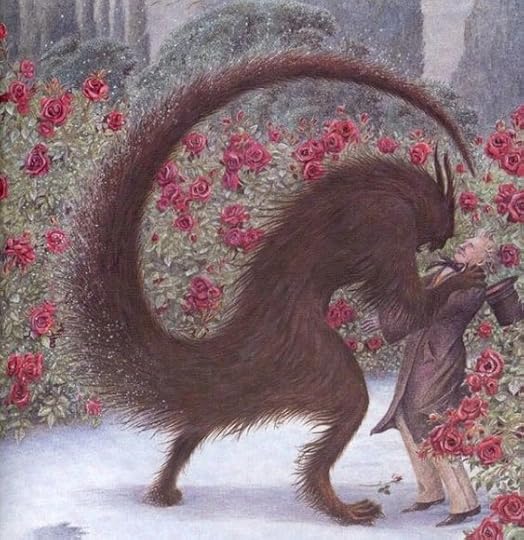
Beast is violent. Simple as that. In the tale, his only outburst is when the merchant steals his rose, and there's a reason for it. He does give the poor old man a fright and threatens him, yes, but he uses his appearance, his ferocity to intimidate. He carries no weapon and doesn't use physical violence. Eilenberg's Beast, however, is physically violent and manhandles Mr Fortune, shaking him "like a ragdoll." To add more cringe to this scene, Eilenberg has Beast go all Iñigo Montoya on the poor merchant. My name is Beast. You stole my rose. Prepare to die.

I'm not even joking!

When Beauty arrives to the castle in her father's stead, the theme of looks equal character continues. Beast refers to himself as "beast by name, beast by nature. Beast, beast, beast!" And just in case we missed the memo that ugly = bad, Eilenberg has Beauty describe him as "unspeakably ugly" and, to kick in the wound even more, as stinky. Indeed, our sweet Beauty, who never in life cared about looks for one second, here is looks-fixated and can't stop remarking on how ugly Beast is. Further ahead in another scene, she goes all "Heavens, he was ugly," and furthermore, makes this vow:

"He will not break my spirit," she vowed. "I will not show him any fear--only that I despise him for his cruelty and loathe him for his ugliness."


... Uh? Hullo! Did Eilenberg even read Beaumont? What happened to the girl that, in the fairy tale, says this about Beast?:
"You are very obliging," answered Beauty, "I own I am pleased with your kindness, and when I consider that, your deformity scarce appears."
"Yes, yes," said the Beast, "my heart is good, but still I am a monster."
"Among mankind," says Beauty, "there are many that deserve that name more than you, and I prefer you, just as you are, to those, who, under a human form, hide a treacherous, corrupt, and ungrateful heart."


Forget that girl, she doesn't exist in this book. Here, she's a hypocrite that, when the above conversation is retold by Eilenberg, she gives a dishonest reply that's also trite: Am I ugly? Yes, no, your palace is lovely, but it's true you're ugly, perhaps, but looks aren't everything. Yes or no will suffice, girl! And Beast, being the violent creep he's been depicted as so far, immediately asks her to marry him, to which she understandably but rudely replies "no, leave me alone, no!"

In the tale, Beast is kind, though he's speech-challenged as part of his curse and feels stupid (the fairy curse included his mind), but never fails to be attentive. Beauty never feels threatened or afraid, she has all the amenities, servants that take care of her, and all she could ask for, even visits to her family when she wants. She is no prisoner; there's an implicit subtext that the rose theft was a ploy to bring the person necessary for the curse to the castle. She never laments her situation as a prison. But in this version, there are no servants and no one in the castle, which is and artificial addition of a supposed "loneliness" to the plot. She's neglected and left to her own devices instead of tended to by an army of servants like in the tale, and she does think of herself as a prisoner. Of course, she stops calling it a prison the minute she discovers trinkets she likes. You understand now why so many people think, mistakenly so, that this tale is all about Stockholm Syndrome? In this version, the situation is created artificially.

Their relationship takes so very little space. Beast, who had violent impulses and at different points was described as barely controlling himself and having pitiless eyes, suddenly transforms into a sweet puppy whose tender soul Beauty is afraid of hurting. For what reason? Goodness knows. Nice girl reforms bad boy? Arsehole softens the minute a gal wags her tail at him? I don't know and I don't care. It's long been clear this is no Beauty and that is no Beast, so what difference does it make to me if they fall in love in one paragraph or in one page?

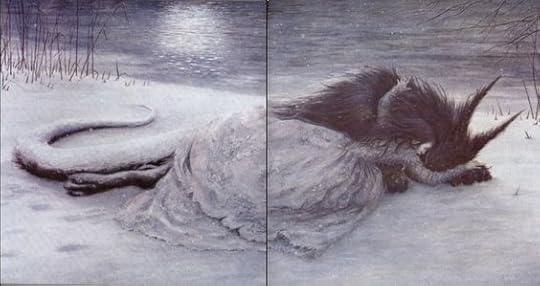
The transformation scene by the end was just the last and final kick: Even when Beauty thinks he's dead in the snow because she betrayed her promise to return, she still can't help but remark on how ugly he is. Oh, but he is "so ugly but beautiful"! So that makes it all right, no superficiality and no obsession with looks. And do forget that you read, when he is back in his human form, that Beauty calls him "handsome" just so she can clarify that she loved him when he was ugly anyway. Nothing to see here, carry on, the end.

And let's pretend we didn't read that there is not just zero explanation for the curse but not even a mention of WHO did it. Was it a he or a she? A witch, enchantress, wizard, the prince stumbled and fell in a cauldron of beastly spells? Nobody knows, we aren't told a thing. This being a retelling, the author could at least have made up a reason for the curse, but he didn't even bother to mention if it was a man or a woman. He did find time, though, to give the last words to Mr Fortune, who cheerily remarks that Beast is now an excellent gardener and has great roses.

Way to miss the point of the tale again, and again, and again.

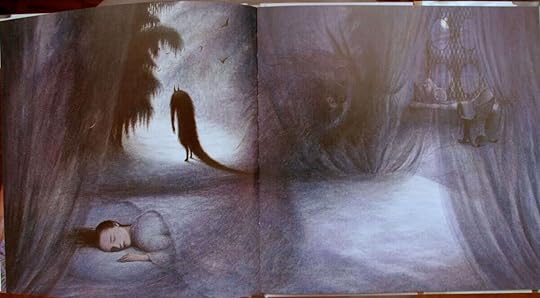
Now, to the art. I'm familiar with Barrett's style from another fairy tale I own, and it pains me to say she was underutilised and misutilised here. She's been able to capture the atmosphere of the tale, giving it a beautifully gothic mood, and gave the right appearance to the setting in the castle. However, I think she went a tad too much for atmospheric and scenic, and too little for capturing the essence of the tale, which is in the characters and their interactions and not in the scenery and mood; and for which, whilst I definitely liked the great atmosphere, hers aren't favourite illustrations of mine. I favour Beauty with Beast illustrations over the grandeur of the setting.

And this has definitely my least favourite interpretation of Beast. I'd like to point out first that this has the most un-Disney Beast I've seen, it isn't some anthropomorphic one that looks and dresses like a man but one that really looks and carries itself completely animalistically and non-humanly. However, his appearance is strangely messy, like a patchwork of animals that failed to mingle in the laboratory. Disney's Beast is also a patchwork of different animals, but he has a certain majesty and presence and you can make out his personality by looking at this mingling. But this Beast looks like a beaten dog or a wet wolverine, or... I don't know what even he is supposed to look like. He's not ugly as much as simply absurdly designed.

So that's it. Fall from grace is completed. I wish I could give this a higher rating on account of Barrett, she produces quality art and I did have my favourites from her illustrations for this book, like the one I included above, which I like because it reminds me of Cocteau's film a bit. But I can't, it's a solid case of bad text overshadowing great art.
Profile Image for jesse.
1,115 reviews109 followers
March 18, 2014

fairy tales are short stories which are read to children with the mission of giving them an important message that they will use at some point in their lives. different values and beliefs are experienced through the stories [1]. such tales helped distinguish good from evil and in many cases, fortune would come knocking on one's door and reward the main lead for making all the right choices.

with the classic opener "once upon a time", readers are thrust into the world of the beauty and the beast infused with magical realism, where the main leads are named after their physical traits.

we all know how the story goes. a widowed merchant (in most versions) and his three daughters fall from grace without a penny to their name. then one day, the father stumbles upon an enchanted castle where he seeks shelter, but makes the mistake of plucking a rose from the beast's garden and thus strikes a bargain with the beast, to take one of his daughters in his stead. so .. beauty, the youngest and fairest of the daughters goes to the beast. long story short, in the end the beast transforms into a handsome young man, whose vicious curse is lifted soley through the power of true lurv.

now, this is where it gets interesting, as a lot of people see a many different aspects in the beauty and the beast folklore ...


the disneyfication of the beauty and the beast folklore objectifies beauty or belle, a prize to be won. disney has made many changes from that original. for example, there is a battle in the end of the disney movie instead of a journey, plus they made the final scenes, a fight between two guys over girl, diminishing her role. in the original version, she has returned to him after a visit to her family, deciding to return to him out of a sense of duty, and a love she does not realize until she fights through the forest and reaches him. again, the meaning is lost in the disney retelling. disney tries to return to the archetype and in the end, as the beast lay dying, she does declare her love for him and he transforms into a prince. belle seems like a good role model, she reads and sees through gaston’s handsome exterior, but she still is demeaned into a prize to be protected and won by the end of the movie [2].

according to maria tater, the beauty and the beast was meant to emphasize the importance of virtue rather than intelligence or looks when marrying. indeed, tater's interpretation of the story can be taken further, as she also argues that beauty and the beast was a tale meant to encourage young women who were forced to marry older men. in this interpretation, the fact that the beast transforms into a handsome, intelligent prince after beauty marries him may signify the fact that a happy marriage can be derived even from those marriages in which there is a great age difference or in which the man is ugly or unintelligent. it may even serve as a way to inform a wife that she can transform her husband [3]. it has even been argued that the beauty and the beast is the prime example of the stockholm syndrome told through the lense of a fairy tale, because how do you overcome fear when you are surrounded by vileness? answer: you embrace it by finding beauty in it as well, of course.

unlike many of the other fairy tales that [the brothers grimm] reproduced, beauty and the beast contains many subtle symbols in its purest form. it shows a girl and how she transfers to a woman; it also shows that beauty is in the eye of the beholder. the one major thing that separates this story from all the rest is that beauty gets to know the beast before marrying him [4]. it shows powerfully, that the deeper you go and the more you want to know, the more meaning and value you will find [5].

book quote:
"well, you are very handsome now," said beauty, with a smile, " but i loved you anyway, the way you were." she stroked his smooth cheeks and his strong hands, pleased to see that his nose was still a little bent and his eyes just as deep, for he looked so much more interesting than the picture-book prince she had always imagined.
bonus:
» modern interpretations of beauty and the beast in film
» a short history of ‘beauty and the beast’ in pop culture
» see the whole beauty and the beast spread with drew barrymore
» k.'s review on monstrous beauty, a twisted dark tale on mermaids

sources:
[1] oppapers, beauty and the beast anthropology
[2] oppapers, disneyfication of the beauty and the beast
[3] academon, persuasive essay - a feminist interpretation
[4] studymode, beauty and the beast interpretation
[5] lynetteabel, aesthetics essay

Profile Image for Grace.
246 reviews186 followers
November 20, 2009
Wow.

I was floored, positively FLOORED by this picture book of Beauty and the Beast. I have my favorite picture books of this fairy tale, but this one simply blew them all out of the water. The pictures are absolutely breathtaking (I literally shivered and cried when I flipped the page to see one image) and the text really elucidated the classic story, drawing you in. Truly, this book made the fairy tale come alive like nothing else I've ever read...adult book or children's book.

Very very VERY highly recommended. It will blow you away.
Profile Image for Amalie .
783 reviews207 followers
June 7, 2023
Illustrations - These are very beautiful and emotional. You can recognise with the brooding, suffering, lonely beast. Also with the frightened and sensitive Beauty.

Massage - The ability to see beyond the surface is rewarded by true love.

The Beast - The best depiction of the Beast I have seen so far. All its features are frightening. But underneath that, we see the lonely, brooding creature.

Story - A rather traditional telling that stays true to the original however the narration is somewhat dry and long.


Profile Image for Sara the Librarian.
844 reviews808 followers
February 6, 2020
This is the single best retelling of this fairy tale I have ever read. Its funny and smart and absolutely lovely. No lie its also a very long retelling, took me an hour to read it to the boys last night, but nobody had any desire to stop once we got started and if we're all a little sleepy this morning it was well worth it.

This is my favorite fairy tale. There's a deep magic to it that I find equal parts beautiful and haunting. The mysterious curse that hangs over the beast and his castle, Beauty's strength and compassion in the face of adversity, the way the idea of love in all its forms is explored. There's a lot happening here!

I think the thing I like best is that you get something here that you don't really find in other fairy tales, an organic, gradually developed love story. I like the prince kissing Sleeping Beauty awake and everybody being all insta love as much as the next girl but there's something kind of cool about Beauty gradually arriving at her true feelings for the Beast, realizing her love for him only when he is gone from her life and loving him for himself not what he looks like. And I like the Beast overcoming his own dark and cruel nature, coming to love Beauty so much that her happiness matters more to him than ending his curse. There's a mutual sacrifice and sadness there that feels, I guess more honest than your average happily ever after. The happy ending in this case is fought for a bit harder and feels that much more rewarding.

This particular retelling is just so rich and funny and deep I almost don't know where to start. Max Eilenberg takes his tiiimmmeeee telling this story and the result is a perfect balance of realism and genuine fairy tale magic. You spend a great deal of time with Beauty and her family, particularly her father the brilliantly named Mr. Fortune. The story is actually book ended by charming sequences where Mr. Fortune introduces the reader to his daughters by showing off their painted portraits and ends with him priding himself on having been responsible for the match between Beauty and her charming prince.

Eilenberg's writing is simply put, wonderful. Its funny and wise and he really knows how to put an image in the readers mind. The whole book really feels like you're being told a story no one else has ever told, I'm not sure how else to put it. There's a rhythm to the writing the makes it perfect for reading a loud yet it feels almost like someone is telling something that really did happen!

I'd be horribly remiss if I didn't talk about Angela Barrett's remarkable illustrations. She's taken just a touch of inspiration from Cocteau's famous film, there's a lingering touch of darkness and genuine sadness to each picture but they are all utterly remarkable. These pictures are haunted and lovely and full of mystery. Something about her work transforms this story from a "fairy tale" to a "Faerie Tale" rife with dark magic and perhaps even a bit of pain. Her vision of the beast is sincerely frightening. But what I liked best was Beauty, because she isn't especially beautiful. She's certainly pretty, but you can see instead that her name derives more from who she is. To get that kind of concept to come through in a picture is nothing short of amazing.

I only actually stopped at one point during my reading and that was when I reached my favorite illustration which I simply must share with you. Full disclosure if you've been living under a rock this might be considered a spoiler.


I actually stopped reading and said "oh my god" and scared the kids.

There's just so much feeling here. Look at the snow blanketing the beast and the absolute despair on Beauty's face. Its just...a lot.

Can't recommend this highly enough and can't wait to add it to my collection.


Profile Image for Abigail.
8,002 reviews265 followers
August 11, 2019
This astonishingly beautiful book has managed to unseat Marianna and Mercer Mayer's lovely Beauty and the Beast as my very favorite retelling of this favorite story, and has, since I first picked it up a few years back, joined the company of those select fairy-tale adaptations - Vladyslav Yerko's The Snow Queen , Yvonne Gilbert's The Wild Swans , Sulamith Wülfing's The Little Mermaid - that I consider masterpieces of the genre. Everything about it, from Max Eilenberg's evocative expansion of the original tale, to Angela Barrett's intensely beautiful illustrations, draws the reader in: in to a world of mystery, enchantment and terror.

Fairy-tales may be beautiful, but they are rarely (unless violently assaulted by the likes of Disney) pretty, and while they frequently end with "happily ever after," it is the terror that precedes that ending which gives them their power, and allows them to speak to us still, so many years after being first put to paper. That darker side is very evident in Eilenberg's text, which places the tale in a nineteenth-century setting, explores the merchant's weaknesses (and I don't just mean the fateful plucking of the rose), and makes the Beast a truly horrifying creature. So many versions of this story envision the Beast as a man who happens to be in animal form. One always get the sense, from both narrative and artwork, that his "beastness" is something of a costume: something that he has put on, and will eventually (all going as expected) shed. Here, it seems much more a part of who he is, perhaps because the author isn't afraid, not just to make him fearsome, but to make him loathsome, with "claws dragging across the floor with a screech that set her (Beauty's) teeth on edge," and "a voice so hoarse it hurt her to listen."

Just as the terror is sharper in Eilenberg's narrative, so too are the emotions deeper, and more true. The language employed is richly descriptive and immensely satisfying, culminating in the haunting scene in which Beauty believes that she has lost her Beast: "Beauty was sobbing uncontrollably now. She had found love and lost it, and it was so much more than she had ever imagined, and the pain was unbearable. He was ugly, but he was beautiful - the most beautiful thing she had ever known - and now she couldn't tell him how much she loved his eyes and his mouth and his crooked nose, his shy kindness and the way he walked and his huge hands, because he had slipped away. 'I love you,' she cried, and her eyes were swimming with tears and the white snow was dazzling and he had gone. 'I love you,' she repeated, as if words would bring him back when the world was melting with grief and her heart bursting with pain, and it was too late and she felt herself slipping down and dissolving into sorrow." Of course, words do dissolve sorrow, and bring love back, and that is the second great strength of fairy-tales - that enchantment is made real, through language, and that the enchantment of language itself is made plain.

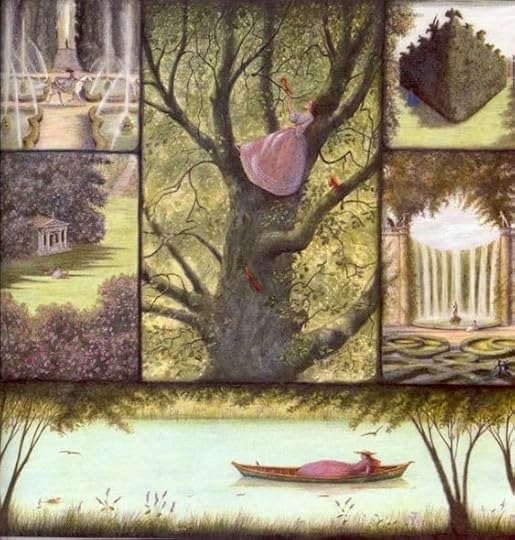
Eilenberg's narrative skillfully captures both the terror and wonder, inextricably bound together, of this tale, just as Angela Barrett brings them into the seen world, with her superlative artwork! I have long been an admirer of her fairy-tale illustrations - her Snow White is one of my favorite retellings of that story - and she does not disappoint here. There is always a sense of mystery and menace in her work - she does dark and eerie very well - even when the subject is ostensibly cheerful, and that quality makes her ideally suited to paint this particular tale. The multi-paneled page on which the Beast lurks, his tail stretched out behind him, over in the left-hand panel, as Beauty enjoys her days at his palace in some of the other panels, manages to convey a sense of lurking menace - a menace made all the more powerful for being embedded in a lovely montage of scenes in which Beauty appears to be enjoying herself. This sense of menace is more overtly depicted in the scene in which Beauty meets the Beast for the first time, gazing up at his impossibly imposing figure. Whether looking at a two-page spread - the gorgeous view of the castle, across the snow! Beauty, flung across an unconscious Beast! - a single-page painting, or her smaller inset and border illustrations, Barrett's artwork is simply mesmerizing! Truly, this Beauty and the Beast is both a visual and textual feast - I don't know how to recommend it highly enough!
Profile Image for Namratha.
1,214 reviews254 followers
June 25, 2017
"A tale as old as time"

The Disney version of Beauty and the Beast will remain my perennial favourite. Belle, the bibliophile, the Beast's grandiose library, the talking cutlery and the many aw-gee-shucks moments made this Disney Classic a much-loved affair.

And yet, reading this beautifully illustrated version left me equally mesmerized.
While this version stays true to the original (no hairy Gaston, no Mrs.Potts or Lumière), it carries you along on a wave of pure dreaminess.
The artwork. Oh, the artwork.

The soft hues, the mellow details, the clarity of Beauty's profile, the sweet furry face of Beast (not repulsive at all) and the smudged sprawling details of the Beast's estate in sumptuous detail left me gobsmacked.

We know the story. And for those who don't and want an introduction into the world of Beauty and the Beast, this edition is beyond briliant.
Profile Image for Marijana☕✨.
704 reviews83 followers
January 15, 2020
Retelling sam po sebi ništa posebno, priča nema nove elemente i dala bih joj trojku (ako i toliko), ali zato ilustracije nestvarne i one su zapravo nosilac ove knjige - zaista je više kolekcionarsko izdanje koje sam morala da imam.
Profile Image for Karen.
77 reviews
February 8, 2011
This is a really nice version from 2006; the illustrations from Angela Barrett are magical and full of rich details. The father is a sort of parody of a rich man with predictable patterns and a tendency to overlook all flaws in his family. So he fails to see that Beauty's older sisters are selfish and vindictive and he abuses the saying, "I simply can't say no to my girls." Of all the retellings of Beauty and the Beast I've read, this one is most playful with that father character. It is also the one where the sisters are most cruel. When Beauty comes back to visit her family after living with the Beast for a few months and becoming genuinely fond of him, the sisters trick her into staying longer then her promised week by rubbing onions in their eyes so as to seem heartbroken that she will depart again. As with most retellings, the Beast is almost dying by the time she returns to the castle. In this one, I was wrought with worry for him along with Beauty even though I was pretty sure the story would stick with tradition and see him saved. There is an aviary in the castle as well as a monkey room, just as in the 1875 Walter Crane version.
Profile Image for Mrs B.
19 reviews3 followers
February 2, 2016
The story is beautifully, classily told by Mr Eilenberg, even if he does use the occasional English idiom with which Americans may not be familiar (both he and the illustrator are English). The writing is pacy, emotive, and sincere in the best possible way. The language is not moon-june-spoon though it is certainly clear -- delivering on the publisher's promise that this is a tale for anybody (of the romantic bent). There is also a dry sense of humour, just enough, in the right places. Bravo, Mr Eilenberg!

As for the paintings: they are intelligent, and most are unspeakably gorgeous, and they illustrate the scenes and emotions with great imaginative flair and taste. The artist has a sensitive eye for beauty and pathos, which comes out in the delicate colouring, the scene-design, and the facial or body expressions of the characters. Angela Barrett is a rare and special artist. I shall be looking out for whatever she does that is still in print.

Why is this book not in print? It certainly lacks nothing. Perhaps it is too good.
Profile Image for Amanda.
840 reviews326 followers
January 14, 2016
This may be my favourite retelling of Beauty and the Beast, but it is most certainly my favourite Beast. The illustrations are showcased well, especially the two page spreads. I really loved all the characters-reminiscent of the original tale but with a bit more personality and private motivation. This was wonderful!
Profile Image for Linda Lipko.
1,904 reviews51 followers
March 23, 2016
Stunningly beautiful illustrations coupled with a lovely rendering of this magical tale lured me into reading this book twice.

The illustrations are simply incredible, leaving me grasping to find a word to do them justice.

When a rich merchant looses his fortune, it is his daughter Beauty who stays by him while his other two selfish daughters whine and complain and are of no emotional support.

When the merchant seeks recovery of one of his lost ships carrying precious cargo, he learns it is of no avail in helping him out of debt. Weary and lost in a blizzard, he stumbles upon a magnificent castle where food, shelter and new clothing is found.

Grateful for his accommodations and the kindness provided, he does not know the benefactor until he plucks a beautiful red rose from a lush garden.

Immediately, an angry beasts demands payment via one of his daughters who must return to the castle and remain there. When the merchant returns home saddened and very upset, it is beauty who volunteers to return to the castle.

Wanting nothing in this beautiful castle, while at first horrified by the beast, she soon learns of his inner soul of kindness and grows to think of him as a friend. When he asks for marriage, she refuses. Asking only to return home for one week, she is transported back. Staying longer than the week, she has a vision that the beast is dying. Quickly returning, in grief, she vows to marry the beast, whereupon he turns into a prince and the live happily ever after.

This particular illustrated book will remain one of my favorites. The images call to be savored time and time again.
Profile Image for Dianna.
1,954 reviews43 followers
March 15, 2010
I got this book to read to my son and it turned out to be too long for his attention span. So I'm reading it myself, and I'm really enjoying the story and especially the illustrations.
Profile Image for Sarah.
745 reviews
May 29, 2023
Beautifully illustrated! Love this book. It’s a very close retelling, which, I don’t really like the mean sisters, but it’s still well worth a read if you love Beauty and the Beast.
Profile Image for Rebecca.
1,140 reviews115 followers
November 2, 2023
This was just weird and didn't seem to understand the source material at all. Some of the art is pretty but doesn't really seem to fit the story somehow.
Profile Image for Drew Graham.
1,071 reviews40 followers
June 16, 2015
When widowed merchant Ernest Fortune suddenly loses his fortune, he and his now destitute family of three daughters relocate to the country, where they eke out a relatively meager existence. Only his youngest, Beauty, is willing to try to appreciate their new home and life, while his older daughters, Gertrude and Hermione, bemoan their material losses. After losing his last hope for one of his ships, he unthinkingly steals a rose from the garden of a mysterious castle, which leads the beastly master of the house to demand one of Fortune's daughters as a prisoner. Beauty offers to go, and soon finds her host to be more than she at first suspected based on his frightening exterior.

Mostly I picked this up because I didn't know which version of Beauty and the Beast I wanted to read for my Disney source material read-through (I ended up with this one but also Marianna Mayer's Beauty and the Beast). Overall this was all right, but I think it was a bit wordy and pretentious in the text. It's fine to embellish and add flourishes and personal touches to retellings of well-known fairy tales, but I thought the author took it a little too far here (for example, the names and details of the characters seemed a little contrived and unnecessary, though they were harmless). I'm torn as to the illustrations too. On one hand, they are gorgeous -- detailed, ethereal, atmospheric, and often presented in really cool sets like triptychs or a set of storyboards to illustrate movement or a series of actions, but on the other hand some of the character designs seem a bit off. Beauty should be much prettier, and the Beast looks like a big cat with pointy ears. Still, it's nice to see fresh interpretations of such familiar characters, and the 19th century setting made for a different backdrop.

This wasn't as groundbreaking a retelling of this story as it probably thinks it is, but it was still a pleasant enough read with some new twists and details to keep it interesting. While I wasn't crazy about some of the character designs, the illustrator did some really unique things that made it feel almost cinematic to look through.
Profile Image for Luke Miller.
22 reviews
May 17, 2017
Eilenberg's retelling of Gabrielle-Suzanne Barbot de Villeneuve's fairy tale stays true to form, although there are some twists and unique additions. In summary, the classic story is not deviated from. A beautiful daughter is ransomed to a cursed prince-turned beast, and the two eventually develop a romance.

However, what drew me to this retelling was not the liberties that Eilenberg takes in the characters (more backstory to Beauty's family than the Disney version), or the more advanced prose for a children's book, but the illustrations by Angela Barrett. Barrett's images are awash in artistic styling, and vivid colorization. Described as "florid" by other reviewers, Barrett's illustrations definitely use the medium of watercolor to add sweeping natural scenes to the story.

While Barrett's illustrations are definitely the highlight of the book, Eilenberg's writing also attempts to convey grandeur in vivid descriptions that could be overbearing for younger readers. However, as previously mentioned, the illustrations will entice readers to continue flipping through the pages.

Found through Goodreads.
Appropriate ages: 2nd - Middle School.
Profile Image for Rachel.
837 reviews100 followers
January 18, 2024
A long, but beautifully descriptive retelling of the original fairy tale adorned with magnificently detailed illustrations that beg you to stay awhile and explore each page. The comparative "opposition in all things" makes for a more brutal and violent portrayal of Beauty's sisters, which didn't thrill me, but the emotional journey with the Beast was touching and charitable and caused my daughters to express empathy more than once. The ending was a bit rushed, lacked depth, and was disappointing in the fact that it never addressed the horrid sisters. However, I did find the father's last narrative cute. I have to admit that the "pretty boy" illustration of the eventual prince--an image that seems to hound every version of this story--was a letdown. Can't an artist ever envision a manly "beastly" prince? All that said, the 20 or more minutes that my daughters and I were immersed in this tale were pleasantly passed.
Profile Image for Kimberli.
144 reviews
November 13, 2007
Max Eilenberg has created a fresh retelling of the timeless fairytale Beauty and the Beast. Set in the nineteenth century, this story pulls out all the stops with long, lyrical text and beautiful watercolor pictures that depict both the luxury and the anguish of the story. Angela Barrett's illustrations express the polarity of the story, starting with pictures of the lovely Beauty and then to scenes scattered with lush roses and the large and looming presence of the beast. This sorrowful and solitary creature is unlike any of the beasts we have seen. This fairytale is great for reading out loud, especially for those old enough to understand the meaning of true love and acceptance.
Profile Image for Gordon.
434 reviews
November 30, 2014
So many times the tale of Beauty and the Beast has been retold, but no retelling is perhaps as richly detailed both in words and illustrations. This version, written by Max Eilenberg, and illustrated by Angela Barrett, is easily the most sumptuous of the many I have read. Eilenberg's version of the story is at once absolutely filled with more than is typically told in any variation of the fable. The richly evocative illustrations set the tale in a hauntingly atmospheric Victorian world. A delightful rendition that children will enjoy reading, and adults will enjoy reading aloud.
Profile Image for MB (What she read).
2,573 reviews14 followers
May 3, 2013
Artwork is lovely.

Story? I didn't like this version of the sisters as evil, and that its 'okay' to hate the beast because hes ugly?!? I find these elements problematic in something intended for children. Not my favorite retelling of this story, for sure.

Beauty is rewarded for her beauty with a beautiful prince. There's no real character development and romance left me cold. Suggest reading Mckinley's Beauty instead.
Profile Image for Samantha.
6 reviews1 follower
May 18, 2015
This version of Beauty and the Beast has a bit of a twist on it. Instead of being captured by a cold, bossy prince turned beast, the beauty in this tale runs off from home WITH a beast.
His appearance may be a little shoddy, but he cares for her and gives more than what most other people would for her.

The illustrations are light, and really add to the story itself.
Profile Image for Jennie.
686 reviews2 followers
January 13, 2015
Beautiful words and illustrations, I love the artistic interpretation of the beast.

Great combination of author and illustrator.

I will be gifting it to my niece for her birthday.

Check it out!
Profile Image for Briana.
773 reviews
September 15, 2024
The illustrations in this book where beautiful, loved the two page spreads. The writing was charming and cute, but doesn't being anything new to retellings of this fairy tale. If you have kids read this to them, they'll love the artwork and its a quick story to get through.
Profile Image for Marielle Davis.
176 reviews
September 27, 2023
So the story of Beauty and the Beast is one that has been retold by many, many authors. It takes a LOT to make one stand out but this edition did it! For one, the art. The design of the Beast is STUNNING. It's hard to create a design that hasn't been done a thousand times before and a lot of illustrators take the easy way out by giving him an animal head and some andromorphic paws before sticking him in the clothes of a royal before calling it a day. This Beast honestly looks creepy and repulsive in the far-away shots, lanky limbs and a tail reminiscent of a reptile covered with shaggy fur, making it easy to believe why Beauty has trouble falling in love with him. The balance is struck in the few close-up shots that show he actually has quite a sweet face despite the fangs, with kind eyes and long fuzzy ears that help to disarm the reader from still thinking him to be a monster. The drawing of him lying almost dead in the snow makes him look so sad and pitiful that readers will immediately be distraught as Beauty is at the thought of him dying. Beauty honestly has never looked more gorgeous and it's easy to see her kind spirit in her face. The backgrounds are lovely and really set the tale a long time ago in a faraway hand.

As far as the story goes, it is a nice distinct version of the tale. Beauty's father, a character often overlooked in stories, gets a distinct personality and his spendthrift ways are explained more thoroughly. Beast is truly terrifying at first before he starts to warm up and become a much sweeter chimera. Beauty is possibly the only character that gets the shaft but there's only so much that can be shifted around to make her seem likable and not shallow or an idiot for not realizing the Beast is under a spell. This version of the tale is rather long, even for a Beauty and the Beast fairy tale. Unlike Cinderella, which can be told in two pages, BATB takes a long storybook to fill in all the details even when it's a truncated version. When even more details are added, as with this version, this can be a bedtime story for kids which can be stretched out to four or five days if one takes their time.
Displaying 1 - 30 of 156 reviews

Can't find what you're looking for?

Get help and learn more about the design.