

What do you think?
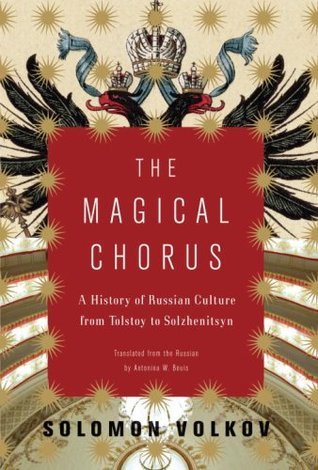
The Magical Chorus: A History of Russian Culture from Tolstoy to Solzhenitsyn
From the reign of Tsar Nicholas II to the brutal cult of Stalin to the ebullient, uncertain days of perestroika, nowhere has the inextricable relationship between politics and culture been more starkly illustrated than in twentieth-century Russia. In the first book to fully examine the intricate and often deadly interconnection between Russian rulers and Russian artists, cultural historian Solomon Volkov (who experienced firsthand many of the events he describes) brings to life the human stories behind some of the greatest masterpieces of our time.
Here is Tolstoy, who used his godlike place among the Russian people to rail against the autocracy, even as he eschewed violence; Gorky, the first native writer to openly welcome the revolution and who would go on to become Stalin’s closest cultural advisor; Solzhenitsyn, who famously brought the horrors of the Soviet regime to light. Here. too, are Nabokov, Pasternak, Mayakovsky, Akhmatova. In each case, Volkov analyzes the alternate determination and despair, hope and terror borne by writers in a country where, in Solzhenitsyn’s maxim, “a great writer is like a second government.”
This is also the story of the nation’s leading lights in painting, music, dance, theater, and cinema—Kandinsky and Malevich, Rachmaninoff and Stravinsky, Diaghilev and Nijinsky, Stanislavsky and Meyerhold, and Eisenstein and Tarkovsky—and the ways in which their triumphs influenced, and were influenced by, the leadership of the time.
With an insider’s insight, Volkov describes what it was like to work under constant threat of arrest, exile, or execution. He reminds us of the many artists who were compelled to live as émigrés, and explores not only their complicated relationships with their adopted countries but Russia’s love-hate relationship with Western culture as a whole—a relationship that has grown increasingly charged in the wake of the Soviet Union’s collapse.
Epic in scope and intimate in detail, The Magical Chorus is the definitive account of a remarkable era in Russia’s complex cultural life.
Here is Tolstoy, who used his godlike place among the Russian people to rail against the autocracy, even as he eschewed violence; Gorky, the first native writer to openly welcome the revolution and who would go on to become Stalin’s closest cultural advisor; Solzhenitsyn, who famously brought the horrors of the Soviet regime to light. Here. too, are Nabokov, Pasternak, Mayakovsky, Akhmatova. In each case, Volkov analyzes the alternate determination and despair, hope and terror borne by writers in a country where, in Solzhenitsyn’s maxim, “a great writer is like a second government.”
This is also the story of the nation’s leading lights in painting, music, dance, theater, and cinema—Kandinsky and Malevich, Rachmaninoff and Stravinsky, Diaghilev and Nijinsky, Stanislavsky and Meyerhold, and Eisenstein and Tarkovsky—and the ways in which their triumphs influenced, and were influenced by, the leadership of the time.
With an insider’s insight, Volkov describes what it was like to work under constant threat of arrest, exile, or execution. He reminds us of the many artists who were compelled to live as émigrés, and explores not only their complicated relationships with their adopted countries but Russia’s love-hate relationship with Western culture as a whole—a relationship that has grown increasingly charged in the wake of the Soviet Union’s collapse.
Epic in scope and intimate in detail, The Magical Chorus is the definitive account of a remarkable era in Russia’s complex cultural life.
333 pages, Hardcover
First published January 1, 2008
About the author
Solomon Volkov
20 books27 followersSolomon Moiseyevich Volkov (born 17 April 1944 in Uroteppa, Tadzhik SSR) is a Russian journalist and musicologist. He is best known for Testimony, which was published in 1979 following his emigration from the Soviet Union in 1976. He claimed that the book was the memoirs of Dmitri Shostakovich, as related to himself.
Ratings & Reviews
Friends & Following
Create a free account to discover what your friends think of this book!
Community Reviews
Displaying 1 - 30 of 37 reviews

April 9, 2017
Imagine condensing a 100 years of cultural history into 300 pages of incredibly dense prose with 100's of famous names being dropped into the conversation. It's a flurry of inspiration that's sure to pad your cultural TBR to keep you busy for a few decades.
I must give a cheers to Antonina W. Bouis for her translation, this must have been a challenge for her. Because this work was so heavily researched, relied on so many interviews with people who knew other people, the quotations are extensive. But as a reading experience, everything still flows where the notes are available but they don't encroach on the reading.
I think this is a book you could go into culturally blind. Only knowing that Russians wrote some famous classics, Crime & Punishment is one, they are great at classical music like that Tchaikovsky fellow was cool... oh and they do ballet well. With this level of Russian cultural history, this book could probably pull you into this deep pool of cultural wealth. But chances are, it could just seem like a lot of name-dropping if you have no plans to explore any of the 100's of cultural artifacts mentioned afterwards.
What made this such a fast read is basically three things:
1. I'm crazy about Russian literature & am glad to already be familiar with some of the works mentioned. From a literature point of view, to get the most powerful, emotional reading experience from this book, I'd recommend a few books to get you into the groove. I can't say how grateful I am to have read these first. It's only a suggested list, not mandatory by any means.
* Some of these giants' works: Tolstoy, Dostoyevsky, Chekov, Gorky, Bulgakov
* One Day in the Life of Ivan Denisovich by Solzhenitsyn & The House of the Dead by Dostoyevsky
* Matryona's House by Solzhenitsyn ... it would be awesome if you're already a diehard fan though.
* Doctor Zhivago by Boris Pasternak
* And Quiet Flows the Don by Sholokhov
* Anything by Vasily Grossman, even the beginnings of his monumental TOMES would work.
*Maybe some Nabokov or give Lolita a flip through for the language is sufficient.
2. Knowing a touch of Russian history. I just finished Red Famine by Anne Applebaum & am so glad to be reading this so fresh off that book. When the few pages of Stalin's peasant collectivization came up, it brought me right back to Applebaum's detailed explanations on this subject. Reading a biography of Stalin is certainly on my list, as heartbreaking as that would be.
3. A love of how arts & literature can be life changing. This book constantly emphasizes through examples, how crucial the arts are for social change, that the pen's mightier than the sword & we as humans are amazing at creating art regardless of the barriers.
If you have a love of the arts, need examples to make a case for why it's important for society, this book could help rejuvenate that part of your soul. The later sections of this book, Volkov goes into a bit of film & music history. There's some amazing gems to be found in these pages for the more popular art buffs.
A few great finds I'm intrigued by the premises of are the films Ivan's Childhood (that Jean Paul Sarte admired) & Andrei Rublev by Director Andrei Tarkovsky, The Russian Ark by Director Alexander Sokurov. I'm so happy for the discovery of the pop singer Vladmir Vysotsky, so far his music is amazing to me.
It's basically an encyclopedia of cultural creations, great for exploring off the beaten path.
1st Impressions:
Another one to buy and highlight. If you like author bios and their historical context, this would be a great one! I read only the first chapter. It's my next book purchase.
I must give a cheers to Antonina W. Bouis for her translation, this must have been a challenge for her. Because this work was so heavily researched, relied on so many interviews with people who knew other people, the quotations are extensive. But as a reading experience, everything still flows where the notes are available but they don't encroach on the reading.
I think this is a book you could go into culturally blind. Only knowing that Russians wrote some famous classics, Crime & Punishment is one, they are great at classical music like that Tchaikovsky fellow was cool... oh and they do ballet well. With this level of Russian cultural history, this book could probably pull you into this deep pool of cultural wealth. But chances are, it could just seem like a lot of name-dropping if you have no plans to explore any of the 100's of cultural artifacts mentioned afterwards.
What made this such a fast read is basically three things:
1. I'm crazy about Russian literature & am glad to already be familiar with some of the works mentioned. From a literature point of view, to get the most powerful, emotional reading experience from this book, I'd recommend a few books to get you into the groove. I can't say how grateful I am to have read these first. It's only a suggested list, not mandatory by any means.
* Some of these giants' works: Tolstoy, Dostoyevsky, Chekov, Gorky, Bulgakov
* One Day in the Life of Ivan Denisovich by Solzhenitsyn & The House of the Dead by Dostoyevsky
* Matryona's House by Solzhenitsyn ... it would be awesome if you're already a diehard fan though.
* Doctor Zhivago by Boris Pasternak
* And Quiet Flows the Don by Sholokhov
* Anything by Vasily Grossman, even the beginnings of his monumental TOMES would work.
*Maybe some Nabokov or give Lolita a flip through for the language is sufficient.
2. Knowing a touch of Russian history. I just finished Red Famine by Anne Applebaum & am so glad to be reading this so fresh off that book. When the few pages of Stalin's peasant collectivization came up, it brought me right back to Applebaum's detailed explanations on this subject. Reading a biography of Stalin is certainly on my list, as heartbreaking as that would be.
3. A love of how arts & literature can be life changing. This book constantly emphasizes through examples, how crucial the arts are for social change, that the pen's mightier than the sword & we as humans are amazing at creating art regardless of the barriers.
If you have a love of the arts, need examples to make a case for why it's important for society, this book could help rejuvenate that part of your soul. The later sections of this book, Volkov goes into a bit of film & music history. There's some amazing gems to be found in these pages for the more popular art buffs.
A few great finds I'm intrigued by the premises of are the films Ivan's Childhood (that Jean Paul Sarte admired) & Andrei Rublev by Director Andrei Tarkovsky, The Russian Ark by Director Alexander Sokurov. I'm so happy for the discovery of the pop singer Vladmir Vysotsky, so far his music is amazing to me.
It's basically an encyclopedia of cultural creations, great for exploring off the beaten path.
1st Impressions:
Another one to buy and highlight. If you like author bios and their historical context, this would be a great one! I read only the first chapter. It's my next book purchase.

June 21, 2022
Solomon Volkov presents a deeply researched and well-presented look into both the artistic and political culture of Russia from the nineteenth century through the turn of the twenty-first century. Highly informative and expertly translated from Russian by Antonina W. Bouis, this is a readable and well-rounded book. Recommended.

May 24, 2009
"Magical Chorus" is a typical Volkov book--very, very intelligent, very interesting, but challenging to read. Volkov's style (as brought to us by his translator) is deceptively simple, but requires multiple re-reads to follow the narrative and recall all of the players he mentions.
In this particular demonstration of his style, Volkov re-tells 20th century Russia by a discussion of its cultural icons. From Tolstoy through "Russian Ark," he shows the interaction between the highest elites of the Communist Party and the highest elites of the Soviet cultural sphere. The key word here, however, is "discussion"--Volkov relies on his own background in this area, his own encounters with these characters, to retell his story, and his style is oftentimes that of an elderly neighbor musing over memories. In addition, Volkov's memory and mastery of detail means he weaves almost *too* easily between politics and culture, dropping names right and left with little set-up of them; he clearly means this book only for those who are already masters of Russian culture.
Despite these criticisms, there's no doubt Volkov's work is one to keep on the shelf--it is a much more realistic and informative retelling of the 20th century culture than Figes' "Natasha's Dance."
In this particular demonstration of his style, Volkov re-tells 20th century Russia by a discussion of its cultural icons. From Tolstoy through "Russian Ark," he shows the interaction between the highest elites of the Communist Party and the highest elites of the Soviet cultural sphere. The key word here, however, is "discussion"--Volkov relies on his own background in this area, his own encounters with these characters, to retell his story, and his style is oftentimes that of an elderly neighbor musing over memories. In addition, Volkov's memory and mastery of detail means he weaves almost *too* easily between politics and culture, dropping names right and left with little set-up of them; he clearly means this book only for those who are already masters of Russian culture.
Despite these criticisms, there's no doubt Volkov's work is one to keep on the shelf--it is a much more realistic and informative retelling of the 20th century culture than Figes' "Natasha's Dance."

May 6, 2008
The title (taken from Anna Akhmatova’s christening of a group of her students) could’ve just as easily been *The Mystical Chorus.* Volkov persuasively shows the requisite religious fervor with which art has been pursued in Russia since Tolstoy--an issue that is reigns relevant, as Putin/Medvedev tighten their grip over current Russian culture and media.
For a State that was officially "sans religion," headed by a government that dealt with artists as violently as any persecuted religion (Andropov, the head of the KGB under Brezhnev and, later, General Secretary of the Communist Party in the early 80s, employed the terms “culture” and “ideology” synonymously), pursuing art in Soviet Russia was akin to practicing a forbidden religion or being a political dissident. As Louis Menand points out in his foreword to the NYRB's edition of *To the Finland Station,* history, too, took on a religion-like status in this supposedly (and violently) secular society: "[History:] was an idea indistinguishable from faith, and for many people Marx was its prophet." (p. xiii)
As seminal of a role as art plays in my life, it’s hard imagine the extent of the commitment an artist had to make in pursuing their work under the eyes of the KGB and the Soviet State. Volkov does a wonderful job illuminating innumerable artists’ struggles and the significance of their work, often exposing artists that never found their way into deserved recognition in the West.
Volkov’s knowledge of Russian culture is immense and personal, which makes for a rich study. He also avoids the trap of stale historiography by following the breadcrumb trail of themes, artists, and genres, rather than sticking to a chronological trajectory. This can feel a bit tangential and be hard to follow at times, but, as a whole, I preferred his style to a more “traditional” history narrative, as it often feels more like listening in on an impassioned conversation, rather than reading a historical text.
While essentially a gloss on what seems like every major and secondary artist in Russia since Tolstoy, I’m not sure that this is the place to start for readers that are just beginning their study of twentieth century Russian culture, as I sometimes had a hard time digesting the minutiae all the while keeping the “big picture” in mind, and I have studied a fair bit of Russian history and culture. That said, Volkov’s wit (kudos to Antonina Bouis, the translator, for conveying this), forceful opinions (biographical bits are often almost gossipy at times), and vast knowledge of the subject matter, make *The Magical Chorus* a wonderful read.
For a State that was officially "sans religion," headed by a government that dealt with artists as violently as any persecuted religion (Andropov, the head of the KGB under Brezhnev and, later, General Secretary of the Communist Party in the early 80s, employed the terms “culture” and “ideology” synonymously), pursuing art in Soviet Russia was akin to practicing a forbidden religion or being a political dissident. As Louis Menand points out in his foreword to the NYRB's edition of *To the Finland Station,* history, too, took on a religion-like status in this supposedly (and violently) secular society: "[History:] was an idea indistinguishable from faith, and for many people Marx was its prophet." (p. xiii)
As seminal of a role as art plays in my life, it’s hard imagine the extent of the commitment an artist had to make in pursuing their work under the eyes of the KGB and the Soviet State. Volkov does a wonderful job illuminating innumerable artists’ struggles and the significance of their work, often exposing artists that never found their way into deserved recognition in the West.
Volkov’s knowledge of Russian culture is immense and personal, which makes for a rich study. He also avoids the trap of stale historiography by following the breadcrumb trail of themes, artists, and genres, rather than sticking to a chronological trajectory. This can feel a bit tangential and be hard to follow at times, but, as a whole, I preferred his style to a more “traditional” history narrative, as it often feels more like listening in on an impassioned conversation, rather than reading a historical text.
While essentially a gloss on what seems like every major and secondary artist in Russia since Tolstoy, I’m not sure that this is the place to start for readers that are just beginning their study of twentieth century Russian culture, as I sometimes had a hard time digesting the minutiae all the while keeping the “big picture” in mind, and I have studied a fair bit of Russian history and culture. That said, Volkov’s wit (kudos to Antonina Bouis, the translator, for conveying this), forceful opinions (biographical bits are often almost gossipy at times), and vast knowledge of the subject matter, make *The Magical Chorus* a wonderful read.
August 23, 2013
Interesting analysis of Russian cultural life c 1890 – 2000 a time of political topsy turvy – Tszardom to perestroika with a revolution thrown in, Soviet Union, glasnost...
The book kicks off with the death of Tolstoy in 1910, his influence in life and death. Many less well known figures in Russia's rich cultural and complex make up I was unfamiliar with. I struggled to recall some of their names and roles.
I found the effect of regime change on cultural life more than fascinating, Stalin in particular. What a cultural enigma! Some peasant! He towers above predecessors and successors when it comes to cultural influence and knowledge. I could feel the heat and neurosis and the faltering steps over egg shells which artists experienced under Uncle Joe. I'm very keen now to read Volkov's Shostakovich and Stalin.
It amazes me that despite all the horrors the Russian people experienced throughout these years the country's cultural life remained strong and vital ( further enriched because of it?) Or is it just the nature of the Russian soul?
The book kicks off with the death of Tolstoy in 1910, his influence in life and death. Many less well known figures in Russia's rich cultural and complex make up I was unfamiliar with. I struggled to recall some of their names and roles.
I found the effect of regime change on cultural life more than fascinating, Stalin in particular. What a cultural enigma! Some peasant! He towers above predecessors and successors when it comes to cultural influence and knowledge. I could feel the heat and neurosis and the faltering steps over egg shells which artists experienced under Uncle Joe. I'm very keen now to read Volkov's Shostakovich and Stalin.
It amazes me that despite all the horrors the Russian people experienced throughout these years the country's cultural life remained strong and vital ( further enriched because of it?) Or is it just the nature of the Russian soul?

October 11, 2009
Surprisingly dull. It didn't seem to have any overall thrust or structure. It was just one anecdote after another--Gorky with Stalin, Akhmatova's persecution, the politicking over the Nobel Prize. I mean, I didn't need convincing about there being a relationship between politics and art in the Soviet Union. I guess I'd hoped for some synthesizing argument. 8/09

November 18, 2023
A chatty survey of high culture under the Soviet state.

July 31, 2017
Solomon Volkov'un Sovyet dönemi devlet-sanat-toplum ilişkilerini ve kültür tarihini incelediği kitap, alanında önemli bir başvuru kaynağı. Özellikle Stalin'in kültür hayatına merakı ve yakın müdahaleleri, ödül-ceza sistemi ve çoğunlukla Sibirya'da veya yurtdışında sürgünde sonlanan kültür adamlarının hayat hikayeleri kaydadeğer. Bilhassa Leo Tolstoy, Gorki, Şolohov, Pasternak, Ahmatova, Soljenitsin'in devrin liderleriyle ve diğer kültür adamlarıyla sıkıntılı ilişkileri ele alınmış... Sovyet tarihinin pek incelenmeyen kültür-sanat hayatı açısından ufuk açıcı bir kitap...
February 12, 2017
Another reviewer says that Volkov's style is 'deceptively simple,' and the book requires multiple re-readings to follow the narrative. That seems to me a very nice way of saying it's a disorganized mass of anecdotes, lacking any guiding thread. On the upside, some of the anecdotes are good.

April 8, 2021
bu kitabı grup halinde okuyup konuşmayı çok isterdim. anlatımı çok akıcı, politika-cı, sanata ve sanatçıya dair çok şaşırtıcı bilgiler edinirken hiç sıkılmadım. çok fazla film, kitap ve müzikle tanışmış olarak ve yeni bakış açılarıyla çıktım. ayrıca uluslararası ödüllerin politik etkisine dair fikrimi perçinledi. çok değerli bir kitap.

August 31, 2014
Dedikodular dedikodular ve dedikodular. Ama sanata ve 20. yy Rus aydınlarına dair ne varsa bu kitapta var. Adlarını bilmediğim kişileri nette arattım ve özellikle ressamlar arasında hiç bilmediğim onlarca mükemmel insan olduğunu farkettim. Biz işin popüler kısmında takılıyormuşuz.
Ve bir de, öyle bir sanat çevresi olan toplum tabi devrim yapar. Sonu pek de iç açıcı olmasa da...
Ve bir de, öyle bir sanat çevresi olan toplum tabi devrim yapar. Sonu pek de iç açıcı olmasa da...

September 30, 2018
I’m a huge fan of everything Volkov has written. He’s a great writer with special insight into Russian high culture. His musical expertise somehow translates into literary sensitivity. This book is nice survey of Russian literary snd culture achievement. Read his other books on Brodsky, Shostikovich, and St. Petersburg too.
March 17, 2024
I finished reading this October 2011.
Excellent.
Interesting tidbits about major Russian artists.
Stalin was involved in a lot of culture wars and was pretty knowledgeable about the arts. Lots of stuff here about what was happening behind the scenes.
Shostakovich, the composer was pretty prominent in this book.
Excellent.
Interesting tidbits about major Russian artists.
Stalin was involved in a lot of culture wars and was pretty knowledgeable about the arts. Lots of stuff here about what was happening behind the scenes.
Shostakovich, the composer was pretty prominent in this book.

August 17, 2009
Good but peters out after a great start - maybe its length is just not enough to do the subject justice, maybe the author just scattered himself, but I thought this could have been a great book based on its first third which is superb
September 11, 2026
This book looks at Russian culture throughout the 20th century. It starts with Tolstoy's death in 1910, and ends with an analysis of Solzhenitsyn, both during his days as a Soviet dissident, and after the fall of the Soviet Union. The author provides considerable insight into Russian culture (including literature, music, and theater/film) throughout this period. It starts after the golden age of Russian culture in the 19th century, but the author does provide considerable insight into early 20th century Russian culture. Much of it was nationalistic, and often in an extremist religious vein. I wasn't as familiar with this period, so the insights were welcome. As the book moved in to the Cold War, much of the material was more familiar. The post-Soviet era was interesting as well, as this period is not as well known in the West. Overall, I thought the author didn't go a good job early on integrating the political history with the cultural history. Both were interesting, but he could have put them together more clearly. As the book moved in to the Cold War era, the integration was better. Overall, it was a good book, but it generally didn't seem like the author knew whether he wanted to focus on cultural history or political history.

June 22, 2021
I enjoyed this book enormously. It should not be the first book a person reads about Russian culture in the 20th Century, but I would compare this to listening to a lecture on the subject from a speaker who is extremely well-informed and passionate about the subject.
Volkov is an independent thinker. He does not follow the conventional wisdom on several topics, and he explains his positions clearly and logically. I was strongly impressed by his views of Sholokhov and The Quiet Don and Volkov's discussion of Andrei Tarkovsky was subtle and nuanced, as well as very convincing.
Simply a splendid book. Highly recommended to anyone with an interest in Russian culture.
Volkov is an independent thinker. He does not follow the conventional wisdom on several topics, and he explains his positions clearly and logically. I was strongly impressed by his views of Sholokhov and The Quiet Don and Volkov's discussion of Andrei Tarkovsky was subtle and nuanced, as well as very convincing.
Simply a splendid book. Highly recommended to anyone with an interest in Russian culture.

February 12, 2018
Russian history through cultural expression – beautifully presented! One thing this book needs, however, is a study guide that walks the reader through each piece of artwork, each piece of music, film, and so on. This book evokes the volatile atmosphere of Russia throughout the 19th and 20th centuries, times of high ideals, great change, and obscene disappointment. Certainly, history is written through human interaction and reaction, and motifs of experience are played by each participant, contributing to an illustrious, magical chorus.
July 3, 2024
Na vele jaren herlezen. Het is een knappe reconstructie van de culturele wereld in Rusland in de 20ste eeuw. Interessant, maar je moet wel ehet een en ander , van Rusland weten om het goed te kunnen volgen. Volkov smijt met namen, en dan natuurlijk Russische namen, wat het ingewikkelder maakt. Hij eindigt bij het begin van het Poetin regime. Misschien komt er nog een vervolg?
November 21, 2017
Not that I like the book, but it suddenly made me think: maybe Russian literature is worth reading after all?..

April 9, 2012
this book is an amazing resource that i will likely return to again and again. as i broaden my reading of 20th century Russian writers, i will want to put them into the political/cultural context of their time and country, along side all the other artist mentioned in The Magical Chorus.
editing this book must have been a bitch. it is not overly long considering how many artists (mostly writers (journalist, novelist, poets) but also theatre and film directors, painters, and composers) are discussed .... AND .... the number of years and political leaders it covers.
the book is extremely readable. it never felt to me that Volkov was in danger of losing control of the myriad of threads he had going. neither did he lean too far in any one direction; never going off in a tangent of dry political dogma, or factual details about time and place but neither did he create tangents that were obsessive in detailing the horrific details of the prisons and camps and executions. he seemed always cognizant of the fact that others - people who had been there and lived it - had done a first rate job of recording these things. his job was to create a over view of all those voices in terms of the times ... in terms of the political explotation of culture during the communist reign in Russia. in this he succeeded ... indeed, he created a magical chorus himself.
art is political. absolutely it is. everywhere. but it is astonishing to read of a time and place where art was so feared and so persecuted. art was either propaganda (for the state) or counter-revolutionary (against the state). there was nothing that was not one or the other. art for art's sake was a myth. it's also astonishing -but in a good way- to read of the underground movement. the writers who got work published via Tamizdat (work published in the west in the Russian language and smuggled back into the country) of Samizdat (self published ... which usually meant hand-written). the banned western jazz that was copied on to x-ray film to make homemade records. the poetry that was memorized and regularly recited to ensure not a word of a beloved verse would be lost.
this is a book i will definitely return to. it's a bit of a paradox, in that, the book is a great introduction to the most notable 20th century artists and so can be a good starting place, but the most memorable parts for me were of the writers who's names were familiar -and even more so- the writers i had actually read. i don't think i would have gotten through it if every name ...well, every name but Solzhenitsyn ... was unfamiliar to me.
i see on the back cover Volkov has a book on Saint Petersburg. i think i would like to get my hands on that.
editing this book must have been a bitch. it is not overly long considering how many artists (mostly writers (journalist, novelist, poets) but also theatre and film directors, painters, and composers) are discussed .... AND .... the number of years and political leaders it covers.
the book is extremely readable. it never felt to me that Volkov was in danger of losing control of the myriad of threads he had going. neither did he lean too far in any one direction; never going off in a tangent of dry political dogma, or factual details about time and place but neither did he create tangents that were obsessive in detailing the horrific details of the prisons and camps and executions. he seemed always cognizant of the fact that others - people who had been there and lived it - had done a first rate job of recording these things. his job was to create a over view of all those voices in terms of the times ... in terms of the political explotation of culture during the communist reign in Russia. in this he succeeded ... indeed, he created a magical chorus himself.
art is political. absolutely it is. everywhere. but it is astonishing to read of a time and place where art was so feared and so persecuted. art was either propaganda (for the state) or counter-revolutionary (against the state). there was nothing that was not one or the other. art for art's sake was a myth. it's also astonishing -but in a good way- to read of the underground movement. the writers who got work published via Tamizdat (work published in the west in the Russian language and smuggled back into the country) of Samizdat (self published ... which usually meant hand-written). the banned western jazz that was copied on to x-ray film to make homemade records. the poetry that was memorized and regularly recited to ensure not a word of a beloved verse would be lost.
this is a book i will definitely return to. it's a bit of a paradox, in that, the book is a great introduction to the most notable 20th century artists and so can be a good starting place, but the most memorable parts for me were of the writers who's names were familiar -and even more so- the writers i had actually read. i don't think i would have gotten through it if every name ...well, every name but Solzhenitsyn ... was unfamiliar to me.
i see on the back cover Volkov has a book on Saint Petersburg. i think i would like to get my hands on that.

Read
January 5, 2009Read the STOP SMILING review of The Magical Chorus:
The Magical Chorus, the latest book by Solomon Volkov, a Russian émigré and veteran journalist and historian, offers a fresh and complex history of the interplay between art and politics in 20th century Russia.
Volkov begins by showing how the avant-garde played a critical role in bringing about political revolution. Many Russian artists in the early 20th century were attracted to the idea of a market-free society as extolled by Marxist and Bolshevik ideas. After a visit to America, the poet Sergei Esenin complained of the country’s lack of interest in art: “The supremacy of the dollar has destroyed any striving in them for complicated issues… Art in America is on the lowest level of development.” Russian artists would eventually ally themselves with the Bolsheviks in the hope of creating a viable alternative to the capitalist model.
Read the review...
The Magical Chorus, the latest book by Solomon Volkov, a Russian émigré and veteran journalist and historian, offers a fresh and complex history of the interplay between art and politics in 20th century Russia.
Volkov begins by showing how the avant-garde played a critical role in bringing about political revolution. Many Russian artists in the early 20th century were attracted to the idea of a market-free society as extolled by Marxist and Bolshevik ideas. After a visit to America, the poet Sergei Esenin complained of the country’s lack of interest in art: “The supremacy of the dollar has destroyed any striving in them for complicated issues… Art in America is on the lowest level of development.” Russian artists would eventually ally themselves with the Bolsheviks in the hope of creating a viable alternative to the capitalist model.
Read the review...

September 15, 2016
Volkov draws on personal memories and interviews with the cultural icons from the end of the Russian Empire to the Soviet Union and back again. He is deeply enmeshed in the history he is telling, in both lived experience and memories from others and is not afraid of leaning into the gossip and connections he has gained. This does create a more immedient sense of personalities in the book but it does also cloud some objectivity, though Volkov is never shy about noting where his story interacts with who he is writing about.
The chapters are roughly divided by political from the last tsars through each Soviet leader, but the cultural leaders are thrown together in a jumble, switching between writers, poets, musicians, and directors as each comes to political attention on a paragraph by paragraph basis. People appear and disappear between chapters, some getting full biographies and others only quick mentions. It's not a book that can be dipped in and out of, but one that requires closer focus.
The chapters are roughly divided by political from the last tsars through each Soviet leader, but the cultural leaders are thrown together in a jumble, switching between writers, poets, musicians, and directors as each comes to political attention on a paragraph by paragraph basis. People appear and disappear between chapters, some getting full biographies and others only quick mentions. It's not a book that can be dipped in and out of, but one that requires closer focus.

April 19, 2008
I gasped with horror when I looked at this book more closely and realized that it had been written by some Soviet emigre dude and translated into English. I expected dry going. But OMG, this really is what it promises to be - a masterful look at Russian culture in the 20th century. Now if someone could pick up where this leaves off and write a masterful history of popular Soviet culture from the Khrushchev era to the present day ...

September 27, 2009
an excellent overview of the complex interplay between 20th century russian politics and artists. the examination includes many luminaries, such as tolstoy, chekhov, akhmatova, mandelstam, gorky, bely, bunin, pasternak, babel, platanov, nabakov, brodsky, solzhenitsyn, prokofiev, rachmaninoff, eisenstein, karkovsky, along with many others. this book provides useful reference material for deeper investigations.
March 19, 2008
interesting, but a little gossipy. i think taking on all art forms for the entire 20th century in 400 pages was perhaps a bit too ambitious. towering figures like akhmatova, pasternak, babel, mandelstam, prokofiev, stravinsky, stanislavsky... each goes flying by in a few pages. think of this book as a very superficial overview and it's not so bad.

January 4, 2016
It's an interesting approach to the natural relation between culture and politics, in this case from the fall of the zar until the 2000's. It's well written despite the (anti)chronology style and invites the reader to go deeper into the cultural events that impacted the development and fall of the URSS.

June 29, 2012
This book was a wonderful historical work spanning the age of Tolstoy to the deatho f Solzhenitsy.
THe only drawback to this book, in my opinion, was that it didn't have a bibliography. If this book had one, I would tried some new authors. Alas, there isn't one.
THe only drawback to this book, in my opinion, was that it didn't have a bibliography. If this book had one, I would tried some new authors. Alas, there isn't one.

Did Not Finish
August 31, 2015I couldn't finish this. I'm sure it's a fascinating read, but the way it's presented is so boring and confusing with all the names that I was getting nothing out of it, and never felt like picking it up.

April 22, 2008
Fascinating book on the intersectionality of politics and the arts in 20th century Russia, and one from which I learned a lot.

May 13, 2009
It's like a Russian lit class but with the addition of all cultural fields. Awesome!!
Displaying 1 - 30 of 37 reviews