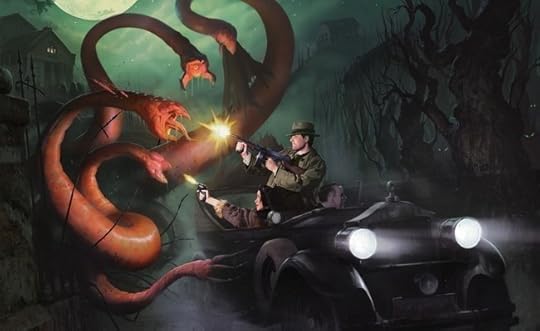
Descend into the nerve-shattering realm of America’s master of horror, H. P. Lovecraft–to a dank place where gloomy maelstroms await the unwary, where the unnatural is surpassed only by the unspeakable, and where all pleasure is perverse. Take a chance. . . . All you can lose is your sanity.
The Doom That Came to Sarnath–The magnificent city had wealth beyond measure, but no riches could save it from a ghastly day of reckoning.
The Shunned House–He vowed to rid the odious structure of the brooding horror that clung to it, but evil would not go gently.
The Dream Quest of Unknown Kadath–Desperate to understand his tormenting vision, one man begins a forbidden and nightmarish journey.
The Tomb–The old Hyde family crypt held a gruesome attraction for a boy, until he communed with the dead and learned their secrets.
The Shadow Out of Time–The quest to understand the devouring force that once possessed a scholar leads a man to the other side of the world, where all will be revealed in one hideous, unholy night.
Howard Phillips Lovecraft, of Providence, Rhode Island, was an American author of horror, fantasy and science fiction.
Lovecraft's major inspiration and invention was cosmic horror: life is incomprehensible to human minds and the universe is fundamentally alien. Those who genuinely reason, like his protagonists, gamble with sanity. Lovecraft has developed a cult following for his Cthulhu Mythos, a series of loosely interconnected fictions featuring a pantheon of human-nullifying entities, as well as the Necronomicon, a fictional grimoire of magical rites and forbidden lore. His works were deeply pessimistic and cynical, challenging the values of the Enlightenment, Romanticism and Christianity. Lovecraft's protagonists usually achieve the mirror-opposite of traditional gnosis and mysticism by momentarily glimpsing the horror of ultimate reality.
Although Lovecraft's readership was limited during his life, his reputation has grown over the decades. He is now commonly regarded as one of the most influential horror writers of the 20th Century, exerting widespread and indirect influence, and frequently compared to Edgar Allan Poe. See also Howard Phillips Lovecraft.
Introduction by Harlan Ellison Terrible Terror or, To Read Him Is to Fear Him - 5 Stars The Shadow Out of Time - 5 Stars The Festival - 3.5 Stars Celephaïs - 4 Stars The Tomb - 5 Stars The Shunned House - 5 Stars Polaris - 3.5 Stars The Other Gods - 3 Stars The Strange High House in the Mist - 5 Stars What the Moon Brings - 4 Stars The Doom That Came to Sarnath - 4 Stars The Dream-Quest of Unknown Kadath - 5 Stars
Early Tales The Beast in the Cave - 4 Stars The Alchemist - 4 Stars Poetry and the Gods - 2 Stars The Street - 4 Stars The Transition of Juan Romero - 4.25 Stars
Fragments Azathoth - 3.5 Stars The Descendant - 3 Stars The Book - 4 Stars The Thing in the Moonlight - 3.5 Stars
Mathematically, it was actually 2.75 stars for me. There were a couple of standout stories, and I will never say that Lovecraft wasn’t one of the greats, but this collection wasn’t a great read for me. I will probably read some more of his work down the road, but I’m gonna have to let the struggle of this read fade a little before that time arrives.
After a long, wonderful childhood of Lovecraftian horror films, I finally got my cherry popped. Actually, I wasn't even aware of the label "Lovecraftian" until recently watching Re-Animator and From Beyond, two awesome movies everyone should watch.
I started this book only knowing it would be dark, have monsters, and would test the boundary of sanity. Besides that vague idea, I didn't even know when or where he was born. Some guy on the inside cover called him a "rock star of horror." Imagine my surprise on being confronted by a prose reminiscent of Edgar Allen Poe. Not that I don't like Poe (whom I believe penned the immortal words, "Prose before hoes"), but the dusty classical style doesn't necessarily ring "rock star" compared to a fat line of Hunter Thompson. But as the pages turned, his strange creatures crawled into my brain.
Lovecraft is truly the king of nightmares. He's the guy that Freddy Krueger fantasizes about under the covers. So many times I've heard the word "nightmarish" strewn over writers like cheap handfuls of confetti. Lovecraft's descriptions of the dream dimension are so vividly described and elaborate that I began to question how much was fiction. Would I close my eyes that night and see the gods on the mountains and wretched giant worms wallowing at the ocean floor of my dreams?
His beautiful, dark poetry cannot be contained by the categorization of horror because it does not address the sublime nature of his work or the sense of exploring the uncharted second half of our existence when we sleep. This story collection will especially please anyone interested in Carl Jung and dream theory. Reading Lovecraft, you'll get the unshakable feeling of discovering the records of an inter-dimensional explorer.
I must confess to one thing, I hadn't heard of Lovecraft before coming into the goodreads community and I must say it was a worthwhile read. So many of my friends and others had been raving about the Cthulhu mythos in this site and when I came across this book in my library, simple curiosity made me pick it up above anything else.
I had gotten a taste of the fantastic pulp fiction through Robert Howard's Solomon Kane and this would probably count as my second foray into this field. Lovecraft is quite a master of fiction in the fantastic realms, myriad landscapes,cultures and creatures inhabit his tales. One thing i found as a "wow" factor are the details to which the author travels. A single tale set in a land borne in his imagination would have detailed thoughts on culture,civilization,lore and much much more which gives it more of a sense of completeness than anything else.
One point that i kept turning over in my mind was the fact that even when the author goes into details and talks about "Spine Tingling" terror and so on and so forth, the terror is delivered in a very sublime manner. This even though proves to be very effective at times is quite a letdown at other times.
I will go forth and fish out the Cthulhu mythos someday soon now and I would definitely want to read through the rest of Lovecraft's works too. The one tale 'Dream-Quest of Unknown Kadath' was in itself a mini fantasy epic and my pick from this collection.
Recommended to all of you with a taste for the bizzare.
Shadows of Death was the last Lovecraft compilation that I bought during my obsessive Lovecraft years. I really only got it because it included The Shadow Out of Time. None of the other Lovecraft collections that my B&N carried back then had that story in them, so I was ecstatic when I found this one sitting on the shelves.
And with all of the references to that particular story in the video game that got me seriously into Lovecraft in the first place (and the fact that, at heart, I am an obsessive completionist), I wasn't about to pass up an opportunity to read about the Yith.
It did not disappoint.
I had previously read all of the other stories in this collection - including Lovecraft's earlier works included here, and a few of his more fleshed-out unfinished stories - although I'll never turn down a chance to reread The Festival, Polaris, or What the Moon Brings.
This is one of the two Lovecraft books I managed to salvage and bring with me on my last big move, and it has a place of honor on my bookshelf. That's more because I'm a Lovecraft fangirl than anything, though. My opinion is absolutely biased.
No matter how many times I read Lovecraft, I always enjoy it. The mixture of insanity and horror resonate within my psyche. I have purposely avoided reading everything he wrote, so that each year I can get a "new" fix of Lovecraft.
This book had maybe two stories I'd never read, one of them was magnificent. All the other stories were well worth reading/rereading, too.
I don't think there's a whole lot of unread Lovecraft for me to get to, unfortunately. The cup runneth dry... :(
Take a walk into the worlds created by one of this first modern horror writers, but make sure to leave a night light on and have a handy flash light for those late-night visits to the bathroom or past other closed doors. While not perfect, Lovecraft was a notorious anti-Semetic biogot (who also married a Jew - someone answer that one, if they can), but he's world building was second to none.
Fantastic stories that take you to the dark places you never thought you'd want to go. Perhaps not night time reading material for some but definitely something you should read.
I had a difficult time reading this one. While it's a great collection of short stories (great examples are The Tomb or The Shunned House ), some of the longer novellas (I'm looking at you, The Dream-Quest of Unknown Kadath) are remarkably dull and simply boring to read. Honestly, I wouldn't recommend this if you wanted to start reading classic Gothic tales or Lovecraft in general.
Though this collection focuses on Lovecraft’s dream cycle, it’s not all-inclusive. That’s frustrating, as the tales are somewhat interconnected. We get a few story fragments, which largely seem to fit in, and a few of his earliest stories, which do not, and which largely are more interesting as a reflection on Lovecraft and his nascent writing process than in and of themselves.
A hit or miss collection of some of Lovecraft's lesser known works along with early and fragmented tales. The Dream-Quest of Unknown Kadeth is easily the highlight. Lovecraft is legendary within horror and science fiction circles, but admittedly, these were very hit or miss for me. Oh well, I have two other collections in my library, mayhaps I began with the low-light of that trinity.
It took me a long time to finish this book. While I absolutely loved the story called The Shadow Out of Time, the other stories were nowhere near as enjoyable; they even had me falling asleep! I can see their appeal at the time they were published, but they did not stir in me any horror or unease.
I'll be honest that the first short story was too much for me. Trying to figure out what he was reading versus what he did was mind bending. I greatly enjoyed the rest of the book, and save for one Lovecrafts racist tendencies don't show too badly.
The cover of this is really slapdash and terrible, this didn't use to be the norm for cheap paperbacks, if my perusals of rat-chewed horror and science fiction paperbacks at garage sales are any indication. The image is some sort of deviant art jpeg and then blood splattered on the title? Lovecraft is not about gore.
That's the thing about Lovecraft, the narrators have survived, because they're narrating the story after all, but they've survived to tell you about some ancient awakening doom that will engulf the planet and enslave us all. Or maybe they're mad. It's more disturbing than gore alone.
One who reads Lovecraft can't help but be envious of the unfortunate narrators of the stories. One feels like setting off to the most lonely and cold corners of university libraries to peruse delicate pages about the practices of ancient, blasphemous cultures. One feels like communing with the fiendish minds of an extinct race while dreaming in a rotting New England manse. All of Lovecraft has a distinct flavor that unites it, and that's why people love it so.
This is not the best place to start with Lovecraft (that would be 'The Best of H.P. Lovecraft') because it kicks off with a slow-moving and long story filled with narration and little action that is very good and characteristic of his style, but likely to scare the curious reader away. You have to be indoctrinated into his mythos before you really dig into the long stories. It worked that way for me. But this is a great cheap collection for the fan curious about earlier stories, and even stories that are not quite horror, but more whimsical and elegiac.
Lovecraft notoriously relies on mood rather than piddling concerns like dialogue or plot, so it's perhaps not surprising that his longer works falter. That's particularly true in this collection, which contains the mind-numbingly dull "The Dream-Quest of Unknown Kadath," which left me longing for a Lovecraft/Nightmare on Elm Street crossover wherein I could send Freddy Krueger after Randolph Carter to finish the meandering bastard off once and for all.
The other issue with this particular collection is that most of the tales, like the aforementioned horror that is "The Dream-Quest", are set in worlds totally of Lovecraft's fevered imagining, which seem to sport a lot of showy lapidary work but not much else. Characters move through strange realms as if there were a spotlight upon them, illuminating only what they approach without ever giving any kind of clear view of the world as a whole (or why all the realms seem so hung up on decorative stone work). Frankly, the author's work is more effective when he brings this kind of nebulous feeling to a more familiar setting, like his storied New England. That breeds horror; the other just breeds the desire for a roadmap, a good flashlight, and possibly a fence who deals in lapis.
Still, if for no other reason this collection is worthwhile for the inclusion of the three page short "The Book," which is utterly delightful for taking the concept of books changing your life and turning it on its head and giving it tentacles. Sadly, this book fails to pack the punch of that story's worm-riddled tome.