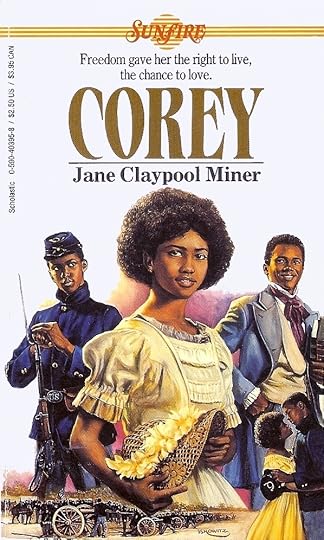
Freedom gave her the right to live, the chance to love. She escaped from the South to the North, where a boy captured her heart. In 1864, 16-year-old Corey has known only slavery. But she is courageous and spirited, and though Ned, a handsome slave from the same South Carolina plantation, hopes to marry her some day, Corey longs for a better life. Then the Civil War tears Corey's family apart, but Corey escapes from slavery. Freedom isn't easy, however. Corey can't find her family, and Ned tells her he is running off to fight. Corey has no one left she can trust, so she heads north to Philadelphia. Here she finds a new home and new friends. And she meets Penn Wilson, a dashing young man who captures her heart and introduces her to a new, free world. But when Ned asks Corey to go West with him, the choices freedom brings seem harder than ever. Will Corey join Ned? Or will she return to the South to help her people - alongside Penn?
Oh look! A young woman of color gets to have romance in this Sunfire book! I haven't read this one, but I think I will try to track it down via interlibrary loan. I want to read it, especially since it will work for my librarians read challenge.
UPDATE: I was surprised by how short this book was. In my memory, the Sunfire books were really long, three or four hundred pages. Is that just my imagination? This one was only about 170 pages.
All in all, I enjoyed reading this book. There was the teen romance aspect of it, which was just as cheesey as I expected, but it actually at least touched on some real issues like black soldiers in the Union army not getting paid, class being a factor in how people were treated, and the problematic nature of the US army using black soldiers to fight against Native Americans. I didn't expect any of that in a teen romance book.
We have Suitor #1: You must settle down and have my babies and clean my house because I am the MAN! Then there's Suitor #2: You must follow your dreams! Because you are independent and feisty! And beautiful!
I read this book as a fourth grader and, nearly 30 years later, vividly remember the title and the cover art so that I was able to easily search for and identify this book. As corny as the text may be, the story of Corey's journey to freedom left a lasting impression on me. I believe this book -- with its strong, capable and intelligent black female lead -- shaped my views of race and left a lasting intellectual and social impact on me that resonates to this day. I am ordering Corey for my 10-year-old daughter so this book can hopefully become a part of her life like it was in mine.
Historical fiction is my all-time favorite genre, but in my adult years, I haven't reached for American Civil War novels that much. In the past, I found that the way certain authors handle the topic of slavery and enslaved people can be pretty "cringe" for me.
Thankfully, in our current time, more Black American authors have been getting the chance to present their own perspectives in historical fiction, also shedding light on the fact that there's so much more to the history of Black people than slavery.
Even so, I have a variety of tastes, and I still like searching for old books as much as new ones. I recently found out about the Sunfire series of more than 30 standalone young adult historical romances that were published back in the 1980s, and the lovely cover of Corey stood out the most to me.
Yup. The one novel in the series that features a Black heroine. While I didn't take that to be a specific reflection of the author herself, I decided to check the novel out.
Now, there's one issue I ran into early in the book that isn't the biggest deal. But for the sake of today's historical fiction writers and readers, I think it's worth it to address this anyway.
In the opening chapter, a woman who goes by the name "Moses" shows up. Many readers would recognize that she's actually Harriet Tubman, and the narrative repeatedly refers to her as "the old woman." Corey figures that this formerly enslaved woman, who albeit moves "like a teenager," must be in her 60s.
I imagine many Americans today also think of Tubman as fairly old. To her credit, she did live to be somewhere in her 90s. However, she was much younger than her 60s during the Civil War.
Granted, even though people in the United States generally didn't live as long back then as they do now (and life expectancy among Black people was even shorter, due in significant part to slavery conditions), if I were depicting Harriet Tubman in a Civil War novel—especially in a novel for young adults—the narrative wouldn't refer to her as an "old woman." Why? Because Tubman was actually only in her early 40s at the time. Besides, people who fight for social and civil change—revolutionary thinkers and movers—oftentimes start fighting as younger people, not older ones.
For instance, Rosa Parks was only 42 when she sparked the Montgomery Bus Boycott, and she'd already been a civil rights activist for over a decade by that time. Martin Luther King, Jr., who delivered his "I Have a Dream" speech when he was only 34, had already been prominent as an activist since his mid-20s. And, yes, Harriet Tubman was also in her 20s when she escaped from slavery and started the work of leading more of her people to freedom.
It can bring quite a shift in perspective on historical events when you don't automatically present or view historical figures as old, and when you also realize that much of America's collective past didn't happen that long ago.
(No, when we talk about the woman "Moses" and the era of American slavery, we aren't talking about ancient history. Tubman was still alive while people were driving cars and when the Titanic sank.)
One more note on the subject of Tubman. See, President Lincoln's ultimate political goal during the war was to keep the Union together, not to abolish slavery, so he didn't take a political stance for the emancipation of all enslaved people. I'm glad that the novel briefly touches on this, but it doesn't mention the fact that Tubman was one of the abolitionists who spoke wisdom on this issue specifically in regard to the president. Saying that the president should set the enslaved people free, Tubman declared, "God won't let Master Lincoln beat the South until he does the right thing." Because Tubman and Lincoln are both in this novel, it would have brought Tubman's Chapter One appearance full circle later on if the author had included at least part of what the abolitionist had to say concerning the president.
Well. I'm saying a lot for a book review. Maybe this is another reason why I don't read many Civil War novels.
Anyhow! As for the art of fiction, I found the unfolding of the plot in this book to be spotty at times. The characters aren't as developed as they could be, and a number of moments would have come alive better if there'd been more emotional flavor added. At certain points in the middle of the read, significant stuff happens, but the story doesn't do much to indicate or show how Corey must feel about all of it.
Moreover, one critical turn of events pops up so late that it makes the novel's ending feel abrupt.
Nevertheless, I imagine "middle school me" would have rather loved this novel if I'd discovered it back then. And still as a longtime lover of historical fiction and old books, I actually had a hard time putting this novel down. I plan to check out more of the books in this series.
Note: • some relatively brief depictions of war violence • one appearance of a racial slur, but not the N-word; no other profanity • the romance doesn't go further than kisses
I originally read this series back in the 80s, checking them out from my elementary school library. Having re-read them as an adult I think they stand the test of time and are still relevant as far as historical fiction is concerned.
I read this book when I went through my historical romance phase back in junior high school. Very moving story and historically accurate. I enjoyed reading this book although I was torn about the ending.
Nostalgia read- This book is part of the Sunfire series of girls set in a historical period of time. My biggest problem with this book is the weighty subject matter being told in 170 pages. The topics of slavery, Civil War, and the assassination of President Lincoln are much to big for this format. I usually like Miner's books (there are many different authors in this series, some better than others) but the subject matters in this book do not fit the Sunfire format in my opinion.
*Rereading my way through the Sunfire series, in publication order*
Sixteen year old Corey is a slave on a South Carolina plantation. She has it somewhat better than others on the plantation, working in the house and learning to read, but she still dreams of escaping for a free life in the north with her mother, sold to a neighboring family four years ago. She gets her opportunity when the war reaches their plantation. Along with her sweetheart Ned and a shoeful of money, Corey sets off north on the Jubilee Trail, in search of both her mother and a life of her own making. She finds the latter in Philadelphia at a Quaker school, where her education is respected and encouraged, and in the possibilities offered by a new love interest, writer, abolitionist, and principal Penn Wilson. Poor Ned, illiterate, impractical, and unable to see ambition for either himself or for Corey, doesn't stand a chance. It's easy to dismiss the "So you want to stay home and have my babies, right?" suitor in a Sunfire, but it seems almost unfair to dismiss Ned so summarily, as he doesn't necessarily speak from a blinkered or patriarchal viewpoint, but rather one built upon a lifetime of doing what one is told and not expecting anything beyond that. Miner does handle the divergence of their relationship gently, but I think she could have taken it in a different direction than the usual Sunfire trope.
Overall this is a good addition to the Sunfire series, with solid history and a nice character arc for Corey. As the only Sunfire featuring a woman of color, its short length is unfortunate (it's a slim 170 pages), as Miner could have done more with this smart, determined heroine and her story. But a satisfying read nonetheless.