Nothing obsessed explorers of the mid-nineteenth century more than the quest to discover the source of the White Nile. It was the planet's most elusive secret, the prize coveted above all others. Between 1856 and 1876, six larger-than-life men and one extraordinary woman accepted the challenge. Showing extreme courage and resilience, Richard Burton, John Hanning Speke, James Augustus Grant, Samuel Baker, Florence von Sass, David Livingstone, and Henry Morton Stanley risked their lives and reputations in the fierce competition. Award-winning author Tim Jeal deploys fascinating new research to provide a vivid tableau of the unmapped "Dark Continent," its jungle deprivations, and the courage—as well as malicious tactics—of the explorers.
On multiple forays launched into east and central Africa, the travelers passed through almost impenetrable terrain and suffered the ravages of flesh-eating ulcers, paralysis, malaria, deep spear wounds, and even death. They discovered Lakes Tanganyika and Victoria and became the first white people to encounter the kingdoms of Buganda and Bunyoro. Jeal weaves the story with authentic new detail and examines the tragic unintended legacy of the Nile search that still casts a long shadow over the people of Uganda and Sudan.
Tim Jeal is the author of acclaimed biographies of Livingstone and Baden-Powell. His memoir, Swimming with My Father, was published by Faber in 2004 and was shortlisted for the PEN Ackerley Prize for Autobiography. He is also a novelist and a former winner of the John Llewellyn Rhys Prize.
Maps.....where are the maps!!!!!! This book which tells of the obsession of the British to find the source of the Nile in basically uncharted Africa and of the intrepid explorers who sought it is an interesting tale. But using the names of the areas of Africa, which before colonization and eventual independence, were so different from what we are used to, that it is easy to get confused as to exactly where these explorers and various rivers were located. African heritage and place names should be preserved but at the least, the author could have put the more modern name in parenthesis or used some other device to clarify geographic locations. The use of the two or three maps that the author included was insufficient.
Now that I have gotten that out of the way.........this history concentrates on a handful of the greatest explorers of Africa and their various reasons for doing so....to bring Christianity to the people, to stop the Arab slave trade, self aggrandizement, possible colonization, or just the love of adventure. We learn about John Speke, Richard Burton, Samuel Baker, David Livingstone, and Henry Stanley and the public and private antagonism among them. The author has a particular dislike for Sir Richard Burton which sometimes interrupts the narrative with pages of dissertation of Burton's faults.
Ravaged by all sorts of diseases unknown at the time and with only quinine as medication, they faced warring tribes, cannibals,unending swamps, tropical heat, and the lack of any type of rapid communication. Their treatment of their African porters and guides was less than honorable in most cases and unconscionable in some cases. But they pushed on and not all would return.
The last two chapters of this book examine the modern result of these explorations which brought colonization to Africa and the tragic consequences suffered because of it in Uganda and the Sudan to this day. It is a slow and sometimes confusing read but provides some excellent insight into the exploration of Africa.
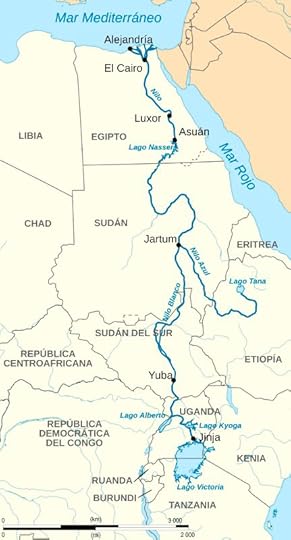
El origen del Nilo fue un misterio durante milenios, nadie sabía de dónde venía ni el porqué de las crecidas que tenían lugar en los meses de verano. Hasta Alejandro Magno preguntó por ello.
Formado por dos ramales, el Nilo blanco y el Nilo azul. Mientras el blanco tiene su origen en el corazón de África, el azul llega desde Etiopía. A este ramal llegaron dos jesuitas españoles en el siglo XVII Pedro Paéz y Jerónimo Lobo. Esta autoría se la apropió un escocés que llegó 40 años más tarde y no dijo nada de los españoles.
Tim Jeal cuenta la historia del descubrimiento de la fuente del Nilo a través de los exploradores que lo hicieron posible. Nombres como Livingstone, Speke, Burton, Grant, Baker y Stanley lo intentaron varias veces. En condiciones precarias, a pie, atravesando la selva con porteadores que caían muertos por cansancio o atacados por indígenas hostiles. La mayor parte del tiempo sin saber dónde se encontraban, perdían sus brújulas, - el Dr. Livingstone estaba la mayor parte del tiempo perdido por ir a su bola- los exploradores estaban siempre enfermos de fiebres atacados por insectos.
Yendo de lago a lago se encontraban con traficantes de esclavos musulmanes o con tribus que los retenían meses en sus poblados. Los problemas entre ellos mismos por celos o traición como el caso del infame Richard Burton contra Speke. Los tejemanejes en Inglaterra para ver quién se llevaba la gloria duraron muchos años.
Pero el libro no acaba con el descubrimiento. Una vez desvelado el enigma del sistema de las cuencas africanas se celebró en Berlín en 1884 una conferencia en la que Inglaterra, Francia, Bélgica y Alemania se repartieron África haciendo las fronteras desde Europa. Se cuenta la carambola que unía a Alemania con el territorio que habían explorado los británicos y el porqué del Congo y Bélgica.
Muy interesante el libro, reúne todas las vivencias de los exploradores, las intrigas en Inglaterra y luego da una explicación sobre lo que supuso para la zona todo esto. Había que trocear el territorio, Sudán, Uganda, Kenia, Tanzania, etc.
An excellent book, it would have received five stars if it weren't for the author's fanatical hatred of Richard Burton. According to Jeal, Burton did nothing that wasn't utterly despicable. Jeal will bring out the same quotes multiple times to prove his point. When talking about Burton, his writing devolves into rhetorical questions and reads like a high-school essay. I understand that he is reacting to the sensationalized portrayals by other biographers, and Burton himself, who was certainly one of history's greatest self-promoters. He's not the most likeable man, but Burton and Speke both behaved like children after their African adventure together, which is not the story Jeal tells. According to Jeal Speke was the perfect gentleman and Burton the lying coward. He spends a lot of time on Burton's character, even naming one of his chapters "About a Rotten Person." Reaction or no, this is not good history. Burton was a complex character and deserves better in this book than to be reduced to a cartoon villain.
The counterpart for Burton is Livingstone, and though Jeal accuses other biographers of hagiography, he certainly commits the same sin. When Livingstone is prevented from seeing if the river flowing out of his lake is going north (toward the Nile) because he simply can't buy boats from the suspicious natives and has to leave without knowing, Jeal portrays is as a tragedy. When Burton and Speke have the same problem, it's a failure in their character. Jeal even says Livingstone would never have allowed himself to be thwarted by such a thing, despite having previously described a very similar situation in which he was.
That aside, the book is rich in beautiful detail. It clearly describes the problems and dangers these men (and women) faced. At it's best, it is a rollicking adventure book. Jeal takes a very sensible approach to the benefits and problems of colonialism in Africa, and shows how some decisions have led to terrible problems (and others to to prosperous nations) today.
I highly recommend this book. Just read another Burton biography to get some perspective.
I had one complaint about this book, there is no real good map of the region so you're able to orient yourself. It was very interesting in describing their present through today.
Retread of The White Nile focusing on the explorers' interpersonal rivalries. Jeal's raison d'être is showing John Speke as the true hero of Nile exploration, while conversely denigrating Richard Burton as a racist, perverted egomaniac. He handles other figures (Stanley, Livingston, Baker, etc.) unremarkably. Most interesting are the sections showing the long-term effects of European exploration. Otherwise, stick with Alan Moorehead.
This book describes the lives of various explorers of the source of the Nile. They were an intrepid group – they had to be – the search was more than arduous through a vast terrain infested with multiple parasites (mosquitoes, tsetse flies...). They would have to bargain for rights of passage with the different indigenous peoples they encountered who were also fighting with slave dealers.
As the author points out these individuals (David Livingstone, Richard Burton, Samuel Baker and his to be spouse Florence von Sass, and Henry Stanley) were not empire builders – they were strong individualists who could not fit into the mainstream of their society. Mr. Jeal illustrates well the rivalries (and friendships) that evolved between them and their benefactors.
Unfortunately what they did, led to empire building as the author demonstrates in the last quarter of his book.
For a further depiction of Henry Stanley see the magnificent book “Stanley” by this same author.
I liked a decent amount of this book, but there were large parts that I didn't think really fit with the rest. It's hard to explain, but all the stuff at the end didn't seem to be about the Nile anymore. There wasn't enough actual exploring to keep me happy. There was some, but then there was a lot of wars and politics that seemed to have nothing to do with the Nile and it bored me. When it comes to HM Stanley, I actually find his expedition to "save" Emin Pasha more interesting than his finding of Livingstone, but I don't see why it was included in this book at all. I don't mind because it's interesting to me, but it illustrates my argument that this book was all over the place when it came to subject matter. The other books I've read about this era and topic, The Last Expedition by Liebowitz and Into Africa by Dugard, I thought were considerably more readable (I've actually read the Liebowitz one twice, I liked it so much).
Normally i find the British Empire and the Victorian Age fascinating but this was a bit dry at times and as other reviewers have mentioned it needed more maps. Not terrible but not great either.
For some reason, back in the mid-1800s, the source of rivers was considered an important scientific/geographic question to the Brits. Therefore, given that the Nile was one of the greatest rivers in the world, the discovery of its source was one of the greatest scientific/geographic questions. Numerous explorers braved disease, dangerous animals, hostile tribes, heat, famine, mud and insects to solve this unimportant mystery. As a secondary goal, they hoped to open the African interior to the ivory trade and as a tertiary goal these explorers also hoped that opening Africa to Europeans would also Christianize the continent and bring an end to the Arab slave trade, which they heartily despised.
You’ve probably heard the quote “Doctor Livingstone I presume.” It was (supposedly) spoken by Henry Morton Stanley, a reporter who ventured into the heart of Africa to determine the fate of David Livingstone. Well, Livingstone had disappeared and was presumed dead while searching for … you guessed it … the source of the Nile. A quest that ultimately claimed his life in 1873.
Explorers of the Nile: The Triumph and Tragedy of a Great Victorian Adventure by Tim Jeal provides a detailed account of several of these explorers in addition to Livingston and Stanley, including: Richard Francis Burton, John Hanning Speke, James Augustus Grant, Samuel Baker and Florence von Sass (none of whom I had heard about prior to reading this book). Jeal credits Speke with figuring out the upper watershed of the Nile and attributing Lake Victoria as its source. In fact much of the book is dedicated to burnishing Speke’s reputation and trashing that of Richard Francis Burton feeling that the former had largely been forgotten and that the latter has received more notoriety than was his due (no doubt in part because of his flamboyant personality and tireless self-promotion).
The last part of the book provides a comparatively rushed account of events that occurred following this period of exploration. Basically, there was a “scramble for Africa” among European powers as they strove to expand their global influence through colonialization. The Belgians (Congo), British (Egypt and South Africa), French (Algeria and West Africa), German (Cameroon, Southwest and East Africa), Italian (Libya and Somalia), Portuguese (Angola, Mozambique) and Spanish (Morocco) all established colonies to the point that by 1914 almost 90 percent of the continent was under European control.
The effects of colonialism were … let’s just say … complex, and are only touched upon in the book. Needless to say, it changed the country’s destiny and the effects are still seen today.
As to the book, it was fine, though rather too long in my estimation and detailed to the point of minutia. Also I felt like Jeal didn’t really have a clear vision for the book. It’s part Victorian adventure, part biography, part personal editorial and then it’s wrapped up with a hurried account of Britain’s colonial ambitions on the dark continent. I think it would have been better served by being more concise and focused.
An absolutely brilliant book on a time of geographical exploration when the goals were noble and the men were made of sterner stuff - at least those who weren't carried over most of their journeys in malarial-induced fevers. Eminently readable, Tim Jeal has put together a synopsis of the Nile source search that covers all the major players, their motivations and the terrible trials and tribulations they undertook, ostensibly in the name of science, but more realistically for a gamut of other more worldly reasons. I loved his take on the big Burton vs Speke debate, and his portraits of both Livingstone and Stanley as men whose conflicted ideals shouldn't mask the substance of their achievements. I certainly could have used more in the first section, covering the individual journeys into the interior. The description and detail were outstanding. I am glad, however, that he saved some space at the end to follow up on how these explorer's seemingly irrelevant (if you believe the idea that these were undertaken simply to fill in blank spaces on the map, one that Jeal disputes with gusto) forays into deepest, darkest Africa set off a chain of consequences that explain many of the problems still plaguing the region now.
A rare book review from me. I did enjoy the book, though I was a bit disappointed that it didn’t cover the earliest Nile expeditions, focusing only on the Victorian era through to the mid–20th century. What was most interesting was the book’s treatment of Speke, which was a bit different from others I’ve read. To be fair, I’ve long been a fan of Burton and have mostly read biographies that show him as more of the hero—despite how difficult and disagreeable he could be. I’ve always thought that Speke bumbled his way into the history books on Burton’s coattails, something I still think despite the author’s more generous take on him. However, the book did make me respect Speke more than before, and I may even try one of his few biographies. Speke is a bit of a weird character in the history of exploration—he was credited with finding the source of the Nile, yet he is mostly unknown. Unlike Burton, who has many biographies, Speke has perhaps only one modern biographer. While Burton himself did not find the source, it was his expedition—and I still think that Speke bumbled across it while out on a hunt or something. Though honestly, to me, Burton was probably the most interesting man in the Victorian era, and his level of awesome is higher even than Theodore Roosevelt.
This particular book takes a tough line that manages to point out that European imperialism doesn't have as much negative things about it as one might expect when it comes to Africa. The state of Africa before European imperialism, far from being a paradise, was a place where Islam was rapidly spreading its influence and where small peoples were being destroyed through the spread of the forgotten Islamic slave trade. The author, without being a huge fan of imperialism, recognizes that the horrors of the East African slave trade did justify European intervention and that the ideals of the Europeans were not wholly evil and their behavior towards the Africans was often idealistic and featuring better government than Africa has known since then, even if Africa has not paid off its promise of providing a worthwhile market for European products to the extent that was hoped for. Nor did Africa prove to provide rich places for European or Indian settlers, as those people attracted hostility and persecution once Europe no longer ruled over the area. The misrule that Africa has seen since independence is, alas, all too easily recognized as well, although the author notes that Africa's triumphs are often neglected because hey don't fit into the narratives that people want to use to promote generosity to Africa.
This audiobook is twelve cds long and it is divided into two sections. The first section, and longer one, looks at the various Victorian adventures that sought to understand the sources of the Nile. We see the rivalry between Burton and Speak, from Burton's unconventional lifestyle to his attempts to sabotage Speak, who ended up dying young and not being given the credit he deserved for his discovery of Lake Victoria and his understanding of the lake as the source of the Nile. After that the author talks about such explorers as Livingston, Stanley, and Baker, among others, discussing how it is that the Great Lakes region was divided into various watersheds, which required numerous exploratory missions, lots of deaths, and eventually brought European powers to seek to colonize the area. The second part of the book then discusses the tragedy that Africa suffered under imperial rule, including a discussion of the struggle over the water of the Nile River and also the suffering that resulted to South Sudan as a result of the division of the Nilotic people between domination by Sudanese Arabs and by Bantu Ugandans, themselves burdened by ancestral enemies.
Was the Nile search worth it? The Nile River has a complicated course, with beginnings in the Ethiopian Highlands as well as in the area south of lake Albert and also in Lake Victoria and a couple of rivers that come out of Rwanda and Burundi. The efforts to uncover the source of the Nile led brave and idealistic and ambitious Europeans to suffer a great deal of irritation and danger and sometimes even death at the hand of African diseases as well as African rulers who were complicit in the Islamic slave trade. The author explores the contingent nature of the history of the area where Britain and France were able to avoid going to war and where Britain rather than Germany ended up securing the Great Lakes region of Africa as a whole. If imperialism is not generally viewed very highly by contemporaries, the efforts against the slave trade and the spread of Christianity in Africa that helped to limit the spread of Islam can all be counted as good things. By and large, if this book has a tough line to draw between its praise of ideals and its desire to give proper honor both to Europeans and Africans, it is an easy enough book to appreciate for its attempts to be fair-minded.
Biography tends to be regarded somewhat askance among academic historians, particularly those working within universities and institutions of higher learning. And that is a pity, because so much of history as a popular source of knowledge of nations, countries, and world events comes to us through that filter. And then there are works such as Tim Jeal's, which lift the genre to an even higher estimation.
Jeal's work on the Nile explorers of the nineteenth century is that important. It revises the assessment mostly handed down for the past 150 years or so of John Hanning Speke as an opportunist who stole the glory appropriately belonging to Richard F. Burton. Jeal shreds that argument apart through his investigations of Burton's and Speke's own works and the heretofore unknown documentation now available from recently discovered archival material, manuscripts, and writings. What emerges is a portrait of Speke as an irascible individual who promoted himself rather poorly. Yet he is seen as someone who is also forthright, dogged, and possessed of a strong moral sense. The same cannot be said for Burton, who Jeal successfully proves spent a lifetime building a publicity campaign attacking Speke while generating undeserved praise for himself.
That is at the core of the book. There are also chapters on Stanley and Livingstone and Samuel Baker. Jeal makes the case that each man, even Burton, was sincere in their opposition to slavery. And their proposals for free trade and commerce were built upon a true humanitarian desire to see central Africa develop the means and strength to protect itself from slavers. Jeal doesn't hold back on these people's shortcomings, but he gives them their dues as men interested in projecting their faith and sincerely seeking out knowledge for the betterment of mankind.
In achieving this goal, Jeal also neatly delineates between this era of exploration and adventure and the one that immediately came after, the so-called "Scramble for Africa" and inroads made into Africa by European imperialism. They are separate ideas, according to Jeal, with the exploitive commercial nature and power politics of the latter era desperately different in motivation than the decades in which Livingstone, Stanley, Baker, Speke, and Burton actually hoped to intervene to stop an evil practice, slavery. For those interested, an even greater revisionist effort is put forth in Jeal's subsequent independent biography of Stanley.
If there is one weakness in this book, it comes with the last two chapters. For some reason, Jeal goes off on a tangent and writes about "what if." He spends too much time fantasizing about what could have happened had British policy in particular been different in Darfur and in Uganda, the area designated as Equatoria. If only a separate Equatoria had been carved out, muses Jeal, then perhaps there would have been no Sudanese civil war and perhaps no Idi Amin in Uganda. Too much irrelevant speculation, here, because it didn't happen. Still, a landmark history of Africa and Britain's role, there. And written with fairness.
I read Explorers of the Nile in part because I enjoyed Tim Jeal’s book on Stanley, and this in many ways takes up that story where it left off. The tale gets quite complicated, not least because what might be the common-sense assumption, that explorers of the Nile started off by sailing up the river from its estuary, is largely wrong. The key discoveries were made by those who entered the interior of Africa from the Indian Ocean coast, notably from Zanzibar. Unless you have an atlas open – and especially if like me you read the book with the pathetic maps available with the Kindle edition – the geography is often difficult to follow.
Nevertheless Jeal does a good job, managing to combine the entertaining if often horrific adventures of the explorers with a largely sensitive account of their impact, both on the indigenous people that they met or employed, and on the slave traders who bedevilled the region (and whose protagonists often knew the geography better than the explorers, even if they didn’t join up the dots to link the Nile to its source). Jeal’s latest book is also more adventurous in looking at the longer-term implications of the penetration of Africa by different explorers and what happened as – at the end of the nineteenth century – the region first became properly colonised. He takes this story, in inevitably sketchy form, right up to the period of decolonisation and its consequences, such as the emergence of the Mau-Mau and the expulsion of the East African Asians.
He even reviews the subsequent history from the likely viewpoints of the notable explorers such as Livingstone, Stanley, Speke and so on. Jeal is responsible, in this book and previous ones, for a considerable reappraisal of the key personalities of the era, often using sources that have only been available in recent years. These reappraisals, of men like Stanley and Burton, will certainly endure. He is building up a definitive and accessible history of a complex place and period, that is also very readable.
Come on. This book is a thinly disguised screed against Richard Francis Burton, and a vehicle to further the author's passionate agenda of rehabilitating the historical reputation of his rival, Speke. The otherworldly accomplishments of Burton are comically understated, while any perceived misjudgment of Speke's is considered with extreme open-mindedness. This reaches the height of absurdity when Jeal dismisses the man who famously underwent adult circumcision to further his explorations as "sybaritic." Jeal seems to think highly of Speke's acumen in navigational technology as a hallmark of an accomplished explorer, while Burton's focus on anthropological investigation is treated as a somewhat trivial and irrelevant interest.
Other than that, the book is simply written in a dull manner. Geographical laundry lists of the explorers' travels are preferred to expounding on the daily slog of their journeys. Similarly, squabbles between the characters are given far more prominence and word volume than any other kind of adversity or challenge they face.
The book is only passably entertaining in a few odd chapters that discuss the start of Stanley's career, and his life's intersection with Livingstone's...
Tim Jeal spends more than half of this book attempting to resurrect the reputation of Speke at the expense of Sir Richard Francis Burton. It is a shame because he comes across as obsessed by the treatment given to Speke. Speke's patriotism is being applauded on page 126 of my book but by page 198 he is having an audience with Napoleon III with future prospects to future expeditions to Africa. This is less than 50 years from the end of the Napoleonic wars, no wonder he was not awarded a knighthood. The weak excuse of not being used to a shotgun when Speke is out hunting does sit well, someone with his extensive knowledge of firearms does not use a loaded weapon as a walking stick, barrel pointing to oneself. The end chapters wander somewhat and contain too many ifs and should ofs. To my mind it is one of Jeals least accomplished books and does not come close to the Blue and White Nile.
Cuando Burton y Speke llegaron al lago Tanganika Burton hacía días que tenía que ser llevado a cuestas entre varios portadores debido a unas fiebres que le habían dejado inmovilizado. Speke, por su parte, apenas pudo apreciar el brillo del reflejo del sol en el lago debido a una infección que le había dejado momentáneamente casi ciego. No es que fueran especialmente desafortunados, estas y otras penalidades eran lo normal cuando unos europeos se internaban en lo más profundo de África buscando las legendarias fuentes del Nilo.
Tim Jeal logra plasmar estas dificultades y la heroica cabezonería de sus protagonistas en un relato lleno de intensidad e interés. Uno no puede menos que dejarse seducir ante la valentía o terquedad de estos exploradores, o indignarse por el comportamiento tan poco caballeroso que demostraban algunos de ellos frente a los nativos o sus propios compañeros.
A book about some remarkable men (and one woman) who put their lives at stake to explore the (to the Europeans) unknown areas of central Africa in the search for the source(s) of the Nile - but also the consequences it would have well into modern times for the land and its people and how something that started out as good intentions somewhere along the line went horribly wrong (as in the cases of Uganda and southern Sudan).
Detailed, well informed, well written and presented. (I actually thought I would find the later part of the book, on the subject of the aftermath less interesting - I really did pick up the book to read about the explorations and not that - but it was just as good.)
Tim Jeal seems to have such an axe to grind with regard to two of the explorers that he is writing about, that it just gets tedious. I began to lose appreciation for any discoveries or successes, simply because I grew weary of reading about who didn't like whom, and who took credit for what, blah, blah, blah.
So disappointed. I looked forward to this tale. *sigh*
There isn’t much new here in terms of Stanley and Livingston. The focus, however, is on the effects of such exploration as well as the disagreements that resulted among the explorers. The narrator’s voice does grow on you some what.
Really interesting but also really depressing. The British incursion into Africa was horrendous and had hideous consequences, but the slave trade was already getting out of hand so I don't know. It's all awful. Just awful.
I'd actually give this one 3.5 stars (I round down because I am opposed to grade inflation - sorry, Tim Jeal!). It was an enjoyable read - I have read one other book by Tim Jeal (biography of Henry Stanley) and appreciate his meticulous and fair approach to his subjects. It's fashionable these days to automatically assume that any European (white) activities in Africa prior to about 2021 were animated by nefarious, greedy, power-hungry white supremacy. Jeal understands that the 19th century European presence in Africa is a much more complicated story than that and as a result his narrative is deeper, more interesting, and more human. I particularly found his distinction between the pure explorers (Livingstone, Stanley, Speke, etc. roughly between 1820-1870) and the later colonialists/imperialists (roughly 1880-1920) to be quite illuminating and a handy way to better understand the motivations of the many players during this period. His portraits of the explorers of the title were not equally interesting or complete (this might just be a function of what documents are available). I would have loved to know more about James Grant and rather less about the Bakers who were deadly dull. Part 2 of the book felt muddled, rushed, and confusing as Jeal tried to cram about 75 years of African history into 110 pages - sort of the popular non-fiction equivalent of sports garbage time. And the biggest flaw was THERE AREN'T ENOUGH MAPS. The action takes place across huge swathes of the African continent with references to a blizzard of westernized place names, native African tribal regions, major and minor towns, shifting country/territory borders, the entire African Great Lakes/Nile watershed, etc. It's impossible (for me, anyway!) to keep it all straight without knowing where everything is in relation to everything else. But overall a fine and blessedly fair-minded effort.
I wasn't sure what to expect with this one, having picked it up on a whim at the bookshop, but was pleasantly surprised. The book covers the adventures of British explorers in Africa attempting to determine the source of the Nile across several decades, and is for the most part very readable.
There were a couple of issues which bugged me throughout. The author never makes extremely clear what the Victorians considered the "source" of a river, so throughout you are left wondering what, in geographic terms, they are actually looking for. Also, Jeal very clearly has his favourites amongst the cast, and will be able to justify almost anything Spake did whilst deriding the same actions of Burton.
My biggest issue was probably the lack of dealing with the pretty ugly overtones of white men coming to Africa, paying porters to carry them through swamps and dessert, and the general attitude of imperialism that became pervasive in British high society in the mid-nineteenth century. The books section on what happened once the Nile source was "discovered" are much better at covering this, but it is pretty much ignored in the first half of the book.
That being said, it is very interesting and scarcely believable at times. Would definitely recommend to anyone looking for some real life adventure stories.
The struggles against wild animals, disease, slavers, and the uncharted African bush was fascinating. It drew me in and had me wondering who would finally claim the honor of discovering the source and who would survive. It also made me feel that the author had his favorites among the explorers. Did he convince me of his take on their different personalities and petty squabbles? Not really, he just came across as completely biased. Still, I think I learned a lot. It was a little hard following their travels without maps, as I listened to it as an audiobook, but not that bad. There were some mature topics covered. Some were alluded to delicately, and some were speculations, but all were for a more mature reader.