Jump to ratings and reviews
Rate this book

A Map of Glass

Rate this book
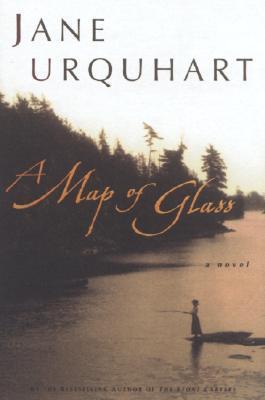
From the author of the best-selling, award-winning The Stone Carvers and The Underpainter comes a new novel that explores love, loss, and the transitory nature of place. After Jerome, a young artist on a remote island retreat, discovers Andrew Woodman s dead body frozen in the ice, he meets the elderly man s former lover, Sylvia, who is curious about the circumstances surrounding Andrew s death. Together, Jerome and Sylvia uncover both the secrets of their own pasts and the breathtaking story of Andrew s ancestors.

371 pages, Paperback

First published January 1, 2005

60 people are currently reading
900 people want to read

About the author

Jane Urquhart

41 books378 followers
She is the author of seven internationally acclaimed novels entitled, The Whirlpool, Changing Heaven, Away, The Underpainter, The Stone Carvers, A Map of Glass, and Sanctuary Line.

The Whirlpool received the French Prix du Meilleur Livre Étranger (Best Foreign Book Award). Away was winner of the Trillium Book Award and a finalist for the prestigious International IMPAC Dublin Literary Award. The Underpainter won the Governor General's Award for English-language fiction and was a finalist for the Rogers Writers' Trust Fiction Prize.

The Stone Carvers was a finalist for the Giller Prize and the Governor General's Award, and was longlisted for the Booker Prize. A Map of Glass was a finalist for a regional Commonwealth Writers' Prize for Best Book.

She is also the author of a collection of short fiction, Storm Glass, and four books of poetry, I Am Walking in the Garden of His Imaginary Palace, False Shuffles, The Little Flowers of Madame de Montespan, and Some Other Garden. Her work has been translated into numerous foreign languages.
Urquhart has received the Marian Engel Award, Calgary's Bob Edwards Award and the Harbourfront Festival Prize, and is a Chevalier dans l’Ordre des Arts et des Lettres in France. In 2005 she was named an Officer of the Order of Canada.
Recently, she was named the 2007 Banff Distinguished Writer.

Urquhart has received numerous honorary doctorates from Canadian universities and has been writer-in-residence at the University of Ottawa and at Memorial University of Newfoundland, the University of Toronto, and the University of Guelph.

She has also given readings and lectures in Canada, Britain, Europe, the U.S.A., and Australia.
In 2007 she edited and published The Penguin Book of Canadian Short Stories, and in 2009 she published a biography of

Lucy Maud Montgomery as part of Penguin’s “Extraordinary Canadians” series.

Urquhart lives in Northumberland County, Ontario, Canada, and occasionally in Ireland.

http://en.wikipedia.org/wiki/Jane_Urq...

Ratings & Reviews

What do you think?
Rate this book

Friends & Following

Create a free account to discover what your friends think of this book!

Community Reviews

5 stars
266 (19%)
4 stars
493 (35%)
3 stars
425 (30%)
2 stars
137 (9%)
1 star
59 (4%)
Displaying 1 - 30 of 120 reviews
Profile Image for Violet wells.
433 reviews4,480 followers
August 24, 2017
This is literary fiction with big black bold capitals. Sometimes literary fiction can be defined as telling a story through oblique methods, filtering it through more than one prism. Done well this can be an ingenious device that opens up multiple levels of the story, a way of making the present answer to the past, one narrator finding clarity in relation to another. Not done so well and it can come across as pretentious obfuscation, sterile auditing or simple hubris, like a pole vaulter choosing to open his competition at a height he has never in his life jumped. For me this novel was a slightly uneasy balancing act at times – straining just a bit too hard to be unerringly profound, sagging at times under the weight of its relentless clutter of forced symbolism.

At the heart of this novel is a fabulous story with compelling characters and big important themes. It’s conventionally written and it’s supremely powerful as narrative. We are given a piece of Canadian history. The Woodman family found a timber and ship-building empire on an island where Lake Ontario meets the St. Lawrence River. This involves cutting down all the island’s trees and changing the topography of the landscape. The pursuit of material riches by successive members of this family will do catastrophic damage to the ecology of the island. The author peoples a microcosm of manmade environmental damage with tremendously engaging characters and conflicts. But the author gives this story another existence. How it reaches us in the modern day. And all the problems for me were with the modern day characters, all of whom seemed like constructs rather than living plausible people.

The novel begins when an artist on a retreat discovers the body of a man frozen in ice. Anthony Woodman, it turns out, had Alzheimer’s and returned home. He was a landscape geographer; the artist who finds him is a photographer who imaginatively reconstructs how landscape might once have looked. Anthony’s lover, Sylvia gets in touch with the artist after reading about the body preserved in ice in the newspaper. She’s essentially an unhappy housewife but to make her more interesting, more profound, she’s given an unnamed mental health condition – a kind of combination of OCD and agoraphobia (her real problem, if you ask me, is she doesn’t have a sense of humour). She builds texture maps for a friend who is blind. Basically we now have three people engaged in an almost identical (and wholly obscure) occupation, the first sign of how overcharged this novel will be of symbolical synchronicity. Less really is often more. The multi-layering of the same motif can be a form of insecurity rather than a sign of unanimity of purpose. Often there was a lack of subtlety in the design of this novel as if the author was continually seduced by images she couldn’t bear not to insert even though they duplicated other images. I could never fathom out how these texture maps worked or why there was a blind character in this novel, except that we equate blindness with spiritual profundity and spiritual profundity seemed the author’s default setting in this novel. (It’s likely Anthony Doerr got some of his ideas for All the Light from this book – blindness, the models, agoraphobia, except he uses them for purposes of dramatic tension and not as somewhat hollow emblems of spiritual complexity). When Sylvia goes to see Jerome, the artist, we learn about her affair with the dead man. Another problem I had was that the author never acknowledges her depiction of romantic love is essentially adolescent. Sylvia’s pious descriptions of her exalted relationship with Andrew is merely the experience all of us have when in love. I needed a bit more irony here. She’s describing what’s essentially a commonplace experience but as if she’s been singled out for some rare and historic achievement. At this point I was asking myself why does this novel need Sylvia? Or if it does why not simply portray her as an unhappy housewife who finds salvation through love – why does she have to have this affliction that sets her apart as otherworldly? At this point this novel really needed to be brought down to earth for me. Her husband, the only down to earth character in the modern part of the novel, is merely sketched in as a pantomime villain. For one thing the presence of Sylvia determines that the story at the heart of this novel reaches us through notebooks, a hackneyed device. Broadly speaking, the novel is about our vain attempts to preserve the past. The presence of the notebooks contradicts this premise.

Anyway, we then get by far the best part of this novel – the account of the Woodman family. The narrative here takes the form of a conventional historical novel (it resembles in form no notebook I’ve ever seen so the notebook motif seems gratuitous). In this part of the narrative we get the sprightly humour and mischief that was missing in the over-earnest overcharged modern part of the novel. We get characters we can identify with who are likeable and, more importantly, plausible unlike the thematic constructs which serve as characters of the modern part.

Finally, I realise this is a harsh review because there was much more to like than dislike about this novel and I’m going to read another of her novels. It would be easy to imagine her in a creative writing class with Michael Ondaatje as her teacher but ignoring his advice not to get led astray by arresting images or clutter her narrative with symbolical signposts.
Profile Image for Marc Lamot.
3,461 reviews1,970 followers
October 14, 2022
This is a richly woven book that blends different stories and themes, all set near Lake Ontaria in Canada. The opening scene, of a confused man in full winter in a desolate snow landscape, is beautifully portrayed. The focus then briefly shifts to an artist who temporarily settles on a Canadian island and finds a corpse, and subsequently to a woman 'with a condition' (a form of autism/Asperger's? Imagined or not?) who apparently had a relationship with the deceased man and now wants to become “the keeper of his past”.

The three storylines mesh neatly together, but then Urquhart begins a very long family chronicle in a somewhat epic, even Marquezian style, including magical elements. That chronicle eventually also merges with the previous storylines. In the meantime, various themes are addressed, such as the question of normality and dealing with people with a condition, the importance of geography and landscapes, the inevitable transience of life, the destructive power of the human will against that of nature, the illuminating force of love, etc. The very detached, somewhat dreamy atmosphere that surrounds Sylvia (the 'autistic' woman) appealed to me, through her emphasis on introspection, on looking through things, and on the all-consuming power of time. Urquhart connects it all with the Canadian landscapes (geographic morphology plays an important part in this novel), and with an artwork by Robert Smithson, A Map of Glass (hence the title), in which the fragility and sublimity of life and matter, and the destructive relationship between man and nature are expressed.

In short, this book has quite some meat on the bone, and Urquhart is a stylist who definitely shows her literary talent. Yet something gnawed while reading; there is something wrong with the book's lavish structure, the different storylines and the sometimes opaque accumulation of images. I couldn't really put my finger on it. So, this novel intrigued, for sure, but it didn't fully resonate. Maybe worth a reread?
Profile Image for Roger Brunyate.
946 reviews740 followers
July 25, 2017
Walking Toward the Past

This wondrous and evocative novel begins with a man walking over the ice to a distant island. He is so stricken with Alzheimer's that he cannot even remember his own name, Andrew, but the four pages in which Jane Urquhart describes his situation are almost poetry:
The whole unnamed world is so beautiful to him now that he is aware he has left behind vast, unremembered territories, certain faces, and a full orchestra of sounds that he has loved.
He is walking, as one of the other characters later remarks, toward his past. The book that follows will be the slow uncovering of that past, not only as it applies to Andrew and his forebears, but by extension to the whole of Canada, its natural resources, and the way of life that squandered then vanished with them.
All this will be the subject of the central section of this three-part novel, an elegantly-told family saga beginning with an English immigrant, Joseph Woodman, who founds a timber and ship-building empire on an island just where Lake Ontario flows into the St. Lawrence River. But the main focus is on Joseph's son, Branwell, Andrew's great-grandfather. Trained in Paris as an artist, he spends the rest of his life on an uneasy balance between art and commerce, two opposing viewpoints that emerge as one of the philosophical axes of the book. Branwell's sister Annabelle in a way has it easier, because as a woman she is not expected to enter the business and so can devote herself to painting—but all she paints are her father's ships and their destruction by water, fire, or time.

Were the novel confined to this historical story, it would still be a very good one. What makes it remarkable are the framing sections set in the present. Andrew, it turns out, was a landscape geographer, a kind of archaeologist who reconstructs earlier lives from the traces people leave in their surrounding world. Jerome McNaughton, who finds Andrew's frozen body, is an artist engaged in similar pursuits, making careful excavations, taking photographs, and building imaginative reconstructions. Both, in their different ways, make maps. So does Urquhart's primary character, Sylvia, who makes tactile maps for a blind friend, Julia, so that she may explore her landscape by feel. It is Sylvia's closeness to Andrew that brings her to Jerome's studio and begins the process of linking past to present—a linkage that Urquhart reinforces by a web of subtle cross-references that are intricate without ever being obtrusive.

Julia is blind; Andrew developed Alzheimer's; Annabelle was lame; Sylvia appears to suffer from a form of autism; even the young and apparently healthy Jerome will turn out to have been spiritually crippled by the legacy of an alcoholic father. The most amazing of Urquhart's many feats of alchemy is that she manages to turn these apparent disabilities into gifts. The reader turns the pages with wonder, enthralled by the writer's inexhaustible ability to see familiar things in a new way. Central to it all is Sylvia, whose social limitations and fear of change will nonetheless turn her into the virtual author of a story of love and family whose very subject is change.


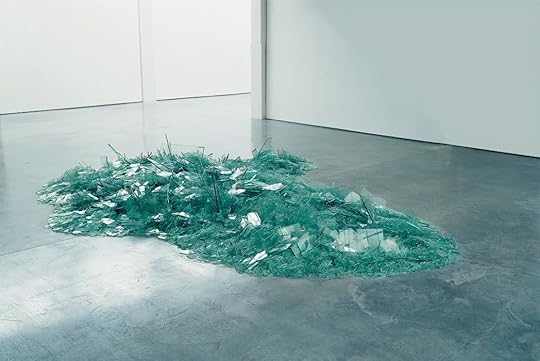
A Map of Glass is even greater than Urquhart's excellent previous novel, The Stone Carvers. Both share a three-part structure; both go back into Canadian history; and both are centered around a work of visual art. The underlying inspiration here is a 1969 piece by Robert Smithson entitled A Map of Broken Glass (Atlantis), an 18-by-15 foot pile of broken window panes that suggests the debris of lost civilizations, but which nonetheless catches the light in unexpected ways and glistens with a mystery of its own. Urquhart's Map is also a lament for the past, but its quiet glow of consolation is nothing short of a miracle.
Profile Image for Traycee Wiebe.
21 reviews1 follower
March 10, 2009
I totally struggled reading this book and so it has to get the lowest rating I've ever given a book. I honestly didn't like it, but instead chose to persevere to the end, giving it as many chances as I could.

What didn't I like? Well, the story, for one. I found the pieces very disconnected and from the very first pages, I felt as though the author had isolated me from context, civilization, normalcy and cognition. I never saw how the storylines came together and I tended to not care about any of the characters at all, though some were redeemable and others not.

I most disliked the main character who clearly had "issues." Did I care what they were? Not really. I just didn't want to spend time with her, in much the same way I probably wouldn't want to if she were a real person in my life. That sounds terribly judgmental, even to my own ears, but I'm trying to be honest.

The book was broken up into 3 parts and I only found the middle portion even remotely interesting. Why? Well because it provided a narrative of a series of events that more or less made sense. This portion takes place several decades before the present day and actually paints a very decent picture of a time and place. Of course, the imagery of the hotel being buried in sand was my favourite part. The rest, honestly, I could care less about.

Urquhart disappointed me with this effort. I was such a huge fan of the story and characters of The Stone Carvers and I really gave this a good shot, reading all the way to the last page... but I just didn't have the heart to give it more than 1 star.
Profile Image for Netta.
185 reviews146 followers
Read
September 5, 2017
There is absolutely nothing wrong with this book. A perfect sample of a very good writing which seems to me too brilliant, too beautifully crafted to be relatable.
Profile Image for switterbug (Betsey).
936 reviews1,494 followers
February 23, 2011
In a haunting, topographically rich novel that transports the reader to a disappearing region of a rural, Canadian peninsula, two narrative time periods tell a story. The novel, textured with the natural world of impermanence and change, progresses with an almost hyperreal cohesion, drawing out its themes under drifts of snow, sheets of ice, bare-branched trees, windswept sand, and glassy lakes. The map of this region moves from macrocosm to microcosm, from the mutations of the landscape to the private storms of it inhabitants, from early nineteenth century to recent times. The story flickers beneath the earth and through the air.

Sylvia is a middle-aged woman with an unspecified "condition" that sounds a lot like Asperger's. She has one friend, who is blind, and a husband, Malcolm, who is blind to her secret life. She stays shuttered in her house, images of tables and bibelots running through her head ceaselessly, the light from the windows casting shadows and reflections that play on the artifacts and with her consciousness. She is an autodidact of esoteric knowledge, of the entire history of this isolated, disappearing, glacial town, and she makes luxuriantly detailed, three-dimensional maps of the area. One day, she gets her driver's license and starts combing the peninsula. She meets a historical geographer, Andrew Woodman, and has a long, secret passionate affair that becomes the focus of her existence. Time passes, (their affair is interrupted by a seven year separation) and she knows that Alzheimer's is eroding his mind and his life, until one day he just disappears. A year later, she reads in a newspaper that he had died (a year ago), was in fact found floating in an ice floe and discovered by a three-dimensional wilderness artist named Jerome McNaughton.

Jerome is a young man suffering from an unresolved past--an alcoholic, abusive father and withering, spineless mother--who now has difficulty committing fully to the woman he loves (Mira), of sharing all his private sorrow and rage. When Sylvia contacts him to meet and discuss Andrew, he reticently agrees. The series of meetings between Sylvia and Jerome and Mira focus on Andrew's ancestral journals--the history of the Woodmans going back to Andrew's great-great grandfather and the timber industry. What the journals reveal about Andrew and his family forms a cynosure between Jerome and Sylvia. And, in turn, their tenuous, brief bond becomes a niche where history, love, and home are revealed and a palpable epiphany takes place.

The novel's most transcendent attribute is the poetic fusion of the landscape with the themes of loss, identity, and home. The story of Andrew is told in reflection. His profession as a historical geographer cleaves with the history and geography of the region (much of it contained in the journals) and progresses to his relationship with Sylvia. Time vacillates between static and dynamic as events almost pour out of time, while the present feels stagnant until the journals' history can influence the ones left behind. There is never an immediacy that the reader feels between Andrew and Sylvia, because Andrew is already a piece of history when the novel opens. I believe the author intended that, and she effectively placed Andrew as a polestar for the healing of others.

The nineteenth century sections were, for me, the most vivid and electrifying. It was through that lens that I was able to visualize the landscape evolving by unchecked capitalism--from forest to deforestation, from rich soil to topsoil for barley, and, eventually, to sand. The tycoon daddys were reminiscent of the American robber barons J.P Morgan and J.D. Rockefeller, steely tycoons who were often tyrannical. The female characters are particularly well fleshed out here. Annabelle, Andrew's great-great aunt, and Marie, his great- grandmother, added pathos to the grandeur of the industrialists. The parallels between characters from both centuries were finely drawn and the fusion of all Andrew's ancestors into his psyche gave the story its most authentic depth of character.

I did have a hard time believing that someone as cloistered as Sylvia for thirty-odd years, who is afflicted with a pronounced social disorder, could go out and have this passionate affair of tremendous life-altering proportions and yet be unnoticed by her husband. I cannot believe that Sylvia has the capacity to live a double life unobstructed. However, she is effective because of the momentum she creates around her and how she is contrasted to the changing environment, as well as paralleled to the history of this region--the hyperreal context I referred to at the beginning of my review.

The story also suffers from a clumsy construction at times. Some of the events are told in a hurried narration and some revelations are telegraphed rather than experienced. There is also a character named Ghost, an archetype who enters late and feels forced into a centerpiece arrangement.

Fortunately, the grace of this story resides in the timeless humanity that is poetically and symbolically rendered. I recommend this unique novel for its astonishing beauty, breathtaking prose, and moving themes. The flaws of this novel dissolve into the scintillating landscape.
Profile Image for Juliet Wilson.
Author 7 books45 followers
November 24, 2009
This is a wonderful novel, set on an island in Lake Ontario, Canada. It follows the story of Sylvia (a woman with what is described as a 'condition' but either is a form of autism or just a personality trait that has been labelled by others to control her) as she aims to find out what happened to her lover, Andrew, who was found dead in the Lake. Sylvia meets with Jerome the young man who found Andrew and together they delve into the past.

Jane Urquhart beautifully evokes the landscape of the area round the lake and the tragic loss of the once vast woodlands that fuelled a huge timber trade until the trees disappeared and barley was planted until the land was robbed of its fertility.

The novel also beautifully studies artistic practice, Jerome's own work as an earth artist, his partner Mira, who is a performance artist and the tactile maps Sylvia makes for Julia, her friend who is blind.

It's a beautiful, rich book and as its that time of the year it may well be one of my books of the year!

Profile Image for Czarny Pies.
2,828 reviews1 follower
April 15, 2021
Jane Urquhart's fans should greatly enjoy "A Map of Glass" which was the last of three novels that she wrote in succession about different schools of American Visual Arts. Urquhart began with "The Underpainter" (1997) looked at Abstract Expressionism with a particular focus on the painted-over images of Robert Rauschenberg. She followed with the "The Stone Carvers" (2001) which dealt with Walter Allward's "Canadian National Vimy Memorial". "A Map of Glass" (2005) deals with Robert Smithson of the Land Art movement and specifically his "Map of Broken Glass", a pile of glass shards.
(In her novel Urquhart also makes repeated references to Joachim Patinir's "Landscape with St. Jerome". Patinir's work however is of lesser importance. Urquhart seems primarily to view him as a precursor to Smithson as the landscape dominates the humans in his paintings.)
Smithson views mankind as being in a destructive relation with the environment, a point of view that Urquhart shares. "The Map of Glass" tells the stories of several generations of a family living on an island where the St. Lawrence River flows into the St. Lawrence. Over a period of almost two centuries, the family manages to cut down almost all the trees in the region and destroy the farming soil. Their community is abandoned and nothing of value remains on the island. The human relations described in the saga range from poor to highly destructive.
Urquhart makes an eloquent case for the importance of Smithson's "Map of Broken Glass" . Her sour view of humanity may also have some legitimacy. The problem her novel is a dog's breakfast. There are too many characters and the plot is filled with improbabilities. Branwell Brontë (who appeared in "Changing Heaven") returns to the fictional world of Urquhart in "A Map of Glass". As in other novel's Urquhart's non-Wasp characters are incompetently done. Branwell marries Marie, a French Canadian who is nothing of the sort. Jerome, a good scot, has a Hindu girlfriend Mira whose views on religion and most other things are highly Anglo-Saxon.
On its own, "A Map of Glass" is quite dreadful. However, it has enough good points that makes a fine addition to Urquhart's complete oeuvre. You should read it if you have already read her two preceding novels.
Profile Image for Rosana.
307 reviews60 followers
November 22, 2011
Definitely there is a thing as “the right book at the right time”. This a second read for me. Alas, I didn’t write a review for it the first time around, although I did give it 4 stars. This time I am upgrading it to 5 stars though.

I re-read it for my bookclub, and I confess that I had not retained much of it from the first time, albeit the 4 stars it had faded out of my memory. But this time I was struck by Jane Urquhart’s poetic descriptions of landscapes and characters.

I did read some of the negative reviews in here and I cannot even say that I don’t agree with some of the objections of other readers towards this book: mainly that the characters are unbelievable. Sylvia, the main character, certainly isn’t a typical autistic individual. But I have chosen to believe in her as someone trapped in a world of feelings and longing.

Loss is the great thread unifying the characters, and Urquhart prose forces us – or forced me, as a reader – to scrutinize deep feelings about death, aging, memory loss and love.

This book hit a cord I guess, in a way that it did not on my first go around with it. Maybe I am older, maybe it was a recent death to someone close to me, maybe it is watching at a distance acquaintances struggling with the early symptoms of Alzheimer’s disease. Maybe, maybe... loss is everywhere.

Profile Image for TBV (on hiatus).
307 reviews70 followers
Read
August 2, 2019
Robert Smithson’s* ‘Map of Broken Glass’ is literally a pile of broken glass. There are different shapes with different reflections depending on how the light catches it, but all part of the same artwork. Award winning author Jane Urquhart presents a pile of literary fragments, and reveals the individual pieces and their connectedness in her complex, multi-layered novel ‘A Map of Glass’. Thoughts, feelings, memories, perceptions and connections emerge as she probes different shards of her novel.

Jerome McNaughton is intrigued by Robert Smithson’s* ‘Map of Broken Glass’. He is drawn to both the “…brilliance and the feeling of danger in the piece: the shattering of experience and the sense that one cannot play with life without being cut, injured.” Jeremy, also an artist (not a painter, “What I do is more sculptural… involves three-dimensional space”) starts a new project of his own. The project takes him to Timber Island which is situated where Lake Ontario narrows into the St Lawrence river. “He had chosen the equinoctial period of late winter, early spring for his residency on the island, and he had chosen it because of the transience he associated with the heavy sinking snow, the dripping icicles of the season. The difficulty of arriving at the place when the ice was either uncertain or breaking up altogether – the enforced isolation brought about by these difficulties – had attracted him as well.” “Grim was what Jerome was after.” Grim is what Jerome finds when he discovers the body of Andrew Woodman embedded in the ice. Andrew who suffered from Alzheimer’s disease and was lost in the ice. While Andrew was still able to remember he could never forget how his ancestors assisted in the raping of the land, in its deforestation. “Andrew felt that he had been destined to become a historical geographer,” she said. “He told me that the mistakes of his ancestors had made this a kind of dynastic necessity. Unlike his forebears, you see, he paid careful attention to landscape, to its present and to the past embedded in its present.” Sylvia, who loved Andrew, seeks out Jerome as he is her last link to Andrew. “The day that you found Andrew you became the present, the end of the story, the end of my story, the reply to the last unanswered question,” she told him. “And you were the end of Andrew’s story as well. You were, in a way, the last thing he told me.”

Sylvia has brought a collection of Andrew’s notebooks with her, the contents of which she shares with an initially reluctant Jerome. Through these notebooks we learn about Andrew’s family history as well as some of Canada’s early history. These memories will eventually trigger some of Jerome’s own long suppressed childhood memories, and so a healing process will begin.

The novel is suffused with art. There is Jeremy’s art. His partner, Mira is also an artist, but her medium is fabric. Sylvia doesn’t realise that she too is an artist; she creates tactile maps for her blind friend Julia. Andrew’s ancestor Branwell painted scenes on walls, and once on a ceiling. He painted an “Allegory of Bad Government”. Branwell also once found himself in front of a miniature city that had been created and placed in Les Invalides in Paris. Branwell’s sister Annabel created a book of relics in which samples of various objects were included. Ms Urquhart skilfully connects all the dots between these various works of art. She creates worlds within a world. I loved the images of Sylvia being replicated in the silver chain attached to the bathtub plug, and the various mirror images that Sylvia had noticed. There are also other connections between the characters in terms of their individual frailties. There are a great many images, ideas and connections in this novel, and it simply isn’t practical to comment on all of them.

#####
Quotes:

“The whole unnamed world is so beautiful to him now that he is aware he has left behind vast, unremembered territories, certain faces, and a full orchestra of sounds that he has loved.”

“Thinking of these things, he realized that the disappearance of such huge vessels from Kingston Harbour and from the quays at Timber Island would have resulted in an absence so enormous it would have been a kind of presence in itself. Gathered together at docksides, tall masts made from virgin pines rocking in the wind, the ships would have been like an afterimage of the forests that were being removed from the country. And when the last of the great trees vanished, this floating afterimage would vanish with them.”

“His silences were huge, mythical almost, and, to her mind, full of portent. Everything about him, even when they were inches apart, suggested disappearance.”

““The whole world is a kind of Braille, if you consider things from that perspective.””

“Sylvia held this inner picture for as long as she could, but then, as always, it began to dissolve.”

“He had explained that braided in the limestone around the Great Lake were the fossils of life forms whose narrow sessions of animation had been silenced forever. Such brief, simple narratives, such unobserved histories, he had said, permanently halted by a wall of ice. Sometimes, he’d said, you could see the direction the animal intended to take. With others – those who were born to a spiral shape for instance – they seemed to have already accepted their fate.”

“”Who killed Cock Robin? I, said the sparrow, with my bow and arrow, I killed Cock Robin,’” he quoted. And all at once he wondered how it was that the rhyme had been implanted in his own memory since he had never seen it in a book.”

“Then a terrible sadness came over her. She realized that the artist in him was someone he had never permitted her to meet.”

“Cumulus clouds bloomed like distant white forests far out over the lake, but never ventured inland to disturb the sunny afternoons. At night the constellations moved above the waves against a clear black background, and sometimes, in the very early mornings, or just before sunset, the water became entirely still as if intent on merging with the sky. Gulls rode the wind, ducks practised flight patterns for future migrations, and each year, on one spectacular July day, a flotilla of enormous arctic swans sailed regally past.”

“Sometimes in August, before the harvest, the fields of barley would turn a peculiar shade of lavender at twilight, mysterious, unfathomable, the deep purple shadows of the maples that edged the fencelines like pools or clouds.”

“Looking at the scaffolding, he said, “I’m not Michelangelo, you know, I’m not Tiepolo.”
“Who?” asked Ghost.
“Who?” echoed Lingelbach, once again pretending to be absorbed in sponging down the bar. When Branwell answered with nothing but a sigh, the owner of the establishment added philosophically, “No matter, whoever they were, they would have had to pay for room and board.””


#####
Notes:
*
Robert Smithson, American artist (1938-1973)
https://www.robertsmithson.com
Profile Image for Mark Edlund.
1,680 reviews2 followers
September 26, 2022
Fiction - a quietly amazing book. Sylvia has a condition which seems like OCD or is on the autistic spectrum...or does she? She lives on Timber Island on Lake Ontario. Past history reveals that her lover's ancestors helped destroy the environment while plundering the forests of the area. Her lover dies in a winter storm and a young artist finds his body in the ice. Sylvia goes to Toronto to find out about the discovery. Lots of incredible characters, thoughts and an ending that had me questioning what was the reality of the story. Since we had just camped at Sandbanks the references to the area were interesting. Fryfolgel Inn is also mentioned.
Canadian references - set in Ontario
Pharmacy references - Sylvia walks past the drugstore in town.
Profile Image for Shane.
Author 12 books297 followers
September 15, 2009
I picked this book up at a talk and reading given by the author, who was explaining some of the history of Northumberland and Prince Edward Counties in Ontario - her childhood home and my present one. Her interest in place and architecture was the theme of that presentation.

Place and architecture also seems to predominate in this book. It tells the story of a withdrawn middle-aged woman, Sylvia, married to a doctor who treats her more as an interesting patient than a wife, and of her supposed love affair with Andrew Woodman, who in an advanced stage of Alzheimers falls and dies in the freezing St.Lawrence River near her home. Given Sylvia's phobia of not wanting to be touched - her "condition" as explained by her husband - one wonders whether the love affair ever happened or whether it spung from Sylvia's imagination, as the good doctor claims. The writing leaves both options open to conjecture depending on how romantic or objective one is.

Sylvia befriends the young artist Jerome, who discovered Andrew's body a year previous, and through a recounting and sharing, the two find a connection: Jerome sees his mother trying to escape the tyranny of his drunken father in Sylvia, while Sylvia finds a person to unburden her feelings that have been locked inside for many years.

The long middle section of the novel is a history of Andrew's family (and not necessarily of Andrew), and it is here that I found the author straying into recording perhaps her own family's history in the area without too much concern for her readers and for the story of the novel - which I though was all about Sylvia and Andrew, with Jerome as catalyst. Being a resident of the area, I found the history behind the sinking hotel in the sand dunes of Sandbanks Provincial Park interesting, but I am not sure who else would have. There was also a lot of "telling" in this section with very little dialogue and character painting.

The author repeatedly uses the technique of suddenly dropping in a character or event, and then peeling back the layers to reveal who these characters are, or how the event occured. It interrupts flow and takes getting used to.

This is not Urguhart's strongest novel, although it's her most recent. Having enjoyed "Stone Carvers" and "The Underpainter" very much, I could not help but feel as I put this book down, that upon earning the distinction of becoming a national literary treasure in Canada, Urquhart was writing what she wanted to record, free of the scutiny and questioning of editors and publishers, and expecting her readers to come along for the ride whether they liked it or not.
Profile Image for Mag.
434 reviews59 followers
January 7, 2018
As all Urquhart’s fiction I have read so far, this book is set in southwestern Ontario, and intertwines two stories: one from the past and one from the present. The story revolves around Sylvia Bradley, a fifty three year old woman who suffers from an unnamed disorder resembling autism to some extent. She is the intermediary between the two stories: that of her lover and his family and that of the man who found her lover frozen to death on one of the small, abandoned islands on Lake Ontario.

If you like Jane Urquhart, you will not be disappointed. This story is very similar to everything else she has written. There are the same ordinary yet extraordinary and quirky characters, snippets of magical realism, great imagery and a true history of southwestern Ontario skillfully woven into two parallel tales. There are even events and characters from another novel _Away_ that make an appearance here. What is new and clearly visible in the novel is her concern with the devastation of the environment and its consequences.
3.5/5
288 reviews2 followers
Read
January 7, 2016
Jane Urquhart is an amazing author. She can take the days, the long slow days of winter, or the boredom and loneliness that can be an endless summer afternoon, and, while retaining their emptiness, make them whole and special for the reader. She is so very sensitive that it would not surprise me to find that she is allergic to everything beyond the desk where she produces her work.

The story is simple and private, the scenery compelling, with a history of its own, and the writing superb. I would recommend Urquhart's books to anyone. Take them slowly, like life itself.
Profile Image for Karan.
344 reviews6 followers
November 11, 2022
Like this alot, exploring the themes of memory, loss, intentional and inevitable forgetting.
Profile Image for Bernie Bonk.
6 reviews2 followers
August 10, 2023
Good Canadian author enjoyed the fact the story takes place in Ontario. It seemed like there were two separate stories, could have been two books. Worth reading.
Profile Image for Sarah.
548 reviews34 followers
unfinished
September 8, 2016
Meh.

However lovely, contemporary prose just doesn't do it for me. Give me an impressionist glance around the room and a bright, blooming swell of internality. So many of these contemporary authors just describe the room...and describe the room...and describe the room. Unless it's Anna Pavlova's room, I can't be bothered!

Sorry, book.
Profile Image for Denise  Plesuk.
14 reviews
September 24, 2016
Found it hard to read this book. The entire time I kept trying to figure out what the character's "condition" was. Even when I finished it I was lost. The only part of the book I enjoyed and found easy to read was the second part.
Profile Image for Sharon.
1,693 reviews38 followers
November 8, 2016
It took me a while to get into this book. Once immersed I found it moving and filled with interesting aspects of Canadian history.
Profile Image for Corey.
256 reviews1 follower
September 16, 2018
I kept reading, and reading, and reading waiting for something exciting to happen...and then I got to the end.
Profile Image for Virginia.
1,285 reviews166 followers
January 19, 2021
"...an absence so enormous it would have been a presence in itself. " I have purchased this book so I can read it again.
Profile Image for Susan.
2,445 reviews73 followers
December 22, 2022
This is my second Urquhart book. I was so-so on the first but put this one on my reading list because I am part of several spell challenges with the Crazy Challenge Connection and U's are difficult to find. But, this book, I think this book was not worth the effort to read it, even if it does help me complete several challenges.

I hated the protagonist. She fell completely flat, in part because Urquhart made her purposefully so. I also hated her because she was manipulative, self-involved, self-entitled, selfish person. She is the type of person I would avoid in real life and I'm not sure why I bothered with her in fiction either.

The middle part of the part was not terrible, but even so I could not round up to two stars, as my initial impulse was. Two stars = OK and One star = I didn't like it. I hated this book but there is no rating lower than one star.

Also: i) NO ONE calls Lake Ontario 'The Great Lake' and NO ONE calls it 'Great Lake Ontario' what type of pretentious BS is that?!?. ii) this book is set in Canada and written by a Canadian author. In Canada we have neighboUrs and enjoy the world's coloUrs. I really hate it when an author americanizes a book like that.

This was my second Urquhart book but for me there will be no third. It has to be far less work to find other U books for my reading challenges than to try to force myself to plow through another one of this author's novels. Really, I'd rather just not complete the challenges than to ever read work by this author again.
1,654 reviews13 followers
July 23, 2020
Being a geographer, anything with the word map or cartographer in the title usually grabs me. Jane Urquhart's books seem to have a lot of exploration of landscapes and its influences on people. The book begins with the death of a geographer named Andrew on a deserted island in mid-winter in Lake Ontario. Several months later, Jerome, an artist, is doing some field research on the island for an art project and comes across Andrew's dead body. About a year later, after reading about the finding of Andrew's body, Sylvia, a very socially-awkward woman gets in touch with Jerome to talk about Andrew, her former lover. They explore together in conversation what Andrew had meant to Sylvia and what they learned from each other. At the end of the first part, Sylvia shares with Jerome and his girlfriend, Mira, copies of notebooks that Andrew had written on the early history of his family on Timber Island. While it read well. this section didn't really sound like what would be in a notebook. Finally, in the final section, they discuss what Andrew's story, before Sylvia's husband Malcolm takes her back to their rural home. While the book had some interesting discussions on role of place in our lives, I found the book a bit too slow and it my least favorite of her books, despite the geographic theme.
Profile Image for Kathy.
235 reviews3 followers
May 3, 2025
3.5 stars. I want to give it 4 star as the writing is beautiful but here are so many themes though that I felt Urquhart could have narrowed things down a bit. Mostly it seems to point to change, decline, loss of the way things used to be, greed at the expense of the natural world, and industries that flourish and die as they do. There is a lot of sadness too. Anabelle’s loneliness, Sylvia’s grief, Andrew’s decline into dementia and then death, Malcolm and Sylvia’s unfulfilling marriage and how he completely has no understanding of her, Jerome’s childhood trauma, a tragic love story and more. I found that the first section dragged somewhat with the slow progress of Sylvia and Jerome’s meetings but the second section about Andrew’s family history was riveting. That section could have been a book in itself, I think. The ending is ambiguous which I don’t typically enjoy. So here it is. Did Sylvia actually have an affair with Andrew or was it imagined as her husband Malcolm claims? I like to think that it was real given that Sylvia had possession of Andrew’s journals. It was most likely easier for Malcolm to believe she invented it all due to her so-called condition (high-functioning ASD, most likely) since the truth would have been too difficult for him to bear. A good read but I have enjoyed other Urquhart books more such as The Stone Carvers and Away.
This entire review has been hidden because of spoilers.
Profile Image for Lynne.
1,093 reviews
July 1, 2019
This is a sad book about how things end, from a landscape once thick with trees, to memory due to Alzheimer's, to independence. "Map of Broken Glass (Atlantis)" the pile of jagged glass shards by sculptor Robert Smithson, https://www.diaart.org/collection/col... , serves as an image for destruction and loss. This is also about how maps, murals, scrapbooks, journals, and story telling are all we have to remember. "Arriving one November morning, she had taken off her coat, had laid it over the back of a wicker chair that was grey with dust. The room had been cool and there was a faint smell of mice beneath the stronger smell of wood smoke. Aftermath was the word that crept into her mind.; the windows were foggy, clouds of dust had gathered under the furniture. Cobwebs swung from the beams. This was the territory of aftermath."
Profile Image for Asia Martello.
7 reviews
January 2, 2023
This book had a great start and got me hooked from page 1. From then onwards and as the storyline develops, the plot remains just as gripping but the narrative just fails to expand into something that I could find meaningful… the descriptions are beautiful and the landscape is definitely evocative, but the story’s building blocks just didn’t really make that much sense to me. The interaction between characters seems forced and attempts to turn the dialogues into something humanly deeper seem to me to fail… much of the book evolves the main character’s ‘illness’ that is described with a million details yet it is completely unclear what the illness is. Unfortunately I thought overall that it had pretty shallow characters and 300 pages of descriptions of their relationship with nature that never really seem to reveal anything insightful
276 reviews
February 4, 2024
I began reading with great interest. I got tired of the style of writing which provided a rich ambiance in description; but it was often too long and too much for me. The story became too convoluted in the middle, in the history, which to me became another story. They merge in the end and I did get to the end. I got there by speed reading a lot of the last half until the very end chapters. I could not follow the relationships in the family because of the slow pace of action and the abundance of word. That may be me and my age or just a book not written in a style that resonates with me. But the story intrigued me enough that I kept going.
264 reviews
October 17, 2022
This book has a slow start complicated by a story within the story. The main character, Sylvia, is clearly on the the autism spectrum. Both her family and her husband limit her world out of love yet she is capable of so much more. As she reaches out to the wider world, we get to know the history of Prince Edward County and several people who accept her (and the world in general) as she is.

This author always provides an intelligent and intriguing read. This book is no exception. Using the metaphor provided by the art piece "A Map of Glass", each character views life from their own prism.
Profile Image for Doug.
Author 11 books31 followers
October 10, 2023
I suppose I could have marked this book DNF. I got about 70 pages into this awkward allegorical and too self-absorbed work when I began to think I’d read it before. I read a long review on Goodreads which pretty much tells the whole story and when I got to the summary of the second part in which the old resort hotel becomes gradually buried by the blowing sands of the Sand Banks, Prince Edward County (quite haunting), I realized I’d read it before, yet the doomed house was all I could remember of this convoluted plot.
Should tell you something.
Displaying 1 - 30 of 120 reviews

Can't find what you're looking for?

Get help and learn more about the design.