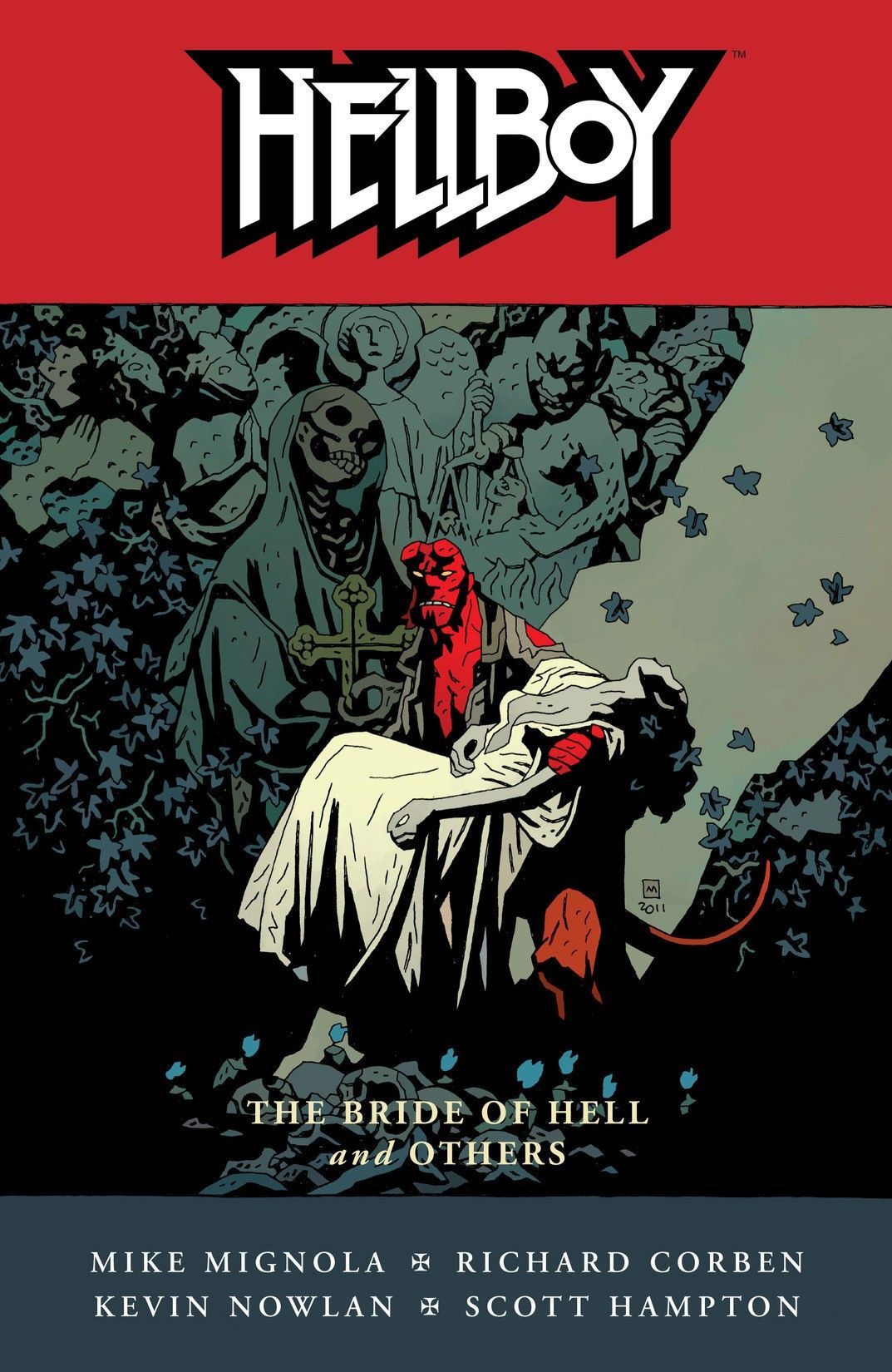
The world's greatest paranormal investigator takes on a carnivorous house, space aliens, a vampire luchador, a vengeful lion demon, and more in this collection featuring the work of comic greats Mike Mignola, Richard Corben, Kevin Nowlan, and Scott Hampton.
Collects Hellboy in Mexico; Double Feature of Evil; The Sleeping and the Dead #1–2; The Bride of Hell; The Whittier Legacy; Buster Oakley Gets His Wish.
Mike Mignola was born September 16, 1960 in Berkeley, California and grew up in nearby Oakland. His fascination with ghosts and monsters began at an early age (he doesn't remember why) and reading Dracula at age 13 introduced him to Victorian literature and folklore from which he has never recovered.
In 1982, hoping to find a way to draw monsters for a living, he moved to New York City and began working for Marvel Comics, first as a (very terrible) inker and then as an artist on comics like Rocket Raccoon, Alpha Flight and The Hulk. By the late 80s he had begun to develop his signature style (thin lines, clunky shapes and lots of black) and moved onto higher profile commercial projects like Cosmic Odyssey (1988) and Gotham by Gaslight (1989) for DC Comics, and the not-so-commercial Fafhrd and the Grey Mouser (1990) for Marvel. In 1992, he drew the comic book adaptation of the film Bram Stoker's Dracula for Topps Comics.
In 1993, Mike moved to Dark Horse comics and created Hellboy, a half-demon occult detective who may or may not be the Beast of the Apocalypse. While the first story line (Seed of Destruction, 1994) was co-written by John Byrne, Mike has continued writing the series himself. There are, at this moment, 13 Hellboy graphic novel collections (with more on the way), several spin-off titles (B.P.R.D., Lobster Johnson, Abe Sapien and Witchfinder), three anthologies of prose stories, several novels, two animated films and two live-action films staring Ron Perlman. Hellboy has earned numerous comic industry awards and is published in a great many countries.
Mike also created the award-winning comic book The Amazing Screw-on Head and has co-written two novels (Baltimore, or, the Steadfast Tin Soldier and the Vampire and Joe Golem and the Drowning City) with best-selling author Christopher Golden.
Mike worked (very briefly) with Francis Ford Coppola on his film Bram Stoker's Dracula (1992), was a production designer on the Disney film Atlantis: The Lost Empire (2001) and was visual consultant to director Guillermo del Toro on Blade II (2002), Hellboy (2004) and Hellboy II: The Golden Army (2008). He lives somewhere in Southern California with his wife, daughter, a lot of books and a cat.
Another fantastic short story collection. Buster Oakley Gets His Wish is a hilarious story of alien abduction and cattle mutilation done Hellboy style. Kevin Nowlan's art is phenomenal. The Hellboy in Mexico stories work quite well. Anytime Hellboy pals around with Lucha Libre is a good time. I also liked how Scott Hampton paints his vampire to look like Christopher Lee.
Volume 11 is a collection of short stories, and, unlike the other volumes, falls a bit short in the epicness category. However, it still is highly enjoyable.
The Birde of Hell and Others is a stand-alone collection of Hellboy short stories, and it’s a really good one! Most stories are really spooky, especially the ones illustrated by the brilliant Richard Corben. Still, there is enough humor and lighthearted silliness, like in the “Buster Oakley Gets His Wish”, a story about an alien abduction, of all things. Overall, it’s a great little collection, and especially fitting for the Halloween season. Its only downside is that, like volume 10, it’s placed in between two really big and important volumes, 9 and 12, and thus disrupts the flow of the main story. Which is why I would recommend reading 10 and 11 either right after 7, or skipping them entirely until finishing the main storyline in 12. It’s a bit confusing, but this is how I’m reading them this time and it works really well! Either way, it’s a worthy read, and a great addition to Hellboy’s chronology.
Volume 11 of the Hellboy series is another compilation of one shots just like “Volume 10: The Crooked Man” and “the Amazing Screw-on Head”, so we don’t get a continuation of the “Wild Hunt” storyline from Volume 9 – that said, this is still an excellent compilation of Hellboy stories!
Included here is a story of Hellboy fighting vampires in Mexico with Lucha Libre wrestler sidekicks, a “double feature of evil” where Hellboy fights an evil house that eats people and in the second one deals with a crazed museum gift shop worker who ends up praying to the wrong Egyptian God and pays the price, another vampire story set in the swinging 60s, a headless Crusader, the Bride of Hell, and finally an alien/cows story.
I think the Hellboy in Mexico story was excellent and could’ve been a longer story than it was and I also loved the “Double Feature of Evil” stories. Richard Corben’s artwork is superb and his depiction of Sobek is truly terrifying.
There’s always been a lot of humour in the Hellboy stories and “Buster Oakley Gets His Wish” continues that tradition starting with a kid trying to summon the Devil leading to all kinds of weird amalgamations of cows (cows cut in half, ghost cows, cows stuck to pigs, cows stuck to humans) and a showdown between Hellboy and some nutball aliens. The excellent Kevin Nowlan illustrates this story and does an amazing job. This guy used to work a lot in the 80s but for some unknown reason hasn’t worked as much recently which is ridiculous when you see the level of skill in drawing all those weird cows!
Mignola provides a brief introduction to each of the stories that gives you some good background info on how the story came to be and where it was originally published. It would’ve been great to see Mignola pick up the thread of the main Hellboy story from Volume 9 in this book but this is a decent stopgap for fans while waiting for that book to appear. Lot of fun to read, some wonderfully spooky and daffy stories featuring everybody’s favourite red guy, and some fantastic art, “The Bride of Hell” is definitely worth a look.
Oh single issues collections you can be really good or just ok. Alas this time you are the later.
I like single issues I think that's one of the things that's missing from modern comics, everyone is writing for the trade and a 5-7 issue arc is the best format. So how does this collection fare?
World: The art here is honestly a mixed bag, there are some stories which are moody and creepy like the Mexico and Vampire tale, then there is the boringness of the Alien story. The art is aight. The world building here is pretty much for the issue, there are no huge call backs to the Mignolaverse and pieces put into place, all you have here are setting and themes that are there to serve the story, fairly standard stuff. I did enjoy some of the mythology though as that's what I love most about Mignola and HB. Good but not great.
Story: I like single issue tales, they are focuses, precise and tells a single tale in as concentrated a form as possible, when they are done well. Here there are some great short arcs like the Mexican and the Vampire arc but the rest are fairly bland and forgettable. Now I know why they waited so long to collect these tales into a collection. As I said two tales stand out as wonderful with the rest being only ok.
Characters: Not much character work found here and not much memorable new short 1 issue villains. The mythology was fine but most of the characters here only served their story as there is little emotionally impact on the story. Standard.
Fairly disappointed in this trade, but given the fact that these tales have been around a while and they are only collecting them now is fairly telling.
Väčšina z poviedok je nadpriemerná. Obzvlášť sa mi páčili poviedky o Strašidelnom dome a ďáblovej neveste. Posledná poviedka s mimozemšťanmi je neskutočne nudná a priemerná, Mignolovi tieto veci nejdú a som toho názoru, že by sa mal držať folklóru a mytologie. Musím pochváliť kresbu Corbena, je hnusná a nepríjemná(myslím to v dobrom). Vcelku je to dobrá kniha a po tej menej vydarenej 10knih som si ju dosť užil.
I've been waiting for this one, and I'm well rewarded, because it is massive. Literally six full-length issues and an eight-page short. Sadly, only the aforementioned short is drawn by Mignola, but with the news that he's going to be returning to regular art duties soon, I suppose we can persevere.
Of the six stories contained herein, three are drawn by Richard Corben, one (as mentioned) by Mignola, one by Kevin Nowlan, and one (that's two issues long) by Scott Hampton. All are written by Mignola. More than half the collection's contents were new to me.
Reading through this, I realized that I tend to think of the Hellboy stories that aren't drawn by Mignola as being somehow out of canon, even though I know better. I can sort of see how this impression would form, starting, as it did, with things like "Makoma," and this collection is definitely a weird one, featuring a story that changes up Hellboy's format, and another one that seems very unusual for canon. But canon they all are, and even the very weird "Buster Oakley Gets His Wish," has a nice moment where Hellboy refers to his adventure in the previous story. It's also nice to see a couple of stories set in my home state of Kansas!
(Also, in The Crooked Man and Others Mignola established a thing where he drew a little frontispiece to each story featuring a spot illustration of some object from the story. This time he changes it up slightly, drawing a skull for every story, most of them relevant to the plot in some way. Pretty brilliant.)
I'll take the stories one at a time:
"Hellboy in Mexico" I'd already read the "Hellboy in Mexico" story when it was new, and it was then and has remained one of my very favorite Hellboy stories. Definitely my favorite Hellboy comic not drawn by Mignola, and probably a contender for my favorite Hellboy comic period. I'm not exactly sure what it is that makes it so great--the framing story, the perfect combination of ridiculousness and pathos--but apparently I'm not the only one who thought so, as there's several other Hellboy in Mexico stories coming out in the near future!
"Double Feature of Evil" I was less of a fan of "Double Feature of Evil," which I also read as a single issue. The framing device is really good, and the nod to "The Shunned House" is spectacular, and Richard Corben draws great mummies, but, while fun, the story definitely didn't catch me quite the same way that, say, "Hellboy in Mexico" did.
"The Sleeping and the Dead" The longest story in the book, and probably one of the best. Scott Hampton's art is very different from pretty much anyone else who's done Hellboy, and it's definitely a good addition to the roster of Hellboy artists. It's also perfect for the story, a quieter, spookier bit of classic vampire stuff, with a really nice ending.
"The Bride of Hell" Man, Richard Corben can draw falling-down churches and zombie Templars (or whatever) like nobody's business. Also, Asmodeus is great, and we get to see some more about the Knights of St. Hagan, who were mentioned in "In the Chapel of Moloch."
"The Whittier Legacy" In his author's notes, Mignola says that "there isn't much room for mood and atmosphere" in an eight-page story, but I think that "The Whittier Legacy" is some great work, and full of wonderful artistic touches, and at least one of Hellboy's trademark lines, "Cut it out. You're making the dead people nervous."
"Buster Oakley Gets His Wish" This is a weird one, even for Hellboy. I'm less fond of it than the others, mostly because weird little aliens are less interesting to me than vampires and demons and junk. But it was kind of cool to see two of the things that people made a big deal about when I was a kid (Satanism and alien abductions) in one story together. Also, another story set in Kansas!
A delightful mixture of the morbid and the absurd, this time containing a large number (seriously, one of the longer Hellboy volumes in recent memory!) of 1-shot stories from Hellboy's past, ranging from the early-to-mid 1950s down to the mid-to-late 1980s. Of particular interest are the encounters with: a family of demon-hunting Mexican wrestlers; the Knights of St. Hagan & a lonely demon in France; an incautious demonologist; and cattle mutilations in Kansas -- though one otherwise uninteresting story about English vampires cleverly ties in to the B.P.R.D: 1946/7 stories. And a few of these stories actually manage to be genuinely amusing, rather than just darkly comic!
Corben's work here is exceptional, just as in Hellboy: The Crooked Man and Others, and I think he's probably replaced Guy Davis as my favorite non-Mignola artist for this series. Kevin Nowlan's art is perfect for the story for which Mignola drafted him -- Mignola is right, Nowlan REALLY knows how to draw barnyard animals -- but Scott Hampton's art was unremarkable and, at times, lifeless. He has potential, but he seems to focus on all the wrong things. Hampton's disappointing art is balanced out by the inclusion of the story about the incautious demonologist which sees the return of Mignola himself as artist!
Another good collection of stories, four stars because I'm almost never satisfied with anthologies and because Mexican wrestlers creep me out. I don't know why, they just do. Probably my favorite here is "The Sleeping and the Dead," which is a fantastic vampire story with some interesting twists. I also like "The Bride of Hell" for its ending--not at all what I think the history of such stories leads us to expect. This was a welcome break from the main Hellboy story, which has become extremely intense.
(Zero spoiler review) It suffers slightly for the fact that this volume was collected with The Storm and the Fury in the library edition, and practically anything would come home with the silver when compared to the masterclass that is the aforementioned title. Much of this was very good. Very great even. The usual Hellboy short story excellence. A couple of the stories however, were pretty forgettable. But hey, I can forgive the odd miss here or there when so much of this series is pure effing gold. 4/5
Not quite as awesomely strong as Vol 10 but still an excellent collection of Hellboy stories from the days when quality control was still extremely high. Almost everything here has a couple of really memorable images, truly eerie moments or at the very least deadpan laughs. Some have all three. There’s a lot of Richard Corben’s seedy, fleshy vision of Hellboy’s world, which is all to the good - as you might expect his work on the Hammer-via-Hellboy title story is a particular treat, with a wonderfully mangy and petulant lion demon whose wedding Hellboy finds just cause and impediment to. The other Corben highlight is Hellboy In Mexico, a magic realist tale of drinking, wrestling and vampires. Scott Hampton’s elegantly gothic art adorns another sad vampire story, and Kevin Nowlan’s rubbery limbed, clean lined style is a great fit for a UFO yarn: minor but very enjoyable.
In Mexico- as a huge wrestling fan, this is a lot of fun.
Sullivan reward- one of the best Hellboy shorts, a scary man and a scary house
House of Sebek- a bit goofy, but a good mix of mythology and modern insanity
The sleeping and the dead- there really aren’t that many vampires stories in Hellboy - I feel like they should be kind of the default villains bht this story is a great twist on vampire lore
The bride of hell- amazing, horrifying. Never trust anyone in a Hellboy story!
Whittier legacy- short but solid, always good art in the shadow realm
Buster Oakley gets his wish- one of the best Hellboy shorts ever written, doesn’t feature Mignola art but is wonderfully silly and horrifying like the best stories
I am starting to get used to the fact these are just collections and not always telling a story arch.
Having said that, I still like these stories. The first story is incredible. I enjoy the thought of Hellboy with some Luchadors killing things. The other stories were pretty interesting and fun, but I want the main course or more Lucha!
I'm looking at the ratings and I'm surprised because this one is, for me, the weakest volume by far, if it wasn't for Hellboy in Mexico I would have rated it a 2. I didnt particularly enjoy any of the short stories (except for Hellboy in Mexico). It was disappointing given that this the second to last volume. Still, is nothing particularly bad, it's Hellboy, it's just that other stories have been better so these ones didnt live up to the expectations.
Hellboy brings an odd mix of ancient folklore and mythology with some contemporary weirdness (as is to be expected): luchadores, vampires, biblical figures, pagan gods, aliens.
As usual, the artwork is great. As usual, the writing is fun, but I’d appreciate some more character development and plot. One issue is drawn by guest illustrator Kevin Nowlan, which adds a bit of diversity to the mix.
More great art supported by decent stories. Nothing to write home about outside of the Mexican adventure, but that alone is worth the purchase. Inessential, but fans will have some fun.
The first and the last of this story collection are some of my favourite Hellboy shorts. The stuff in the middle is a little more so-so, but still far from terrible.
The last anthology collection in the main series of Hellboy, and final pathway for the conclusion of the character’s main storyline, “The Bride of Hell” brings back iconic illustrator Richard Corben to participate not in one, but three different short stories, accompanied by other names such as Mignola himself, Scott Hampton, and Kevin Nowlan. Initiating this collection we have “Hellboy in Mexico” (or, A Drunken Blur), as a One-Shot illustrated by Corben, and places Hellboy in the 80s alongside Abe Sapien, who notices a photo of his partner, revealing that Hellboy already visited the country in the 50s, fighting alongside a trio of luchadores who were brothers against vampires and demons, and partying and drinking every night until one of the brothers is attacked by the vampires and turned into an ancient Aztec God known as Camazotz, who Hellboy has to fight at a Mayan temple. A personal favorite, mostly because this was the very first comic about Hellboy I ever read, or maybe because of the subject, its hard to tell, but there’s just something about Corben’s art depicting a vintage Mexican scenery, or the fact that the story is unapologetically stereotypical regarding the Mexican culture, with the whole “Luchadores” theme going on, the Aztec Gods, the Vampires, the Mayan temple, the wasteland-like environment directly related to the Mexican desert, this One-Shot had everything, and I’m glad to discover this wasn’t the only entry in the Hellboy universe which places the character in that location. I can’t simply wait to read the entire book of “Hellboy in Mexico”, which seemingly also includes this issue so, there’s also that. Right afterwards we have a great addition to these short-stories with “Double Feature of Evil”, another One-Shot that includes two separate stories as if a bunch of zombies were watching a double feature about Hellboy, one is “Sullivan’s Reward” and it takes place in 1960, where Hellboy gets contacted by a serial killer who claims the house he’s living in is making him do all those crimes, since each kill makes the house pay him in gold, the second segment is “The House of Sebek”, a classic mummy story set in a university museum, involving a man claiming to be a pharaoh, who also manages to bring mummies back to life. The two are lots of fun, and Corben’s illustrations combined the already dominated gothic style of his, with the eerie, and mysteriously ephemeral ambience of a museum with tons of Egyptian artifacts. The idea of this being a film that a group of zombies are watching inside an abandoned theater- with plenty of classic Universal Monsters poster references-, is magnificent, and proof that Mignola is yet to run out of original ideas to present his stories by. Third one is “The Sleeping and the Dead”, and perhaps the darkest of the entire collection, and also the entire series. Also, the first to present authentic gothic European vampires in the Hellboy universe. In 1966, Hellboy stalks a woman vampire in an English inn. He shoots her and follows the track to make sure the creature is dead, but he encounters an old man who shoots at him, after waking up and tracking him to his house, Hellboy discovers that the woman is dead, but she was his sister, converted by an older vampire, who also happens to enslave him, and kidnap the younger sister and torture her, turning her into something else completely. Hellboy is tricked into fighting the younger sister, since the older vampire will find out about the vampire Hellboy killed, and eventually released an entire army of buried vampires in a church cemetery. For being the first entirely vampire-focused Hellboy story, this delivered heavily, not only at showcasing these creatures, but from the very script. While Hampton’s style combines Photoshop techniques- something quite new and innovative at the time of this one’s publishing-, the entire handheld designs are still noticeable, and the mix creates the ultimate gothic-Victorian environment, there’s even a small artistic nod to the “Hammer Productions” in the design of the older vampire that I couldn’t help but to appreciate. Perhaps the entire backstory of the enslaved family makes for some of the grittiest and saddest fates ever depicted in these tales, without giving away the ending, the conclusion regarding the younger sister was almost heartbreaking. In the titular “Bride of Hell”, Hellboy travels to France to rescue a young woman, but ends up learning about the “Knights of Saint Hagan”. The girl, Teressa Cipriano, is kidnapped by a cult looking to summon a demon in order to offer her as sacrifice, Hellboy stops them and rescues the woman while being followed by the demon, until he stumbles upon the ruins of a church to St. Hagan, there, they encounter a priest who seems to be guarding the ruins, however, he explains to Hellboy the story of Saint Hagan, which might give a 180 degree turn to the whole context behind the demon summoned, the Saint himself, and the woman Hellboy just rescued. Corben returns for the third One-Shot in the book, and this one might be the most outstanding one. I mentioned my devotion for “Hellboy in Mexico”, but the fact is, the entire vision put on Saint Hagan makes for some of the best historical context Mignola has handled regarding the Crusaders, and the Church. There is a plot-twist that reinvents the latter as a potential antagonist force, and it was brilliant how Mignola toyed with the idea. I believed the ending lacked a little more strength, but nevertheless, the story was exciting and engaging. No wonder it was the story that made it to the main title of the anthology. Oddly enough, the weakest entry in this collection was Mignola’s written, and illustrated “The Whittier Legacy”, the shortest in the bunch, and while its always a welcoming factor to have Mignola returning to the illustrations, the other titles in here overshadows this one. In 1985, after Professor Emile Stoop disappears, along with the bodies of three members of the Whittier Family and a skull once used by the family in occult rituals, Hellboy is brought in to find out what’s going on. Possession, corpses, monsters and an ending that was actually quite cool from a visual standpoint, when I mentioned that this was the weakest in the book, I didn’t mean to say it was a bad one, on the contrary, is Mignola, and at this point he is a signature of quality, either narratively, or artistically, but the story was meant to be something anyone without enough Hellboy-pedigree could enjoy, and in that regard it does succeed; it’s a very straight-forward short that’s meant to grab an audience without previous knowledge of this franchise, but it is clear that at this point, the expectation leans towards something in the likes of the rest of the content in this anthology. And last, “Buster Oakley Gets His Wish”, which was illustrated wonderfully by Kevin Nowlan, who also provided the colors. This one was interesting in two distinct ways: first, it is almost a 100% comedy with plenty of dark elements to make it a worthy element in the series, and second, it validates the existence of aliens in the world of Hellboy, now, before going full insane with this statement, aliens are not that crazy of a concept in this universe, perhaps because most of the deities and mythical creatures appearing in here possess a certain Lovecraftian nature, and while that has delivered certain mysticism, the fact is, Lovecraft’s cosmic horror is precisely horror based on alien-like concepts, from outer space more specifically. So, it isn’t that controversial to accept the existence of aliens in the world created by Mignola, it is an attractive and daring concept that, yes, is a little ridiculed because of the conventional design given to the aliens, but as I said, this is mostly a dark comedy. It begins with a group of children gathered in the woods trying to perform a satanic ritual led by, you guest it, Buster Oakley, problem is it seems to work because suddenly, a bright light shines down from the sky, and the next thing we know, the kids disappeared, so now Hellboy is trying to find them but, not in the way he- or we-, might’ve expected. I won’t spoil what happens to the kids but, yeah, aliens + farm animals + abductions + Mignola’s twisted sense of humor, you get the idea. As for a preamble to the final event it is weird to been thrown once again to another anthology that takes us back all the way to the 50s, the 60s and the 80s. But then again, is Mignola, and his imagination knows no boundaries when it comes to fantasy, and horror, and truth is, we get to know more about the character of Hellboy throughout these short stories, even more than in the main storyline. As a matter of fact, the main storyline kind of serves as a consequence of these shorts, even if they arrive later on in the comic’s publication. In the end, an anthology of Hellboy’s shorts is just as good, and the next chapter (“The Storm” and “The Fury”) is meant to be the heavily anticipated climax of the series, and I just can’t wait to see how Hellboy’s fate unravels.
In this volume detailing the adventures of Bureau for Paranormal Research and Defense (BPRD) agent, Hellboy, big red goes on the hunt for cursed houses, crazed Egyptian pharaohs, devious vampires, and probing aliens. This collection of one shots and mini-series tackles every paranormal beastie a demon could hope for.
This volume opens with a hilarious tale of Hellboy and five lost months spent drinking Tequila, wrestling, and hanging out with luchadores in Mexico. In this story he ends up fighting Mayan bat-god turned wrestler Camazotz (which roughly translates to death bat) who legend has it loves playing Tlachtli with human heads. Certainly a worthy adversary for everyone’s favorite investigator. Highlights include seeing Hellboy passed out in sombrero and poncho and struggling to see how much Spanish you remember from High School.
Mike Mignola keeps up the pace with “Double Feature of Evil”, the premise being that an undead audience is watching a double feature of Hellboy tales in a run down theatre. The first story is “Sullivan’s Reward”, where an alcoholic replaces his love of alcohol for a desire to kill. For once being a lush is preferable to being anything else, specifically a serial killer. In the second tale, entitled “The House of Sebek”, Hellboy encounters a crazed gift shop worker who is convinced he is Thesh, Pharoah of Egypt. The only problem is he kind of sucks at it.
“The Sleeping and the Dead” takes on one of my favorite paranormal monsters: vampires (or vahampires depending on your pronunciation). It’s amazing it took this long for Hellboy to encounter the fanged undead, but he finally does and it’s nothing short of spectacular, with a crazed plot by vampire kind to take over humanity and an ethereal child who may be the most terrifying creature Hellboy has ever encountered. Her propensity to sing nursery rhymes while simultaneously morphing into a corpse and clutching dead kittens is nothing short of terrifying.
Finally, the star in this collection (which really does have everything) completes this volume. In “Buster Oakley Gets His Wish”, Hellboy is called out to investigate cattle mutilations, which may be connected to the teenage witchcraft being committed around the cows at night. From ghost cows to paganism, aliens and anal probes, this tale is off the wall insanity, and everything I love about this series. Another plus is the amazing artwork from powerhouse Kevin Nowlan, who draws some creepy, extremely detailed cow-faces that will have you shivering.
Hellboy is an amazing comic for so many reasons. Hellboy himself is abrasive, funny, and never seems to run short of amazing adventures. In addition to this, anyone can pick up a volume or a one-shot and immediately fall in love with the world of the BPRD. There are no tricky mythologies, or characters being killed and resurrected on a regular basis, rather there is a strong collection of stories from the mind of Mike Mignola and illustrated by some amazingly talented artists. This trade is no exception.
This is the most mixed bag, for me, out of all of the Hellboy short story compilations. Some of the stories, such as "Hellboy in Mexico", "The Sleeping and the Dead", and "The Whittier Legacy", are enjoyable entries into Hellboy's personal history roaming the world and ridding various places of evil supernatural threats. I even like "Double Feature of Evil", which is exactly what it sounds like, a double story entry with art by Richard Corben (who also did the Mexico story), featuring some very bizarre situations. On the other hand, the title story and "Buster Oakley Gets His Wish" feel...off somehow, as if they each broke a rule of some sorts of the Hellboy universe. They just don't seem to fit. The latter because, while we do have aliens in Hellboy stories before this point, they aren't the stereotypical, cliched, livestock-abducting and anal-probing creatures we get here. And I'm still unsure exactly how Buster Oakley got his wish. His wish was to be a deformed monster? As for the title story, I liked the historical and folkloric vibes it gave off, but the demon's interaction with Israeli politics, even though it occurs in ancient times, seemed a bit too central stage to me. When we see supernatural creatures interfering with human society like that in Hellboy stories, it's either in very secretive ways, or took place in prehistoric times, such as with the Hyperboreans.
Probably the best story in this volume is the first one, which, ironically, is the most extraneous story here. It relates one of the incidents from Hellboy's five month "drunken blur" in Mexico, in which he fights luchador monsters while drunk on tequila; an intriguing conceit, especially since it opens the door for many more stories set in Mexico in that five month period. Like I said, though, this strength is exactly what makes it redundant here, since Dark Horse just published an entire volume called Hellboy in Mexico, which tells the rest of these stories, and also reprints this very story as well. So it doesn't even need to be here.
Again, this volume feels like the weakest one, but Hellboy stories are still usually better reads than most comics out there, even at their lowest points. And the dip in quality here is mitigated by the fact that the very next volume — also the last in the main Hellboy series — is the earth-shattering, world changing The Storm and the Fury. If this volume represents a series low, then the very next gives us some of the most memorable and heartbreaking events in the series, as well as the culmination (or the beginning of it, at least) of the mythological promises made in the very first story.
One more, I'm having trouble getting into Corben's art. Some of it is great, and I love the EC vibe, but it's making me nostalgic in the wrong way: instead of thinking 'this is a great homage to the EC classics' I start feeling like I should just put Hellboy down and read the real thing. Some of Corben's character and backgrounds are great: expressive, detailed, idiomatic. But there are also a lot of little details that throw me off. Some of the exaggeration on the characters lacks a sense of shape and form, so there are a lot of oddly flat faces and problems with proportion, particularly when we're looking at the characters from a distance.
Then there's the fact that every woman who shows up has huge, pendulous breasts which are barely contained by a plunging neckline--and I mean all the women: old crones and young ingenues alike. The style is more Harry Crumb perversity than busty superheroine exploitation, but it still strikes me as an odd and tonally inappropriate choice. There are also various perspective issues, such as tables and the rooms they are in having vanishing points that simply don't match.
As for the stories themselves, they are less remarkable and less expansive than earlier volumes. There are some truly odd moments, but they tend to the goofy rather than the mythic. Otherwise the stories we're getting are rather straightforward examples of classic British and American horror. They're not badly written or stupid or anything, they just aren't particularly impressive.
Earlier collections constantly enlarged Hellboy's world and character, changing tone, culture, and time period frenetically, building by implication a much larger world in the vast space between all those disparate points. These stories, being more tonally and culturally similar lack that implication of depth.
“Hellboy Volume 11: The Bride of Hell and Others” is a collection of short one off comics that give the Hellboy cannon more depth and introduce us to some...interesting aspects of Hellboy’s past. For example we discover that Hellboy spent some time in Mexico, in “Hellboy in Mexico.” We also get a double feature (just like the classic horror movies) when a man calls the BRPD and says he’s been killing people, but he’s convinced its the house making him (which frankly is my favorite story out of this series.) Hellboy is forced to match wits with an evil house...and a somewhat stupid and greedy human. Who do you think survives? We also get “The Bride of Hell,” “The Sleeping and the Dead,” “The Whittier Legacy” (originally serialized on USAtoday.com to give new readers a chance to discover the Hellboy universe,) and finally “Hellboy: Buster Oakley Gets His Wish” where Hellboy meets some farmers, cows, and...aliens?
This is a fantastic collection of short Hellboy comics and it’s nice just to see the different styles of artwork that are introduced in this volume. It ranges from the classic Hellboy style, to one done in watercolors---which adds some really unique mystical quality to the story, to a more modern style that fits for Hellboy meeting some aliens. Each artist seems to bring his own style to the Hellboy mythos and really adds to the story and makes the artwork come alive in a new way. The stories themselves, with the exception of the second half of the double feature, are entertaining, interesting, and give us greater understanding of Hellboy.
Hellboy has always had a pulpy dimension—you only need to look at Lobster Johnson or Herman von Klempt to detect Mignola's affinity for retro-inspired camp. Usually, however, this fails to detract from the sense of mythos and horror that makes the series so engaging.
That is, until now.
Sadly, The Bride of Hell and Others finds Mignola breaching the line between campiness and kitsch. Whether it's Hellboy duking it out with a demonic lucha libre wrestler, or defending himself against an extraterrestrial-inflicted anal-probe, it's hard to consolidate these tales within the larger scope of the comic's universe. Yes, Hellboy can often be pretty funny—at times, even downright silly (see, for instance, "The Mole" from The Crooked Man and Others). But this isn't humour; it's banality.
Neither was I taken by the artwork. Despite his excellent work on "The Crooked Man," Richard Corben can't quite pull-off the atmosphere of dread that these tales seem to require. As for Kevin Nowlan and Scott Hapton, both are too conventionally "comic-y" for my tastes.
The last of the Hellboy 'and others' comics, this was a good collection of Hellboy and his capers with the B. P. R. D. All of the stories in this volume are rock solid and range from kind of creepy to getting a laugh from me. The reference in the 'Buster Oakley' story to the previous 'Whittier Legacy' gave me a chuckle and Buster Oakley was already a weird enough story, with cows, pigs, ghost cows, pigs glued to cows and aliens. So that was my favourite story. There was one double that I read in this volume, it seems weird that Hellboy in Mexico is collected in this edition when a 'Hellboy in Mexico' volume is a thing that exists.
Sometimes I like the Hellboy collections that are short stories instead of the ones that into the larger story arc. The shorts let writer/creator Mike Mignola team up with different artists and explore other fables and horror mythologies. Mignola also gets to jump around to different time periods in Hellboy's career. We see Hellboy join Mexican masked wrestlers to battle monsters and vampires in 1950s Mexico. Another tale dips into horror and alien abductions, and Mgnola manages a very sympathetic portrayal of Asmodeus.
I do like how Hellboy has moved away from simple fight stories into all sorts of folklore. There are some punch ups, but overall things don't simply get solved with fist fights any more. While this as a collection of short stories rather than one long continuous tale I really enjoyed it. There was Hellboy and Mexican wrestlers in what was quite a sad tale, there were vampire children and worse, everything had a wonderful reinvention of folklore tale, down to the very modern idea of cattle mutilation and UFOs. This was definitely one of my favourite Hellboy collections.
Nice set of one-shot stories again, I didn't enjoy it as much as I enjoyed Hellboy: The Crooked Man and Others. I'm definitely a short-story fan, but Hellboy seems to have more one-offs than any other comic book series that I follow. I'm not even sure that I can remember what was going on the last time there was a main story-arc volume.
I've come to appreciate the laid-back structure of Hellboy collections. It used to throw me off that some issues were just blips of his life and didn't have long story arcs. Now, I realize it's just Hellboy showing up random years and doing rad shit. Fighting monsters with Mexican wrestlers? Fighting a beloved bride of the underworld? FIGHTING AN ENTIRE EVIL HOUSE? Fuck yeah. Keep killin' it, Hellboy.




![Profile Image for [Name Redacted].](/_next/image?url=https%3A%2F%2Fi.gr-assets.com%2Fimages%2FS%2Fcompressed.photo.goodreads.com%2Fusers%2F1347082397i%2F287915._UY200_CR0%2C0%2C200%2C200_.jpg&w=128&q=75)


