Jump to ratings and reviews
Rate this book

The Book of Hyperborea #1

The Tale of Satampra Zeiros

Rate this book
first published in Weird Tales, November, 1931

Audio CD

First published November 1, 1931

Loading...
Loading...

About the author

Clark Ashton Smith

753 books1,034 followers
Clark Ashton Smith was a poet, sculptor, painter and author of fantasy, horror and science fiction short stories. It is for these stories, and his literary friendship with H. P. Lovecraft from 1922 until Lovecraft's death in 1937, that he is mainly remembered today. With Lovecraft and Robert E. Howard, also a friend and correspondent, Smith remains one of the most famous contributors to the pulp magazine Weird Tales.

His writings are posted at his official website.

Ratings & Reviews

What do you think?
Rate this book

Friends & Following

Create a free account to discover what your friends think of this book!

Community Reviews

5 stars
43 (23%)
4 stars
64 (34%)
3 stars
58 (31%)
2 stars
19 (10%)
1 star
0 (0%)
Displaying 1 - 30 of 31 reviews
Profile Image for Stephen.
1,516 reviews12.6k followers
November 20, 2011
Hey Cthulhu...move that ponderous, tentacled rump over...there's a new sheriff Elder God in town...behold Tsathoggua*:

Photobucket

*Hint on Pronunciation: Drink half a bottle of Scotch, insert a handful of jelly beans in your mouth, chew 7 times and then say "soggy underwear"...you should be very close.

A lavishly, luscious, lovecraftian story by HPL's good friend and colleague, Clark Ashton Smith. The tale is set in Smith's Hyperborean Cycle, a fictional prehistoric setting generally similar in feel (though not in detail) to the world inhabited by Conan in the Robert E. Howard stories. Think iron age technology, magic and monsters and a sort of wild, "end of an age, world in transition" vibe). In addition to being an excellent story in its own right, this particular gem is also a key component of the Cthulhu Mythos because it introduces the nasty, eldritch, long-tongue "elder deity" named Tsathoggua.

PLOT SUMMARY**

**Given that the story is only 15 pages long and the appearance of Tsathoggua is fairly well known, I don't think I will be divulging any major spoilers in my description and I will avoid giving away the ending. Of course, with stories like this, as with Lovecraft himself, it's really the atmosphere and the richness of the prose that create the reading experience as many of these plots follow similar paths.

The story is told in the first person by Satampra Zieros of Uzuldaroum, a thief and adventurer who recounts his fateful meeting with Tsathoggua, an encounter that cost him his right hand. Through Satampra, we learn that he and his comrade, Tirouv Ompallios, travelled to investigate a collection of mysterious and ancient ruins rumored to contain untold wealth along with unknown, a potentially supernatural, danger. Eventually, the pair of scoundrels arrive at their destination and discover an eons-old temple of the “elder god” Tsathoggua.

From here, the atmosphere of the story begins to sweat tension like a church going hooker and the narrative pace really accelerates. As they begin to investigate, they discover a raised basin filled with a viscous, foul-smelling ooze.

Photobucket

Since I could never do Smith justice, here in his own words is how the discovery is described:
The basin, as I have said, was very large; indeed, it was no less than six feet in diameter by three in depth and its brim was the height of a tall man’s shoulder from the floor…When we approached and peered over the brim, we saw that the bowl was filled with a sort of viscous and semi-liquescent substance, quite opaque and of a sooty color. It was from this that the odor came- an odor that, though unsurpassably foul, nevertheless was not an odor of putrefaction, but resembled rather the smell of some vile and unclean creature of the marshes. The odor was almost beyond endurance and we were about to turn away, when we perceived a slight ebullition of the surface, as if the sooty liquid were being agitated from within...
That is a good example of Smith’s marvelous prose.

...What happens next, I will leave you to uncover that treasure for yourself. I will simply say that I thought the story was terrific and showed Smith's skill as both a wordsmith and a storyteller. Throughout the narrative, Smith slowly accretes the sense of dread and danger until it is almost palpable...and then he just keeps going.

4.0 to 4.5 stars. HIGHLY RECOMMENDED!!!
Profile Image for Martin.
327 reviews174 followers
June 12, 2019
Tomb robbers and treasure seekers beware the unsleeping guardian of the shrine of the god Tsathoggua.

My companion Tirouv Ompallios and I had incomparable success in stealing riches.
I refer to the theft of the jewels of Queen Cunambria, which were kept in a room where two-score venomous reptiles wandered at will; and the breaking of the adamantine box of Acromi, in which were all the medallions of an early dynasty of Hyperborean kings.
The breaking of that box was a glorious feat, for it had to be done in absolute silence, on account of the proximity of a dozen guards who were all armed with tridents.

Having fallen on hard time the thieves plan a last great theft.
“Tirouv Ompallios,” I said, “is there any reason why you and I, who are brave men and nowise subject to the fears and superstitions of the multitude, should not avail ourselves of the kingly treasures of Commoriom? A day’s journey from this tiresome town, a pleasant sojourn in the country, an afternoon or forenoon of
archaeological research-and who knows what we should find?”
“You speak wisely and valiantly, my dear friend,” rejoined Tirouv Ompallios. “Indeed, there is no reason why we should not replenish our deflated finances at the expense of a few dead kings or gods.”

Never overlook the guardian.
What unimaginable horror of protoplastic life, what loathly spawn of the primordial slime had come forth to confront us, we did not pause to consider or conjecture. The monstrosity was too awful to permit of even a brief contemplation; also, its intentions were too plainly hostile, and it gave evidence of anthropophagic inclinations; for it slithered toward us with an unbelievable speed and celerity of motion, opening as it came a toothless mouth of amazing capacity. As it gaped upon us, revealing a tongue that uncoiled like a long serpent, its jaws widened with the same extreme elasticity that accompanied all its other movements.

Shiver with excitement as you read the tale of the only survivor who escaped the evil guardian.

Enjoy!
Profile Image for AJ.
76 reviews
February 17, 2018
A creepy, atmospheric thriller about a pair of wandering rogues who tempt fate for a chance at riches. The tale is recalled by "Satampra Zeiros" the lead protagonist, as he records an account of events which befell he and his life long partner in crime "Tirouv Ompallios"; "as a warning to all good thieves and adventurers who may hear some lying legend of the lost treasures of Commoriom, and be tempted thereby".

After considering the bleak reality of their reserves running low Satampra and Tirouv skip dinner and instead purchase some strong pomegranate wine at a nearby tavern in effort to clear their minds for a new scheme. The duo now with emboldened spirits, decide to tarry about no longer and come morning set out on a quest for kingly treasure.

Our illustrious adventurers then embark on an excursion leading them to an escapade among the ruins of an ancient capitol in the land of Commoriom called "Hyperborea" (a fantastic setting drawn from Greek myth shared by both H. P. Lovecraft, and Robert E. Howard).

Reminiscent of (although progenitor to) an old school Dungeons & Dragons module, role-players will instantly feel a connection with this classic. My only criticism is in the length of the final act, which I felt could have been shortened for better delivery. Clark of course loved to indulge himself in fancifully, descriptive writing, which drew out the finale.

*Additional note regarding reader sensitivities, in general Clark Ashton Smith makes usage of archaic language. There is one instance in this story in which he utilizes the controversial form of "stingy" or "miserly" which could easily be misconstrued in the context it was given.

For those interested a well done, ambient, audio reading of this work may be found at "Tales of Weird".

Profile Image for Jamie.
1,480 reviews237 followers
August 9, 2020
Dripping with same dense, richly descriptive ominous foreboding as characteristic of Lovecraft's writing. In fact, if I hadn't known it wasn't him while reading, I would just have assumed so.
Profile Image for Lizz.
460 reviews129 followers
May 28, 2025
I don’t write reviews.

Oh, how I adore his sumptuous style! This a perfect story: moving slickly and smoothly along, as a dolphin swimming through water, or a hot knife cutting butter. Combined with his beautiful prose, it’s beyond delightful.

This story was inspiration to Lovecraft’s The Mound. The theives decide to raid an abandoned temple of Tsathoggua. It’s maybe not the smartest choice, since the original inhabitants had long-since fled, due to a sibyl’s prohpecy of doom. Not to be detracted by superstitions, they move ahead, hoping to find ill-gotten gain, but end up meeting something disturbingly interested in them.

“And so, in an semi-eternal protraction of inconclusive horrors, the night wore on.”
Profile Image for Benjamin Uke.
662 reviews52 followers
February 2, 2026
is a decadent sword-and-sorcery short story set in the dying, opulent world of Zothique. The narrator, Satampra Zeiros, recounts his ill-fated partnership with the cynical adventurer Avyctes as they attempt to loot the abandoned city of Ylourgne.


4/5 A masterclass of atmosphere, it's written like a decadent poet-priest, turning horror into something jeweled, perfumed, and lethal. That said, seeking action (as is custom for the genre) may find the story static, more concerned with mood than momentum.
Profile Image for Christopher Buza.
Author 1 book6 followers
November 10, 2020
Smith had me at "the spectral beams of the cadaverous moon." I was introduced to Clark Ashton Smith through my Lovecraft readings, and I see that same atmospheric, poetic genius in his work. This frame tale accomplishes many beautiful things over the course of its relatively short page count. I personally think Smith has a knack for humor that doesn't show up too often in weird fiction, making him a standout among his peers and offering freshness to a genre that can quickly grow formulaic. Yet he builds the genre's signature dread just as well. The one drawback, like a majority of fantasy, particularly of this swords and sorcery era, is the flood of names that move back and forth across the line that separates "world-building" from "overwhelming." Within the first paragraph alone, Smith drops enough multisyllabic juggernauts to turn off many readers. If you push through, you find an engaging, suspenseful tale that hits all the right weird fiction notes.
Profile Image for Per.
1,339 reviews14 followers
November 26, 2021
https://archive.org/details/WeirdTale...
http://www.eldritchdark.com/writings/...

The first story of the Hyperborean cycle -- https://en.wikipedia.org/wiki/Hyperbo...

Hyperborea is a legendary continent in the Arctic. Before it was overwhelmed by the advancing ice sheets of the Pleistocene age, Hyperborea was a warm and fertile paradise, with lush jungles inhabited by the last remnants of the dinosaurs. A race of yeti-like bipeds, known as the Voormi, once populated Hyperborea, but were wiped out by the pre-human settlers who migrated here from the south. These pre-humans built the first capital of Hyperborea, at Commoriom. Later they moved to Uzuldaroum, when prophesies foretold of Commoriom's doom.
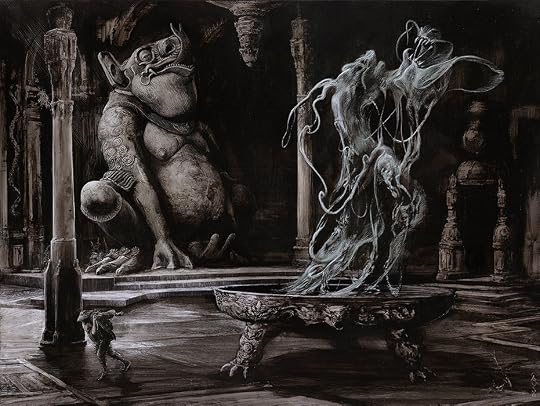

...featuring Tsathoggua (the Sleeper of N'kai, also known as Zhothaqquah) [...] a supernatural entity in the Cthulhu Mythos. Even though Tsathoggua is an invention of Clark Ashton Smith, there's two mentions of the entity in Weird Tales before the publication of Smith's story; first by Robert E. Howard in The Children of the Night(*) and second by H. P. Lovecraft in The Whisperer in Darkness(**).

(*) https://www.goodreads.com/review/show...
(**) https://www.goodreads.com/review/show...
Profile Image for Timothy McGowan.
76 reviews1 follower
August 22, 2024
Man has enough money to buy two loaves of bread or one bottle of wine and bought the wine. 10/10
Profile Image for Keith.
1,062 reviews11 followers
October 11, 2022
“Though the sun had not yet neared the horizon, the shades that were cast upon us from gigantic boles and branches became ever denser, and we moved in a dark-green twilight fraught with oppressive odors of lush growth and of vegetable corruption. There were no birds nor animals, such as one would think to find in any wholesome forest, but at rare intervals a stealthy viper with pale and heavy coils glided away from our feet among the rank leaves of the roadside, or some enormous moth with baroque and evil-colored mottlings flew before us and disappeared in the dimness of the jungle. Abroad already in the half-light, huge purpureal bats with eyes like tiny rubies arose at our approach from the poisonous-looking fruits on which they feasted, and watched us with malign attention as they hovered noiselessly in the air above.”


[Art by Santiago Caruso]

“The Tale of Satampra Zerios” is a short story by Clark Ashton Smith (1893-1961). I read it because it is featured in a The Literature of Lovecraft, Vol. 1 , a collection of stories by authors that were admired by H.P. Lovecraft (1890-1937). The two were friends, corresponding from 1922 to HPL’s death in 1937. Along with other authors such Robert E. Howard, they shared different ideas, including concepts from what is now called the Cthulhu Mythos, and “The Tale of Satampra Zerios” features the god-like being Tsathoggua from this shared Universe. Smith sent a manuscript of this story to Lovecraft long before its 1931 publication in Weird Tales. In a letter dated December 3, 1929, HPL praised it: “What an atmosphere! I can see & feel & smell the jungle around immemorial Commoriom… You have achieved in its fullest glamour the exact Dunsanian touch which I find almost impossible to duplicate” (Melton, 2018). In fact, I enjoyed “The Tale of Satampra Zerios” more than any Dunsany story that I have read. I found the descriptions easier to imagine and the story to be inherently more suspenseful. The quote at the beginning of this review shows how Smith creates a sense of oppressive dread. The story is well worth reading for anyone interested in horror and fantasy literature.

While HPL did not write about “The Tale of Satampra Zerios” specifically in his lengthy literary essay Supernatural Horror in Literature, he did praise Clark:
Of younger Americans, none strikes the note of cosmic terror so well as the California poet, artist, and fictionist Clark Ashton Smith, whose bizarre writings, drawings, paintings, and stories are the delight of a sensitive few. Mr. Smith has for his background a universe of remote and paralysing fright—jungles of poisonous and iridescent blossoms on the moons of Saturn, evil and grotesque temples in Atlantis, Lemuria, and forgotten elder worlds, and dank morasses of spotted death-fungi in spectral countries beyond earth’s rim. His longest and most ambitious poem, The Hashish-Eater, is in pentameter blank verse; and opens up chaotic and incredible vistas of kaleidoscopic nightmare in the spaces between the stars. In sheer daemonic strangeness and fertility of conception, Mr. Smith is perhaps unexcelled by any other writer dead or living. Who else has seen such gorgeous, luxuriant, and feverishly distorted visions of infinite spheres and multiple dimensions and lived to tell the tale? His short stories deal powerfully with other galaxies, worlds, and dimensions, as well as with strange regions and aeons on the earth. He tells of primal Hyperborea and its black amorphous god Tsathoggua; of the lost continent Zothique, and of the fabulous, vampire-curst land of Averoigne in mediaeval France. Some of Mr. Smith’s best work can be found in the brochure entitled The Double Shadow and Other Fantasies (1933).


Title: “The Tale of Satampra Zeiros”
Author: Clark Ashton Smith
Dates: 1929
Genre: Fiction - Short story, horror, fantasy
Word count: 4,848 words
Date(s) read: 10/10/22
Reading journal entry #280 in 2022

Link to the story: http://www.eldritchdark.com/writings/...
Link to Lovecraft’s essay: https://www.hplovecraft.com/writings/...
Link to the image: https://santiagocaruso.com.ar/gallery...

Sources:
Fifer, C., & Lackey, C. (2015, June 5). Episode 259 - The Tale of Satampra Zeiros. H.P. Lovecraft Literary Podcast
https://www.hppodcraft.com/episodes/2...

Lovecraft, H. P., & Joshi, S. T. (2012). The annotated supernatural horror in literature (second edition). Hippocampus Press. https://www.hplovecraft.com/writings/... (Original work published 1927)

Melton, N. (2018, April 17). “The Tale of Satampra Zeiros” by Clark Ashton Smith. My Weird Life https://weirdlifereviews.wordpress.co...

Smith, C.A. (2021). The tale of Satampra Zeiros. In H.P. Lovecraft Historical Society (Ed.), The literature of Lovecraft, vol. 1.. (S. Branney, Narr.; A. Leman, Narr.) [Audiobook]. HPLHS. https://www.hplhs.org/lol.php (Original work published 1929)

The contents of The Literature of Lovecraft, Vol. 1 are:
"The Adventure of the German Student" by Washington Irving
"The Avenger of Perdóndaris" by Lord Dunsany
"The Bad Lands" by John Metcalfe
"The Black Stone" by Robert E. Howard
The Boats of the "Glen Carrig" by William Hope Hodgson
"Count Magnus" by M.R. James
"The Dead Valley" by Ralph Adams Cram
"The Death Mask" by Henrietta Everett
"The Fall of the House of Usher" by Edgar Allan Poe
"The Ghost of Fear" by H.G. Wells (also called “The Red Room”)
"The Ghostly Kiss" by Lafcadio Hearn
"The Horla" by Guy de Maupassant
"The House and the Brain" by Edward Bulwer-Lytton
"The House of Sounds" by Matthew Phipps Shiel
"Idle Days on the Yann" by Lord Dunsany
"Lot #249" by Arthur Conan Doyle
"The Man-Wolf" by Erckmann-Chatrian
"The Middle Toe of the Right Foot" by Ambrose Bierce
"The Minister's Black Veil" by Nathaniel Hawthorne
"The Monkey's Paw" by W.W. Jacobs
"One of Cleopatra's Nights" by Théophile Gautier
"The Phantom Rickshaw" by Rudyard Kipling
The Place Called Dagon by Herbert Gorman
"Seaton's Aunt" by Walter de la Mare
"The Shadows on the Wall" by Mary E. Wilkins
"A Shop in Go-By Street" by Lord Dunsany
"The Signal-Man" by Charles Dickens
"Skule Skerry" by John Buchan
"The Spider" by Hanns Heinz Ewers
"The Story of a Panic" by E.M. Forster
"The Strange Case of Dr. Jekyll and Mr. Hyde" by Robert Louis Stevenson
"The Tale of Satampra Zeiros" by Clark Ashton Smith
"The Tapestried Chamber" by Sir Walter Scott
"The Upper Berth" by F. Marion Crawford
"The Vampyre" by John Polidori
"The Venus of Ille" by Prosper Mérimée
"The Were Wolf" by Clemence Housman
"What Was It?" by Fitz-James O'Brien
"The White People" by Arthur Machen
"The White Wolf of the Hartz Mountains" by Frederick Marryat
"The Willows" by Algernon Blackwood
"The Yellow Sign" by Robert W. Chambers
"The Yellow Wallpaper" by Charlotte Perkins Gilman

Here is a list of the stories in the order in which they were written, with links to my reviews of them:
The Vampyre (1819) by John William Polidori
The Adventure of the German Student (1824) by Washington Irving
The Tapestried Chamber (1828) by Walter Scott
The Minister's Black Veil (1836) by Nathaniel Hawthorne
The Venus of Ille (1837) by by Prosper Mérimée
The White Wolf of the Hartz Mountains (1839) by Frederick Marryat
The Fall of the House of Usher (1839) by Edgar Allan Poe
What Was It? (1859) by by Fitz-James O'Brien
The House and the Brain (1859) by Edward Bulwer-Lytton
The Signal-Man (1866) by Charles Dickens
The Man-Wolf by Erckmann-Chatrian
The Ghostly Kiss (1880) by Lafcadio Hearn
One of Cleopatra's Nights (1882) by by Théophile Gautier
The Upper Berth (1886) by F. Marion Crawford
The Strange Case of Dr. Jekyll and Mr. Hyde (1886) by Robert Louis Stevenson
The Horla (1887) by Guy de Maupassant
The Phantom Rickshaw (1888) by Rudyard Kipling
”The Middle Toe of the Right Foot” (1891) by Ambrose Bierce
Lot #249 (1892) by Arthur Conan Doyle
The Yellow Wallpaper (1892) by Charlotte Perkins Gilman
The Ghost of Fear (1894) by H.G. Wells- also called The Red Room
The Yellow Sign (1895) by Robert W. Chambers
The Dead Valley (1895) by Ralph Adams Cram
The Were-Wolf (1896) by Clemence Housman
The Monkey's Paw (1902) by W.W. Jacobs
The Shadows on the Wall (1903) by Mary E. Wilkins
Count Magnus (1904) by M.R. James
The White People (1904) by Arthur Machen
The Willows (1907) by Algernon Blackwood
The Boats of the "Glen Carrig" (1907) by William Hope Hodgson
Idle Days on the Yann (1910) by Lord Dunsany
The Story of a Panic (1911) by E.M. Forster
The House of Sounds (1911) by Matthew Phipps Shiel
A Shop in Go-By Street (1912) by Lord Dunsany
The Avenger of Perdóndaris (1912) by Lord Dunsany
sThe Spider (1915) by Hanns Heinz Ewer
The Death Mask (1920) by H.D. Everett
The Bad Lands (1920) by John Metcalfe
Seaton's Aunt (1922) by Walter de la Mare
The Place Called Dagon (1927) by Herbert S. Gorman
Skule Skerry (1928) by John Buchan
The Tale of Satampra Zeiros (1929) by Clark Ashton Smith
The Black Stone (1931)
*The difference between a short story, novelette, novella, and a novel: https://owlcation.com/humanities/Diff...

Vignette, prose poem, flash fiction: 53 - 1,000 words
Short Stories: 1,000 - 7,500
Novelettes: 7,500 - 17,000
Novellas: 17,000 - 40,000
Novels: 40,000 + words
Profile Image for TheLeninist.
9 reviews12 followers
April 24, 2016
This is a pretty significant Cthulhu-Mythos story as well as the first Hyperborea story. It introduces the Toad-God Tsathoggua and his 'formless spawn' which became quite popular and were used in many other Clark Ashton Smith stories e.g. "The Holiness of Azedarac" & "The Door to Saturn" and in many Lovecraft stories as well such as "The Mound" and "The Whisperer in Darkness". Tsathoggua is easily Smith's most famous deity, the brother of Cthulhu worshiped in Saturn before the Earth was born, in Hyperborea in pre-history, in Averoigne in the middle-ages, and slumbering dormant in the subterranean vaults of K'yan waiting his return...

As I said this story also introduces the northern land of Hyperborea inspired by the Greek legend. Hyperborea ended up featuring in 11 CAS stories (known as the Hyperborean Cycle) and is my favorite out of all CAS settings. It has a lot in common with Robert E. Howard's Conan stories which take place during 'the Hyborian Age' and they actually share a lot of the place names. In fact, there is a Hyperborea in the Hyborian age although its not the same thing. Cthulhu-Mythos fanatics have determined that the Hyperborea of Smith exists near the arctic at the dawn of an ice-age around 800.000 years ago while the Hyborian Age is 15.000 B. C. The approach of the ice has a significance for the plot of some of the stories as well. Lovecraft suggested to Smith in a letter that Commorium probably exists in the North near Lomar which itself was overtaken by ice in the HPL story "Polaris".

Anyway this particular story is about two thieves who are in dire need of quick cash. They decide to travel to the ruined old capital of Hyperborea named Commoriom to look for valuables. As one would expect it doesn't end too well for them...

Interestingly this takes place pretty late in Hyperboria's timeline as the capital Commoriom is already ruined and Uzuldaroum is the new capital. Many later Hyperboria stories take place when Commoriom is still the capital though. Commorium's fate is hinted at and finally explained in "The Testament of Athammaus".

"The Tale of Satampra Zeiros" was praised by Lovecraft and indeed is atmospheric and hints of terrible ancient secrets, some of which shall be revealed in further stories.
Profile Image for Tom.
731 reviews41 followers
September 26, 2018
A voyage into the jungle to discover the forgotten riches of an abandoned city goes horribly wrong as a latent ectoplasmic form wreaks havoc on the tomb plunderers. It has been noted elsewhere that this tale owes more than a casual nod to Lord Dunsany.
Profile Image for Andrew Hale.
1,067 reviews5 followers
May 1, 2024
With the potential of buddy adventures between the two main characters, Smith gives us a tale of warning that knocks any hope of such escapades into the abyss. Enthralling prose and weird fiction, a nightmarish encounter to experience, but an intriguing tale to read. Similar to The Tomb-Spawn and The Weaver in the Vault.

The town of Uzuldaroum is

The Abominations of Yondo
The Charnel God
The Dark Eidolon
The Death of Malygris
The Double Shadow
The Empire of the Necromancers
The Isle of Torturers
Necromancy in Naat
The Tale of Satampra Zeiros
The Tomb-Spawn
The Voyage of King Eurovan
The Weaver in the Vault
Profile Image for Ravsta P..
116 reviews
September 15, 2022
The first Clark Ashton Smith story I ever read in a slim Penguin classics collection of his varied work. Lovecraft had been my top fave writer for a while, but was rapidly supplanted by Smith for the richness and variety of language, as well as the more varying themes and settings.

This is a jungle tale of thievery gone bad, although this is no spoiler. Very worth reading for the super laden sumptuous nature of the language alone, and the humour is cunningly interspersed but easily missed by the less erudite reader. Smith is a book lover's writer, without doubt.

I highly recommend Smith, across all of his styles; prose, prose poetry and poetry. Few wrote like him, few ever will, and that is just and right for a man with an eidetic memory and an upbringing on his father's tales of worldwide ranging adventure.

Read it, and fall under the alluring sway of Clark Ashton Smith.

Rav.
Profile Image for NanoCyborg.
33 reviews32 followers
May 18, 2025
Probably the most Lovecraftian/Cthulhu-Mythos of all the Hyperborean stories so far (along with it's precursor in chronology, The Testament of Athammaus).

Satampra Zeiros is a hilarious and foolhardy character, inspired by drink with his friend to find the riches of long-desolate Commoriom. What he finds, instead however, is something beyond his understanding and something that will haunt him for the rest of his days.

He writes this all in the past tense, as an older man looking back on his life.
90 reviews1 follower
April 12, 2020
Its an okay story but the wording and prose is too prolix and esoteric. It's like this guy made it his mission to put as many rare and confusing words as possible and all it does is break up the flow of the action. Instead of me reading the next sentence of the chase sequence, I'm double-reading each line to see if I understood it. I guess this is just the way CAS writes but it's too jarring to be truly enjoyable.
Profile Image for Marcos Ibáñez Gordillo.
348 reviews5 followers
June 3, 2021
Me parecía muy divertido cómo hablaba de la pareja de protagonistas. Muy pocas páginas, sólo media frase cada uno y ya los quería. Presentación del primigenio Tsathoggua bien rechulona.
Lástima que esta wea de hiperbórea sea tan inabarcable. No voy a decir que no vaya a leer más, pero en otra década quizá
Profile Image for nooker.
782 reviews1 follower
August 9, 2020
I play Tsathoggua in Cthulhu Wars, so I thought it was overdue for me to actually learn about the character. This story is really a great white hunter/explorer exploring the unknown temple. it is interesting, but doesn't really tell much. Still interesting.
6,726 reviews5 followers
September 18, 2023
Entertaining horror listening 🎧

I listened to this as part of Cliassic Horror Tales - 500+ stories box set. The story is very interesting and a very quick read. I would recommend to readers of horror novels. 2023

213 reviews1 follower
January 18, 2025
Foundational weird fiction. Maybe it's the generational ADHD, but it did seem to drone on without a great building of much tension or compelling pay-off - always a challenge for a short story, but this is basically just very evocative pulp fiction.
Profile Image for Zac Hawkins.
Author 5 books42 followers
September 26, 2020
Before who’s ashen forma does the flora and fauna of Hyperborea tremble in the shadow of Tsathoggua.
Profile Image for Gabe Chaves.
114 reviews
August 5, 2021
It's an interesting pulp tale. This was one of Lovecraft's favorites of Smith's stories.
Profile Image for Fadomon.
86 reviews3 followers
March 10, 2022
Never have a set of characters deserved retribution more
Profile Image for William Cherico.
Author 2 books2 followers
September 3, 2024
Creepy and good atmosphere. The fate of Satampra Zeiros' friend is pretty creative and fun, and this is a neat introduction to the god Tsathoggua.
Profile Image for Aaron.
279 reviews2 followers
September 9, 2024
Sometimes, the tomb raiding life is worth it. And well sometimes you're just a tasty treat for the servants of Tsathoggua!
Displaying 1 - 30 of 31 reviews