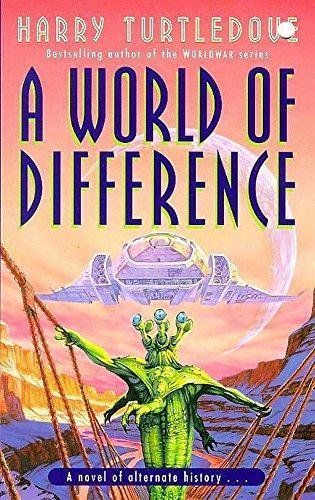
When the Viking lander on the planet Minerva was destroyed, sending back one last photo of a strange alien being, scientists on Earth were flabbergasted. And so a joint investigation was launched by the United States and the Soviet Union, the first long-distance manned space mission, and a symbol of the new peace between the two great rivals.
Humankind's first close encounter with extraterrestrials would be history in the making, and the two teams were schooled in diplomacy as well as in science. But nothing prepared them for alien war—especially when the Americans and the Soviets found themselves on opposite sides. . . .
Praise for A World of Difference
“A master storyteller.” — Houston Chronicle
“[Harry] Turtledove has proved he can divert his readers to astonishing places. he's developed a cult following over the years. . . . I know I'd follow his imagination almost anywhere.” — San Jose Mercury News
“Turtledove never tires of exploring the paths not taken, bringing to his storytelling a prodigious knowledge of his subject and a profound understanding of human sensibilities and motivations.” — Library Journal
Dr Harry Norman Turtledove is an American novelist, who has produced a sizeable number of works in several genres including alternate history, historical fiction, fantasy and science fiction.
Harry Turtledove attended UCLA, where he received a Ph.D. in Byzantine history in 1977.
Turtledove has been dubbed "The Master of Alternate History". Within this genre he is known both for creating original scenarios: such as survival of the Byzantine Empire; an alien invasion in the middle of the World War II; and for giving a fresh and original treatment to themes previously dealt with by other authors, such as the victory of the South in the American Civil War; and of Nazi Germany in the Second World War.
His novels have been credited with bringing alternate history into the mainstream. His style of alternate history has a strong military theme.
I first read this one by Harry Turtledove not long after the paperback edition was published in 1990. I enjoyed this story of US-USSR rivalry over colonization of the Planet Minerva. The problem is that there are Minervans--aliens--living there and two groups of them are fighting a war against each other. The Americans and the Soviets take sides and the Cold War heats up on an alien planet...Upon my rereading this book, I did not feel so engaged in the story. I think it dragged somewhat and could have been shorter. It's an early effort by Turtledove and different than other books of his, which are mainly alternative histories, such as alternative histories of the Civil War and World War II. Interestingly, when I saw Turtledove at a science fiction convention in 2005, I had this book with me for him to sign. When I told him that I really enjoyed the book, he gave me a look of utter disbelief and said something like, "Really?" He signed the book, but I couldn't get over that look. I took it to mean he couldn't believe I had liked it...I know there are authors who don't care to be reminded of their early work...Maybe that look meant something else....?
Imagine if Mars was more Earth-like. Who would we find living there? Welcome to Minerva.
Both the Americans and the Russians plan to land on Minerva at once Bragg nodded. “They haven’t been playing with their orbit again, anyhow.” He had worn a crew cut when it was stylish, kept it through the years when it wasn’t, and still had it now that it was in again. The only difference was that gray streaked it now. He picked up the radio mike. “Zdrast’ye, Tsiolkovsky,” he said, and went on in Russian that was accented but fluent. “All well aboard?” “Very well, thank you, Brigadier Bragg.” Colonel Sergei Tolmasov sounded like an Oxford don. Just as the Americans used Russian to talk to the Soviet ship, the crew of the Tsiolkovsky always replied in English. Tolmasov’s dry wit went well with the slightly fussy precision he brought to the language. “Good to find you in your expected place, old fellow.” “We were thinking the same thing about you,” Bragg said. The Tsiolkovsky had changed orbits several times in the week since it and Athena had reached Minerva. Had each burn not taken place on the far side of the planet from Athena, Levitt would have been happier about believing the Russians when they said the maneuvers were just to enhance their observations. As things were, he had not been sorry when Bragg also started jinking. “Let them worry, too,” the pilot had said. Now Tolmasov remarked, “I will be glad when we are all on the ground, and this foolish maneuvering can cease.” “Agreed,” Bragg said at once. “We’ll be too busy cheating the natives to worry so much about each other.”
The Minervans in their castles of ice A drop of water fell from the castle ceiling onto Reatur’s head. He extended an eyestalk and stared balefully upward at the ice. Was it starting to drip already? Plainly, it was. Summer was coming. Reatur was not happy about summer. It would be too hot; it always was. Most of the tools made of ice would melt; they always did. The domain master would have to see to getting the stone tools out of storage, as he did toward the end of every spring. He did not like stone tools. They were hard to make and expensive to buy. His peasants did not like them, either. They were heavier than ice and tiring to use in the fields. He wished he lived in a land with a better climate, where ice stayed ice the year around. Even his castle’s thick walls would drip and trickle all summer long. He remembered the really scorching summer-how long ago was it? Seven years, that was it-when big chunks of the roof had melted and fallen in. Lucky his domain had been at peace then, and lucky the collapse had killed only mates.
Two groups of Minervans are at war. Unfortunately the Americans and the Russians have allied themselves with opposing aliens. “Long as the Russians keep to their side of Jotun Canyon, none o’ their business what we do over here. Besides, if they even think we’ve given guns to the Minervans here, maybe they’ll get serious about keeping Hogram’s gang on their own side where they belong.” “Or maybe they’ll give them guns, too, to keep things balanced,” Irv pointed out. “Hadn’t thought of that.” Bragg frowned, but his face cleared after a moment. “I don’t believe it. Tolmasov’s not that dumb. No matter what he thinks of us, no way he’d let the natives have the drop on him. I wouldn’t, not in his long johns.” “I suppose not,” Irv said. “If we started shooting at each other here, it could even touch off a war back home.”
Humankind's first close encounter with extraterrestrials would be history in the making, and the two teams were schooled in diplomacy as well as in science. But nothing prepared them for alien war - especially when the Americans and the Soviets found themselves on opposite sides.
This was a book that I read both because of its author and its premise. With dozens of alternate history novels, novellas, and short stories to his credit, Harry Turtledove is the acknowledged master of the genre, and I have enjoyed many of his works. The description of the story also had much to offer, moving away from the standard Civil War/World War II setting of far too many alternate histories to pose a much more refreshing one – what if the fourth planet from our sun was capable of sustaining life?
Much of what Turtledove does with this is imaginative. No longer the “red planet” we know, he bestows upon it a different name – “Minerva” rather than Mars. To make it habitable, then planet is larger, though its distance from the sun means that it is still a cold place. He also devises an ecology based around entirely different premises, imagining evolution producing radial rather than symmetrical species with their own cycles and habits. After this life is discovered by an American probe in 1976, the two superpowers of the United States and the Soviet Union race to send manned missions to Minerva to explore it for themselves, with the story itself being a tale of the two missions’ simultaneous arrival on the planet.
Yet as I read this book, I was struck by how conventional it was. Once the premise is outlined, the plot quickly develops along the lines of the American-versus-Soviet space contests typical of many sci-fi novels produced during the Cold War. Propping up the story with an alternate-history setting allows Turtledove to get away with this, but it gives the entire book a prematurely dated feel. Moreover, too many of the characters are underdeveloped, sometimes leaving them indistinguishable from one another. The “Minervans” suffer from similar flaws, with only a few of them clearly defined in any way and none of them ever coming across as truly alien.
As a result, the book might disappoint readers familiar with Turtledove's later work. While not a bad novel, it lacks the distinctive characters and immersion into detailed alternate Earths that are hallmarks of many of the author's subsequent writings. Fans of Turtledove's other novels will find the absence of such elements leaving them wanting more, as it fails to provide what they have come to expect from this notable author.
If, like me, you enjoy Turtledove's writing style, then A World of Difference is a welcome addition to his body of work. Published in 1990 his approach to aliens is very much a first run-through precursor to that of the ones in his later World War series, with an emphasis on their biology as a foundation for the way they speak, their attitudes to sex and gender, and little mannerisms that really bring them to life as real characters. As usual, much of what is in the book is an allegory for human politics and history, and as such this science fiction story may appeal more to those with an interest in history than hard science.
While all the usual Turtledove tropes are there to be enjoyed (including unnecessary and rather juvenile - but still welcome - sex scenes) the ending is somewhat anti-climactic but doesn't really devalue the novel as a whole.
For those who loved his World War series I would recommend this as an interesting addendum.
In this story, earth history is just like we all know right up until the Viking lander. In this universe, though, Mars is not our planet. It is more massive, it has an atmosphere and intelligent life. It is also called Minerva. The last photos taken by the Viking lander on Minerva are of a native Minervan attacking it. This naturally spurs all sorts of efforts to send a manned mission. Since the period is the 70s, the cold war is in full swing and the Soviets and Americans are determined to beat each other. They land at different but nearby sites and befriend tribes antagonistic towards each other. The cold war has moved to the red planet.
How did I miss this one? Maybe I confused it with A Different Flesh, which I'd already read. Anyway, I got this as an ebook and thoroughly enjoyed it. Mars as a habitable planet, with intelligent creatures, visited by humans during the Cold War. Interesting characters, including the aliens. Lots of plot twists. Brings the world alive. Another Turtledove book I am sad to see end, and I am running out of his novels and short stories to read. Luckily he has a couple of books coming out this year, and I can go back and reread my favorites.
This alternate history story posits what if Mars was a habitable world home to sentient life. It tells an interesting story that fleshes out the alien culture and believably has the planet become the site of a Cold War proxy conflict
Russian and American spacecraft land in two different parts of the planet Minerva, and find themselves at odds when the natives of their respective regions go to war with each other.
Missione su Minerva, in originale "A World of Difference", è un libro di fantascienza dell'autore statunitense Harry Turtledove, edito nel 1990. L'autore raggiunse un grande successo grazie al ciclo fantasy di Videssos e ai successivi cicli ucronici dell'Invasione e della Colonizzazione. La Saga di Videssos si basa sulla storia di un luogo immaginario chiamato Videssos, creato ad immagine dell'Impero bizantino, di cui lo stesso Turtledove è un esperto essendosi laureato in storia bizantina presso la UCLA. La sua formazione da storico risulta evidente dalla precisione con cui descrive sia le civiltà reali sia quelle immaginarie. Inoltre tratta molto spesso il tema del genocidio, in un'ottica che supera la divisione bene/male e approfondisce i problemi connessi con questo argomento.
La trama di questo romanzo: la storia è ambientata in un presente alternativo, quello che adesso è così di moda con il filone "ucronico", in cui il pianeta più vicino alla Terra non è Mercurio ma uno inventato di nome Minerva. Quando la Viking 1 la sonda spaziale atterra su Minerva nel 1976, cattura una foto di un Minerviano nativo che brandisce uno strumento primitivo, dimostrando così l'esistenza di vita intelligente su altri mondi. Partono due spedizioni, una americana e una russa, mentre sulla Terra la guerra fredda è all'apice tra le due superpotenze. Le due spedizioni atterrano in due luoghi differenti ma si ritrovano implicati nella guerra tra le due fazioni della razza indigena. Gli umani porteranno scompiglio sugli indigeni, sia per la loro tecnologia che per la nuova e strana mentalità.
Di Turtledove ho letto il ciclo dell'Invasione e della Colonizzazione, mi manca tutta la sua produzione fantasy, ma avevo apprezzato molto il suo stile e le sue storie: ben narrate, ben documentate, forse un poco lente in alcuni punti e con tanta farcitura che in alcuni casi rallente la lettura che su storie come queste dovrebbe essere di intrattenimento puro e dunque abbastanza movimentate e veloci.
La civiltà aliena è molto ben descritta, ben caratterizzata e solida anche se questo è un romanzo auto conclusivo. Anche gli aspetti della vita degli astronauti a stretto contatto tra loro e in una prima missione di contatto con una civiltà aliena sono ben descritti, anche se forse tutto è visto come figure o completamente positive o del tutto negative.
I remember really getting into this book when I was in high school... The story is that humans send a Viking space probe to the planet 'Minerva' (I'm not sure if that was supposed to be 'Mars' or not), and it was destroyed... so they send a small manned mission to find out what happened. The crew consisted of three married couples, chosen because they were supposed to be more emotionally stable over long trips that way (of course, there was all kinds of drama). When they get there, they find the planet populated with strange looking aliens with radially symmetrical bodies, and have six feet, six arms, and six eyes, all pointed outward. The aliens are at a medieval level of technology, and they think and act pretty much the same as humans... only their bodies make them different. We get a first person point of view from most of the humans as well as a selection of the aliens. If I remember correctly, from then on the story mostly concerns itself with alien tribal warfare and the humans changing the alien society by helping with their childbirth... turns out that the alien womenfolk get pregnant early then die immediately. You see, they have six babies at a time that bud out from their sides... each clutches a major artery in its mouth, and when they are born they fall away leaving the mother to bleed out within seconds. The humans gain the trust of a chief by standing by with hemostats to stanch the bleeding, ushering a new age of alien society. The humans all resolve their drama somehow and go home.
This entire review has been hidden because of spoilers.
I've liked most of the Harry Turtledove I've read, even though some people claim now a brand for ghostwriters of alternate history; I'm going to believe that isn't true. Anyway, I was a little surprised to see a Turtledove book revolving around first contact and an interesting alien race.
Don't get me wrong; this is an alternate history novel. The aliens live on Earth's twin planet, and the Soviet Union never fell. I do wish the alternate history aspects had been a bit meatier, but that's a conceptual issue, not an execution issue. The real concept of the novel were the aliens, and while they won't be going down in history as one of the best fictionalized races, their physiology and culture was interesting enough to carry the novel. I do think that it was a bit too easy for the aliens and the humans to cross the language barrier, but I suppose Turtledove thought he had to do that for the plot.
And the plot was.... sufficient. It was pretty predictable, but there were a few twists in the personal lives of the characters. The melodrama felt slightly unnecessary, but it didn't detract that much from the book. I enjoyed it, like the rest of this novel. I'll probably never come back to it, but it was a good chink in Turtledove's sci0fi armor.
I am very torn on this book -- I'm generally not a huge fan of sci-fi related to outer space and aliens (I accept it when it's there), but on the other hand I found myself really intrigued by the political conflict at work within the novel. It's interesting to see the ways in which Turtledove weaves history into an alien story that as time goes on, becomes less about aliens and more about personal beliefs amongst the protagonists. The book definitely had it's pacing problems at times. For me, I find Turtledove's writing a touch on the dry side, but once he hits his stride with the story, I tend to be a bit more forgiving towards it.
I liked this book, but I didn't love it. I was appreciative to how he approaches the connection between humans and aliens, but I still am not huge on stories based on extraterrestrials. Recommended for fans of the more harder style of sci-fi than those who don't like having the "science" in their "fiction".
What if a planet, named Minerva, was not as far away from Earth as Mars and it has sentient life forms? What if the Russians and Americans decided to send simultaneous, but independent missions to this planet called Minerva? And, what if the Russians and Americans allied with opposite sides of warring tribes of Minervans? And what if .... So go the stories of the alternative history and SciFi author Harry Turtledove. I found the story quite enjoyable, especially the effects of humans on the Minervans. The effects of the Minervans on the humans is also interesting.
This is rather a surprising book in that it reads like a juvenile - in the sense that Starship Troopers is a juvenile - but cannot be with the sexual content. It suffers from a bit too much simplicity of social dynamics but is a good yarn well spun.
I thought this was going to be WAY more cheesey than it actually was. I like that Turtledove takes a subject that seems pretty cliche (squasy aliens on Mars, for example...) and gives it a serious plot and credible characters.
Light but fun read. Turtledove has a good story teller's touch. Written in 1980, the USA and USSR both send a mission to Minerva, the fourth planet (alternative universe-- there is no mars) and each lands in a different 'tribe' of Minervans. The cold war heats up on frozen Minerva! Good beach read.
Humans initiate first contact with alien species on a distant planet. The unusual aspects are that the aliens are 6-sided instead of 2-sided as humans and that their births have a 100% fatality rate for the mothers, which shape their culture very differently as all women give birth at a young age and never go beyond young adulthood.
Il libro � ambientato in un presente alternativo, in cui il pianeta pi� vicino alla Terra si chiama Minerva. Un giorno la sonda Viking, prima di spegnersi definitivamente, fotografa uno strano essere con in mano uno strano bastone, probabilmente un'arma. Partono due spedizioni, una americana e una russa. Sulla Terra la guerra fredda non � ancora terminata e la rivalit� � altissima. Le due spedizioni atterrano nei due versanti di un'enorme gola, e si ritrovano in mezzo a una guerra tra due fazioni della razza indigena. Gli umani porteranno scompiglio sugli indigeni, sia per la loro tecnologia che per la nuova e strana mentalit�. Mi piace molto lo stile di scrittura di Turtledove. Mi ha conquistata col ciclo della colonizzazione e non mi ha pi� delusa. Forse i suoi libri sono un po' lenti, non c'� tanto thrilling, ma scorrono comunque via che � un piacere. In questo libro, come in quelli della colonizzazione, la civilt� aliena � molto ben definita, in tutti gli aspetti del quotidiano. Forse non sono cos� tanto alieni quando dimostrano emozioni, desideri e difetti tipicamente terrestri. Anche in questo romanzo gli americani sono i buoni e i russi sono i cattivi/antipatici/egoisti. Nella colonizzazione c'erano anche i cinesi a fare una figura pessima, qui almeno ci sono solo i russi. Interessante, anche se non molto approfondita, l'evoluzione dei rapporti tra gli astronauti, costretti a vivere spalla contro spalla per un periodo di tempo cos� lungo. A parte la sviolinata filonazionalista, la storia � comunque piacevole e sarei curiosa di sapere quali sono stati gli effetti a lungo termine della "favolosa aria di libert�" tipicamente occidentale. Io credo che avrebbe distrutto la societ� feudale degli indigeni, ma Turtledove probabilmente, in un eventuale seguito, l'avrebbe elevato a modello comportamentale per eccellenza.