

What do you think?
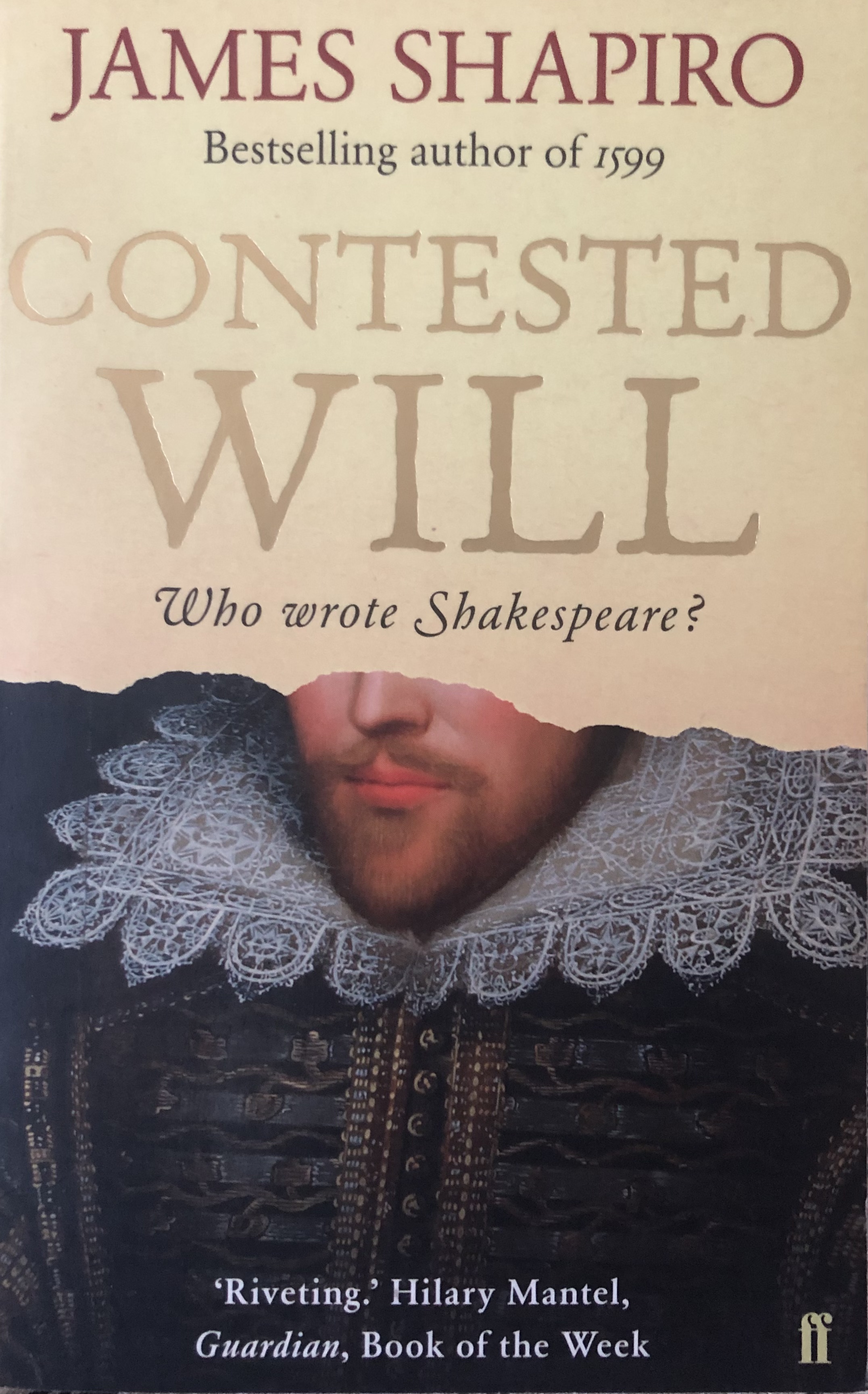
Contested Will: Who Wrote Shakespeare?
What links the following people?
Sigmund Freud. Henry James. Mark Twain. Helen Keller. Charlie Chaplin. Sir Derek Jacobi. Mark Rylance.
They've all asked the question: did Shakespeare really write Shakespeare?
For centuries, conspiracy theories have raged. Now the celebrated author of "1599" addresses the biggest question in literary history: was Shakespeare the single genius behind the greatest works in the English language?
Sigmund Freud. Henry James. Mark Twain. Helen Keller. Charlie Chaplin. Sir Derek Jacobi. Mark Rylance.
They've all asked the question: did Shakespeare really write Shakespeare?
For centuries, conspiracy theories have raged. Now the celebrated author of "1599" addresses the biggest question in literary history: was Shakespeare the single genius behind the greatest works in the English language?
367 pages, Paperback
First published January 1, 2010
About the author
James Shapiro
25 books213 followersA specialist in Shakespeare and the Early Modern period, James S. Shapiro is Larry Miller Professor of English and Comparative Literature at Columbia University, where he has taught since 1985. He has been awarded fellowships from the National Endowment for the Humanities, the Guggenheim Foundation, the New York Public Library Cullman Center for Scholars and Writers, and the American Academy in Berlin. In 2011, he was inducted into the American Academy of Arts and Sciences. He currently serves as a Shakespeare Scholar in Residence at the Public Theater in New York City.
Ratings & Reviews
Friends & Following
Create a free account to discover what your friends think of this book!
Community Reviews
Displaying 1 - 30 of 347 reviews

July 5, 2010
This well-written exploration of the most popular of all literary conspiracy theories--namely, denying that Shakespeare wrote Shakespeare--may contain (at least for my taste) too many details about the most prominent Baconians and Oxfordians, but such details are germane to Shapiro's subject, since he is more interested in the reasons why people began to question--and continue to question--Shakespearean authorship than he is in the reasons for and against this opinion.
Shapiro believes--as I do--that there is no compelling reason to doubt Shakespeare's authorship of the plays (apart from the obvious evidence of occasional collaboration) because Shakespeare's authorship was unquestionably accepted by his peers and contemporaries, remaining virtually unchallenged for the next two hundred years, and no compelling evidence or cogent reason has since emerged to challenge this long-held opinion.
Shapiro argues that three late 18th century intellectual developments-- rather than any newly-uncovered evidence--precipitated the questioning of Shakespeare's authorship: 1) the romantic conception of the poet as genius, which gave rise to a "bardolatrous" reverence for every comma of the Shakespeare canon, transforming the corpus into a series of sacred texts and establishing Stratford as a shrine, 2) the romantic assumption that a great poet's works must inevitably have a profound connection to his autobiography, which caused readers to be disappointed and dissatisfied with the sparse details of Shakespeare's life, sparking a corresponding desire to find autobiographical details elsewhere, and 3) the "Higher Criticism" recently applied by German scripture scholars to the Bible provided powerful literary tools that could be used to question the origins and structural principles of any established, revered text, suggesting new explanations for the methods and sources of their composition. Nineteenth century readers began to question how the grammar-school educated, prosaic, middle-class "man of Stratford" could have possibly written such rarified works of genius, and began to examine the plays themselves for textual evidence of another author's biography and voice.
Shapiro examines the careers of various prominent Shakespeare sceptics--Delia Bacon, Mark Twain, Helen Kelley, Dr. Looney (sic!), Sigmund Freud--and shows how their own histories and desires led them to question Shakespeare's authorship, and he concludes with a brief, persuasive defense of the traditional position--namely, that Shakespeare indeed wrote Shakespeare.

April 4, 2010
I am a Shakespeare fanatic so I was predisposed to liking this book (especially as Shapiro is very much of the opinion that Shakespeare DID write all the plays attributed to him), but I was pleasantly surprised by how much I learned. I've taken graduate level courses on Shakespeare and Textual Criticism, so I was familiar with most of the evidence that Shapiro presents for Shakespeare. With a few exceptions, there was nothing new here in that regard. What impressed me was the approach Shapiro takes to addressing the authorship question. Rather than simply giving a list of reasons why we shouldn't accept the case for Bacon, Oxford, or any of the other candidates, Shapiro looks at why readers and critics began to doubt Shakespeare in the first place, and how those views are reflective of the way readers throughout the last four centuries have approached literature, and even how the perceive themselves. It isn't just about the desire for a good conspiracy theory or the snobbery of people who can't accept that a "common" man could be the greatest literary genius of all time (although these are both factors), but about the modern construction of identity and the need to see the author's image reflected in what we read.
One criticism I have is that I think Shapiro engages in a bit too much psychoanalyzing of the anti-Shakespeare figures, especially as he is so critical of these people for trying to determine Shakespeare's identity through readings of the plays and sonnets. However, unlike the anti-Shakespeareans, when Shapiro psychoanalzyes, he pretty much always has evidence to back him up (for instance, if he says that Delia Bacon became obsessed to the point of mania with her theories, he will cite a letter from Nathaniel Hawthorne that says just that). Perhaps most readers are more interested in this type of argument than I am - I find the historical and physical evidence more interesting.
One criticism I have is that I think Shapiro engages in a bit too much psychoanalyzing of the anti-Shakespeare figures, especially as he is so critical of these people for trying to determine Shakespeare's identity through readings of the plays and sonnets. However, unlike the anti-Shakespeareans, when Shapiro psychoanalzyes, he pretty much always has evidence to back him up (for instance, if he says that Delia Bacon became obsessed to the point of mania with her theories, he will cite a letter from Nathaniel Hawthorne that says just that). Perhaps most readers are more interested in this type of argument than I am - I find the historical and physical evidence more interesting.
November 6, 2023
The fact that we need books like this is a sad reflection on the delusional stupidity of way to many people - the idea that there is any mystery as to who wrote the plays attributed to Shakespeare is nonsense - if you doubt that Shakespeare wrote these plays then you probably think aliens built the pyramids. As with all nonsense the interesting question is not did Shakespeare write these plays? did aliens build the pyramids? did Egyptians teach Mesoamericans to build pyramids? was Richard III a saintly figure wrongly maligned by the Tudors? etc. etc. etc. but why at some period did these beliefs come about? Once you approach the question from that angle all sorts of things become clear.
For two hundred years after his death nobody doubted that Shakespeare wrote the plays, sonnets, etc. But towards the 18th century the acting profession under Garrick was attempting to establish its respectability as 'artists' (as opposed to montebanks and prostitutes) and the emergence of the idea of the 'artist' as viewed by romantics caused an influx of visitors to Stratford-upon-Avon to 'discover' the 'real' Shakespeare. That the only traces of Shakespeare they could find were in legal documents about money didn't fit with their view of Shakespeare as an ethereal 'artist' (although oddly proving how similar he was to actor/managers like Garrick) so gradually the idea was created that the real Shakespeare was someone else, someone more 'fitting' to a national hero/poet.
So as the 19th and 20th century advanced a whole slew of noisy but ill informed men and women pontificated on who Shakespeare must be. That they were all middle class and deeply trapped within England's class system it was inevitable that they concentrated on figures like the Earl of Oxford of Francis Bacon, who was the first and last, Lord Verulam. One of the universal trends in the game of hunt the real Shakespeare is that he is always someone from a grander class than either the real Shakespeare or those who were seeking a replacement.
Quite how absurd their choices, particularly the Earl of Oxford, only became apparent when 'Monstrous Adversary: The Life of Edward de Vere' by Alan H. Nelson was published in 2003. Edward de Vere was so ghastly that it would be embarrassing if he was Shakespeare. Of course it wasn't like Professor Nelson discovered a cache of lost, hidden or secret documents. He simply did what anyone should do, he hit the archives and did some research. It is amazing how many fantastical theories collapse when exposed to reality.
A wonderful book, well worth reading, but like all de-bunkers of nonsense this book will never be read by those who should read it.
For two hundred years after his death nobody doubted that Shakespeare wrote the plays, sonnets, etc. But towards the 18th century the acting profession under Garrick was attempting to establish its respectability as 'artists' (as opposed to montebanks and prostitutes) and the emergence of the idea of the 'artist' as viewed by romantics caused an influx of visitors to Stratford-upon-Avon to 'discover' the 'real' Shakespeare. That the only traces of Shakespeare they could find were in legal documents about money didn't fit with their view of Shakespeare as an ethereal 'artist' (although oddly proving how similar he was to actor/managers like Garrick) so gradually the idea was created that the real Shakespeare was someone else, someone more 'fitting' to a national hero/poet.
So as the 19th and 20th century advanced a whole slew of noisy but ill informed men and women pontificated on who Shakespeare must be. That they were all middle class and deeply trapped within England's class system it was inevitable that they concentrated on figures like the Earl of Oxford of Francis Bacon, who was the first and last, Lord Verulam. One of the universal trends in the game of hunt the real Shakespeare is that he is always someone from a grander class than either the real Shakespeare or those who were seeking a replacement.
Quite how absurd their choices, particularly the Earl of Oxford, only became apparent when 'Monstrous Adversary: The Life of Edward de Vere' by Alan H. Nelson was published in 2003. Edward de Vere was so ghastly that it would be embarrassing if he was Shakespeare. Of course it wasn't like Professor Nelson discovered a cache of lost, hidden or secret documents. He simply did what anyone should do, he hit the archives and did some research. It is amazing how many fantastical theories collapse when exposed to reality.
A wonderful book, well worth reading, but like all de-bunkers of nonsense this book will never be read by those who should read it.
August 12, 2011
I had expected a strong overlap between Shapiro's book and the parallel sections of Schoenbaum's Shakespeare's Lives, the 400 year history of attempts to create a Life of Shakespeare. But there is no replication. Shapiro is no less scholarly, but he goes further in striving to understand the creators, and gullible victims, of the idea that Shakespeare did not write the works attributed to him.
The book is unusual in coming from a genuine Shakespearean scholar (most avoid this subject like the plague), and in never resorting to derision or ridicule. Delia Bacon emerges as a tragic figure, with brilliant early career, controlling family, disappointed love, mental decline. Thomas Looney by contrast is sinister -- cult religious beliefs, aristocratic obsessions, Nazi sympathies. Shapiro avoids the usual comments on Looney's unfortunate name, but merely tells us that it rhymes with "bony". He does not argue against the beliefs of Baconians and Oxfordians, he simply tells their story, and when it is as well told as it is here, it proves indeed to be a sufficient refutation. He then tells the stories of the most celebrated of the believers, Mark Twain, in old age, and Freud. Again we learn why it could have happened.
But the Baconians have withered away and died (Shapiro explains why this should be), while the Oxfordians, after an interval when it seemed that they might do the same, are everywhere. Hence the need for this book. It is a profound and entertaining account of an extraordinary mental aberration, which should be read by anyone in danger of infection.

July 23, 2022
I would never have read this if someone hadn't recommended it as thoroughly anti all those ludicrous, classist, and ultimately antisemitic (as they all inevitably are) conspiracy theories that Shakespeare, a glover's son and moneylender (see?), couldn't have produced one if not the greatest bodies of work in the English language. But it is! Shapiro retains a measured, academic tone that still takes no prisoners with the twisted logic of Bacon cipher adherents -- including people whose work I love and respect, such as Mark Twain* and Henry James -- and the odious Oxfordians (Freud, others). Basically, all of these people would rather believe in elaborate incestuous conspiracies than that a great artist may have also written for money. It's basically QAnon in an intellectual hat. Maybe slightly more benign... but it still represents a troubling willingness to hold to any pet, in-group theory over clear facts.
Anyway, after all that, the final third of this book is a brief account of much of what we do know of Shakespeare's life, and what his contemporaries wrote about him, and honestly it was like taking a cool, refreshing swim after a long, sweaty walk. Great artistic ability is not contingent on noble birth. If you think otherwise...please unpack that. (But maybe skip consulting a Freudian.)
*He also thought Queen Elizabeth was secretly a man and hated Jane Austen, so... Not every thought's a winner, Sam.
Anyway, after all that, the final third of this book is a brief account of much of what we do know of Shakespeare's life, and what his contemporaries wrote about him, and honestly it was like taking a cool, refreshing swim after a long, sweaty walk. Great artistic ability is not contingent on noble birth. If you think otherwise...please unpack that. (But maybe skip consulting a Freudian.)
*He also thought Queen Elizabeth was secretly a man and hated Jane Austen, so... Not every thought's a winner, Sam.

December 28, 2011
The authorship of the plays is really a nonquestion, interesting to people who think that Dan Brown fellow was writing about real history with all that code and secret society stuff. It didn't occur to anyone to question the authorship of Shakespeare's plays until more than two hundred years after his death and doing so makes about as much sense as questioning that Dante or Dickens or Poe or Atwood wrote the works we put their names on; once someone asks the question, though, the anomaly hunting and convoluted storytelling begin and you can find reasons to question the truth of just about anything if you want to badly enough (moon landings, anyone?). The refusal to believe Shakespeare wrote his plays depends on a few basic ideas and ways of thinking.
First, a highly Romantic idea of authorship, with the Artist an exalted figure, someone touched by a kind of mysterious spiritual power we call Genius, set apart from the ordinary, working in isolation, against the grain of his/her (usually his) society, a rebel, a prophet, producing Art for a tiny elite of people sensitive enough to hear the Truth (if not sensitive enough to produce Art themselves), rejected and unheard by the masses who can't bear to face the Truth of Art. This is a conception of the Artist and of Art that would have made no sense to anyone before the Romantics came up with it in the late eighteenth and early nineteenth centuries (which is why it occurred to no one to think of Shakespeare in this way until then). But it is utterly incompatible with any evidence that the Artist, especially the great Shakespeare, operated in the real world of practicality and business and money and family and property and contracts and debts and legal documents and co-workers; such things are far too mundane to associate with Art. And so the mundane Shakespeare, who sued for the repayment of debts and expected to be paid for his work and bought property and wrote a will some people now don't approve of and worked with other people, couldn't be an Artist.
Second, basic snobbery. Great Art is produced by sensitive, highly educated, well-traveled, privileged, sophisticated people with sensibilities far above those of ordinary people who work for a living and come from small towns and wear boring clothes and worry about the rent. You know, like aristocrats and people who associate with aristocrats. Because aristocrats are so much more sensitive and exciting and glamorous than boring ordinary, nonaristocratic people. So boring, ordinary Shakespeare from a boring, provincial town, who associated with other boring, ordinary people (and even married one), and didn't travel and didn't grow up with all the privileges and wasn't educated at an elite school couldn't possibly have produced these plays about sophisticated, complicated, interesting people, because he was ordinary in his background and connections and ordinary people aren't capable of imagining things they haven't personally experienced.
Third, a fascination with conspiracy and a pride in being one of the few who are in on the secret. The world we see is dull, but underneath the surface, it is full of intrigue and mystery and scheming and plot-making, except that most people are too lazy and pedestrian to see it properly. So it falls to the few who are able to see beneath the surface to expose the conspiracies that lurk in the shadows. We should be grateful to them, really, but they, like Artists, are usually unappreciated and unrecognised by the masses as the visionaries they are.
Fourth, the autobiographical fallacy, the idea that authors are really always writing about themselves, that they can only write about they know and have experienced themselves, that they are prisoners of their personal psychological makeup and constantly revealing it even (or especially) when they think they are writing about someone else who isn't them, that fictional characters are always alter egos for their authors (except when they aren't) or portraits of real individual people who can be identified by name. And lyric poetry above all, like the sonnets, is explicitly and narrowly autobiographical and can't possibly be anything else and the "I" of a poem is always the author.
James Shapiro is remarkably patient with all this stuff, and you could not ask for a more helpful guide through the labyrinth of the authorship question (or nonquestion). He lays out clearly the roots of the problem, the motivations for questioning Shakespeare's authorship (and the history of the issue and their reasons for asking the question are far more interesting than their convoluted answers). As he points out, there is a great deal of evidence that his contemporaries knew Shakespeare as an author, as the author of his plays, and none whatsoever that he wasn't. And if you start thinking about the practicalities of the conspiracy it would have taken to hide the authorship of someone else under his name (let alone why it would have occurred to anyone to have done such a strange and difficult thing, especially at a time when anonymous publication was so common and so easy), just who would have had to know enough to be dangerous, how many people had to keep how many secrets, you realize what nonsense the whole thing is. People just aren't that good at keeping secrets, at being consistently competent and controlled enough to make a conspiracy of this magnitude work. This is where conspiracy theories always fall down: I just don't believe in cabals of master-plotters who never slip up, never make a mistake, and who are perfectly in control of secret information.
In some ways, of course, the identity of the author doesn't matter. The play's the thing, after all. But Shapiro has a thoughtful response to the temptation to dismiss the whole matter (as most academics have done): "When I first explored the idea of writing this book some years ago, a friend unnerved me by asking, 'What difference does it make who wrote the plays?' The reflexive answer I offered in response is now much clearer to me: 'A lot.' It makes a difference as to how we imagine the world in which Shakespeare lived and wrote. It makes an even greater difference as to how we understand how much has changed from early modern to modern times. But the greatest difference of all concerns how we read the plays. We can believe that Shakespeare himself thought that plays could give to 'airy nothing' a 'local habitation and a name.' Or we can conclude that this 'airy nothing' turns out to be a disguised something that needs to be decoded, and that Shakespeare couldn't imagine 'the form of things unknown' without having experienced it firsthand. It's a stark and consequential choice."
First, a highly Romantic idea of authorship, with the Artist an exalted figure, someone touched by a kind of mysterious spiritual power we call Genius, set apart from the ordinary, working in isolation, against the grain of his/her (usually his) society, a rebel, a prophet, producing Art for a tiny elite of people sensitive enough to hear the Truth (if not sensitive enough to produce Art themselves), rejected and unheard by the masses who can't bear to face the Truth of Art. This is a conception of the Artist and of Art that would have made no sense to anyone before the Romantics came up with it in the late eighteenth and early nineteenth centuries (which is why it occurred to no one to think of Shakespeare in this way until then). But it is utterly incompatible with any evidence that the Artist, especially the great Shakespeare, operated in the real world of practicality and business and money and family and property and contracts and debts and legal documents and co-workers; such things are far too mundane to associate with Art. And so the mundane Shakespeare, who sued for the repayment of debts and expected to be paid for his work and bought property and wrote a will some people now don't approve of and worked with other people, couldn't be an Artist.
Second, basic snobbery. Great Art is produced by sensitive, highly educated, well-traveled, privileged, sophisticated people with sensibilities far above those of ordinary people who work for a living and come from small towns and wear boring clothes and worry about the rent. You know, like aristocrats and people who associate with aristocrats. Because aristocrats are so much more sensitive and exciting and glamorous than boring ordinary, nonaristocratic people. So boring, ordinary Shakespeare from a boring, provincial town, who associated with other boring, ordinary people (and even married one), and didn't travel and didn't grow up with all the privileges and wasn't educated at an elite school couldn't possibly have produced these plays about sophisticated, complicated, interesting people, because he was ordinary in his background and connections and ordinary people aren't capable of imagining things they haven't personally experienced.
Third, a fascination with conspiracy and a pride in being one of the few who are in on the secret. The world we see is dull, but underneath the surface, it is full of intrigue and mystery and scheming and plot-making, except that most people are too lazy and pedestrian to see it properly. So it falls to the few who are able to see beneath the surface to expose the conspiracies that lurk in the shadows. We should be grateful to them, really, but they, like Artists, are usually unappreciated and unrecognised by the masses as the visionaries they are.
Fourth, the autobiographical fallacy, the idea that authors are really always writing about themselves, that they can only write about they know and have experienced themselves, that they are prisoners of their personal psychological makeup and constantly revealing it even (or especially) when they think they are writing about someone else who isn't them, that fictional characters are always alter egos for their authors (except when they aren't) or portraits of real individual people who can be identified by name. And lyric poetry above all, like the sonnets, is explicitly and narrowly autobiographical and can't possibly be anything else and the "I" of a poem is always the author.
James Shapiro is remarkably patient with all this stuff, and you could not ask for a more helpful guide through the labyrinth of the authorship question (or nonquestion). He lays out clearly the roots of the problem, the motivations for questioning Shakespeare's authorship (and the history of the issue and their reasons for asking the question are far more interesting than their convoluted answers). As he points out, there is a great deal of evidence that his contemporaries knew Shakespeare as an author, as the author of his plays, and none whatsoever that he wasn't. And if you start thinking about the practicalities of the conspiracy it would have taken to hide the authorship of someone else under his name (let alone why it would have occurred to anyone to have done such a strange and difficult thing, especially at a time when anonymous publication was so common and so easy), just who would have had to know enough to be dangerous, how many people had to keep how many secrets, you realize what nonsense the whole thing is. People just aren't that good at keeping secrets, at being consistently competent and controlled enough to make a conspiracy of this magnitude work. This is where conspiracy theories always fall down: I just don't believe in cabals of master-plotters who never slip up, never make a mistake, and who are perfectly in control of secret information.
In some ways, of course, the identity of the author doesn't matter. The play's the thing, after all. But Shapiro has a thoughtful response to the temptation to dismiss the whole matter (as most academics have done): "When I first explored the idea of writing this book some years ago, a friend unnerved me by asking, 'What difference does it make who wrote the plays?' The reflexive answer I offered in response is now much clearer to me: 'A lot.' It makes a difference as to how we imagine the world in which Shakespeare lived and wrote. It makes an even greater difference as to how we understand how much has changed from early modern to modern times. But the greatest difference of all concerns how we read the plays. We can believe that Shakespeare himself thought that plays could give to 'airy nothing' a 'local habitation and a name.' Or we can conclude that this 'airy nothing' turns out to be a disguised something that needs to be decoded, and that Shakespeare couldn't imagine 'the form of things unknown' without having experienced it firsthand. It's a stark and consequential choice."

May 30, 2015
"Sweet Swan of Avon! What a sight it were
To see thee in our waters yet appear,
And make those flights upon the bankes of Thames
That so did take Eliza and our James!" -- Ben Jonson
When I was nowt but a lad I read Sir Edwin Durning-Lawrence's Bacon is Shakespeare (1910) in the school library, which is when I first came across the notion that Shakespeare didn't write Shakespeare. According to him the plays are full of cryptic clues asserting that Francis Bacon used Will as a mask for writing all those plays. Typical is the nonsense word in Love's Labour's Lost, "honorificabilitudinitatibus," which Durning-Lawrence claimed was an anagram in Latin for hi ludi F. Baconis nati tuiti orbi ("these plays F Bacon's offspring preserved for the world"). For an impressionable young mind there was much to mull over, but I wasn't gullible enough to be convinced, and especially not by that coded 'message' -- how many other phrases or sentences, in Latin or otherwise, can be concocted from that word?
Yet the fancy that Shakespeare was too much of a country bumpkin to be capable of writing such gems was one I was to come across again and again, with a bewildering array of candidates paraded for acceptance. Where was the comprehensive and informed rebuttal which would take all the claims seriously while marshalling killer counter-arguments?
Well, Contested Will is that book. Not only is this a detailed academic discussion, it's also lucidly written; it treats the reader as intelligent, without any hint of being talked down to. Though unencumbered by footnotes this fascinating study nevertheless includes a Bibliographical Essay for the relevant references and necessary justifications for the author's arguments. And not only does Shapiro document the rise and fall (and sometimes further rise) of the two principal claimants (Francis Bacon, Lord Verulam and Edward de Vere, Earl of Oxford) but he also demonstrates how Shakespeare is the only credible person in the frame for writing the Works of Shakespeare.
Shapiro found that the fact that Christopher Marlowe and the Earl of Oxford had died in 1593 and 1604 respectively (and therefore were in no position to write Shakespeare's later plays) was no bar to conspiracy theorists supporting their particular candidates. Many academics are content to label such theorists as from the lunatic fringe; "my interest," writes the author, "is not what people think ... so much as why they think it." The principal danger, he feels, is that of "reading the past through contemporary eyes," and, as he reviews the byways into which Shakespearean studies sometimes get diverted, too often we find that is indeed the case.
As Shakespeare's plays became popular the natural desire was to find out more about the man, about whom precious few biographical details were known, and who was not only put on a pedestal but in effect deified. Two consequences arose from this desire for facts. The first was that documentary evidence was often manufactured to make up for the lack of material available in the 18th and early 19th centuries, notably by one William-Henry Ireland and later by John Payne Collier in the 1830s. This mix of genuine and fake documentation naturally caused no end of mischief. The second was that genuine scholars such as Edmond Malone started to assert that the plays themselves referred not only to contemporary events but also to Shakespeare's own life. "Underlying [Malone's] reasoning here was the presumption that Shakespeare could only write about what he had felt or done rather than heard about, read about, burrowed from other writers or imagined."
Wouldbe authors today are often told to "write about what you know", but this was not advice that was given out in earlier centuries when to write about oneself would have been of no interest to anyone else. As the plays portray foreign countries and court life and use legal jargon, for example, the argument soon ran that the Shakespeare who retired to provincial Stratford, lent money and dealt in malt was not the playwright whose work knew no bounds; from there it was a short step to claim Will was merely the illiterate son of a glover.
Parallel with the denigration of Shakespeare the man was the influence of so-called Higher Criticism, a term coined by Johann Gottfried Eichhorn to describe an approach using historical methodology to study the origins, date, composition and transmission of the Old Testament. This approach, which questioned received wisdom about sacred texts by critical interrogation, was one which soon found favour with those seeking answers to the Shakespeare 'problem'. By diverse routes the solution as to who really wrote 'Shakespeare' led to Francis Bacon, a path trod first by Delia Bacon (no relation), followed by fellow Americans Mark Twain and Helen Keller and ultimately by cipher hunters such as Ignatius Donnelly, Orville Ward Owen, Elizabeth Wells Gallup and the aforementioned Sir Edwin Durning-Lawrence. Even Henry James, though more circumspect, alluded to the Baconian theory in a popular short story "The Birthplace" in a manner which reflected his own inclinations.
Baconian support started to wither away in the twentieth century even as a rival theory reared its head. John Thomas Looney (the last name rhymes with 'boney' apparently) was originally attracted by the Church of Humanity (formerly the Positivist School) which T H Huxley characterised as "Catholicism minus Christianity". When his ambition there was thwarted he turned to the Bard for inspiration. According to his 'Shakespeare' Identified he noticed that Shakespeare's poem Venus and Adonis had similarities to some of the Earl of Oxford's poetry. From this germ of an idea came the familiar denigration of the glover's son and the substitution of a titled personage to write sophisticated political allegories masquerading as plays. Looney's theory proved sufficient to create Oxfordians of talented individuals, from Sigmund Freud (Shapiro details the psychoanalyst's love of the plays and his cornerstone use of the Hamlet's character) to contemporary actors such as Derek Jacobi and Mark Rylance. Whether they hold, as some Oxfordians did, that Elizabeth I was a man, or that the queen had affairs with Essex and/or Southampton (and even wilder theories) is not one I've pursued -- nor intend to.
To discover how strongly Shapiro makes the case for Shakespeare as writer of Shakespeare one has to read the author's own informed arguments in Contested Will. (Good title, by the way.) For me, as for many, the argument revolves precisely on why the author of the plays has to be a noble, or another playwright, instead of a talented, imaginative and literate man from Stratford. After all, these days there is no end of talented, imaginative and literate writers from the provinces who don't necessarily have a university education or a title to allow them to write entertaining and convincing literature. It's just that, especially in these days of media exposure and electronic trails, everybody has a documented backstory, so much so that it's hard to credit that over four centuries ago occasionally certain details were just not forthcoming. As gossip abhors a vacuum such gaps can easily be filled with speculation and memes mutate to beliefs; luckily for us Shapiro rehabilitates the sceptic's ugly duckling, to restore him as Ben Jonson's sweet swan of Avon.
To see thee in our waters yet appear,
And make those flights upon the bankes of Thames
That so did take Eliza and our James!" -- Ben Jonson
When I was nowt but a lad I read Sir Edwin Durning-Lawrence's Bacon is Shakespeare (1910) in the school library, which is when I first came across the notion that Shakespeare didn't write Shakespeare. According to him the plays are full of cryptic clues asserting that Francis Bacon used Will as a mask for writing all those plays. Typical is the nonsense word in Love's Labour's Lost, "honorificabilitudinitatibus," which Durning-Lawrence claimed was an anagram in Latin for hi ludi F. Baconis nati tuiti orbi ("these plays F Bacon's offspring preserved for the world"). For an impressionable young mind there was much to mull over, but I wasn't gullible enough to be convinced, and especially not by that coded 'message' -- how many other phrases or sentences, in Latin or otherwise, can be concocted from that word?
Yet the fancy that Shakespeare was too much of a country bumpkin to be capable of writing such gems was one I was to come across again and again, with a bewildering array of candidates paraded for acceptance. Where was the comprehensive and informed rebuttal which would take all the claims seriously while marshalling killer counter-arguments?
Well, Contested Will is that book. Not only is this a detailed academic discussion, it's also lucidly written; it treats the reader as intelligent, without any hint of being talked down to. Though unencumbered by footnotes this fascinating study nevertheless includes a Bibliographical Essay for the relevant references and necessary justifications for the author's arguments. And not only does Shapiro document the rise and fall (and sometimes further rise) of the two principal claimants (Francis Bacon, Lord Verulam and Edward de Vere, Earl of Oxford) but he also demonstrates how Shakespeare is the only credible person in the frame for writing the Works of Shakespeare.
Shapiro found that the fact that Christopher Marlowe and the Earl of Oxford had died in 1593 and 1604 respectively (and therefore were in no position to write Shakespeare's later plays) was no bar to conspiracy theorists supporting their particular candidates. Many academics are content to label such theorists as from the lunatic fringe; "my interest," writes the author, "is not what people think ... so much as why they think it." The principal danger, he feels, is that of "reading the past through contemporary eyes," and, as he reviews the byways into which Shakespearean studies sometimes get diverted, too often we find that is indeed the case.
As Shakespeare's plays became popular the natural desire was to find out more about the man, about whom precious few biographical details were known, and who was not only put on a pedestal but in effect deified. Two consequences arose from this desire for facts. The first was that documentary evidence was often manufactured to make up for the lack of material available in the 18th and early 19th centuries, notably by one William-Henry Ireland and later by John Payne Collier in the 1830s. This mix of genuine and fake documentation naturally caused no end of mischief. The second was that genuine scholars such as Edmond Malone started to assert that the plays themselves referred not only to contemporary events but also to Shakespeare's own life. "Underlying [Malone's] reasoning here was the presumption that Shakespeare could only write about what he had felt or done rather than heard about, read about, burrowed from other writers or imagined."
Wouldbe authors today are often told to "write about what you know", but this was not advice that was given out in earlier centuries when to write about oneself would have been of no interest to anyone else. As the plays portray foreign countries and court life and use legal jargon, for example, the argument soon ran that the Shakespeare who retired to provincial Stratford, lent money and dealt in malt was not the playwright whose work knew no bounds; from there it was a short step to claim Will was merely the illiterate son of a glover.
Parallel with the denigration of Shakespeare the man was the influence of so-called Higher Criticism, a term coined by Johann Gottfried Eichhorn to describe an approach using historical methodology to study the origins, date, composition and transmission of the Old Testament. This approach, which questioned received wisdom about sacred texts by critical interrogation, was one which soon found favour with those seeking answers to the Shakespeare 'problem'. By diverse routes the solution as to who really wrote 'Shakespeare' led to Francis Bacon, a path trod first by Delia Bacon (no relation), followed by fellow Americans Mark Twain and Helen Keller and ultimately by cipher hunters such as Ignatius Donnelly, Orville Ward Owen, Elizabeth Wells Gallup and the aforementioned Sir Edwin Durning-Lawrence. Even Henry James, though more circumspect, alluded to the Baconian theory in a popular short story "The Birthplace" in a manner which reflected his own inclinations.
Baconian support started to wither away in the twentieth century even as a rival theory reared its head. John Thomas Looney (the last name rhymes with 'boney' apparently) was originally attracted by the Church of Humanity (formerly the Positivist School) which T H Huxley characterised as "Catholicism minus Christianity". When his ambition there was thwarted he turned to the Bard for inspiration. According to his 'Shakespeare' Identified he noticed that Shakespeare's poem Venus and Adonis had similarities to some of the Earl of Oxford's poetry. From this germ of an idea came the familiar denigration of the glover's son and the substitution of a titled personage to write sophisticated political allegories masquerading as plays. Looney's theory proved sufficient to create Oxfordians of talented individuals, from Sigmund Freud (Shapiro details the psychoanalyst's love of the plays and his cornerstone use of the Hamlet's character) to contemporary actors such as Derek Jacobi and Mark Rylance. Whether they hold, as some Oxfordians did, that Elizabeth I was a man, or that the queen had affairs with Essex and/or Southampton (and even wilder theories) is not one I've pursued -- nor intend to.
To discover how strongly Shapiro makes the case for Shakespeare as writer of Shakespeare one has to read the author's own informed arguments in Contested Will. (Good title, by the way.) For me, as for many, the argument revolves precisely on why the author of the plays has to be a noble, or another playwright, instead of a talented, imaginative and literate man from Stratford. After all, these days there is no end of talented, imaginative and literate writers from the provinces who don't necessarily have a university education or a title to allow them to write entertaining and convincing literature. It's just that, especially in these days of media exposure and electronic trails, everybody has a documented backstory, so much so that it's hard to credit that over four centuries ago occasionally certain details were just not forthcoming. As gossip abhors a vacuum such gaps can easily be filled with speculation and memes mutate to beliefs; luckily for us Shapiro rehabilitates the sceptic's ugly duckling, to restore him as Ben Jonson's sweet swan of Avon.

March 31, 2013
I am not the greatest fan of Shakespeare -- or at least, of how rarely someone can discover his work for themselves, at their own pace. Of how he might well be the only literary figure people can think of on short notice. But I am a Stratfordian: I do believe that William Shakespeare of Stratford wrote at least the plays firmly attributed to him and probably more, now orphaned or lost to us. So I wasn't sure about this book. It's not immediately clear, at a glance, what theory Shapiro subscribes to.
He seems fairly even-handed, though as I quickly discovered, he is a Stratfordian. His narration of the various 'discoveries' and 'proofs' is always sympathetic, and he refrains from too much commentary thereupon. It's a very readable book, made more so by the respect with which he treats all parties.
I actually ended up reading this in one go, and taking it rather to heart, too. The story of the Shakespeare authorship question felt like a warning, a reminder of all the pitfalls of academia. Clever ideas are no good without extensive research to back then up.
He seems fairly even-handed, though as I quickly discovered, he is a Stratfordian. His narration of the various 'discoveries' and 'proofs' is always sympathetic, and he refrains from too much commentary thereupon. It's a very readable book, made more so by the respect with which he treats all parties.
I actually ended up reading this in one go, and taking it rather to heart, too. The story of the Shakespeare authorship question felt like a warning, a reminder of all the pitfalls of academia. Clever ideas are no good without extensive research to back then up.
May 9, 2023
I've long been a Shakespeare nut (almost all of my novels are named after Shakespearean quotes), but after being grilled by an "Earl of Oxford wrote the plays" conspiracy theorist, this book was recommended to me as a way of defending myself. Allegations that "Oxford must have written the play because 'Hamlet' is like his life, and Hamlet is Shakespeare's autobiographical play," and "no one with a knowledge of falconry could have written the plays" seemed so ridiculous I was reduced to spluttering.
This book really helped me understand not only how Shakespeare's authorship was questioned, but also how conspiracy theories get perpetuated (yes, even pre-Internet). Romantic ideas of authorship (that one must personally experience and FEEL something to produce art) and research into how Biblical texts were historically produced (i.e., not written by Moses or Mathew) caused people to question EVERYTHING. "If God didn't write the Bible, maybe Shakespeare didn't write Shakespeare."
Despite the fact that Oxford and many of the authors supposedly who "wrote" the plays died before the majority of the plays were written, conspiracy theorists just couldn't accept that someone who wasn't educated at university and not aristocratic could have *gasp* used his imagination and research to write plays. I love how Shapiro calls out even some of his academic colleagues for reading too much speculative biography into the plays, and there's some really interesting analysis of how the different theaters Shakespeare wrote for influenced the structure of the plays and the way he wrote verse.
The book also highlights why the fact Shakespeare wrote Shakespeare MATTERS. More and more, authors are asked to market themselves and their persona, as if texts are incidental to one's "brand." The more books are required to autobiographical, the more people like Shakespeare--ordinary on the surface, a jobbing actor, a guy trying to make a living acting--are written out of authorship.
This book really helped me understand not only how Shakespeare's authorship was questioned, but also how conspiracy theories get perpetuated (yes, even pre-Internet). Romantic ideas of authorship (that one must personally experience and FEEL something to produce art) and research into how Biblical texts were historically produced (i.e., not written by Moses or Mathew) caused people to question EVERYTHING. "If God didn't write the Bible, maybe Shakespeare didn't write Shakespeare."
Despite the fact that Oxford and many of the authors supposedly who "wrote" the plays died before the majority of the plays were written, conspiracy theorists just couldn't accept that someone who wasn't educated at university and not aristocratic could have *gasp* used his imagination and research to write plays. I love how Shapiro calls out even some of his academic colleagues for reading too much speculative biography into the plays, and there's some really interesting analysis of how the different theaters Shakespeare wrote for influenced the structure of the plays and the way he wrote verse.
The book also highlights why the fact Shakespeare wrote Shakespeare MATTERS. More and more, authors are asked to market themselves and their persona, as if texts are incidental to one's "brand." The more books are required to autobiographical, the more people like Shakespeare--ordinary on the surface, a jobbing actor, a guy trying to make a living acting--are written out of authorship.
April 13, 2011
James Shapiro captures the anti-Shakespeare movement in the opening pages of this book as "a failure to grasp what could not be imagined". One of the main arguments against Shakespeare remains to this day the lack of evidence that he received any formal education or traveled to any of the places that feature in his brilliant works - and his opponents cannot imagine how he could have done so. Although I am staunch member of the Shakespeare of Stratford camp, I figured if I was going to read one authorship book in my life it might as well be written by Shapiro (he is a great writer and 1599 is a must read for any fan of Shakespeare!). I was not disappointed. Shapiro spends time on Oxford and Bacon, and while the information in the first 2/3 of the book was of interest to me, the real greatness of this book lies in the last 1/3 of the book in which Shapiro shows us why Shakespeare, after all, is the author of the works attributed to him (as they were in his lifetime!). I learned new things to support my love of the Bard, but also appreciate how the authorship question came to be and what I can do to dispute it (should anyone ever dare to discuss this with me). Recommended for anyone interested in this topic.

June 23, 2022
Contested Will by James Shapiro
Please give my Amazon review a helpful vote - https://www.amazon.com/gp/customer-re...
This is a fascinating and educational book that puts together a lot of threads and ties in a lot of information about the Bard that I had never heard before. The subject of the book is to explain why we are beset with the interminable "Authorship Question" ("AQ") which seemingly blew up out of nowhere, improbably elevated one person or another on the flimsiest grounds, and refuses to go away because it is a spear carrier for other debates.
Shakespeare, aka "The Man from Avon," has been a victim of his own success. He was recognized and lauded as a genius not long after his death. By the eighteenth century, Shakespeare was being described as a literary god, so elevated that it seemed impossible that a mere mortal could have been the author of Shakespearian prose. Interest in Shakespeare's life, led to an examination of the prosaic side of the Man from Avon, and it was discovered that Shakespeare led a quotidian business life as a malt dealer and money lender. (In point of fact, Shapiro suggests that given the norms of the time, these activities were more likely to have been the domain of Mrs. Shakespeare.) These discoveries led the cognoscenti to question whether a person so interested in the mercantile world - *Sniff, sniff* - could have been an artist.
Mixed into this porridge was the turn taken by eighteenth-century Shakespearian scholar, Edmond Malone, who discerned that Sonnet 93 contained autobiographical information about Shakespeare's relationship with his wife. Malone set in motion a hunt for Shakespeare in the text, which has not abated.
Shapiro thinks this approach is the worst. Throughout the book, he cogently argues that the idea that author's can only write what they know - a position that became canonical in the 19th-century with authors like Mark Twain - is specious since writers can read and, more importantly, use their imagination. Shapiro observes about the contemporary reaction of one Shakespear scholar to Malone's thesis:
"As noted earlier, Malone’s annotations appeared in an edition of Shakespeare’s Works edited by George Steevens. Steevens, an established scholar, had warmly welcomed the younger Malone into the world of Shakespeare editing three years earlier, even as Dr. Johnson had welcomed him; but when he read Malone’s note to Sonnet 93, Steevens insisted on adding a rejoinder. He knew and feared where this kind of speculation could lead. It was a very slippery slope, with conjecture piled upon conjecture. He too had consulted Oldys’s notes and saw through Malone’s ploy, insisting that whether “the wife of our author was beautiful or otherwise was a circumstance beyond the investigation of Oldys.” Steevens added that whether “our poet was jealous of this lady is likewise an unwarrantable conjecture.”
Shapiro, James. Contested Will: Who Wrote Shakespeare? (pp. 42-43). Simon & Schuster. Kindle Edition.
I've had this same experience in reading various biographies that purport to tell us what a historical figure was thinking at some point in time. Likewise, I really liked Stephen Greenblatt's "Will in the World," but I discovered that I had to be careful in keeping track of the qualifications about speculation and "maybe" that supported the cantilevered conclusions he reached.
Things took a particular turn in the nineteenth century when Higher Criticism was leading to questions about the historicity of the Bible, generally, and Moses, particularly. One scholar wrote a parody of Higher Criticism by applying it to Shakespeare (just like one can find Lincoln Mythicists on the internet.) It was only a matter of time before this parody was being done in a more serious fashion. It was just part of the spirit of the age.
Frances Bacon was the leading contender for approximately seventy years. Enthusiasts believed that Bacon had left codes in the plays that announced that he was the author. In 1920, Edward de Vere, the seventeenth Earl of Oxford took the pole position. A substantial reason for this change was Sigmund Freud's enthusiasm for de Vere because an Oxfordian authorship fit Freud's theories about the death of fathers playing a role in psychological formation. De Vere's father may have died at the right time to influence the writing of Hamlet, which Freud made a centerpiece of his theories. Freud was evangelical in his enthusiasm and attempted to bring others to the Oxfordian camp.
The Authorship Question is not always the question.
Oxfordians seem to have two goals: (a) undermining the Man from Avon and (b) undermining every other contender. Based on this undermining, it is assumed that Oxford will float to the top.
Shapiro's concluding chapters put the stake through the heart of the AQ, in my opinion. Frankly, I had not known how well-known Shakespeare was. Based on my reading, I had concluded that Shakespeare's personal life was a mystery. Not so. Shapiro quotes multiple sources - offhand entries and diaries and other sources - that show that Shakespeare was out and about, hanging out at the book stalls, meeting people in public. Shakespeare was successful and famous as an actor and playwright. People came up to him in public and asked him questions, such as which playwright had written this or that play. They wrote down his answers. There was no question in their mind that this man was the author of the plays they loved. Likewise, Shakespeare was compensated handsomely for his work as an owner of the King's Men. His level of compensation speaks to more than being an actor.
Shapiro also points out that the plays themselves speak to an insider's knowledge of the demands of the theater. Thus, some plays identify by name the actors who were to play the roles being written specifically for that actor. Shakespeare - the author - changed the kinds of plays he wrote when an actor retired. Likewise, when the King's Men began to play inside a playhouse at the end of Shakespeare's career, rather than outside at the Globe, the tenor of the plays changed to take advantage of the gloom and intimacy of such a setting. (I will also add, though it is not found in the book, that linguistic analysis shows that the words Shakespeare used when he played the Ghost in MacBeth show up more frequently in the next play, which is what we would expect - we actually experience it when we write and draw up the language we used most recently.)
This book is a fascinating intellectual history. It offers some solid historical reasons for why we have an authorship question about Shakespeare, but not Poe or Hemingway.
Please give my Amazon review a helpful vote - https://www.amazon.com/gp/customer-re...
This is a fascinating and educational book that puts together a lot of threads and ties in a lot of information about the Bard that I had never heard before. The subject of the book is to explain why we are beset with the interminable "Authorship Question" ("AQ") which seemingly blew up out of nowhere, improbably elevated one person or another on the flimsiest grounds, and refuses to go away because it is a spear carrier for other debates.
Shakespeare, aka "The Man from Avon," has been a victim of his own success. He was recognized and lauded as a genius not long after his death. By the eighteenth century, Shakespeare was being described as a literary god, so elevated that it seemed impossible that a mere mortal could have been the author of Shakespearian prose. Interest in Shakespeare's life, led to an examination of the prosaic side of the Man from Avon, and it was discovered that Shakespeare led a quotidian business life as a malt dealer and money lender. (In point of fact, Shapiro suggests that given the norms of the time, these activities were more likely to have been the domain of Mrs. Shakespeare.) These discoveries led the cognoscenti to question whether a person so interested in the mercantile world - *Sniff, sniff* - could have been an artist.
Mixed into this porridge was the turn taken by eighteenth-century Shakespearian scholar, Edmond Malone, who discerned that Sonnet 93 contained autobiographical information about Shakespeare's relationship with his wife. Malone set in motion a hunt for Shakespeare in the text, which has not abated.
Shapiro thinks this approach is the worst. Throughout the book, he cogently argues that the idea that author's can only write what they know - a position that became canonical in the 19th-century with authors like Mark Twain - is specious since writers can read and, more importantly, use their imagination. Shapiro observes about the contemporary reaction of one Shakespear scholar to Malone's thesis:
"As noted earlier, Malone’s annotations appeared in an edition of Shakespeare’s Works edited by George Steevens. Steevens, an established scholar, had warmly welcomed the younger Malone into the world of Shakespeare editing three years earlier, even as Dr. Johnson had welcomed him; but when he read Malone’s note to Sonnet 93, Steevens insisted on adding a rejoinder. He knew and feared where this kind of speculation could lead. It was a very slippery slope, with conjecture piled upon conjecture. He too had consulted Oldys’s notes and saw through Malone’s ploy, insisting that whether “the wife of our author was beautiful or otherwise was a circumstance beyond the investigation of Oldys.” Steevens added that whether “our poet was jealous of this lady is likewise an unwarrantable conjecture.”
Shapiro, James. Contested Will: Who Wrote Shakespeare? (pp. 42-43). Simon & Schuster. Kindle Edition.
I've had this same experience in reading various biographies that purport to tell us what a historical figure was thinking at some point in time. Likewise, I really liked Stephen Greenblatt's "Will in the World," but I discovered that I had to be careful in keeping track of the qualifications about speculation and "maybe" that supported the cantilevered conclusions he reached.
Things took a particular turn in the nineteenth century when Higher Criticism was leading to questions about the historicity of the Bible, generally, and Moses, particularly. One scholar wrote a parody of Higher Criticism by applying it to Shakespeare (just like one can find Lincoln Mythicists on the internet.) It was only a matter of time before this parody was being done in a more serious fashion. It was just part of the spirit of the age.
Frances Bacon was the leading contender for approximately seventy years. Enthusiasts believed that Bacon had left codes in the plays that announced that he was the author. In 1920, Edward de Vere, the seventeenth Earl of Oxford took the pole position. A substantial reason for this change was Sigmund Freud's enthusiasm for de Vere because an Oxfordian authorship fit Freud's theories about the death of fathers playing a role in psychological formation. De Vere's father may have died at the right time to influence the writing of Hamlet, which Freud made a centerpiece of his theories. Freud was evangelical in his enthusiasm and attempted to bring others to the Oxfordian camp.
The Authorship Question is not always the question.
Oxfordians seem to have two goals: (a) undermining the Man from Avon and (b) undermining every other contender. Based on this undermining, it is assumed that Oxford will float to the top.
Shapiro's concluding chapters put the stake through the heart of the AQ, in my opinion. Frankly, I had not known how well-known Shakespeare was. Based on my reading, I had concluded that Shakespeare's personal life was a mystery. Not so. Shapiro quotes multiple sources - offhand entries and diaries and other sources - that show that Shakespeare was out and about, hanging out at the book stalls, meeting people in public. Shakespeare was successful and famous as an actor and playwright. People came up to him in public and asked him questions, such as which playwright had written this or that play. They wrote down his answers. There was no question in their mind that this man was the author of the plays they loved. Likewise, Shakespeare was compensated handsomely for his work as an owner of the King's Men. His level of compensation speaks to more than being an actor.
Shapiro also points out that the plays themselves speak to an insider's knowledge of the demands of the theater. Thus, some plays identify by name the actors who were to play the roles being written specifically for that actor. Shakespeare - the author - changed the kinds of plays he wrote when an actor retired. Likewise, when the King's Men began to play inside a playhouse at the end of Shakespeare's career, rather than outside at the Globe, the tenor of the plays changed to take advantage of the gloom and intimacy of such a setting. (I will also add, though it is not found in the book, that linguistic analysis shows that the words Shakespeare used when he played the Ghost in MacBeth show up more frequently in the next play, which is what we would expect - we actually experience it when we write and draw up the language we used most recently.)
This book is a fascinating intellectual history. It offers some solid historical reasons for why we have an authorship question about Shakespeare, but not Poe or Hemingway.

Read
October 1, 2026I’m not exactly a scholar of Shakespeare - I have the same rudimentary knowledge as every British person, mainly consisting of Romeo & Juliet/Macbeth/Hamlet - yet I found this, to my suprise, to be a brilliant read. This is a book about historiography as much as it is a book about Shakespeare himself, exploring why our suspicions towards Shakespeare have shifted over the centuries and what that reveals about us. There’s a unique maturity to Shapiro’s imploration that we accept how little we can know of Shakespeare’s psychology and life, as he warns against our urge to project a contemporary understanding of human behaviour upon people from another time.

September 20, 2023
Shapiro lost me in the middle there for a while, but he brought it home at the end.

March 24, 2025
my favorite theory was that Shakespeare was a Frenchman named Jacques Pierre whose name just got totally mispronounced

April 11, 2012
A hugely important book. The silliness over allegations that other people wrote Shakespeare's plays and poems continues into the 21st century, with no good reason. The great thing about Shapiro's book is that he analyses the history of such claims, as well as the stories of the two most common claimants - Francis Bacon and Edward De Vere, Earl of Oxford - from an academic point-of-view, allowing us to see the reasons why these traditions arose, and the motivations behind those who were doing it. Shapiro manages to explain that there was plenty of cause for doubt, largely owing to lack of information, and misinformation, about Shakespeare's time.
Ultimately, the conclusion that Shapiro reaches is perfectly reasonable: the original supporters of Bacon and Oxford had their own reasons, and can at least be forgiven for inventive thinking. However, no new evidence has come to light in the last hundred years, and indeed evidence only points further to the futility of the argument, and the fact that Shakespeare is still the most likely candidate to have written his plays. (One of the most delightful ironies of the case, Shapiro points out, is that only a secret of truly shocking order - for instance, that Oxford was the lover and/or brother of Queen Elizabeth - could have caused a conspiracy so elaborate as to be almost impossible, yet such a secret would surely lead to someone doing otherwise with their life than writing luxuriously pointless comedies like "Much Ado About Nothing" and cheekily hiding obvious clues to their identity in the poems - while also having the foresight to anticipate that 20th century literary analysis would be able to pick up on them!)
Shapiro's book is the best of its kind in elaborating on the theories of Bacon and Oxford. However, there are better books on the case FOR Shakespeare, as this section is surprisingly short, which perhaps just evidences that Shapiro spent all of his research time on the claimants. Still, that's acceptable. Shapiro touches the basics of what we now know about Shakespeare, and pulls out a number of interesting facts (such as that the 'k' and 's' of a typesetter's kit could easily become entangled if pressed together, hence why a hyphen or 'e' was often included in "Shakespeare". It's not, as some nuts would have you believe, yet another hilariously unsubtle reference from Oxford that "Shake-speare" was a pseudonym.)
Oxfordians are probably very interesting people: they have rich imaginations, a refusal to subscribe to mainstream thought without questioning, and a love of good drama. Unfortunately, they also subscribe to a thought from over a hundred years ago that is thoroughly outdated. It's a thought that ignores the realities of playmaking, typesetting, copyright, and beliefs of the age, as well as imagining a kind of English writer's circle that could hold such a secret. (As a member of such a writing circle in another city, we ALL know each other: I doubt anyone in the theatre could fake their identity for three decades). Beyond this, their assumptions are based primarily on the idea that someone of less-than-aristocratic birth couldn't be a genius. As Shapiro notes, one of the old claims was that Shakespeare's aristocrats are so complex that they could only be written by an aristocrat. Even putting aside the simplistic retorts to that (do the murderers, teenage girls, and prostitutes of Shakespeare's plays come from another writer too?), one must wonder about the vast number of peasants and lower-born figures who are just as richly drawn.
It's a shame that an incredibly fringe theory (one that was almost obliterated until the rise of the internet, as Shapiro notes) has crept into the popular imagination of late. It does disservice to a long-dead great, makes inaccurate and ridiculous assumptions about Elizabethan life, and promotes the idea that we should all just "stay in our place". Rubbish. Read this book!
Ultimately, the conclusion that Shapiro reaches is perfectly reasonable: the original supporters of Bacon and Oxford had their own reasons, and can at least be forgiven for inventive thinking. However, no new evidence has come to light in the last hundred years, and indeed evidence only points further to the futility of the argument, and the fact that Shakespeare is still the most likely candidate to have written his plays. (One of the most delightful ironies of the case, Shapiro points out, is that only a secret of truly shocking order - for instance, that Oxford was the lover and/or brother of Queen Elizabeth - could have caused a conspiracy so elaborate as to be almost impossible, yet such a secret would surely lead to someone doing otherwise with their life than writing luxuriously pointless comedies like "Much Ado About Nothing" and cheekily hiding obvious clues to their identity in the poems - while also having the foresight to anticipate that 20th century literary analysis would be able to pick up on them!)
Shapiro's book is the best of its kind in elaborating on the theories of Bacon and Oxford. However, there are better books on the case FOR Shakespeare, as this section is surprisingly short, which perhaps just evidences that Shapiro spent all of his research time on the claimants. Still, that's acceptable. Shapiro touches the basics of what we now know about Shakespeare, and pulls out a number of interesting facts (such as that the 'k' and 's' of a typesetter's kit could easily become entangled if pressed together, hence why a hyphen or 'e' was often included in "Shakespeare". It's not, as some nuts would have you believe, yet another hilariously unsubtle reference from Oxford that "Shake-speare" was a pseudonym.)
Oxfordians are probably very interesting people: they have rich imaginations, a refusal to subscribe to mainstream thought without questioning, and a love of good drama. Unfortunately, they also subscribe to a thought from over a hundred years ago that is thoroughly outdated. It's a thought that ignores the realities of playmaking, typesetting, copyright, and beliefs of the age, as well as imagining a kind of English writer's circle that could hold such a secret. (As a member of such a writing circle in another city, we ALL know each other: I doubt anyone in the theatre could fake their identity for three decades). Beyond this, their assumptions are based primarily on the idea that someone of less-than-aristocratic birth couldn't be a genius. As Shapiro notes, one of the old claims was that Shakespeare's aristocrats are so complex that they could only be written by an aristocrat. Even putting aside the simplistic retorts to that (do the murderers, teenage girls, and prostitutes of Shakespeare's plays come from another writer too?), one must wonder about the vast number of peasants and lower-born figures who are just as richly drawn.
It's a shame that an incredibly fringe theory (one that was almost obliterated until the rise of the internet, as Shapiro notes) has crept into the popular imagination of late. It does disservice to a long-dead great, makes inaccurate and ridiculous assumptions about Elizabethan life, and promotes the idea that we should all just "stay in our place". Rubbish. Read this book!

June 22, 2016
In this detailed and cohesive exploration of the 'authorship question' Shapiro takes the conspiracy theorists and sceptics seriously, and then meticulously exposes the fallacies, misapprehensions and sometimes sheer dogged refusals of common sense that support their theories that Shakespeare couldn't have written 'Shakespeare'. It goes without saying that this is properly researched and draws on a career spent writing on and teaching Shakespeare and early modern literature.
What Shapiro does so well is to contextualize the arguments themselves in their historical, social and cultural settings, drawing out the ways in which concepts such as authorship, literature, the imagination, and the self condition the ways in which Shakespeare (and all other literature) is read, received and given meaning. For example, the idea of fiction as a vehicle for personal revelation certainly didn't exist in the Renaissance period, comes to prominence with the Romantics in the nineteenth century and then gets contested and overturned again with the postmodern. There are, then, historical moments when the literature-as-autobiography theory that underpins the sceptical view of Shakespeare is itself either given some valence or its converse.
Most of all, Shapiro makes a plea for understanding Shakespeare's works as supreme exercises of the imagination: he might never indeed have travelled to Italy, had a legal education or dabbled in alchemy (all arguments used by the anti-Stratfordians) but are they also saying that an author needs to be a murderer to write a Macbeth, a cross-dresser to create a Rosalind, and a military General to portray a Coriolanus or Anthony? Pah!
For an erudite and eminently sensible approach to what authorship might mean historically and culturally, read this.
What Shapiro does so well is to contextualize the arguments themselves in their historical, social and cultural settings, drawing out the ways in which concepts such as authorship, literature, the imagination, and the self condition the ways in which Shakespeare (and all other literature) is read, received and given meaning. For example, the idea of fiction as a vehicle for personal revelation certainly didn't exist in the Renaissance period, comes to prominence with the Romantics in the nineteenth century and then gets contested and overturned again with the postmodern. There are, then, historical moments when the literature-as-autobiography theory that underpins the sceptical view of Shakespeare is itself either given some valence or its converse.
Most of all, Shapiro makes a plea for understanding Shakespeare's works as supreme exercises of the imagination: he might never indeed have travelled to Italy, had a legal education or dabbled in alchemy (all arguments used by the anti-Stratfordians) but are they also saying that an author needs to be a murderer to write a Macbeth, a cross-dresser to create a Rosalind, and a military General to portray a Coriolanus or Anthony? Pah!
For an erudite and eminently sensible approach to what authorship might mean historically and culturally, read this.

February 5, 2011
Why am I so surprised that the author of 1599 would have researched and written a fantastic book regarding the so-called Shakespeare authorship controversy? I really shouldn't have been. If I could give this book more stars, I would.
For years, as an English teacher, I encountered students, particularly back in the '80s and '90s, who would ask me who really wrote Shakespeare. (Some would ask if they had to read the plays since it wasn't proven that there was a Shakespeare who really wrote them. Good try, kids.) Whilst I would entertain the controversy for a time, my personal response was that really I didn't care who wrote the plays: the plays speak for themselves in terms of their greatness. I've investigated some of the claims against the 'Stratford Man'; I even attended a performance of Mark Rylance's heartfelt I am Shakespeare play.
Deep down, I still feel that it doesn't matter who wrote the plays. The plays are wonderful in themselves. However, I must confessed that if pressed, I support the man from Stratford. The Oxfordian arguments can be compelling, but they're too conveniently tidy for me. Shapiro's research basically presents that opinion in an insightful manner as he analyses why people question the authorship in the first place, what research has been done and the veracity of the anti-Stratfordian arguments. He builds a strong case for Shakespeare in attractive writing that made me devour the book and want more.
For years, as an English teacher, I encountered students, particularly back in the '80s and '90s, who would ask me who really wrote Shakespeare. (Some would ask if they had to read the plays since it wasn't proven that there was a Shakespeare who really wrote them. Good try, kids.) Whilst I would entertain the controversy for a time, my personal response was that really I didn't care who wrote the plays: the plays speak for themselves in terms of their greatness. I've investigated some of the claims against the 'Stratford Man'; I even attended a performance of Mark Rylance's heartfelt I am Shakespeare play.
Deep down, I still feel that it doesn't matter who wrote the plays. The plays are wonderful in themselves. However, I must confessed that if pressed, I support the man from Stratford. The Oxfordian arguments can be compelling, but they're too conveniently tidy for me. Shapiro's research basically presents that opinion in an insightful manner as he analyses why people question the authorship in the first place, what research has been done and the veracity of the anti-Stratfordian arguments. He builds a strong case for Shakespeare in attractive writing that made me devour the book and want more.

April 25, 2011
I love this book. It was absolutely fascinating and at the same time enlightening.
I'm no expert on the authorship question, but I did have my doubts about Shakespeare, after reading up on the other "candidates". While Shapiro (a Stratfordian) didn't wipe away all my doubts, he did something far more important. He illustrated the authorship question.
His book is not so much a nitpicky detail about why someone or other probably wrote Shakespeare, it's rather a look at why Baconians and Oxfordians arrived at the conclusion that their candidates might have been Shakespeare.
Shapiro sets the discoveries against the backdrop of the time and also the personal background (as far as that is known) of the proponent of the theory. He also explains how people like Sigmund Freud or Mark Twain got involved and why they came to their conclusions.
This, to me, was more telling and more enlightening then listing of supposed facts. Shapiro gives his reason for Shakespeare being "the guy from Stratford" in the last chapter and the epilogue. It's not convincing, but then, as is pointed out many times - no concrete evidence remains and we can therefore only hazard a guess.
I recommend this book for anyone interested in the authorship question - although I would suggest having read a book (perhaps "Who Wrote Shakespeare" by John Mitchell - it gives an excellent overview) filled with the "facts" put forth for the different candidates as a bit of a background.
I'm no expert on the authorship question, but I did have my doubts about Shakespeare, after reading up on the other "candidates". While Shapiro (a Stratfordian) didn't wipe away all my doubts, he did something far more important. He illustrated the authorship question.
His book is not so much a nitpicky detail about why someone or other probably wrote Shakespeare, it's rather a look at why Baconians and Oxfordians arrived at the conclusion that their candidates might have been Shakespeare.
Shapiro sets the discoveries against the backdrop of the time and also the personal background (as far as that is known) of the proponent of the theory. He also explains how people like Sigmund Freud or Mark Twain got involved and why they came to their conclusions.
This, to me, was more telling and more enlightening then listing of supposed facts. Shapiro gives his reason for Shakespeare being "the guy from Stratford" in the last chapter and the epilogue. It's not convincing, but then, as is pointed out many times - no concrete evidence remains and we can therefore only hazard a guess.
I recommend this book for anyone interested in the authorship question - although I would suggest having read a book (perhaps "Who Wrote Shakespeare" by John Mitchell - it gives an excellent overview) filled with the "facts" put forth for the different candidates as a bit of a background.

November 16, 2011
Wonderful examination of how many centuries of wrong ideas can lead readers away from an otherwise straightforward concept that some guy named Shakespeare wrote poems and plays. Shapiro does his best to remain objective and curious about a wide variety of people who were anything but towards Shakespeare. From the foolhardy forger Ireland and the hell-bent biographer Malone, to heart-breaking Delia Bacon and overly-optimistic Looney with his influence over Freud, up to current disbelievers like Jeremy Irons and hipster director Jim Jarmusch, everyone has firm beliefs but less and less proof. Shapiro writes as fairly as one can imagine about the unimaginative minds behind the various conspiracies that put the quill into hands of Marlowe, Francis Bacon and de Vere, among others. The real culprit, it seems, are the wide number of -ism's that led otherwise brilliant minds down slippery slopes.
What was also very revealing about Shapiro's work was how reading this book influenced the way I would see authors and related personalities in movies. No need to point out the incredible inaccuracies of an otherwise unmentionable movie last November. Watching A Dangerous Method, however, revealed much about how Sigmund Freud could be so far off base, and finally the advance screening of Coriolanus last night, to remind me of how that guy Shakespeare was simply someone who liked to read, and write wonderful plays about his reading.
What was also very revealing about Shapiro's work was how reading this book influenced the way I would see authors and related personalities in movies. No need to point out the incredible inaccuracies of an otherwise unmentionable movie last November. Watching A Dangerous Method, however, revealed much about how Sigmund Freud could be so far off base, and finally the advance screening of Coriolanus last night, to remind me of how that guy Shakespeare was simply someone who liked to read, and write wonderful plays about his reading.
April 11, 2015
I realize that this is a scholarly and carefully researched work on a controversial subject and that I am merely a plebeian reader who does not have the credentials to appreciate it. However, I found the manifold miniscule details, however historically relevant, made for a very slow-paced book, and I did not have the patience to finish it. I felt out of my element in this strictly intellectual genre, even given the generous smattering of witty anecdotes and fascinating tidbits. I would probably feel more comfortable with fast-paced, sexually explicit romance and/or fantasy/sci fi, featuring alien species with whom I could better identify, than with the costumed and dignified writers and researchers who populated James Schapiro's Contested Will: Who Wrote Shakespeare?

February 8, 2023
now all i need is for someone to give a bad opinion so i can debate them and win

December 30, 2022
This was a mostly interesting book on what is an inexhaustibly stupid topic. Who wrote Shakespeare? Well – Shakespeare did. Whether that person was the ‘glover from Stratford’ or some jumped-up aristo depends on your personal classism, I suspect. The idea that Shakespeare wasn’t ‘educated’ enough to write his plays is one of the factors Shapiro debunks with ease in the last, and most engaging, section: a grammar school education in Tudor times equals a classics undergraduate degree now. It’s not like there hasn’t been lamenting of the fall in educational standards from the likes of C.S. Lewis and Cardinal Newman since the turn of the last century to alert us to the fact that whether or not we were smarter or better in the past, the educated classes were hella more educated.
‘Others would fine-tune this taxonomy, but Delia Bacon was the first to propose it: pure motives, good breeding, foreign travel, the best of educations and the scent of the court were necessary criteria for an author of works of ‘superhuman genius’.’ AKA he couldn’t be ‘working class’.
The class debate isn’t one Shapiro even touches on, which I find curious. The first I ever heard of this stupid concept was Roland Emmerich’s film Anonymous, which is a display case of all the manifest dumbassery of the Oxfordian camp – up to and including Queen Elizabeth having a child by her own son, that same guy who’s also taking time out from a busy plotting and machinations schedule to write the equivalent of Marvel tentpoles. At the time, the greatest put-down of said film was the fact that it’s inherent snobbery that drives the anti-Shakespeare camp to assign these works of ‘genius’ to anyone other than a ‘grammar-school boy’. The film came out the year after this book, but I don’t imagine Shapiro was a fan. I'm just not sure why this key element didn't gain his attention.
Fundamentally the people who don’t think writers can write outside their own experience don’t write. Shapiro is interested in extending a somewhat tenuous theory about the turn in literature towards the autobiographical – tenuous not so much in that such a turn exists (it definitely does, and explains the PLAGUE of memoirs in this century) but that it’s some kind of cultural existential crisis. It’s a fair point that we read differently now, but there's lots of other interconnection factors. For example, more people now read than ever before, which means that the people who used not to be able to, now read - but badly.
As someone who’s tried my hand at fiction, involving many scenarios and places I’ve never experienced: like, of course this is possible? If escapism is the aim, this utilisation of imagination is the point. T.S. Eliot is quoted in this book:
‘I am used … to having my personal biography reconstructed from passages which I got out of books, or which I invented out of nothing because they sounded well; and to having my biography invariably ignored in what I did write from personal experience.’
True words were ne’er spoken.
As I said, I found the chapter on Shakespeare himself far more interesting than a deep-dive on the disturbed Delia Bacon or Mark Twain’s immense narcissism. The fact that moving theatres from the Globe (outdoors) to Blackfriars (indoors), which required breaks to trim candles, led to Shakespeare using the intermissions to introduce elements like time jumps in The Winter’s Tale – that’s the kind of extrapolation I want to read about! Also the fact that Antonin Scalia was a ‘committed Oxfordian’. I’ve been mainlining the 5-4 podcast – while not expecting to be remotely so entranced by a podcast on ‘how much the [US] Supreme Court sucks’ – and the hosts hate Scalia. Scalia being Team Oxford is so on point for him.
‘Others would fine-tune this taxonomy, but Delia Bacon was the first to propose it: pure motives, good breeding, foreign travel, the best of educations and the scent of the court were necessary criteria for an author of works of ‘superhuman genius’.’ AKA he couldn’t be ‘working class’.
The class debate isn’t one Shapiro even touches on, which I find curious. The first I ever heard of this stupid concept was Roland Emmerich’s film Anonymous, which is a display case of all the manifest dumbassery of the Oxfordian camp – up to and including Queen Elizabeth having a child by her own son, that same guy who’s also taking time out from a busy plotting and machinations schedule to write the equivalent of Marvel tentpoles. At the time, the greatest put-down of said film was the fact that it’s inherent snobbery that drives the anti-Shakespeare camp to assign these works of ‘genius’ to anyone other than a ‘grammar-school boy’. The film came out the year after this book, but I don’t imagine Shapiro was a fan. I'm just not sure why this key element didn't gain his attention.
Fundamentally the people who don’t think writers can write outside their own experience don’t write. Shapiro is interested in extending a somewhat tenuous theory about the turn in literature towards the autobiographical – tenuous not so much in that such a turn exists (it definitely does, and explains the PLAGUE of memoirs in this century) but that it’s some kind of cultural existential crisis. It’s a fair point that we read differently now, but there's lots of other interconnection factors. For example, more people now read than ever before, which means that the people who used not to be able to, now read - but badly.
As someone who’s tried my hand at fiction, involving many scenarios and places I’ve never experienced: like, of course this is possible? If escapism is the aim, this utilisation of imagination is the point. T.S. Eliot is quoted in this book:
‘I am used … to having my personal biography reconstructed from passages which I got out of books, or which I invented out of nothing because they sounded well; and to having my biography invariably ignored in what I did write from personal experience.’
True words were ne’er spoken.
As I said, I found the chapter on Shakespeare himself far more interesting than a deep-dive on the disturbed Delia Bacon or Mark Twain’s immense narcissism. The fact that moving theatres from the Globe (outdoors) to Blackfriars (indoors), which required breaks to trim candles, led to Shakespeare using the intermissions to introduce elements like time jumps in The Winter’s Tale – that’s the kind of extrapolation I want to read about! Also the fact that Antonin Scalia was a ‘committed Oxfordian’. I’ve been mainlining the 5-4 podcast – while not expecting to be remotely so entranced by a podcast on ‘how much the [US] Supreme Court sucks’ – and the hosts hate Scalia. Scalia being Team Oxford is so on point for him.
September 15, 2016
Three and a half stars.
"This is a book about when and why people began to question whether William Shakespeare wrote the plays long attributed to him, and, if he didn't write them, who did." An accurate summary: Shapiro does make a very strong case in support of Shakespeare's authorship, but his main interest is the nature and origin of the questioning.
Belief that a glover's son from Stratford could not have written such complex and powerful works has attracted some big names: Sigmund Freud, Mark Twain and Helen Keller, plus, at least on the sidelines, such figures as Henry James, Orson Welles, Charlie Chaplin, Malcolm X, Sir Derek Jacobi and Jeremy Irons. Further doubts were based on the educational level implied by the works. In refuting these, Shapiro describes the impressive education an Elizabethan Grammar School student would have received (but does not mention that, according to Michael Wood, Shakespeare was taken out of school at 14, probably to work for his father).
Hand in hand with such doubts has been the assumption that the plays are in large measure autobiographical: the expertise displayed in them mean their author must have been a lawyer, a courtier, a European traveller, a soldier, a lover of falconry and music. . . . (Ironically, Mark Twain, one of the advocates of the view that Shakespeare's expertise could not have been faked or borrowed was sued for inserting into one of his books some expertise he himself had borrowed without acknowledgement.)
For a while, such images led to Francis Bacon being nominated as the real Shakespeare. Hidden ciphers in the text that revealed his authorship were eagerly pointed to, but somehow never made convincing. Bacon passed out of favour. Christopher Marlowe was popular for a while. The current front-runner, with the resources of Wikipedia behind him, is apparently Edward de Vere, Earl of Oxford. Like Marlowe, he has longevity problems, having died in 1604, before about ten of the plays were written. But—of course—those plays could have been written before his death and released later under a political agenda.
So we have a conspiracy theory—in fact, several—to support the Oxfordians. And as Shapiro notes, conspiracy theories are intrinsically irrefutable. The Shakespearean examples grew up in the time of Watergate and its aftermath. One of their weaknesses is that there is apparently no agreement as to whether there was a private conspiracy between Oxford and Shakespeare or a major political cover-up (in one version with Oxford as Elizabeth's illegitimate son), or perhaps an open secret, an arrangement that everyone recognised and no one mentioned.
Another stumbling block for the Oxfordians is the growing evidence that Shakespeare, particularly in his last plays—and like most dramatists of the time—collaborated with other playwrights. This would have had the Earl of Oxford working with one George Wilkins, "who kept an inn and may have run a brothel".
Shapiro makes the point that orthodox academic Shakespeareans have not done a good job of defending their case. A reason for this, he suggests, is that they have fallen into one of the same traps as the doubters—the temptation to find autobiography at the heart of the works. Thus events at court are matched to the plays and characters identified with real people. This sort of analysis is particularly applied to the Sonnets. Michael Wood's speculation defines the starting point: "if we take [the Sonnets] as a mainly private record of real events and emotions, however much reshaped as poetry for publication . . . "* Shapiro, on the other hand, maintains that Shakespeare's sonnets were written within established conventions that had nothing to do with self-revelation, and that in fact autobiography was essentially unknown to Shakespeare's audience, almost a meaningless concept.
But by the time questions about the authorship of Shakespeare's plays grew to prominence, major literary works were realistic and apparently based in the author's experience. I suppose we needn't be surprised that Henry James questioned the imaginative powers of an artisan's son. I suspect Virginia Woolf (despite Orlando) might have agreed. And Mark Twain believed in writing from his own experience. So did Conrad much of the time. Would Dickens have claimed more for the power of imagination? Would Jane Austen? What about Wells? It seems that few major writers and fewer dramatists have weighed in on the question of imagination versus experience as it applies to Shakespeare. (Shaw and Tolstoy may have been sceptical about Shakespeare's status, but they don't seemed to have questioned his authorship.)
So the doubts partially grew out of literary myopia. But, Shapiro maintains, cultural myopia played a part too. The original questioners were unaware that, for Shakespeare, dramatists' copyright did not exist; plays were often published with no indication of who had written them. In printing an arbitrary hyphen might be inserted into a name, simply to keep the type from breaking. Lifespans were shorter. Shakespeare lived longer than most of his siblings and had passed the expected lifespan when he retired. The will (with the notorious "second-best bed" reference) did not define actual bequests; those would be based on a separate inventory (in Shakespeare's case, now lost).
Family bonds, Shapiro suggests, were less powerful then: the emotional centre was the household. (But could that have been true for all Shakespeare's audience? If so, what would they have made of Hamlet's grief, or Macduff's—or Ophelia's—or Lear's grief and sense of betrayal?)
At the end of this fascinating book, Shapiro insists on the reality of Shakespeare's imagination: "Even when he is closest to personal experience and sets much of As You Like It in a version of Warwickshire's Forest of Arden, it turns out to be a magical landscape, inhabited not only by shepherds and hermits but also by lions, snakes, and a divinity, . . . "
* In Search of Shakespeare p. 203; Shapiro's quote is not quite verbatim.
"This is a book about when and why people began to question whether William Shakespeare wrote the plays long attributed to him, and, if he didn't write them, who did." An accurate summary: Shapiro does make a very strong case in support of Shakespeare's authorship, but his main interest is the nature and origin of the questioning.
Belief that a glover's son from Stratford could not have written such complex and powerful works has attracted some big names: Sigmund Freud, Mark Twain and Helen Keller, plus, at least on the sidelines, such figures as Henry James, Orson Welles, Charlie Chaplin, Malcolm X, Sir Derek Jacobi and Jeremy Irons. Further doubts were based on the educational level implied by the works. In refuting these, Shapiro describes the impressive education an Elizabethan Grammar School student would have received (but does not mention that, according to Michael Wood, Shakespeare was taken out of school at 14, probably to work for his father).
Hand in hand with such doubts has been the assumption that the plays are in large measure autobiographical: the expertise displayed in them mean their author must have been a lawyer, a courtier, a European traveller, a soldier, a lover of falconry and music. . . . (Ironically, Mark Twain, one of the advocates of the view that Shakespeare's expertise could not have been faked or borrowed was sued for inserting into one of his books some expertise he himself had borrowed without acknowledgement.)
For a while, such images led to Francis Bacon being nominated as the real Shakespeare. Hidden ciphers in the text that revealed his authorship were eagerly pointed to, but somehow never made convincing. Bacon passed out of favour. Christopher Marlowe was popular for a while. The current front-runner, with the resources of Wikipedia behind him, is apparently Edward de Vere, Earl of Oxford. Like Marlowe, he has longevity problems, having died in 1604, before about ten of the plays were written. But—of course—those plays could have been written before his death and released later under a political agenda.
So we have a conspiracy theory—in fact, several—to support the Oxfordians. And as Shapiro notes, conspiracy theories are intrinsically irrefutable. The Shakespearean examples grew up in the time of Watergate and its aftermath. One of their weaknesses is that there is apparently no agreement as to whether there was a private conspiracy between Oxford and Shakespeare or a major political cover-up (in one version with Oxford as Elizabeth's illegitimate son), or perhaps an open secret, an arrangement that everyone recognised and no one mentioned.
Another stumbling block for the Oxfordians is the growing evidence that Shakespeare, particularly in his last plays—and like most dramatists of the time—collaborated with other playwrights. This would have had the Earl of Oxford working with one George Wilkins, "who kept an inn and may have run a brothel".
Shapiro makes the point that orthodox academic Shakespeareans have not done a good job of defending their case. A reason for this, he suggests, is that they have fallen into one of the same traps as the doubters—the temptation to find autobiography at the heart of the works. Thus events at court are matched to the plays and characters identified with real people. This sort of analysis is particularly applied to the Sonnets. Michael Wood's speculation defines the starting point: "if we take [the Sonnets] as a mainly private record of real events and emotions, however much reshaped as poetry for publication . . . "* Shapiro, on the other hand, maintains that Shakespeare's sonnets were written within established conventions that had nothing to do with self-revelation, and that in fact autobiography was essentially unknown to Shakespeare's audience, almost a meaningless concept.
But by the time questions about the authorship of Shakespeare's plays grew to prominence, major literary works were realistic and apparently based in the author's experience. I suppose we needn't be surprised that Henry James questioned the imaginative powers of an artisan's son. I suspect Virginia Woolf (despite Orlando) might have agreed. And Mark Twain believed in writing from his own experience. So did Conrad much of the time. Would Dickens have claimed more for the power of imagination? Would Jane Austen? What about Wells? It seems that few major writers and fewer dramatists have weighed in on the question of imagination versus experience as it applies to Shakespeare. (Shaw and Tolstoy may have been sceptical about Shakespeare's status, but they don't seemed to have questioned his authorship.)
So the doubts partially grew out of literary myopia. But, Shapiro maintains, cultural myopia played a part too. The original questioners were unaware that, for Shakespeare, dramatists' copyright did not exist; plays were often published with no indication of who had written them. In printing an arbitrary hyphen might be inserted into a name, simply to keep the type from breaking. Lifespans were shorter. Shakespeare lived longer than most of his siblings and had passed the expected lifespan when he retired. The will (with the notorious "second-best bed" reference) did not define actual bequests; those would be based on a separate inventory (in Shakespeare's case, now lost).
Family bonds, Shapiro suggests, were less powerful then: the emotional centre was the household. (But could that have been true for all Shakespeare's audience? If so, what would they have made of Hamlet's grief, or Macduff's—or Ophelia's—or Lear's grief and sense of betrayal?)
At the end of this fascinating book, Shapiro insists on the reality of Shakespeare's imagination: "Even when he is closest to personal experience and sets much of As You Like It in a version of Warwickshire's Forest of Arden, it turns out to be a magical landscape, inhabited not only by shepherds and hermits but also by lions, snakes, and a divinity, . . . "
* In Search of Shakespeare p. 203; Shapiro's quote is not quite verbatim.

October 9, 2023
Just discovered I don't actually care who wrote the Shakespeare plays.

July 3, 2023
Arguments with anti-Stratfordians can be infuriating, because the debate very quickly veers off into abuse-slinging: "Shakespeare was an illiterate country bumpkin, a second rate actor who could barely write his own name," and "You must be part of the conspiracy to conceal the truth." It's noteworthy how the first argument uses the language of the Victorian class system, and why no one ever answers the question how an illiterate man could earn his living as an actor. Doesn't an actor, by definition, have to read scripts and study his lines? And why should someone have to take the Grand Tour of Europe in order to write plays set in Verona, or Athens, or Bohemia? It's not as though he got the geography right -- Bohemia (now Czech Republic) doesn't have a seacoast. And no one who saw the original performances of "Winter's Tale" cared in the least. It's tempting to treat ideas like this as not worth dignifying with a response, but that does nothing to stop them from flourishing. So Shapiro took on the heroic task of presenting a serious debate on the subject, treating anti-Stratfordians with respect even as he dismantles their claims. But he also does a lot more than that, which is what makes this book such an informing and entertaining read.
First, he traces the origins of the anti-Stratfordian theories, giving us a history of thought in the modern period about art and the role of the author. Shakespeare's legacy was exalted to near-godhood in the two centuries after his death, and that idolatry sent people in search of biographical information. Unfortunately, they didn't like what they found: he was a hardworking theatrical professional who made a good living at his job and invested his money in land and malt. That's it? That's the life of the great flaming genius? Where's the evidence for his philosophy (very popular in the 19th century) or of his personal inner struggles, passions, and love life (more popular in the 20th)? So people searched for answers in his works, but couldn't square them with the well recorded facts. Therefore -- ta da! The boring man from Stratford couldn't have been the author! The types of "evidence" that anti-Stratfordians invoked also shifted with prevailing technologies. Delia Bacon lived at the time when the telegraph and Morse Code were hot news, and was sure there were hidden ciphers in the Shakespearean corpus that would prove Francis Bacon's authorship. The image of Shakespeare as brooding, tragic hero took off about the time of Freud.
In his final chapters, Shapiro also gives an immensely helpful description of theatrical practice in Shakespeare's time. A playwright was intimately involved in the production of a play, because he needed to know the strengths of the actors in the troupe, and of the available men and boys who could be hired for short-term contracts. (A boy actor's career was brief, for the same reason that boy sopranos don't stay with the Vienna Boy's Choir for long). Writing the play first and casting it later was unheard of. If a cast member had a great singing voice, the playwright would give him some songs. If not, he wouldn't make that character sing. The boy who played Ophelia must have been a good singer, because after Ophelia goes mad she bursts into song at the drop of a hat.
The playwright also had to deal with the physical staging: does an actor playing two roles, which was a common practice, have time for his costume changes between scenes? And the playwright had better not slip up and put both characters in the same scene. The playwright, like the master builder of a Gothic cathedral, had to be present on site and dealing with other practical issues as they arose.
I don't know if this book will convince any true-believing "Oxfordians" or "Baconians" that they're wrong, but it has a better chance of doing so than most counter-arguments. I hope some anti-Stratfordians will be at least open minded enough to give it a try.
First, he traces the origins of the anti-Stratfordian theories, giving us a history of thought in the modern period about art and the role of the author. Shakespeare's legacy was exalted to near-godhood in the two centuries after his death, and that idolatry sent people in search of biographical information. Unfortunately, they didn't like what they found: he was a hardworking theatrical professional who made a good living at his job and invested his money in land and malt. That's it? That's the life of the great flaming genius? Where's the evidence for his philosophy (very popular in the 19th century) or of his personal inner struggles, passions, and love life (more popular in the 20th)? So people searched for answers in his works, but couldn't square them with the well recorded facts. Therefore -- ta da! The boring man from Stratford couldn't have been the author! The types of "evidence" that anti-Stratfordians invoked also shifted with prevailing technologies. Delia Bacon lived at the time when the telegraph and Morse Code were hot news, and was sure there were hidden ciphers in the Shakespearean corpus that would prove Francis Bacon's authorship. The image of Shakespeare as brooding, tragic hero took off about the time of Freud.
In his final chapters, Shapiro also gives an immensely helpful description of theatrical practice in Shakespeare's time. A playwright was intimately involved in the production of a play, because he needed to know the strengths of the actors in the troupe, and of the available men and boys who could be hired for short-term contracts. (A boy actor's career was brief, for the same reason that boy sopranos don't stay with the Vienna Boy's Choir for long). Writing the play first and casting it later was unheard of. If a cast member had a great singing voice, the playwright would give him some songs. If not, he wouldn't make that character sing. The boy who played Ophelia must have been a good singer, because after Ophelia goes mad she bursts into song at the drop of a hat.
The playwright also had to deal with the physical staging: does an actor playing two roles, which was a common practice, have time for his costume changes between scenes? And the playwright had better not slip up and put both characters in the same scene. The playwright, like the master builder of a Gothic cathedral, had to be present on site and dealing with other practical issues as they arose.
I don't know if this book will convince any true-believing "Oxfordians" or "Baconians" that they're wrong, but it has a better chance of doing so than most counter-arguments. I hope some anti-Stratfordians will be at least open minded enough to give it a try.

July 22, 2010
Most of this book is not about arguing the case of who really wrote Shakespeare's plays--it's about examining why various people including Mark Twain, Henry James, and Sigmund Freud doubted that "the man from Stratford" could possibly have done it. The answers lie not in the truth or falsity of their positions, but in their prejudices about the nature of fiction and in the spirits of the times in which they lived. Fairly convincing, but not of great intrinsic interest to me. Finally in the last two chapters Shapiro tackles the "problem" itself in what strikes me as a magisterial way, and he pretty much demolishes the claims of the doubters, popular as they have become in recent years. I agreed with him to start with (the idea that a person of little formal education could not possibly write brilliantly about the human condition strikes me as foolish and elitist on its face. Did Dickens not write Dickens? Did Lincoln not write the Second Inaugural or the Gettysburg Address?); by the time Shapiro is done, I'm gratified to have such an expert agree with me, and I'm even more convinced that Shakespeare was Shakespeare, and not Bacon or Marlowe, and certainly not the Earl of Oxford.

August 7, 2010
This book is quite engaging. It's starts a little slow, but rewards the patient reader amply. The story of Delia Bacon alone made reading the book worthwhile. But there is more to the book than Delia Bacon. Mark Twain, Henry James and Sigmund Freud make appearances as well, since each had a strong opinion about the authorship of Hamlet and the rest.
I had no strong opinion about the authorship question before reading the book, but Shapiro argues persuasively that William Shakespeare did indeed write the plays. That's not really the most interesting aspect of the book, though. Even more interesting is the psychology of those who vehemently deny Shakespeare's authorship and the often strange turns their arguments have to take to make a case for Francis Bacon or The Earl of Oxford.
I had no strong opinion about the authorship question before reading the book, but Shapiro argues persuasively that William Shakespeare did indeed write the plays. That's not really the most interesting aspect of the book, though. Even more interesting is the psychology of those who vehemently deny Shakespeare's authorship and the often strange turns their arguments have to take to make a case for Francis Bacon or The Earl of Oxford.
June 7, 2020
I had no interest in the Shakespeare authorship controversy, none. Then I read a book about the Oak Island treasure hunt. Maybe you can’t guess the connection? Well, one of the conjectures as to what lays buried at the bottom of that watery pit is the lost originals of Shakespeare’s works and the final proof of the identity of the author. I mean, what better place could there be to preserve paper documents for posterity? Anyway, I was startled by the detail that was put into proving that theory. It even touched on the Baconian Theory. It didn’t convince me, but I was curious about just how many people ascribed to this theory. When I found out that this book was about the controversy but by a traditional Shakespeare scholar, I decided to give it a try.
For a book about a rather pointless academic conspiracy theory, it was really very fascinating and illuminating. Let me just start off by saying that I am just as firmly convinced now as I ever was that Shakespeare wrote Shakespeare, but this was a fun journey through the evolution of the whole thing. It starts out at the very beginning with the scholars who decided, without proof, that Shakespeare’s works were autobiographical and progresses through to those who determine that those assumed ‘biographical details’ don’t match known details so Shakespeare couldn’t really have written Shakespeare. That would include chapters on one the most prominent proponents of the latter theory, including the crazy, literally, she went crazy, founder of the Baconian Theory, the founder of the Oxfordian theory, and prominent supporters such as Freud, Helen Keller, and Mark Twain. It ended with a discussion of the known, historically supported, facts about Shakespeare and his times. Even though that was a short section it was more than adequate to answer the charges of skeptics.
The most fascinating part to me was the discussion of how Higher Criticism undermined both the Bible and Shakespeare. Did you know the first book to propose that he didn’t write the play was actually a parody mocking on Higher Criticism? It was Historic Doubts Respecting Shakespeare by Samuel Mosheim Schmucker. (I really want to get my hands on the book right now.) I love, how at the end of this book, the author urges us to not trust Higher Criticism. He doesn't apply that particular advise to the Bible but only applies it to Shakespeare) So for those chapters, and if you are really interested in the controversy, I would highly recommend this book.
It does delve a little into Freud’s theories about the hidden meanings of the plays and what he claims they reveal about the author. That part can be a little mature, but he handles it delicately.
For a book about a rather pointless academic conspiracy theory, it was really very fascinating and illuminating. Let me just start off by saying that I am just as firmly convinced now as I ever was that Shakespeare wrote Shakespeare, but this was a fun journey through the evolution of the whole thing. It starts out at the very beginning with the scholars who decided, without proof, that Shakespeare’s works were autobiographical and progresses through to those who determine that those assumed ‘biographical details’ don’t match known details so Shakespeare couldn’t really have written Shakespeare. That would include chapters on one the most prominent proponents of the latter theory, including the crazy, literally, she went crazy, founder of the Baconian Theory, the founder of the Oxfordian theory, and prominent supporters such as Freud, Helen Keller, and Mark Twain. It ended with a discussion of the known, historically supported, facts about Shakespeare and his times. Even though that was a short section it was more than adequate to answer the charges of skeptics.
The most fascinating part to me was the discussion of how Higher Criticism undermined both the Bible and Shakespeare. Did you know the first book to propose that he didn’t write the play was actually a parody mocking on Higher Criticism? It was Historic Doubts Respecting Shakespeare by Samuel Mosheim Schmucker. (I really want to get my hands on the book right now.) I love, how at the end of this book, the author urges us to not trust Higher Criticism. He doesn't apply that particular advise to the Bible but only applies it to Shakespeare) So for those chapters, and if you are really interested in the controversy, I would highly recommend this book.
It does delve a little into Freud’s theories about the hidden meanings of the plays and what he claims they reveal about the author. That part can be a little mature, but he handles it delicately.

Read
September 15, 2018Whomst is Shakespeare? That is the question.
The answer is at hand, thusly: 'tis me. I am Shakespeare. Come, let us march against the powers of heaven - who first lays hand on me, I'll be his priest!
Right, that's done, book review:
This is a history of the theory that Shakespeare wasn't Shakespeare. Shapiro lays out the background and beginnings of the Shakespeare authorship controversy , then explores the rise and fall (and rise again) of the most prominent candidates and their notable backers, explaining how each's Shakespearity came about and what personal, cultural and political needs were met by their Billification before deftly shredding the whole alternaBard cottage industry in the final chapter.
The book is neatly crafted and Shapiro is a fair reader of the alternate cases, teasing out the changes in conceptions of authorship and individuality through the course of the Elizabethan, Georgian, Victorian and modern eras and their role in facilitating the alt-Shakes conspiracy theory, and his refutation is better for somehow having avoided calling these people jerks for the base elitism and snobbery that lies at the heart of the idea.
The answer is at hand, thusly: 'tis me. I am Shakespeare. Come, let us march against the powers of heaven - who first lays hand on me, I'll be his priest!
Right, that's done, book review:
This is a history of the theory that Shakespeare wasn't Shakespeare. Shapiro lays out the background and beginnings of the Shakespeare authorship controversy , then explores the rise and fall (and rise again) of the most prominent candidates and their notable backers, explaining how each's Shakespearity came about and what personal, cultural and political needs were met by their Billification before deftly shredding the whole alternaBard cottage industry in the final chapter.
The book is neatly crafted and Shapiro is a fair reader of the alternate cases, teasing out the changes in conceptions of authorship and individuality through the course of the Elizabethan, Georgian, Victorian and modern eras and their role in facilitating the alt-Shakes conspiracy theory, and his refutation is better for somehow having avoided calling these people jerks for the base elitism and snobbery that lies at the heart of the idea.

September 27, 2025
Food for your brein.
I begon to read this book because I just finished Ken Follets Collumn of fire and I wanted to stay in the Elisabethian Engeland just a little bit longer.
I have to admit that I am completely satisfied.I got everything I wanted and even more.
Secret codes, strange messages that have been discovered within the texts of Shakespeares plays. Secret intimate sometimes even incestous theories about Elisabeth the Queen of England. Two of the greatest brains that have been convinced that the original actor William Shakespeare did not / could not wrote his plays and why.
Great many details about life and writing plays in Elisabethian Engeland even a lawsuit People v.s William Shakespeare !
Who won?
You should read this book to find out ;-)
James Shapiro is a very mesmerizing writer who know how to entertain his readers. I have already read his book The year of Shakespeare and I love it. I have to admit that Contested will of who wrote Shakespeare I love even more.
During the reading /listening to the book and all the theories I got convinced that what we think about the Shakespeare plays says much more about ourselves than about Shakespeare.......however I am still convinced he wrote it
stay toon ;-))
I begon to read this book because I just finished Ken Follets Collumn of fire and I wanted to stay in the Elisabethian Engeland just a little bit longer.
I have to admit that I am completely satisfied.I got everything I wanted and even more.
Secret codes, strange messages that have been discovered within the texts of Shakespeares plays. Secret intimate sometimes even incestous theories about Elisabeth the Queen of England. Two of the greatest brains that have been convinced that the original actor William Shakespeare did not / could not wrote his plays and why.
Great many details about life and writing plays in Elisabethian Engeland even a lawsuit People v.s William Shakespeare !
Who won?
You should read this book to find out ;-)
James Shapiro is a very mesmerizing writer who know how to entertain his readers. I have already read his book The year of Shakespeare and I love it. I have to admit that Contested will of who wrote Shakespeare I love even more.
During the reading /listening to the book and all the theories I got convinced that what we think about the Shakespeare plays says much more about ourselves than about Shakespeare.......however I am still convinced he wrote it
stay toon ;-))
Displaying 1 - 30 of 347 reviews