Jump to ratings and reviews
Rate this book

Black Misery

Rate this book
Black Misery was first published in 1969, but the gentle, funny, and sometimes melancholy words of Langston Hughes still cause a blink of recognition. After 25 years, it remains relevant in our own time. As you turn the pages you may say, "I remember feeling like that!" You may say, "I feel
like that now."
As you look at Arouni's black and white illustrations and read the short but powerful one sentence captions, you feel the predicament of a black child adjusting to the new world of integration of the 1960s. You feel the mix of hope and dismay that characterized the decade.
Langston Hughes was a writer who often made his readers ask hard questions about life. In Black Misery he wrote about prejudice and indifference, but he wrote with humor and compassion. Today--just as we did 25 years ago-we smile and even laugh, and we also understand that some things are more than
hard, are more than sad. They are pure misery.
Black Misery was the last book that Langston Hughes wrote. He died in May 1967, while working on the manuscript.

72 pages, Paperback

First published January 1, 1969

1 person is currently reading
182 people want to read

About the author

Langston Hughes

647 books2,185 followers
Through poetry, prose, and drama, American writer James Langston Hughes made important contributions to the Harlem renaissance; his best-known works include Weary Blues (1926) and The Ways of White Folks (1934).

People best know this social activist, novelist, playwright, and columnist James Mercer Langston Hughes, one of the earliest innovators of the then-new literary art form jazz poetry, for his famous written work about the period, when "Harlem was in vogue."

https://en.wikipedia.org/wiki/Langsto...

Ratings & Reviews

What do you think?
Rate this book

Friends & Following

Create a free account to discover what your friends think of this book!

Community Reviews

5 stars
72 (63%)
4 stars
28 (24%)
3 stars
12 (10%)
2 stars
0 (0%)
1 star
1 (<1%)
Displaying 1 - 22 of 22 reviews
Profile Image for Diane.
1,133 reviews3,239 followers
December 14, 2013
Do not be fooled by the shortness of this book -- it is a tremendously powerful statement about what it was like to be a black child in the 1960s in America. The poet Langston Hughes wrote this in 1969 to focus on the "miseries" of African Americans. Each page has a description of misery and is accompanied with a stark and haunting drawing.

These are some of my favorite lines:

"Misery is when you heard on the radio that the neighborhood you live in is a slum but you always thought it was home."

"Misery is when you learn that you are not supposed to like watermelon but you do."

"Misery is when you can see all the other kids in the dark but they claim they can't see you."

"Misery is when you find out your bosom buddy can go in the swimming pool but you can't."

"Misery is when you start to help an old white lady across the street and she thinks you're trying to snatch her purse."

"Misery is when you see that it takes the whole National Guard to get you into the new integrated school."

This book is categorized as juvenile, and I think it would be a good way for parents to discuss the history of race in America with children. Some of the lines would need to be given historical context; for example, pools and schools are no longer segregated, so that would have to be explained for the poem to be better understood.

In the introduction to the 1994 edition, Jesse Jackson writes that while times have changed and racial segregation is illegal, discrimination still exists. "Department store Santas are still, usually, white. The jobless rate for African Americans is double that of white Americans. The double standard in our educational system still tracks some youth to Yale while others are tracked to jail. The battle is not over. May the next generation find joy and celebration in overcoming the obstacles that remain."
Profile Image for Alyssa.
16 reviews
June 1, 2017
LTCY 504- Langston Hughes shares the miseries faced as a black child growing up in the 1960s through pictures and single sentences that paint a picture of what life was like. This story is a great way for students to see the fundamental miseries that people face, some relatable to this day. Some of the miseries that Hughes mentions are trivial or less serious and others are deep and reflective. I have read this story aloud to students like story time (even with high schoolers) and then had them create their own page of misery to add to the book. We then compiled a class book of misery and read that aloud to the class. We discussed how easily we look and judge others, but how often we share in the same miseries in the world and that we should work together to lessen others' misery.
Profile Image for Ashley.
51 reviews6 followers
November 20, 2012
Short like a children's book but hits you like the best kind of searing poetry.

I used this book as part of my unit on _To Kill a Mockingbird_ with Kate. Between the two books and the things I'm reading on Maori history, now I kind of want to write a response called _White Guilt_.
Profile Image for SCBookGal843.
176 reviews21 followers
January 17, 2013
Black is so many ways is associated with bad things. To a young African American child black is never a good thing. Langston Hughes shows aspect of misery as associated the black and the life of young African American children. Through the eyes of babes the truth is spoken.
Profile Image for M.W.P.M..
1,679 reviews28 followers
January 18, 2022
An eloquent and affecting poem by the incomparable Langston Hughes, described by the publsher as being a "soul portrait of what it is like to grow up black in America", Black Misery is a short long poem but a deeply moving soul portrait, with illustrations by Arouni...

description
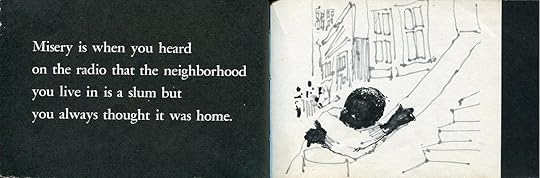
Misery is when you heard on the radio that the neighborhood you live in is a slum but you always thought it was home.
description
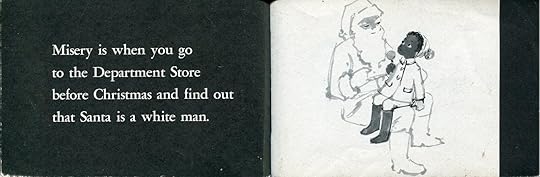
Misery is when you go to the Department Store before Christmas and find out that Santa is a white man.
Profile Image for Kris Dersch.
2,371 reviews25 followers
July 1, 2022
First of all, the title doesn't land in a way it would have when this was published. If you read the afterward to the modern edition, you'll understand this was an addition to a book for and about kids called Misery that was popular at that time. So in the current context, the title is bizarre and doesn't really speak to what this is.
I'm not 100% sure how well this holds up as a book, but as an artifact of its time and as Langston Hughes's final book it is for sure interesting. The foreward and afterward are definitely worth the read and give context. I classified it as poetry but it is probably more like a picture book or even picture book for adults.
Profile Image for Marianne Evans.
472 reviews
September 18, 2019
So simple, so sincere, so painful. I've struggled with the whole "black face" issue. Hard as I've tried I couldn't possibly understand the deep pain, until I read this line from Langston Hughes. "Misery is when you start to play a game and someone begins to count out "Eenie, meenie, minie, mo....". OH GOD, I get it now. I'm so sorry.
Profile Image for Jeremy.
Author 3 books376 followers
March 23, 2017
Heartbreaking, yet contains Hughes's humor. Nuanced in its recognition that racism exists on all sides, and that often the issue isn't racism so much as it is classism.

Jesse Jackson (who grew up in Greenville, SC, in the 1950s) wrote the introduction.

This book is based on the Misery books by Suzanne Heller (1960s). Hughes was friends with Arna Bontemps. Hughes wrote only 27 out of the planned 45 before he died.
Profile Image for kat ✩°̥࿐୨୧.
11 reviews5 followers
October 23, 2024
Amazing book. “Misery is when you first realize so many things bad have black in them, like black cats, black arts, blackball.” “Misery is when the teacher asked you who was the Father of our Country and you said, “Booker T. Washington.”
Profile Image for Utkarsh Chauhan.
1 review
May 23, 2017
great book
This entire review has been hidden because of spoilers.
Profile Image for Leslie L.
9 reviews
March 8, 2022
I really liked how it expressed the misery of black children back then but I feel like it could have been better at making me feel the pain of the kids.
Profile Image for Hendrix Eva.
1,983 reviews3 followers
August 20, 2024
Achingly beautiful illustrations and a powerful message
267 reviews18 followers
March 9, 2020
3.5 stars

The captions for a series of black and white drawings were written by Langston Hughes shortly before his death. A few ("Misery is when Uncle Joe gave you a button-up sweater and you wanted a slip-over that bunches at the bottom.") are universal, the rest are wry comments on being black: having to eschew watermelon, being suspected of attempted purse-snatching if you offer to help an old white woman across the street, hearing your mother say a bad word because the taxi driver won't pick her up. A few pages are weak, but most of the book has impact and the illustrations are deft; despite the juvenile format, the book should have wide appeal.


I can't remember where I found that quote, stuck into my reading binder so many years ago, but today I finally decided to pick it up from the library. Remarkably quick read, I must say, since the format is illustration-with-caption, but a powerful one nonetheless. The ones that were powerful, were, but some of the "weaker" ones weren't as moving. I still must say that I recommend this book highly for a reflection on the racism of America (particularly love the first panel), and the introduction to the 1994 edition shows just how well it's aged.
Profile Image for Nancy.
124 reviews10 followers
June 20, 2008
Langston Hughes' last book was written for children. The reality of some of the passages unfortunately still ring true throughout the U.S.
Profile Image for Robin.
191 reviews20 followers
April 11, 2011
"Misery is when you heard on the radio that the neighborhood you live in is a slum but you always thought it was home."
Profile Image for J. Robin Whitley.
Author 9 books38 followers
July 8, 2013
This book came out in 1969. For those of us who grew up in this time, it is a heart-breaking truth teller of the racial tension of that time.
Displaying 1 - 22 of 22 reviews