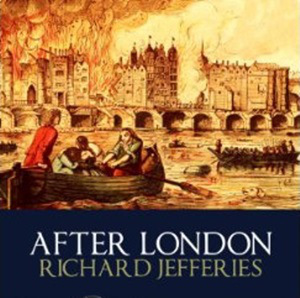
The World as mankind knew it has come to a end. Nature and civilization are recovering from disaster. The few survivors of man, live in a quasi-medieval society. One of the earliest and best post-apocalypse novels ever written!!
(John) Richard Jefferies (1848-1887) is best known for his prolific and sensitive writing on natural history, rural life and agriculture in late Victorian England. However, a closer examination of his career reveals a many-sided author who was something of an enigma. To some people he is more familiar as the author of the children’s classic Bevis or the strange futuristic fantasy After London, while he also has some reputation as a mystic worthy of serious study. Since his death his books have enjoyed intermittent spells of popularity, but today he is unknown to the greater part of the reading public. Jefferies, however, has been an inspiration to a number of more prominent writers and W.H. Hudson, Edward Thomas, Henry Williamson and John Fowles are among those who have acknowledged their debt to him. In my view his greatest achievement lies in his expression, aesthetically and spiritually, of the human encounter with the natural world – something that became almost an obsession for him in his last years.
He was born at Coate in the north Wiltshire countryside - now on the outskirts of Swindon - where his family farmed a smallholding of about forty acres. His father was a thoughtful man with a passionate love of nature but was unsuccessful as a farmer, with the result that the later years of Jefferies' childhood were spent in a household increasingly threatened by poverty. There were also, it seems, other tensions in the family. Richard’s mother, who had been brought up in London, never settled into a life in the country and the portrait of her as Mrs Iden - usually regarded as an accurate one - in his last novel, Amaryllis at the Fair, is anything but flattering. Remarks made in some of Jefferies’ childhood letters to his aunt also strongly suggest an absence of mutual affection and understanding between mother and son. A combination of an unsettled home life and an early romantic desire for adventure led him at the age of sixteen to leave home with the intention of traversing Europe as far as Moscow. In this escapade he was accompanied by a cousin, but the journey was abandoned soon after they reached France. On their return to England they attempted to board a ship for the United States but this plan also came to nothing when they found themselves without sufficient money to pay for food.
A self-absorbed and independent youth, Jefferies spent much of his time walking through the countryside around Coate and along the wide chalk expanses of the Marlborough Downs. He regularly visited Burderop woods and Liddington Hill near his home and on longer trips explored Savernake Forest and the stretch of the downs to the east, where the famous white horse is engraved in the hillside above Uffington. His favourite haunt was Liddington Hill, a height crowned with an ancient fort commanding superb views of the north Wiltshire plain and the downs. It was on the summit of Liddington at the age of about eighteen, as he relates in The Story of My Heart, that his unusual sensitivity to nature began to induce in him a powerful inner awakening - a desire for a larger existence or reality which he termed 'soul life'. Wherever he went in the countryside he found himself in awe of the beauty and tranquility of the natural world; not only the trees, flowers and animals, but also the sun, the stars and the entire cosmos seemed to him to be filled with an inexpressible sense of magic and meaning.
I would classify Richard Jefferies’ _After London_ as part of a somewhat obscure subset of post-apocalyptic fiction I like to call ‘post-apocalyptic pastoral’ along with books like Edgar Pangborn’s Davy, Richard Cowper’s The Road to Corlay, and John Crowley’s Engine Summer. Unlike the norm with post-apocalyptic fiction the world is not dominated by a radioactive wasteland, or rife with twisted mutants or lumbering zombies, and while life may be hard when compared to our own it often does not display the level of nasty and brutish shortness more common in other examples of the genre at large. To be sure our advanced society has fallen and life has reverted to a much simpler mode (usually, as is the case in this volume, one approximating the Middle Ages), but this reversion to simplicity is often seen as an improvement, or at least is not denigrated as a curse.
The book itself is divided into two main sections. The first, “The Relapse into Barbarism”, is narrated from the point of view of a scholar of the latter days, and is partially a history of the fall of civilization (though there is so little in the way of information that calling this a history is really a bit of a misnomer), and is in greater part an enumeration of the flora, fauna, and tribes of mankind that have since survived and overrun a newly ruralized England. Given Jefferies’ position as a nature writer, and even perhaps something of an early environmentalist, it is not surprising that his lingering descriptions of the reclamation of the world by nature dominate this section. Indeed the details of what actually prompted the fall of the Victorian era society of ‘the Ancients’ is never fully explained (aside from some tantalizing references to a tradition that a ‘dark body’ passed by the earth, or even implications that climate change and flooding may have prompted it) and in some ways his insistence on the utter destruction of nearly all traces of the old world doesn’t quite mesh with the lack of any known apocalyptic event (even one only vaguely remembered at a great distance). It is not surprising then that I’ve seen it argued that this book isn’t really an example of post-apocalyptic fiction and that the set-up is merely a veneer to which a Victorian adventure story has been applied. Indeed as the main story narrative develops in the second half of the novel, “Wild England”, it begins to seem that the entire apocalyptic set-up does little more than allow the author to set his adventure in a pseudo-medieval world, so one does begin to wonder why he didn’t just set it in the actual Middle Ages instead?
Once the second part of the story comes to what might be considered the epicentre of the fall, the site of the lost city of London itself, I think the post-apocalyptic element of the story becomes important for what Jefferies wanted to accomplish and shows itself to be more than simply a veneer. Indeed the title “After London” homes in on what might be considered the underlying conceit of the novel and the entire reason for this to be post-apocalyptic at all. We see here Jefferies’ distaste for the modern city-based civilization of his day and his yearning for a ‘simpler’ life dominated by nature rather than human society (though the latter still looms large in the world and is as fraught with problems and corruption as ever). Indeed while Jefferies presents what he perhaps considers to be a ‘better’ mode of human life in that it is largely agrarian it is far from an idyllic arcadia of man in union with nature. This is a world where man is at odds with both nature and his fellow man, though as always it is in the latter conflict where the greatest evil lies.
Our protagonist Felix is a scion of the noble house of Aquila which has fallen on hard times and is out of favour with the court. Restless with the apparent lack of opportunity to improve his prospects due to the oppressive constraints placed on him by his rigid society, Felix decides to leave his home and make a voyage upon the great inland lake that now dominates the centre of England in the hopes of finding his fortune and winning the hand of his great love Aurora. So far so medieval romance, especially as his first adventure puts him in the army camp of a venal prince besieging a nearby town. The camp itself is dominated by the unruly display of posturing knights and degradation of the servant class and Felix’s hopes of advancement are ultimately dashed by the ignorance of those around him.
When Felix flees this example of human depravity, even in the midst of what passes for ‘civilization’ in this world, he ends up voyaging into a world much more familiar to readers of post-apocalyptic fiction. Stumbling upon the site of fallen London Felix finds a landscape that is no longer the lush riot of nature that has dominated the world thus far and we see something that reminded me of nothing so much as a post-nuclear wasteland. The earth itself is dead, some portions hard as iron, others crumbling as though made of rotten wood. Emanations from the ground produce a toxic miasma the hangs over everything and we even see human remains whose depiction astonishingly reminded me of the after-images of a nuclear blast. Not strange at all for the genre in general, but quite strange when one recalls that even the inkling of nuclear fallout couldn’t have been anywhere in Jefferies’ mind and this is all simply the result of the decay of the ancient city and its pollutants (exhibiting Jefferies’ distaste for both the physical and moral corruption of urban society). Felix manages to escape from this poisonous wasteland and eventually stumbles upon a society of primitive shepherds to whom his somewhat more advanced knowledge, and especially his ability to ward off their gipsy enemies with the long bow (a weapon unknown to them), win him a place of leadership amongst them that may bring about the realization of all of his hopes and dreams. The story then ends incredibly abruptly as Felix begins his return journey to find his love in the hopes of bringing her back with him and I was left to wonder if Jefferies had died while writing the story (he hadn’t), or planned a direct sequel (no inkling of this that I was able to discover). Ultimately it was a pleasant enough story, though somewhat frustrating and even haphazard in the inconsistencies that appear to exist between the set-up and ultimate execution.
"Il semble pourtant que Richard Jefferies ait herité de son père l'amour de la nature, des bons livres, de la pêche, de la chasse, et que tous ses goûts l´empecherent d´embrasser de métier de fermier. L'insuccès de son père comme agriculteur prévint sans aucun doute Richard contre cette vie, et ce fut l´ennui qu´il y trouvait et le désir d' y échapper qui le firent entrer dans la carrière de journaliste et de romancier".*
in "Richard Jefferies étude d'une personnalité" by Clinton Joseph Masseck
The book starts with the grim words: “after London ended” there “was green everywhere”. After the first spring, all “the country looked alike”.
Jepheries dedicates two chapters to a superb* exercise of “evolutionary” Biology. Only in the third chapter man is approached.
So, lots of lines make up the description of vegetable and animal species: those which survived/evolved, and those that perished.
There were “wheat fields”; but no one to care for them; the wheat being eaten by sparrows, rooks and pigeons. Twenty years on other plants took possession. There are big swamps…and the country now is “an immense forest”. The former roads are blocked. And thirty years on: there’s no single open space: the “fields had been left to themselves”.
On the animal kingdom: some dogs survived, but the poodle got extinct. The worst thing (worse than mice) are the rats, that people fear and came in vast numbers from the old cities.
There are horses still,... some species of pigs, and the forest cat and the wild sheep. Some few lions and tigers…still. The black wood dogs are ferocious.
As in a sort of biblical creation-sequence revisited, Jepheries approaches, finally, the men. Beset by wars and hatred.
You might wonder on what happened that caused the end of London.
It was extraterrestrial. It was due to the “passage of a dark body through space”, which “altered the flow of magnetic currents”, which, according to Jepheries, influence men’s minds.
It seems men were filled with the “desire to return to the east”. People started leaving the cities, especially rich people. The bulk of those remaining were “those unlettered”, rude and ignorant.
Barbarians stayed. Bushmen being a type living solely in the woods. It’s a kind of medieval society reedited. The barbarians are depraved, lawless. They devour raw meat. Yet, there are still the nobles; they are in possession of the knowledge.
What about London? and the Thames?
They’ve been replaced by a Lake; of stagnant water; a “oozy mass of fatal vapor”.
Surviving, are the Welsh and the Irish and the Scotts (“the finest of men”). They fight against each other, though. The Welsh think the Isle is “theirs”. The Irish take possession of the ancient city of Chester. All north Umbria is to the Scotts. Oxford is now called Sypolis.
The silver is their standard currency; yet, a corrupt justice prevails.
In the midst of this black picture, a noble man stands out, Sir Felix Aquila, the eldest of the three sons of a baron. A man dedicated to study, to annotations, to thought; a loner. He still holds letters from a lady called Aurora Thyma; and hanging on the wall, an ivory cross, she gave him. A “relic of the old world”.
Felix is quite different from his brother Oliver: a man of sport and exercise.
Felix feels he’s got to see Thyma again. So the brothers depart to her castle.
Yet things are not easy for the couple. Despite all the reciprocal love.
A master-piece concerning the nature approach. Maybe prescient.
*It seems that Richard Jefferies had inherited from his father the love of nature, good books, fishing, hunting, and that all these tastes prevented him from embracing the profession of farmer. The failure of his father as a farmer undoubtedly made Richard to avoid this life, and it was the boredom he found there and the desire to escape which made him enter into the career of journalist and novelist".
** Jepheries was a naturalist of renown. A museum, in Liddington, has been dedicated to him.
First book read after my first cataract surgery and if I hadn’t been trapped at home, I’m not sure I would have finished it. The first whole section is primarily an info dump—how the U.K. has changed since some rather nebulous apocalypse (or maybe it was nebulous to me because I was struggling to read with one eye, a harder task that I anticipated).
I don’t require that the main character be likeable—I’ll take a curmudgeon any day as protagonist, but this young man was pretty clueless and it’s a wonder that he survived the book. And that despite the fact that very little happens. Then, at the end, when things begin to happen, the author yanks him out of the plot again, and sends him off on a mission that seemed to me to be quite hopeless. The end.
I am very unsure how this novel ended up on the Guardian’s list of 1000 novels that everyone should read. I could only recommend it as an example of many things that should not be done in a post-apocalyptic novel. Read The Earth Abides or Alas, Bablyon instead and leave this one in the library. Certainly save your money and do not buy it.
‘After London’ has the distinction of being a very early post-apocalyptic novel, written in 1885. This is rather the most interesting thing about it, as although some of the details are striking, the plot is very formulaic. The book begins with a lyrical evocation of England after a mysterious, ill-understood environmental disaster. Said disaster could very well be retconned as climate change upheaval, as it results in a changed sea level and a new, massive inland lake. After this disaster, the population is greatly reduced, for the very prosaic reason that everyone with enough wealth to leave has departed. This results in the return of a prelapsarian natural environment, largely consisting of forest. I very much enjoyed the account of the progress of brambles across the roads and saplings across the fields, the return of dogs, cows, and pigs to a predomestic state. Subsequently the book follows the aptly-named Felix, a very highly strung young man who leaves his home (and much more pragmatic sweetheart Aurora), setting out in a canoe to have adventures. His encounters suggest that parts of England have lapsed into Malory’s Le Morte d' Arthur, whilst others resemble the Old Testament.
For the time in which it was written, the book is deeply reactionary. Not only does it glorify an environment unspoiled by man, with lavish descriptions of the wildlife therein, but it vilifies the remains of civilisation. The London of the title is a poisonous wasteland, an area of pollution and death. Nothing lives there and people foolish enough to venture in are lucky to escape alive, as industrialisation has poisoned its air, soil, and water. Few structures or artifacts remain from this tainted past; even technologies of the Middle Ages have been forgotten. On the other hand, the plays of Sophocles have survived and the story includes a performance of Antigone. The author seems to yearn for simpler times, perhaps a return to some mythical Ancient Greek golden age. That said, the society depicted is a deeply flawed one, something that Felix unwisely cannot keep quiet about. There is a strong critique of feudalism to be found here, notably in the ironic fact that most poor people are slaves, yet use of the word slave is taboo.
As a novel, ‘After London’ doesn’t have a terrific amount to recommend it. As an early post-apocalyptic vision, it is interesting to compare with Mary Shelley’s The Last Man. And as an ode to radical rewilding, it certainly paints a delightfully vivid picture.
Изключително добре написана постапокалиптична книга, особено като се има предвид годината на издаването ѝ. Джефрис не задълбава в причините за апокалипсиса, но има намеци за пандемия в началото, както и такива за климатични изменения, заради напредващата по негово време индустриализация, към края. Второто е изключително напредничево, но имайки предвид, че повечето му книги са природоизследователски, някак става ясно, че е имало мислещи за околната среда хора, преди да стане модерно, много преди. Книгата е разделена на две части, като първата е по-скоро популярно описание на една Британия, след упадъка на цивилизацията. Личи си професионализмът и дългото обмисляне на развитието на флората, фауната и останките от човечеството. Всичко това е довело до една пасторална идилия, без възникналите доста по-късно клишета, породени от атомната заплаха. Втората част е приключенска. Обхваща търсенията на късмета от Феликс – син на дребен, изпаднал в немилост, благородник из пущинаците на тази върнала се към феодално-робовладелския строй Англия, но запазила малка част от знанията на цивилизацията. Феликс обикаля и се среща с различните човешки общества, през които автора пречупва идеите си и дори на места иронизира съвременниците си. Единствената ми забележка (като изключим така типичното за времето си леко мудно повествование) е, че финалът остана някак във въздуха. Ако беше писана век по-късно щеше да има десетки продължения, едно от друго по-кошмарни. За щастие си е останала самостоятелен диамант. И все пак искам още от тази красива зелена Англия с голямо сладководно езеро в средата и волни племена Цигани (не ме разпъвайте, той така си ги нарича, благодарение на операта на Леонкавало), бушмени и полудиви овчари, с корумпирана феодална система и графове, принцове и барони постоянно вкопчени в дребни схватки, с пълни с подивели прасета, овце, крави и кокошки гори, с артефакти и остатъци знание от „Древните“. В книгата е обхваната само Англия, като има намеци, че и на континента положението е същото, все пак авторът не се е съсредоточил извън пределите на родината си, което малко прескача постапокалипсиса, но за времето си, смятам е добре.
Realmente no estoy muy decidida entre 3 o 4 estrellas. Encuentro que tiene valor como ecotopía, pero me da la sensación de que le falta un hervor.
Tiene dos partes muy bien diferenciadas. La primera narra qué le pasó a Inglaterra tras alguna clase de cataclismo que la dejó sumida de nuevo en la Edad Media. Con racismo, clasismo y nacionalismo incluidos. Y donde se cantan las glorias a una naturaleza salvaje que gana el territorio perdido en plan Prypiat tras la explosión de Chernobyl. Narrada en forma más de ensayo que de novela. Enumerando hechos y haciendo descripciones más que nada.
La segunda, ahora sí novelada, cuenta la historia del hijo poco valorado de un noble que quiere hacer algo grande y bueno por este nuevo mundo tan decadente y poco civilizado. Emprende un viaje a lo desconocido que irá mostrando al lector cómo funciona el nuevo mundo de manera más concreta y a la par nos irá mostrando sus preferencias en cuanto a los modos de vida y de gobierno y sus planes al respecto.
Está claro que Jeffereis odiaba profundamente la industrialización que sus contemporáneos estaban llevando a cabo y los estragos que ésta le hacía a la naturaleza y prefería regresar a la Edad Media que ver cómo se desarrollaba esta horrible evolución hacia lo catastrófico que preveía. Todo ello sin despreciar por completo los avances tecnológicos, pues podemos entender que a algunos de ellos sí les encontraba su mérito. Al menos en cierto modo.
Me ha parecido un libro curioso. Fácil de leer, pero en cierto modo un tanto ingenuo, en sus ideas y en la forma de narrarlas.Como novela es amena pero creo que un tanto infantil o poco trabajada. Interesante pero extraño. Da la impresión de que abre muchos melones que no termina de cerrar. Con un final demasiado abierto. Me ha dejado un tanto perpleja, ya que esperaba otra cosa. Aunque en la línea de Walden y similares, con mucho de ideario y poco de novela.
After London is made up of two distinct parts. First is "The Relapse into Barbarism", which describes the decline of civilization, but more importantly the recovery of nature, after an unspecified disaster. This section draws heavily on Jefferies background as a nature writer, and is essentially a detailed thought experiment on what would happen to the English countryside without many men around. For a potentially dry topic, it is surprisingly readable - largely because Jefferies describes the reaction of each aspect or species plausibly, then moves on without bogging down in details. Normally, this kind of material would exist mainly as backdrop for the characters. Here, one gets the feeling that the second half of the book was written mainly as an excuse for this imagination of the environment.
The second part of the book "Wild England", is a more standard adventure story about a sullen and disaffected young noble and his search for a place in the world (one that will impress his beloved). The story is simple, and still relies heavily on descriptions of the environment as the hero travels around. But it is again well thought through, and the hero's emotions are as plausible and realistic as the scenery around him.
The book is a pleasant read, if not exciting. I would have considered giving it a higher mark, but for the fact that the story effectively stops mid-stream. We can imagine what happens next; it's not essential that we're told. But because there's no gradual letdown, it feels very abrupt - enough so that on reading an e-copy a couple of decades after the print version, I went looking on the internet to see whether I had somehow been shortchanged.
So, a fun, interesting read, but a little disappointing at the end.
This was very different from the normal post-apocalyptic fare, and quite refreshing once I'd adapted to the slower pace. It was originally published in 1885, which surprised me, because I probably would have dated it at least 40 years later.
Don't expect a thrilling fast-moving adventure tale with a defined ending. Expect a detailed, immersive encyclopedic picture of the wilderness that took over from a civilisation over 30 years ago, of the animals' adaptations, of the human cultural changes and the understanding that what caused this destruction has probably been lost in the transition to oral history. The first fifth gives the reader a view through the distant lens of time, as if a time lapse camera were panning across the scene.
Disclaimer: I received a free copy from NetGalley in exchange for an honest review.
El mayor acierto de este autor tan poco conocido es haberse dedicado a la ficción especulativa apocalíptica en un momento en el que nadie más lo hacía. Imaginar en pleno siglo XIX un cataclismo a escala planetaria que consiguiera destruir Londres y que hiciera que la pujante Inglaterra victoriana retrocediera hasta una suerte de Edad Media feudal dominada por la naturaleza, tiene mucho mérito. Muchísimo. Pero ahí se quedó. Tras crear el marco perfecto para cualquier aventura, Jefferies opta por contar una historia bastante vacua, donde apenas sucede nada y donde, ni el protagonista ni el lector saben realmente hacia dónde se encaminan. Una lástima, porque podría haber sido un pelotazo, y se queda solo en pasable rareza.
This is one of the first post apocalyptic books written which is what made me curious to read it. Regardless that I found this book mediocre it is pretty important to the genre.
The story takes place in England where after the collapse of civilization nature takes over again and surviving people live in a society pretty much the same as the Middle ages. A young men goes on a quest to find something that he can use to marry the woman that he loves.
I found the idea very intriguing but unfortunately the plot was pretty boring. There is pretty much nothing about the apocalypse. Considering that it is barely mentioned the book could have just taken place in the Middle Ages and the story wouldn't be any different.
Of course I can see why Richard Jefferies made it a post apocalyptic science fiction book. He was a naturalist who mainly wrote about nature. He wanted to show life without modern civilization. I would even say he didn't see it as dystopia but as utopia. This is pretty obvious when Felix comes across the ruins of London. This was pretty much the only time when it being a sci fi book was of importance and the two chapters that I actually enjoyed reading. One can see the author compare the toxicity of "ancient" London with natural environment of the new England. And this was pretty interesting.
Climate change being the trending topic in our time, especially very recently considering that the big climate change march just took place yesterday, I would think this book would be of interest to many, nature defeating the toxic humanity. Even though we never find out what exactly happened. I would really like this book more if it would address this topic.
Described by the Observer as a strong candidate for the most beautiful of all Victorian novels, the fact of Jeffries being a nature writer shines through both in his scientific description of post apocalyptic England and the descriptions of the hero's voyages which teem with detail about the birds and landscapes he passes through. The strongest parts of the book are the descriptions of environmental collapse in the first part and Felix's trip through the nightmare landscapes of an extinct London which are truly gripping. I was less enthralled with the descriptions of future feudal societies although there is some interest in Jeffries proto-socialist philosophising about the corruption of the nobility, the inability of the lower classes to overthrow a society that they recognise to be rotten and which enslaves the vast majority of them and the eulogising of a society of workers (the Shepherds) where men and women's work is of equal value, sharing and hospitality are the norm and war is for defence rather than glory or gain as in the other societies Felix encounters, which, perhaps, were the parts that were said to give William Morris such inspiration for his News from Nowhere in which "absurd hopes curled around... [his]... heart as... [he]...read it."
Some "classics" are under-appreciated for a reason. The back-cover quote by A.S. Byatt is spot-on: the setting here is spectacular, and the book's first thirty pages, which describe the slow takeover of a post-apocalyptic London by its natural elements, have hardly aged a day (they're comparable to what Alan Weisman does in "The World Without Us," even). Sadly, "After London's" descent into "suck" territory is swift and profound-- it's like Jeffries expended all of his imaginative energy on backstory, leaving no wit or creativity or interest at all for his characters (Felix Aquila has to count as one of the least likeable protagonists I've ever encountered), plot arc (where is the damn CONFLICT?), or even prose style (we get it, RICHARD... there is an island up ahead... OOH). If you skipped pages 30-130 of this novel, you would not only NOT miss out on a single thing of importance-- you would save yourself a hundred pages of sheer boredom (if you know of a less thrilling or erotic love story than Felix and Aurora's, please alert me so that I can never experience that story myself). Heck, if you skipped pages 30-230 (i.e., the end) of this novel, you wouldn't miss out on much... Whatever point Jeffries has to make is deftly summarized by his wonderful first several chapters. This book might work in a classroom, where the author's concern with society would be contextualized and deepened by outside sources... On it's own, "After London" is mostly a total drag.
note I haven't finished the medievalist narrative of Part II, but I imagine it'd be wonderful to teach. Part I, Victorian lit of collapse, nature writing, and the imagining of a return of a nasty feudal society: would teach beautifully. Basically 'After Man' but done in 1880s.
I can imagine that any of us who live near large cities probably have mixed feelings about them. Living near New York City gives me good chances to see bands that I like that probably aren't going to play the local bar in my suburban town, but on the other hand they can be so crowded its hard to get around and everything is expensive anyway. But for the most part I'm glad its there and if it was suddenly teleported into another dimension I like to think I'd miss it.
Richard Jeffries apparently had less mixed feelings about London, to the point where he basically had it sink into the earth and then wrote a book about how much better the world was without it. And those are the best parts of the book!
If anyone knows anything about Jeffries today, its probably people who have a thing for 19th century nature writing. Born in the mid-1800s and spending much of his childhood on a family farm, it was pastoral enough to influence pretty much anything he wrote afterwards, fictional or non-fictional. Deciding to become a writer, his early attempts at novels were met with a 19th century style, "Oh, isn't that interesting?" Soon enough he changed tactics slightly and started writing essays his experiences growing up in the country. That gained him quite a bit of positive attention and after a while even his novels were drawing upon those same experiences.
Few of those are remembered today (Penguin had a collection of his essays but that seems to be out of print now) and other than this novel the most likely work you'll probably come across from him is his autobiography titled "The Story of My Heart" . . . here his writing about nature is manifestly joyous and probably enough to make you want to don a crown of flowers and frolic in the forest while listening to the Incredible String Band on repeat. Maybe invite some friends along!
But as a SF fan and someone not particularly inclined toward books where people gush about the English countryside (which in all fairness sounds nice and I would like to see it in person some day) the route I took to Jeffries is probably the route that most people are going to take, which is to discover this novel. Published in 1885 before science-fiction was even really a thing (Verne published "Journey to the Center of the Earth" in the 1860s so there was some precedent) beyond "weirdo science fantasy" its not his only contribution to fantastic fiction (1881's "Wood Magic" featured talking animals and some unpublished short stories toyed with the idea of everything falling apart) but its definitely the one everyone remembers, mostly because . . . well, London goes away.
Unfortunately for all those people rushing to this novel hoping for a big scene of destruction to rival Tokyo taking one on the chin (twice!) in "Akira" are going to be a bit disappointed. This is the 19th century and big action disaster setpieces weren't always on the menu. Instead we get a book that's divided into two parts, with the first part written long after the fact and describing the world centuries after some catastrophe that wiped out London and appears to have taken the rest of modern civilization as we know it.
This is the part of the book that gets the most attention from people today . . . some of that is admittedly novelty since post-apocalyptic fiction was a bit of a new frontier in the late 1800s so reading a Victorian depiction of what life looks like after The Big One has hit is fascinating in its own right. Lasting about fifty pages its seems to function not unlike how Jeffries nature writing must read, with plenty of descriptions of animals and forest and the people who live in them . . . the only difference is that we're looking at a world that has drop kicked civilization to the curb and is letting nature slowly take over again. Sometimes less a leap of the imagination and more like Jeffries staring at the smelly streets and buildings around him and visualizing all of it turned to pristine forest much like that old Bugs Bunny cartoon where the castaways start seeing each other as hamburgers and hot dogs. Sometimes the mind wants what the mind wants. With the writing as rapturous as it is the complete lack of a plot in this section goes down a bit easier and if you want to perceive it as a long prelude setting the scene for everything that comes after that I would say that's probably not inaccurate.
But yes, a plot does kick in eventually. Part Two "Wild England" arrives and suddenly the narrative shifts from "future scholar lecturing about the world" to "The Adventures of Sir Felix" so we finally get to see how these people live in this new society.
Alas, its probably the least imaginative portion of the book. With civilization as we know it gone and most science just of a fond vague memory of things that once made beeping noises it turns out that everyone just reverts to the old British default of a feudal society, with a monarchy of sorts and lords and courts and fiefdoms and whatnot. We get to hang out with Sir Felix, the son of a Baron. He's got a slight head for science, an ambitious but dense older brother and a lady love named Aurora that he pines for as the epitome of perfection. Like anyone in a medieval society that wasn't duty bound to work themselves to death he wants to make a name for himself, perhaps secure some riches so he can marry his beloved and live happily ever after in their forested wonderland. So he decides to build a canoe and go on a journey.
If this sounds mostly straightforward it basically is and having established a mostly fantastic setting Jeffries seems to content to let everyone just wander around in it. If not for the first part and the occasional references to the longago past where London wasn't in a poisonous sinkhole and people had whatever Victorians imagined the transportation of the future looked like (probably steam powered carriages or something) you could be convinced this was just a bit of historical fiction coming of age tale with a young lad out to find himself, though seemingly in a more pleasant environment than what actual medieval times were like (I've read Barbara Tuchman's "A Distant Mirror" . . . the 14th century sucked for everyone!) where his biggest concern seems to be figuring out how to spend more time with Aurora and sitting through dull dinners.
It also means that with glorious, glorious nature not quite the focus anymore Jeffries' prose lands with a bit more of a thud . . . its never terrible but you keep waiting for it to really take flight and instead it kind of plods ahead, reliable and determined and not very exciting. It’s a short book (my edition is a bit over two hundred pages) so I thought I'd polish it off quickly and I was surprised at times with how slow my progress was. Part of it I tried to read on an airplane, which may not have been the best environment to immerse myself in its pastoral reclamations but even when I got home it was far more of a chore than I expected. Maybe my head wasn't in the game . . . I've read 19th century novels before so its not like I haven't been exposed to a more ruminative style but boy, sometimes those paragraphs just drone on.
It picks up briefly in the other celebrated sequence where Felix winds up near the remains of good ol' London and it winds up being just as eerie and degraded as the first portion of the book would have you believe. Its vivid and alien to the extent that you wonder if you've slipped into another book by accident, a book running headfirst into its own premise and reminding itself why it even exists. Its enough to make you wish that his reconstructed society of the future was even weirder than what we get, like there's nothing but giant collapsed dirigibles everywhere and people try to use ghosts for currency. But instead its courtly manners and casual racism (as you'd expect the nobility is enlightened by their standards but the Romani are of course thieves and the Bushman are basically poor people who became savages because they didn't have coats of arms or something).
Sadly, the brief bit in Merrie Londinium is indeed brief and before too long the book essentially just ends, with Felix at least satisfied for the moment but not inclined to give us more of his exciting adventures in doing obsessive things for a cute girl.
This is an odd one. Its so not of its time that you have to give it kudos for being a little bit of an innovator (I feel you don't get to Crowley's "Engine Summer" and Russell Hoban's "Riddley Walker" without this one breaking up the soil a bit) but at the same it is very much of its time and so its probably not quite suited for today's audiences unless you're the kind of person who actively seeks this stuff out. Its definitely a notable work in proto-SF (or at least proto-science-fiction-as-we-understand-it), with a focus not only on nature but people's relationship to it when all the technology is gone. I think what I like the most about it is how ordinary it is at times . . . once we've set the scene its just a Week in the Life of Felix, in a society that's already adapted even as you can see where some people are starting to push a bit at the edges. That's where the charm is for me . . . its not a pull out all the stops tale of people trying upend the old order and remake the world but just people trying to live in the world. Which for most of us is achievement enough these days, and hard to do even without metropolises sinking into sulfurous oblivion.
Es un libro peculiar, muy centrado en describir un mundo postapocalíptico en el que la naturaleza vuelve a extenderse y la humanidad se ve reducida. Creo que la forma de valorar este texto puede ser como antecedente y pionero de otras distopías, pero el libro en sí mismo a mí me ha aburrido bastante. Tiene algunos puntos que pueden ser interesantes o llamar la atención (la evolución de distintas poblaciones de animales tras la catástrofe), pero la abundancia de descripciones y una historia sin mucho contenido y con un protagonista nada carismático han hecho que me cueste terminarlo y muchos días lo haya dejado tras leer un par de páginas.
jefferies writes a somewhat hard to classify post apocalyptic novel and i'm not really sure it's that successful. mostly the cool bits are when he gets to basically just do his nature writing in a fictional setting, although the descriptions of how the basically feudal future society works are good too, very sociological in their attention to detail. the sequence in the ruins of london where everything's covered in inescapable black soot and deadly yellow vapor is memorable too. but i'm not really sure what to make of it, other than that.
La primera parte donde explica la decadencia de inglaterra y el cómo va evolucionando es lo que más me ha gustado. Teniendo en cuenta de la época que es ciertos escenarios son más impresionantes.
La segunda parte, aunque interesante, me ha parecido más floja ya que no profundizaba en aspectos que me hubiesen interesado más.
Part I. The Relapse into Barbarism This part of the book is told from the perspective of a scholar from the far future, narrating what is known about the world and its ancient history. He begins by recounting in great length the animal population, and what it owes to human cultivation: the known breeds of dogs and cats and horses and racoons; ho they are and what they do. Gradually, humans are mentioned, and gone into. It is clear that this new world belongs to nature rather than man. It seems that this new society has medieval-era technology, is rather tribalist. He never mentions America, implying they have not contacted each other since the apocolypse. Nowadays, the Irish are in a sort of constant war with the inhabitants of England, frequently raiding their coasts. There are also a race of wild men, similar to the wild men of english folklore; that is, they are naked men who live in the woods and hunt with spears and don't do much else. except here they are called the bushmen. The most elite of the surviving civilizations known to the historian are actually the romani, who remain relatively unchanged since the ancient era (of the 1800s.) Modern society is dependant upon slavery, and makes slaves out of almost anybody as punishments for infractions, as well as changing what counts as an infraction everyday. Yes, the world is very corrupt. The narrator actually mentions things the ancients built which sound like planes, implying futuristic technology was achieved. The nature of the apocolypse itself is only dimly understood. The earth was said to have passed through a nebula that tilted the earth's axis, changing people's psychological disposition, and encouraging them to flee east-- which according to the narrator, activated their more barbaric tendencies. Racism on the part of Richard Jeffries or the narrator? I don't know. There are also other apoclypse events of unknown relation, such as famine, flooding and massive silt deposits that block the world's waterways, leading to war and societal collapse. Sometime afterwards, a large lake developed in the middle of England, encapsulating London and several other neighboring cities. It is now surrounded by poisonous swamps, containing foul water and an odor so bad it can kill people who go too near it. But, the narrator speculates, buried under this lake is probably the ruins of ancient cities and artifacts, which have become nonexistant in the new world, as all iron has been melted down for tools. In this world, iron is scarce and very desired. These chapters do a good job of exhibiting the narrator's knowledge and intelligience, in the face of his unwilling ignorance of the past. It stands in contrast to works like The Scarlet Plague, which bemoan the loss of knowledge as society continues past the apocalyptic era, this one simply shows that history is difficult to keep despite the existence of those who wish to preserve it.
Part II. Wild England I. Sir Felix - Our main character is described, a bookish, intelligient young man named Felix. He lives somewhat luxuriously in a wooden fortress, and even has a few childrens' books on ancient rome from the 1800s. Also described is an ivory cross that hangs beside his bed, a relic of the old world- it is strongly implied Christianity is dead. II. The House of Aquila - Felix's brother named Oliver is introduced, as well as their father, Sir Constans, whom they refer to by his title, as is the custom. Oliver is much more manly than Felix, and both have a sort of brotherly resentment, despite doing everything together. III. The Stockade - Oliver and Felix decide to go fishing with each other in their canoe. On the way there, they have to pass the stockade with a sort of rope ladder. They make it into the canoe, where Felix is working on carving out a secret drawer. As they pass underneath a beech tree, Felix is happy about getting in the shade. As in the orevious chapters, everything is described very thoroughly, and the idea is to soak up the world and the environment of the story. IV. The Canoe - Felix confesses to Oliver that he is making his canoe to go to the lake, not just laze about on the river. He and Oliver share some tense words, before moving onto a moneylender seen at the estate recently. It turns out the local prince is in a bad situation monetarily, partially because he tried to design a warmachine oncez and the guild of battering-ram crafters lobbied against him. At the same time, political enemies slander him and accuse him of witchcraft, and drain his wealth. Despite this, though, his estate becomes a garden, with healthy cows and sheep and coveted horses and green pastures and plentiful crops, though his money leaves as soon as it comes in. V. Baron Aquila - Felix decides he should leave as soon as possible, after he says farewell to his girlfriend Aurora. He meets with Oliver again, and they go back home. There they meet the Baron Aquila, named Lord John, whom they hate. He offers them valuable Devon tobacco cigars, which Oliver throws away after he leaves. VI. The forest Track - Felix launheshis canoe, to find that it is lopsided, which depresses him. But Oliver offers to fix it, and they do, adding a sail. It works now. The pace suddenly quickens, as they spend days going down the river, and casually commanding serfs to build a shed for the canoe. Back home, Felix and Oliver travel to Thyma Castle, where Aurora is, so Felix can see her one more time. Baron Thyma is a friend of their father's. He quietly disapproves of Felix's interest in Aurora, somewhat feeling he'd rather Aurora marry Oliver. Felix and Oliver begin the journey to Thyma castle through a path in the forest. VII. The Forest Track (continued) - They continue on their way down the path. They find a branch which they are disturbed to notice could only have been broken by a bushman's club. Felix also avoids stepping on an adder, and they see a red stag. Then they come upon Thyma castle, which is ringed around by two walls, one of wood and one of mortar. Inside is a great house dating from the time of the ancients. They are let inside. Aurora and the baronness are there to greet them. VIII. Thyma Castle - Oliver and Felix have a feast at Thyma castle, where Aurora and her father, Baron Thyma, are being visited by the prestigious Lord Durand. Aurora avoids making eye contact with Felix, being careful to not incense her father, but Felix interprets it as her affections opportunistically switching to Durand. He becomes saddened. He walks outside after the feast is done, and sees travellers coming down the road in wagons. He overhears one of them talking about him, saying "Oh, he's nobody-- he doesnt even have a horse", to be replied with; "He's not nobody! He's Oliver's brother--" which only makes him sadder. IX. Superstitions - The lady of Thyma castle is a little more sympathetic to Aurora's love for Felix than the Lord is. Felix retires to his room, which he remembers from when he visited in his youth. He finds a book on the table describing a man who was captured by the Romany, and forced to be their servant. It describes all kinds of strange superstitions the Romany have; this chapter perfectly emualtes the feeling of reading a creepy book by the light of the fire, and feeling transported into another, darker world. This book is obvioualy a present to him by Aurora. But, blinded by jealousy, Felix does not see it. He goes to sleep. X. The Feast - Sophocles is performed in the garden, and a feast is held. Felix tries, against his jealous conscious, to go see Aurora. As he comes upon her room, Aurora's maid walks past and whispers to him to go to the rose arbour, which he does. Aurora is there waiting. She tries to make out with him, but Felix is blind and stubborn. He tells her she was with Durand the whole time; she says she couldnt help it-- clear misunderstanding. He leaves in a huff, and she is offended. XI. Aurora - Felix and Aurora have an emotional discussion, whose passion is expanded, by the narrator, into their religious perspectives. It turns out that Aurora is a big believer in what has remained of the old Christianity. She is not a fan of the Pope and Vice-pope, nor the liberal Holy League that oppose them. She actually spends most of her time holding church services for whoever wants to come and personally transcribing and distributing copies of old religious texts to convert as many people as possible. It is nice to see a female love interest in the medieval period written in a novle from the 1800s who does something in the community. Afterwards, Felix seems to ask her for sex, but she calms his passions. They are interrupted by the maid saying somebody strange is in the garden, and Felix goes off riding on his horse. XII. Night in the Forest - Felix rides home, superstitious fears arising in his heart. On the way, is shot at by what he thinks is a crossbow bolt. He escapes from danger, and reaches home; but finds that his horse was struck with a bushman's poisoned weapon. The horse is in agony and will die in nine hours. He is told to kill it, but he cannot bear to kill the horse that bore him for so long. Ultimately, a servant does it with a spear. The horse is buried in the morning. Oliver asks Felix if he is to leave on his journey. XIII. Sailing Away - Felix gathers Oliver and some serfs and he pushes off at a boat landing. He and Oliver shake hands before Felix leaves, careful not to look back. Oliver is rapt in thought (very unusual for him). He sails for a while, coming upon the straits that lead to the big lake. XIV. The Straits - Felix lands on the shore and surveys the land from the top of a hill. He realizes, as he is about to push off, his boat has slightly tipped and taken on some water. He realizes he forgot to bring something to properly bail out with. He spends the night on the island, with the protection of the fire and a crude cowhide tent. XV. Sailing Onwards - Felix manages to push off from the island, avoiding a potentially dangerous warship. He makes some observations about the strait and the kingdoms around there, including one king who has many enemies and is the leader of the Holy League, as well as the fact that a fort should be built there so as to prevent an enemy army from forming a beachhead and conquering England. Here I start to get an idea of what this journey may be about; he wants to give the king the idea and somehow claim the credit for it. XVI. The City - He comes across the king's city. He is surprised to find it is built with bricks, and the roofs are made with red clay shingles, instead of thatch or wood shingles. He tries to get in, but is told he can't. A ferrymen rejects his offer to enter because he is a stranger. He finds a woman who ferries him across, and finds out from her that he did not tell Felix about her so that she couldnt get any money. Capitalism. He enters the city and eats at a table at an inn, and converses with the people there. He learns it is actually a slave table, and is horrified, since being even in the presence of slaves is seen in this world as taboo. And yet, he has a moment of realization in humanizing these people. Wanting to join the King's levy, he falls in with a man driving a waggon who is going off to the king's camp. XVII. The Camp - He wakes up in the king's camp. A very long description of the camp and the people there commences. He finds the king's tent. XVIII. The King's Levy - Felix tries to approach the king, but is beat up by his guard. His spirit is crushed. He contemplates down by the river, the scene which is illustrated on the front cover of the first edition. He then finds a man who asks him who is master is-- he does not know what he means. He takes him in to serving his master, a merchant named De Lacy. The soldiers are all knaves to their masters. Camp life is described. The people are nice to each other, but they are all morally bankrupt people. Felix even feels forced to accept money stolen from a random person's purse, which one of the soldiers offers him out of friendship; to refuse the friendship-offering would be a grave offense. He hears tales around the campfire of political intrigue, saucy, influential ladies and backroom deals. Felix comes to realize now, as a member of the lower classes, that society is rotten to the core. The people in power are unscrupulous, and even the humble serfs become morally bankrupt in order to survive and feel good about themselves. Felix even learns that he is not as good at woodcrafting as he thought he was. His ego and niavety are both checked. XIX. Fighting - Felix sees the king once or twice, at a distance. He realizes how unapproachable he is. But mostly, this chapter describes the kind of fighting that Felix witnesses while in the King's service. Mostly disappointing stuff. A couple of knights and their slaves go and sack a small hamlet, meeting either no resistance or a small force which immediately submits. But one time, he experiences an assault by the king onto an enemy fortress 40 men attack; Felix's admiration for the attackers swell, as they almost take the walls, but he is horrified to see that they are defeated brutally. The king rides out and sneers at them. Felix is angry as Hell. Why didnt the king send out reinforcements? Or at least pay them resoect for their sacrifice? Well, it turns out that reinforcements would have done no good in a situation which turned out to be hard-fought. It either would mean bringing in the whole army to support the suffering detachment, or a disgraceful and embarassing retreat, followed by a follow-on attack from the defenders of the fortress. A victory is not worth the sacrifice unless it can be won easily. As for the sneer, that is actually the sentiment of the whole camp. Nevertheless, Felix voices his opinions too loudly; and though the men in the camp try to protect him, he is ratted out to the king by an anonymous source, who is likely an enemy spy who desires to stokes resentment against the king. And so, in the morning, Felix is arrested. XX. In Danger - Felix appears before the king. He is able to tell the king what he should have done instead with confidence; that he should have taken the middle of the three cities first and cut the other two off from each other, rather than taking the nearest one first. The king is impressed with his reasoning; the generals also realize he is the guy who suggested they add levers to the ballistas to make them shoot better. He is in good standing. But he takes it too far by suggesting that they could build catapults, and throw giant boulders with just ropes. So he loses all favor with the king immediately, and they laugh at him. He is let free from the tent. Dejected, he gets in his canoe and defects. XXI. A Voyage - he sails away from the camp. He finds himself inside the lake, which is much bigger than he anticipated. XXII. Discoveries - He keeps sailing. He comes across a strange yellow mist that seems to turn the water black as it passes over it. He finds a strange black island with a giant mountain on it made of black stuff, which his feet sink into as he steps into it, for some reason. Then the wind suddenly stops, and he is forced to sleep inside the canoe. XXIII. Strange Things - Felix continues to walk along the strange, apparently iron island, snd discovers some skeletons of past explorers, who have recovered ancient treasures, including a diamond, the likes of which Felix reckons must be one of the biggest in the world, about the size of his fingernail. He does not realize that the air is slowly poisoning him, leaving him in an opium-like stupor. He continues on, and finds strange white constructions made of ash clinging delicately together, which crumble to the touch. He realizes these must be the remains of buildings. He wonders if he can find the remains of the flaming giant, of which there are stories; a burning man embedded halfway in the ground, which scholars believe is a partially submerged bronze statue, which is lit on fire due to subterranean fires from oil explosions. XXIV. Fiery Vapours - Felix runs to his canoe, which briefly catches fire, before being put out again. He starts sailing away, until he notices the birds moving atrangely in the sky. The sound of an explosion tears through the air, and his canoe is thrust forward. He wonders what it was, and decides it must have been one of the subterranean explosions. Eventually he leaves the danger zone and breathes clean air again. He reflects on the astonishing thing he has just dine, and cherishes the value of the diamond he holds in his hand. It is interesting that after encountering this priceless experience Felix starts thinking about monetary value. After landing briefly ashore, he finds that his boat, sail, his skin and clothing are all bathed in black. He panics. (This makes me wonder about the part of the introduction which says that the tilted axis of the earth towards the east made men more barbaric. Maybe Jeffries is implying symbolically that Felix has turned back into a barbarian after having visited the ruins of his iniquitous forefathers?) Anyway, the black all quickly fades away. He gets back in the boat and sails away. Eventually the boat gets stuck on a reef, and is split straight down the middle, effectively rendering it forever useless. Felix swims ashore, and encounters a man with a spear. XXV. The Shepherds - He tries to talk to the man, and the only language that works is some shepherd's dialect from back home. He is taken to their people, a simple communal folk who raise sheep and lead simple lives. They are constantly harassed by the gipsies. Their ways of life are described. The people are definitely portrayed as string, hardworking, and brave, though a little simple and not very intelligient. They instantly regard Felix with some amazement snd reverence for his story about the abandoned city. He also astounds them with his skill at archery. Felix hears that a band of gipsies was seen nearby, and leads up leading a march against them. XXVI. Bow and Arrow - A battle is had with the gipsies, Felix leading the brave shepherds to victory, and inspiring him with his amazing skills as a bowman. Fhe shepherds now regard him as a great leader. XXVII. Surprised - Felix analyzes the land and the river and the hills, and decides that this indeed is the perfect place for a fortress. Now that the shepherds worship him as a king, he commands the building of a palisade snd fortress on the river. He also tells them that wherever lightning strikes, there is surely water (merely an expression), but when a lightning strike indeed does reveal the location of a spring of fresh water, greatly cherished b
a very well developed world and some interesting ideas, even if the narrator tends to describe scenery and intricacies of pallisades for a little too long.
Required reading for lovers of the dystopian, post-apocalyptic trope. Not only is this the OG dystopian, post-apocalyptic novel, it is (perhaps surprisingly) quite an engaging read. Part I answers several compelling questions such as 'what happens to zoo animals after the apocalypse?' while Part II digs into the story of a petty neo-medieval princelet striving to make his mark in the world. While I found the book wholly beguiling, the action really picks up steam in the second half. Definite recommendation.
After London or Wild England by Richard Jefferies is included on the 1,000 Novels Everyone Must Read List
8 out of 10
This is a work of Science Fiction, one hundred and forty years old, one of the first examples of post-apocalyptic fiction, it seems incredibly accurate to this reader, indeed, there are some things that have already happened, or at the very least I imagine they did, starting with…Armageddon, on some levels, we are there
Sure, one has to be optimistic, in fact, I will divert this note for now, insisting on optimism and what the experts say, and then maybe I will descend in hell, and describe After London or Wild England, what happens to that place, and the world, once humans will have triggered the doomsday machine from Dr. Strangelove Dr. Strangelove or How I Learned To Stop Worrying and Love the Bomb https://realini.blogspot.com/2020/01/... is about a nuclear calamity, but let us get into ‘Happiness Activity No 2: Cultivating Optimism - you can keep a journal where you write about the best possible scenario for you coming into being’, unless we have the world on fire
Cultivating Optimism as activity number two is from the marvelous The How of Happiness by Sonja Lyubomirsky https://realini.blogspot.com/2014/07/... and there is also a book by the co-founder of Positive Psychology, Martin Seligman, who wrote about a fundamental change He has studied dogs, placed in conditions where they could not avoid stress, pain, and what happened was that even when the restrictions were lifted, they would not try to escape, because of learned pessimism, they had learnt it is hopeless to try and ergo they acted in conformity with what had happened to them
Learned Optimism https://realini.blogspot.com/2013/07/... explains that the reverse is possible – so now back to After London which looks at what would happen in a future that would follow the apocalypse – by the way, the earth will survive, even if humans would not, it could not be blown up Richard Jefferies speculates on animals, the grass that would cover the land, forests would expand, trying to adopt an ‘objective’ point of view, it does not sound so bad, I mean, if it takes the extinction of man, in order to allow the rest to thrive, survive, maybe we should not be so selfish, as a species, and make room for the others Much of what the author imagined has already happened, in a way, just like Jules Verne https://realini.blogspot.com/2014/06/... had anticipated humans flying and so much more, the planet is heating up, fires, every year is hotter, islands will be covered by waves
There is also the political side of things and I will try to use the jocular side, there will be a shit show, but a show nonetheless, what with the election of Orange Jesus, the most outrageous…Man of the Year my ass, the clown of the century is more accurate, though TIME gave him the title, yes, I know it reflects impact, not good or evil The Economist has two articles in the latest issue on illiteracy, highlighting the fact that about twenty percent of adults in the OECD group of rich countries -we can only shudder at the figures for the rest – are at the level of a ten-year-old, in reading and numeracy, and that explains their choices in elections, at least for me
Places like Chile, Poland have an even worse situation and America, the land of the Orange Felon aka Commander in Chief, has a situation where more than twenty percent have this problem, so what do you expect, they admire one of their own, an idiot who lies, cheats, abuses, insults and is as disgusting as possible Planet of the Apes https://realini.blogspot.com/2018/01/... by Pierre Boulle is the nec plus ultra on postapocalyptic scenario, along with the aforementioned Dr. Strangelove, and that ending is one of the best in history, would there be a need for a spoiler alert here, I wonder?
- No, on two counts, first, nobody gets this far, actually, maybe no one explores beyond the first couple of lines
The other reason would be that, if an Adventurous Hungarian say – this is a perverse character from the intensely erotic, unbelievably explicit, with all the sexual endeavors possible Delta of Venus https://realinibarzoi.blogspot.com/20... - has reached this far… Well, then he would know about Planet of The Apes, because if he did not, then we have Catch 22 https://realinibarzoi.blogspot.com/20... let us move on, you have the Statue of Liberty on the shore, and thus the hero understands that he is actually on his home planet
Humans have destroyed – the same fallacy I mentioned earlier, earth could not be destroyed, humankind could, does in fact boil it, but that is not a terminal condition for the planet, life could actually continue, not as diverse as we had seen it, most of the animals would be gone, but not all, the tiny ones could flourish, we did exterminate so many species, never mind myriad of individuals, so we are close to see After London
Now for my standard closing of the note with a question, and invitation – maybe you have a good idea on how we could make more than a million dollars with this http://realini.blogspot.com/2022/02/u... – as it is, this is a unique technique, which we could promote, sell, open the Oscars show with or something and then make lots of money together, if you have the how, I have the product, I just do not know how to get the befits from it, other than the exercise per se
There is also the small matter of working for AT&T – this huge company asked me to be its Representative for Romania and Bulgaria, on the Calling Card side, which meant sailing into the Black Sea wo meet the US Navy ships, travelling to Sofia, a lot of activity, using my mother’s two bedrooms flat as office and warehouse, all for the grand total of $250, raised after a lot of persuasion to the staggering $400…with retirement ahead, there are no benefits, nothing…it is a longer story, but if you can help get the mastodont to pay some dues, or have an idea how it can happen, let me know
Some favorite quotes from To The Hermitage and other works
‘Fiction is infinitely preferable to real life...As long as you avoid the books of Kafka or Beckett, the everlasting plot of fiction has fewer futile experiences than the careless plot of reality...Fiction's people are fuller, deeper, cleverer, more moving than those in real life…Its actions are more intricate, illuminating, noble, profound…There are many more dramas, climaxes, romantic fulfillment, twists, turns, gratified resolutions…Unlike reality, all of this you can experience without leaving the house or even getting out of bed…What's more, books are a form of intelligent human greatness, as stories are a higher order of sense…As random life is to destiny, so stories are to great authors, who provided us with some of the highest pleasures and the most wonderful mystifications we can find…Few stories are greater than Anna Karenina, that wise epic by an often foolish author…’
‚Parturiunt montes, nascetur ridiculus mus’
“From Monty Python - The Meaning of Life...Well, it's nothing very special...Try and be nice to people, avoid eating fat, read a good book every now and then, get some walking in, and try and live together in peace and harmony with people of all creeds and nations.”
This is such an odd book. I really enjoyed it though. A very old stab at the post apocalyptic novel, it revolves around what’s become of the UK after some civilization ending event. Society has reverted back to largely feudal traditions and the main character is a very angsty nerd. Not even joking. He’s not a good knight, but he knows how to make contraptions no one can fathom and no one will give him the time of day. So he resolves to make his own way in the world.
An early scientific postapocalypse, and a strange book. Jefferies was primarily a nature writer, and the first half of the book is dedicated to a biology-first view of succession and speciation in a post-collapse UK. River mouths have silted up, and much of southern England is now a great lake fed by the Thames and Severn; humans have divided into castes more or less based on Victorian classism, so that indigents become the savage aboriginal Bushmen, gypsies remain gypsies while getting more prominent (but no less vicious), and the urban population is ruled by the fragments of the former educated class. This might be expected to be a cheap justification for a lazy-medieval setting, and the social stuff does default to a handwavy, vicious Dark Ages, owing a good deal to A Connecticut Yankee in King Arthur's Court. But this doesn't feel like the primary interest; the setting is what Jefferies is really interested in.
The second half is an wandering-hero narrative, burdened down with unenthusiastic stock elements -- a lady-love who can only be won by leaving her to seek adventure, the noble-born, educated hero's displays of techne and prowess that lead to his rapid elevation to leadership of lesser men; even the brutal nature of Dark Age politics feels by-the-numbers. The narrative is scrappy and often pointless; many loose threads are abandoned, almost all are concluded without much development, and the story cuts out abruptly as the newly-powerful hero begins a journey home to woo his lady. A great deal of time is wasted on ponderous descriptions, and as a hero Felix is the stuff of sulky adolescent wish-fulfillment.
Certain elements -- a blighted marsh, thick with ancient corpses, its miasma a physical manifestation of the indelible corruption of modernity; the slow, meticulous attention to the process of travel and the land travelled through, the emphasis on worldbuilding -- feel like much more modern fantasy; this book was a big influence on William Morris, and through him J.R.R. Tolkien.
This book is amazing. I can't believe it's not more widely known. I would love to watch a movie/TV series based on it. It's astonishing to me how many of the hallmarks of our apocalyptic media are already present here in this 1885 text.
Part 1 of the book explains how nature retakes England after an unspecified disaster caused by industrialization several generations ago. It also affected continental Europe and presumably the entire industrialized world. Apparently the disaster happened slowly enough that the upper classes could flee (they've never been heard from again), and so all the survivors are from the poor and lower classes. All sorts of tech and knowledge have been lost, and the human civilization that has regrown in disaster's wake is fragmented, despotic, tyrannical (slavery has been reintroduced), and lost in many ways.
Parts 2-3 follow the adventures of Felix who is an interestingly flawed protagonist. He is smarter and better than the other fellows but also petulant and whiny and quick to take offense. Half the time, Felix is being an idiot and making things worse for himself, and the other half, he's being Wesley Crusher and reversing the polarity of the shield array. No, wait, a better comparison is to Ayla. Felix is constantly inventing a new trigger for a crossbow or telling seasoned warriors how to better lay seige to a city or being mistaken for divinity by shepherds on account of his skill with the bow.
His accidental foray into the heart of London, which resembles nothing so closely as the site of a nuclear disaster, is truly chilling and a prescient ecological warning.
I thoroughly enjoyed this book, and I am crossing my fingers that my students do, too.
The first section of the novel is a “factual and scientific” account of what happened to the infrastructure of the city of London after British civilization fell due to an unknown catastrophe. It reminded me very much of The World Without Us, and it was fascinating to see that many of Alan Weisman’s conclusions had been anticipated by Jefferies almost 150 years earlier.
The second section follows a more traditional narrative structure and tells the story of Felix Aquila, a young nobleman in the medieval society that has arisen in Britain hundreds of years after the fall of civilization. Due to the many dangers that lurk in the wilderness, people have taken to living in walled encampments and rarely venturing beyond their borders, but Felix, much like Katniss Everdeen in The Hunger Games, is a hunter and regularly escapes over the walls surrounding his family’s fort. One day he decides to build a boat and explore as much of the great inland sea as he can, and the rest of the story details his adventures on this journey.
This book is not without its flaws, most notably that it ends abruptly without much of a resolution, but it is definitely worth reading, both as a source of many of the ideas for later post-apocalyptic fiction and as a gripping adventure story in its own right.
The first part of the book is splendid, while the adventure story in the second drags a bit and ends very suddenly in the middle of things. So much so, in fact, that I went online to see if my Gutenberg Ebook was incomplete.
There are many themes in that narrative, none of which are seen through. This might actually be a design, to show the aimlessness of history, that the catastrophe in the first part is already pointing to, on a more private scale. Say the wrong thing and a story that seemed to be going somewhere is suddenly over. But even if it is, it still did not quite work for me.
But the first part really is captivating. I recommend reading just that, and leaving the adventure part for another life.
This is one of those books that has some super interesting concepts being explored throughout and is important to literary history, especially that of genre fiction and speculative fiction, but isn't actually the most well written novel overall. Read for the ideas and the themes, not for the writing, plot, or characters.
At last, a beautifully crafted, beautifully formed, and highly realistic post apocalyptic world! No Hunger Games here! An absolute pleasure to read. I want more of this world.