Jump to ratings and reviews
Rate this book

Hello America

Rate this book
In the year 2030, crew members of the SS Apollo explore the derelict, windswept desert that was once America and, in Las Vegas, they discover that megalomaniac President Charles Manson has preserved late twentieth-century technology and culture

224 pages

First published June 1, 1981

80 people are currently reading
1760 people want to read

About the author

J.G. Ballard

469 books4,070 followers
James Graham "J. G." Ballard (15 November 1930 – 19 April 2009) was an English novelist, short story writer, and essayist. Ballard came to be associated with the New Wave of science fiction early in his career with apocalyptic (or post-apocalyptic) novels such as The Drowned World (1962), The Burning World (1964), and The Crystal World (1966). In the late 1960s and early 1970s Ballard focused on an eclectic variety of short stories (or "condensed novels") such as The Atrocity Exhibition (1970), which drew closer comparison with the work of postmodernist writers such as William S. Burroughs. In 1973 the highly controversial novel Crash was published, a story about symphorophilia and car crash fetishism; the protagonist becomes sexually aroused by staging and participating in real car crashes. The story was later adapted into a film of the same name by Canadian director David Cronenberg.

While many of Ballard's stories are thematically and narratively unusual, he is perhaps best known for his relatively conventional war novel, Empire of the Sun (1984), a semi-autobiographical account of a young boy's experiences in Shanghai during the Second Sino-Japanese War as it came to be occupied by the Japanese Imperial Army. Described as "The best British novel about the Second World War" by The Guardian, the story was adapted into a 1987 film by Steven Spielberg.

The literary distinctiveness of Ballard's work has given rise to the adjective "Ballardian", defined by the Collins English Dictionary as "resembling or suggestive of the conditions described in J. G. Ballard's novels and stories, especially dystopian modernity, bleak man-made landscapes and the psychological effects of technological, social or environmental developments." The Oxford Dictionary of National Biography entry describes Ballard's work as being occupied with "eros, thanatos, mass media and emergent technologies".

Ratings & Reviews

What do you think?
Rate this book

Friends & Following

Create a free account to discover what your friends think of this book!

Community Reviews

5 stars
185 (10%)
4 stars
583 (33%)
3 stars
706 (40%)
2 stars
221 (12%)
1 star
63 (3%)
Displaying 1 - 30 of 184 reviews
Profile Image for Darwin8u.
1,834 reviews9,034 followers
May 26, 2018
"For all his weirdness, he has the old Yankee virtues. He wants to see America great again, and becoming President is little more than decoration on the cake."
- J.G. Ballard, Hello America

description

Ballard has writen as strange, post-globally warmed world, where America has been deserted AND desert-ed (extreme desertification). People have returned to Europe and Africa, abandoning America and its dunes. But America is big. It's impact on the global subconcious is huge. It fills dreams and nighmares. Ballard writes about an expedition returning to America. Pushing Westward again and coming to grips with both the real America and the fantasy that holds so tightly onto the global imagination. Ballard explores New York, D.C., St. Louis, Vegas and Hollywood.

It is funky to think of this book being written in 1981. It is even more strange that President Trump is both missing and imprinted ALL over it. This book seems more relevant today than when it was first written. It seems both prophetic, and a strange trip into the dark corners of the American Dream made real.
Profile Image for Steven Godin.
2,782 reviews3,373 followers
June 7, 2025

Another one of these ecological disaster/post-apocalyptic novels from Ballard. One where people are now few—at least in America after nearly everyone migrated, and where wildlife now flourishes. A cross country journey—east coast to west, that really was impressive when it came to imagery—

Giant cacti in Times Square, riding camels to the White House, vast dune valleys, lush rain forests, a tropical L.A. where monkeys have turned the Hollywood Bowl into their crib; where alligators sun themselves next to the abandoned pools of Beverly Hills; where elephants stomp down freeways and where flamingos become part of the skyline. Then there is Las Vegas, which starts off with a rather bizarre scene; a show, involving holograms of Frank Sinatra, Dean Martin, Judy Garland, and a robotic audience.

Because the novel is so rich with a painter's eye for imagery—a similar experience I found with The Drowned World, and can just be read as a picturesque adventure yarn, I had to keep telling myself that there is an actual story going on—a story, reading it now in 2022, that felt more serious than I'm sure it did back in 1981, and that could easily become reality in due course. And it all starts off with energy shortages and the price of gasoline going through the roof...

I like to think of Ballard as a sort of David Bowie of British lit; how he changed and evolved by writing different types of novels rather than just sticking with sci-fi. Not close to his best work, but it certainly wasn't bad either.
Profile Image for mark monday.
1,874 reviews6,305 followers
September 29, 2024
...what exactly we signify by the term "America". It's an emotive symbol, Wayne, went out of fashion in the 1980s and 1990s, somehow lost its appeal...'
young Wayne has stowed himself onboard the SS Apollo. the ship's mission: revisit the U.S. a century after nearly all of its citizens fled due to catastrophic climate change. his own goal: to become the new king of America. can the American Dream still be found in this dead land?
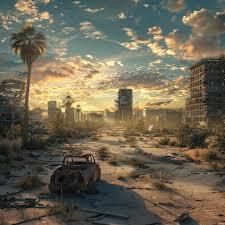
the first half reads like a part of Ballard's apocalypse trilogy, except instead of crystallization, water, or fire taking over the world, there is sand. so much sand. for a long while Hello America reads like a tour of desert America, its great Eastern cities dry and barren, its sole inhabitants wandering groups of "Indians" with tribal names like 'Executives' & 'Professors' & 'Divorcées' - no Native Americans in these tribes, these are the degraded descendents of former cities. we watch the small band of explorers travel the eastern lands, dwindling in numbers, and not so slowly going completely bonkers. the second half of the book is quite different: Wayne and the last two members of his group come to Las Vegas. there they find that the western U.S. has become a hothouse jungle full of easily slaughtered animal life. this near-empty yet still lit up playland is ruled by an escaped lunatic who has renamed himself Charles Manson, his followers a cadre of armed teens from Mexico. this tense band of revolutionaries have sole control of America's missile launchers. what could go wrong?

Ballard's writing style is as dry as the new deserts of North America. this is a contemplative and very sardonic book that attacks the usual suspects: capitalism and consumerism, egomania and megalomania, American exceptionalism, the tunnel vision of leaders and tyrants alike. nearly everyone suffers from mental illness and/or some sort of nervous breakdown - quite unlike the coolly composed author, who makes sure to keep his story crisp, streamlined, and straightforward. Ballard never breaks a sweat. although "straightforward" may describe the narrative, the book itself is anything but. this is a work of postmodernism: nothing can be taken at face value; everything is subject to deconstruction. Hello America is a study of the psychological effects of modernity, told in the style of a glum comic book. expect grim caricature rather than anything approaching realism in this bleakly amusing book.
Profile Image for Susan Budd.
Author 6 books297 followers
July 25, 2021
Going back in time, to 1976, say, a happy notion ...” (130).

That’s all I want. But I keep waking up here in 2021.

And if that isn’t bad enough, I pick up Hello America with no idea what it’s about and what do I get? I get a story about the 45th and 46th Presidents of the United States. The 45th President, described as a combination of Richard Nixon, Howard Hughes, and Charles Manson, “wants to make America great again ” (172). The future 46th President is a man who is really more comfortable in the role of Vice President, but who says: “Don’t worry—before we go I’ll arrest Manson and take over the Presidency” (193).

So much for reading as escape.

The only way for me to review this novel is to review the first and second halves separately. But that is not true of this novel alone. I feel the same way about Ballard’s three apocalyptic novels. In all of them, the first half is superior to the second half.

My criticism of the second half of Hello America is not limited to the disturbingly uncanny predictions. There’s also the whole tiresome Las Vegas fiasco that begins in chapter 18. But the reason I keep coming back for more Ballard even after he spoils the second halves of his books is that the first halves are so good.

True to formula, Ballard introduces a small cast of characters to a post-apocalyptic environment and then lets their psyches become one with it.

I was eager to join this road trip across a post-apocalyptic America because it seemed to be the landscape that most suited my own psyche. I have a fascination with the desert which is odd because I have never been to a desert. The farthest I’ve ever been from New York City is Florida and there ain’t no deserts between here and Florida.

My fascination with the desert started several years ago when I read John C. Van Dyke’s The Desert. I had already read and enjoyed Mary Austin’s The Land of Little Rain, but it was Van Dyke who got me hooked on the desert. I went on to read Joseph Wood Krutch’s The Desert Year and Edward Abbey’s Desert Solitaire.

So naturally I wanted to trek across the great desert that was 22nd century America. This is where Ballard excels. In his description of the actual road trip. It’s only when the expedition arrives in Vegas that the book declines. Ballard should have remembered his own words: “Movement was what America was about” (58)

But the desert! That he does well.

He creates an aura of the surreal with fantastic similes.

On all sides was a secret but rich desert life. Scorpions twitched like nervous executives in the windows of the old advertising agencies. A sidewinder basking in a publisher’s doorway paused to observe Wayne approach and then uncoiled itself in the shadows, waiting patiently among the desks like a merciless editor. Rattlesnakes rested in the burrow-weed on the window-sills of theatrical agents, clicking their rattles at Wayne as if dismissing him from a painful audition” (42).

Then he paints his desert scenery.

In front of them was an unbroken expanse of sand strewn with sage-brush, a dusty plantation of cacti and prickly pear. A century earlier the Hudson had dried up, and was now a broad wadi filled with the desert flora that had come in from New Jersey. The harsh and glaring light of the early afternoon had given way to the red earth colours of evening. They stood silently by their horses at the edge of the half-buried expressway” (46).

In this landscape, Captain Steiner becomes a “plainsman of the Old West” (44), a “solitary sheriff or gunfighter” (60). “Steiner has surrendered completely to the desert” (100).

Wayne can understand this. The desert is calling him too. But where Steiner is called to wander alone in the desert, Wayne’s calling is to lead others. In his journal, Wayne describes his own surrender to the desert.

I can understand how religions always started in the desert—it’s like an extension of one’s mind. Far from being a wilderness, every rock and prickly pear, every gopher and grasshopper seems to be part of one’s brain, a realm of magic where everything is possible. The whiteness, too, I feel close to some new truth that I’m leading the others towards” (97).

Add to these associations ~ the desert as a place of wandering, the desert as the birthplace of religions ~ a highway, for this is an America desert.

The endless ribbon of the highway unwound into the haze, lined with mile after mile of abandoned cars and trucks. Each evening they left the road and spent the night in one of the hundreds of empty motels and country clubs along the route, resting around the drained swimming pools that seemed to cover the entire continent” (76).

Then, best of all, Ballard adds a touch of poetry.

Moving through a kind of dream, an embalmed yellow world of sand and amber-like air. We have entered the area of deepest desert, an almost abstract landscape. ... A terrain of opalised trees and sandy palm-gardens set among endless suburbs and factories, shopping malls and theme parks, all silent and forgotten under a mantle of glazed light” (99).

This is what appeals to my own “fantasy of America” (33). The cacti and prickly pear and red earth colors of the desert should feel completely alien to me, but they don’t. They feel homey and familiar, as if there were some inner desert place within me that recognizes this landscape as its own.

The endless highway is part of that fantasy. The seemingly endless expanse of our country with its seemingly endless opportunities is the foundation of the American mythos. This is the expansiveness of which Whitman sang. Each character feels it and is drawn to it.

McNair “was eager to explore the length and breadth of America” (114). He “needed its size and scale to find his real talents” (31). Anne “needed to breathe, to extend herself, even to dream” (37). Captain Steiner “had really been preparing himself, not for the open ocean, but for the open land” (37).

And what is this expansiveness to me? Why am I drawn to the endless highway with its road-side motels? The endless highway is more than a metaphor. Being ‘on the road’ is also a state of mind: The hypnotic white line on the endless highway. The surrealism of the road-side motels, all different yet somehow the same. So dreamlike and curiously strange. Day flowing into day unawares. Always moving, like Zeno’s arrow.

Is this not a glimpse of eternity?

This is what going home looks like.
Profile Image for Richard Derus.
4,165 reviews2,263 followers
May 18, 2017
Rating: 2.5* of five

Here's what I remember from my 30-plus year ago read. I thought the premise was a revenge fantasy perpetrated by an angry, anti-American Brit who had opened up an ax-grinding franchise for all the Europeans tired of the US economic and cultural hegemony.

A quick flip through our library's copy reinforced that belief. I'm not in the least surprised that the coming Netflix series adaptation comes via Ridley Scott, who seems to me to be getting world-weary.

Book: Not again. Series: I'll try an episode, but have little interest and less hope.
Profile Image for Lee Foust.
Author 11 books213 followers
November 1, 2018
How did J. G. Ballard know, in 1981, that the 45th president of the United States of America would be Charles Manson? How did he know that the U.S., by that time, would be a great ruin, a desert, bereft of both economic life and culture, and that the president's mantra would be how he needed to "Make America great again." How did he know that at the heart of the American Dream there is a racist fear of infection from outside so psychically powerful, a self-loathing so profound that it would lead to total implosion, to America nuking its own cities in order to create the misguided and artificial sense of purity that it so desperately desires?

The rag-tag plot here is fine but it's only Ballard's nod to the conventions of the sci. fi. novel form. The real joy of reading this novel lies in appreciating the surreal touches, the dream images of Americana, the landscape reversal of our green, Eastern seaboard to a vast forbidding desert and Los Vegas to a tropical paradise, and all of the iconic images of a ruined actuality leaving a kind of dream residue of propagandistic pop culture dripping across the landscape. Nomadic "Indians" are all that remain of the former American citizens, and the grandchildren of U.S. refugees raised in Europe return to re-colonize the former super power. The reversals are both brilliant and prescient.

I can only assume that, by dealing with these pop culture dream images, Ballard so well diagnosed the heart of America's self-loathing and deepest paranoia, that much of his diagnosis has indeed come to pass. I can think of no better avatar for the 45th president than Charles Manson and no better diagnosis of his aims than total self-destruction to create the racial purity of which the so-called "white" mutts of America dream.
Profile Image for Oleksandr Zholud.
1,541 reviews155 followers
February 12, 2021
This is strange SF novel: part post-apoc and warning about environmental degradation, part a satire of what the America (meaning the USA) is during the period, when the book has been written (1981). I read is as a part of monthly reading for February 2021 at The Evolution of Science Fiction group.

The story starts with a group of European explorers on a coal-burning ship visit and rediscover the US in early 22nd century. As story progresses, there is more info about members of the crew as well as what has happened: most of the team have a nostalgy for the mid-20th century (big fast cars, Hollywood stars, etc) and at the end of the century on the one hand the oil was exhausted, on the other – there was a massive desertification of the States and people en masse left the US. The reason for the expedition is a rising radioactivity levels from that territories. The explorers cross the USA from New York to Washington to Las Vegas, meeting new Indians and other strange people.

This book is strange.

There is a satire, like new Indian tribes of Professors, Bureaucrats, Gangsters, with names like GM, Heinz, Pepsodent and Xerox (‘Why Xerox?’ Steiner had asked, at which GM proudly patted his wife’s pregnant waist and replied sensibly: ‘All women called Xerox – they make good copies.’). There are androgenous robots like in then-new movies like Westworld (1973), the fear of nuclear holocaust. At one moment there is a US president, who offers to ‘make America great again’, but this is not a prophecy about Trump, but actual slogans of Ronald Reagan.

There is clearly artificial “death of empire’ with equaling the USA and the Northern America – what happened with Canada and Mexico? Was Alaska depopulated? It is not realistic and was made for a sake of a story.

A rather weak SF that hasn’t aged well.
Profile Image for S̶e̶a̶n̶.
978 reviews581 followers
March 23, 2017
America has been abandoned following a worldwide catastrophic energy crisis. To meet the food security needs of the now swollen populations of Europe and Asia, the Bering Straits have been dammed, thus manipulating the ocean currents to turn northern Europe and Siberia into a verdant agricultural hub while simultaneously transforming much of the USA into a blistering desert. Only one expedition has so far returned to investigate this barren land, and was largely deemed a failure. Now a new team of explorers has landed on the shores of New York City. Some members of this diverse group are full of hope at the possibility of recolonization, while others are burning with scientific curiosity. What they find as they cross the country will shock them, ultimately leading to the most intense self-scrutiny for some. Ballard is among the most self-assured of storytellers. In his capable hands there is little room for doubt as to the plausability of his carefully crafted world. Engaging in its prescience and its originality, his prose demands serious consideration beyond the value of mere entertainment.
Profile Image for Kuszma.
2,849 reviews285 followers
June 18, 2024
El ne higgyétek, ha bárki azzal etetne titeket, hogy ez tudományos-fantasztikus irodalom. Még akkor se, ha maga Ballard tenné ezt. Ne tévesszen meg benneteket a sporadikusan elszórt műszaki rizsa, meg az agymenések a klimatikus- és gazdasági viszonyok átalakulásáról – ez a regény valójában egy gigászi metafora arról, hogy az Amerikai Álom sokkal nagyobb, mint maga Amerika, és még akkor is élni és virulni fog, amikor a Közép-Nyugat végtelen síkságain már csak viperagyíkok meg ördögszekerek kóborolnak.

description

A XXII. század elején vagyunk. Pöttöm expedíció köt ki New Yorkban egy ambiciózus potyautassal kiegészülve, hogy feltérképezze a nagy kontinenst, ami már száz éve lakatlan sivatag – legalábbis a rendelkezésükre álló információk szerint. Ballard azt is kifejti, miért: egyfelől az erőforrások felelőtlen felélése, másfelől meg mesterségesen előidézett klímaváltozás okozta Uncle Sam vesztét – amíg ugyanis Eurázsia behúzta a kéziféket, és visszaállt egy laza XIX. századi szintre gőzhajtányokkal meg tervgazdálkodással, addig az USA tövig nyomta a gázpedált, és bele is rongyolt a szalagkorlátba. No most ez az egész teória számos sebből vérzik, sok szempontból nehéz komolyan venni, szóval jobban teszi mindenki, ha inkább ignorálja, és csak azzal foglalkozik, ami a könyvben érték: a szerző áradó lelkesedésével, ahogy leltárt készít az ember nélküli Amerikáról, ami így néptelenül még hatalmasabb és impozánsabb, mint amikor büszke polgárok bandukoltak útjain. Ez egy gigászi, pszichedelikus tér, ami brutális mágnesként vonzza magához a lelkeket, meghatványozza a vágyakat és termékeny hallucinációkkal tölti meg az elmét. Ennek a hol felperzselt, hol fülledt világnak a plasztikus leírása néha egészen lenyűgöző.

És a tanulság? Talán annyi, hogy a „Váltsd valóra az álmaid!” és „Légy önmagad!” nagy amerikai programja valahogy azokra van leginkább mozgósító hatással, akiket a köznyelv őrültnek nevezne.
Profile Image for Nate D.
1,653 reviews1,251 followers
June 15, 2017
As far as exhaustive travelogues into the deconstructed iconography of America by a foreigner go, Angela Carter's The Passion of New Eve and Ann Quin's Tripticks may beat this out, but Ballard's sprawling post-apocalyptic vision goes even deeper into what it is exactly that this country means and signifies, and his is a welcome addition to the sub-genre*.

This seems to be deemed lesser Ballard, and it does have that distanced quality that is his peculiar pitfall, where all the characters and plot points are archetypes and symbols rather anything to be directly empathized or engaged with. But the sheer continuous manic energy with which he shuffles the tokens and spins the roulette wheel carry this through nicely nonetheless. It also helps to think of this as an ironic 19th-century expedition novel -- I'm pretty sure these were Ballard's model, and may explain the weird stodginess that inhabits the prose and action from time to time.


*see also: Amerika, Dreamerika!.
Profile Image for Radiantflux.
467 reviews500 followers
February 6, 2019
23rd book for 2019.

Now as I approach the 1980s of Ballard's oeuvre I am starting to wonder if I will have the strength to get through to the end.

This is another post-apocalyptic novel, this time set in a depopulated and desert-ed America, which Ballard uses as a stage prop to put forward his vision of the American dream. The physical reality depicted by Ballard is ridiculous—so nothing new here—what is damning is that there are no sparks on the psychological side of things. It's just a bland, bland story, with less satirical bite to it than any B-grade 1950s Western.

2-stars.
Profile Image for Althea Ann.
2,255 reviews1,209 followers
April 17, 2014
This month's post-apocalyptic book club selection.

Well, Ballard sure did like to write this story. He wrote it a few times.

Since I most recently read his 'Drowned World,' (https://www.goodreads.com/review/show...) I noticed that it was essentially the same book as that one, but I think he's written it a few more times as well.

However, 'Hello, America' almost reads like a satire of 'Drowned World.' Was it intended to be? I'm not sure.

An expedition reaches the eastern shore of a long-abandoned United States. Ostensibly, they're there for research purposes, but they barely make a nod toward their cause. Instead, they each are subsumed by the dream of the long-dead myth of America, and head West through devastated landscapes, encountering absurdist tribal population remnants, and finding a man who calls himself President (and also calls himself Manson).

The satire (if it was intended as such) didn't work for me - I felt that it actually undercut a lot of what is usually so effective about Ballard's writing. The characterization is even sketchier than Ballard's usual, and the sexism is over the top.

There were a few memorable moments, and even a few chuckles, but I wouldn't call this one of Ballard's best.
Profile Image for Alan.
1,268 reviews158 followers
July 4, 2014
Under the guise of crossing America{...}they were about to begin that far longer safari across the diameters of their own skulls.
—p.81
Hello America starts in New York City—or just next door, at least. It's very much an alternate history, now—J.G. Ballard wrote it in 1981, after all. He could not anticipate events that were still in NYC's future, events which would change the landscape and iconography of the Big Apple forever. And even the reissue from 1994 has long been overtaken by events in the real world.

In this novel, the World Trade Center is still standing, though it's long been abandoned and even overshadowed by a 200-story "OPEC Tower" which was also left to the elements long ago. All of the skyscrapers of New York, in fact—as well as the rest of the U.S.—have been derelict for more than a century, after the death of the fossil-fuel economy in the 1990s, and a climatic collapse that rendered North America uninhabitable and destroyed the economies of Europe and the rest of the world into the bargain. The entire continent has been forsaken, turned by massive climate-control projects initiated from overseas into a desert to surpass the Sahara.

What Wayne, our protagonist and sometime narrator, discovers along with his shipmates on the Apollo, a British steamship bearing the first expedition to American shores in a century or so (give or take), as they steam into the mouth of the Hudson River ("Jonkers"?!?—p.48), is a derelict country, overwhelmed by desertification and nearly devoid of people. The few surviving Americans with their degenerate cargo-cult societies are dubbed "Indians" by Captain Steiner and the rest of the Apollo's crew, although in fact they are just degraded descendants of the same European immigrants who settled the continent in the first place. Real Native Americans don't put in an appearance.

Young Wayne, the stowaway, is actually at the center of this narrative. He is, or may be, an American himself—at least, his family history suggests that he could be considered the kind of intrepid pioneer with little to lose who first came to North America back in the 16th and 17th Centuries. And, as such pioneers often were, he's not exactly simon-pure when it comes to either his motives or his history.

Wayne does, however, ably embody the pioneer spirit, and his evolving role as the guardian of the expedition's water supply (and, eventually, a Presidential aspirant) puts him in a unique position to observe how his European counterparts react to the vast wasteland that the U.S. has become, as they trek westward to an ultimate confrontation in... Las Vegas?


J.G. Ballard obviously had a lot of fun with Hello America. Its foreboding regarding global climate change is still relevant, and its deconstruction of American media icons is still pertinent, but it's best understood nowadays, I think, as a cautionary tale of the road not taken. So although the specifics of Ballard's future history may diverge from reality... Hello America is still a story worth reading.
Profile Image for Stephen.
19 reviews2 followers
January 2, 2010
The surreal elements of this book - the pop culture inconography set against a desolate wasteland - can be a distraction. I read this as paean to the essence of American character Ballard loved. Celebrity , worship, the decadence of Las Vegas, the general metabolism of American commercial culture versus the stoicism and individualism that also defines us. I think the choice of Las Vegas as a sort of end game, and the charater of Manson as the archetypal paranoria of the boundless American energy warped by a bounded imagination suggest more than satire. In a sense Ballard is suggesting a sort of cultural catharsis, a self immolation that would open a new canvas, so to speak or chapter. Worth reading
Profile Image for Paul Dembina.
693 reviews162 followers
February 23, 2024
Rather more plot-driven than other Ballard novels and lighter on the extreme metaphors hence the slightly lower rating, but still most enjoyable

Interesting that one of the characters jokes about another being a potential 45th President of the US (the book was published in 1981, so this would have been well beyond the number that was current) and later there are vague comments about making America great again. The 45th President was in fact Mr Trump - prophetic!
Profile Image for Simon.
587 reviews271 followers
October 28, 2013
I don't know if I'm just getting tired of Ballard's parallel explorations of post-apocalyptic landscapes and his character's inner physiological landscapes, whether the particular theme used in this book just didn't resonate with me, or whether this was just one of his poorer efforts. Whatever the case it's lead me to the conclusion that I've read enough Ballard to be going on with for a while.

The American Dream has collapsed after depleting all its natural resources and suffering severe environmental catastrophe but lives on in the minds of certain individuals, a century later, as they attempt to explore this near abandoned continent. Can America be restored to its former glory with our protagonist Wayne as its new president? Can his hopes and dreams for America be reconciled with those he is travelling with and those he meets along the way?

I found the author's ideas somewhat preposterous and the plot and character developments felt shoehorned into narrative. Ballard knew what he what story he wanted to tell but not really how to tell it, or that's how it seemed to me anyway. It had it's moments and wasn't a complete failure but overall it fell flat.
Profile Image for Keith.
108 reviews3 followers
October 26, 2013
Middling Ballard in many ways--I understand the 2-3 star reviews--but one for which I have a real soft spot. It's a novel that for me is in dialogue with Aldous Huxley's under-appreciated dystopic gobbledy-gook, _Ape & Essence_. (Ballard's "tribe of garrulous baboons" seals the allusion for me, the spider monkeys that have taken over the Hollywood Bowl, the giraffes loping down crumbling interstates...) Just as Huxley's novel seemed to anticipate bizarro Reaganite pieties ("family values" + "mutually-assured destruction"), so does Ballard's seem to be speaking directly to our moment ("family values" + "anthropogenic climate change"). The most demented thing about both novels, then, is how much post-nuclear America resembles the pre-nuclear one.
Profile Image for Jean-Luke.
Author 3 books484 followers
September 26, 2025
I tried to explain to him my own dreams of a renascent USA, but he clearly thinks I'm crazily impractical, hung up on brand names and a lot of infantile delusions about unlimited growth. In his eyes it was an excess of fantasy that killed the old United States, the whole Mickey Mouse and Marilyn thing, the most brilliant technologies devoted to trivia like instant cameras and space spectaculars that should have stayed in the pages of science fiction. As he put it, some of the last Presidents of the USA seemed to have been recruited straight from Disneyland.
Wait, when was this written? Checks copyright. Turns our Dear Leader is so fucking basic that a book published fifty years ago and set one hundred years in the future pretty much eviscerates him and his whole Reign/Reich/Regime, and this is before we even get to the part with the naked man baby playing war games in a gaudy Las Vegas hotel suite.

A group of pilgrims sail from Plymouth to North America, but the voyage is that of the SS Apollo early in the 22nd century rather than that of the Mayflower in 1620. America is desertified and possibly radioactive following a complete collapse due to an energy crisis, and has lain nearly abandoned for a century. It seems the shit hit the fan sometime during the forty-fourth presidency, although had Ballard known what was coming he would have picked the forty-fifth or the the forty-seventh, of which there are strong whiffs (not surprising given that they're using the Nazi playbook). Perhaps it wasn't something that difficult to see coming. A tale as old as time, Nazis love to whine... The Statue of Liberty resting drowned in the waters outside New York is nothing if not suitable symbolism for our the current state of things in America. But hey, at least you'll feel better about the price of gas, which hasn't yet reached $300/gallon.

Hello America is a parody of America—of its motels, its car culture, its consumerist superficiality, its idolatry, its warmongering, its Manifest Destiny, and its Wild West mythologizing. It isn't an easy book to pin down—partly road novel, partly speculative fiction, partly sci-fi action popcorn romp, with some Vonnegut thrown in for good measure. Angela Carter's The Passion of New Eve, published in 1977, imagines a similar America, in which Charles Manson also plays a significant role, and ultimately packs more of an emotional punch.
Profile Image for Matīss Mintāls.
198 reviews44 followers
July 16, 2022
Pēc tā, ko esmu lasījis tulkotu latviešu valodā, no Balarda gaidīju kaut ko dziļāku un nopietnāku, šis vairāk likās astoņdesmito gadu puiku piedzīvojumu gabals. Fantastiskā (vai šajā gadījumā precīzāk būtu - spekulatīvā) daļa diezgan nepārliecinoša un, manuprāt, maz ticama.
Groteskā daļa ar "prezidentu" Mensonu un mazliet trako zinātnieku Flemingu un viņa 44 robotu ganāmpulku bija interesantākā daļa, taču arī tā likās vairāk uzmetuma līmenī.
Ja gribas lasīt kaut ko līdzīgu Žila Verna piedzīvojumu romāniem, tad būs ok.
Profile Image for Jason Pettus.
Author 20 books1,453 followers
October 6, 2024
2024 reads, #66. THE‌ ‌GREAT‌ ‌COMPLETIST‌ ‌CHALLENGE:‌ ‌In‌ ‌which‌ ‌I‌ ‌revisit‌ ‌older‌ ‌authors‌ ‌and‌ ‌attempt‌ ‌to‌ ‌read‌ every‌ ‌book‌ ‌they‌ ‌ever‌ ‌wrote‌

Currently‌ ‌in‌ ‌the‌ ‌challenge:‌ ‌Margaret‌ Atwood‌ |‌ ‌JG‌ ‌Ballard‌ |‌ Clive‌ ‌Barker‌ |‌ Christopher‌ Buckley‌ |‌ ‌Jim Butcher's Dresden Files | ‌Lee Child's Jack Reacher | ‌Philip‌ ‌K‌ ‌Dick‌ |‌ ‌Ian Fleming | CS Forester's Horatio Hornblower | William‌ ‌Gibson‌ |‌ ‌Michel‌ Houellebecq‌ |‌ John‌ ‌Irving‌ |‌ ‌Kazuo‌ ‌Ishiguro‌ |‌ Shirley‌ Jackson‌ | ‌John‌ ‌Le‌ ‌Carre‌ |‌ Bernard‌ ‌Malamud‌ |‌ Cormac McCarthy | China‌ ‌Mieville‌ |‌ Toni Morrison | ‌VS‌ Naipaul‌ |‌ Chuck‌ ‌Palahniuk‌ |‌ ‌Tim‌ ‌Powers‌ |‌ ‌Terry‌ ‌Pratchett's‌ ‌Discworld‌ |‌ Philip‌ ‌Roth‌ |‌ Neal‌ Stephenson‌ |‌ ‌Jim‌ ‌Thompson‌ |‌ John‌ ‌Updike‌ |‌ Kurt‌ ‌Vonnegut‌ |‌ Jeanette Winterson | PG‌ ‌Wodehouse‌ ‌

Finished: ‌Isaac‌ ‌Asimov's‌ ‌"Future History" (Robot/Empire/Foundation‌)

The more I’m reading of him for this Completist Challenge, the more I’m realizing that JG Ballard was simply a problematic author, and that there’s no way to get around that, one who veered wildly between tones and quality from one book to the next, which I suppose is the main reason he never transcended his cult status to become one of the titans of Postmodernism. And thus two books ago did we get what’s widely considered the best novel of his career, 1975’s High-Rise (my review), followed immediately by what was without doubt the worst book so far of his career, 1979’s almost unreadable The Unlimited Dream Company (my review); but instead of following these up with a book of either type, Ballard switched gears once again and wrote a flat-out satirical comedy, 1981’s Hello America, whose entire 300 pages can be boiled down to the single sentence, “The US sux LOL.”

To be clear, there’s nothing even remotely subtle, experimental or interesting going on here, like is the case with his best books when he has a point to make; nor is this a return to his straightforward “Catastrophe” sci-fi novels that started his career back in the early 1960s, even though the premise is eerily similar. Namely, in a post-oil “soft apocalypse” world, there’s virtually no way to make America’s car-based infrastructure work anymore, so the citizens of the country simply abandon it, allowing an ascendent Europe now full of “Little America” neighborhoods to do some ecological Hail Marys like damming up the Bering Strait and reversing the flow of the planet’s oceans, which makes the rest of the world nice again but turns North America into an environmentally destroyed, uninhabitable wasteland. Now it’s a hundred years later, and a group of “America scholars” are returning to the country for the first time in decades, because of European sensors noting a disturbing recent rise in radioactivity from this now abandoned nation, and worrying that perhaps one of the US’s old nuclear missile silos has sprung a leak somewhere.

Yeah, not a bad set-up so far, I agree; but instead of doing anything interesting with this, Ballard uses the milieu for nothing else than to make a series of lame, groan-inducing dad jokes about Americans’ tendency towards laziness, reactionary religions, pride over their own ignorance, and blissful embrace of capitalism as lifestyle, giving us chapter after chapter of such silliness as the few remaining people on the continent now naming their children after the brand names still found on the crumbling billboards (get ready for lots of people named things like “Xerox” and “Pepsi”), and these “New Native Amercians” now organizing themselves into such tribes as Financiers (who go shirtless except for ties around their necks that are still in perfect half-Windsors), Gangsters (who wear dirty and shredded pinstripe black suits and beat-up old Fedoras, their women all with bleached-blonde hairdos), etc. And while letting the ending remain relatively spoiler-free, let’s just say that there’s an obvious and plodding reason the madman who has declared himself the current US President is named Manson, and an obvious and plodding reason that he’s set up Las Vegas as America’s new capital.

The entire book is like this, frankly, just page after page of, “Hey folks, Americans sure are proud of how stupid they are, aren’t they?” and “Hey folks, Americans sure love their shiny empty things, don’t they?”, political commentary at its absolute least nuanced or interesting, just Ballard running around smashing everything he sees directly on their noses with a giant two-by-four. That’s particularly disappointing from someone who had just written High-Rise a few years prior to this, which works so well because its satire sneaks in sideways when you’re least expecting it, a fever dream of a horror story in which modern architecture and 20th-century living warp into monsters unto themselves that end up destroying everything they touch. Hello America, on the other hand, reads like a high-school student who’s recently become a fan of Ballard, and who tries to write a Ballardian novel himself but is incapable of understanding the subtle details that make a Ballardian novel work.

I expect more from Ballard at this point in his career, after finally figuring out the formula that makes his writing work in classics like High-Rise and Concrete Island (my review), and who should’ve gotten his avant-garde bug out of his system from earlier, noble but flawed experiments like The Atrocity Exhibition and Crash (my review). Thankfully, though, even Ballard seems to have realized this, for his next novel goes in an utterly different direction from anything he had written up to that point, when he decided to write a hyper-real autobiographical novel about his own actual childhood as the son of a British ambassador, accidentally caught behind enemy lines at the start of World War Two, 1984’s Empire of the Sun (eventually adapted into an Oscar-nominated film by Steven Spielberg, which is why the name might seem familiar). That’s what I’ll be tackling next as well, so I hope you’ll have a chance to join me here next summer for that.

JG Ballard books being reviewed for this series: The Drowned World (1962) | The Burning World (1964) | The Crystal World (1966) | The Atrocity Exhibition (1970) | Crash (1973) | Concrete Island (1974) | High-Rise (1975) | The Unlimited Dream Company (1979) | Hello America (1981) | Empire of the Sun (1984) | The Day of Creation (1987) | Running Wild (1988) | The Kindness of Women (1991) | Rushing to Paradise (1994) | Cocaine Nights (1996) | Super-Cannes (2000) | Millennium People (2003) | Kingdom Come (2006)
Profile Image for Benjamin Kahn.
1,733 reviews15 followers
April 29, 2020
I liked the concept of this novel. It started off fairly slowly, and reminded me of a lot of Ballard's earlier work - the great quantities of sand of The Burning World, the buried buildings of The Drowned World and it was altogether less interesting than I thought it would be. His listing of American geographical locations was a bit monotonous too. But it was OK. And then he got to Las Vegas and it went all to hell.

The whole Las Vegas thing was frantic and boring, with Ballard trying to cram as many American pop references in as he could. These references reminded me of lot of The Atrocity Exhibiton, which I hated. The gasoline shortage that brought the nation to its knees is magically lifted in Las Vegas, because of secret, government stores that only President Manson can find. There is a huge suspension of disbelief required, that quite frankly, Ballard does nothing to earn. The longer it went, the more I hated it. And the escape to California at the end rings false because Ballard had already discussed how the climate there was screwed up as well.

I also found it hard to believe that Europe had survived so unscathed, that a giant dam could be built that would screw up the climates of several countries with no one raising a peep, and that the female scientist, practically the only female character in the book, could have her head turned by clothes and makeup. Ballard seems not only Eurocentric, but also very sexist. And makeup only exists in the States? Europe can't figure out how to make it? None of the makeup, gasoline or liquor has spoiled over the years? Please. I also wasn't sure how welcoming all the European nations would have been to American refugees, based on how unwelcoming so many countries are today to real-world refugees.

The tribes - Bureacrats, executive, gangsters, etc were ridiculous. Not clever enough to be satire, not well-conceived enough to be believable. If he had taken that and ran with it, it might have been amusing, but humour is not really Ballard's stock-in-trade. I did notice that he named the only black character Pepsodent which seemed a little racist. My edition had a very overwrought foreword talking about how relevant this book is today. Maybe because of climate change, but otherwise, no, it isn't. Really disappointing.
Profile Image for Dan.
254 reviews15 followers
May 21, 2009
When I was done with this all those years ago, I beamed. He's a genius I thought. I would love to have his talents, his insights, his poetry.
But I was young and I knew that I was somewhat disappointed by it deep down. The big tipoff was Charles Manson as a long-lived fellow who seemed more grandfatherly than a blathering maniac. He still is weird and evil. But there was more that was somewhat disappointing but I can't recall. I'll read it again soon. It was a good adventure for the most part, a dippy road trip. I'll find another way of thinking about it now that I'm older and more critical-minded (I hope).
Profile Image for Tom.
59 reviews7 followers
March 16, 2014
This book seemed very familiar from the beginning. I thought the generally vague, somewhat stereotypical and one-dimensional characters and the silver screen-ready descriptions might have been producing this effect, but when I reached the last chapters - after an annoying internal debate every night for ten days to determine whether to continue reading or to eighty-six the whole novel - I realized that I had already read it when I was a teenager. Which was exactly the right time that you should read this book: as a teenager.
547 reviews68 followers
November 20, 2016
Ballard as tiresome and unexciting as ever. It would save everyone's time if subsequent editions of his books were simply the lecture notes and seminar handouts that have done most of the work in spreading his reputation; the actual texts are blandly unexciting and undistinguished. Alan Burns did it better, but if you ask me John Wyndham also did it better, along with a bunch of other people who never got the benefit of JG's PR team. Truly the great "sage of Shepperton", and a suitable model for Will Self.
Profile Image for Angus McKeogh.
1,376 reviews82 followers
January 6, 2016
Great book. So strange and quirky. Ballard was writing these "dystopian" novels well before all the current YA authors made them all the rage. And he does it with much more originality, class, and style.
Profile Image for Jeff Koeppen.
688 reviews52 followers
March 26, 2025
I saw Ballard's Hello America on my bookshelf and read the blurb and thought I had already read it but after further review I discovered its setting was something I read before in Ballard's The Drought. In both books, the primary characters are traveling through drought-stricken lands.

In Hello America, set in the early 22nd century, the United States' climate has been severely altered by a dam built by the Russians in the Bering Strait. The dam altered the ocean currents and the end result was the majority of the US turning in to a desert with an exception of lands west of the Rockies being turned in to a tropical rain forest complete with exotic animals and plant life. Most citizens of the United States relocated to colonies on the other continents, and there are very few people left in the country.

The story kicks off with a steamship expedition from Europe consisting of folks with a variety of skills to the US to explore and look for the cause of rising radioactivity, which was detected in Europe. After scraping the ship's hull on the fallen Statue of Liberty, they land in New York City and begin to explore and set up scientific experiments.

I really enjoyed the first two-thirds of the book in which the group explore New York, along the east coast, and then head west. A number of interesting discoveries are made in the strange arid setting. Once they get to Las Vegas and discover other folks it felt like the novel dragged somewhat. And like many other future dystopian novels I've read the characters in Vegas were fascinated with the history / historical figures / pop culture of when the author wrote the novel. You mean to tell me that one hundred years from now people will be obsessed over the criminals and presidents of today? I don't buy that. I don't go around talking about Calvin Coolidge or Baby Face Nelson. It's as if there weren't any notable people of note to admire between 1989 and 2100.

The ending was strong and redeemed the one-third or so which I felt dragged and was sometimes nonsensical. The central mystery was solved and the climax was quite intense and dramatic. I would recommend this to any fans of the dystopian genre or any fans of Ballard. It is a short novel and I found the majority of it entertaining.
Profile Image for Alex Abbott.
152 reviews4 followers
September 11, 2025
Ballard is an interesting author because I like and understand his thematic interests-- the increasingly schizoid nature of the 20th century's mass media, exploring the empty signifiers of American culture, arguing that life has increasingly become a dulled simulacra of itself-- but this one was a little messier to me than Crash and Atrocity Exhibition.

This carries on much of the same spirit of those books, but it is placed in a much clunkier narrative. It's not a book that is meant to be taken literally, with more emphasis placed on the ideas and a clear extended allegory about the destructive American character, but the narrative gets very silly. Ballard can cook more when he's doing stream of consciousness style prose with ideas like he does in Atrocity Exhibition.
Profile Image for Nick.
39 reviews
Read
September 22, 2025
There’s something funny about how when British artists, even the good ones, try to satirize America it inevitably results in something like President Ronald McDonald and VP Mickey Mouse have been sworn in for the United States of BlackBerry. There’s a line late in the book (“after a long journey, the ghosts of Charles Manson and IBM meet in Caesar’s Palace”) that felt like Ballard’s first germ of an idea, and it’s a good one! But the rest of the book was too thuddingly obvious and out of touch with American culture to develop into an interesting novel.
Profile Image for Tamara.
241 reviews2 followers
June 28, 2025
Surprisingly, I found this quite boring. However, it takes place in a post apocalyptic USA in which a lunatic president raves about "making America great again".....it was published in 1981. So, that's interesting.
Displaying 1 - 30 of 184 reviews

Can't find what you're looking for?

Get help and learn more about the design.