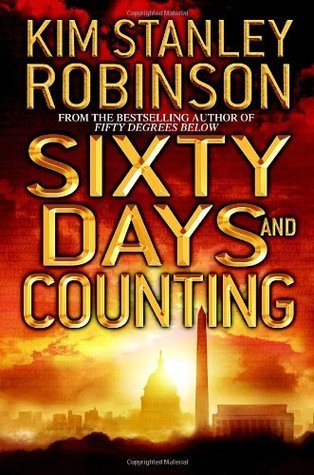
By the time Phil Chase is elected president, the world’s climate is far on its way to irreversible change. Food scarcity, housing shortages, diminishing medical care, and vanishing species are just some of the consequences. The erratic winter the Washington, D.C., area is experiencing is another grim reminder of a global weather pattern gone haywire: bone-chilling cold one day, balmy weather the next.
But the president-elect remains optimistic and doesn’t intend to give up without a fight. A maverick in every sense of the word, Chase starts organizing the most ambitious plan to save the world from disaster since FDR–and assembling a team of top scientists and advisers to implement it.
For Charlie Quibler, this means reentering the political fray full-time and giving up full-time care of his young son, Joe. For Frank Vanderwal, hampered by a brain injury, it means trying to protect the woman he loves from a vengeful ex and a rogue “black ops” agency not even the president can control–a task for which neither Frank’s work at the National Science Foundation nor his study of Tibetan Buddhism can prepare him.
In a world where time is running out as quickly as its natural resources, where surveillance is almost total and freedom nearly nonexistent, the forecast for the Chase administration looks darker each passing day. For as the last–and most terrible–of natural disasters looms on the horizon, it will take a miracle to stop the clock . . . the kind of miracle that only dedicated men and women can bring about.
Kim Stanley Robinson is an American science fiction writer. He has published 22 novels and numerous short stories and is best known for his Mars trilogy. His work has been translated into 24 languages. Many of his novels and stories have ecological, cultural, and political themes and feature scientists as heroes. Robinson has won numerous awards, including the Hugo Award for Best Novel, the Nebula Award for Best Novel and the World Fantasy Award. The Atlantic has called Robinson's work "the gold standard of realistic, and highly literary, science-fiction writing." According to an article in The New Yorker, Robinson is "generally acknowledged as one of the greatest living science-fiction writers."
Honestly, getting through all three books in KSR's Science in the Capital trilogy feels like a bit of a long haul, but it's odd. After finishing it, I feel nostalgic.
This is a good end to the series even if our real-life seems to be going through all the same issues without the positive effects of a science-enthusiastic president who is also willing to go all the way out on a limb to make the differences that need to be made in their (and our) climate catastrophe.
Of course, it's all the variables that are the real devils. Carbon reuptake, salinization of the ocean, restarting the normal processes as well as priming the economic pumps of our modern world is all explored in these novels.
By this one, I'm rather overwhelmed with a sense of OPTIMISM.
Other than that, character-wise, I'm ALSO filled with a sense of optimism. Plots are resolved. Both Mr. Mom and Frank have found new balances. The Buddhism angle is very strong and frankly fantastic on a humanistic level.
At the end of this, I was fully supportive of the messages about climate and policy change and felt like I wanted to get out there and try to make my own difference.
That's not a bad thing to feel after reading anything. :)
I have mixed feelings about this series. On one hand, it has a lot of interesting facts, not only on climate change but on many, many other topics. On the other hand, it has too much politics for my taste and a couple of side storylines which could have been less detailed.
Still, this last part ties all loose ends and we get a reasonable ending. If it starts out as a dystopia in the first volume, it ends up almost as a utopia. But one can dream, right? A country to have a president whose prime concern would be the health of Earth and its inhabitants, not wealth and power. LOL. Utopia, as I said.
Below fragment is one ‘posted’ by the new elected president, Phil Chase, on his blog. How not to love KSR for his way of thinking?
“CUT TO THE CHASE Posted 11:53 PM:
We Americans don’t want to be in a state of denial about our relationship to the world and its problems. If we’re five percent of the world’s population and we’re burning one quarter of the carbon being burned every year, we need to know that, and we need to think about why it’s happening and what it means. It’s not a trivial thing and we can’t just deny it. It’s a kind of obesity. There are different kinds of denial. One is sticking your head in the sand. You manage not to know anything. Like that public service ad where there’s a bunch of ostriches down on a big beach, and all the big ones have their heads in the sand, and some of the little ones do too, but a lot of the little ones are running around, and they see a giant wave is coming in and they start yelling down the holes to the big ones, There’s a wave coming! and one of the big ones pulls his head out and says Don’t worry, just stick your head in like this, and the little ones look at each other and figure that if that’s what their parents are doing it must be okay, so they stick their heads in the sand too—and in the last frame you see that all the holes in the sand are windows made of little TVs and computer screens. That kind of says it all. And there you are seeing it on TV. But there are other kinds of denial that are worse yet. There’s a response that says I’ll never admit I’m wrong and if it comes to a choice between admitting I’m wrong or destroying the whole world, then bring it on. This is the Götterdämmerung, in which the doomed gods decide to tear down the world as they lose the big battle. The god-damning of the world. It’s a term sometimes used to describe what Hitler did in the last months of World War Two, after it was clear Germany was going to lose the war. Of course people are offended by any comparison to the actions of Adolf Hitler. But consider how many species have died already, and how many more might die if we keep doing what we’re doing. It may not be genocide, but it is ugly. Species-cide. As if nothing else matters but us, and specifically the subset of us that agrees with everything we say. When you take a look at our own Rapture culture, these people pretending to expect the end of the world anytime now, you see that we have our own Götterdämmerung advocates, all very holy of course, as the world destroyers always are. And it’s an ugly thing. Countries can go crazy, we’ve seen it happen more than once. And empires always go crazy. But right now we need to stay sane. We don’t want the United States of America to be hauled before the World Court on a charge of attempted Götterdämmerung. We can’t let that happen, because THIS IS AMERICA, land of the free and home of the brave—the country made of people from all the other countries—the grand experiment that all world history has so far been conducting! So if we blow it, if America blows it, then all world history might be judged a failure so far. We don’t want that. We don’t want to go from being the hope of the world to convicted in the World Court of attempted Götterdämmerung. 5,392,691 responses"
As a whole, this series is 100% North American. It has a lot of references specific to American history, details which I am not aware, one of them being, for example, the friendship between Thoreau and Ralph Waldo Emerson. The book abounds in quotes from both of them, which are very interesting and relevant but I failed to grasp the point of their relationship to this story. There are also a lot of geographical features, how they changed, what that means for those who knew them before the change and many other references.
However, to an American, it will have a totally different impact than it had on me. I dare to say that I almost see it as a mandatory reading. To see all the differences caused in the ecosystem and not only, because of our actions, it is kind of frightening and also, awakening.
I will leave here few more fragments; love them too much and I think they are worthy to be read:
“ ‘There are good anchors to reality and bad anchors to reality. Try to avoid the bad ones.’ Ha!” Rudra snorted. “Thanks for such wisdom, oh High Holiness! Look, he even calls them the Four Bad D’s. It’s like the Chinese, they are always Four Thises and Six Thats.” “The Eight Noble Truths?” Frank said. “Bah. That’s Chinese Buddhism.” “Interesting. And what exactly are the Four Bad D’s?” “Debt, depression, disease, death.” “Whoah. Those are four bad D’s, all right. Are there four good D’s?” “Children, health, work, love.” “Man you are a sociobiologist. Could you add habits, maybe?” “No. Number very important. Only room for four.”
“We are visitors on this planet. We are here for ninety or one hundred years at the very most. During that period, we must try to do something good, something useful, with our lives. Try to be at peace with yourself, and help others share that peace. If you contribute to other people’s happiness, you will find the true goal, the true meaning of life.”
“This generation has a rendezvous with destiny.” Our time has to be understood as a narrow gate, a window of opportunity, a crux point in history. It’s the moment when we took responsibility for life on Earth.
A homeless man named Frank somehow gets a post at the National Science Foundation studying alternative energy and fighting global warming. After a year in the position, during which he is distracted by chasing escaped zoo animals, foiling a plot to rig the presidential vote, and an untreated brain injury, he decides to look up some stuff about solar power on Google right before his report is due. He finds, to his surprise, that someone has actually implemented solar power somewhere and calls them up for a long, rambling conversation about nothing. He lives for a time with an elderly Buddhist monk in a garden shed. A friend of Frank's, who is on the staff of the new president, believes that these same Buddhists took the soul of his two-year old child.
Frank jogs with some special government agents that may or may not be real. He asks them to help him stalk a woman he was trapped in an elevator with and even though she has moved to Maine to get away from him, he tracks her down for a visit. He then updates her on the psychotic fantasy he is experiencing. She is scared, so she pretends to go along with it and surprise!, even fakes an attack by a bunch of secret agents, which Frank swallows. As they part ways to escape this imagined attack she pledges to "call him". There is a climate disaster going on during all of this and the gulf stream is re-started by barges and oil tankers dumping all the salt in the world into the north Atlantic ocean.
After being thrown off the trail of his stalking victim again, Frank visits some scientists in California to talk about genetic engineering, but is too focused on his inability to follow the conversation to follow the conversation.
Well, now I know what an ecological disaster thriller is like when you remove the ecological disaster. Turns out the thriller departs with it.
Robinson follows up with the characters of the first two "Science in the Capitol" books as they put plans into motion to save the world. There's a certain amount of scientific interest to the plans themselves, but not enough to carry the book. The storytelling is distant and removed, with almost every event narrated or seen though the eyes of characters on the periphery of the action. It doesn't help that the politics seem downright naive after the last few years of Washington gridlock.
Told differently, the same plot and characters might have done a better job of keeping my attention. But would it really have hurt to throw in a tornado full of sharks or something?
Trilogy by author most famous for the "Mars" trilogy about a group of scientists that terraform Mars - the obvious premise of this set is that the earth itself needs terraforming in response to climate change/global warming and that scientists need to take more of an active involvement politically both with the electorate and with those who have previously controlled their purse strings and that the research bodies need to actively set the research agenda (a new Manhattan project or race for the moon) rather than responding to proposals received.
Main characters are based around the NSF (the US research body responsible for evaluating funding proposals) mainly Anna Quibler (whose husband Charlie stays at home with their hyper-active younger son Joe while working as an advisor, particularly on environmental matters to a famous Democrat "world" senator - Phil Chase) and Frank Vanderwal (initially on a one year secondment from which he resigns to the NSF leader Diana Chang, he then retracts his resignation when she permits him to lead a redirection of the NSF into an aggressive programme to investigate ways to mitigate climate change both medium and short term. Frank is homeless in his second year and ends up living in a treehouse in the park while starting a relationship with Caroline a mysterious girl with whom he was trapped in a lift. Eventually she reveals that she is a government agent, married to a sinister agent, who has been assigned to track Frank who through various of his activities, particularly his relationship with a researcher Yann who worked both for NSF and a biotech firm he was involved in and who is investigating the use of mathematical algorithms which Frank realises could be used to help genetic engineering).
In both books the earth's climate is changing drastically due to: a hyper El Nino in "Forty Signs of Rain" which leads to Washington being flooded and the shutting down of the Gulf Stream in "Fifty Degrees Below" with Europe and US hit by a severe winter, followed by the collapse of large parts of the Antarctic ice sheet. This, the intervention of the NSF in politics and Caroline’s intervention to give Frank an election fixing programme which one of his ex-intelligence colleagues Eduardo manages to reverse, lead to Phil Chase's election as president. The first acts of terraforming are an NSF organised (and reinsurance funded!) dump of massive quantities of salt to restart the Gulf Stream and a USSR effort to build on work by Yann as well as Frank's ex Marta, to engineer trees with the ability to absorb extra CO2, followed by an effort to pump sea water (caused by the into natural basins in dry areas of the world (again with reinsurance funding) and back onto the more stable parts of the Antarctic ice sheet.
Other themes of the book (which at first detract, then dominate and then become the story) are:
• Frank's emphasis that man is at roots a savannah based primate with the history of civilisation being too short to have changed our evolutionary instincts - he often observes and analyses behaviour in this light, but also sees his lifestyle as a return to his original roots - and plays golf Frisbee with a group of free-gans (who only eat food they can scavenge) as well as tracking animals freed from the zoo during the flood.
• The importance of physical exercise and the outdoors – the characters spend extended periods of the narrative backpacking, kayaking and climbing often with no other narrative development involved.
• Mental ability and the brains function – in light of seeming damage to Frank’s judgement and decision making ability following an attack and blow to the nose.
• Buddhism and its relation to science and knowledge - particularly the Tibetan exiles who come to Washington to lobby for the sea level threatened island nation of Khembalung (which then is inundated when a piece of ice breaks of Antarctica)
• Government surveillance - including the use of virtual futures markets with automated players used to assess potential security risks as well as series of competing and ultra-secret agencies.
• The failures of market based capitalism particularly in the light of costs which it externalises such as climate change. The book portrays it as a feudalistic system where workers don’t get the benefit of their own capital production and where the World Bank/free market system has effectively led to the elimination and apparent impossibility of other free, more moral and co-operative systems.
• The 19th Century American Philosophers – Transcendentalist Ralph Waldo Emerson and naturalist Henry Thoreau.
I'm rating this book well for global climate change awareness and ideas, but I never really got on with any characters and some of their strands just padded out the book. I'll try not to spoil. I read this first when it is the third of a trilogy. But you read them as you get them, and I read Green Mars first of any of KSR's books and had no problem despite the fact that it was second in a trilogy. With 60 Days I had no idea who most of the characters were; why or how they were in Washington politics (oddly, no lobbyists were present) when the world was about to end from climate change. I didn't get any backstory.
World about to end? I saw a few power cuts. Washington was cold during winter so people had to light fires in the house, and some zoo animals had escaped. Nobody was making efforts to recapture them. During a mountain hike we saw that the plants had died from drought and a character dismisses it as something that must happen every century. I got references to salting the North Atlantic which occurred in a previous book. Other people around the world were working on climate change issues, so every now and then we'd get a report in by phone, but we saw lichen on Russian trees and a dyke being built. This geoengineering is probably going to have to come to pass, but it seemed like civil engineering, steel and concrete groups were getting rich. A nuclear powered ship gave electric power to a city. Come on, is this a disaster novel or not? Show us more challenge than a few power cuts. Make us live through forest fires and a landmark under water.
To me, Frank, Charlie, Phil and whoever else all had exactly the same middle-class white American voice. One of them quoted inordinate amounts from American authors, which, sorry, came across as padding. Name them and quote sparingly. No person seemed to be a person who actually did anything except make phone calls. No women did anything except work in a lab and an office, and the mother of a small child seems insanely uninterested in being with him. A woman who drops out of sight for safety - that line was never explained and she did nothing either. Some Tibetan ancestry people are present and they seem to be the token ethnic diversity characters, because they don't do anything either. We meet a bunch of freegans, living off leftovers, but the populace as a whole has to be wealthy enough to leave out the leftovers. And they seem entirely uninterested in doing anything either, not even participating in a climate march; just sponging off those who are working in more ways than one.
I may get the earlier books and love them, but I read another cli-fi book Carbon Run by Joe Follansbee while in the middle of this one (which I don't recommend as you can get confused) and that was a lot more dramatic and clear-visioned about what will happen as the world warms. None of it will be good. KSR's book is optimistic for a clear-sighted liberal leader to make science at the forefront and cut through politicking. Let's hope he's right. He says that China has poisoned the environment which is true, but he says America has been cleaning up its environment for decades. Only by externalising manufacturing to China. And by wanting goods cheaply made rather than safely or cleanly made. See The People's Republic of Chemicals by Chip Jacobs.
Meanwhile, fit LED bulbs, eat less meat, buy less stuff, and walk rather than drive. We could have done with that kind of advice in the book, instead of our characters driving and globetrotting.
second read - 25 November 2010 - ****. This is the third book of a tightly-coupled trilogy comprised of Forty Signs of Rain (2004), Fifty Degrees Below (2005), and Sixty Days and Counting (2007).
It hasn't been so long since I last read this book, but I had forgotten some of the sudden plot twists near the end. Happily they surprised me all over again. This book is somewhat weaker in the science of global climate change than the first two, and primarily focuses its time on politics. Well now, we have had the unexpectedly progressive President Obama for about two years, with rhetoric as inspirational as Phil Chase, but he has lost support in a big way during the recent midterm elections. It makes me think how much of a fantasy the administration of Phil Chase in this book is. In fact, the ending as a whole has a somewhat happier than you might reasonably expect feel to it. Nonetheless, I found this to be a powerful series of books with speculative science relevant to the problems of the Earth today.
first read - 24 March 2007 - ****. This is the conclusion of KSR's new near-future environmental-disaster trilogy, which began with Forty Signs of Rain, and Fifty Degrees Below. The trilogy works like a single extended novel, published in three parts, and must be read in sequence.
I really liked these books. Realistic action is there, but is drawn out quite slowly, maybe too slowly for some readers, to make room for the sophisticated internal landscapes of the major characters. Frank Vanderwall, the NSF researcher living a modern 'feral' lifestyle in and around Washington DC, is the primary character. He struggles with the possibility of his own mental illness, lives out of his VW minivan and treehouse and on the hospitality of some Tibetan Buddhist exiles, and tries to connect with his elusive undercover girlfriend Caroline. Of all the characters, Caroline is probably the least developed, playing more of symbolic role in Frank's mind than a real one, until the end of the book. Very nicely done last words in the book, by the way.
As difficult as it is to imagine, KSR has written an optimistic book about climate change. He believes that we have the technological capability of saving the Earth, it we can only develop the political and economic will to do so. The newly elected president in this book articulates and pursues an agenda of reforming our global economy to one which motivates our salvation rather than our destruction. I don't know how realistic these ideas are, but it is great fun exploring them together with Thoreau, Emerson, the Dalai Lama, and Franklin Delano Roosevelt, and I felt inspired to think there is hope for us as a civilization. When I read Phil Chase's inaugural address and other speeches, and compare them to the denial of a problem by those who are leading my country right now, I could just cry.
Újraolvasás, nagyjából, ugyanis most a trilógia egykötetes, Green Earth c. kiadásában olvastam, amiben Robinson egy kicsit megvágta, átírta és aktualizálta az eredeti részeket.
A trilógia befejező részében Robinson szépen elvarrja a szálakat, miközben a klímaváltozás terén épp csak megindult a küzdelem. A helyzet azonban nem reménytelen, Phil Chase személyében egy igazán elkötelezett elnök vezeti az Egyesült Államokat és a világ legjobb elméi grandiózus tudományos projektekben - itt KSR igazán elemében van az ötletelésben - igyekeznek javítani a helyzeten.
A történet középpontjában továbbra is Frank Vanderwal áll, az ő személyén keresztül követhetjük nyomon az eseményeket. Robinson zsenialitása szerintem abban áll, hogy egy hétköznapi ember (igaz, nem teljesen hétköznapi, de messze nem egy szuperhős) szemszögéből tudja bemutatni a klímakatasztrófát; a mindennapok monoton ritmusába tudja belecsempészni az emberiség sorsfordító küzdelmét.
Akárcsak az előző kötetek, ez is kedvenc, továbbra is.
This is the last of a trilogy. The first was a bit lame, sort of wandering around and going nowhere. The second was much tighter. This third and final book is maybe the best of the three.
In the Robinson writing timeline this is my next favorite book after Red Mars. Since I originally wrote this review 10+ years ago, he has produced more awesome stuff. This trilogy was written in what for me was a Robinsonian less good period.
Stuff happens, big blockbusting events, with healthy doses of what makes Robinson so special-- his real love for human beings, despite their foibles. His optimism in the face of a tough realistic look at what's going on. This, much MUCH more than the unable to get past my suspension of disbelief Pacific Edge, may be Robinson's true utopian novel. Real people with real flaws solving real big problems, with solutions that stretch, but do not break, credibility.
Between a 4 & 5 star rating. Nice wrap up to the trilogy.
Review pending - busy past two weeks that I haven't actually had much time to get some reading down. Time to get some heel-digging done before month's end!
A multitude of teachings around the big issues of our time. An easy read in digestible parts, around science and politics, history and a suggested way forward for the humanity. I suggest it for all who want to change the world (for the better). The five star rating is given in the hope that you will read the whole series of three books, and come tell me which parts we will do differently and how to implement.
Publié au milieu des années 2000, Sixty Days and Counting est le dernier roman de la trilogie Science in the Capital, rééditée ensuite dans un volume unique sous le titre Green Earth.
Ce troisième roman présente les mêmes points forts et faibles que le précédent : il y a quelques longueurs, mais l'ensemble est tout de même très bon. Le récit, toujours axé sur l'articulation entre science et politique face au changement climatique qui s'accélère, est prenant. Les personnages sont toujours aussi plaisants à suivre, et leurs arcs narratifs ont droit à une conclusion digne de ce nom.
Curiously enough, Robinson defied my expectation and wrapped this series up stronger than he began it.
To recap, the trilogy follows the lives of some Washington, D.C., folks (and a few others) as they struggle with the sudden onset of dramatic changes in weather patterns as climate change accelerates.
Robinson is science-heavy, as usual. This is by far his biggest strength as an author, and often — but not always — more than compensates for his weaknesses as a storyteller.
In the first two thirds of the series, there was too large of a focus on heavy weather. We were slowly getting to know his characters, but much of the story was focused above their heads. In the final installment, the weather recedes a bit, and we can zoom in on the humans here, who we’ve gotten to know quite well by now.
This is somewhat of a surprise — complementing a Kim Stanley Robinson book because of character development?
The deadly weather in the first two books has wrought changes in the U.S. political landscape, which unfortunately allow Robinson a bit too much leeway in indulging his Northern California liberal inclinations. There’s a bit of a miscalculation here: he describes how the horrible weather has hit Washington hard, and the eastern seaboard to a lesser extent, but doesn’t go into much detail about whether blue states in the America heartland have suffered as well. Without that background, the triumphalism of the liberals is quite a stretch — with the new president writing blog posts and making speeches that are far to the left of center. The result is that Robinson does a little too much Randian speechifying. Nothing quite as bad as John Galt’s, but a bit tiresome nevertheless.
IMDB has a category in it’s “goofs” entitled “Incorrectly regarded as goofs,” I think some of what seems goofy here in Sixty Days and Counting qualifies. The massive projects the new president launches with international partners are depicted as being undertaken almost instantly. Given how long it takes to do anything in national politics, this seems pretty absurd. But that’s what I think is actually quite accurate: if something radical were going to be done at all, the long-winded negotiations would have to be excised. After all, these discussions serve two purposes: to get buy-in regarding the necessity of action and the safety of the plans, and to give opponents time to rip the heart out of any plan. In Robinson’s world (and, perhaps, in ours) the impending devastation is so stupendous that no one who hasn’t already bought in to these projects is paying attention, meaning delay serves no constructive purpose.
In our real world, we haven’t gotten any where near that level of certainty among high-level decision-makers, and if things ever get bad enough that they are convinced, it will probably be too late in many ways.
Overall, I’d still rate the whole trilogy as worth about three-plus stars. The scope wasn’t quite broad enough — when the Gulf Stream fails and a “the youngest Dryas” threatens, we never learn what is happening in Miami, much less in England — and the final optimism is, lamentably, too fantastic.
Note to self: This is the book where the world's mountain ranges are compared with respect to their appeal to backpackers, and the Sierra Nevadas win (yeah!). Google Books has a preview of the page.
...Sixty Days and Counting is the most optimistic of the three in a way, but reading it didn't make me share Robinson's optimism. In the book things get done. Despite my annoyance with the way the American political system believing the universe revolves around them (really, in that respect they can teach Wall Street a lesson) you get the sense that the characters in this novel will not let the world cook itself. We have now arrived more or less at the point in time where this novel is set, and if I look around, I still see an outrageous level of denial about the state of the planet and how much trouble we are really in. Robinson is right, we can change things if we want to. But apparently we don't. There is a good chance we'll see another El Niño event this year and some predictions indicate it will be a strong one. Let's hope it won't be the hyperniño described in Forty Signs of Rain. I'm beginning to wonder if in the end, that is what it will take to wake people up. I'd much prefer it if people read these books, thought about it, and not let it come to that.
this is the third book in KSR's environmental trilogy. the trilogy is both a cautionary tale of the consequences of our current path toward catastrophic climate change and an optimistic look at what we can do about it. Although the book was interesting enough it had a few fairly significant flaws. First, climactic effects came on much more suddenly that is currently predicted and the solutions to those problems seemed too quick and easy. For example, the election of a strong environmentally focused president and efforts by the NSF got things done by the government and private companies almost without effort in a matter of months. Second, there were a number of subplots that were a bit muddy (some kind of conspiracy to rig the election that was never explained very well). Lastly, this was a very philosophical book with many quotations from Emerson and Thoreau. I thought it suffered from the same problem I had with Thoreau. It is all very well to live off the land (or in the book's case, like a freegan) but it is nice to have neighbors to borrow stuff from (or dumpsters to get food from). The thing is, you need neighbors/restaurant owners who have worked for a surplus of stuff so you don't have to. If you like KSR the trilogy is probably worth reading but I have read better books by him.
There's some really genuinely interesting ideas in here, but it's over-long and doesn't really quite work as a novel. The subplot about the fictional enclave of Khembalung is particularly tiresome and has little to do with the story, the spy subplot never really gets explained, and Robinson's speciality - writing about scientists as people, is done better in the earlier books in the trilogy.
I loved this "Science in the Capital" trilogy. I enjoyed getting to know the main characters, and I was rooting for them all to succeed. I learned a lot as well, about climate science, about politics, about security surveillance, about fregans and Buddhists and the Drowning Nations. Loved it. I'm glad that Robinson is a prolific writer, as I plan on working my way through the rest of his books.
I love Kim Stanley Robinson, but his Science in the Capital series I could easily do without—it's vaguely preachy and horribly dull. While I might give Green Earth a spin, it's admittedly low on my list of things to read.
I read the first two books in this trilogy last year and ever since I finished them, I wondered; and then what happened? Well, now I know the answer to this question, and I can honestly say that this, the third of three books, made the entire trilogy into a huge disappointment, even though the series started out by showing some promise. Sixty Days And Counting by Kim Stanley Robinson (NYC: Bantam Books; 2007) is the last instalment in a eco-political near-future sci-fi thriller trilogy. This particular book’s title refers to the first sixty days of the new president’s administration, which is the time period that this book presumably focuses upon.
Those of you who read the previous two books in this series will remember that, at the end of the previous book, Fifty Degrees Below, Senator Phil Chase was elected President of the United States. Chase was elected, thanks to the combined efforts of NSF scientist, Frank Vanderwal, his spook girlfriend, Caroline Barr, and a number of Frank’s clandestine colleagues around the country — all of whom joined forces to prevent the right-wingers, including Caroline’s (ex?) husband, from yet again stealing the presidency for their own personal gain and evil ends (but the author never clarifies what exactly are the goals of these evil people, I guess he assumes we all are privy to this information, although I certainly am not).
By the time Chase is elected president, it is clear that the planet’s climate is going to hell in a hand-basket. Not only is the weather in Washington DC wildly unpredictable — warm one day, freezing the next — but there are other daily indications that things are not going well, such as widespread housing and food shortages, flooding, drought, loss of biodiversity and numerous other problems. However, there is some reason for optimism: scientists have at least managed to restart the Gulf Stream, for example.
Because Chase was elected President, his principle advisor, Charlie Quibler, must go to work full-time at the White House instead of spending his days yelling advice into his cell phone while running through the city’s parks, chasing after his toddler son, Joe — a proposition that Charlie hates. But he finally does give up his mister mom role by entrusting his precious younger child to the White House daycare staff, and works down the hall from the President himself, helping Chase make key appointments to his cabinet.
One of those choices was appointing NSF head, Diane, to the role of Presidential Science Advisor. Diane, of course, asks Frank and Anna Quibler to join her, but Anna refuses, wisely preferring to stay at the NSF. Frank is suffering from a brain injury that renders him indecisive, and further, he is also in love with Diane, so he accepts her invitation, although he’d rather return to his previous job in California.
The novel mostly focuses on Frank, once again, although why it does, I do not know — so would it be trite of me to point out that even though he is working at the White House, Frank is still officially homeless? Hello?? Has the author ever heard of Homeland Security? Okay, it’s true that Frank often stays with the expat Khembalese on their estate in Maryland instead of in his van or in his treehouse in a downtown park in Washington DC, and that he rarely hangs out with his homeless friends anymore and only tracks escaped zoo animals when he has spare time, instead of every evening as he did in the second book when he was working at NSF. I should also point out that when Frank stays with the Khembalese, he is properly nourished too, instead of living on refuse retrieved from dumpsters throughout the greater Metro area. But seriously, does the author expect the reader to accept that Homeland Security has no clue what Frank is doing every minute of every day, particularly where his favorite dumpsters are located and where he sleeps at night?
Anyway, after this idiosyncratic beginning, the novel rapidly devolves into a silly 500-plus page cat-and-mouse political spy thriller where poor, indecisive Frank is stuck in the middle of two women (and because this book is written by a man, neither of them knows about the other, of course), unable to decide who he is really in love with; the powerful, articulate and intelligent Diane, or the nearly invisible and flighty, but occasionally sexually available Caroline? Of course, there is Caroline’s (ex?) husband to consider, too. He’s the man who gave Frank his little brain injury in the second book by smashing him in the face with a tire iron.
The book occasionally comes up for air from the contrived Frank-Diane-Caroline emotional ménage à trois to examine other topics that were introduced in the two previous books, such as the effect that the Khembalese ummm, “exorcism” had on Joe’s personality. Basically, in the second book, the Khembalese perform a so-called “exorcism” ritual that transforms the toddler from a complete brat into a more affable kid. But his parents, Charlie and Anna, are troubled by this sudden docility, realizing that they prefer their little Joe to be banging innocent playmates on the head with steel dump trucks that are the size of footballs. So by the end of this book, poof, the Quiblers get their wish: the Khembalese undo their hocus-pocus and little Joe is once again happily terrorizing his parents, their friends and all the children within city blocks of where he is located.
Additionally, this book includes a brief but nonetheless unsatisfying glimpse at the so-called “ferals” and homeless people (mostly men, mostly mentally ill) whom Frank spent so much time with in book two, giving off the impression that these people were not very important to Frank (nor to the story, and definitely not to the author). Further, I was especially disappointed with the thoughtlessly casual way that the author dealt “the problem” of the homeless teenager, Chessman: the author hinted that Chessman might have an important role in the development of the story as early as the middle of the second book, since Frank repeatedly wondered about Chessman’s mysterious disappearance from that point onwards. But Chessman’s disappearance had nothing whatsoever to do with the story’s development or resolution, making it appear that the author didn’t know what to do with this particular character, which makes me wonder why Chessman was introduced into the story in the first place.
In addition to all those little quibbles, I have a few other things I’d like to mention: I thought that Frank’s brain injury, which made him unable to think clearly and to make decisions, was an absolutely ridiculous plot device. Ditto for Frank’s entire lifestyle as a homeless, tree-dwelling, dumpster-diving, frisbee-flicking, animal-tracking primate who happened to be employed as a scientist at NSF. I mean, really, this was such an overt insult to all those truly hard-working scientists out there who actually do work at NSF or elsewhere!
I also thought the “exorcism” (and its subsequent reversal) of Joe Quibler by the Khembalese was beyond stupid: It was an overt insult to the author’s main characters, most of whom were scientists — people who are steeped in rationality and logic, who are not about to believe in that sort of mumbo-jumbo. He thoughtlessly betrayed so many of his characters, beginning with the cooly rational Anna Quibler, with this truly ridiculous and dead-end story line.
Further, I was astonished at the audacity and lack of ethics displayed by the scientists who released an untested, genetically-engineered lichen that would supposedly reverse global warming by absorbing carbon [yes, there was a wee bit of science in this book, although you will have to look hard to find it]. And finally, I admit that I laughed out loud when the author suggested that nearly all (or was it all?) of the US military’s funds be shifted to ecological programs — puhleeze. I thought the author was writing a “hyper-realistic science-fiction novel” not a comic fantasy.
Okay, this is my last complaint: I didn’t like ANY of the characters. After spending 1500 pages with all of the characters in this story, I ended up wanting to slap every one of them for various reasons — starting with Frank — because they were so annoying, so stupid, so out-of-character! Well, except for Diane and Phil Chase, but we, the readers, never get to know either of them because the author was too busy regaling us with yawn-inspiring anecdotes about how women look sexy when throwing softballs or rock-climbing or kayaking up dangerous waterfalls.
Oddly, after taking more than one thousand pages to develop the story, the author casually wraps up most of his plot line’s wacky loose ends in only a few pages (three or four), none of which are even remotely interesting or logical. In short, Sixty Days doesn’t end with a bang, as I had expected, instead, it ends with a barely audible whimper, accompanied by a stinky sulfurous cloud as it quietly slides out of the authors bowels and past his sphincter muscles, and plops unceremoniously onto thousands of dead trees that these stupid books were printed on.
In short, I view this book as another justification that I should be a published author because I would never dream of insulting my readers in any one of these many elementary ways.
NOTE: Originally published at scienceblogs.com on 4 February 2008.
His books set on mars are more believable than this. This series is a lunatic, sexist, racist, political fan fiction of America, that goes out of its way to worship power. The realism that grounds Robinson’s Green Mars trilogy, 2312, and Ministry for the Future is so utterly absurd in the context of this fairytale that it reads like bad satire. Where are the oil companies? Where are the auto makers? Where are the weapons manufacturers? Where is any of the coordinated opposition that real climate action faces? Nowhere in these novels. Robinson abandons all critique and dialectic thought here in favor of this full throated endorsement of American exceptionalism. This series is riddled with sexist portrayals of women, racial stereotypes, white savior narratives, and bad science. A book like this, from an author like Robinson, is damaging to the climate movement. It enables passivity by endorsing a naive view of political change.
I really enjoyed the first two books in this series - lots of interesting info about climate change, science, politics...etc, delivered from multiple POV. I enjoyed hearing about the Quibbleys, Frank and Caroline, the Tibetans, Phil Chase - so I was eager for book three of this series. And now that I have read this, I am a little conflicted.
This book was mostly about Frank and Caroline and the crazy ex-husband election conspiracy and then there was quite a bit about young Joe and the religious stuff that came up from the Lamas. And then everything kind of tied up in a nice neat bow. So not so much about climate change and the consequences as I thought would happen? Not bad mind you, but not really my favourite book of the series.
What is it about KSR? His books have so many boring details and weird side stories that they're almost unreadable, and then again they're also so spot on in describing societal and political conflicts with fantastic characters that I'm left breathless. This one takes place just a few years in the future when the world is seriously on the brink of climate collapse but - KSR is the most wonderful optimist and he's seriously anti-capitalism. We can do it. We can save ourselves. Together we can save ourselves. I love KSR.
This book does not so much end the series as simply give up on it, pairing off his shallow characters in silly romance, and launching the pres into the equivalent of a freshman essay on Marx having only read the Cliff notes. What a disappointment. I only finished it because I thought something might happen. Instead we get faint geoengineering triumphalism and a wildly unrealistic scenario in which the US military saves China from itself. This is not so much a spoiler alert as an admonition not to bother reading this. It's a shame the writer is so obsessed with his juvenile, macho male characters - with a little editing and a focus on the women, this could have been a lot better.
Laatste deel van de trilogie, waarbij nu CO2-uitstoot (en bijkomende opwarming) een belangrijke rol speelt en dus de temperatuur op aarde enorm zal/kan beïnvloeden, zoals het smelten van de poolkappen en hoe dat enorme gevolgen heeft qua stijging van de zeespiegel, enz... Verschillende voorstellen worden uitgedokterd (o.a. water verpompen om het smelten tegen te gaan, droge landstukken weer met water vullen, ...), zonder echt te weten wat de gevolgen op (lange) termijn zullen zijn.
Ook speelt Frank Vanderwal nog steeds een hoofdrol, net als zijn nieuwe vriendin Caroline (geheime dienst), die moet onderduiken want in levensgevaar voor de kwaaie bedoelingen van haar man. Intussen speelt ze wel bewijsmateriaal voor de stemvervalsing van de verkiezingen door aan Frank, die dat op zijn beurt aan zijn collega's doorgeeft voor onderzoek. En zo komt er nog meer aan het licht, o.a. hoeveel geheime diensten er wel niet bestaan (en hoe het eigenlijk een zootje is). Frank zelf is ook in gevaar, wordt ook gevolgd in zijn doen en laten. Dat drijft hem zover dat hij de Tibetanen (Khembalung) verlaat - hij heeft er wel een hele tijd gewoond, ook helpen de nieuwe locatie in te richten (boomhut en zo) - en bij zijn makkers in het bos (eerder de krakers) gaat overnachten. Hij verkocht zelfs z'n busje om een ouder VW-busje te kopen en die op te knappen. Kwestie van iets anoniemer de baan op te zijn. Zijn boomhut was intussen toch vernield door het team van Cooper (man van Caroline).
De korstmossen van Yann Pierzinski en Marta (Franks ex) zijn zo goed dat ze zich in een onverwacht grote mate verspreiden. Ze zijn bijna té goed. Wat dat voor gevolgen heeft/zal hebben, kunnen ze niet voorspellen, want ze hadden niet op een dergelijke groei gerekend.
USA en China zijn in gesprekken inzake verbetering van het milieu en dus reductie van de CO2-uitstoot, evenals oplossingen voor schonere energie (= sluiting kolencentrales), met behulp van de Navy. Elektriciteitsproblemen zijn er nog steeds in Amerika (gelukkig zijn er generatoren). Charlie Quibler heeft het drukker dan ooit, maar vindt dat z'n jongste zoon, Joe, na de geestenuitdrijving door de Tibetanen, niet meer de spontane deugniet is. Vandaar dat Charlie vraagt om de betrokken geest te laten terugkeren zodat Joe weer de deugniet wordt ipv een iets kalmere versie. En zo kan Charlie dan weer aan thuiswerk doen, hoewel dat niet volgens de zin van president Phil Chase is, gezien de belangrijke milieukwesties die hoogdringend dienen aangepakt te worden.
Lang verhaal kort: het wordt spannender en spannender en alles komt uiteindelijk wel op z'n pootjes terecht. Zoals voorheen wordt elk deel geïntroduceerd door een tekst met spirituele dan wel wetenschappelijke inhoud (op vertelwijze, dus geen droge afhaspeling van feiten e.d.). Wel dienen er zich enkele typfouten aan, zoals nsf ipv NSF en dergelijke kleine dingetjes. Op zich niet erg, maar je kunt er niet naast kijken. Ook staat er weer heel wat filosofisch spul in van Emerson en Thoreau. Verder vergelijkingen met oude presidenten van de USA: Roosevelt (vooral deze, want Phil Chase spiegelt zich daaraan), Lincoln, ... Een mooie mix van fictie, wetenschappelijke input en geschiedenis. Altijd leuk wanneer je iets bijleert. :-)
Zoals eerder gezegd dien je de 3 boeken als een trilogie te lezen, anders ben je niet meer in het verhaal. Als je wat science-minded bent en bezorgd (of het ligt in je interessesfeer) over het milieu, klimaatkwesties, ... dan is deze trilogie zeker een aanrader, wat mij betreft. Misschien niet Kim Stanley Robinsons beste serie, maar zeker de moeite. Tot slot is het ook een betoog tegen het kapitalisme dat de wereld al tientallen jaren in z'n greep houdt.
Dit waren m'n eerste KSR-boeken en ik ga zeker andere van zijn werken lezen.
This entire review has been hidden because of spoilers.
Unfortunately disappointing. This was the third book in a trilogy that started out as an interesting speculative fiction about the social, political, and environmental effects of global warming. Robinson's strength is that he can explain the science behind much of what he writes about. This book had less of the science in it than the other two. Instead, it tried to wrap up various storylines involving a number of uncompelling characters. Robinson also tried to shoehorn a political conspiracy / love story into the narrative, because otherwise there was no drama in the story at all. All in all, this series seems to be Robinson's manifesto about the importance of science in modern society, as well as the problems of our current capitalist system, using global warming as a prop for his political views. The final book used much too much exposition to get to the end, and hardly even dealt with the impact of global warming other that to hammer the reader over the head with Robinson's belief that we need to develop a more sustainable culture. I'm not sure why I keep reading Robinson's work. I was similarly disappointed in his Mars trilogy, and was unable to finish the last one as I felt it dealt mostly with characters I was not interested in. I also felt The Years of Rice and Salt faltered toward the end. This will most likely be the last book I read by this author.
All loose ends wrapped up...In my review of Fifty Below I worried that Robinson was going to pull some magic "it'll all work out" bit. The thing is, he did...and I didn't even see it until it was done. He uses a sort of narrative time-warp to go from pie-in-the-sky brainstorming to 'maybe we can do this' to 'up and running'. What I'd expect to be a ten-year plan suddenly is going in about a year of narrative time. Hell he wraps up with a trple wedding (close-enough).
That said, I enjoyed the book. The Frank/Caroline spy-thriller side feels a bit Crichton-esqe forced at times. My favorite parts is how the world changes and so many people just go forward with the new normal. Odf course we're putting up solar-cells, or course we're home gardening, blackouts are a normal part of winter in DC.
The end of the world screaming is alwaysinteresting and entertaining, but there is no real end. Everything keeps going. The unthinkable becomes history - how could it have happened any differently?
Kim Stanley Robinson writes what I like to call humanistic science fiction. All this characters are highly developed within his books and the storys just revolve around these fully developed characters.
The three books in the series follow our protaganist through an Earth transformed by severe climate changes and what that does to him personally and how it reshapes society in response to those changes. All three books stand on their own but you get a better picture by reading all three in order.
As with the previous two books in the series, I am astonished by the author's grasp of climate science and politics and his bravery in exploring all sides of specific issues and potential remedies. While not quite as exciting, impactful, or engaging as Fifty Degrees Below, the writing and story are solid and provide a satisfying end to the trilogy.